REVIEW 3 major objections 5 minor 1 cited by
The impact of stellar rotations and binaries on the shape of upper main sequence near turn off in open cluster NGC\,6067
T0 review · 3 major / 5 minor · reviewed 2026-08-06 · deepseek-v4-flash
Pith's one-line read This paper argues that the extended main-sequence turn-off in open cluster NGC 6067 is caused by a spread in stellar rotation rates, with fast rotators appearing redder and concentrated toward the cluster center, and that…
desk verdict Useful new v sini data for NGC 6067, but the headline rotation-color correlation is built on excluding seven red slow rotators without evidence, and that exclusion is load-bearing for the paper's main claim. read the letter →
The pith
A machine-rendered reading of the paper's core claim, the machinery that carries it, and where it could break.
The reading
What carries the argument
The load-bearing measurement is the projected rotational velocity v sini, obtained by fitting synthetic spectra to Gaia-ESO spectra of eMSTO members. The argument then runs through two further devices: the fiducial-line pseudo-color separating blue (bMS) from red (rMS) parts of the eMSTO, and cumulative radial distributions with a Kolmogorov-Smirnov test (statistic 0.2609, p = 0.0001) comparing where the two groups live. A synchronization-time formula from Hurley et al. (2002) is used to show that close binaries in the cluster would be tidally locked, making the spatial distribution the decisive test between binary braking and star-disk interaction.
What would settle it
Measure v sini for every one of the 280 eMSTO members rather than only the 41 with public spectra, and recompute the cumulative radial distributions; if the red fast rotators are not actually more concentrated in the core once the full population is sampled, the star-disk interaction conclusion fails. A second check would be to measure the binary fraction separately for blue and red eMSTO stars; if blue stars turn out to have substantially more binaries, tidal locking would re-emerge as a viable cause.
Extended reading notes
Core claim
The central claim is that the observed eMSTO in NGC 6067 is a rotation effect, not an age spread or a binary artifact. The paper shows a positive correlation between v sini and color offset from the main-sequence fiducial line, with bluer-side eMSTO stars averaging about 146 km/s and redder-side eMSTO stars averaging about 247 km/s. Four double-lined spectroscopic binaries all have slowly rotating components, consistent with tidal locking, but the red fast rotators are more centrally concentrated than the blue slow rotators, contrary to what mass segregation of tidally locked binaries would predict. The authors therefore conclude that star-disk interactions in the pre-main-sequence phase, modulated by the cluster environment, produced the rotation spread and hence the eMSTO.
Load-bearing premise
The load-bearing premise is that the bluer-side and redder-side groups chosen by color are faithful stand-ins for slow and fast rotation across the whole turn-off population; with spectra for only 41 of the 280 stars, the central-versus-outskirt pattern of the unsampled majority is inferred, not measured.
Editorial extensions
If this is right
- If the central claim is right, the eMSTO of NGC 6067 is not evidence of extended star formation or a significant binary population; it is a rotation phenomenon.
- Gravity darkening is implicated as the physical link: fast rotators appear slightly redder and fainter at the same mass, which is why they occupy the red side of the main sequence.
- Tidal locking is not the main brake on eMSTO rotation in this cluster; the four SB2 binaries, though slow-rotating, are too few to explain the blue population.
- The spatial pattern, with red fast rotators in the center, matches the star-disk interaction scenario, where central stars lose their disks earlier to photoevaporation and dynamical encounters and spin up.
- The disappearance of fast rotators below about 1.6 solar masses is consistent with magnetic braking setting in for lower-mass stars, so the rotation-spread explanation only applies to the upper main sequence.
Reading between the lines
- A direct extension would be to measure v sini for all 280 eMSTO members; if the central concentration of fast rotators survives a complete sample, the star-disk interaction interpretation is on much firmer ground.
- If the environment controls disk lifetimes, then clusters with denser cores or stronger ultraviolet fields should show a larger eMSTO width and a stronger center-versus-outskirts contrast; this cross-cluster prediction is not made explicitly in the paper.
- Because v sini collapses true rotation onto the line of sight, the paper's rotation-color correlation may underestimate the real spread in equatorial velocities; a statistically deprojected sample could separate the gravity-darkening signal from inclination effects.
- Applying the same analysis to a cluster of similar age but lower metallicity would test whether the rotation-spread mechanism scales with metallicity, as rotational evolution models predict.
Editorial analysis
A structured set of objections, weighed in public.
Referee Report
Summary. The paper analyzes the extended main-sequence turn-off (eMSTO) in the open cluster NGC 6067 using Gaia DR3 astrometry/photometry and Gaia-ESO spectroscopy. The authors derive projected rotational velocities for 41 eMSTO stars, identify two Be stars and four SB2 binaries, and report a positive correlation between v sin i and color (r = 0.506, p = 0.004) after excluding seven slow-rotating red stars. They split the eMSTO into bluer (bMS) and redder (rMS) groups, report mean v sin i values of 146 km/s and 247 km/s respectively, and find that rMS stars are more centrally concentrated than bMS stars (K-S p = 0.0001). On this basis they argue against tidal locking in binaries as the main cause of the rotation spread and propose instead that pre-main-sequence star-disk interactions produced the spread, with the eMSTO itself arising from the rotation spread.
Significance. If the central correlation and the spatial segregation result are robust, the paper would provide an interesting new datapoint in the debate over the origin of eMSTOs, supporting the rotation-spread scenario and an environmental, pre-main-sequence origin. The study uses standard and mostly appropriate methods: Gaia-ESO spectra, synthetic spectral fitting, differential reddening correction, SB2 decomposition with GIRFIT, and a synchronization-time calculation. The paper also usefully presents quantitative measurements for a cluster with known Be stars and SB2 systems. However, the headline statistical claim rests on a post-hoc exclusion of the most inconvenient data points, and the spatial argument extrapolates from a small spectroscopic subsample to the full photometric eMSTO population; both points need substantial additional support before the conclusions can be accepted.
major comments (3)
- [Section 5.1, Figure 11] The central correlation (r = 0.506, p = 0.004) is computed after excluding seven eMSTO stars (IDs 21, 229, 317, 358, 403, 797, 807) with v sin i < 50 km/s on the red side, and the only stated justification is that they 'could be binaries undetectable from the current set of spectroscopic data.' No radial-velocity variability, RUWE, or other independent binarity evidence is presented for these stars. Because these seven points are the most direct counterexamples to the claimed monotonic v sin i-color relation, the reported correlation is not robust as presented. A simple inclusion of these stars in the rMS sample lowers the rMS mean from roughly 247 km/s to roughly 185 km/s, approaching the bMS mean of 146 km/s, and the reported p-value will degrade correspondingly. The authors should show that the correlation and the bMS/rMS comparison survive inclusion of these stars, or provide independent evidence that they are binaries and quantify the unresolved-binary contribution to the eMSTO width.
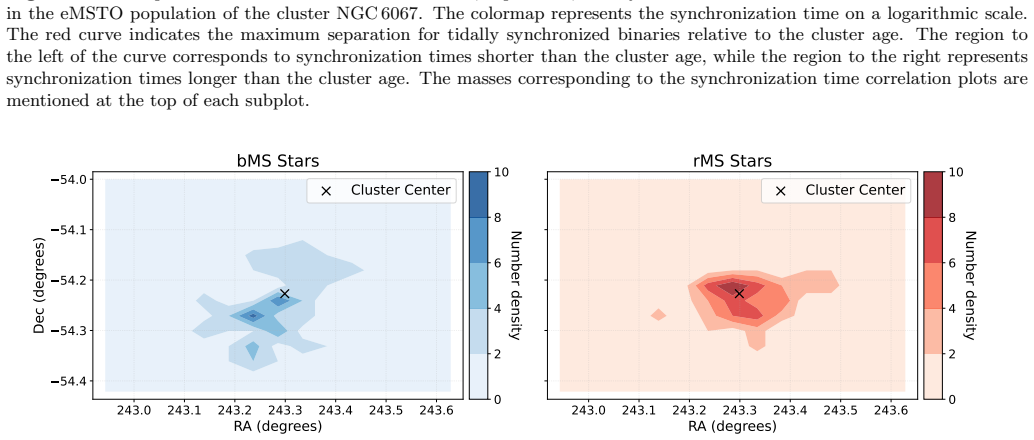
- [Section 5.2, Figure 14] The spatial argument treats the photometrically defined bMS and rMS samples as faithful proxies for slow and fast rotation across the entire eMSTO population, but v sin i is measured for only 41 of the 280 eMSTO stars (23 bMS and 18 rMS). The density contours and the K-S test in Figures 14 and 15 use all 280 stars, so the central concentration of rMS stars is not a measured central concentration of fast rotators. If the unsampled majority has a different rotation distribution, the inference that fast rotators are centrally concentrated, and hence the star-disk interaction conclusion, would be weakened. The authors should either measure rotational velocities for a substantially larger subsample or model the selection function and demonstrate that the unsampled stars cannot change the conclusion.
- [Section 5.2 and Table 4] The argument against tidal locking is internally inconsistent with the paper's own binary detections. The text assumes that if tidal locking were responsible for the slow-rotating eMSTO population, then the bMS population would consist of the tidally locked binaries and should be centrally concentrated. However, the four detected SB2 systems (IDs 70, 609, 643, 691) all have component v sin i values below 20 km/s and are stated to occupy the red part of the eMSTO. Thus the observed central concentration of rMS stars could instead be interpreted as a central concentration of tidally locked slow rotators, which would support rather than exclude the tidal-locking mechanism. The rejection of tidal locking needs to be reformulated using the actual colors and locations of spectroscopically confirmed slow rotators, not an assumed association between bMS stars and tidally locked binaries.
minor comments (5)
- [Section 3.1] The removal of nine outlier stars is described only as 'significantly deviating from the MS in visual inspection'; please provide quantitative selection criteria or show the removed stars explicitly in the CMD.
- [Table 3] The [Fe/H] entry for star ID 717 is printed as '-0.13+-0.05' and should be formatted consistently with the other uncertainties.
- [Figure 11] The horizontal axis label reads 'GBP - GRP (mag)' while the text and caption define the abscissa as the pseudo-color Delta(GBP-GRP); the label should be changed to match the quantity actually plotted.
- [Section 4.4, Table 4] The SB2 components have radial velocities that differ from the cluster mean of about -38.8 km/s by tens of km/s; one or two sentences explaining why these systems are still considered cluster members would help the reader.
- [Section 5.2] The K-S test result for the bMS and rMS radial distributions would be easier to interpret if the sample sizes entering the test were stated in the text or figure caption.
Circularity Check
No load-bearing circularity: the v sini-color correlation, bMS/rMS group means, and spatial K-S test are based on independent Gaia photometry and Gaia-ESO spectra, with only minor non-load-bearing self-citations.
full rationale
The central derivation chain is not circular in the technical sense. The v sini values come from Gaia-ESO spectra and the colors from Gaia DR3; the two are independent measurements. The positive correlation in Figure 11 is computed after excluding seven stars with v sini < 50 km/s, and the paper speculates that they 'could be binaries undetectable from the current set of spectroscopic data.' This exclusion is a data-robustness choice, not a definitional construction: the paper's own bMS/rMS statistics (23 bMS and 18 rMS stars, with the 14 non-SB2 rMS stars averaging 247 ± 8 km/s) imply that the seven slow stars are not part of the rMS fast-rotator sample, so including them would mainly add blue-side slow rotators and would not erase the signal. The spatial conclusion rests on the photometric K-S test (p = 0.0001) between bMS and rMS radial distributions, which is independent of the v sini fitting. The SDI explanation is imported from prior literature (Bastian et al. 2020) and tested against the new spatial data, not derived from the model's own assumptions. The self-citations to Maurya et al. (2023, 2024) are methodological or bibliographic and are not load-bearing; no uniqueness theorem or ansatz is smuggled through them. The paper also explicitly acknowledges the unresolved-binary caveat ('we cannot completely rule out the contribution of the photometrically unresolved binaries in broadening the upper MS'), which is a limitation for the interpretation but not a circular dependency. Overall, the empirical content is self-contained and externally anchored, so the circularity score is low rather than elevated.
Assumptions & free parameters
free parameters (4)
- eMSTO selection box =
G = 9.85 to 14.05 mag; G_BP-G_RP = 0.20 to 0.70 mag
- Outlier exclusion threshold =
v sini < 50 km/s
- Fiducial line and reddening reference cuts =
0.5 mag magnitude bins; 80th percentile distance cut; reference magnitude range G = 14.1 to 16.1
- Isochrone age and mass scale =
log(age) = 7.96 (91 Myr); masses 2.1 to 5.3 Msun
assumptions (4)
- domain assumption Standard stellar models (Marigo isochrones, ATLAS9 atmospheres, SPECTRUM) accurately represent NGC 6067 stars
- domain assumption The 41 eMSTO stars with spectra are representative of the 280 eMSTO stars in the spatial distribution argument
- domain assumption Tidally locked binaries, if present in the eMSTO, would be preferentially centrally concentrated due to mass segregation
- domain assumption The star-disk interaction model of Bastian et al. (2020) applies to NGC 6067 and predicts faster disk dissipation in the cluster center
Cite this review
Pith. "Pith review of The impact of stellar rotations and binaries on the shape of upper main sequence near turn off in open cluster NGC\,6067." pith.science (2026). https://pith.science/paper/EISFO54X
@misc{pith2026250714433,
  author       = {Pith},
  title        = {Pith review of: The impact of stellar rotations and binaries on the shape of upper main sequence near turn off in open cluster NGC\,6067},
  year         = {2026},
  howpublished = {\url{https://pith.science/paper/EISFO54X}},
  note         = {Machine review of arXiv:2507.14433}
}
read the original abstract
We present the analysis of the extended Main Sequence Turn-Off (eMSTO) in the open cluster NGC\,6067. We derive the projected rotational velocity, \textit{v}sin\textit{i}, of the stars belonging to the eMSTO region of the main sequence (MS) utilizing \textit{Gaia}-ESO spectra. Our results reveal a positive correlation between \textit{v}sin\textit{i} and the color of eMSTO stars, where fast-rotating stars predominantly occupy the red part of the MS while slow-rotating ones prefer a bluer side of the MS. The gravity-darkening effect might be a reason for this correlation. We find that most of the close binaries present in the eMSTO population would be slow-rotating due to the tidal-locking phenomenon. We identify four double-lined spectroscopic binaries (SB2) featuring slow-rotating companions, further supporting this tidal-locking hypothesis. However, the spatial distribution and the cumulative radial distribution indicate a higher concentration of red eMSTO stars in the cluster's central region than their bluer counterparts. This suggests that tidal locking is less likely to be the cause of the observed spread in rotation rates among eMSTO stars. Instead, we propose that star-disk interactions during the pre-main-sequence phase might have played a crucial role in spreading the rotation rates of stars, leading to the eMSTO phenomenon in NGC\,6067.
Figures


Figures from the paper (12 more)



Forward citations
Cited by 1 Pith paper
-
Examining the stellar-merger origin of the blue main sequence in the open cluster NGC\,3532 with N-body simulations
N-body models of NGC 3532 produce only 0-8 stellar mergers, too few to explain the cluster's ~37% blue main-sequence population, disfavoring the merger origin for its slow rotators.
Reference graph
Works this paper leans on
-
[1]
Allison, R. J., Goodwin, S. P., Parker, R. J., et al. 2009, mnras, 395, 1449, doi: 10.1111/j.1365-2966.2009.14508.x
-
[2]
2017, MNRAS, 469, 1330, doi: 10.1093/mnras/stx783
Alonso-Santiago, J., Negueruela, I., Marco, A., et al. 2017, MNRAS, 469, 1330, doi: 10.1093/mnras/stx783
-
[3]
2021, A&A, 656, A149, doi: 10.1051/0004-6361/202141747
Alonso-Santiago, J., Frasca, A., Catanzaro, G., et al. 2021, A&A, 656, A149, doi: 10.1051/0004-6361/202141747
-
[4]
Amard, L., & Matt, S. P. 2020, ApJ, 889, 108, doi: 10.3847/1538-4357/ab6173
-
[5]
Amard, L., Roquette, J., & Matt, S. P. 2020, MNRAS, 499, 3481, doi: 10.1093/mnras/staa3038
-
[6]
Bastian, N., & de Mink, S. E. 2009, MNRAS, 398, L11, doi: 10.1111/j.1745-3933.2009.00696.x
arXiv 2009
-
[7]
2020, MNRAS, 495, 1978, doi: 10.1093/mnras/staa1332
Bastian, N., Kamann, S., Amard, L., et al. 2020, MNRAS, 495, 1978, doi: 10.1093/mnras/staa1332
-
[8]
2018, MNRAS, 480, 3739, doi: 10.1093/mnras/sty2100
Bastian, N., Kamann, S., Cabrera-Ziri, I., et al. 2018, MNRAS, 480, 3739, doi: 10.1093/mnras/sty2100
Show all 69 references
-
[9]
Bekki, K., & Mackey, A. D. 2009, MNRAS, 394, 124, doi: 10.1111/j.1365-2966.2008.14320.x
2009
-
[10]
2019, MNRAS, 486, 2075, doi: 10.1093/mnras/stz549
Blanco-Cuaresma, S. 2019, MNRAS, 486, 2075, doi: 10.1093/mnras/stz549
2019 doi
-
[11]
2014, A&A, 569, A111, doi: 10.1051/0004-6361/201423945
Blanco-Cuaresma, S., Soubiran, C., Heiter, U., & Jofr´ e, P. 2014, A&A, 569, A111, doi: 10.1051/0004-6361/201423945
2014 doi
-
[12]
P., Mohanty, S., et al
Bouvier, J., Matt, S. P., Mohanty, S., et al. 2014, in Protostars and Planets VI, ed. H. Beuther, R. S. Klessen, C. P. Dullemond, & T. Henning, 433–450, doi: 10.2458/azu uapress 9780816531240-ch019
2014 doi
-
[13]
2016, MNRAS, 457, 809, doi: 10.1093/mnras/stv2977
Cabrera-Ziri, I., Bastian, N., Hilker, M., et al. 2016, MNRAS, 457, 809, doi: 10.1093/mnras/stv2977
2016 doi
-
[14]
2020, A&A, 640, A1, doi: 10.1051/0004-6361/202038192
Cantat-Gaudin, T., Anders, F., Castro-Ginard, A., et al. 2020, A&A, 640, A1, doi: 10.1051/0004-6361/202038192
2020 doi
-
[15]
A., Clayton, G
Cardelli, J. A., Clayton, G. C., & Mathis, J. S. 1989, ApJ, 345, 245, doi: 10.1086/167900
1989 doi
- [16]
-
[17]
2022, MNRAS, 512, 3992, doi: 10.1093/mnras/stab3589
Chen, J., Li, Z., Zhang, S., Deng, Y., & Zhao, W. 2022, MNRAS, 512, 3992, doi: 10.1093/mnras/stab3589
2022 doi
-
[18]
P., Marino, A
Cordoni, G., Milone, A. P., Marino, A. F., et al. 2023, A&A, 672, A29, doi: 10.1051/0004-6361/202245457 D’Antona, F., Di Criscienzo, M., Decressin, T., et al. 2015, MNRAS, 453, 2637, doi: 10.1093/mnras/stv1794 D’Antona, F., Dell’Agli, F., Tailo, M., et al. 2023, MNRAS, 521, 44...
2023 doi
-
[19]
2021, A&A, 649, A5, doi: 10.1051/0004-6361/202039834
Fabricius, C., Luri, X., Arenou, F., et al. 2021, A&A, 649, A5, doi: 10.1051/0004-6361/202039834
2021 doi
-
[20]
R., Mucciarelli, A., Lanzoni, B., et al
Ferraro, F. R., Mucciarelli, A., Lanzoni, B., et al. 2023, Nature Communications, 14, 2584, doi: 10.1038/s41467-023-38153-w Fr´ emat, Y., Neiner, C., Hubert, A. M., et al. 2006, A&A, 451, 1053, doi: 10.1051/0004-6361:20053305 Gaia Collaboration, Prusti, T., de Bruijne, J. H. J...
2023 doi
-
[21]
2019, A&A, 622, A66, doi: 10.1051/0004-6361/201834505
Georgy, C., Charbonnel, C., Amard, L., et al. 2019, A&A, 622, A66, doi: 10.1051/0004-6361/201834505
2019 doi
-
[22]
2014, ApJ, 797, 35, doi: 10.1088/0004-637X/797/1/35
Goudfrooij, P., Girardi, L., Kozhurina-Platais, V., et al. 2014, ApJ, 797, 35, doi: 10.1088/0004-637X/797/1/35
2014 doi
- [23]
-
[24]
Grevesse, N., Asplund, M., & Sauval, A. J. 2007, SSRv, 130, 105, doi: 10.1007/s11214-007-9173-7
2007 doi
-
[25]
Groenewegen, M. A. T. 2021, A&A, 654, A20, doi: 10.1051/0004-6361/202140862
2021 doi
-
[26]
G., & Day, C
Hills, J. G., & Day, C. A. 1976, Astrophys. Lett., 17, 87
1976
-
[27]
1995, ApJ, 439, 875, doi: 10.1086/175226
Hubeny, I., & Lanz, T. 1995, ApJ, 439, 875, doi: 10.1086/175226
1995 doi
-
[28]
L., & Reffert, S
Hunt, E. L., & Reffert, S. 2023, A&A, 673, A114, doi: 10.1051/0004-6361/202346285 —. 2024, A&A, 686, A42, doi: 10.1051/0004-6361/202348662
2023 doi
-
[29]
R., Tout, C
Hurley, J. R., Tout, C. A., & Pols, O. R. 2002, MNRAS, 329, 897, doi: 10.1046/j.1365-8711.2002.05038.x
2002
-
[30]
G., Zanni, C., Matt, S
Ireland, L. G., Zanni, C., Matt, S. P., & Pantolmos, G. 2021, ApJ, 906, 4, doi: 10.3847/1538-4357/abc828 19
2021 doi
-
[31]
2021, MNRAS, 508, 2302, doi: 10.1093/mnras/stab2643
Saracino, S. 2021, MNRAS, 508, 2302, doi: 10.1093/mnras/stab2643
2021 doi
-
[32]
2020, MNRAS, 492, 2177, doi: 10.1093/mnras/stz3583
Kamann, S., Bastian, N., Gossage, S., et al. 2020, MNRAS, 492, 2177, doi: 10.1093/mnras/stz3583
2020 doi
-
[33]
2023, MNRAS, 518, 1505, doi: 10.1093/mnras/stac3170
Kamann, S., Saracino, S., Bastian, N., et al. 2023, MNRAS, 518, 1505, doi: 10.1093/mnras/stac3170
2023 doi
-
[34]
2024, A&A, 691, A98, doi: 10.1051/0004-6361/202451427
Khalatyan, A., Anders, F., Chiappini, C., et al. 2024, A&A, 691, A98, doi: 10.1051/0004-6361/202451427
2024 doi
-
[35]
Kraft, R. P. 1967, ApJ, 150, 551, doi: 10.1086/149359
1967 doi
-
[36]
A., Stempels, H
Kupka, F., Piskunov, N., Ryabchikova, T. A., Stempels, H. C., & Weiss, W. W. 1999, A&AS, 138, 119, doi: 10.1051/aas:1999267
1999 doi
-
[37]
C., & Weiss, W
Stempels, H. C., & Weiss, W. W. 2000, Baltic Astronomy, 9, 590, doi: 10.1515/astro-2000-0420
2000 doi
-
[38]
Kurucz, R. L. 2005, Memorie della Societa Astronomica Italiana Supplementi, 8, 14
2005
-
[39]
A., Hern´ andez, J., et al
Lindegren, L., Klioner, S. A., Hern´ andez, J., et al. 2021, A&A, 649, A2, doi: 10.1051/0004-6361/202039709
2021 doi
-
[40]
2017, ApJ, 835, 77, doi: 10.3847/1538-4357/835/1/77
Marigo, P., Girardi, L., Bressan, A., et al. 2017, ApJ, 835, 77, doi: 10.3847/1538-4357/835/1/77
2017 doi
-
[41]
F., Milone, A
Marino, A. F., Milone, A. P., Casagrande, L., et al. 2018, ApJL, 863, L33, doi: 10.3847/2041-8213/aad868
2018 doi
-
[42]
Matt, S., & Pudritz, R. E. 2005, ApJL, 632, L135, doi: 10.1086/498066
2005 doi
-
[43]
C., Samal, M
Maurya, J., Joshi, Y. C., Samal, M. R., Rawat, V., & Gour, A. S. 2023, Journal of Astrophysics and Astronomy, 44, 71, doi: 10.1007/s12036-023-09959-3
2023 doi
-
[44]
R., Amard, L., et al
Maurya, J., Samal, M. R., Amard, L., et al. 2024, MNRAS, 532, 1212, doi: 10.1093/mnras/stae1611
2024 doi
-
[45]
McCrea, W. H. 1964, MNRAS, 128, 147, doi: 10.1093/mnras/128.2.147
1964 doi
-
[46]
2017, The Journal of Open Source Software, 2, 205, doi: 10.21105/joss.00205
McInnes, L., Healy, J., & Astels, S. 2017, The Journal of Open Source Software, 2, 205, doi: 10.21105/joss.00205
2017 doi
-
[47]
2017, A&A, 608, A95, doi: 10.1051/0004-6361/201730442
Merle, T., Van Eck, S., Jorissen, A., et al. 2017, A&A, 608, A95, doi: 10.1051/0004-6361/201730442
2017 doi
-
[48]
P., Bedin, L
Milone, A. P., Bedin, L. R., Piotto, G., & Anderson, J. 2009, A&A, 497, 755, doi: 10.1051/0004-6361/200810870
2009 doi
-
[49]
P., Piotto, G., Bedin, L
Milone, A. P., Piotto, G., Bedin, L. R., et al. 2012, A&A, 540, A16, doi: 10.1051/0004-6361/201016384
2012 doi
-
[50]
2011, A&A, 528, A44, doi: 10.1051/0004-6361/201015814
Mucciarelli, A. 2011, A&A, 528, A44, doi: 10.1051/0004-6361/201015814
2011 doi
-
[51]
2019, The Journal of Open Source Software, 4, 1721, doi: 10.21105/joss.01721
Naidoo, K. 2019, The Journal of Open Source Software, 4, 1721, doi: 10.21105/joss.01721
2019 doi
-
[52]
2024, A&A, 689, A162, doi: 10.1051/0004-6361/202450255
Niederhofer, F., Bellini, A., Kozhurina-Platais, V., et al. 2024, A&A, 689, A162, doi: 10.1051/0004-6361/202450255
2024 doi
-
[53]
C., Mathieu, R
Nine, A. C., Mathieu, R. D., Schuler, S. C., & Milliman, K. E. 2024, ApJ, 970, 187, doi: 10.3847/1538-4357/ad534b
2024 doi
-
[54]
2003, A&A, 399, 603, doi: 10.1051/0004-6361:20021759
Palacios, A., Talon, S., Charbonnel, C., & Forestini, M. 2003, A&A, 399, 603, doi: 10.1051/0004-6361:20021759
2003 doi
- [55]
-
[56]
2022, A&A, 666, A121, doi: 10.1051/0004-6361/202243141
Randich, S., Gilmore, G., Magrini, L., et al. 2022, A&A, 666, A121, doi: 10.1051/0004-6361/202243141
2022 doi
-
[57]
E., Frinchaboy, P
Ray, A. E., Frinchaboy, P. M., Donor, J., Chojnowski, S. D., & Melendez, M. 2022, AJ, 163, 195, doi: 10.3847/1538-3881/ac5835
2022 doi
-
[58]
Reddy, A. B. S., Giridhar, S., & Lambert, D. L. 2013, MNRAS, 431, 3338, doi: 10.1093/mnras/stt412
2013 doi
-
[59]
W., et al
Riello, M., De Angeli, F., Evans, D. W., et al. 2021, A&A, 649, A3, doi: 10.1051/0004-6361/202039587
2021 doi
-
[60]
C., & Martayan, C
Rivinius, T., Carciofi, A. C., & Martayan, C. 2013, A&A Rv, 21, 69, doi: 10.1007/s00159-013-0069-0
2013 doi
-
[61]
2006, A&A, 459, 137, doi: 10.1051/0004-6361:20053008
Rivinius, T., ˇStefl, S., & Baade, D. 2006, A&A, 459, 137, doi: 10.1051/0004-6361:20053008
2006 doi
-
[62]
2021, MNRAS, 508, 3710, doi: 10.1093/mnras/stab2772
Stasevic, S. 2021, MNRAS, 508, 3710, doi: 10.1093/mnras/stab2772
2021 doi
-
[63]
Sills, A., & Pinsonneault, M. H. 2000, ApJ, 540, 489, doi: 10.1086/309306
2000 doi
-
[64]
Spitzer, Lyman, J., & Hart, M. H. 1971, ApJ, 164, 399, doi: 10.1086/150855
1971 doi
-
[65]
Sun, W., de Grijs, R., Deng, L., & Albrow, M. D. 2021, MNRAS, 502, 4350, doi: 10.1093/mnras/stab347
2021 doi
-
[66]
2019, ApJ, 883, 182, doi: 10.3847/1538-4357/ab3cd0
Sun, W., Li, C., Deng, L., & de Grijs, R. 2019, ApJ, 883, 182, doi: 10.3847/1538-4357/ab3cd0
2019 doi
- [67]
-
[68]
M., Beccari, G., et al
Venuti, L., Cody, A. M., Beccari, G., et al. 2024, AJ, 167, 120, doi: 10.3847/1538-3881/ad1f65 von Zeipel, H. 1924, MNRAS, 84, 665, doi: 10.1093/mnras/84.9.665
2024 doi
-
[69]
2022, Nature Astronomy, 6, 480, doi: 10.1038/s41550-021-01597-5
Wang, C., Langer, N., Schootemeijer, A., et al. 2022, Nature Astronomy, 6, 480, doi: 10.1038/s41550-021-01597-5
2022 doi
Reviewed August 6, 2026 · model on record in the stance chip above.
Discussion (0). Continue with ORCID to comment.