REVIEW 2 major objections 6 minor 31 references
On the vector potential formulation with an energy-based hysteresis model and its numerical solution
T0 review · 2 major / 6 minor · reviewed 2026-08-06 · deepseek-v4-flash
Pith's one-line read This paper shows that a magneto-quasistatic field problem coupled to an energy-based magnetic hysteresis model is equivalent to one strongly convex minimization problem, and supplies two globally convergent iterative solvers for it.
desk verdict A clean variational formulation for vector-potential hysteresis that deserves referee time, but the Newton convergence claim is delegated to unpublished preprints and needs either proof or softening. read the letter →
The pith
A machine-rendered reading of the paper's core claim, the machinery that carries it, and where it could break.
The reading
What carries the argument
The load-bearing object is the convex functional (9): $\int_\Omega \frac{\nu_0}{2}|\mathrm{curl}\,A-J|^2 - \langle H_s,\mathrm{curl}\,A\rangle + U(J) + \chi |J-J_p|_\varepsilon\,dx$, minimized over $A\in V\subset H_0(\mathrm{curl})$ and $J\in L^2(\Omega)^3$. Strong convexity in $(A,J)$ gives a unique minimizer and makes the first-order optimality conditions necessary and sufficient; those conditions are exactly the field equations (10)-(11) (or the inclusion (12) when $\varepsilon=0$). The regularization $|x|_\varepsilon$ of the pinning term makes the problem twice differentiable for $\varepsilon>0$, allowing the Newton method, while the block method minimizes alternately in $A$ and $J$. The splitting $H_0(\mathrm{curl})=\nabla H^1_0 \oplus V$ encodes gauging and boundary conditions.
What would settle it
Run the block-coordinate descent and the Newton method on the two-dimensional T-joint benchmark with a deliberately poor initial guess (e.g. $A_0=0$, $J_0$ far outside the polarization range), and check whether the iterates' residuals in the optimality system (10)-(11) decrease to zero at the claimed linear rate; if either method stalls or converges to a point that does not satisfy the first-order condition, the global convergence assertions would be contradicted.
Extended reading notes
Core claim
On its own terms, the central discovery is Assertion 6: the unique minimizer $(A,J)$ of the strongly convex functional (9), with $J$ a polarization and $B=\mathrm{curl}\,A$, yields fields $B$ and $H=\nu_0(B-J)$ that satisfy the field equations (1)-(2) and reproduce the hysteresis minimization (3) for $J$. The equivalence is obtained from the first-order optimality conditions, and it extends to the non-smooth case $\varepsilon=0$ through subdifferential inclusions. Consequently the whole coupled problem is a variational problem with a unique solution, and its discretization by Nédélec and piecewise-constant finite elements inherits that well-posedness. The paper further asserts (Assertions 9 and 11) that both a damped Newton method and a block-coordinate descent converge globally, with linear rate, to that minimizer from any starting point.
Load-bearing premise
The proof that the regularized Newton method converges globally from any starting point relies on two external preprints by the same authors; if those results do not apply to the infinite-dimensional function spaces and nonsmooth pinning terms used here, the paper itself does not yet contain a complete proof of that convergence claim.
Editorial extensions
If this is right
- Finite element discretization of (9) inherits well-posedness; any conforming discretization yields a unique discrete solution.
- The Newton method's per-iteration cost is essentially that of a linear magnetostatic problem, since the polarization increment can be eliminated locally (Remark 10).
- Since the functional already contains all information of the field equations, any a posteriori error estimate for the functional directly controls the error in the fields.
- The equivalence gives a constructive route to hysteresis loss computation: the pinning term $\chi |J-J_p|_\varepsilon$ integrated over the load step yields the loss density.
- The convergence theory likely extends to multiple pinning forces and to the higher-order and curved-element discretizations mentioned in the paper, because the variational structure is preserved.
Reading between the lines
- The same variational characterization might be used to couple the energy-based hysteresis model to other dissipative effects, e.g. eddy currents or mechanical deformation, by adding further convex terms to the functional; the paper does not explore this.
- The block-coordinate descent method here is a slight variant of the original iterative scheme (6)-(7); if the convexity arguments are robust, they may be adaptable to prove convergence of the original scheme under an additional convexity or coercivity condition, which the paper leaves open.
- The equivalence suggests a natural multigrid or domain-decomposition solver based on the functional, since the block updates are local in $J$ and elliptic in $A$.
- The paper's regularization error $\sqrt{\varepsilon}$ (Remark 1) provides a ready-made tolerance: one can choose $\varepsilon$ so that the error of the smooth model is below the discretization error, though the paper does not give such an adaptive strategy.
Editorial analysis
A structured set of objections, weighed in public.
Referee Report
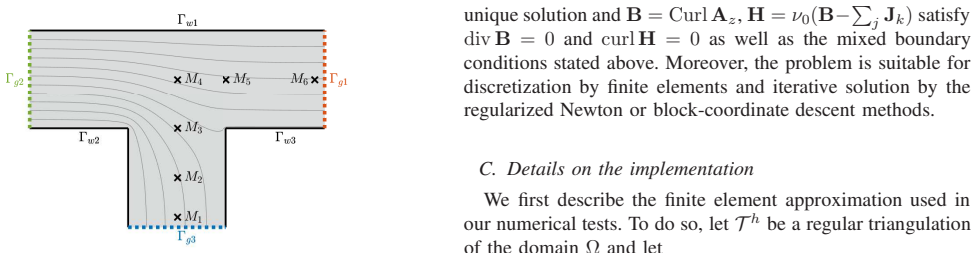
Summary. The paper proposes a variational reformulation of magnetoquasistatic field equations coupled to the energy-based vector hysteresis model of Henrotte et al. For a single load step, the coupled system (1)-(3) is shown to be equivalent to the minimization of a strongly convex functional (9) over the vector potential A and the magnetic polarization J. The authors claim well-posedness of the continuous and discrete problems, present a regularized Newton method and a block-coordinate descent method, and illustrate the approach with numerical experiments on the T-joint transformer benchmark.
Significance. The central variational equivalence is a genuinely useful contribution: if it holds, it provides a clean formulation that avoids the numerical inversion of the hysteresis operator needed in earlier scalar-potential or vector-potential approaches. The first-order optimality argument in Assertion 6 is self-contained and non-circular, and the discrete well-posedness in Assertion 7 is immediate. The two proposed solvers, if fully justified, would give practitioners two globally convergent options. However, the manuscript's support for the Newton method is only a reference to the authors' preprints, and the same is largely true for the block-coordinate descent method. Thus the practical significance of the paper depends on completing or making explicit those convergence proofs.
major comments (2)
- [Section III-B, Assertion 9] The proof of Assertion 9 is a two-sentence reference to [27] and the preprints [28], [29], yet this assertion carries one of the two advertised global-convergence claims. The objective in (9) contains U(J) = -2 As Js / pi log(cos(pi/2 |J|/Js)), whose gradient is unbounded as |J| tends to Js; the energy is finite only for |J| < Js almost everywhere. Consequently the Newton operator (19) contains U''(J), which is not a bounded multiplication operator on L2 unless the iterates are pointwise bounded away from saturation. Standard damped-Newton global-convergence theorems require assumptions such as Lipschitz continuity of the Hessian on the relevant sublevel set and control of the Newton decrement; the manuscript does not verify these for (9), and it is not automatic that the magnetostatics results in [28] or [29] cover the singular boundary and the pinning term chi |J - Jp|_eps. Please provide a self-contained proof of the claimed global linear convergence, or state the theorem from [28]/[29] and verify its hypotheses step by step.
- [Section III-C, Assertion 11] The proof of Assertion 11 likewise consists of a reference to [30] with the sentence 'The results follow immediately'. The abstract's second global-convergence claim therefore also rests on an external result whose hypotheses are not stated. In particular, [30] concerns a non-smooth convex minimization problem in plasticity, not the present coupled field problem; the linear-rate conclusion for the infinite-dimensional Hilbert space setting of (23) is not immediate. Please give the precise convergence theorem from [30] and check its assumptions, or prove the assertion directly.
minor comments (6)
- [Assumption 2] The displayed formula for U(J) omits the absolute value; as written it defines a scalar function of a vector argument. It should read U(J) = -2 As Js / pi log(cos(pi/2 |J| / Js)).
- [Remark 10 and equation (19)] The denominator in the pinning-term derivative is missing from the displayed formula: it should read chi / |J - Jp|_eps (I - v otimes v), not chi |J - Jp|_eps (I - v otimes v).
- [Section IV-D] The phrase 'mesh-independent with constant average iteration counts' is presented as an expected and confirmed property, but Assertions 9 and 11 only state linear convergence and no mesh-independent rate is proved. Please either state a rate theorem or qualify this conclusion as an empirical observation.
- [Introduction, second paragraph] The name 'Berqvist' should be 'Bergqvist'.
- [Section IV] The numerical section uses a five-cell model with multiple pinning forces, whereas the analysis in Sections II and III is stated for a single internal variable. Please state explicitly that the uniqueness and convergence assertions extend to the multi-cell case, for example by noting that the functional (26) is again strongly convex and satisfies the same structural assumptions.
- [References] Reference [29] is cited only as an arXiv preprint. Since the proof of Assertion 9 relies on it, please provide a full statement of the cited result or update the reference to a published version if one exists.
Circularity Check
No circular derivation: the variational equivalence is self-contained, and the only self-citation dependency (Newton convergence via authors' preprints) is a proof-gap rather than an input-output reduction.
full rationale
The core derivation chain is not circular. Assertions 3-6 derive the minimizer of the strongly convex problem (9) via first-order optimality conditions, and the resulting equations (10)-(12) are algebraically the field equations together with the stationarity condition of the hysteresis minimization (3); this is a genuine variational characterization, not a fitted-input/prediction reversal, and no constants are fitted to the reported iteration counts or loss values. The block-coordinate descent convergence (Assertion 11) is delegated to the external reference [30]. The only self-citation-adjacent element is Assertion 9 (Section III-B): the proof states 'The discrete setting is fully covered by the results in [27]. The arguments presented in [28], [29] allow to treat also the infinite dimensional problem in a rigorous manner.' Since [29] is the authors' own preprint and the assumptions of its convergence theorem are not verified for the saturating energy U(J) with gradient blowing up at |J|=Js, the infinite-dimensional global convergence claim is unsupported inside this manuscript. That is a completeness/correctness risk, not a circular reduction: the paper never defines Assertion 9 into the hypotheses of [28]/[29], so there is no exhibited equivalence-by-construction. Hence no circular step is identified; score 1 reflects the minor self-citation dependency without treating it as circular.
Assumptions & free parameters
free parameters (3)
- regularization parameter epsilon =
not specified (epsilon > 0)
- time step tau for load cycle =
0.02 (200 steps over [0,2])
- Armijo line-search parameters q, sigma =
q = 0.5, sigma = 0.1
assumptions (9)
- standard math The functional in (9) is strongly convex, coercive, and continuous; standard convex analysis guarantees a unique minimizer.
- standard math Minimizers of the convex functional are characterized by first-order optimality conditions with subdifferentials.
- domain assumption Omega is a bounded Lipschitz domain, topologically trivial, with a stable direct splitting H0(curl) = grad H1_0 + V.
- domain assumption The source current satisfies js = curl Hs for some Hs in H(curl; Omega).
- domain assumption The energy density U(J) has the specific log-cos form with parameters As, Js.
- domain assumption The internal polarization is governed by the minimization problem (3) with pinning term chi |J - Jp|_epsilon.
- standard math |x| <= |x|_epsilon <= |x| + sqrt(epsilon), so the regularization error is controlled.
- domain assumption The infinite-dimensional damped Newton convergence analysis of Heid [28] and Egger-Engertsberger-Radu [29] applies to the present problem setting.
- standard math Alternating minimization converges for this strongly convex functional (Carstensen [30]).
Cite this review
Pith. "Pith review of On the vector potential formulation with an energy-based hysteresis model and its numerical solution." pith.science (2026). https://pith.science/paper/2XTS57GK
@misc{pith2026250714521,
  author       = {Pith},
  title        = {Pith review of: On the vector potential formulation with an energy-based hysteresis model and its numerical solution},
  year         = {2026},
  howpublished = {\url{https://pith.science/paper/2XTS57GK}},
  note         = {Machine review of arXiv:2507.14521}
}
read the original abstract
The accurate modelling and simulation of electric devices involving ferromagnetic materials requires the appropriate consideration of magnetic hysteresis. We discuss the systematic incorporation of the energy-based vector hysteresis model of Henrotte et al. into vector potential formulations for the governing magnetic field equations. The field model describing a single step in a load cycle is phrased as a convex minimization problem which allows us to establish existence and uniqueness of solutions and to obtain accurate approximations by finite element discretization. Consistency of the model with the governing field equations is deduced from the first order optimality conditions. In addition, two globally convergent iterative methods are presented for the solution of the underlying minimization problems. The efficiency of the approach is illustrated by numerical tests for a typical benchmark problem.
Figures

Reference graph
Works this paper leans on
-
[28]
P . Heid. A short note on an adaptive damped Newton method for strongly monotone and Lipschitz continuous operator equations. Arch. Math. , 121:55–65, 2023
work page 2023
-
[29]
Global convergence of iterative solvers for problems of nonlinear magnetostatics
H. Egger, F. Engertsberger, and B. Radu. Global converg ence of iterative solvers for problems of nonlinear magnetostatics. arXiv:2403.18520
-
[27]
Nocedal and S
J. Nocedal and S. Wright. Numerical Optimization . Springer, 2006
2006
-
[30]
C. Carstensen. Domain decomposition for a non-smooth c onvex mini- mization problem and its application to plasticity. Numer . Lin. Algebra Appl., 4:177–190, 1997
work page 1997
-
[1]
G. Meunier. The Finite Element Method for Electromagnetic Modeling . Wiley, 2008
2008
-
[2]
S. J. Salon. Finite Element Analysis of Electrical Machines . Springer, New Y ork, NY , 2012
work page 2012
-
[3]
D. C. Jiles and D. L. Atherton. Theory of ferromagnetic hy steresis. J. Magnetism. Magn. Materials , 61:48–60, 1986
1986
-
[4]
I. D. Mayergoyz. Mathematical Models of Hysteresis . Springer-V erlag New Y ork Inc., 1991
work page 1991
Show all 31 references
-
[5]
Benabou, S
A. Benabou, S. Cl´ enet, and F. Piriou. Comparison of Prei sach and Jiles- Atherton models to take into account hysteresis phenomenon for finite element analysis. J. Magn. Magn. Mater ., 261:139–160, 2003
2003
-
[6]
Gyselinck, P
J. Gyselinck, P . Dular, N. Sadowski, J. Leite, and J. P . A. Bastos. Incorpo- ration of a Jiles-Atherton vector hysteresis model in 2D FE m agnetic field computations: Application of the Newton-Raphson method. COMPEL, 23:685–693, 2004
2004
-
[7]
Bergqvist
A. Bergqvist. Magnetic vector hysteresis model with dry friction-like pinning. Physica B: Condensed Matter , 233:342–347, 1997
1997
-
[8]
Henrotte, A
F. Henrotte, A. Nicolet, and K. Hameyer. An energy-based vector hysteresis model for ferromagnetic materials. COMPEL, 25:71–80, 2006
2006
-
[9]
Francois-Lavet, F
V . Francois-Lavet, F. Henrotte, L. Stainier, L. Noels, a nd C. Geuzaine. An energy-based variational model of ferromagnetic hyster esis for finite element computations. J. Comp. Appl. Math. , 246:243–250, 2013
2013
-
[10]
Prigozhin, V
L. Prigozhin, V . Sokolovsky, J. W. Barrett, and S. E. Zir ka. On the energy-based variational model for vector magnetic hyster esis. IEEE Trans. Magn., 52:1–11, 2016
2016
-
[11]
Kaltenbacher, K
M. Kaltenbacher, K. Roppert, L. D. Domenig, and H. Egger . Comparison of energy based hysteresis models. In 23rd International Conference on the Computation of Electromagnetic Fields , pages 1–4, 2022
2022
-
[12]
Jacques, R
K. Jacques, R. Sabariego, C. Geuzaine, and J. Gyselinck . Inclusion of a direct and inverse energy-consistent hysteresis model in magnetostatic finite element formulations. IEEE Trans. Magn. , 52:7300304, 2015
2015
-
[13]
Domenig, K
L. Domenig, K. Roppert, and M. Kaltenbacher. Incorpora tion of a 3D energy-based vector hysteresis model into the finite elemen t method using a reduced scalar potential formulation. IEEE Trans. Magn., 60:1–8, 2024
2024
-
[14]
Egger, F
H. Egger, F. Engertsberger, L. Domenig, K. Roppert, and M. Kaltenbacher. On forward and inverse magnetic vector hys teresis operators. IEEE Trans. Magn. , 61:7300207, 2025
2025
-
[15]
Jacques, C
K. Jacques, C. Geuzaine, F. Henrotte, and J. Gyselinck. Comparison between differential and variational forms of an energy-ba sed hysteresis model. In IEEE International Energy Conference , pages 1–6, 2016
2016
-
[16]
Egger, F
H. Egger, F. Engertsberger, L. Domenig, K. Roppert, and M. Kaltenbacher. On nonlinear magnetic field solvers using l ocal Quasi-Newton updates. Comp. Math. Appl. , 183:20–31, 2025
2025
-
[17]
Egger and F
H. Egger and F. Engertsberger. A semi-smooth Newton met hod for magnetic field problems with hysteresis. arXiv:2506.01499, 2025
2025 arXiv
-
[18]
K. Jacques. Energy-Based Magnetic Hysteresis Models - Theoretical Development and Finite Element F ormulations . PhD thesis, Universit´ e de Li` ege, 2018
2018
-
[19]
P . Monk. Finite Element Methods for Maxwell’s Equations . 2003
2003
-
[20]
Ekeland and R
I. Ekeland and R. T´ emam. Convex Analysis and V ariational Problems . SIAM, 1999
1999
-
[21]
R. T. Rockafellar. Convex Analysis. Princeton Univ. Press, 1970
1970
-
[22]
N´ ed´ elec
J.-C. N´ ed´ elec. Mixed finite elements in R3. Numer . Math., 35:315–341, 1980
1980
-
[23]
D. Boffi, F. Brezzi, and M. Fortin. Mixed Finite Element Methods and Applications. Springer, Berlin, Heidelberg, 2013
2013
-
[24]
Albanese and G
R. Albanese and G. Rubinacci. Integral formulation for 3d eddy-current computation using edge elements. IEE Proc. Sci. Meas. Tech. , 135:457– 462, 1988
1988
-
[25]
Rapetti, A
F. Rapetti, A. Alonso Rodr´ ıguez, and E. De Los Santos. O n the tree gauge in magnetostatics. J, 5:52–63, 2022
2022
-
[26]
Egger, F
H. Egger, F. Engertsberger, and B. Radu. On the converge nce of higher order finite element methods for nonlinear magneto statics. arXiv:2408.12283, 2024
2024 arXiv
-
[31]
Gfrerer and J
H. Gfrerer and J. V . Outrata. On a semismooth* Newton met hod for solving generalized equations. SIAM J. Optim. , 31:489–517, 2021
2021
Reviewed August 6, 2026 · model on record in the stance chip above.
Discussion (0). Sign in to comment.