REVIEW 5 major objections 6 minor 39 references
Wave-Particle Turbulence Simulation of Spatially Developing Round Jets: Turbulent Flow Modeling and Method Validation
T0 review · 5 major / 6 minor · reviewed 2026-08-06 · deepseek-v4-flash
Pith's one-line read The wave-particle method WPTS reproduces the round jet at Re = 5000 — decay rate, mean velocity, Reynolds stresses — on a grid with only 2% of the cells DNS needs.
desk verdict Useful round-jet validation of the WPTS closure, but the 2%-grid accuracy claim lacks a same-cost baseline that would show the particle component is actually doing the work. read the letter →
The pith
A machine-rendered reading of the paper's core claim, the machinery that carries it, and where it could break.
The reading
What carries the argument
The load-bearing object is the turbulent collision time $\tau_t$ and the wave-particle split it governs. Its model, $e^{-\Delta t/\tau_t} = (1-\omega_p)e^{-\Delta t/\tau_{mac}} + \omega_p E_p$, blends a macroscale Smagorinsky-type relaxation time $\tau_{mac}$ with a particle-retention fraction $E_p = 0.8$, using coefficients $C_s^2 = 0.05$ and $k = 0.98$; this model decides how much of each cell's fluid is sampled into stochastic particles, $W^{hp}_i = e^{-\Delta t/\tau_n} W^h_i$, and how long those particles free-stream before being reabsorbed. Sampled particles receive a velocity perturbation drawn from the local turbulent kinetic energy scaled by $C_0 = 0.5$, are transported under the pressure gradient, and are deleted with their mass, momentum, and energy merged back into the wave field. The $\tau_t$ model therefore plays three roles at once: it determines where particles exist, how far they travel, and how much resolved kinetic energy is handed to the subgrid (particle) representation.
What would settle it
Re-run the same jet on the same $84^3$ grid with the closure constants varied one at a time — for example $E_p = 0.6$ and $1.0$, $C_s^2 = 0.03$ and $0.10$, $C_0 = 0.3$ and $0.7$, $k = 0.95$ and $0.99$ — and recompute $B_u$ and the Reynolds-stress profiles at $x = 25, 30, 35$. If the decay rate or the stress levels move materially outside the DNS and experimental bands, the reported accuracy is tied to the chosen operating point rather than to the closure itself. A complementary check is to apply the identical constants to another spatially developing shear flow, such as a plane channel or a backward-facing step at $\mathrm{Re} \approx 5000$, and see whether the mean flow and second-order statistics still match reference data.
Extended reading notes
Core claim
The paper's central discovery is that turbulent flow can be split, at grid resolution, into a wave component that carries the resolved Navier-Stokes dynamics and a stochastic particle component that carries unresolved subgrid kinetic energy through free transport, with the split controlled by a modelled turbulent collision time; and that this decomposition delivers quantitative turbulence statistics on a very coarse grid. For a round jet at $\mathrm{Re}_j = 5000$ and $Ma = 0.6$ on an $84^3$ grid, the method captures the linear centreline-velocity decay with $B_u = 5.69$, mean axial and radial velocity profiles that collapse onto DNS and experimental data at $x = 25, 30, 35$, and Reynolds-stress profiles in reasonable agreement, with only the cross-stress term slightly elevated. The decomposition is adaptive: where the grid resolves the flow, the particle field vanishes and WPTS reduces to the gas-kinetic scheme solving the Navier-Stokes equations, while in the shear layer near the jet exit particles appear in proportion to the resolved strain. Switching the inlet perturbation frequency ratio from $f = 2.40$ to $f = 2.22$ shifts the transition region but leaves the self-similar statistics essentially unchanged.
Load-bearing premise
The load-bearing premise is a single hand-set formula for the turbulent collision time, $e^{-\Delta t/\tau_t} = (1-\omega_p)e^{-\Delta t/\tau_{mac}} + \omega_p E_p$ with $C_s^2 = 0.05$, $E_p = 0.8$, $k = 0.98$, and sampling constant $C_0 = 0.5$, carried over unchanged from the authors' earlier mixing-layer study; if this closure is not a general property of turbulence but is tuned to that flow, the 2%-grid accuracy reported for the jet will not transfer to other configurations.
Editorial extensions
If this is right
- The same closure constants ($C_s^2 = 0.05$, $E_p = 0.8$, $k = 0.98$, $C_0 = 0.5$) that worked for the mixing layer also work for the round jet, which is the evidence that the method's coarse-grid accuracy is not specific to one flow geometry.
- For this jet, WPTS yields a centerline decay constant $B_u = 5.69$, bracketed by the DNS value 5.50 and the experimental values 5.80 and 6.06; the model therefore sits inside the spread of established data without recalibration.
- The collapse of mean-velocity and Reynolds-stress profiles at three downstream stations supports using WPTS to study the self-similar region of round jets on coarse grids.
- Because WPTS reverts to the gas-kinetic scheme wherever the grid resolves the flow, a coarse-grid simulation needs no global decision about where turbulence modelling applies; the particle field appears and disappears locally.
- The near-insensitivity of the self-similar statistics to the inlet frequency ratio ($f = 2.40$ vs $2.22$) indicates the reported decay rate and stresses are not an artifact of the chosen forcing.
Reading between the lines
- The particle-concentration field shown in the paper tracks the resolved shear — dense near the jet exit, thin downstream — which suggests WPTS particle density could double as a built-in indicator of where the grid fails to resolve the flow and could guide adaptive mesh refinement; the paper does not make this suggestion.
- The '2% of DNS cells' comparison counts grid points, not cost: particle sampling, transport, and bookkeeping add overhead per cell, so a wall-clock or CPU-hour comparison against a well-tuned LES on the same grid would sharpen (or erode) the efficiency claim.
- The four closure constants are carried from one flow to the next without recalibration, and the paper reports no sensitivity study; a systematic sweep over $E_p$, $C_s^2$, $k$, and $C_0$, or a third canonical flow such as a channel or backward-facing step, would reveal whether 2%-grid accuracy is a property of the closure or of its current operating point.
Editorial analysis
A structured set of objections, weighed in public.
Referee Report
Summary. The paper applies the wave-particle turbulence simulation (WPTS) method to a spatially developing round jet at Re=5000 and Ma=0.6 on an 84^3 grid said to contain roughly 2% of the cells used in the reference DNS. The method couples a fifth-order WENO-AO gas-kinetic wave solver with stochastic fluid particles whose non-equilibrium transport is intended to model subgrid turbulent kinetic energy. The authors report a centerline velocity decay constant Bu=5.69, radial mean-velocity profiles, and anisotropic Reynolds stress profiles at three axial stations, all stated to collapse and agree with DNS and experimental data; they also present a sensitivity test on the inlet perturbation frequency ratio f.
Significance. If the central claim holds, the paper is a useful and rather striking demonstration: a coarse-grid wave-particle closure, with constants carried over from the authors' prior mixing-layer study rather than refit to the jet, reproduces the mean flow and second-order statistics of a spatially developing round jet. Strengths include the use of external DNS and experimental data for validation, a falsifiable quantitative prediction (Bu=5.69 versus literature values 5.50-6.06), and the adaptive spatial distribution of the particle component. The weaknesses identified below concern statistical and grid-convergence support, sensitivity of the closure constants, and attribution of the accuracy to the wave-particle mechanism as opposed to the underlying high-order wave solver and inlet forcing; these gaps currently prevent the 2%-grid efficiency claim from being fully established.
major comments (5)
- [§3.3.1, Table 1] The quantitative comparisons, including Bu=5.69 and the Reynolds stress profiles in Figure 6, come from a single realization and a 23Te averaging window, with no confidence intervals, block-averaged error bars, or a second realization. The agreement with DNS (Bu=5.50) and experiments (5.80, 6.06) cannot be assessed as 'excellent' unless the sampling uncertainty of the present statistics is quantified; please report estimated statistical error bars on Bu and on the stress profiles, for example by block averaging over the 23Te window.
- [§3.2, §3.3.1] The central claim that the computation uses only 2% of the DNS cells is not accompanied by a grid-convergence or resolution-sensitivity study, and the reference DNS grid size is not stated. Without at least one additional grid level showing that Bu and the Reynolds stress profiles are insensitive to the mesh, the reported accuracy is a single-grid result rather than a demonstrated property of the method; the 2% efficiency figure therefore needs explicit support.
- [§2, Eq. (16)] The turbulent collision time closure in Eq. (16) and the sampling constant C0=0.5 are load-bearing: they determine the wave-particle split, the particle lifetime, and hence the subgrid transport. The constants Cs^2=0.05, Ep=0.8, and k=0.98 are taken from the authors' prior study [35] with no sensitivity analysis in this paper. A small perturbation study of these constants (for example +/-20% in Ep and Cs^2) is needed to support the claim that the closure transfers to the round jet without recalibration.
- [§2, §3.3.1] No baseline computation is reported that isolates the role of the wave-particle mechanism. The wave component is the fifth-order WENO-AO gas-kinetic scheme, which supplies its own implicit dissipation on coarse grids, and the inflow is strongly forced by dual-mode plus broadband perturbations (Section 3.2). A same-grid computation with the particle transport disabled, or with the particle flux set to zero, would show whether the observed accuracy is attributable to WPTS or to the wave solver and inlet conditioning; this attribution matters because the abstract's claim is specifically about WPTS.
- [§3.3.2] The paper itself notes that low-density far-field particles retained through the Ep term may have a non-negligible influence on fluid evolution and turbulent statistics, but this influence is never quantified. Please report, at the three statistical stations x=25,30,35, the split of the resolved versus particle-borne contribution to the sampled Reynolds stresses, or run an Ep=0 sensitivity case, so that the reader can judge whether the reported statistics are robust to particle retention in the far field.
minor comments (6)
- [§3.2] The sentence 'corresponding to approximately 2% that employed in DNS study [18]' should state the DNS grid size explicitly, since the 2% figure is central to the paper's efficiency claim.
- [§2, Eq. (9)] The notation DN(.,.) in Eq. (9) is not defined in this paper; please define the sampling operator or restate the formula from [35].
- [§2, Eq. (16)] The symbol ωp in Eq. (16) is not defined in the text; please state its meaning and range.
- [§2, Eqs. (8) and (10)] The treatment of the particle transport time tf is confusing: Eq. (8) says sampled particles are evolved with tf=Δt, while Eq. (10) computes tf for surviving particles as min[-τn ln(η), Δt]. Please clarify the order of these operations and the definition of tf for newly sampled versus surviving particles.
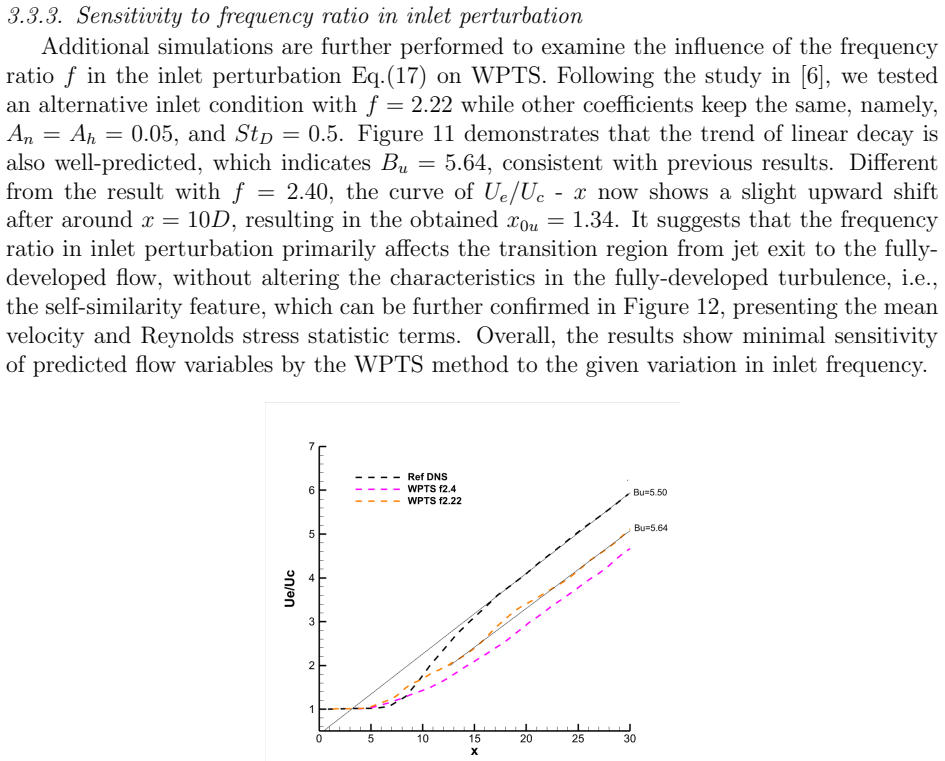
- [§3.3.3] The sensitivity test changes only the inlet frequency ratio f, but the virtual origin changes from x0u=3.44 to 1.34 while Bu changes only slightly; the discussion should state more explicitly that the inlet frequency primarily affects the virtual origin and transition region rather than the fully developed decay rate, as the manuscript currently gestures at this point.
- [References] The closure details and all model coefficients are attributed to the arXiv preprint [35]; either cite a published version if available or include a short summary of the closure derivation so that the present paper is more self-contained.
Circularity Check
No circularity: the round-jet prediction is validated against independent DNS and experimental data with closure constants fixed from prior work, not refit to the jet.
full rationale
The central claim — that WPTS on 84^3 cells predicts round-jet mean velocity, centerline decay, and Reynolds stresses — is tested against external benchmarks (Sharan and Bellan DNS [18]; Hussein et al. [7]; Panchapakesan and Lumley [16]). The turbulence collision-time model (Eq. 16) and its coefficients (Cs^2=0.05, Ep=0.8, k=0.98, C0=0.5) are taken unchanged from the authors' own earlier preprint [35]; they are fixed inputs to the jet simulation, not parameters fitted to the jet data. No equation in the paper defines the predicted decay constant Bu or the Reynolds stresses in terms of the DNS or experimental values used for comparison, so there is no reduction of a 'prediction' to its input by construction. The self-citation to [35] supplies the heuristic closure and the constant values, but the load-bearing evidence for the accuracy claim is the independent empirical comparison, which makes the claim externally falsifiable. The paper's own caveat that far-field particles 'may have a non-negligible influence on fluid evolution, consequently affecting turbulent statistics variables' (Sec. 3.3.2), and the absence of a same-grid particle-free baseline, concern causal attribution and robustness, not logical circularity. No circular step can be exhibited from the text, so the circularity score is 0.
Assumptions & free parameters
free parameters (5)
- Cs^2 (Smagorinsky coefficient) =
0.05
- Ep (particle retention weighting) =
0.8
- k (turbulence temperature threshold) =
0.98 if sqrt(Theta_t)>1e-10, else 0
- C0 (particle TKE sampling amplitude) =
0.5
- Reference particle mass =
1e-3 * Omega
assumptions (5)
- ad hoc to paper BGK relaxation equation (Eq.1) with equilibrium state g that includes a turbulence temperature Theta_t is a valid model of coarse-grid turbulent flow.
- ad hoc to paper Particles obey Eq.(7) with pressure gradient as the sole external force, and their creation/deletion encodes TKE production and dissipation.
- ad hoc to paper The turbulent collision time closure Eq.(16) with constants Cs^2=0.05, Ep=0.8, k=0.98 determines the wave-particle split and transport times.
- domain assumption Inlet perturbation parameters (An=Ah=0.05, StD=0.5, f=2.40) from reference [6] reproduce the natural transition of this jet.
- domain assumption Averaging over 23Te and over the azimuthal direction yields converged statistics for the self-similar region.
invented entities (2)
-
WPTS stochastic fluid particles
-
Turbulent collision time tau_t
Cite this review
Pith. "Pith review of Wave-Particle Turbulence Simulation of Spatially Developing Round Jets: Turbulent Flow Modeling and Method Validation." pith.science (2026). https://pith.science/paper/LF22JFFQ
@misc{pith2026250714524,
  author       = {Pith},
  title        = {Pith review of: Wave-Particle Turbulence Simulation of Spatially Developing Round Jets: Turbulent Flow Modeling and Method Validation},
  year         = {2026},
  howpublished = {\url{https://pith.science/paper/LF22JFFQ}},
  note         = {Machine review of arXiv:2507.14524}
}
read the original abstract
Spatially developing round jet flows are fundamental to numerous engineering applications. This letter applies the wave-particle turbulence simulation (WPTS) method, a recently developed multiscale approach, to simulate a spatially developing circular jet at Reynolds number 5000, a canonical configuration for validating turbulence models. The study aims to further establish the effectiveness and accuracy of WPTS for shear-driven turbulent flows. WPTS employs a multiscale framework that couples wave and particle components, where the wave component captures cell-resolved flow structures while the particle component models sub-grid flow information through non-equilibrium transport. Using a computational grid containing only 2% of the cells required for direct numerical simulation (DNS), WPTS successfully predicts both qualitative flow features and quantitative turbulence statistics, including: the characteristic linear decay of centerline velocity, radial profiles of mean velocity, and anisotropic Reynolds stress components. The results demonstrate excellent agreement with DNS data and experimental measurements. These findings establish WPTS as an effective computational tool for turbulence simulation, capable of maintaining high fidelity in capturing essential turbulence characteristics while utilizing significantly coarser grids than traditional methods. The successful application to turbulent jet flow demonstrates the method's potential for extension to more complex engineering flow configurations, offering a computationally efficient alternative for industrial applications.
Figures


Figures from the paper (10 more)



Reference graph
Works this paper leans on
-
[35]
Wave-particle based multiscale modeling and simulation of non-equilibrium turbulent flows
Xiaojian Yang and Kun Xu. Wave-particle based multiscale modeling and simulation of non-equilibrium turbulent flows. arXiv preprint arXiv:2503.07207 , 2025. 19
arXiv 2025
-
[1]
Christophe Bogey and Christophe Bailly. Large eddy simulations of transitional round jets: influence of the reynolds number on flow development and energy dissipation. Physics of Fluids , 18(6), 2006
work page 2006
-
[2]
Christophe Bogey, Christophe Bailly, and Daniel Juv´ e. Noise investigation of a high subsonic, moderate reynolds number jet using a compressible large eddy simulation. Theoretical and Computational Fluid Dynamics, 16:273–297, 2003
work page 2003
-
[3]
GY Di Veroli and S Rigopoulos. Modeling of aerosol formation in a turbulent jet with the transported population balance equation-probability density function approach. Physics of Fluids , 23(4), 2011
work page 2011
-
[4]
External intermittency simulation in turbulent round jets
T Gilliland, KKJ Ranga-Dinesh, M Fairweather, SAEG Falle, Karl W Jenkins, and AM Savill. External intermittency simulation in turbulent round jets. Flow, Turbulence and Combustion, 89:385–406, 2012
work page 2012
-
[5]
Numerical simulation of forced circular jets: effect of flapping perturbation
Trushar B Gohil and Arun K Saha. Numerical simulation of forced circular jets: effect of flapping perturbation. Physics of Fluids , 31(8), 2019
work page 2019
-
[6]
Simulation of the blooming phenomenon in forced circular jets
Trushar B Gohil, Arun K Saha, and K Muralidhar. Simulation of the blooming phenomenon in forced circular jets. Journal of Fluid Mechanics , 783:567–604, 2015
work page 2015
-
[7]
Velocity measurements in a high-Reynolds- number, momentum-conserving, axisymmetric, turbulent jet
Hussein J Hussein, Steven P Capp, and William K George. Velocity measurements in a high-Reynolds- number, momentum-conserving, axisymmetric, turbulent jet. Journal of Fluid Mechanics , 258:31–75, 1994
work page 1994
Show all 39 references
-
[8]
Performance Enhancement for High-order Gas-kinetic Scheme Based on WENO- adaptive-order Reconstruction
Xing Ji and Kun Xu. Performance Enhancement for High-order Gas-kinetic Scheme Based on WENO- adaptive-order Reconstruction. Communications in Computational Physics , 28(2):539–590, 2020
2020
-
[9]
Experimental and computational study of a high-reynolds jet flow
Ali Khosronejad, Christopher Feist, Jeff Marr, and Fotis Sotiropoulos. Experimental and computational study of a high-reynolds jet flow. Canadian Journal of Civil Engineering , 44(7):569–578, 2017
2017
-
[10]
A digital filter based generation of inflow data for spatially developing direct numerical or large eddy simulations
Markus Klein, Amsini Sadiki, and Johannes Janicka. A digital filter based generation of inflow data for spatially developing direct numerical or large eddy simulations. Journal of Computational Physics , 186(2):652–665, 2003. 18
2003
-
[11]
Development of turbulence in subsonic sub- merged jets
Polina S Landa and Peter Vaughan Elsmere McClintock. Development of turbulence in subsonic sub- merged jets. Physics Reports, 397(1):1–62, 2004
2004
-
[12]
An implicit unified gas-kinetic wave– particle method for radiative transport process
Chang Liu, Weiming Li, Yanli Wang, Peng Song, and Kun Xu. An implicit unified gas-kinetic wave– particle method for radiative transport process. Physics of Fluids , 35(11), 2023
2023
-
[13]
Unified gas-kinetic wave-particle methods I: Continuum and rarefied gas flow
Chang Liu, Yajun Zhu, and Kun Xu. Unified gas-kinetic wave-particle methods I: Continuum and rarefied gas flow. Journal of Computational Physics , 401:108977, 2020
2020
-
[14]
An implicit adaptive unified gas-kinetic scheme for steady-state solutions of nonequilibrium flows
Wenpei Long, Yufeng Wei, and Kun Xu. An implicit adaptive unified gas-kinetic scheme for steady-state solutions of nonequilibrium flows. Physics of Fluids , 36(10), 2024
2024
-
[15]
Analysis of a turbulent round jet based on direct numerical simulation data at large box and high reynolds number
Cat Tuong Nguyen and Martin Oberlack. Analysis of a turbulent round jet based on direct numerical simulation data at large box and high reynolds number. Physical Review Fluids , 9(7):074608, 2024
2024
-
[16]
Turbulence measurements in axisymmetric jets of air and helium
Nagangudy R Panchapakesan and John L Lumley. Turbulence measurements in axisymmetric jets of air and helium. Part 1. Air jet. Journal of Fluid Mechanics , 246:197–223, 1993
1993
-
[17]
Unified gas-kinetic wave-particle method for multiscale flow simulation of partially ionized plasma
Zhigang Pu and Kun Xu. Unified gas-kinetic wave-particle method for multiscale flow simulation of partially ionized plasma. Journal of Computational Physics , 530:113918, 2025
2025
-
[18]
Investigation of high-pressure turbulent jets using direct numerical simulation
Nek Sharan and Josette Bellan. Investigation of high-pressure turbulent jets using direct numerical simulation. Journal of Fluid Mechanics , 922:A24, 2021
2021
-
[19]
Numerical simulation of three-dimensional circular free turbulent jet flow using different Reynolds average Navier-Stokes turbulence models
Nilesh Kumar Sharma, Satish Kumar Dewangan, and Pankaj Kumar Gupta. Numerical simulation of three-dimensional circular free turbulent jet flow using different Reynolds average Navier-Stokes turbulence models. Computational Thermal Sciences: An International Journal , 15(3), 2023
2023
-
[20]
Features of far-downstream asymptotic velocity fluctuations in a round jet: A one-dimensional turbulence study
Sparsh Sharma, Marten Klein, and Heiko Schmidt. Features of far-downstream asymptotic velocity fluctuations in a round jet: A one-dimensional turbulence study. Physics of Fluids , 34(8), 2022
2022
-
[21]
Self-similarity of fluid residence time statistics in a turbulent round jet
Dong-hyuk Shin, RD Sandberg, and ES Richardson. Self-similarity of fluid residence time statistics in a turbulent round jet. Journal of Fluid Mechanics , 823:1–25, 2017
2017
-
[22]
A direct numerical simulation study of higher order statistics in a turbulent round jet
GN Taub, Hyungoo Lee, S Balachandar, and SA Sherif. A direct numerical simulation study of higher order statistics in a turbulent round jet. Physics of Fluids , 25(11), 2013
2013
-
[23]
Calibration of the reynolds stress model for turbulent round free jets based on jet half-width
Cem Turutoglu, Sertac Cadirci, Serdar Yilmaz, and Duygu Erdem. Calibration of the reynolds stress model for turbulent round free jets based on jet half-width. Physics of Fluids , 36(11), 2024
2024
-
[24]
Reynolds number effects on transition, turbulence intensity and axial- velocity decay rate of turbulent round jets
Ramanathan Varadharajan. Reynolds number effects on transition, turbulence intensity and axial- velocity decay rate of turbulent round jets. arXiv preprint arXiv:1708.03140 , 2017
2017 arXiv
-
[25]
Large eddy simulation of flow development and noise generation of free and swirling jets
Zhen-Hua Wan, Lin Zhou, Hai-Hua Yang, and De-Jun Sun. Large eddy simulation of flow development and noise generation of free and swirling jets. Physics of Fluids , 25(12), 2013
2013
-
[26]
Direct numerical simulation of subsonic round turbulent jet
Zhihua Wang, Pei He, Yu Lv, Junhu Zhou, Jianren Fan, and Kefa Cen. Direct numerical simulation of subsonic round turbulent jet. Flow, Turbulence and Combustion , 84:669–686, 2010
2010
-
[27]
Adaptive wave-particle decomposition in ugkwp method for high-speed flow simulations
Yufeng Wei, Junzhe Cao, Xing Ji, and Kun Xu. Adaptive wave-particle decomposition in ugkwp method for high-speed flow simulations. Advances in Aerodynamics, 5(1):25, 2023
2023
-
[28]
A gas-kinetic BGK scheme for the Navier–Stokes equations and its connection with artificial dissipation and Godunov method
Kun Xu. A gas-kinetic BGK scheme for the Navier–Stokes equations and its connection with artificial dissipation and Godunov method. Journal of Computational Physics , 171(1):289–335, 2001
2001
-
[29]
Direct modeling for computational fluid dynamics: construction and application of unified gas-kinetic schemes , volume 4
Kun Xu. Direct modeling for computational fluid dynamics: construction and application of unified gas-kinetic schemes , volume 4. World Scientific, 2014
2014
-
[30]
A unified computational fluid dynamics framework from rarefied to continuum regimes
Kun Xu. A unified computational fluid dynamics framework from rarefied to continuum regimes . Ele- ments in Aerospace Engineering, Cambidge University Press, 2021
2021
-
[31]
A unified gas-kinetic scheme for continuum and rarefied flows
Kun Xu and Juan-Chen Huang. A unified gas-kinetic scheme for continuum and rarefied flows. Journal of Computational Physics , 229(20):7747–7764, 2010
2010
-
[32]
Modeling and computation for non-equilibrium gas dynamics: Beyond single relaxation time kinetic models
Xiaocong Xu, Yipei Chen, and Kun Xu. Modeling and computation for non-equilibrium gas dynamics: Beyond single relaxation time kinetic models. Physics of Fluids , 33(1):011703, 2021
2021
-
[33]
Comparison of the performance of high-order schemes based on the gas-kinetic and HLLC fluxes
Xiaojian Yang, Xing Ji, Wei Shyy, and Kun Xu. Comparison of the performance of high-order schemes based on the gas-kinetic and HLLC fluxes. Journal of Computational Physics , 448:110706, 2022
2022
-
[34]
Unified gas-kinetic wave–particle method for polydisperse gas–solid particle multiphase flow
Xiaojian Yang, Wei Shyy, and Kun Xu. Unified gas-kinetic wave–particle method for polydisperse gas–solid particle multiphase flow. Journal of Fluid Mechanics , 983:A37, 2024
2024
-
[36]
Space-time correlations of velocity in a Mach 0.9 turbulent round jet
Peng-Jun-Yi Zhang, Zhen-Hua Wan, and De-Jun Sun. Space-time correlations of velocity in a Mach 0.9 turbulent round jet. Physics of Fluids , 31(11), 2019
2019
-
[37]
Enhanced delayed detached-eddy simulation with anisotropic minimum dissipation subgrid length scale
Ziyu Zhou, Maochao Xiao, Dian Li, and Yufei Zhang. Enhanced delayed detached-eddy simulation with anisotropic minimum dissipation subgrid length scale. Physics of Fluids , 37(2), 2025
2025
-
[38]
Unified gas-kinetic wave-particle methods II
Yajun Zhu, Chang Liu, Chengwen Zhong, and Kun Xu. Unified gas-kinetic wave-particle methods II. Multiscale simulation on unstructured mesh. Physics of Fluids , 31(6):067105, 2019
2019
-
[39]
Unified gas-kinetic scheme with multigrid convergence for rarefied flow study
Yajun Zhu, Chengwen Zhong, and Kun Xu. Unified gas-kinetic scheme with multigrid convergence for rarefied flow study. Physics of Fluids , 29(9), 2017. 20
2017
Reviewed August 6, 2026 · model on record in the stance chip above.
Discussion (0). Continue with ORCID to comment.