REVIEW 4 major objections 6 minor 53 references
The Serpent Eating Its Own Tail: Dust Destruction in the Apep Colliding-Wind Nebula
T0 review · 4 major / 6 minor · reviewed 2026-08-06 · deepseek-v4-flash
Pith's one-line read The paper establishes that the O-type supergiant near the Apep colliding-wind binary is a bound third star that routinely destroys the dust spiral along its sight line, and that the inner Wolf-Rayet binary orbits once every 193±11 years.
desk verdict First real look at Apep's outer shells gives a solid 193-yr period from shell spacing, but the cavity carving and triple claim are fitted by hand and asserted, not yet proven. read the letter →
The pith
A machine-rendered reading of the paper's core claim, the machinery that carries it, and where it could break.
The reading
What carries the argument
The engine of the analysis is a fast geometric code that renders a colliding-wind nebula as a point cloud of dust rings expanding from the wind-wind shock, wrapped into a spiral by the binary orbit, and projected against the sky; its special feature is a Gaussian-weighted 'dust destruction cone' placed along the line of sight to the tertiary star, which removes modelled dust inside the cone and reproduces the observed cavity. The second load-bearing mechanism is the identification of each concentric dust shell with a single periastron passage: because dust production switches on and off around periastron, each shell is a fossil of one orbit, and the equal spacing of the three shells directly measures the orbital period. The physical account of the cavity combines grain sublimation, shattering at the tertiary wind-wind shock, radiative-torque disruption, and photodissociation of freshly formed nano-grains, with the wind-momentum ratio of about 13 inferred from the 90-degree opening angle.
What would settle it
Take deep sub-millimetre observations of the oldest, coldest shells with ALMA: a model-free expansion velocity for the outermost shell must agree with the 1020 km s−1 ballistic expansion and with three shells spaced by equal 193-year intervals if the orbit claim is right, while the cavity should persist in cold dust if it is true destruction. A cavity that fades or changes shape at long wavelengths, a radial velocity for the O star that disagrees with the system's centre-of-mass motion, or non-uniform shell spacings would refute the hierarchical-triple and long-period conclusions.
Extended reading notes
Core claim
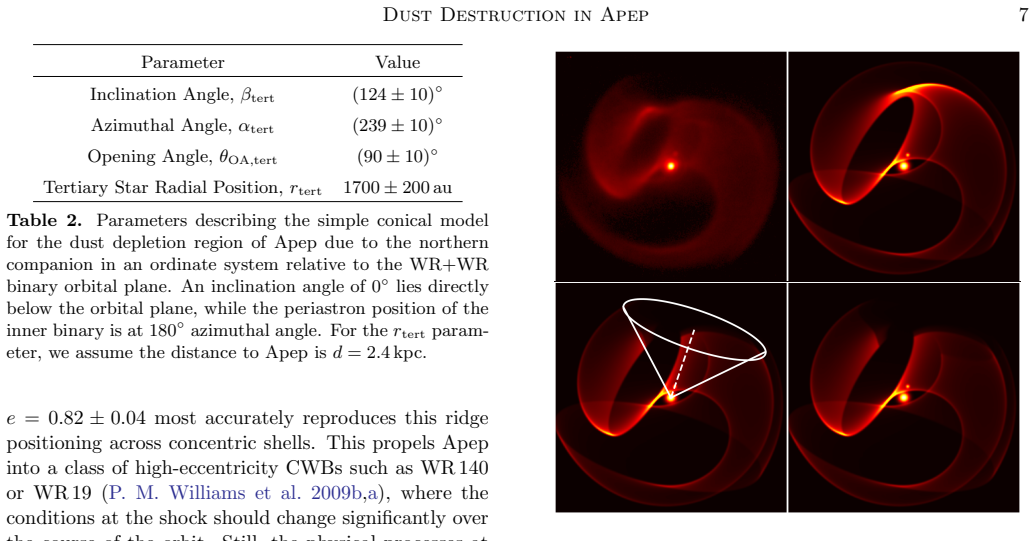
On the paper's own terms, the discovery is that Apep is a hierarchical triple: the O8 Iaf supergiant north of the WR+WR binary is dynamically bound to it, as demonstrated by the cavity it carves in the dust nebula. The cavity is modelled as a Gaussian 'dust destruction cone' with opening angle 90±10 degrees, centred on the O star's position 1700±200 au from the inner binary; dust that expands into the O star's wind and radiation is destroyed rather than deflected, leaving a scar in all three shells. The same JWST MIRI imaging that reveals the cavity also reveals three concentric dust shells, one per periastron passage, whose spacing together with four VLT epochs spanning 2016–2024 yields an orbital period of 193±11 years, an eccentricity of 0.82±0.04, and a dust production window of only about 25 years around periastron. The paper concludes that this makes Apep by far the longest-period dust-producing colliding-wind binary known, while the slow nebular expansion of 1020±100 km s−1 (at the assumed 2.4 kpc distance) compared with spectroscopic wind speeds of 2100 and 3500 km s−1 remains unexplained; the new geometric fits disfavour a wind anisotropy significantly misaligned with the orbital plane but cannot rule one out.
Load-bearing premise
Everything rests on the assumptions that each dust shell is born in a single brief burst at a periastron passage and then expands outward ballistically at constant speed, so that shell spacing directly measures the orbital period, and that the northern cavity is a genuine depletion of dust along the line of sight to the O star rather than a projection, illumination, or background-subtraction artifact.
Editorial extensions
If this is right
- Apep becomes the first colliding-wind nebula in which dust destruction by a bound tertiary star has been directly observed, and one of only a handful of confirmed triple colliding-wind binaries.
- The 193±11 year inner-binary period is almost an order of magnitude longer than the next longest dust-producing colliding-wind binary (WR 48a, about 32 years), so dust must be able to form in far wider and slower-shocking systems than previously seen.
- With eccentricity 0.82±0.04, dust production is confined to roughly 25 years around periastron; the last periastron was 1956±6 and the next is predicted for 2149±9.
- The small displacement of the cavity across the three shells favours a wide, eccentric orbit for the O supergiant, in which case the Kozai-Lidov timescale is short compared with stellar lifetimes and the tertiary must be included in models of the inner binary's evolution.
- The three shells show no measurable acceleration or deceleration over about 600 years, meaning the dust is a clean ballistic record of the orbit and the Wolf-Rayet winds kinematically dominate the region out to the outermost shell.
Reading between the lines
- The cavity behaves as a calibrated probe of the O supergiant's wind and radiation: future hydrodynamical simulations of a dust-laden WR wind colliding with an O-star wind could be checked directly against the 90-degree opening angle and the inferred wind-momentum ratio of about 13.
- If dust survives in a 193-year, mostly adiabatic shock, even longer-period dusty colliding-wind binaries should exist; blind mid-infrared surveys for concentric shells around other Wolf-Rayet systems could extend the empirical period ceiling beyond Apep.
- The cavity positions in the three shells could be re-measured with a second JWST epoch several years from now, or with ALMA images of older shells; detecting the predicted slow motion of the cavity would measure the tertiary's orbit directly instead of bounding it.
Editorial analysis
A structured set of objections, weighed in public.
Referee Report
Summary. The paper presents new multi-epoch VLT/VISIR and JWST/MIRI imaging of the Apep colliding-wind nebula, identifies three concentric dust shells, and fits a new geometric model (the open-source code xenomorph) to infer the orbital and wind parameters of the central WR+WR binary. The headline results are an orbital period of 193±11 yr, an eccentricity of 0.82±0.04, and the claim that the northern O supergiant is a bound tertiary member of a hierarchical triple, revealed by a dust cavity that the O star carves in the nebula. The paper also argues that dust is destroyed rather than displaced in this cavity, discusses possible destruction mechanisms (sublimation, sputtering, RATD), and concludes that Apep is a singular laboratory for long-period colliding-wind binaries.
Significance. If the cavity interpretation and the inferred period are correct, this is a substantial result: Apep would become the longest-period dust-producing WR colliding-wind binary known, a rare hierarchical triple WR system, and the first clear example of a tertiary star destroying dust in a CWB nebula. The multi-epoch dataset is strong, and the shell-spacing argument for a long period has the potential to be relatively model-independent. The paper also ships open-source, JAX-accelerated code and clearly describes its data processing, which are concrete strengths. The significance is currently limited by the manual, GUI-based fitting and by the fact that the central new claim—the O-star cavity—rests on a phenomenological model that the paper itself admits does not reproduce all observed structure.
major comments (4)
- [Section 2.2.1 and Table 1] The orbital period is introduced as an adopted input from Han et al. (submitted), found via proper-motion analysis, yet Section 3 and the abstract describe the geometric fit as confirming a 193±11 yr period. Because P_orb was fixed during the xenomorph fit, that fit cannot independently confirm the period. If the independent shell-spacing argument is meant to provide the confirmation, it must be derived explicitly in this paper, with its own uncertainty budget, rather than being presented as an output of the same fixed-input fit.
- [Section 3.1 and Appendix B.6] The statement that 'there are no alternative configurations that can explain such cavity ridge positions' is not supported by any quantitative test. The cavity parameters, including the destruction amplitude A_tert=1.75, were chosen manually in a GUI, no goodness-of-fit or residual statistic is reported, and no null test is described for the possibility that the northern deficit arises from background subtraction, illumination, projection, or PSF artifacts. A quantitative comparison (e.g., a residual map, a simple artifact-injection test, or a bootstrap over the known O-star position) is needed before the word 'unambiguously' in the abstract is justified.
- [Section 4.1] The paper's own Section 4.1 states that the tertiary cone model 'does not exactly produce the observed structure' and cannot reproduce the southern ridge. The conclusion that dust is destroyed rather than displaced is based on the failure of three ad hoc deflection prescriptions, not on a positive detection of dust destruction. Given that the cavity is the main observational support for the hierarchical-triple claim, this is a load-bearing limitation. The paper should either present a positive test of the destruction interpretation (e.g., a predicted brightness decrement profile, or an independent check of dust depletion) or explicitly temper the abstract and Section 3 claims.
- [Section 3.1 and Table 2] The cavity orientation was fitted from nebular geometry alone, and the O-star position was checked only after the fit, with the agreement described as 'precisely matches'. Since the O-star position is known independently, the significance of this alignment can and should be quantified (e.g., by a chi-square test of the fitted cavity axis against the astrometric position, accounting for both uncertainties). Without this, the association of the cavity with the O star remains suggestive rather than demonstrated.
minor comments (6)
- [Abstract and Section 3] The abstract's 'over 190 years' is unnecessarily vague; Table 1 quotes 193±11 yr, and the text should state the range consistently.
- [Section 2.2.1] The heading 'T ertiary cavity' contains a typo and should read 'Tertiary cavity'.
- [Section 3.1] The text uses 'Fig 3' where 'Figure 3' is the journal style, and the cavity opening angle '90±10' should be given as '90°±10°' or with an explicit unit.
- [Section 2.1 and Appendix A] The paper relies on Y. Han et al. (submitted) for both the MIRI reduction and the proper-motion period, but that paper is not yet available; the present manuscript should summarize the relevant reduction steps and the proper-motion method in enough detail to make the present analysis self-contained.
- [Section 2.2.1 and Figure 2] The simulated images are convolved with a fixed 2-pixel Gaussian blur to 'emulate the observation point spread functions', but no PSF-matching validation is shown; a supplementary figure comparing raw and convolved model profiles across the shells would strengthen confidence in the ridge alignment.
- [Section 3 and Table 1] The phrase 'confirm an orbital period' in the abstract overstates the certainty given that the period was an input to the fit; consider rephrasing to 'consistent with' or 'supported by' the shell-spacing analysis.
Circularity Check
Orbital period and expansion speed are adopted from the same-group companion paper and then reported as 'confirmed'/'fitted' outputs, while the dust-cavity result retains independent content.
-
self citation load bearing
[Section 2.2.1 (Parameter Estimation with the Geometric Model); Table 1; Section 3 (Results); Abstract]
"We treat the orbital eccentricity, inclination, longitude of ascending node, argument of periastron, and orbital phase as free parameters. We adopt the orbital period of Y. Han et al. (submitted) which was found via a proper motion analysis of dust ridge expansion. ... The most surprising result of the fitting (and the proper motion analysis in Y. Han et al. submitted), given by the separation between successive shells now revealed by JWST, is that the central WR+WR binary in the centre of the Apep system must have an orbital period of 193±11 yr."
In the geometric fit, P_orb is deliberately fixed; only e, i, Omega, omega, and phase are free, so the model cannot determine the period. Table 1 nonetheless lists P_orb = 193±11 yr with W25 (this work) as a reference, and the Abstract says 'We confirm an orbital period of over 190 years'. The 193 yr value is the adopted proper-motion result of the same-group companion paper (Y. Han et al., submitted), so presenting it as a confirmation from the geometric fit is an adopted input renamed as an output. The paper's own fitting only yields a lower bound of 170 yr, as stated in Section 3, confirming that the specific 193±11 yr value does not come from the fit described here.
-
fitted input called prediction
[Section 2.2.1; Table 1 caption; Section 4 (Discussion and Conclusions)]
"We adopt a distance of 2.4 kpc (J. R. Callingham et al. 2019; Y. Han et al. 2020) to the system which sets the nebula expansion speed as a fixed parameter when coupled with the adopted orbital period (due to the trigonometry of the nebula expanding in the plane of the sky). ... Our fitted expansion speed of 1020±100 km s−1 (at an assumed distance of 2.4 +0.2 −0.5 kpc; Y. Han et al. 2020, submitted) confirms this discrepancy."
The expansion speed is not a free parameter; it is fixed by the adopted distance (2.4 kpc) and the adopted period (193 yr), so the stated 1020 km/s is a derived constant (90 mas/yr × 2.4 kpc), not an independent fit. Table 1 attributes it to W25 and Section 4 calls it 'fitted' and uses it to confirm the nebula expansion/wind-speed discrepancy, but it carries no new information beyond the adopted inputs. Reporting an input-derived quantity as a fitted result and then using it as confirmation is therefore circular by construction.
full rationale
The period claims fail the reduction test. In Section 2.2.1 the authors state that P_orb is not fitted but adopted from the same-group submitted proper-motion analysis, and that this adopted period, together with the adopted distance, fixes the nebula expansion speed. Yet Section 3 and the Abstract present 193±11 yr as a result of 'the fitting', and Table 1 lists it with reference W25. Since the geometric fit cannot vary P_orb, the 'confirmation' is the input returned as output; at most the fit gives a lower bound of 170 yr. Similarly, v_dust = 1020±100 km/s is fixed by the adopted P and d and is then called 'fitted' in Section 4. These are genuine instances of adopted inputs renamed as predictions/confirmations, and the input comes from a same-author companion paper, so the self-citation is load-bearing for the period claim. The central new claim—the O-star cavity and hierarchical triple association—is not formally circular: the authors state that the cavity orientation was fitted from nebular geometry alone, not from the O-star position, so the later 'precise match' to the star is a post-hoc check rather than a definitional identity. The discovery was motivated by the apparent alignment, the uniqueness claim is unquantified, and Section 4.1 admits the cone model does not reproduce all observed structure, but those are robustness/correctness concerns rather than demonstrated circular reductions. Overall, the paper has partial circularity in reporting the period and expansion speed, while the dust-cavity result retains independent observational content.
Assumptions & free parameters
free parameters (19)
- Orbital eccentricity e =
0.82 ± 0.04
- Orbital inclination i =
24 ± 3 deg
- Longitude of ascending node Omega =
164 ± 15 deg
- Argument of periastron omega =
10 ± 10 deg
- Orbital period P_orb =
193 ± 11 yr
- Dust shell expansion speed v_dust =
1020 ± 100 km/s
- Orbital phase at July 2024 =
0.35 ± 0.02
- Shock cone opening angle theta_OA =
126 ± 5 deg
- Dust turn-on true anomaly =
-108 ± 10 deg
- Dust turn-off true anomaly =
141 ± 10 deg
- Azimuthal variation width sigma_az =
30 ± 10 deg
- Azimuthal variation amplitude A_az =
0.5
- Cavity polar angle beta_tert =
124 ± 10 deg
- Cavity azimuthal angle alpha_tert =
239 ± 10 deg
- Cavity opening angle theta_OA,tert =
90 ± 10 deg
- Tertiary star radial position r_tert =
1700 ± 200 au
- Dust destruction amplitude A_tert =
1.75
- Dust nucleation distance r_nuc =
0 au
- Dust acceleration constant A =
null
assumptions (9)
- domain assumption Each observed dust shell is produced at a single periastron passage of the inner binary.
- domain assumption Dust expands ballistically from the shock cone at constant speed after formation.
- standard math Keplerian two-body orbit for the WR+WR binary.
- domain assumption Distance d=2.4 kpc to Apep adopted from Callingham et al. 2019 and Han et al. 2020.
- domain assumption The nebula is optically thin and observed column density is proportional to the histogram of model particles.
- domain assumption The observed cavity is caused by the O supergiant and not by unrelated foreground, background, or ISM structure.
- domain assumption The O-star wind mass-loss rate lies in the range 10^-5.2 to 10^-6 solar masses per year.
- ad hoc to paper Gaussian destruction cone prescription is a valid phenomenological description of the tertiary effect.
- domain assumption Dust production is episodic with sharp turn-on and turn-off in true anomaly.
invented entities (1)
-
Tertiary dust destruction cone
independent evidence
Cite this review
Pith. "Pith review of The Serpent Eating Its Own Tail: Dust Destruction in the Apep Colliding-Wind Nebula." pith.science (2026). https://pith.science/paper/TP3KT2XV
@misc{pith2026250714610,
  author       = {Pith},
  title        = {Pith review of: The Serpent Eating Its Own Tail: Dust Destruction in the Apep Colliding-Wind Nebula},
  year         = {2026},
  howpublished = {\url{https://pith.science/paper/TP3KT2XV}},
  note         = {Machine review of arXiv:2507.14610}
}
read the original abstract
Much of the carbonaceous dust observed in the early universe may originate from colliding wind binaries (CWBs) hosting hot, luminous Wolf-Rayet (WR) stars. Downstream of the shock between the stellar winds there exists a suitable environment for dust grain formation, and the orbital motion of the stars wraps this dust into richly structured spiral geometries. The Apep system is the most extreme WR-CWB in our Milky Way: two WR stars produce a complex spiral dust nebula, whose slow expansion has been linked to a gamma-ray burst progenitor. It has been unclear whether the O-type supergiant 0.7" distant from the WR+WR binary is physically associated with the system, and whether it affects the dusty nebula. Multi-epoch VLT/VISIR and JWST/MIRI observations show that this northern companion star routinely carves a cavity in the dust nebula - the first time such an effect has been observed in a CWB - which unambiguously associates the O star as a bound component to the Apep system. These observations are used together with a new geometric model to infer the cavity geometry and the orbit of the WR+WR binary, yielding the first strong constraints on wind and orbital parameters. We confirm an orbital period of over 190 years for the inner binary - nearly an order of magnitude longer than the next longest period dust-producing WR-CWB. This, together with the confirmed classification as a hierarchical triple, cements Apep as a singular astrophysical laboratory for studying colliding winds and the terminal life stages of the most massive star systems.
Figures


Figures from the paper (4 more)


Reference graph
Works this paper leans on
-
[1]
Abbott, D. C. 1978, ApJ, 225, 893, doi: 10.1086/156554
-
[2]
Antognini, J. M. O. 2015, MNRAS, 452, 3610, doi: 10.1093/mnras/stv1552
-
[3]
Antognini, J. M. O., & Thompson, T. A. 2016, MNRAS, 456, 4219, doi: 10.1093/mnras/stv2938 Astropy Collaboration, Robitaille, T. P., Tollerud, E. J., et al. 2013, A&A, 558, A33, doi: 10.1051/0004-6361/201322068 Astropy Collaboration, Price-Whelan, A. M., Sip˝ ocz, B. M., et al. 2018, AJ, 156, 123, doi: 10.3847/1538-3881/aabc4f Astropy Collaboration, Price-...
-
[4]
Bloot, S., Callingham, J. R., & Marcote, B. 2022, MNRAS, 509, 475, doi: 10.1093/mnras/stab2976
-
[5]
2018, JAX: composable transformations of Python+NumPy programs, 0.3.13 http://github.com/google/jax
Bradbury, J., Frostig, R., Hawkins, P., et al. 2018, JAX: composable transformations of Python+NumPy programs, 0.3.13 http://github.com/google/jax
work page 2018
-
[6]
Callingham, J. R., Crowther, P. A., Williams, P. M., et al. 2020, MNRAS, 495, 3323, doi: 10.1093/mnras/staa1244
-
[7]
Callingham, J. R., Tuthill, P. G., Pope, B. J. S., et al. 2019, Nature Astronomy, 3, 82, doi: 10.1038/s41550-018-0617-7 Cant´ o, J., Raga, A. C., & Wilkin, F. P. 1996, ApJ, 469, 729, doi: 10.1086/177820
-
[8]
Crowther, P. A., & Evans, C. J. 2009, A&A, 503, 985, doi: 10.1051/0004-6361/200912631 del Palacio, S., Garc ´ ıa, F., De Becker, M., et al. 2023, A&A, 672, A109, doi: 10.1051/0004-6361/202245505
Show all 53 references
-
[9]
N., Pritchard, J., Murphy, T., et al
Driessen, L. N., Pritchard, J., Murphy, T., et al. 2024, PASA, 41, e084, doi: 10.1017/pasa.2024.72
2024 doi
-
[10]
W., Pittard, J
Eatson, J. W., Pittard, J. M., & Van Loo, S. 2022a, MNRAS, 517, 4705, doi: 10.1093/mnras/stac3000
-
[11]
W., Pittard, J
Eatson, J. W., Pittard, J. M., & Van Loo, S. 2022b, MNRAS, 516, 6132, doi: 10.1093/mnras/stac2617
-
[12]
Gayley, K. G. 2009, ApJ, 703, 89, doi: 10.1088/0004-637X/703/1/89 Gr¨ afener, G., Vink, J. S., de Koter, A., & Langer, N. 2011, A&A, 535, A56, doi: 10.1051/0004-6361/201116701
2009 doi
-
[13]
G., Lau, R
Han, Y., Tuthill, P. G., Lau, R. M., & Soulain, A. 2022, Nature, 610, 269, doi: 10.1038/s41586-022-05155-5
2022 doi
-
[14]
G., Lau, R
Han, Y., Tuthill, P. G., Lau, R. M., et al. 2020, MNRAS, 498, 5604, doi: 10.1093/mnras/staa2349
2020 doi
-
[15]
R., Millman, K
Harris, C. R., Millman, K. J., van der Walt, S. J., et al. 2020, Nature, 585, 357, doi: 10.1038/s41586-020-2649-2
2020 doi
-
[16]
2023, A&A, 672, A60, doi: 10.1051/0004-6361/202245281
Hastings, B., Langer, N., & Puls, J. 2023, A&A, 672, A60, doi: 10.1051/0004-6361/202245281
2023 doi
-
[17]
2024, exoplanet-dev/jaxoplanet: Astronomical time series analysis with JAX, v0.0.2 Zenodo, doi: 10.5281/zenodo.10736936
Hattori, S., Garcia, L., Murray, C., et al. 2024, exoplanet-dev/jaxoplanet: Astronomical time series analysis with JAX, v0.0.2 Zenodo, doi: 10.5281/zenodo.10736936
2024 doi
-
[18]
Hoang, T., & Tram, L. N. 2019, ApJ, 877, 36, doi: 10.3847/1538-4357/ab1845
2019 doi
-
[19]
N., Lee, H., & Ahn, S.-H
Hoang, T., Tram, L. N., Lee, H., & Ahn, S.-H. 2019, Nature Astronomy, 3, 766, doi: 10.1038/s41550-019-0763-6
2019 doi
- [20]
-
[21]
Hunter, J. D. 2007, Computing in Science & Engineering, 9, 90, doi: 10.1109/MCSE.2007.55
2007 doi
-
[22]
M., & Kern, W
Kells, L. M., & Kern, W. F. 1940, Plane and Spherical Trigonometry, 2nd edn. (New York: McGraw Hill Book Company)
1940
-
[23]
2012, A&A, 546, A60, doi: 10.1051/0004-6361/201219006
Lamberts, A., Dubus, G., Lesur, G., & Fromang, S. 2012, A&A, 546, A60, doi: 10.1051/0004-6361/201219006
2012 doi
-
[24]
M., Eldridge, J
Lau, R. M., Eldridge, J. J., Hankins, M. J., et al. 2020, ApJ, 898, 74, doi: 10.3847/1538-4357/ab9cb5
2020 doi
-
[25]
M., Hankins, M
Lau, R. M., Hankins, M. J., Han, Y., et al. 2022, Nature Astronomy, 6, 1308, doi: 10.1038/s41550-022-01812-x
2022 doi
-
[26]
M., Wang, J., Hankins, M
Lau, R. M., Wang, J., Hankins, M. J., et al. 2023, ApJ, 951, 89, doi: 10.3847/1538-4357/acd4c5
2023 doi
-
[27]
N., Stone, J
Lemaster, M. N., Stone, J. M., & Gardiner, T. A. 2007, ApJ, 662, 582, doi: 10.1086/515431
2007 doi
-
[28]
P., Lau, R
Lieb, E. P., Lau, R. M., Hoffman, J. L., et al. 2025, ApJ, 979, L3, doi: 10.3847/2041-8213/ad9aa9
2025 doi
-
[29]
2012, A&A, 539, A110, doi: 10.1051/0004-6361/201118328
Maeder, A., Georgy, C., Meynet, G., & Ekstr¨ om, S. 2012, A&A, 539, A110, doi: 10.1051/0004-6361/201118328
2012 doi
-
[30]
R., De Becker, M., et al
Marcote, B., Callingham, J. R., De Becker, M., et al. 2021, MNRAS, 501, 2478, doi: 10.1093/mnras/staa3863 22White et al
2021 doi
-
[31]
Markley, F. L. 1995, Celestial Mechanics and Dynamical Astronomy, 63, 101, doi: 10.1007/BF00691917
1995 doi
-
[32]
G., Hennicker, L., et al
Moens, N., Poniatowski, L. G., Hennicker, L., et al. 2022, A&A, 665, A42, doi: 10.1051/0004-6361/202243451
2022 doi
-
[33]
J., Nicholl, M., et al
Moore, T., Smartt, S. J., Nicholl, M., et al. 2023, ApJ, 956, L31, doi: 10.3847/2041-8213/acfc25
2023 doi
-
[34]
D., & Dermott, S
Murray, C. D., & Dermott, S. F. 1999, Solar System Dynamics (Cambridge University Press), doi: 10.1017/CBO9781139174817
1999 doi
-
[35]
Murray, N., M´ enard, B., & Thompson, T. A. 2011, ApJ, 735, 66, doi: 10.1088/0004-637X/735/1/66
2011 doi
-
[36]
2016, ARA&A, 54, 441, doi: 10.1146/annurev-astro-081915-023315
Naoz, S. 2016, ARA&A, 54, 441, doi: 10.1146/annurev-astro-081915-023315
2016 doi
-
[37]
R., & Pittard, J
Parkin, E. R., & Pittard, J. M. 2008, MNRAS, 388, 1047, doi: 10.1111/j.1365-2966.2008.13511.x
2008
-
[38]
D., Henson, M., Lieb, E
Richardson, N. D., Henson, M., Lieb, E. P., et al. 2025, ApJ, 987, 160, doi: 10.3847/1538-4357/addf30 Rodr ´ ıguez, L. F., Arthur, J., Montes, G., Carrasco-Gonz´ alez, C., & Toal´ a, J. A. 2020, ApJ, 900, L3, doi: 10.3847/2041-8213/abad9d
2025 doi
-
[39]
2022, A&A, 666, A49, doi: 10.1051/0004-6361/202243635
Schirmer, T., Ysard, N., Habart, E., et al. 2022, A&A, 666, A49, doi: 10.1051/0004-6361/202243635
2022 doi
-
[40]
Soulain, A., Lamberts, A., Millour, F., Tuthill, P., & Lau, R. M. 2023, MNRAS, 518, 3211, doi: 10.1093/mnras/stac2999
2023 doi
-
[41]
2018, A&A, 618, A108, doi: 10.1051/0004-6361/201832817
Soulain, A., Millour, F., Lopez, B., et al. 2018, A&A, 618, A108, doi: 10.1051/0004-6361/201832817
2018 doi
-
[42]
D., Richardson, N
Thomas, J. D., Richardson, N. D., Eldridge, J. J., et al. 2021, MNRAS, 504, 5221, doi: 10.1093/mnras/stab1181
2021 doi
-
[43]
2016, Computational Astrophysics and Cosmology, 3, 6, doi: 10.1186/s40668-016-0019-0
Toonen, S., Hamers, A., & Portegies Zwart, S. 2016, Computational Astrophysics and Cosmology, 3, 6, doi: 10.1186/s40668-016-0019-0
2016 doi
-
[44]
G., Monnier, J
Tuthill, P. G., Monnier, J. D., & Danchi, W. C. 1999, Nature, 398, 487, doi: 10.1038/19033
1999 doi
-
[45]
G., Monnier, J
Tuthill, P. G., Monnier, J. D., Lawrance, N., et al. 2008, ApJ, 675, 698, doi: 10.1086/527286
2008 doi
-
[46]
Usov, V. V. 1991, MNRAS, 252, 49, doi: 10.1093/mnras/252.1.49 van Marle, A. J., Langer, N., Yoon, S. C., & Garc ´ ıa-Segura, G. 2008, A&A, 478, 769, doi: 10.1051/0004-6361:20078802
1991 doi
-
[47]
E., et al
Virtanen, P., Gommers, R., Oliphant, T. E., et al. 2020, Nature Methods, 17, 261, doi: 10.1038/s41592-019-0686-2
2020 doi
-
[48]
J., Moffat, A
Wallace, D. J., Moffat, A. F. J., & Shara, M. M. 2002, in Astronomical Society of the Pacific Conference Series, Vol. 260, Interacting Winds from Massive Stars, ed. A. F. J. Moffat & N. St-Louis, 407
2002
-
[49]
White, R. M. T. 2025, xenomorph: the fastest way to model the colliding winds of massive binary stars, Zenodo, doi: 10.5281/zenodo.15875502
2025 doi
- [50]
-
[52]
M., van der Hucht, K
Williams, P. M., van der Hucht, K. A., van Wyk, F., et al. 2012, MNRAS, 420, 2526, doi: 10.1111/j.1365-2966.2011.20218.x
2012
-
[53]
M., Marchenko, S
Williams, P. M., Marchenko, S. V., Marston, A. P., et al. 2009b, MNRAS, 395, 1749, doi: 10.1111/j.1365-2966.2009.14664.x
2009
-
[54]
A., & Petrov, B
Zhekov, S. A., & Petrov, B. V. 2025, A&A, 693, A266, doi: 10.1051/0004-6361/202452599
2025 doi
Reviewed August 6, 2026 · model on record in the stance chip above.
Discussion (0). Continue with ORCID to comment.