REVIEW 4 major objections 5 minor 35 references
Latent-attention Based Transformer for Near ML Polar Decoding in Short-code Regime
T0 review · 4 major / 5 minor · reviewed 2026-08-06 · deepseek-v4-flash
Pith's one-line read A redesigned transformer decoder reaches near-maximum-likelihood error rates for short polar codes and keeps one architecture viable across code rates and lengths.
desk verdict A genuinely new transformer decoder for short polar codes with a serious label-source ambiguity in its near-ML claim; deserves peer review after major revision. read the letter →
The pith
A machine-rendered reading of the paper's core claim, the machinery that carries it, and where it could break.
The reading
What carries the argument
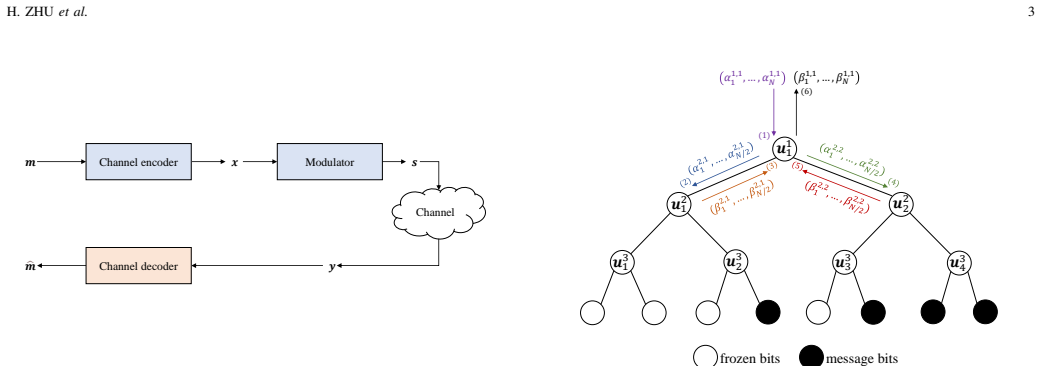
The load-bearing object is the latent-attention block and its code-aware mask. Each layer computes attention weights as $\mathrm{softmax}\left(\frac{Q_{ib}K_{ib}^T}{\sqrt{d_m}}\right)V_{ib}$, where $Q_{ib}=Q_f+P_{ib}$ combines a learned frozen-bit query bias with the latent positional encoding $P_{ib}$, $K_{ib}$ comes from a layer-specific positional key encoder, and $V_{ib}=[V_y,U_f]$ concatenates embedded channel values with the frozen-bit embedding. The code-aware mask zeros out illegal connections among padding, frozen, and message positions, and front-padding preserves absolute bit indices so the same network can shift between code rates and lengths by mask replacement. This mechanism is what carries the near-ML performance and the generalization claim.
What would settle it
Retrain the LAT decoder with the same protocol but with experience-reflow reference labels generated by SC decoding only, then compare BER/BLER at N=16, k=8 against the ML bound. If near-ML error rates persist, the architecture is responsible; if they fall back to SC-level performance, the ML benchmark was supplying the near-ML result through training labels.
Extended reading notes
Core claim
On its own terms, the central discovery is that the short-code failure of transformer decoders for polar codes is architectural rather than fundamental: generic self-attention computes context correlations that distort the positional, hierarchical dependencies of polarization, and this can be fixed by decoupling $Q$, $K$, and $V$. In the LAT decoder, layer-specific latent positional encoders generate the Key matrix and a positional Query bias, while the Value matrix concatenates channel-value embeddings with frozen-bit embeddings; a code-aware mask enforces that only valid decoding connections contribute to attention. The paper supports this with a score-function view from Tweedie's formula, arguing that the layer-wise residual updates approximate the ML estimator's gradient, and with an energy-based argument that the training objective is optimizable. The reported outcome is BER/BLER close to ML and SCL for N=16, k=8, better than the ECCT transformer baseline, and stable performance across N in {8,16} and rates 0.25–0.75 after configuration-specific fine-tuning.
Load-bearing premise
The load-bearing premise is that the near-ML curves reflect the architecture rather than the benchmark: Eq. (44) allows the ML decoder to supply experience-reflow training labels, and the model is fine-tuned on each test configuration before evaluation; if either supervision channel is removed, the claimed generalization may collapse.
Editorial extensions
If this is right
- If the claims hold, transformer decoders can operate at ML error-rate limits for short polar codes without exhaustive ML search or large decoding lists.
- A single LAT architecture with code-aware masks can serve multiple (N, R) configurations, removing the retrain-per-code requirement of ECCT-style transformer decoders.
- The training recipe—entropy-aware importance sampling, experience reflow, dynamic label smoothing, and a BLER-aware KLD loss—can be reused as a package for other neural decoders.
- The larger BER gain than BLER gain indicates the continuous KLD objective mainly sharpens bit decisions; further BLER improvement would need a stronger discrete-loss regularizer.
Reading between the lines
- Inference: because the masked attention weights are interpretable step-wise dependencies, the same latent-attention design could be lifted to other structured codes whose decoding constraints can be written as masks; the paper itself tests only polar codes.
- Inference: the near-ML result may be partly inherited from the benchmark if the experience-reflow labels in Eq. (44) are generated by the ML decoder; retraining with SC-only labels would reveal how much of the performance is architectural.
- Inference: the generalization claim is fast adaptation rather than zero-shot transfer, since the paper reports degraded performance without per-configuration fine-tuning.
Editorial analysis
A structured set of objections, weighed in public.
Referee Report
Summary. The paper proposes a decoder-only transformer architecture, the latent-attention transformer (LAT), for short-length polar codes. The architecture replaces standard self-attention with a latent-attention mechanism in which Query and Key matrices are generated by layer-specific latent positional encoders, augmented by frozen-bit prior knowledge, a front-padding scheme, and a code-aware mask that adapts to varying code lengths and rates. The training pipeline combines entropy-aware importance sampling, an experience-reflow buffer, dynamic label smoothing, and a BLER-aware regularization term. The authors report that, after per-configuration fine-tuning, the LAT decoder achieves BER and BLER close to those of ML decoding for a (16,8) polar code, and that it adapts to other short-code configurations more flexibly than the ECCT baseline. The central claims are that LAT achieves near-ML performance in the short-code regime and generalizes across code rates and lengths.
Significance. If the near-ML and generalization claims were fully supported, the paper would offer a useful contribution: a transformer decoder that keeps a single architecture across several short polar-code configurations while approaching ML performance, and a training recipe that sharpens performance near the decoding boundary. The paper also contains interesting ideas: the front-padding scheme that preserves absolute bit positions, the code-aware mask that isolates padding and frozen positions, and the layer-specific latent positional encoders. These are concrete architectural proposals that go beyond a direct application of the ECCT. However, the current evidence for the main claims is limited: the near-ML result is shown for one code configuration, the evaluation protocol includes per-configuration fine-tuning before testing, the source of the experience-reflow labels is not specified, and no confidence intervals or multiple-run statistics are reported. The theoretical section does not provide a rigorous substitute for these missing empirical controls. The contribution is therefore promising but not yet established.
major comments (4)
- [V-B, Eq. (44)] The paper does not specify which conventional decoder produced the reference labels m* in Eq. (44). Since the ML decoder is explicitly listed as an option and is also the benchmark in Fig. 8, the near-ML curves may be partly fitted to ML decisions rather than independently achieved. Please state exactly which decoder generated m* for the results in Section VI, and provide an ablation in which m* is generated by a strictly weaker decoder (e.g., SC or SCL) to show that the reported performance is not a consequence of label leakage from the ML benchmark.
- [VI-B and VI-C] The reported results are obtained after 100 epochs of per-configuration fine-tuning, and Section VI-C explicitly states that performance degrades when no fine-tuning is employed before testing. This means the cross-configuration results in Fig. 9 are not zero-shot generalization but a form of retraining. The phrase "robust generalization capabilities" in the abstract is therefore misleading. Please report the zero-shot (no-fine-tuning) performance for all configurations in Fig. 9, and define precisely what is meant by generalization, since the current protocol conflates adaptation with generalization.
- [VI-B, Fig. 8] The central near-ML claim rests on a single code configuration (N=16, k=8) with no confidence intervals, no number of independent training runs, and no number of test blocks. Transformer training is stochastic and the reported margin to ML is small in BLER; without repeated runs and variance estimates, the "near ML" and "outperforms SC by 0.80 dB" statements are not statistically supported. Please provide results over multiple seeds, report mean and spread, and include at least two additional short-code configurations in the ML-benchmark comparison.
- [IV-A, Eq. (32)] The mathematical foundation section states E{m|y}=E{x|y}=y+σ²∇log p(y), but this equation is dimensionally and semantically problematic: m has length k, x is a binary codeword of length N, and y+σ²∇log p(y) is the posterior mean of the continuous BPSK signal, not the posterior mean of the bits. This conflation does not directly invalidate the empirical results, but it is presented as a foundation for the architecture and should be corrected or removed.
minor comments (5)
- [III-C, Eqs. (21)-(23)] The layer index ib is used for Qib, Kib, and Vib, but Eq. (18) and Eq. (20) use Q, K, V without specifying how the layer-specific matrices are fed into the multi-head attention; please make the index propagation explicit.
- [V-B, Eq. (44)] The retention condition \tilde{m}_{i,m_i} I(\hat{m}_i \neq m_i) < p_b mixes a soft probability with a hard indicator; the intended logic of the buffer update should be stated in words or with a clearer formula.
- [VI-C, Fig. 9] The text describing Fig. 9 says panels (a) and (b) are BER and BLER across code configurations, while the figure caption lists (a) and (b) as Eb/N0 variation; please align the text with the captions.
- [Throughout] There are numerous typos and wording issues, including "addvancing," "is formulates as," "duel input sequences," "the propose latent attention mechanism," and "decoding detectors"; a careful language edit is needed.
- [Table I] The symbol Nb is used both for the number of decoding layers in Section III and for the batch size in Table I; this notation clash should be resolved.
Circularity Check
The near-ML claim is partly trained into the model if Eq. (44)'s reference labels came from the ML decoder, and the generalization claim is supported only after per-configuration fine-tuning.
-
fitted input called prediction
[Section V-B, Eq. (44); Section VI-B, Fig. 8]
"m⋆ denotes a reference decoding label obtained through conventional decoders (e.g., SCL decoder or ML decoder). ... The LAT decoder is trained for additional 100 epochs as fine-tuning for a specific code configuration before test."
If the ML decoder generated m*, the neural decoder is supervised by ML decisions during experience reflow; reporting near-ML BER/BLER against the ML decoder then largely restates the training target. The paper does not specify which reference decoder produced m* and provides no ablation with a strictly weaker label source, so the central near-ML claim is not independently established.
-
other
[Section VI-C, Fig. 9]
"Notably, performance degradation occurs when no fine-tuning is employed before testing. Nevertheless, the LAT decoder exhibits rapid adaptability through test-time fine-tuning."
The claimed generalization across code rates and lengths is evaluated only after fine-tuning the model on each tested configuration. The paper's own admission that performance degrades without fine-tuning means the Fig. 9 curves reflect per-configuration adaptation rather than zero-shot transfer, so the 'robust generalization' claim is fitted to the evaluated configurations rather than predicted.
full rationale
The architectural contributions (latent attention, code-aware mask, front-padding) are self-contained and do not reduce to their inputs, and there is no load-bearing self-citation. The mathematical foundation in Section IV is heuristic and does not smuggle in the result via citation. However, the central empirical claim of near-ML performance is not independently anchored: Section V-B Eq. (44) explicitly permits the ML decoder to be the source of experience-reflow training labels, while Section VI-B benchmarks against the ML decoder. If that option was exercised, the near-ML curves in Fig. 8 partly measure imitation of the ML decoder rather than an independent decoding capability. The paper never states which reference decoder produced m* and offers no ablation with a strictly weaker label source; Section VI-D preserves experience reflow in the weakened baseline, so that comparison does not resolve the ambiguity. Additionally, Section VI-C concedes that performance degrades without fine-tuning, so the cross-configuration generalization claim is demonstrated only after per-configuration fine-tuning. These are support gaps rather than proof that the architecture reduces to its inputs by construction, so the score is moderate.
Assumptions & free parameters
free parameters (4)
- lambda_B (BLER regularization weight) =
0.1
- p_b (confidence threshold for experience reflow) =
0.55
- L_m (experience buffer size) =
128
- Architecture dimensionality hyperparameters (d_m, N_max, d_f, N_b) =
Ambiguous values in Table I
assumptions (4)
- domain assumption Frozen bit positions are selected via Gaussian approximation of subchannel reliability.
- ad hoc to paper Front-padding preserves the polar code tree structure under an affine bit transformation.
- ad hoc to paper The energy-based model in Section IV-A justifies trainability and decoding capability of the LAT architecture.
- domain assumption Reported performance is measured on a configuration that has received additional fine-tuning.
Cite this review
Pith. "Pith review of Latent-attention Based Transformer for Near ML Polar Decoding in Short-code Regime." pith.science (2026). https://pith.science/paper/YTBANNJG
@misc{pith2026250714951,
  author       = {Pith},
  title        = {Pith review of: Latent-attention Based Transformer for Near ML Polar Decoding in Short-code Regime},
  year         = {2026},
  howpublished = {\url{https://pith.science/paper/YTBANNJG}},
  note         = {Machine review of arXiv:2507.14951}
}
read the original abstract
Transformer architectures have emerged as promising deep learning (DL) tools for modeling complex sequence-to-sequence interactions in channel decoding. However, current transformer-based decoders for error correction codes (ECCs) demonstrate inferior performance and generalization capabilities compared to conventional algebraic decoders, especially in short-code regimes. In this work, we propose a novel latent-attention based transformer (LAT) decoder for polar codes that addresses the limitations on performance and generalization through three pivotal innovations. First, we develop a latent-attention mechanism that supersedes the conventional self-attention mechanism. This architectural modification enables independent learning of the Query and Key matrices for code-aware attention computation, decoupling them from the Value matrix to emphasize position-wise decoding interactions while reducing context correlation interference. Second, we devise an advanced training framework incorporating three synergistic components: entropy-aware importance sampling that emphasizes low-probability regions in the signal constellation space, experience reflow that introduces empirical labels to improve characterization of decoding boundaries, and dynamic label smoothing for likelihood-based regularization. Third, we propose a code-aware mask scheme which allows dynamic adaptation for varying code configurations. Numerical evaluations demonstrate that the proposed LAT decoder achieves near maximum-likelihood (ML) performance in terms of both bit error rate (BER) and block error rate (BLER) for short-length polar codes. Furthermore, the architecture exhibits robust generalization capabilities across diverse code rates and code lengths.
Figures


Figures from the paper (6 more)


Reference graph
Works this paper leans on
-
[1]
On the road to 6G: Visions, requirements, key tech- nologies and testbeds,
C. Wang, et al. , “On the road to 6G: Visions, requirements, key tech- nologies and testbeds,” IEEE Commun. Surv. Tutor. , vol. 25, no. 2, pp. 905–974, Feb. 2023. 14
work page 2023
-
[2]
W. Xu, J. Wu, S. Jin, X. You, and Z. Lu, “Disentangled representation learning empowered CSI feedback using implicit channel reciprocity in FDD massive MIMO,” IEEE Trans. Wirel. Commun., vol. 23, no. 10, pp. 15169–15184, Oct. 2024,
work page 2024
-
[3]
A mathematical theory of communication,
C. E. Shannon, “A mathematical theory of communication,” Bell Syst. Tech. J., vol. 27, pp. 379–423 and 623–656, July and Oct. 1948
work page 1948
-
[4]
Channel coding: The road to channel capacity,
D. J. Costello and G. D. Forney, “Channel coding: The road to channel capacity,” Proc. IEEE, vol. 95, no. 6, pp. 1150–1177, Jul. 2007
work page 2007
-
[5]
W. Xu, Z. Yang, D. W. K. Ng, M. Levorato, Y . C. Eldar, and M. Debbah, “Edge learning for B5G networks with distributed signal processing: Semantic communication, edge computing, and wireless sensing,” IEEE J. Sel. Topics Signal Process. , vol. 17, no. 1, pp. 9–39, Jan. 2023,
work page 2023
-
[6]
Near shannon limit error- correcting coding and decoding: Turbo-codes,
C. Berrou, A. Glavieux, and P. Thitimajshima, “Near shannon limit error- correcting coding and decoding: Turbo-codes,” in Proc. IEEE Int. Conf. Commun., Piscataway, New Jersey, May 1993, pp. 1064–1070
work page 1993
-
[7]
Low-density parity-check codes,
R. G. Gallager, “Low-density parity-check codes,” IRE Trans. Info. Theory, vol. 8, no. 1, pp. 21–28, Jan. 1962
work page 1962
-
[8]
E. Arıkan, “Channel polarization: A method for constructing capacity achieving codes for symmetric binary-input memoryless channels,” IEEE Trans. Inf. Theory, vol. 55, no. 7, pp. 3051–3073, Jul. 2009
work page 2009
Show all 35 references
-
[9]
On the rate of channel polarization,
E. Arıkan and E. Telatar, “On the rate of channel polarization,” in Proc. IEEE Int. Symp. Inf. Theory , Seoul, Korea, Jul. 2009, pp. 1493–1495
2009
-
[10]
CRC-aided decoding of polar codes,
K. Niu and K. Chen, “CRC-aided decoding of polar codes,” IEEE Commun. Lett., vol. 16, no. 10, pp. 1668–1671, Oct. 2012
2012
-
[11]
6G: A welcome chance to unify channel coding?
M. Geiselhart, F. Krieg, J. Clausius, D. Tandler, and S. ten Brink, “6G: A welcome chance to unify channel coding?” IEEE BITS Inf. Theory Mag., vol. 3, no. 1, pp. 67–80, Oct. 2023
2023
-
[12]
Channel coding for 6G extreme connectivity requirements, capabilities and fundamental tradeoffs,
H. Zhang and W. Tong, “Channel coding for 6G extreme connectivity requirements, capabilities and fundamental tradeoffs,” IEEE BITS Inf. Theory Mag., vol. 3, no. 1, pp. 54–66, Oct. 2023
2023
-
[13]
Recent advances in deep learning for channel coding: A survey,
T. Matsumine and H. Ochiai, “Recent advances in deep learning for channel coding: A survey,” IEEE Open J. Commun. Soc. , vol. 5, pp. 6443–6481, Oct. 2024
2024
-
[14]
Multilayer feedforward networks are universal approximators,
K. Hornik, M. Stinchcombe, and H. White, “Multilayer feedforward networks are universal approximators,” Neural Netw., vol. 2, no. 5, pp. 359–366, Jul. 1989
1989
-
[15]
In-datacenter performance analysis of a tensor processing unit,
N. P. Jouppi, et al. , “In-datacenter performance analysis of a tensor processing unit,” in Proc. Int. Symp. Comput. Archit. , New York, NY , USA, Jun. 2017, pp. 1–12
2017
-
[16]
Comparing energy efficiency of CPU, GPU and FPGA implementations for vision kernels,
M. Qasaimeh, K. Denolf, J. Lo, K. Vissers, J. Zambreno, and P. H. Jones, “Comparing energy efficiency of CPU, GPU and FPGA implementations for vision kernels,” in Proc. IEEE Int. Conf. Embed. Softw. Syst. , Las Vegas, NV , USA, Jun. 2019, pp. 1–8
2019
-
[17]
List decoding of polar codes,
I. Tal and A. Vardy, “List decoding of polar codes,” Inf. Theory Proc. , vol. 61, no. 5, pp. 1–5, Mar. 2011
2011
-
[18]
List successive cancellation decoding of polar codes,
K. Chen, K. Niu, and J. R. Lin, “List successive cancellation decoding of polar codes,” Electron. Lett., vol. 48, no. 9, pp. 500–501, Apr. 2012
2012
-
[19]
Stack decoding of polar codes,
K. Niu and K. Chen, “Stack decoding of polar codes,” Electron. Lett., vol. 48, no. 12, pp. 695–696, Jun. 2012
2012
-
[20]
On deep learning- based channel decoding,
T. Gruber, S. Cammerer, J. Hoydis, and S. ten Brink, “On deep learning- based channel decoding,” in Proc. Conf. Inf. Sci. Syst. , Baltimore, MD, USA, Mar. 2017, pp. 1–6
2017
-
[21]
Performance evaluation of channel decoding with deep neural networks,
W. Lyu, Z. Zhang, C. Jiao, K. Qin, and H. Zhang, “Performance evaluation of channel decoding with deep neural networks,” inProc. IEEE Int. Conf. Commun. , Kansas City, MO, USA, May 2018, pp. 1–6
2018
-
[22]
Performance analysis of deep learning based on recurrent neural networks for channel coding,
R. Sattiraju, A. Weinand, and H. D. Schotten, “Performance analysis of deep learning based on recurrent neural networks for channel coding,” in Proc. IEEE Int. Conf. Adv. Netw. Telecommun. Syst. , Indore, India, Dec. 2018, pp. 1–6
2018
-
[23]
Attention is all you need,
A. Vaswani, N. Shazeer, N. Parmar, J. Uszkoreit, L. Jones, A. N. Gomez, Ł. Kaiser, and I. Polosukhin, “Attention is all you need,” in Proc. Adv. Neural Inf. Process. Syst. , Long Beach, California, USA, Dec. 2017, pp. 6000–6010
2017
-
[24]
Error correction code transformer,
Y . Choukroun and L. Wolf, “Error correction code transformer,” in Proc. Conf. Neural Inf. Process. Syst. , New Orleans, LA, USA, Dec. 2022, pp. 38695–38705
2022
-
[25]
CrossMPT: Cross-attention message-passing transformer for error correcting codes,
S.-J. Park, H.-Y . Kwak, S.-H. Kim, Y . Kim, and J.-S. No, “CrossMPT: Cross-attention message-passing transformer for error correcting codes,” arXiv preprint arXiv:2405.01033 , 2024
2024 arXiv
-
[26]
On the design and performance of machine learning based error correcting decoders,
Y . Yuan, P. Scheepers, L. Tasiou, Y . G ¨ultekin, F. Corradi, and A. Alvarado, “On the design and performance of machine learning based error correcting decoders,” arXiv preprint arXiv:2410.15899 , 2024
2024
-
[27]
Efficient design and decoding of polar codes,
P. Trifonov, “Efficient design and decoding of polar codes,” IEEE Trans. Commun., vol. 60, no. 11, pp. 3221–3227, Nov. 2012
2012
-
[28]
Beyond dis- crete selection: continuous embedding space optimization for generative feature selection,
M. Xiao, D. Wang, M. Wu, P. Wang, Y . Zhou, and Y . Fu, “Beyond dis- crete selection: continuous embedding space optimization for generative feature selection,” in Proc. IEEE Int. Conf. Data Min. (ICDM) , Shanghai, China, Dec. 2023, pp. 688–697
2023
-
[29]
Mish: A self regularized non-monotonic activation function,
D. Misra, “Mish: A self regularized non-monotonic activation function,” arXiv preprint arXiv:1908.08681 , 2019
1908 arXiv
-
[30]
Deep residual learning for image recognition,
K. He, X. Zhang, S. Ren, and J. Sun, “Deep residual learning for image recognition,” in Proc. IEEE Conf. Comput. Vis. Pattern Recognit. (CVPR), Las Vegas, NV , USA, Jun. 2016, pp. 770–778
2016
-
[31]
Layer normalization,
J. L. Ba, J. R. Kiros, and G. E. Hinton, “Layer normalization,” arXiv preprint arXiv:1607.06450, 2016
2016 arXiv
-
[32]
Rethinking the inception architecture for computer vision,
C. Szegedy, V . Vanhoucke, S. Ioffe, J. Shlens, and Z. Wojna, “Rethinking the inception architecture for computer vision,” in Proc. IEEE Conf. Comput. Vis. Pattern Recognit. (CVPR), Las Vegas, NV , USA, Jun. 2016, pp. 2818–2826
2016
-
[33]
Tweedie’s formula and selection bias,
B. Efron, “Tweedie’s formula and selection bias,” J. Am. Stat. Assoc. , vol. 106, no. 496, pp. 1602–1614, Dec. 2011
2011
-
[34]
A fast iterative shrinkage-thresholding algorithm with application to wavelet-based image deblurring,
A. Beck and M. Teboulle, “A fast iterative shrinkage-thresholding algorithm with application to wavelet-based image deblurring,” in Proc. IEEE Int. Conf. Acoust., Speech Signal Process. , Taipei, Taiwan, China, Apr. 2009, pp. 693–696
2009
-
[35]
White-box transformers via sparse rate reduction,
Y . Yu, S. Buchanan, D. Pai, T. Chu, Z. Wu, S. Tong, B. D. Haeffele, and Y . Ma, “White-box transformers via sparse rate reduction,” in Proc. Adv. Neural Inf. Process. Syst., New Orleans, Louisiana, USA, Dec. 2023, pp. 9422–9457
2023
Reviewed August 6, 2026 · model on record in the stance chip above.
Discussion (0). Sign in to comment.