REVIEW 4 major objections 4 minor 10 references
Morse matchings and Khovanov homology of 4-strand torus links
T0 review · 4 major / 4 minor · reviewed 2026-08-06 · deepseek-v4-flash
Pith's one-line read This paper proves two periodicity recursions for the integral Khovanov homology of negative 4-strand torus links and, with computer-checked base cases, determines the homology tables for every n at least 28, exposing infinitely many…
desk verdict A substantial new computation of Khovanov homology for 4-strand torus links, built on a proof with an explicitly admitted load-bearing gap in Lemma 5.1; worth refereeing, but not yet reliable as stated. read the letter →
The pith
A machine-rendered reading of the paper's core claim, the machinery that carries it, and where it could break.
The reading
What carries the argument
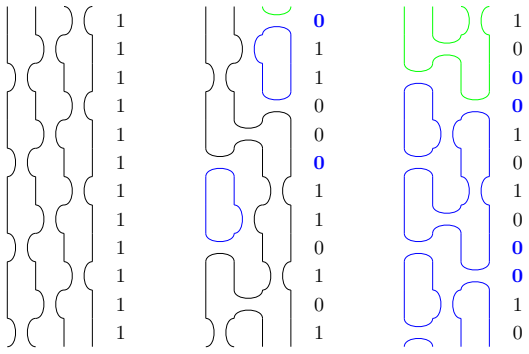
The engine is the greedy matching $M_{\mathrm{gr}}$, a maximal collection of pairwise disjoint isomorphism edges in the graph of Bar-Natan's local tangle complex after delooping (replacing each circle by two quantum-shifted summands); a matching is Morse when reversing its edges leaves no directed cycles, and then the unmatched cells form a homotopy equivalent complex. For the 4-strand torus braid $(\sigma_1\sigma_2\sigma_3)^n$, the unmatched cells are classified as formal words $W$ built from three periodic blocks $A=1^{12}$, $B=101011000110$, $C=(010001)^2$, and the maps $a_n,b_n,c_n$ duplicate the first occurrence of a block, lengthening the braid by 12 crossings. Proposition 4.4 shows these maps commute with the differentials in the appropriate grading regions, which is exactly what turns block duplication into the homology recursions of Theorem 1.1. Grading functions $t_A,t_B,t_C$ control when each block must appear, yielding the vanishing bounds needed for the induction over computer-verified base cases.
What would settle it
Run the greedy-matching algorithm on the braid $(\sigma_1\sigma_2\sigma_3)^{51}$ and compare the unmatched cells with the formal word set $W$; specifically, test Equivalence (24) for the omitted case $a \in (g_4 \circ I_B \circ g_2 \circ I_A)(\{e\})$. Any mismatch refutes $W=U$, and with it the recursion theorem, since all later arguments depend on that classification.
Extended reading notes
Core claim
The central claim is Theorem 1.1: for all $n\geq 0$ and all gradings satisfying $-2n+2i-j\geq 14$, both unreduced and reduced Khovanov homology satisfy $\mathrm{Kh}_{i,j}(T(4,-n)) \cong \mathrm{Kh}_{i,j-12}(T(4,-n-4))$ (and the reduced analogue), and for $-9n+4i-3j\geq 41$ they satisfy $\mathrm{Kh}_{i,j}(T(4,-n)) \cong \mathrm{Kh}_{i-8,j-24}(T(4,-n-4))$. Because Proposition 4.6 gives vanishing outside two explicit half-planes, these recursions cover every bidegree once $n\geq 28$, so the remaining job is a finite computer check of base cases; the paper performs it for $n=28,\ldots,82$ and thereby obtains the full integral tables. In the stable limit, the tables produce 4-torsion exactly at the bidegrees predicted by the conjecture, and over $\mathbb{F}_2$ the stable homology coincides with the Koszul-complex homology of the conjecture.
Load-bearing premise
The load-bearing premise is the classification $W=U$ of unmatched cells as formal words: the proof in Lemma 5.1 omits one case and falls back on computer verification for $n \leq 50$, so if the greedy matching produces any unmatched cell outside $W$ for some $n > 50$, the recursions and all homology tables for large $n$ would have to be revised.
Editorial extensions
If this is right
- For every negative 4-strand torus link with at least 28 crossings in the braid word, the full integral Khovanov homology table is now explicit, including free part and torsion.
- The stable Khovanov homology $\mathrm{Kh}(T(4,\infty))$ contains infinitely many $\mathbb{Z}/4\mathbb{Z}$ summands, one in each bidegree $(9+4k,14+6k)$ for $k\geq 0$.
- Over $\mathbb{F}_2$, the stable computations match the Gorsky–Oblomkov–Rasmussen conjecture in the region $i \geq 42$, $j \geq \frac{3}{2}i - 1$, giving the first verification of the conjecture for 4 strands in this range.
- A knot with at most $4n$ positive crossings cannot be changed into $T(4,2n+1)$ by a single proper rational tangle replacement; distinct odd 4-strand torus knots with $|n|,|m|\geq 5$ also require at least two such replacements.
Reading between the lines
- If the greedy matching is acyclic for every $m$-strand torus braid, the same block-duplication strategy should yield recursive descriptions for $m>4$; the missing ingredient is an analogue of the $b_n$ commutation proof.
- The paper points to a third recursion that would describe $\mathrm{Kh}_{i,j}(T(4,n))$ for all gradings and all $n$; proving it would remove the $n\geq 28$ restriction and make the whole table a closed formula.
- A small algorithmic proof for the omitted final case of Lemma 5.1 would eliminate the only computer-dependent step in the classification of unmatched cells, making the induction self-contained.
- The $\mathbb{Z}[G]$-splitting argument should transfer to any family whose reduced Khovanov homology is thin in high homological degrees, since only the top part is needed to recover the $G$-action.
Editorial analysis
A structured set of objections, weighed in public.
Referee Report
Summary. This paper develops an algorithmic discrete Morse theory for Bar-Natan's tangle complexes, with cancellations performed globally after all Morse layers are processed. The main application is to negative 4-strand torus links T(4,-n): Theorem 1.1 gives two families of recursion isomorphisms for unreduced and reduced Khovanov homology, Theorem 1.2 uses these recursions plus computer base cases for n=28,...,82 to determine integral homology tables for all n>=28, and Section 4.3 compares the stable limit with the GOR conjecture. The paper also derives a splitting of Naot's Z[G]-complex for T(4,2n+1) and, via the lambda-invariant, lower bounds of 2 on rational Gordian distances from these torus knots. The proofs rest on a combinatorial classification of the unmatched cells of the greedy matching (W=U, Lemmas 5.1-5.3) and on a detailed path-correspondence argument for the an and cn recursions (Section 6).
Significance. Assuming the combinatorial claims can be completed, this is a significant advance. It would give the first complete integral Khovanov homology for an infinite family of 4-strand torus links, exhibiting infinitely many Z/4Z summands; it confirms the GOR conjecture over F2 in a large degree range, and the rational Gordian distance bounds are new geometric applications. The methodology is original and the paper has clear strengths: the main recursions are derived from a fixed matching rather than fitted to the answer, the computer-aided steps (Lean linarith, basecases.py, Khoca) are documented, and the comparison with the GOR conjecture is against an external prediction. The central claims are specific and falsifiable. However, the completeness of the paper currently depends on several unproven or under-proven combinatorial assertions, most importantly the omitted final case in Lemma 5.1.
major comments (4)
- [Section 5, Lemma 5.1] The proof of W=U, the classification of unmatched cells, explicitly omits the final case 'showing that Equivalence 24 holds for a in (g4 o IB o g2 o IA)({e})'. This family generates exactly the B-block 101011000110 that defines the bn correspondence and is used in Lemma 5.2. Since Proposition 4.1, Proposition 4.4, and hence Theorem 1.1 all rely on W=U, this omission is load-bearing. The sentence reporting verification with braidalgo.py for n=0,...,50 does not close the gap: the induction in Theorem 1.2 proceeds from base cases n=28,...,82 to all n>=83, so the equivalence must be established for all word lengths. A complete proof of this case, or a certified exhaustive check for all n, is required.
- [Section 5, Lemma 5.2] The bound 'the longest word in W which does not contain A^2, B^2 or C^2 has length 3*23' is asserted with the justification 'by staring at the definition of W'. This is a nontrivial finiteness statement about the infinite set W and is the basis for the induction in Lemma 5.3, Lemma 4.5, and Proposition 4.1: it guarantees that every sufficiently long unmatched cell lies in the image of some gamma_*. Since the rest of the paper depends on this lemma, the assertion must be replaced by a verifiable argument, for example a regular-language or finite-state proof, or a machine-checked enumeration.
- [Section 3, Proposition 3.6] In Case II of the acyclicity proof, the statement 'By staring at the diagrams of a and x, one can conclude that isopair(y,j,k)=* ...' is not a proof. Proposition 3.6 is the result that Mgr is a Morse matching on Psi J(sigma1 sigma2 sigma3)^n K; it is used to define the complexes C_n and in the an-case of Proposition 4.4. The omitted check is finite and local, so it should either be written out explicitly or replaced by a small verified case analysis. The same comment applies to the 'straightforward evaluation of T' used in Section 6.2.2 to prove that Phi_n is well-defined.
- [Section 6.2.2, Task 2] The proof that the maps Lambda(B_{n-2}(p)) are orientation-preserving rests on the assertion that 'a straightforward evaluation of T (albeit tedious due to the number of cases)' gives T(p1, r_{2l+1}) >= 1 for all p in A_n. This inequality is the precise condition needed to apply Lemma 6.4 and Lemma 6.5, so it is load-bearing for the cn-case of Proposition 4.4. The evaluation should be presented or the cases should be mechanically checked, rather than left as an unstated computation.
minor comments (4)
- [Section 2.2, Lemma 2.2] The proof is omitted as a 'case-by-case application of relations'; since this lemma classifies all isomorphisms used by the matching algorithms, the case analysis should be included or made available in an appendix.
- [Figure 1 caption] The caption states 'For n >= 14' while Theorem 1.2 states that the results hold for n >= 28; please clarify whether the figure is valid for n >= 14 and adjust either the caption or the theorem statement accordingly.
- [Section 4.3, Proposition 4.8] The passage 'Observing Figures 1 and 17 ... one can see' should be replaced by an explicit derivation of the Z/4Z summands in Kh(T(4, infinity)), since this is the evidence for agreement with the GOR conjecture in the stable limit.
- [Section 7, Numerical Result 7.1] The exceptional braid diagram data and the exhaustive search are only available through the repository [Kel25]; please include the relevant output as supplementary material or describe the search in sufficient detail to make the numerical result reproducible.
Circularity Check
No circular reduction in the Khovanov recursion derivation; the load-bearing gap is the omitted final case of Lemma 5.1, which is a completeness risk, not a circularity.
full rationale
Score 1: essentially self-contained, non-circular derivation with two flagged caveats. The main recursions (Theorem 1.1) are derived, not fit: Proposition 4.1 defines the bijections a_n, b_n, c_n combinatorially by gamma_A, gamma_B, gamma_C (replacing the first occurrence of a fixed length-12 word by its square), and Proposition 4.4 proves differential commutation by explicit path correspondences — a graph embedding with sign bookkeeping (Lemma 6.1) for a_n, and the Phi_n surgery map with R-equivalence classes (Section 6.2) for c_n. No parameter is tuned to the target homology: the grading shifts (0,12) and (8,24) are read off from the grading effect of gamma_* in the proof of Proposition 4.1, and the inequality regions of Theorem 1.1 come from the fixed linear functions t_A, t_B, t_C. Theorem 1.2 rests on concrete base cases n = 28,...,82 computed by the external program Khoca [LL16] and checked by Python scripts, so the induction is grounded outside the paper's own machinery. The GOR comparison (Propositions 4.8 and 4.9) is against an external conjecture with its own Koszul/Poincare series; Proposition 4.8 proves the algebraic 4-torsion by a self-contained ideal-membership argument (Equation 21), and the topological side is read off from the independently computed tables. The only self-citation is Section 3, where [Kel24] supplies acyclicity of Mgr on 2- and 3-strand torus braids; the load-bearing 4-strand acyclicity is proven in-paper (Proposition 3.6), so that citation is not load-bearing. Flagged explicitly per the manuscript-review rule: Lemma 5.1's proof omits its final case — 'We omit the details of the last case: showing that Equivalence 24 holds for a in (g4 o IB o g2 o IA)({e})' — and the fallback verification (braidalgo.py) only covers n <= 50. Because Lemma 5.2, Lemma 5.3, Lemma 4.5, Lemma 6.2, and hence both recursions of Theorem 1.1 and the induction in Theorem 1.2 for n >= 83, depend on the complete equality W = U, this omission is a genuine correctness/completeness risk for the central claims; however it is not circular, since W is defined independently of U (Equation 22) and no statement reduces to its own input. That risk belongs in a correctness assessment, not in the circularity score.
Assumptions & free parameters
assumptions (3)
- domain assumption The omitted case of Lemma 5.1, classifying unmatched cells for a ∈ (g4 ◦ IB ◦ g2 ◦ IA)({e}), holds as stated.
- ad hoc to paper Lemma 5.2: the longest W-word containing no A^2, B^2 or C^2 subword has length 3·23.
- domain assumption The computer base cases for n = 28,...,82 computed by Khoca are correct.
Cite this review
Pith. "Pith review of Morse matchings and Khovanov homology of 4-strand torus links." pith.science (2026). https://pith.science/paper/ASRFQETE
@misc{pith2026250715060,
  author       = {Pith},
  title        = {Pith review of: Morse matchings and Khovanov homology of 4-strand torus links},
  year         = {2026},
  howpublished = {\url{https://pith.science/paper/ASRFQETE}},
  note         = {Machine review of arXiv:2507.15060}
}
abstract
Given a link or a tangle diagram, we define algorithmic Morse theoretic simplifications on their Khovanov homology. In contrast to Bar-Natan's scanning algorithm, the cancellations are postponed until the end and performed in one go. Although our novel approach is computationally inferior to Bar-Natan's algorithm, it side-steps the need for a large amount of iterations, making it more fitting for theoretical analysis. Our main application is towards integral Khovanov homology of 4-strand torus links, for which we compute non-trivial Khovanov homology groups in all homological degrees and find an abundance of $4$-torsion. At the limit $T(4,\infty)$, our computations agree with a conjecture of Gorsky, Oblomkov and Rasmussen. For finite $n$, we use the $\lambda$-invariant of Lewark, Marino and Zibrowius to derive lower bounds on proper rational Gordian distances from $T(4,n)$.
Figures


Figures from the paper (15 more)




Reference graph
Works this paper leans on
-
[1]
Unknotting number and Khovanov homology
[Ali19] Akram Alishahi. “Unknotting number and Khovanov homology”. English. In: Pac. J. Math. 301.1 (2019), pp. 15–29. [AD19] Akram Alishahi and Nathan Dowlin. “The Lee spectral sequence, unknotting number, and the knight move conjecture”. English. In: Topology Appl. 254 (2019), pp. 29–38. [BCD25] Aninda Banerjee, Apratim Chakraborty, and Swarup Kumar Das...
work page 2019
-
[8]
[Mal24] Leonardo Maltoni. “Reducing Rouquier complexes”. In: Proceedings of the London Math- ematical Society 129.1 (June 2024). [Man18] Andrew Manion. “The Khovanov homology of 3-strand pretzels, revisited”. In: New York Journal of Mathematics 24 (2018), pp. 1076–1100. [MO08] Ciprian Manolescu and Peter Ozsvath. On the Khovanov and knot Floer homologies ...
work page 2018
-
[10]
Morse Theory from an Algebraic Viewpoint
arXiv: 2501.11547 [math.GT]. [Sk¨ o06] Emil Sk¨ oldberg. “Morse Theory from an Algebraic Viewpoint”. In: Transactions of the American Mathematical Society 358.1 (2006), pp. 115–129. [Sto07] Marko Stoˇ si´ c. “Homological thickness and stability of torus knots”. In: Algebraic & Geometric Topology 7.1 (Mar. 2007), pp. 261–284. [Sto09] Marko Stoˇ si´ c. “Kho...
-
[2008]
On the Khovanov and knot Floer homologies of quasi-alternating links
arXiv: 0708.3249 [math.GT]. [MU21] Leonardo de Moura and Sebastian Ullrich. “The Lean 4 Theorem Prover and Program- ming Language”. In: Automated Deduction – CADE 28 . Springer International Publish- ing, 2021, pp. 625–635. [Nao06] Gad Naot. “The universal Khovanov link homology theory”. English. In: Algebr. Geom. Topol. 6 (2006), pp. 1863–1892. [ORS13] P...
work page Pith review arXiv 2006
-
[2017]
Torsion in thin regions of Khovanov homology
[Cha+22] Alex Chandler et al. “Torsion in thin regions of Khovanov homology”. In: Canadian Journal of Mathematics 74.3 (2022), pp. 630–654. [For98] Robin Forman. “Morse Theory for Cell Complexes”. In: Advances in Mathematics 134.1 (1998), pp. 90–145. [Fre+10] Michael H. Freedman et al. “Man and machine thinking about the smooth 4-dimensional Poincar´ e co...
work page 2022
-
[2019]
[ILM21] Damian Iltgen, Lukas Lewark, and Laura Marino
arXiv: 1909.00418 [math.GT]. [ILM21] Damian Iltgen, Lukas Lewark, and Laura Marino. Khovanov homology and rational un- knotting
arXiv 1909
-
[2021]
Polynomials for torus links from Chern-Simons gauge theories
arXiv: 2110.15107 [math.GT]. [ILR93] J.M. Isidro, J.M.F. Labastida, and A.V. Ramallo. “Polynomials for torus links from Chern-Simons gauge theories”. In: Nuclear Physics B 398.1 (June 1993), pp. 187–236. [Kel25] T. Kelom¨ aki. Code and data to accompany this paper. https://github.com/Stobelius/ DMT_Khovanov/. Accessed: 20.07.2025
-
[2024]
A Khovanov stable homotopy type
arXiv: 2409.05743 [math.GT]. [LS14] Robert Lipshitz and Sucharit Sarkar. “A Khovanov stable homotopy type”. In: Journal of the American Mathematical Society 27.4 (Apr. 2014), pp. 983–1042. 52 [LM25] Charles Livingston and Allison H. Moore. KnotInfo: Table of Knot Invariants . URL: knotinfo.math.indiana.edu. May
arXiv 2014
Show all 10 references
-
[2025]
Khovanov’s homology for tangles and cobordisms
arXiv: 2504.02625 [math.GT]. [Bar05] Dror Bar-Natan. “Khovanov’s homology for tangles and cobordisms.” eng. In: Geometry & Topology 9 (2005), pp. 1443–1499. [Bar06] Dror Bar-Natan. “Fast Khovanov Homology Computations”. In: Journal of Knot Theory and Its Ramifications 16 (July...
2005 arXiv
-
[2306]
A categorification of the Jones polynomial
11186 [math.GT]. [Kho00] Mikhail Khovanov. “A categorification of the Jones polynomial”. In: Duke Mathematical Journal 101.3 (2000), pp. 359–426. [Lee05] Eun Soo Lee. “An endomorphism of the Khovanov invariant”. In: Advances in Mathe- matics 197.2 (2005), pp. 554–586. [LL16] L...
2000
Reviewed August 6, 2026 · model on record in the stance chip above.
Discussion (0). Continue with ORCID to comment.