REVIEW 2 major objections 6 minor 55 references
Lecture notes on link homologies and knotted surfaces
T0 review · 2 major / 6 minor · reviewed 2026-08-06 · deepseek-v4-flash
Pith's one-line read The notes argue that link homology theories, via the maps they assign to link cobordisms, are effective invariants that distinguish knotted surfaces in 4-space.
desk verdict A useful, honest set of lecture notes on link homology cobordism maps and knotted surfaces, with one localized reproducibility gap in the self-contained Bar-Natan example. read the letter →
The pith
A machine-rendered reading of the paper's core claim, the machinery that carries it, and where it could break.
The reading
What carries the argument
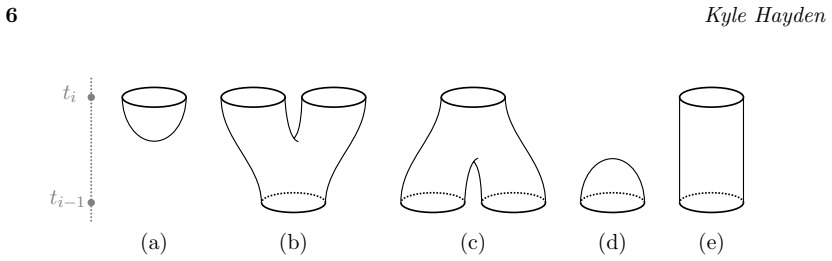
The load-bearing object is the cobordism map. For Khovanov homology it is assembled from the cube of resolutions: each link diagram gives $2^n$ smoothings, each circle is assigned the rank-two Frobenius algebra $A=R\langle 1,x\rangle$, and the elementary cobordisms---birth, merging saddle, splitting saddle, death, and Reidemeister moves---are converted into the maps $\iota$, $m$, $\Delta$, $\epsilon$, and the local cobordisms encoded in the notes' tables. For link Floer homology, the analogous maps come from counting holomorphic Whitney disks in the symmetric product $\mathrm{Sym}^g(\Sigma)$ that avoid, or intersect with multiplicity, the basepoint divisors. The Bar-Natan category, the category of formal complexes of planar tangles modulo the sphere relation, the torus relation, and the 4-tube relation, is what makes the Khovanov complex and its cobordism maps invariant: invariance under Reidemeister moves is proved by chain homotopy equivalences whose chain homotopies use exactly those local relations.
What would settle it
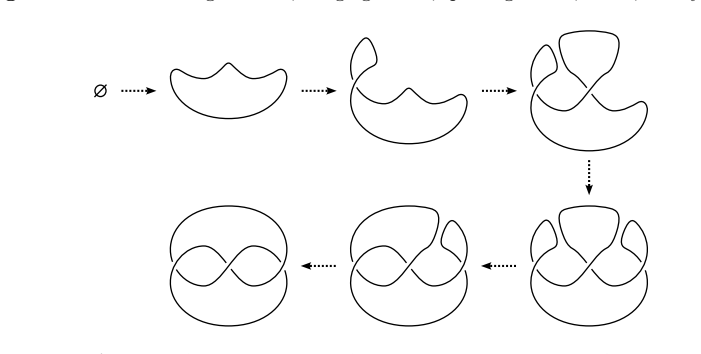
A direct chain-level calculation of the two Khovanov cobordism maps for the $9_{46}$ slice-disk pair depicted in the notes would settle the distinguishing claim: the notes state one map sends the class $\phi$ to $1$ and the other to $0$, so equal images would refute it. Independently, an explicit isotopy rel boundary between two movies of the same link cobordism whose induced Khovanov maps differ by more than a sign would falsify the central invariance theorem.
Extended reading notes
Core claim
The central claim is functoriality. A link cobordism $\Sigma \subset S^3 \times I$ between links $L_0$ and $L_1$ induces a map $\mathrm{Kh}(\Sigma): \mathrm{Kh}(L_0) \to \mathrm{Kh}(L_1)$ that is bigraded of degree $(0,\chi(\Sigma))$, well-defined up to sign, and invariant under isotopy of $\Sigma$ rel boundary; the corresponding statement for link Floer homology is that every decorated link cobordism induces a well-defined, isotopy-invariant map $\mathrm{HFL}(\Sigma)$. The notes use these maps as the organizing tool for a survey of knotted surfaces: they distinguish pairs of slice disks with the same boundary, detect exotically knotted surfaces in $B^4$, show that Seifert surfaces of equal genus need not be smoothly isotopic in the 4-ball, and bound stabilization distance. The second half of the notes builds the Khovanov side from scratch---cube of resolutions, the Frobenius algebra $A = R\langle 1,x\rangle$, merge/split/birth/death maps, and the Bar-Natan category of formal complexes modulo local relations---so that the cobordism maps can be computed explicitly.
Load-bearing premise
The whole link Floer half of the survey assumes, as a black box, that the holomorphic-curve counts defining the homology are well-defined and independent of the auxiliary choices; the notes cite rather than prove this analytic foundation.
Editorial extensions
If this is right
- Slice disks with a common boundary knot that are non-isotopic rel boundary are distinguished by their Khovanov and link Floer cobordism maps (Theorems 1.8 and 1.9).
- Exotically knotted surfaces in $B^4$ are detected: infinitely many knots bound infinitely many genus-one surfaces that are pairwise topologically isotopic but not diffeomorphic, and Khovanov homology detects such pairs in every genus (Theorems 1.10 and 1.11).
- Equal-genus Seifert surfaces for a fixed knot need not be smoothly isotopic through surfaces in $B^4$, settling a long-standing question in the negative (Theorem 1.13).
- The stabilization distance between exotically knotted slice disks can be made arbitrarily large, and Bar-Natan homology can distinguish surfaces even after one internal stabilization (Theorems 1.14 and 1.15).
- Because the maps compose functorially, composing a distinguishing pair of cobordisms with a ribbon concordance preserves the distinction, so the detection propagates to new surfaces (Exercise 3.27 and the remarks around it).
Reading between the lines
- Beyond the notes, the explicit chain-level recipes for Reidemeister and saddle maps suggest that distinguishing slice disks by Khovanov maps can be automated: one could compute the images of the two $9_{46}$ disks over $\mathbb{Z}$ with a program and turn the existence proof into a routine check.
- Beyond the notes, the invariance proof through the Bar-Natan category indicates that any Frobenius algebra satisfying the same local relations yields a functorial link homology theory, so new theories built this way would immediately come with cobordism maps.
- Beyond the notes, the link Floer stabilization-distance bounds leave open whether Khovanov or Bar-Natan maps can also force arbitrarily large stabilization distance, a question the notes do not answer.
- Beyond the notes, the mostly zero or formulaic behavior on closed surfaces suggests that the predictive power of these functors is concentrated in surfaces with boundary; designing a closed-surface invariant would require adding structure beyond the maps surveyed here.
Editorial analysis
A structured set of objections, weighed in public.
Referee Report
Summary. These lecture notes, from the 2024 Georgia Topology Summer School, survey the use of link homology theories — principally Khovanov homology and link Floer homology — as functors from the category of links and link cobordisms in S^3×I to modules, and their applications to knotted surfaces in the 4-ball. The first lecture states the functoriality theorems (Theorems 1.2 and 1.4) and surveys applications: distinguishing slice disks, detecting exotically knotted surfaces, resolving Livingston's Seifert-surface question, and lower bounds on stabilization distance. The second lecture develops Khovanov homology from the cube of resolutions and the Frobenius algebra A = R⟨1,x⟩, discusses the cobordism maps with explicit Reidemeister I and II tables, and includes many worked examples, culminating in a detailed calculation distinguishing two slice disks for the knot 9₄₆. The third lecture introduces Bar-Natan homology over F2[H] and Bar-Natan's formal-complex category, sketches the proof of Reidemeister invariance via local relations, and proves (Proposition 3.7) that a pair of slice disks for a strongly invertible knot remain distinct after one internal stabilization, using a spectral-sequence computation attributed to the program KnotJob. The notes close with the ribbon-concordance application.
Significance. As an expository contribution, these notes are valuable: the survey portions are accurate and carefully attributed, the computations in Figures 21, 23, 25 and Tables 1–2 are explicit enough to serve as worked examples, and the exercises (1.16–1.19, 2.12–2.19, 3.3–3.27) genuinely guide the reader through substantial results from the literature. The notes are unusually candid about provenance, flagging where results are quoted from refereed sources, where proofs are sketched, and where computations come from the computer program KnotJob. The load-bearing claims of the survey — functoriality of Khovanov and link Floer cobordism maps and the applications that follow — rest on cited literature and are reported faithfully. The main caveat is that the notes' own self-contained demonstration (Proposition 3.7) depends on a spectral-sequence step that is not justified in the text and on a computation that is not shipped; this is the one point that needs substantive work before the notes can serve as a fully reliable self-study reference.
major comments (2)
- [§3.1, Proposition 3.7 (proof of H·δBN ≠ 0)] The decisive claim H·δBN ≠ 0 is not established by the argument as written. The text states that 'all elements in bigrading (0,1) survive to the second page, which implies that H·δBN ≠ 0,' but survival to the E2 page does not by itself imply the nonvanishing of H·δBN: one must also know that the E∞-class corresponding to δBN is a generator of the free F2[H]-tower summand in BN^{0,1}(K) rather than a torsion class, that the spectral sequence collapses at E3 (the collapse is asserted but the d2 differential is not shown in Table 3), and that the F2[H]-module structure of BN(K) is exactly two free towers plus torsion. None of these identifications is supplied, and δBN itself is never identified among the classes counted in Table 3. Because this is the load-bearing step for Proposition 3.7 — the notes' own demonstration of the stabilization-distance phenomenon — the proof should either be completed (defining the Bar-Natan–Lee–Turner spectral sequence, stating how its E∞ term relates to the associated graded of the H-filtration, and proving the free-tower lemma) or the notes should explicitly defer the verification to [Hay23, §5.2] rather than presenting the implication as established.
- [§3.1, Table 3 and the KnotJob computation] The computation behind Table 3 is not reproducible from the notes: the KnotJob input (a machine-readable diagram of the knot K of Figure 32) and the program output are not provided, Figure 32 shows K only as a diagram, and Table 3 gives only the bigraded ranks of part of the first two pages. Consequently the assertions that 'this spectral sequence collapses on its third page' and that 'all elements in bigrading (0,1) survive to the second page' cannot be checked by a reader. Since Proposition 3.7 is advertised as illustrating the power of Bar-Natan homology, the notes should either supply the data as ancillary files or state clearly that the example is an illustration whose computational verification is deferred to the published source [Hay23, §5.2].
minor comments (6)
- [§2.1, definition of the quantum grading] The two displayed expressions defining q(α) are mutually inconsistent when n− ≠ 0: 'v+(α) − v−(α) + h(α) + n+ − n−' is not equal to 'deg(α) + h(α) + n+ + n−'; the intended quantum-grading convention should be stated correctly.
- [Example 1.5] Example 1.5 uses U for the Bar-Natan variable, while the rest of the notes (e.g., §3.1) fixes R = F2[H]; the notes should adopt a single notation for this variable or explicitly note the change of convention.
- [§1.5, machine computation] The sentence 'efficient software exists to compute the hat-flavored knot Floer homology [HFK of knots with > 100 crossings' contains an unclosed bracket, presumably a typo for '[HFK]'; the citation formatting should be fixed.
- [Table 3, caption] The caption does not state what the entries of Table 3 are; it should say that the entries are bigraded ranks over F2 and should identify which rows and columns are omitted and why those ranges suffice for the argument.
- [§3.1, proof of Proposition 3.7] In the proof sketch, the verification that φ is mapped to 1 by Kh(−D) and to 0 by Kh(−D′) is left to the reader as an exercise in the middle of a proof; a brief indication of the movie (for example, which band moves occur) would make the sketch practicable.
- [References, [Ozs06]] The citation key [Ozs06] is used in the text and in the reference list for a paper whose authors are Ozsváth and Szabó; the key should be [OS06] (or similar) for consistency with the surrounding OS citations.
Circularity Check
No circularity: the notes survey external theorems; Proposition 3.7 has a verification gap (unshipped KnotJob computation) but no definitional or fitted-input circularity.
full rationale
This is a survey/lecture-note paper with no fitted parameters, no data-fitting, and no construction that defines an output in terms of the target. The functoriality theorems (1.2, 2.7, 1.4) and all surveyed applications (1.8–1.15) are quoted from prior published work (Jacobsson, Bar-Natan, Khovanov, Morrison–Walker–Wedrich; Juhasz–Zemke; Sundberg–Swann; Juhasz–Miller–Zemke; Hayden–Sundberg; HKM+22; Guth; Hayden), and the notes do not re-derive those theorems from weaker assumptions. Heavy self-citation (Theorems 1.11, 1.13, 1.15, and examples from [HS24, Hay23, GHKP23]) is present but is not load-bearing in a circular sense: the results are external theorems with independent published proofs, and the notes merely survey them. The only internally presented 'proof' that might be questioned is Proposition 3.7, whose decisive claim H·δBN ≠ 0 is justified by an unshipped KnotJob computation and a terse spectral-sequence inference (Section 3.1, Table 3). That is a verification/completeness gap: the diagram of K, the KnotJob input, and the program output are not provided, and the statement that 'all elements in bigrading (0,1) survive to the second page' does not by itself establish H·δBN ≠ 0 without identifying δBN among the surviving classes and checking later differentials. This is not a circularity: nothing in the argument is defined in terms of the conclusion, and no fitted or computed quantity is renamed as a prediction. Under the stated rules, missing computation and omitted proof support belong to correctness risk rather than circularity, so the circularity score is 0.
Assumptions & free parameters
assumptions (6)
- domain assumption Analytic foundations of Heegaard Floer homology: holomorphic Whitney disk moduli spaces in Sym^g(Σ) admit well-defined counts (compactness, transversality) independent of complex structure and Heegaard diagram.
- domain assumption Functoriality theorems: Khovanov cobordism maps are invariant up to sign (Theorem 1.2 and Theorem 2.7) and link Floer cobordism maps are invariant for decorated cobordisms (Theorem 1.4).
- standard math Carter-Saito movie moves: any two movies of isotopic cobordisms are related by finitely many movie moves.
- domain assumption Bar-Natan's local relations (S), (T), (4Tu) define the quotient Cob3/l and make the formal complex JTK an invariant (Theorem 3.18).
- domain assumption Conway-Powell theorem: smooth, properly embedded disks in B^4 with common boundary and Z-complement are topologically isotopic rel boundary.
- ad hoc to paper Correctness of the Bar-Natan-Lee-Turner spectral sequence computation for the knot K of Figure 32, as produced by KnotJob and reported in Table 3.
Cite this review
Pith. "Pith review of Lecture notes on link homologies and knotted surfaces." pith.science (2026). https://pith.science/paper/SNDE3OVR
@misc{pith2026250715305,
  author       = {Pith},
  title        = {Pith review of: Lecture notes on link homologies and knotted surfaces},
  year         = {2026},
  howpublished = {\url{https://pith.science/paper/SNDE3OVR}},
  note         = {Machine review of arXiv:2507.15305}
}
read the original abstract
Link homology theories (such as knot Floer homology and Khovanov homology) have become indispensable tools for studying knots and links, including powerful 4-dimensional obstructions. These notes, based on lectures given at the 2024 Georgia Topology Summer School, discuss what these toolkits say about surfaces in 4-space themselves, via the homomorphisms assigned to link cobordisms. We begin with a brief overview of these theories (focusing on their shared formal properties) and survey some of their applications to knotted surfaces. Afterwards, we give an introduction to Khovanov homology (with an eye towards its cobordism maps), discuss hands-on computational techniques for Khovanov and Bar-Natan homology, and outline the role of the Bar-Natan category in this story.
Figures


Figures from the paper (34 more)



Reference graph
Works this paper leans on
-
[1]
" write newline "" before.all 'output.state := FUNCTION fin.entry.original add.period write newline FUNCTION new.block output.state before.all = 'skip after.block 'output.state := if FUNCTION new.sentence output.state after.block = 'skip output.state before.all = 'skip after.sentence 'output.state := if if FUNCTION not #0 #1 if FUNCTION and 'skip pop #0 i...
-
[2]
Alishahi , https://doi.org/10.2140/pjm.2019.301.15 Unknotting number and K hovanov homology , Pacific J. Math., 301(1):15--29, 2019
-
[3]
Bar-Natan , https://doi.org/10.2140/gt.2005.9.1443 Khovanov's homology for tangles and cobordisms , Geom. Topol., 9:1443--1499, 2005
-
[4]
Bar-Natan , Fast K hovanov homology computations , Journal of Knot Theory and Its Ramifications, 16(03):243--255, 2007
work page 2007
-
[5]
Baykur, Sunukjian , Knotted surfaces in 4-manifolds and stabilizations , Journal of Topology, 9(1):215--231, 2016
work page 2016
-
[6]
Culler, Dunfield, Goerner, Weeks , Snap P y, a computer program for studying the geometry and topology of 3 -manifolds , Available at http://snappy.computop.org
-
[7]
Conway, Powell , Characterisation of homotopy ribbon discs , Advances in Mathematics, 391:107960, 2021
work page 2021
-
[8]
Conway, Powell , https://doi.org/10.2140/gt.2023.27.739 Embedded surfaces with infinite cyclic knot group , Geom. Topol., 27(2):739--821, 2023
Show all 55 references
-
[9]
Carter, Saito , https://doi.org/10.1090/surv/055 Knotted surfaces and their diagrams , volume 55 of Mathematical Surveys and Monographs , American Mathematical Society, Providence, RI, 1998
1998 doi
-
[10]
Dai, Mallick, Stoffregen , Equivariant knots and knot F loer homology , Journal of Topology, 16(3):1167--1236, 2023
2023
-
[11]
Elliott , State cycles, quasipositive modification, and constructing H -thick knots in K hovanov homology , PhD thesis, Rice University, 2010, Proquest LLC, Ann Arbor, MI, 2010
2010
-
[12]
V., Amsterdam, 2005
Etnyre , Legendrian and transversal knots , In Handbook of knot theory , pages 105--185, Elsevier B. V., Amsterdam, 2005
2005
-
[13]
Floer , Morse theory for L agrangian intersections , J. Diff. Geom., 28:513--547, 1988
1988
-
[14]
Fox , https://doi.org/10.1090/S0002-9904-1966-11467-2 Rolling , Bull. Amer. Math. Soc., 72:162--164, 1966
1966 doi
-
[15]
Fintushel, Stern , https://doi.org/10.4310/MRL.1997.v4.n6.a10 Surfaces in 4 -manifolds , Math. Res. Lett., 4(6):907--914, 1997
1997 doi
-
[16]
Guth, Hayden, Kang, Park , http://arxiv.org/abs/2310.19713 Doubled disks and satellite surfaces , Preprint, arxiv:2310.19713, 2023
2023 arXiv
-
[17]
Greene , https://doi.org/10.1090/noti2194 Heegaard F loer homology , Notices Amer. Math. Soc., 68(1):19--33, 2021
2021 doi
-
[18]
Guth , For exotic surfaces with boundary, one stabilization is not enough , J. Eur. Math. Soc. (DOI 10.4171/JEMS/1541), arXiv:2207.11847, 2024
2024 arXiv
-
[19]
Hayden , Corks, covers, and complex curves , arXiv:2107.06856, 2021
2021 arXiv
- [20]
-
[21]
Hayden, Kim, Miller, Park, Sundberg , Seifert surfaces in the 4-ball , J. Eur. Math. Soc. (to appear), arxiv:2205.15283, 2022
2022 arXiv
-
[22]
Hayden, Sundberg , Khovanov homology and exotic surfaces in the 4-ball , Journal f \"u r die reine und angewandte Mathematik (Crelles Journal), 2024(809):217--246, 2024
2024
-
[23]
Jacobsson , https://doi.org/10.2140/agt.2004.4.1211 An invariant of link cobordisms from K hovanov homology , Algebr. Geom. Topol., 4:1211--1251, 2004
2004 doi
-
[24]
Topol., 25(6):2963--3012, 2021
Juh\' a sz, Miller, Zemke , Transverse invariants and exotic surfaces in the 4-ball , Geom. Topol., 25(6):2963--3012, 2021
2021
-
[25]
Juh \'a sz, Zemke , Distinguishing slice disks using knot F loer homology , Selecta Mathematica, 26:1--18, 2020
2020
-
[26]
Topol., 17(2):Paper No
Juh\'asz, Zemke , https://doi.org/10.1112/topo.12338 Stabilization distance bounds from link F loer homology , J. Topol., 17(2):Paper No. e12338, 112, 2024
2024 doi
-
[27]
Kang , Link homology theories and ribbon concordances , Quantum Topology, 13(1):183--205, 2022
2022
-
[28]
Kauffman , https://doi.org/10.1016/0040-9383(87)90009-7 State models and the J ones polynomial , Topology, 26(3):395--407, 1987
1987 doi
-
[29]
J., 101(3):359--426, 2000
Khovanov , https://doi.org/10.1215/S0012-7094-00-10131-7 A categorification of the J ones polynomial , Duke Math. J., 101(3):359--426, 2000
-
[30]
Khovanov , http://www.jstor.org/stable/3845459 An invariant of tangle cobordisms , Trans. Amer. Math. Soc., 358(1):315--327, 2006
2006
- [31]
-
[32]
Math., 197(2):554--586, 2005
Lee , An endomorphism of the K hovanov invariant , Adv. Math., 197(2):554--586, 2005
2005
-
[33]
Litherland , https://doi.org/10.2307/1998993 Deforming twist-spun knots , Trans. Amer. Math. Soc., 250:311--331, 1979
1979 doi
-
[34]
J., 29(3):289--298, 1982
Livingston , http://projecteuclid.org/euclid.mmj/1029002727 Surfaces bounding the unlink , Michigan Math. J., 29(3):289--298, 1982
1982
-
[35]
Lipshitz, Sarkar , https://doi.org/10.1090/tran/8736 A mixed invariant of nonorientable surfaces in equivariant K hovanov homology , Trans. Amer. Math. Soc., 375(12):8807--8849, 2022
2022 doi
-
[36]
Levine, Zemke , Khovanov homology and ribbon concordances , Bull. Lond. Math. Soc., 51(6):1099--1103, 2019
2019
-
[37]
Morrison , Bar-natan's local K hovanov homology , https://tqft.net/math/Bar-NatanLocalHomology_Slides.pdf, June 2005
2005
-
[38]
Morrison , Delooping , https://tqft.net/math/Delooping_Slides.pdf, September 2005
2005
-
[39]
Topol., 26(8):3367--3420, 2022
Morrison, Walker, Wedrich , Invariants of 4-manifolds from K hovanov- R ozansky link homology , Geom. Topol., 26(8):3367--3420, 2022
2022
-
[40]
Math., 186(1):58--116, 2004
Ozsv\' a th, Szab\' o , https://doi.org/10.1016/j.aim.2003.05.001 Holomorphic disks and knot invariants , Adv. Math., 186(1):58--116, 2004
2003 doi
-
[41]
Ozsv \'a th, Szab \'o , https://doi.org/10.4007/annals.2004.159.1027 Holomorphic disks and topological invariants for closed three-manifolds , Ann. of Math. (2), 159(3):1027--1158, 2004
2004 doi
-
[42]
Ozsv \'a th, Peter and Szab \'o , Zolt \'a n , Holomorphic triangles and invariants for smooth four-manifolds , Adv. Math. , 202 ( 2 ): 326--400 , 2006
2006
-
[43]
okova G eometry- T opology C onference 2007 , pages 15--35, G\
Perutz , Hamiltonian handleslides for H eegaard F loer homology , In Proceedings of G \"okova G eometry- T opology C onference 2007 , pages 15--35, G\"okova Geometry/Topology Conference (GGT), G\"okova, 2008
2007
-
[44]
Plamenevskaya , Transverse knots and K hovanov homology , Math. Res. Lett., 13(4):571--586, 2006
2006
-
[45]
Rasmussen , Floer homology and knot complements , PhD thesis, Harvard University, arXiv preprint math/0306378, 2003
2003 arXiv
-
[46]
Rasmussen , Khovanov's invariant for closed surfaces , Unpublished note; arXiv:0502527, 2005
2005
-
[47]
Rasmussen , Khovanov homology and the slice genus , Inventiones mathematicae, 182(2):419--447, 2010
2010
-
[48]
Sch\" u tz , K not J ob , Available at https://www.maths.dur.ac.uk/users/dirk.schuetz/knotjob.html, 2023
2023
-
[49]
Sundberg, Swann , Relative K hovanov-- J acobsson classes , Algebraic & Geometric Topology, 22(8):3983--4008, 2023
2023
-
[50]
Sundberg , Khcob , https://github.com/imsundberg/imsundberg.github.io, 2023
2023
-
[51]
Szab \'o , K not F loer homology calculator , Available at https://web.math.princeton.edu/ szabo/HFKcalc.html, 2019
2019
-
[52]
Tanaka , Khovanov- J acobsson numbers and invariants of surface-knots derived from B ar- N atan's theory , Proceedings of the American Mathematical Society, 134(12):3685--3689, 2006
2006
-
[53]
Zemke , https://doi.org/10.4007/annals.2019.190.3.5 Knot F loer homology obstructs ribbon concordance , Ann. of Math. (2), 190(3):931--947, 2019
2019 doi
-
[54]
Zemke , https://doi.org/10.4171/QT/124 Link cobordisms and absolute gradings on link F loer homology , Quantum Topol., 10(2):207--323, 2019
2019 doi
-
[55]
Zhang , http://arxiv.org/abs/2501.03115 Notes on K hovanov homology , Preprint, arXiv:2501.03115, 2025
2025 arXiv
Reviewed August 6, 2026 · model on record in the stance chip above.
Discussion (0). Continue with ORCID to comment.