REVIEW 3 major objections 5 minor 34 references
Drafting the Landscape of Computational Musicology Tools: a Survey-Based Approach
T0 review · 3 major / 5 minor · reviewed 2026-08-06 · deepseek-v4-flash
Pith's one-line read A survey of 51 practitioners across four music data modalities finds that limited functionality, integration difficulties, and poor documentation are the most consistent unmet needs in computational musicology tools.
desk verdict A useful but modest descriptive survey of computational musicology tool users; the headline 'significant gaps' overstates what a 51-person convenience sample can support, but the data and transparency make it worth engaging. read the letter →
The pith
A machine-rendered reading of the paper's core claim, the machinery that carries it, and where it could break.
The reading
What carries the argument
The carrying object is the survey instrument itself: a structured online questionnaire that combines demographic questions (role, field, experience, programming proficiency, usage frequency), modality-specific questions (common tasks, tools used, satisfaction, disliked aspects, corpus size, missing features), and cross-cutting questions (support channels, tool-selection criteria, integration difficulties). A modality here is a data representation of music: symbolic notation, audio signal, image, or text. The analysis turns these self-reports into per-modality frequency patterns, co-occurrence counts between tasks and tools, and concern rankings, which are the evidence for the claimed gaps.
What would settle it
A replication survey with a larger, more geographically diverse sample that finds different leading concerns (for example, cost or speed instead of limited functionality) or satisfaction averages above 4 on the same 5-point scale would refute the paper's generalization about the field.
Extended reading notes
Core claim
The paper's central claim is that the current landscape of computational musicology tools is misaligned with practitioners' actual workflows. Based on 51 valid responses, it reports that limited functionality, integration difficulties, and poor documentation are the dominant unmet needs across symbolic, audio, image, and text modalities; that satisfaction averages between 3.31 and 3.45 on a 5-point scale; that medium-sized collections (100–1,000 items) dominate research practice; and that nearly half of respondents report cross-modal integration difficulties. The paper presents this as the first systematic investigation of practical needs in computational musicology and as quantitative support for a long-observed communication gap between musicologists and software developers.
Load-bearing premise
The 51 people who answered the survey are treated as standing in for the whole field of computational musicology, even though they were recruited from the authors' own contacts and academic mailing lists and the paper admits this may skew toward established Western researchers.
Editorial extensions
If this is right
- If the reported gaps are real, the highest-leverage development targets are adding missing functionality, smoothing tool-to-tool integration, and improving documentation, in that order of reported importance.
- Because over 85% of respondents work with more than one modality and nearly half report integration difficulties, tools that treat modalities in isolation will continue to fall short of researchers' needs.
- The prevalence of small and medium collections (100–1,000 items) means deep-learning-heavy tools will not automatically transfer to musicological research without strategies for scarce data.
- The clear GUI preference among musicologists, set against the library and command-line focus of developers, implies that visual, interactive tools are a necessary complement to programmatic ones rather than a nice-to-have.
Reading between the lines
- Beyond the paper: pairing the self-reported gaps with behavioral traces from issue trackers of widely used tools could test whether 'limited functionality' means genuinely missing features or mostly discoverability and training problems.
- Beyond the paper: a standing, recurring version of this survey would turn the one-shot snapshot into a longitudinal signal that tool maintainers could use to track whether the reported gaps close over time.
- Beyond the paper: qualitative interviews with the minority of respondents who report satisfaction at 4 or 5 could reveal which workflows are already well served and which tool-design patterns deserve replication.
Signed reviews
Editorial analysis
A structured set of objections, weighed in public.
Referee Report
Summary. The paper presents a survey-based study of computational musicology (CM) practitioners, reporting on tool usage patterns, common analytical tasks, satisfaction levels, data characteristics, and prioritized features across four data modalities: symbolic music, audio, images, and text. Based on 51 valid responses, it identifies limited functionality, integration difficulties, and poor documentation as the most common complaints, and derives recommendations for tool development, interoperability, and GUI accessibility. The authors acknowledge the convenience sample and its potential biases, but frame the findings as revealing significant gaps between current tooling capabilities and user needs.
Significance. If the findings are robust, the paper offers a valuable, community-facing evidence base for tool developers in a field where user needs are often inferred anecdotally. Its strengths include a clear survey instrument covering multiple modalities, explicit attention to tasks, tools, and satisfaction, and a transparent discussion of sample limitations. The study is one of few attempts to systematically collect practitioner-level data on CM tooling, and the descriptive summaries could inform funding and development priorities. However, the central claim of 'significant gaps' currently rests on incompletely reported evidence, most notably the omission of the survey's open-ended gap question and ambiguous denominator definitions in the headline figures.
major comments (3)
- [Section 3.2 / Section 4 / Figure 6] The open-ended question 'List tasks for which you lack adequate tools. What specific features are missing or need improvement?' is the most direct evidence for the paper's central claim of gaps between capabilities and user needs, yet Section 4 never reports or analyzes these responses. The headline finding that 'limited functionality' is the consistent primary concern across modalities (Fig. 6) rests instead on a closed-ended checkbox from 'What do you not like about them?' This is an indirect measure that does not capture the specifics of missing features or tasks. The authors should either report a thematic analysis of the open-ended answers or substantially qualify the gap claim as based on complaint categories rather than user-described unmet needs.
- [Figure 6 / Figure 7] The denominators used to compute the percentages in Figures 6 and 7 are not defined in the text. For Figure 6, it is unclear whether percentages are over participants, tool mentions, or issue-tool pairs; since respondents could name up to five tools per modality and could select multiple issues, the relative rankings (e.g., limited functionality vs. difficult installation) may be an artifact of the response format. In addition, per-modality respondent counts are not reported, so the claim that the pattern is 'consistent across all modalities' is fragile given that only 51 total responses are spread over four modalities, with image and text likely having much smaller N. Please provide the denominator definitions and per-modality sample sizes.
- [Section 5] The statement 'over 85% of surveyed users engage with multiple modalities in their research workflows' appears without any supporting statistic in Section 4. No figure or table in the results reports this percentage, so the claim cannot be verified from the presented data. This number is used to motivate the 'Towards Integrated Music Analysis' discussion, so it should be either added to the results with a clear computation or removed.
minor comments (5)
- [Section 3.1] The list of programming proficiency options has a formatting issue: 'None / Very Basic (e.g., only using GUIs; Basic: Using existing scripts/tools...' appears to be missing a closing parenthesis or semicolon after 'GUIs'. Please correct the typography.
- [Figure 4] The caption 'Corpora size' does not explain what the bars represent; please add axis labels (e.g., percentage of respondents) and specify which modality each group corresponds to.
- [Section 5] The paper describes itself as 'the first systematic investigation of the practical needs of CM practitioners,' but reference [12] (Inskip and Wiering, 2015) already surveyed musicologists' attitudes toward technology. Please soften the novelty claim to acknowledge prior related surveys and specify what is new (e.g., focus on tool functionality across modalities).
- [Section 1] The phrase 'joint to the advent of personal computing technology' should be 'coupled with the advent of personal computing technology'.
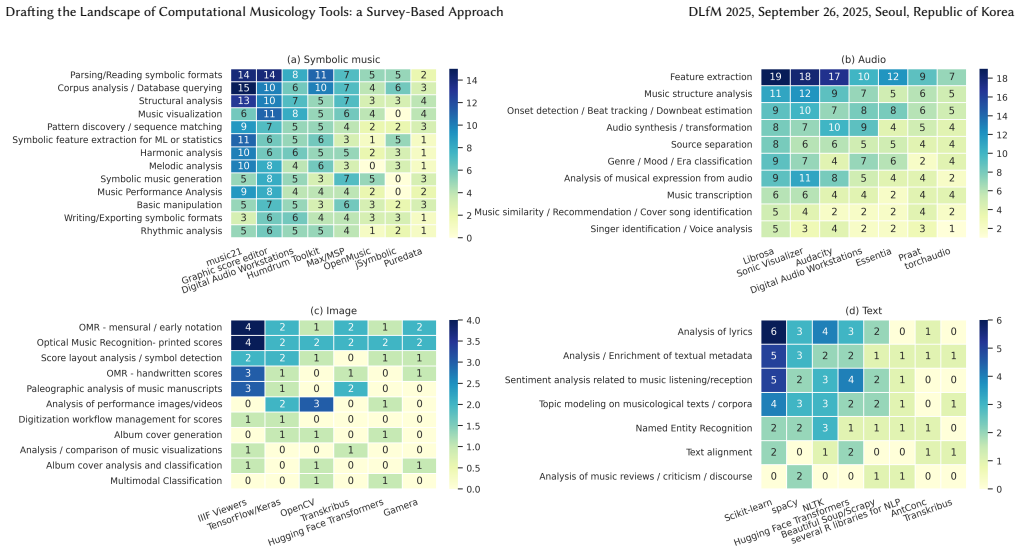
- [Captions of Figures 2 and 3] The 'top 80%' and 'top 75%' filtering is mentioned only in the captions; please explain in the text how the filtering was performed and whether the excluded values affect any conclusions.
Circularity Check
No meaningful circularity: the survey findings are descriptive aggregations of participant responses, and self-citations are contextual rather than load-bearing.
full rationale
The paper makes no derived 'predictions' or fitted parameters; it reports counts, percentages, means, and co-occurrences from survey responses. The central claims about limited functionality, integration difficulties, and poor documentation are direct summaries of closed-ended and open-ended responses, not outputs of a model trained on those responses. Self-citations (e.g., Musif [18,30], OMR active learning [27], multimodal survey [31], systematic composer-ID survey [28]) appear in related work and discussion as context or as pointers to tools and prior studies; none of these citations is invoked as proof of the survey findings, nor does any uniqueness theorem or ansatz depend on them. The paper explicitly acknowledges sample limitations in Section 5, noting that the sample 'may not fully capture the global perspectives' and that distribution 'may introduce a bias,' which is a validity caveat, not a circularity issue. The skeptic's concerns about unspecified denominators in Figure 6 and unreported open-ended gap data are internal-validity or reporting weaknesses, not circularity: the claim is not equivalent to its input by construction. No circular step can be exhibited, and the score reflects only the presence of numerous self-citations that are not load-bearing.
Assumptions & free parameters
assumptions (3)
- domain assumption Self-reported survey responses accurately reflect actual tool usage and satisfaction.
- domain assumption The 51 retained respondents are sufficiently representative of the computational musicology community for cross-modality generalizations.
- ad hoc to paper Standard descriptive statistics suffice to identify 'significant gaps'.
Cite this review
Pith. "Pith review of Drafting the Landscape of Computational Musicology Tools: a Survey-Based Approach." pith.science (2026). https://pith.science/paper/LYSIQCT3
@misc{pith2026250715590,
  author       = {Pith},
  title        = {Pith review of: Drafting the Landscape of Computational Musicology Tools: a Survey-Based Approach},
  year         = {2026},
  howpublished = {\url{https://pith.science/paper/LYSIQCT3}},
  note         = {Machine review of arXiv:2507.15590}
}
read the original abstract
Since the 60s, musicology has been increasingly impacted by computational tools in various ways, from systematic analysis approaches to modeling of creativity. This article presents a comprehensive assessment of the current state of Computational Musicology tools based on survey data collected from practitioners in the field. We gathered information on tool usage patterns, common analytical tasks, user satisfaction levels, data characteristics, and prioritized features across four distinct domains: symbolic music, music-related imagery, audio, and text. Our findings reveal significant gaps between current tooling capabilities and user needs, highlighting some limitations of these tools across all domains. This assessment contributes to the ongoing dialogue between tool developers and music scholars, aiming to enhance the effectiveness and accessibility of computational methods in musicological research.
Figures


Figures from the paper (5 more)


Reference graph
Works this paper leans on
-
[1]
Carlos Agon. 1998. OpenMusic: Un langage visuel pour la composition musicale assistée par ordinateur. Ph. D. Dissertation. Paris 6
work page 1998
-
[2]
Christopher Ariza. 2008. The Interdisciplinary Future of Music Informatics. Computer Music Journal 32, 3 (2008), 66–70
work page 2008
-
[3]
Gary Berlind, Barry S Brook, Lejaren A Hiller, Jan P LaRue, and George W Logemann. 1966. Addendum: Writings on the Use of Computers in Music. In College Music Symposium. JSTOR, 143–157
work page 1966
-
[4]
Rachel M Bittner, Magdalena Fuentes, David Rubinstein, Andreas Jansson, Ke- unwoo Choi, and Thor Kell. 2019. mirdata: Software for Reproducible Usage of Datasets.. In ISMIR. 99–106
work page 2019
-
[5]
Dmitry Bogdanov, Nicolas Wack, Emilia Gómez, Sankalp Gulati, Perfecto Herrera, Oscar Mayor, Gerard Roma, Justin Salamon, José Zapata, and Xavier Serra. 2013. Essentia: an open-source library for sound and music analysis. In Proceedings of the 21st ACM international conference on Multimedia . 855–858
work page 2013
-
[6]
Lee Cheng and Samuel Leong. 2017. Educational affordances and learning design in music software development. Technology, Pedagogy and Education 26, 4 (2017), 395–407
work page 2017
-
[7]
Nicholas Cook. 2004. Computational and Comparative Musicology . Oxford University Press, New York, Chapter 6. doi:10.1093/acprof:oso/9780195167498. 003.0006 online edn, Oxford Academic, 1 May 2008, accessed 16 May 2025
arXiv 2004
-
[8]
Michael Scott Cuthbert and Christopher Ariza. 2010. music21: A toolkit for computer-aided musicology and symbolic music data. (2010)
work page 2010
Show all 34 references
-
[9]
Johanna Devaney, Daniel McKemie, and Alex Morgan. 2024. pyAMPACT: A Score-Audio Alignment Toolkit for Performance Data Estimation and Multi- modal Processing. In International Society for Music Information Retrieval, Late Breaking Demo
2024
-
[10]
Walter B Hewlett and Eleanor Selfridge-Field. 1991. Computing in musicology, 1966–91. Computers and the Humanities 25 (1991), 381–392
1991
-
[11]
David Huron. 2002. Music information processing using the Humdrum toolkit: Concepts, examples, and lessons. Computer Music Journal 26, 2 (2002), 11–26
2002
-
[12]
Charles Inskip and Frans Wiering. 2015. In their own words: using text analysis to identify musicologists’ attitudes towards technology. In 16th International Society for Music Information Retrieval Conference
2015
-
[13]
Andres Karjus. 2025. Machine-assisted quantitizing designs: augmenting hu- manities and social sciences with artificial intelligence. Humanities and Social Sciences Communications 12, 1 (2025), 1–18
2025
-
[14]
Emmanouil Karystinaios and Gerhard Widmer. 2024. Graphmuse: A library for symbolic music graph processing. arXiv preprint arXiv:2407.12671 (2024)
2024 arXiv
-
[15]
Jan LaRue. 1970. Some Computer Aids to Musicology. (1970)
1970
-
[16]
Weigl, Joanna Bullivant, and Kevin R
David Lewis, David M. Weigl, Joanna Bullivant, and Kevin R. Page. 2018. Publish- ing musicology using multimedia digital libraries: creating interactive articles through a framework for linked data and MEI (DLfM ’18). Association for Com- puting Machinery, New York, NY, USA, 2...
2018
-
[17]
Harry B Lincoln. 1970. The current state of music research and the computer. Computers and the Humanities 5, 1 (1970), 29–36
1970
-
[18]
Ana Llorens, Federico Simonetta, Martín Serrano, and Álvaro Torrente. 2023. Musif: A Python Package for Symbolic Music Feature Extraction. In Proceedings of the Sound and Music Computing Conference . Stockholm, Sweden. doi:10.5281/ zenodo.8341211
2023
-
[19]
Luca Andrea Ludovico, Adriano Baratè, Federico Simonetta, and Davide An- drea Mauro. 2019. On the Adoption of Standard Encoding Formats to En- sure Interoperability of Music Digital Archives: The IEEE 1599 Format. In 6th International Conference on Digital Libraries for Musico...
2019
-
[20]
Brian McFee, Colin Raffel, Dawen Liang, Daniel PW Ellis, Matt McVicar, Eric Battenberg, and Oriol Nieto. 2015. librosa: Audio and music signal analysis in python. SciPy 2015 (2015), 18–24
2015
-
[21]
Cory McKay, Julie Cumming, and Ichiro Fujinaga. 2018. JSYMBOLIC 2.2: Extract- ing Features from Symbolic Music for use in Musicological and MIR Research.. In ISMIR. 348–354. DLfM 2025, September 26, 2025, Seoul, Republic of Korea Morgado et al
2018
-
[22]
Aliaksei Miniukovich, Simone Sulpizio, and Antonella De Angeli. 2018. Visual complexity of graphical user interfaces. In Proceedings of the 2018 international conference on advanced visual interfaces . 1–9
2018
-
[23]
Maria Panteli, Emmanouil Benetos, and Simon Dixon. 2018. A review of manual and computational approaches for the study of world music corpora. Journal of New Music Research 47, 2 (2018), 176–189
2018
-
[24]
Pearce and Geraint A
Marcus T. Pearce and Geraint A. Wiggins. 2012. Auditory Expectation: The Information Dynamics of Music Perception and Cognition. Topics in Cognitive Science 4, 4 (2012), 625–652
2012
-
[25]
Miller Puckette et al. 1996. Pure data: another integrated computer music envi- ronment. Proceedings of the second intercollege computer music concerts (1996), 37–41
1996
-
[26]
Michael Rector. 2018. Sonic Visualizer: A Tool For Closer Listening. American Music Teacher 67, 5 (2018), 21–23
2018
-
[27]
Sachin Sharma and Federico Simonetta. 2025. Experimenting Active and Sequen- tial Learning in a Medieval Music Manuscript. In 2025 IEEE 35th International Workshop on Machine Learning for Signal Processing (MLSP)
2025
-
[28]
Federico Simonetta. 2025. Style-Based Composer Identification and Attribution of Symbolic Music Scores: A Systematic Survey. Transactions of the International Society for Music Information Retrieval (2025). doi:10.48550/arXiv.2506.12440
2025 doi
-
[29]
Federico Simonetta, Federico Avanzini, and Stavros Ntalampiras. 2022. A Percep- tual Measure for Evaluating the Resynthesis of Automatic Music Transcriptions. Multimedia Tools and Applications (2022). doi:10.1007/s11042-022-12476-0
2022 doi
-
[30]
Federico Simonetta, Ana Llorens, Martín Serrano, Eduardo García-Portugués, and Álvaro Torrente. 2023. Optimizing Feature Extraction for Symbolic Music. In Proceedings of the 24th International Society for Music Information Retrieval Conference. Milan. doi:10.5281/zenodo.10265409
2023 doi
-
[31]
Federico Simonetta, Stavros Ntalampiras, and Federico Avanzini. 2019. Multi- modal Music Information Processing and Retrieval: Survey and Future Challenges. In Proceedings of 2019 International Workshop on Multilayer Music Representa- tion and Processing . IEEE Conference Publ...
2019
-
[32]
Bob L. T. Sturm. 2014. A Simple Method to Determine if a Music Information Retrieval System is a “Horse. ”. IEEE Transactions on Multimedia 16, 6 (2014), 1636–1644
2014
-
[33]
Anja Volk and Aline Honingh. 2012. Mathematical and computational approaches to music: challenges in an interdisciplinary enterprise. Journal of Mathematics and Music 6, 2 (2012), 73–81
2012
-
[34]
Yao-Yuan Yang, Moto Hira, Zhaoheng Ni, Artyom Astafurov, Caroline Chen, Christian Puhrsch, David Pollack, Dmitriy Genzel, Donny Greenberg, Edward Z Yang, et al. 2022. Torchaudio: Building blocks for audio and speech processing. In ICASSP 2022-2022 IEEE International Conference...
2022
Reviewed August 6, 2026 · model on record in the stance chip above.
Discussion (0). Continue with ORCID to comment.