Wave-induced drift in third-order deep-water theory
Pith reviewed 2026-05-19 03:54 UTC · model grok-4.3
The pith
Classical Stokes drift underestimates surface particle motion and overestimates it at depth in third-order wave theory.
A machine-rendered reading of the paper's core claim, the machinery that carries it, and where it could break.
Core claim
In third-order deep-water wave theory the classical Stokes drift formulation provides a slight underestimate of the drift at the surface and a slight overestimate at depth. Incorporating difference harmonic terms into the formulation yields an improved agreement with the drift obtained from nonlinear wave theories, particularly at greater depth. Numerical integration of particle trajectory mappings computed via the reduced Hamiltonian formulation confirms this for sea states with one, two, and several harmonics, as well as for parametric wave spectra.
What carries the argument
Reduced Hamiltonian formulation that isolates bound harmonics and mutual frequency corrections up to third order, enabling direct comparison of Stokes drift expressions to integrated particle trajectories.
If this is right
- For regular waves the adjusted drift expression matches trajectory integrations better than the classical form.
- For irregular waves and parametric spectra the inclusion of difference harmonics changes drift estimates especially at greater depth.
- Accurate drift predictions improve modeling of wave-driven transport of floating objects or pollutants.
Where Pith is reading between the lines
- Revised drift formulas may alter estimates of wave-induced surface currents used in large-scale ocean models.
- The same harmonic corrections could be tested in shallow-water or directional wave settings to check generality.
- Lagrangian particle tracking in wave models may need to incorporate difference-frequency terms for better long-term transport forecasts.
Load-bearing premise
The reduced Hamiltonian formulation correctly isolates bound-harmonic and frequency-correction contributions up to third order so that numerical trajectory results can be compared directly to the Stokes drift expression.
What would settle it
Compute particle trajectories from a fully nonlinear wave simulation at third order or higher and check whether the version of the drift formula that includes difference harmonics matches the integrated paths more closely than the classical Stokes expression at depths below the surface.
Figures




read the original abstract
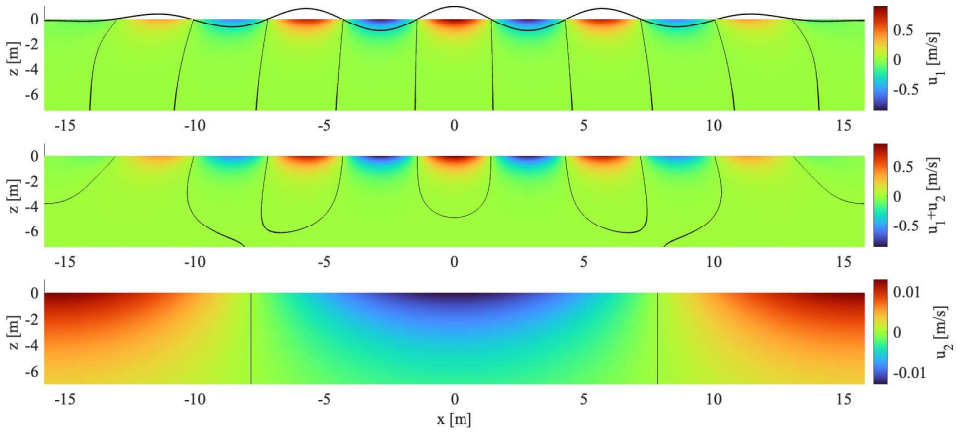
The goal of this work is to investigate particle motions beneath unidirectional, deep-water waves up to the third-order in nonlinearity. A particular focus is on the approximation known as Stokes drift, and how it relates to the particle kinematics as computed directly from the particle trajectory mapping. The reduced Hamiltonian formulation of Zakharov and Krasitskii serves as a convenient tool to separate the effects of weak nonlinearity, in particular the appearance of bound harmonics and the mutual corrections to the wave frequencies. By numerical integration of the particle trajectory mappings we are able to compute motions and resulting drift for sea-states with one, two and several harmonics. We find that the classical Stokes drift formulation provides a slight underestimate of the drift at the surface, and a slight overestimate at depth. Incorporating difference harmonic terms into the formulation yields an improved agreement with the drift obtained from nonlinear wave theories, particularly at greater depth. The consequences of this are explored for regular and irregular waves, as well as parametric wave spectra.
Editorial analysis
A structured set of objections, weighed in public.
Referee Report
Summary. The paper investigates particle motions and wave-induced drift beneath unidirectional deep-water waves up to third order in nonlinearity. Using the reduced Hamiltonian formulation of Zakharov and Krasitskii to isolate bound harmonics and frequency corrections, the authors numerically integrate particle trajectories for sea states with one, two, and multiple harmonics. They report that the classical Stokes drift slightly underestimates drift at the surface and overestimates it at depth, with inclusion of difference-harmonic terms improving agreement particularly at greater depths. The analysis extends to regular waves, irregular waves, and parametric spectra.
Significance. If the central comparison holds, the work provides a useful refinement to Lagrangian drift approximations in nonlinear wave theory by demonstrating the role of difference harmonics. The Hamiltonian separation of effects is a methodological strength that enables clear attribution of corrections. The extension to irregular waves and spectra adds practical relevance for ocean transport modeling.
major comments (1)
- [Numerical integration procedure and velocity reconstruction] The central comparison between integrated trajectories and the modified Stokes-drift expression requires that the interior velocity field used for dx/dt = ∇ϕ be reconstructed to exactly the same third-order truncation as the surface elevation and frequency corrections from the Zakharov-Krasitskii Hamiltonian. The manuscript does not explicitly verify that all O(ε³) contributions arising from the Dirichlet-Neumann operator expansion are retained in the vertical structure of the potential; omission of such terms would systematically alter the mean Lagrangian drift, especially at depth where bound-wave decay rates differ from the linear term.
minor comments (2)
- [Stokes-drift modification] Clarify the precise definition and truncation order of the difference-harmonic terms added to the Stokes-drift expression; a short appendix deriving these terms from the same Hamiltonian would strengthen the comparison.
- [Figures] Figure captions for the depth-dependent drift profiles should state the exact number of harmonics and the steepness values used in each panel to facilitate direct reproduction.
Simulated Author's Rebuttal
We thank the referee for their careful reading and constructive comment on the consistency of our third-order formulation. We address the point below and indicate the planned revision.
read point-by-point responses
-
Referee: [Numerical integration procedure and velocity reconstruction] The central comparison between integrated trajectories and the modified Stokes-drift expression requires that the interior velocity field used for dx/dt = ∇ϕ be reconstructed to exactly the same third-order truncation as the surface elevation and frequency corrections from the Zakharov-Krasitskii Hamiltonian. The manuscript does not explicitly verify that all O(ε³) contributions arising from the Dirichlet-Neumann operator expansion are retained in the vertical structure of the potential; omission of such terms would systematically alter the mean Lagrangian drift, especially at depth where bound-wave decay rates differ from the linear term.
Authors: We agree that exact consistency of truncation between the surface variables and the interior velocity field is essential for the Lagrangian drift comparison. In the reduced Zakharov-Krasitskii Hamiltonian employed here, the Dirichlet-Neumann operator is expanded to third order for both the surface elevation and the velocity potential; the interior potential is then reconstructed from this operator applied to the surface values, retaining all O(ε³) contributions to the vertical structure. This ensures that bound-wave decay rates and mean drifts are treated uniformly. Nevertheless, the manuscript does not contain an explicit verification step for the interior field. We will add a short derivation (or appendix) in the revised version that confirms retention of the relevant O(ε³) terms in the potential expansion used for trajectory integration. revision: yes
Circularity Check
No circularity: results follow from direct numerical trajectory integration using cited prior Hamiltonian truncation
full rationale
The paper separates bound harmonics and frequency corrections via the Zakharov-Krasitskii reduced Hamiltonian taken from prior literature, then computes Lagrangian drifts by explicit numerical integration of particle paths dx/dt = ∇ϕ. The modified Stokes-drift expression is constructed by adding difference-harmonic terms by hand and compared to those integrated paths. No parameter is fitted to the drift data being reported, no quantity is defined in terms of the result it is claimed to predict, and no load-bearing step reduces to a self-citation whose content is itself unverified within the present work. The derivation chain therefore remains self-contained against external benchmarks.
Axiom & Free-Parameter Ledger
axioms (1)
- domain assumption The reduced Hamiltonian formulation separates bound harmonics and frequency corrections up to third order.
Lean theorems connected to this paper
-
IndisputableMonolith/Foundation/AlexanderDuality.leanalexander_duality_circle_linking unclear?
unclearRelation between the paper passage and the cited Recognition theorem.
The reduced Hamiltonian formulation of Zakharov and Krasitskii serves as a convenient tool to separate the effects of weak nonlinearity, in particular the appearance of bound harmonics and the mutual corrections to the wave frequencies.
What do these tags mean?
- matches
- The paper's claim is directly supported by a theorem in the formal canon.
- supports
- The theorem supports part of the paper's argument, but the paper may add assumptions or extra steps.
- extends
- The paper goes beyond the formal theorem; the theorem is a base layer rather than the whole result.
- uses
- The paper appears to rely on the theorem as machinery.
- contradicts
- The paper's claim conflicts with a theorem or certificate in the canon.
- unclear
- Pith found a possible connection, but the passage is too broad, indirect, or ambiguous to say the theorem truly supports the claim.
Reference graph
Works this paper leans on
-
[1]
Journal of Fluid Mechanics 958 , A17
Andrade, D & Stuhlmeier, R 2023 The nonlinear Benjamin-Feir instability - Hamiltonian dynamics, discrete breathers, and steady solutions . Journal of Fluid Mechanics 958 , A17
work page 2023
-
[2]
Bj rnestad, M. , Buckley, M. , Kalisch, H. , Stre er, M. , Horstmann, J. , Fr ysa, H. G. , Ige, O. E. , Cysewski, M. & Carrasco-Alvarez, R. 2021 Lagrangian measurements of orbital velocities in the surf zone . Geophysical Research Letters 48 (21), e2021GL095722
work page 2021
-
[3]
Breivik, , Bidlot, J-R & Janssen, P AE M 2016 A Stokes drift approximation based on the Phillips spectrum . Ocean Model. 100 (5007), 49--56
work page 2016
-
[4]
van den Bremer, T S & Breivik, 2018 Stokes drift . Philosophical transactions of the royal society a: mathematical, physical and engineering sciences 376 (2111), 20170104
work page 2018
-
[5]
van den Bremer, T. S. , Whittaker, C. , Calvert, R. , Raby, A. & Taylor, P. H. 2019 Experimental study of particle trajectories below deep-water surface gravity wave groups . J. Fluid Mech. 879 , 168--186
work page 2019
-
[6]
Applied Scientific Research 29 , 430--446
Broer, LJF 1974 On the hamiltonian theory of surface waves . Applied Scientific Research 29 , 430--446
work page 1974
-
[7]
Carter, J D. , Curtis, C W. & Kalisch, H 2020 Particle Trajectories in Nonlinear Schr \" o dinger Models . Water Waves 2 (1), 31--57
work page 2020
-
[8]
Constantin, A 2006 The trajectories of particles in Stokes waves . Invent. Math. 166 (3), 523--535
work page 2006
-
[9]
Constantin, A 2012 Nonlinear water waves with applications to wave-current interactions and tsunamis \/ . SIAM
work page 2012
-
[10]
Constantin, A , Ehrnstr \" o m, M & Villari, G 2008 Particle trajectories in linear deep-water waves . Nonlinear Anal. Real World Appl. 9 (4), 1336--1344
work page 2008
-
[11]
Constantin, A & Villari, G 2008 Particle trajectories in linear water waves . J. Math. Fluid Mech. 10 -1, 1--18
work page 2008
-
[12]
Craik, Alex D. D. 2004 The origins of water wave theory . Annu. Rev. Fluid Mech. 36 (1), 1--28
work page 2004
-
[13]
Curtis, C. W. , Carter, J. D. & Kalisch, H. 2018 Particle paths in nonlinear Schr \" o dinger models in the presence of linear shear currents . J. Fluid Mech. 855 , 322--350
work page 2018
-
[14]
Dalzell, J F 1999 A note on finite depth second-order wave-wave interactions . Appl. Ocean Res. 21 (3), 105--111
work page 1999
-
[15]
Dean, R G. & Dalrymple, R A. 1991 Water wave mechanics for engineers and scientists \/ . World Scientific Publishing Co
work page 1991
-
[16]
Galvagno, M. , Eeltink, D. & Stuhlmeier, R. 2021 Spatial deterministic wave forecasting for nonlinear sea-states . Phys. Fluids 33 (10), 102116
work page 2021
-
[17]
Gao, Z , Sun, Z. C. & Liang, S. X. 2021 On two approaches to the third-order solution of surface gravity waves . Phys. Fluids 33 (9), 097101
work page 2021
-
[18]
Ge, Z , Whitman, R L. , Nevers, M B. & Phanikumar, M S. 2012 Wave-induced mass transport affects daily escherichia coli fluctuations in nearshore water . Environmental Science & Technology 46 (4), 2204--2211
work page 2012
-
[19]
Henry, D 2006 The Trajectories of Particles in Deep-Water Stokes Waves . Int. Math. Res. Not. 2006 (Article ID 23405), 1--13
work page 2006
-
[20]
Applied Numerical Mathematics 199 , 59--72
Ige, O E & Kalisch, H 2024 Particle trajectories in a weakly nonlinear long-wave model on a shear flow . Applied Numerical Mathematics 199 , 59--72
work page 2024
-
[21]
2004 The Interaction of Ocean Waves and Wind \/
Janssen, P A.E.M. 2004 The Interaction of Ocean Waves and Wind \/ . Cambridge University Press
work page 2004
-
[22]
Janssen, P A E M 2009 On some consequences of the canonical transformation in the Hamiltonian theory of water waves . J. Fluid Mech. 637 , 1--44
work page 2009
-
[23]
Cambridge: Cambridge University Press
Johnson, R S 1997 A Modern Introduction to the Mathematical Theory of Water Waves \/ . Cambridge: Cambridge University Press
work page 1997
-
[24]
Journal of Geophysical Research 74 (28), 6991--6994
Kenyon, K E 1969 Stokes drift for random gravity waves . Journal of Geophysical Research 74 (28), 6991--6994
work page 1969
-
[25]
Khait, A. & Shemer, L. 2019 Nonlinear wave generation by a wavemaker in deep to intermediate water depth . Ocean Engineering 182 , 222--234
work page 2019
-
[26]
1994 On reduced equations in the Hamiltonian theory of weakly nonlinear surface waves
Krasitskii, V P. 1994 On reduced equations in the Hamiltonian theory of weakly nonlinear surface waves . J. Fluid Mech. 272 , 1--20
work page 1994
-
[27]
Lannes, D 2013 The water waves problem: mathematical analysis and asymptotics\/ , , vol. 188 . American Mathematical Soc
work page 2013
-
[28]
Journal of Physical Oceanography 50 (12), 3455--3465
Lenain, L & Pizzo, N 2020 The contribution of high-frequency wind-generated surface waves to the stokes drift . Journal of Physical Oceanography 50 (12), 3455--3465
work page 2020
-
[29]
& Vertenstein, M 2016 Langmuir mixing effects on global climate: Wavewatch iii in cesm
Li, Q , Webb, A , Fox-Kemper, B , Craig, A , Danabasoglu, G , Large, W G. & Vertenstein, M 2016 Langmuir mixing effects on global climate: Wavewatch iii in cesm . Ocean Modelling 103 , 145--160
work page 2016
-
[30]
Longuet-Higgins, M. S. 1950 A Theory of the Origin of Microseisms . Philos. Trans. R. Soc. A Math. Phys. Eng. Sci. 243 (857), 1--35
work page 1950
-
[31]
Longuet-Higgins, M. S. 1953 Mass Transport in Water Waves . Philos. Trans. R. Soc. A Math. Phys. Eng. Sci. 245 (903), 535--581
work page 1953
-
[32]
Longuet-Higgins, M. S. & Phillips, O. M. 1962 Phase velocity effects in tertiary wave interactions . J. Fluid Mech. 12 (3), 333--336
work page 1962
-
[33]
Madsen, P A. & Fuhman, D R. 2006 Third-order theory for bichromatic bi-directional water waves . J. Fluid Mech. 557 , 369
work page 2006
-
[34]
Madsen, P A. & Fuhrman, D R. 2012 Third-order theory for multi-directional irregular waves . J. Fluid Mech. 698 , 304--334
work page 2012
-
[35]
Mei, C. C. , Stiassnie, M. A. & Yue, D. K.-P. 2018 Theory and applications of ocean surface waves \/ , 3rd edn. World Scientific Publishing Co
work page 2018
-
[36]
Miles, JW 1977 On Hamilton's principle for surface waves . J. Fluid Mech 83 , 153--158
work page 1977
-
[37]
Environmental Fluid Mechanics 21 (1), 1--10
Mossa, M 2021 The recent 500th anniversary of leonardo da vinci's death: a reminder of his contribution in the field of fluid mechanics . Environmental Fluid Mechanics 21 (1), 1--10
work page 2021
-
[38]
Okamoto, H & Shoji, M 2012 Trajectories of fluid particles in a periodic water wave. Philos. Trans. A. Math. Phys. Eng. Sci. 370 (1964), 1661--1676
work page 2012
-
[39]
Environmental Research Letters 15 (2), 023003
van Sebille, Erik , et al 2020 The physical oceanography of the transport of floating marine debris . Environmental Research Letters 15 (2), 023003
work page 2020
-
[40]
Slunyaev, A V. & Shrira, V I. 2013 On the highest non-breaking wave in a group: Fully nonlinear water wave breathers versus weakly nonlinear theory . J. Fluid Mech. 735 , 203--248
work page 2013
-
[41]
In Nonlinear Dispersive Waves\/ (ed
Stuhlmeier, R 2024 An introduction to the Z akharov equation for modelling deep water waves . In Nonlinear Dispersive Waves\/ (ed. D. Henry ) , pp. 99--131 . Springer
work page 2024
-
[42]
Stuhlmeier, R & Stiassnie, M 2019 Nonlinear dispersion for ocean surface waves . J. Fluid Mech. 859 , 49--58
work page 2019
-
[43]
Stuhlmeier, R & Stiassnie, M 2021 Deterministic wave forecasting with the Zakharov equation . J. Fluid Mech. 913 , 1--22
work page 2021
-
[44]
Svendsen, I A 2005 Introduction to nearshore hydrodynamics\/ , , vol. 24 . World Scientific Publishing Company
work page 2005
-
[45]
Umeyama, M 2012 Eulerian-Lagrangian analysis for particle velocities and trajectories in a pure wave motion using particle image velocimetry. Philos. Trans. Roy. Soc. London Ser. A 370 (1964), 1687--1702
work page 2012
-
[46]
van den Bremer , T. S. & Taylor, P H. 2016 Lagrangian transport for two-dimensional deep-water surface gravity wave groups . Proceedings of the Royal Society A: Mathematical, Physical and Engineering Sciences 472 , 20160159
work page 2016
-
[47]
Ocean modelling 40 (3-4), 273--288
Webb, A & Fox-Kemper, B 2011 Wave spectral moments and stokes drift estimation . Ocean modelling 40 (3-4), 273--288
work page 2011
-
[48]
Wehausen, J Y & Laitone, E V 1960 Surface Waves . Encycl. Phys. 9 (Springer Verlag), 446--778
work page 1960
-
[49]
Zakharov, VE 1968 Stability of periodic waves of finite amplitude on the surface of a deep fluid . J. Appl. Mech. Tech. Phys. 9 (2), 190--194
work page 1968
-
[50]
Zhang, J & Chen, L 1999 General Third Order Solutions for Irregular Waves in Deep Water . J. Eng. Mech. 125 7, 768--779
work page 1999
discussion (0)
Sign in with ORCID, Apple, or X to comment. Anyone can read and Pith papers without signing in.