REVIEW 5 major objections 5 minor 4 cited by
Decadal evolution of a repeating fast radio burst source
T0 review · 5 major / 5 minor · reviewed 2026-08-06 · deepseek-v4-flash
Pith's one-line read This paper reports clear decadal evolution of repeating fast radio burst FRB 20121102A: local dispersion and rotation measures have declined steadily, which the authors attribute to an expanding young supernova remnant.
desk verdict Credible and important report of decadal DM/RM evolution in FRB 20121102A, but the DM-decline significance needs a cross-instrument calibration budget before the headline is fully trusted. read the letter →
The pith
A machine-rendered reading of the paper's core claim, the machinery that carries it, and where it could break.
The reading
What carries the argument
The argument is carried by two line-of-sight observables — the dispersion measure DM, the integrated free-electron column, and the rotation measure RM, the same column weighted by the parallel magnetic field — measured burst-by-burst with the 'DM-power' algorithm, which fits each burst's DM by maximizing structure in the frequency-integrated profile. The interpretive engine is the free-expansion supernova remnant model, in which both quantities decay as power laws, $\mathrm{RM} \propto t^{-\alpha}$ and $\mathrm{DM} \propto t^{-\beta}$, so the observed $|d\ln\mathrm{RM}/dt| \simeq 0.1$ yr$^{-1}$ directly yields the remnant age $t_{\mathrm{SNR}} \sim 10\alpha$ yr. A secondary mechanism — pair injection by an enhanced magnetar wind into the nebula, contributing DM but not RM — is invoked to explain the 2015–2019 DM plateau while the RM kept decaying.
What would settle it
Two concrete checks would settle the claim. First, a dedicated inter-telescope calibration — observing the same bright burst or calibrator with FAST, GBT, and archival Arecibo data paths within days and comparing DM fits — would test whether the 8–17 pc cm$^{-3}$ decline is astrophysical rather than a cross-instrument offset. Second, the expanding-ejecta model makes a forward prediction: the DM should keep falling once the pair-injection episode ends, and the RM should keep its monotonic decline without sign changes; a flattening or reversal of either trend, or an RM that stalls while DM continues, would contradict the interpretation.
Extended reading notes
Core claim
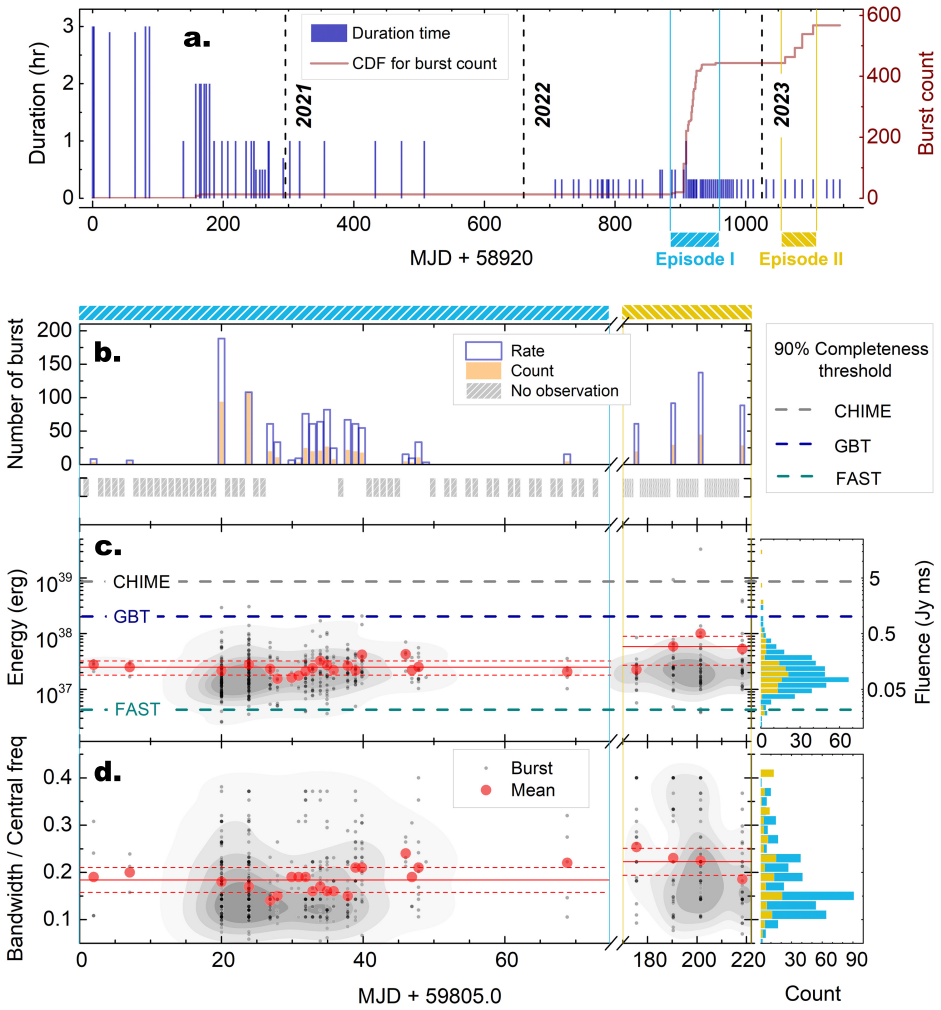
On the paper's own terms, the discovery is that FRB 20121102A's surrounding plasma is demonstrably changing on decade timescales. Over 98.3 hours of FAST and GBT monitoring (555 bursts in 2022–2023) combined with archival data, the observed dispersion measure fell from its early about 557 pc cm$^{-3}$ level by 8–17 pc cm$^{-3}$, about 7% of the local contribution after subtracting Milky Way and intergalactic foregrounds, with a fitted slope $d\mathrm{DM}_{\mathrm{obs}}/dt = -3.93 \pm 0.11$ pc cm$^{-3}$ yr$^{-1}$ over MJD 58785–60064 — claimed at 11.8$\sigma$. The rotation measure measured from the bright burst B489 on 3 March 2023, RM = 30,755 $\pm$ 16 rad m$^{-2}$, continues the monotonic decay from the about $10^5$ rad m$^{-2}$ value of 2016, a drop of about 70%, while the RM scatter $\sigma_{\mathrm{RM}}$ decreased by about 13%. Because the intergalactic and Milky Way foregrounds cannot vary on these timescales, the paper concludes that the evolution is local and attributes it to the free expansion of a young supernova remnant, with $|d\ln\mathrm{RM}/dt| \simeq 0.1$ yr$^{-1}$ implying an SNR age of a few times (1–10) years; the apparent DM plateau of 2015–2019 is explained by electron-positron pair injection from an enhanced magnetar wind, which adds DM but not RM.
Load-bearing premise
The decline is real only if DM measurements made by different telescopes, at different epochs, and with different fitting algorithms (Arecibo, GBT, FAST; DM-power versus earlier methods) are directly comparable at the sub-pc cm$^{-3}$ level; if cross-instrument offsets of several pc cm$^{-3}$ exist, the claimed local DM decline could be largely instrumental.
Editorial extensions
If this is right
- FRB 20121102A becomes the first repeating FRB with confirmed decadal environmental evolution, showing that at least some FRB surroundings are young, expanding, and transient.
- The RM decay rate implies an associated supernova remnant still in free expansion with an age of a few times (1–10) years, consistent with the source's measured age of $\gtrsim 12$ years, supporting the young magnetar scenario for repeating FRBs.
- The host galaxy's interstellar medium contributes roughly 200 pc cm$^{-3}$ of the dispersion measure, with the remaining declining component of similar size tracing the supernova ejecta.
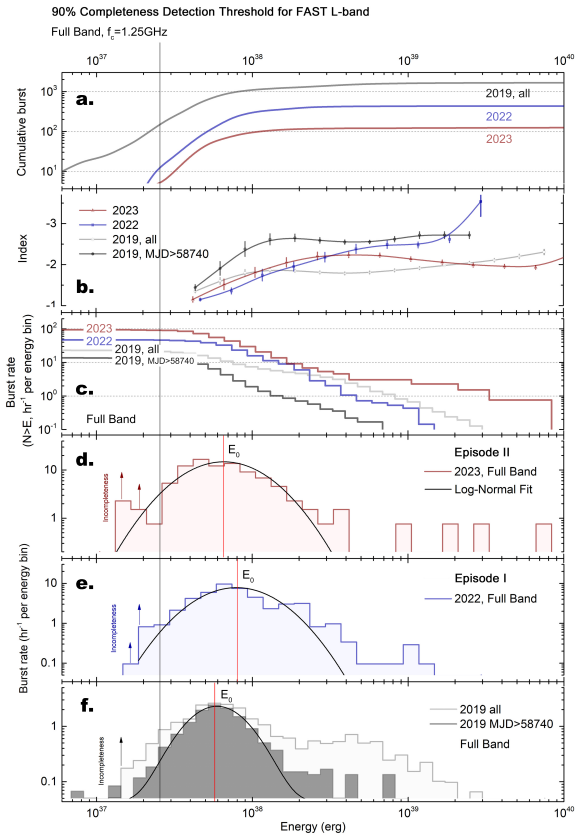
- Because burst energies, waiting times, and morphology are statistically unchanged between 2019 and 2023 while DM and RM evolve, the central engine appears stable and the DM and RM trends can be read as clean probes of the local environment.
- The total isotropic energy of the 555 bursts, $1.92 \times 10^{40}$ erg, is already about 21% of a magnetar's dipolar field energy under the assumed efficiency, which the paper argues challenges magnetar models with low radio efficiency such as the synchrotron maser mechanism.
Reading between the lines
- If the expanding-remnant picture is right, continued monitoring should see the dispersion measure resume a power-law decline once the pair-injection episode ends, and the fitted decay indices would distinguish fully ionized from shocked ejecta — a forecast that extends beyond the paper.
- The same decade-long DM and RM monitoring could be applied to other active repeaters with large rotation measures, such as FRB 20190520B, to test whether young expanding remnants are a generic feature of repeating FRB environments.
- Tracking the ratio of the RM and DM decay rates gives a running estimate of the line-of-sight magnetic field in the ejecta; the paper's current 2.2–2.6 mG estimate could be monitored for the decline expected as the remnant expands.
Editorial analysis
A structured set of objections, weighed in public.
Referee Report
Summary. This manuscript reports the results of a 98.3-hour FAST/GBT monitoring campaign of the repeating fast radio burst FRB 20121102A carried out between March 2020 and April 2023, during which 555 bursts were detected in two active episodes. Combining these data with archival observations, the authors claim a significant decline of roughly 7% in the local dispersion measure over a decade, a 70% decrease in rotation measure from 2016 to 2023, and a 13% decrease in the RM scatter. The paper attributes these trends to the expansion of a young supernova remnant, supplemented by an enhanced pair wind from the central magnetar, and presents extensive analyses of burst energies, waiting times, and periodicity searches.
Significance. If the reported environmental evolution is real, this would be the first clear observational evidence for decadal changes in the immediate surroundings of a repeating FRB, providing strong support for the young magnetar/SNR scenario. The paper's strengths include a large, well-characterized burst catalog with publicly available code, and a clear separation between the observational measurements and the theoretical interpretation. The DM and RM trends are independently measurable, and the theoretical model is presented as an interpretation rather than a derivation, although it contains several free parameters. The wide range of transient behaviors analyzed (energy distributions, waiting times, periodicity, morphology) makes this a valuable dataset for the FRB community.
major comments (5)
- [Fig. 2b; Methods §2] The central decadal DM-decline claim combines absolute DM measurements from different telescopes (Arecibo, GBT, FAST) and different fitting algorithms (DM-power for the new data versus earlier methods) without an inter-telescope or inter-algorithm calibration budget. The reported 8–17 pc cm^-3 decrease in DM_local is only a few times the typical cross-telescope systematic offsets in FRB DM measurements, and the long-term slope dDM/dt = -0.43 pc cm^-3 yr^-1 quoted in Methods §8 is directly at the level of such offsets. The authors explicitly note that the period I (2012) measurement has underestimated systematic errors, yet it is used in the long-term slope. I request a direct re-analysis of the archival datasets with the DM-power pipeline, or an explicit systematic error term added to each absolute DM measurement and propagated into the derived slopes, before the decadal claim can be considered robust.
- [Eq. (1); Methods §2] The quoted 11.8σ significance for the DM decline during MJD 58785–60064 is not derived in the paper. The MCMC slope is -3.93 ± 0.11 pc cm^-3 yr^-1, which naively corresponds to ~36σ, so the 11.8σ must arise from a different test (possibly including the scatter), but no description of this test is provided. Furthermore, the per-burst DM uncertainties (0.1–0.5 pc cm^-3) are far smaller than the observed burst-to-burst DM scatter of 2–4 pc cm^-3 reported in the main text (Fig. 2c). If this scatter represents intrinsic variability, the significance of the trend should be re-evaluated using a likelihood that includes an extra variance term; the current treatment likely overstates the significance.
- [Methods §7; polarization analysis] The claim that σ_RM decreased by 13% compares the newly measured σ_RM = 26.73 ± 0.96 rad m^-2 (from the single linearly polarized burst B489 at L-band) with a previous value of 30.9 rad m^-2 obtained at higher frequencies and with a different sample. No estimate of the cross-frequency or method-dependent systematics is given. Since the depolarization and the Faraday-complexity fits depend on frequency, this comparison could be dominated by systematic differences. The RM decay itself is supported by multiple prior measurements, but the σ_RM decrease should be presented with a caveat or with a dedicated cross-frequency analysis.
- [Methods §8, Eqs. (35)–(42)] The derivation of the foreground host ISM DM (DM0 ~ 200 pc cm^-3) via Eq. (36) uses the same observed dDM/dt and dlnRM/dt that the model is intended to explain, together with model-dependent indices α and β. In the subsequent pair-wind calculation, the parameters γ, R_w, ΔDM, and ε_B are chosen to reproduce the observed DM offset, so the resulting luminosity ratio L_w,en/L_w ~ 210 is a consistency check, not a prediction. The text should clearly label this as an illustrative scenario with degenerate parameters, particularly because the observational claims do not depend on it.
- [Main text, energy budget paragraph] The sentence claiming that the total energy emitted during the observing campaigns is ~21% of the magnetar's dipolar magnetic energy (1.7×10^47 erg) with radiative efficiency η~10^-4 is numerically inconsistent. With the measured isotropic radio energy of 1.92×10^40 erg, η=10^-4 implies a total energy of 1.92×10^44 erg, which is ~0.1% of the dipole energy, not 21%. This error directly undermines the subsequent statement that the energy budget challenges low-efficiency models such as the synchrotron maser; the authors should correct the calculation or the claim.
minor comments (5)
- [Abstract] The abstract claims a 7% decline of local DM, but the range quoted in the text is 4–9% (8–17 pc cm^-3 on DM_local ~203 pc cm^-3); please make this consistent.
- [Methods §2] There is a typo in 'peirod II' which should read 'period II'.
- [Fig. 2b] The error bars on the archival DM points (periods I and II) are not described; please specify their origin and whether they include systematic contributions.
- [Methods §8] The text gives DM_obs ≃ 557 pc cm^-3 for the 2012 discovery, while the main text says ⟨DM_obs⟩ = 565 pc cm^-3 for early-time observations; these values should be reconciled.
- [Eq. (1) and surrounding text] The derivation of the 11.8σ significance is missing; please add a short description of the test used or a reference to the method.
Circularity Check
No significant circularity: the DM/RM trends are direct measurements, and the SNR/wind model is a post-hoc interpretation whose parameters are constrained by, not used to construct, the data.
full rationale
The central claims are observational: dDM_obs/dt = -3.93 +/- 0.11 pc cm^-3 yr^-1 over MJD 58785-60064, the RM decline to 30,755 +/- 16 rad m^-2, and the ~13% decrease in sigma_RM. These are measured from burst dispersion, Faraday rotation, and archival data, and the paper's null-hypothesis MCMC test in Methods Section 2 is a statistical assessment of the DM slope, not a derivation of it from the model. The theoretical section (Methods Section 8) uses the observed DM, dDM/dt, and dln RM/dt as inputs to estimate the SNR age (t_SNR = alpha |dt/d ln RM|), the host-ISM DM (Eq. 36), and the required enhanced-wind luminosity amplification (Eq. 42). These are explicit inversions or consistency requirements, labeled as 'estimate' and 'required', and none is presented as an independent first-principles prediction. Eq. 36 does algebraically rearrange the observed local DM and its time derivatives under assumed alpha/beta values, so the resulting DM0 ~ 200 pc cm^-3 is close to the input DM_host ~ 203 pc cm^-3; however, this decomposition is not load-bearing for the main decadal-evolution detection and is not disguised as a prediction. The power-law RM/DM scalings are supported by external works (Piro & Gaensler 2018; Hilmarsson et al. 2021) in addition to co-authored Yang et al. papers, so no uniqueness claim rests solely on self-citation. The main vulnerability identified by the skeptic -- cross-telescope and cross-algorithm absolute DM calibration -- is a systematic-error concern about the comparability of Arecibo, GBT, and FAST DM values, not a circularity of the derivation chain. The paper itself flags part of this risk in Methods Section 2 by noting that the period I DM 'statistical and systematic errors may be underestimated'. No circular step meets the standard of exhibiting a specific reduction of a prediction to its inputs.
Assumptions & free parameters
free parameters (4)
- gamma (pair Lorentz factor) =
chosen as gamma_1 (order unity)
- R_w (magnetar wind nebula radius) =
~0.01 pc (R_w,-2 = 1)
- DeltaDM (extra DM from pair injection) =
a few pc cm^-3
- epsilon_B (magnetic energy fraction) =
1e-5 to 1e-1
assumptions (5)
- domain assumption The Milky Way and intergalactic medium contributions to DM are DM_MW = 218 pc cm^-3 and DM_IGM = 164 pc cm^-3 and their time variations are negligible.
- domain assumption The observed RM is produced almost entirely by plasma local to the FRB source.
- domain assumption During free expansion, SNR DM and RM follow power laws DM ∝ t^-β and RM ∝ t^-α with α, β of order unity.
- domain assumption An electron-positron pair plasma contributes to DM but not to RM.
- domain assumption The host galaxy redshift of FRB 20121102A is z = 0.193 with a luminosity distance of 949 Mpc.
invented entities (1)
-
Enhanced pair wind from the FRB central engine
Cite this review
Pith. "Pith review of Decadal evolution of a repeating fast radio burst source." pith.science (2026). https://pith.science/paper/MNRT3J5T
@misc{pith2026250715790,
  author       = {Pith},
  title        = {Pith review of: Decadal evolution of a repeating fast radio burst source},
  year         = {2026},
  howpublished = {\url{https://pith.science/paper/MNRT3J5T}},
  note         = {Machine review of arXiv:2507.15790}
}
abstract
The origin of fast radio bursts (FRBs), the brightest cosmic radio explosions, is still unknown. Bearing critical clues to FRBs' origin, the long-term evolution of FRBs has yet to be confirmed, since the field is still young and most FRBs were seen only once. Here we report clear evidence of decadal evolution of FRB~20121102A, the first precisely localized repeater. In conjunction with archival data, our FAST and GBT monitoring campaign since 2020 reveals a significant 7% decline of local dispersion measure (DM). The rotation measure (RM) of 30,755$\pm$16 $\mathrm{rad\,m^{-2}}$ detected in the last epoch represents a 70% decrease compared to that from December 2016. The $\sigma_{RM}$ parameter, which describes the complexity of the magneto-ionic environment surrounding the source, was shown to have decreased by 13%. These general trends reveal an evolving FRB environment, which could originate from an early-phase supernova associated with an enhanced pair wind from the FRB central engine.
Figures

Figures from the paper (1 more)

Forward citations
Cited by 4 Pith papers
-
Propagation Diagnostics of Supernova Remnant Environments around Young Repeating FRBs. I. Hydrodynamic Evolution of the Source-Local Dispersion Measure
In 2D simulations of a neutron-star wind inside expanding supernova ejecta, the source-local dispersion measure declines roughly as age^-2, is dominated by ejecta rather than wind, and reproduces the FRB 20190520B dec...
-
Indication for Decreasing Dispersion Measure in the Population of Repeating Fast Radio Bursts and Connection to Young Supernova Remnant Expansion
Population-level statistical test on repeating FRB DM evolution finds decreasing trends more common than increasing (p=0.033), consistent with young SNR expansion reducing local electron density.
-
Probing the Dispersion and Rotation Measure Contributions from Supernova Remnants in Fast Radio Burst Source Environments with 1D SNR Simulation
Unshocked SN ejecta dominate evolving FRB local DM (DM∝t^{-1.8–1.9}); matching observed dDM/dt implies tens–hundreds pc cm^{-3} of SNR DM_source and GHz transparency by ≲70 yr.
-
The magnetar model's energy crisis for a prolific repeating fast radio burst source
FRB 20240114A's estimated energy output over 214 days exceeds 86% of a typical magnetar's dipole magnetic energy, the strongest such constraint yet, if typical beaming and efficiency are assumed.
Reference graph
Works this paper leans on
-
[1]
author Petroff , E. , author Hessels , J. W. T. & author Lorimer , D. R. title Fast radio bursts at the dawn of the 2020s . journal volume 30 , pages 2 ( year 2022 )
work page 2022
-
[2]
author Kumar , P. , author Luo , R. & author Price , D. C. et al. title Spectropolarimetric variability in the repeating fast radio burst source FRB 20180301A . journal volume 526 , pages 3652-3672 ( year 2023 )
work page 2023
-
[3]
title The physics of fast radio bursts
author Zhang , B. title The physics of fast radio bursts . journal Reviews of Modern Physics volume 95 , pages 035005 ( year 2023 )
work page 2023
-
[4]
author Li , D. et al. title A bimodal burst energy distribution of a repeating fast radio burst source . journal volume 598 , pages 267-271 ( year 2021 )
work page 2021
-
[5]
author Hilmarsson , G. H. et al. title Rotation Measure Evolution of the Repeating Fast Radio Burst Source FRB 121102 . journal volume 908 , pages L10 ( year 2023 )
work page 2023
-
[6]
author Rajwade , K. M. , author Mickaliger , M. B. & author Stappers , B. W. et al. title Possible periodic activity in the repeating FRB 121102 journal volume 495 , pages 3551-3558 ( year 2020 )
work page 2020
-
[7]
author Yang , Y. P. et al. title Faraday Rotation Measure Variations of Repeating Fast Radio Burst Sources . journal volume 520 , pages 2039-2054 ( year 2023 )
work page 2023
-
[8]
author Nan , R. D. et al. title The Five-hundred-meter Aperture Spherical radio Telescope (FAST) project . journal International Journal of Modern Physics D volume 20 , pages 989–1024 ( year 2011 )
work page 2011
Show all 68 references
-
[9]
author Li , Di. et al. title FAST in Space: Considerations for a Multibeam, Multipurpose Survey Using China's 500-m Aperture Spherical Radio Telescope (FAST) . journal IEEE volume 19 , pages 112-119 ( year 2018 )
2018
-
[10]
author Tendulkar , S. P. et al. title The Host Galaxy and Redshift of the Repeating Fast Radio Burst FRB 121102 . journal volume 834 , pages L7 ( year 2017 )
2017
-
[11]
title Planck 2015 results
author Planck Collaboration et al. title Planck 2015 results. XIII. Cosmological parameters . journal volume 594 , pages A13 ( year 2016 )
2015
-
[12]
& author Sironi , L
author Plotnikov , I. & author Sironi , L. , title The synchrotron maser emission from relativistic shocks in Fast Radio Bursts: 1D PIC simulations of cold pair plasmas . journal volume 485 , pages 3816-3833 ( year 2019 )
2019
-
[13]
author Lin , H. H. et al. title DM-power: an algorithm for high precision dispersion measure with application to fast radio bursts . journal arXiv e-prints , pages 2208.13677 ( year 2022 )
2022 arXiv
-
[14]
author Nimmo , K. et al. title Highly polarized microstructure from the repeating FRB 20180916B . journal Nature Astronomy volume 5 , pages 594-603 ( year 2021 )
2021
-
[15]
author Scholz , P. et al. title The Repeating Fast Radio Burst FRB 121102: Multi-wavelength Observations and Additional Bursts . journal volume 833 , pages 177 ( year 2016 )
2016
-
[16]
author Petroff , E. et al. title FRBCAT: The Fast Radio Burst Catalogue . journal PASA volume 33 , pages e045 ( year 2016 )
2016
-
[17]
author Oostrum , L. C. et al. title Repeating fast radio bursts with WSRT/Apertif . journal volume 635 , pages A61 ( year 2020 )
2020
-
[18]
author Cruces , M. et al. title Repeating behaviour of FRB 121102: periodicity, waiting times, and energy distribution . journal volume 500 , pages 448-463 ( year 2021 )
2021
-
[19]
author Hewitt , D. M. et al. title Arecibo observations of a burst storm from FRB 20121102A in 2016 . journal volume 515 , pages 3577-3596 ( year 2022 )
2016
-
[20]
& author Zhang , B
author Yang , Y.-P. & author Zhang , B. title Dispersion Measure Variation of Repeating Fast Radio Burst Sources . journal volume 847 , pages 22 ( year 2017 )
2017
-
[21]
, author Seymour , A
author Michilli , D. , author Seymour , A. & author Hessels , J. W. T. et al. title An extreme magneto-ionic environment associated with the fast radio burst source FRB 121102 . journal volume 553 , pages 182 ( year 2018 )
2018
-
[22]
, author Li , D
author Feng , Y. , author Li , D. & author Yang , Y. P. et al. title Frequency-dependent polarization of repeating fast radio bursts implications for their origin . journal Science volume 375 , pages 1266-1270 ( year 2022 )
2022
-
[23]
author Hilmarsson , G. H. , author Michilli , D. & author Spitler , L. G. et al. title Rotation Measure Evolution of the Repeating Fast Radio Burst Source FRB 121102 journal volume 908 , pages 10-23 ( year 2021 )
2021
-
[24]
, author Paragi , Z
author Plavin , A. , author Paragi , Z. & author Marcote , B. et al. title FRB 121102: Drastic changes in the burst polarization contrasts with the stability of the persistent emission journal volume 511 , pages 6033-6041 ( year 2022 )
2022
-
[25]
, author Connor , L
author Anna-Thomas , R. , author Connor , L. & author Dai , S. et al. title Magnetic field reversal in the turbulent environment around a repeating fast radio burst journal Science volume 380 , pages 599-603 ( year 2023 )
2023
-
[26]
author Niu , C. H. , author Aggarwal , K. & author Li , D. et al. title A repeating fast radio burst associated with a persistent radio source journal volume 606 , pages 873-877 ( year 2022 )
2022
-
[27]
author Yang , Y. P. , author Lu , W. B. & author Feng , Y. et al. title Temporal Scattering, Depolarization, and Persistent Radio Emission from Magnetized Inhomogeneous Environments near Repeating Fast Radio Burst Sources journal volume 928 , pages L16 ( year 2022 )
2022
-
[28]
, author Piro , L
author Bruni , G. , author Piro , L. & author Yang , Y. P. et al. title A nebular origin for the persistent radio emission of fast radio bursts journal volume 632 , pages 1014–1016 ( year 2024 )
2024
-
[29]
author Zanazzi , J. J. & author Lai , D. title Periodic Fast Radio Bursts with Neutron Star Free Precession journal volume 892 , pages L15 ( year 2020 )
2020
-
[30]
author Zhu , W. W. , author Xu , H. & author Zhou , D. J. et al. title A radio pulsar phase from SGR J1935+2154 provides clues to the magnetar FRB mechanism journal Sci. Adv. volume 9 , pages eadf6198 ( year 2023 )
2023
-
[31]
author Piro , A. L. & author Gaensler , B. M. title The Dispersion and Rotation Measure of Supernova Remnants and Magnetized Stellar Winds: Application to Fast Radio Bursts journal volume 861 , pages 150 ( year 2018 )
2018
-
[32]
author Hotan , A. W. , author van Straten , W. & author Manchester , R. N. title PSRCHIVE and PSRFITS: An Open Approach to Radio Pulsar Data Storage and Analysis journal Publications of the Astronomical Society of Australia volume 21 , pages 302-309 ( year 2004 )
2004
-
[33]
author Ransom , S. M. title New search techniques for binary pulsars . 2001PhDT.......123R , journal Ph.D.\ Thesis ( year 2001 )
2001
-
[34]
, author Zhang , X
author He , K. , author Zhang , X. Y. & author Ren , S. Q. et al. title Deep Residual Learning for Image Recognition journal Proceedings of the IEEE conference on computer vision and pattern recognition volume , pages 770-778 ( year 2016 )
2016
-
[35]
, author Li , Y
author Xie , M. , author Li , Y. X. & author Wang , Y. B. et al. title Learning distinctive margin toward active domain adaptation journal Proceedings of the IEEE conference on computer vision and pattern recognition volume , pages 7993-8002 ( year 2022 )
2022
-
[36]
author Spitler , L. G. , author Cordes , J. M. & author Hessels , J. W. T. et al. title FAST RADIO BURST DISCOVERED IN THE ARECIBO PULSAR ALFA SURVEY journal volume 790 , pages 101 ( year 2014 )
2014
-
[37]
, author Tang , N
author Jiang , P. , author Tang , N. Y. & author Hou , L. G. et al. title The Fundamental Performance of FAST with 19-beam Receiver at L Band journal Research in Astronomy and Astrophysics volume 20 , pages 064 ( year 2020 )
2020
-
[38]
title Fast Radio Burst Energetics and Detectability from High Redshifts
author Zhang , B. title Fast Radio Burst Energetics and Detectability from High Redshifts . journal volume 867 , pages L21 ( year 2018 )
2018
-
[39]
author Gourdji , K. et al. title A Sample of Low-energy Bursts from FRB 121102 . journal volume 877 , pages L19 ( year 2019 )
2019
-
[40]
author Atwood , W. B. , author Ziegler , M. & author Johnson , R. P. et al. title A Time-differencing Technique for Detecting Radio-quiet Gamma-Ray Pulsars . journal volume 652 , pages L49 ( year 2006 )
2006
-
[41]
, author Baughman , B
author Ziegler , M. , author Baughman , B. M. & author Johnson , R. P. et al. title A Search for Radio-Quiet Gamma-Ray Pulsars in EGRET Data Using a Time-Differencing Technique . journal volume 680 , pages 620-626 ( year 2008 )
2008
-
[42]
author Abdo , A. A. , author Ackermann , M. & author Atwood , W. B. et al. title The Fermi Gamma-Ray Space Telescope Discovers the Pulsar in the Young Galactic Supernova Remnant CTA 1 . journal Science volume 322 , pages 1218 ( year 2008 )
2008
-
[43]
author Welch , P. D. title The Use of Fast Fourier Transform for the Estimation of Power Spectra: A Method Based on Time Averaging Over Short, Modified Periodograms . journal IEEE Trans. Audio & Electroacoust volume 15 , pages 70-73 ( year 1967 )
1967
-
[44]
author Lomb , N. R. title Least-Squares Frequency Analysis of Unequally Spaced Data . journal volume 39 , pages 447-462 ( year 1976 )
1976
-
[45]
author Scargle , J. D. title Studies in astronomical time series analysis. II. Statistical aspects of spectral analysis of unevenly spaced data . journal volume 263 , pages 835-853 ( year 1982 )
1982
-
[46]
, author Stappers , B
author Caleb , M. , author Stappers , B. W. & author Rajwade , K. et al. title Are all fast radio bursts repeating sources? . journal volume 484 , pages 5500-5508 ( year 2019 )
2019
-
[47]
author Chamma , M. A. , author Rajabi , F. & author Kumar , A. et al. title A broad survey of spectro-temporal properties from FRB 20121102A . journal volume 522 , pages 3036-3048 ( year 2023 )
2023
-
[48]
author Hewitt , D. M. , author Snelders , M. P. & author Hessels , J. W. T. et al. title Arecibo observations of a burst storm from FRB 20121102A in 2016 . journal volume 515 , pages 3577-3596 ( year 2022 )
2016
-
[49]
title Observational Effects of Banded Repeating FRBs
author Aggarwal , K. title Observational Effects of Banded Repeating FRBs . journal volume 920 , pages L18 ( year 2021 )
2021
-
[50]
, author Good , D
author Pleunis , Z. , author Good , D. C. & author Kaspi , V. M. et al. title Fast Radio Burst Morphology in the First CHIME/FRB Catalog . journal volume 923 , pages 1 ( year 2021 )
2021
-
[51]
author Dai , Z. G. & author Zhong , S. Q. title Periodic Fast Radio Bursts as a Probe of Extragalactic Asteroid Belts . journal volume 895 , pages L1 ( year 2020 )
2020
-
[52]
, author Wang , B
author Luo , R. , author Wang , B. J. & author Men , Y. P. et al. title Diverse polarization angle swings from a repeating fast radio burst source journal volume 586 , pages 693-696 ( year 2020 )
2020
-
[53]
author Zhang , C. F. , author Jiang , J. C. & author Men , Y. P. et al. title A highly polarised radio burst detected from SGR 1935+2154 by FAST journal The Astronomer's Telegram volume 13699 , pages 1-1 ( year 2020 )
1935
-
[54]
, author Niu , J
author Xu , H. , author Niu , J. R. & author Chen , P. et al. title A fast radio burst source at a complex magnetized site in a barred galaxy journal volume 609 , pages 685-688 ( year 2022 )
2022
-
[55]
author Jiang , J. C. , author Wang , W. Y. & author Xu , H. et al. title FAST Observations of an Extremely Active Episode of FRB 20201124A. III. Polarimetry journal Research in Astronomy and Astrophysics volume 22 , pages 124003 ( year 2022 )
2022
-
[56]
author Dubus , Guillaume , title Gamma-ray binaries and related systems journal volume 21 , pages 64 ( year 2013 )
2013
-
[57]
, author Raga , A
author Cant \'o , J. , author Raga , A. C. & author Wilkin , F. P. title Exact, Algebraic Solutions of the Thin-Shell Two-Wind Interaction Problem journal volume 469 , pages 729 ( year 1996 )
1996
-
[58]
, author Kudritzki , R
author Puls , J. , author Kudritzki , R. -P. & author Herrero , A. et al. title O-star mass-loss and wind momentum rates in the Galaxy and the Magellanic Clouds Observations and theoretical predictions. journal volume 305 , pages 171 ( year 1997 )
1997
-
[59]
author Cordes , J. M. , author Wharton , R. S. & author Spitler , L. G. et al. title Radio Wave Propagation and the Provenance of Fast Radio Bursts journal arXiv e-prints volume , pages 1605.05890 ( year 2016 )
2016 arXiv
-
[60]
, author Law , C
author Chatterjee , S. , author Law , C. J. & author Wharton , R. S. et al. title A direct localization of a fast radio burst and its host journal volume 541 , pages 58-61 ( year 2017 )
2017
-
[61]
& author Linder , E
author Kumar , P. & author Linder , E. V. title Use of fast radio burst dispersion measures as distance measures journal PhysRevD volume 100 , pages 083533 ( year 2019 )
2019
-
[62]
author Katz , J. I. title Fast radio bursts: A brief review: Some questions, fewer answers journal Modern Physics Letters A volume 31 , pages 1630013 ( year 2016 )
2016
-
[63]
, author Kashiyama , K
author Murase , K. , author Kashiyama , K. & author M \'e sz \'a ros , P. title A burst in a wind bubble and the impact on baryonic ejecta: high-energy gamma-ray flashes and afterglows from fast radio bursts and pulsar-driven supernova remnants journal volume 461 , pages 1498-...
2016
-
[64]
author McKee , C. F. & author Truelove , J. K. title Explosions in the interstellar medium journal Physics Reports volume 256 , pages 157-172 ( year 1995 )
1995
-
[65]
author Ostriker , J. P. & author Gunn , J. E. title Do Pulsars Make Supernovae? journal volume 164 , pages L95 ( year 1971 )
1971
-
[66]
author Chevalier , R. A. title The interaction of supernovae with the interstellar medium journal volume 15 , pages 175-196 ( year 1977 )
1977
-
[67]
& author Zhang , B
author Ioka , K. & author Zhang , B. title A Binary Comb Model for Periodic Fast Radio Bursts journal volume 893 , pages L26 ( year 2020 )
2020
-
[68]
author Wang , F. Y. , author Zhang , G. Q. & author Dai , Z. G. et al. title Repeating fast radio burst 20201124A originates from a magnetar/Be star binary journal Nature Communications volume 13 , pages 4382 ( year 2022 )
2022
Reviewed August 6, 2026 · model on record in the stance chip above.
Discussion (0). Continue with ORCID to comment.