REVIEW 5 major objections 6 minor 40 references
Efficient design of rna sequences with desired properties, structure, and motifs using a grammar variational autoencoder
T0 review · 5 major / 6 minor · reviewed 2026-08-06 · deepseek-v4-flash
Pith's one-line read A grammar-guided autoencoder designs stable RNAs to order
desk verdict RGVAE is a workmanlike but incremental grammar-VAE variant with one clean feasibility result, but its central MFE-based outperformance claim is undermined by length-confounded comparisons. read the letter →
The pith
A machine-rendered reading of the paper's core claim, the machinery that carries it, and where it could break.
The reading
What carries the argument
The load-bearing object is the stochastic context-free grammar $G$ with rules $S \to LS \mid L$, $L \to aF\hat{a} \mid a$, $F \to aF\hat{a} \mid LS$, where $\hat{a}$ pairs with $a$; production probabilities are learned from the training set via the inside-outside algorithm. Parses become one-hot rule vectors, a CNN encoder maps them to a ten-dimensional Gaussian latent space, and an RNN decoder with a stack-based validity mask samples only rules the grammar allows. Bayesian optimization over the summed constraint scores in this latent space is what turns generation into targeted design.
What would settle it
Take the reported best sequences, compute their lengths, and compare minimum free energy per nucleotide, or compare only sequences matched for length, against the training data, randomized sequences, and the GAN baseline; if the per-nucleotide MFE advantage disappears, the headline stability improvement is an artifact of length.
Extended reading notes
Core claim
RGVAE claims that representing RNA sequences by their SCFG parse trees, rather than by raw nucleotide strings, gives a latent space in which property optimization is both valid and efficient. Training on tRNA sequences, the model learns a decoder that only emits production-rule sequences the grammar accepts, so decoded RNAs are structurally plausible. Optimizing this latent space with a summed constraint score, the authors report generated sequences that satisfy target GC-content, motif, length, positional, and structure constraints while exhibiting lower minimum free energy than the training set and the compared baselines. The central discovery is that grammar-constrained latent optimization is a flexible route to multi-constraint RNA design.
Load-bearing premise
The central claim assumes that the lower raw minimum free energies reported for RGVAE sequences reflect genuinely more stable structures, because raw MFE is not normalized by sequence length and longer sequences naturally reach more negative values.
Editorial extensions
If this is right
- Continuous latent optimization replaces combinatorial sequence search: new candidates are generated by decoding sampled latent points rather than enumerating sequences.
- Multiple constraints such as minimum free energy, GC-content, motifs, secondary structure, and base positions can be combined into a single objective and optimized jointly.
- The grammar's validity masking ensures every decoded sequence is parseable under the chosen SCFG, so structurally meaningful candidates are not wasted.
- Because the model is trained on a tRNA family, retraining on other RNA families should bias generation toward other consensus secondary structures.
- In the reported scenarios the method outperformed randomized design and a GAN-based baseline, suggesting generative modeling is a viable alternative to inverse-folding heuristics.
Reading between the lines
- The reported minimum free energy gains may partly reflect sequence length: raw MFE decreases as length grows, and the comparisons do not normalize for length; per-nucleotide or length-matched MFE would be a sharper test.
- Grammar choice is a hidden driver: the paper shows one grammar outperforms another, so the method's success depends on matching the grammar's rule set to the target RNA class.
- The summed-score objective is simple; a Pareto or scalarized multi-objective approach could trade off constraints more explicitly.
- The same grammar-latent recipe could extend to other sequence design problems with context-free structure, such as protein or DNA nanostructure design, given an appropriate grammar.
Editorial analysis
A structured set of objections, weighed in public.
Referee Report
Summary. The manuscript presents RGVAE, an RNA grammar variational autoencoder that augments the grammar VAE framework with a stochastic context-free grammar (SCFG) over RNA base-pairing productions. RNA sequences are parsed into production-rule sequences, encoded by a CNN into a continuous latent space, and decoded by an RNN with a stack-based masking scheme; Bayesian optimization in the latent space is then used to generate sequences satisfying constraints. The paper reports experiments on tRNA sequences from Rfam for minimum free energy (MFE) minimization, GC-content targeting, length constraints, mandatory/forbidden motifs, base positional constraints, and target secondary structures, comparing against the training data, the RNAGEN model, and random sequence baselines.
Significance. A reliable generative model for multi-constraint RNA design would be practically important for synthetic biology and RNA-based drug discovery. The work's strengths are its combination of SCFG and GVAE, the breadth of constraints addressed, and the public release of code and data. However, the headline quantitative claims rest on MFE comparisons that do not control for sequence length and on best-of-sample selections rather than distributional comparisons, so the significance of the reported outperformance is not yet established. The feasibility demonstration for exact target secondary structure is useful but rests on a single successful sequence.
major comments (5)
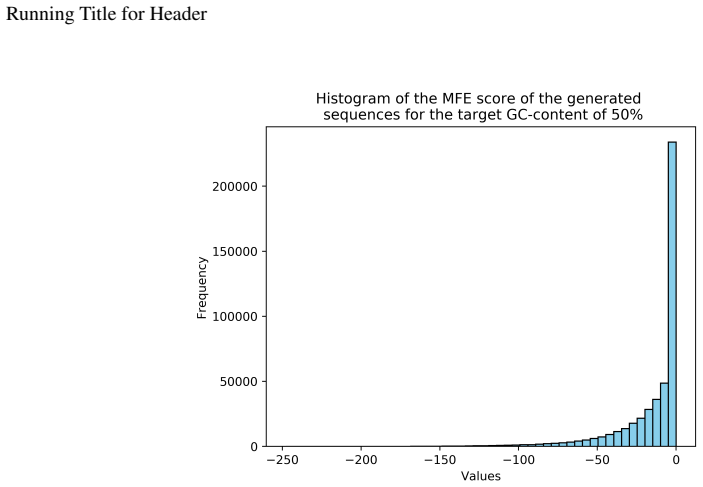
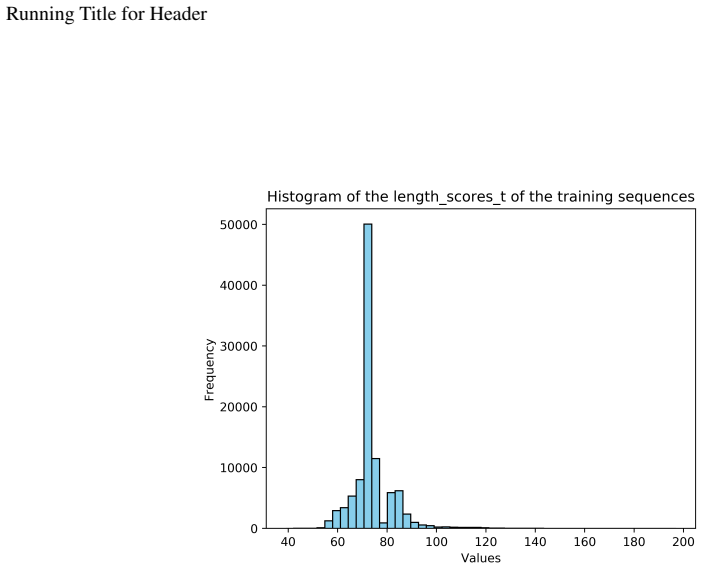
- [Sec. 3.1–3.2, Table 1] The central outperformance claim is not supported by the reported MFE comparisons because sequence lengths are never given. RNA minimum free energy generally becomes more negative as sequence length increases because more base pairs can form. The reported minima (-261.2 vs -91.59 in Sec. 3.1; -215.8 vs -68.7 at 50% GC in Table 1) could therefore reflect longer RGVAE sequences rather than greater thermodynamic stability. Please report lengths for every method and include length-matched draws or per-nucleotide MFE, and apply the same control to the random and RNAGEN baselines.
- [Sec. 3.3, Table 2] Even where a length range is imposed (100–150 nt), the comparison is based on the single minimum-MFE sequence after filtering, not on a distributional comparison over generated samples. The best-of-sample minimum depends on the number of candidates and on how many sequences passed the filter; without this information, the -145.6 vs -54 difference is not valid evidence of model superiority. Please report medians and quantiles over the filtered sets, candidate counts, and confidence intervals for the MFE difference.
- [Abstract, Sec. 3] The abstract states that RGVAE 'significantly outperform[s] other alternatives such as randomized design and regular VAEs that do not utilize the SCFG,' but no regular VAE baseline appears in any experiment. The comparisons are only to training data, RNAGEN, and random sequences. Please either add a regular VAE trained on the same data and evaluated under identical constraints, or remove/qualify the claim about regular VAEs.
- [Sec. 2.5–2.6] The grammar is ambiguous, but the encoder requires a single parse tree per sequence and the paper does not state how the parse tree is chosen (e.g., most probable under the SCFG, CYK, or random). This choice affects which production-rule sequence is encoded and is required for reproducibility. Please specify the parsing algorithm and state whether the inside-outside probabilities are used to resolve ambiguity.
- [Sec. 3.5] The exact-structure experiment finds eight sequences with the target structure after filtering and only one that additionally satisfies the motif and positional constraints. This single successful example can illustrate feasibility but cannot support the broad claim of efficient design under multiple constraints. Please report the total number of generated candidates, the success rate, and the same filtering applied to the baselines.
minor comments (6)
- [Sec. 3.4] The sentence 'the MFE is -91.8%' should say '-91.8' with energy units; the percent sign is incorrect.
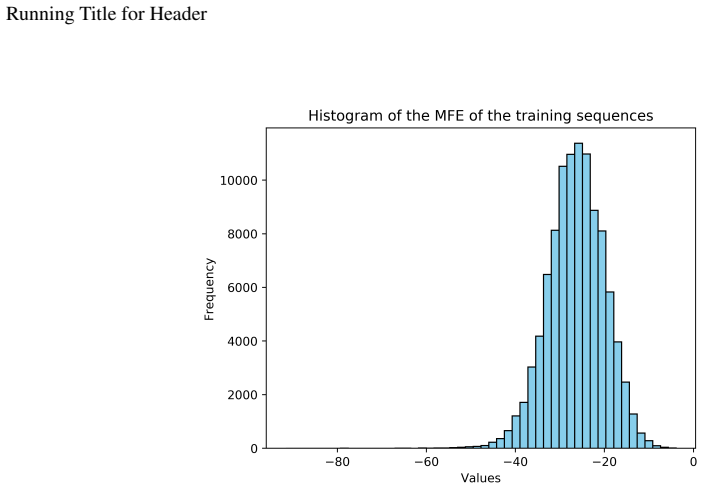
- [Figures 15 and 16] The text says these histograms show the training data and the RGVAE-generated sequences, but the Figure 16 caption says RNAGEN; please reconcile the caption with the text.
- [Sec. 2.5.1 and Figure 3 caption] There are typos: 'SCFT' should be 'SCFG' in the encoder description, and 'Boz 6' should be 'Box 6' in the Figure 3 caption.
- [Sec. 3.1] The grammar G0 as written contains the redundant production S→S|S and appears ambiguous; please clarify the intended production rules.
- [Table 1] RNAGEN has N/A for the 20% and 30% GC targets, but the paper does not report how many RNAGEN sequences were sampled or why none satisfied the GC range, making the comparison incomplete.
- [Sec. 3.6] The alignment score adds |m2−n2+m−n|/2 as a length penalty, but the variables and the rationale for this specific penalty are not defined clearly; please state the dimensions involved and justify the formula.
Circularity Check
No significant circularity: the derivation chain is self-contained and its claims are checked against external predictors (ViennaRNA) and external baselines; the length-normalization concern is an evaluation-quality issue, not a circular reduction.
full rationale
The paper's pipeline is a standard train-then-optimize generative model. The SCFG production probabilities are fit to external Rfam tRNA data, the encoder/decoder follow the external grammar-VAE architecture of Kusner et al. ([26]), and the target quantities (MFE, GC-content, secondary-structure distance) are computed by external tools such as ViennaRNA or by alignment to external target structures. There is no step in which the quantity being 'predicted' is defined by the fitted parameters, and no fitted parameter is renamed as a prediction. The grammar does not encode the MFE objective; being parseable by the grammar is neither necessary nor sufficient for the lowest MFE, so the claim that the SCFG 'ensures' thermodynamic stability is an overstatement but not a circular one. The baseline 'random RNAs based on grammar' uses the same SCFG probabilities as the trained model, so the comparison with RGVAE is controlled rather than circular. The paper contains no load-bearing self-citation chains or imported uniqueness theorems. The strongest substantive concern, that MFE values in Sections 3.1 and 3.2 are not normalized by sequence length, is a statistical/correctness issue about comparability of evidence and does not amount to the derivation reducing to its own inputs. Therefore no circular step can be quoted and exhibited, and the appropriate score is 0.
Assumptions & free parameters
free parameters (4)
- Latent dimension =
10
- SCFG production probabilities =
estimated from training data via inside-outside
- Number of Bayesian optimization iterations =
5 (in Section 3.1)
- GC-content tolerance =
±2%
assumptions (4)
- domain assumption The chosen SCFG grammar G from [13] can represent the secondary structures relevant for the design targets.
- domain assumption ViennaRNA's MFE prediction is a reliable ground-truth measure of thermodynamic stability.
- domain assumption The inside-outside algorithm on the training data yields a single parse tree per sequence suitable for encoding.
- domain assumption Bayesian optimization in the continuous latent space reliably finds good solutions for the summed constraint scores.
Cite this review
Pith. "Pith review of Efficient design of rna sequences with desired properties, structure, and motifs using a grammar variational autoencoder." pith.science (2026). https://pith.science/paper/YHYHD6XA
@misc{pith2026250715912,
  author       = {Pith},
  title        = {Pith review of: Efficient design of rna sequences with desired properties, structure, and motifs using a grammar variational autoencoder},
  year         = {2026},
  howpublished = {\url{https://pith.science/paper/YHYHD6XA}},
  note         = {Machine review of arXiv:2507.15912}
}
read the original abstract
Designing structurally stable RNA sequences with specific motifs and other desirable properties is an important challenge in bioinformatics. The potential design space increases exponentially with the length of the RNA to be engineered, which makes this a difficult combinatorial optimization problem. In this paper, we propose an RNA grammar variational autoencoder (RGVAE) that can efficiently generate novel RNA sequences with specific target properties. The proposed RGVAE builds on the recently proposed grammar VAE, where we incorporate the stochastic context-free grammar (SCFG) to design strutural RNAs with desired motifs and characteristics. Using the SCFG can ensure that the generated RNA sequence can form a thermodynamically stable secondary structure. Given a RNA sequence, the SCFT is used to find the parse tree, which is represented in a continuous low-dimensional latent space by the RGVAE encoder. We can optimize the RNA in the latent space, where the latent representation can be decoded by the RGVAE decoder to reconstruct the RNA sequence. Based on a number of practical uses cases, we demonstrate that RGVAE can be used to efficiently design structurally stable RNAs with specific target properties, which significantly outperform other alternatives such as randomized design and regular VAEs that do not utilize the SCFG. Code availability: the source code of RGVAE and the data used in this study are provided in https://github.com/nzarnaghinaghsh/RGVAE/tree/main, DOI 10.5281/zenodo.15569206.
Figures


Figures from the paper (23 more)







Reference graph
Works this paper leans on
-
[26]
Grammar variational autoencoder
Matt J Kusner, Brooks Paige, and José Miguel Hernández-Lobato. “Grammar variational autoencoder”. In: International conference on machine learning. PMLR. 2017, pp. 1945–1954
work page 2017
-
[2]
Multi-Objective Latent Space Optimization of Generative Molecular Design Models
ANM Abeer et al. “Multi-objective latent space optimization of generative molecular design models”. In:arXiv preprint arXiv:2203.00526(2022)
work page Pith review arXiv 2022
-
[3]
Chapter 16 - Targeted Hybrid Capture for Inherited Disease Panels
Sami S. Amr and Birgit Funke. “Chapter 16 - Targeted Hybrid Capture for Inherited Disease Panels”. In: Clinical Genomics. Ed. by Shashikant Kulkarni and John Pfeifer. Boston: Academic Press, 2015, pp. 251–269. ISBN: 978-0-12-404748-8.DOI: https://doi.org/10.1016/B978- 0- 12- 404748- 8.00016- 2 .URL: https://www.sciencedirect.com/science/article/pii/B97801...
doi:10.1016/b978- 2015
-
[4]
MolGPT: molecular generation using a transformer-decoder model
Viraj Bagal et al. “MolGPT: molecular generation using a transformer-decoder model”. In:Journal of chemical information and modeling62.9 (2021), pp. 2064–2076
work page 2021
-
[5]
Application of generative autoencoder in de novo molecular design
Thomas Blaschke et al. “Application of generative autoencoder in de novo molecular design”. In:Molecular informatics37.1-2 (2018), p. 1700123
work page 2018
-
[6]
Designing RNA secondary structures is hard
Édouard Bonnet, Paweł Rz ˛ a˙zewski, and Florian Sikora. “Designing RNA secondary structures is hard”. In: Journal of Computational Biology27.3 (2020), pp. 302–316
work page 2020
-
[7]
Eric Bonnet et al. “Evidence that microRNA precursors, unlike other non-coding RNAs, have lower folding free energies than random sequences”. In:Bioinformatics20.17 (2004), pp. 2911–2917
work page 2004
-
[8]
Ritwika Bose, Irfana Saleem, and Anthony M Mustoe. “Causes, functions, and therapeutic possibilities of RNA secondary structure ensembles and alternative states”. In:Cell Chemical Biology()
Show all 40 references
-
[9]
The distribution of RNA motifs in natural sequences
Véronique Bourdeau et al. “The distribution of RNA motifs in natural sequences”. In:Nucleic acids research 27.22 (1999), pp. 4457–4467
1999
-
[10]
INFO-RNA—a fast approach to inverse RNA folding
Anke Busch and Rolf Backofen. “INFO-RNA—a fast approach to inverse RNA folding”. In:Bioinformatics 22.15 (2006), pp. 1823–1831
2006
-
[11]
The autoencoding variational autoencoder
Taylan Cemgil et al. “The autoencoding variational autoencoder”. In:Advances in Neural Information Processing Systems33 (2020), pp. 15077–15087
2020
-
[12]
A structural interpretation of the effect of GC-content on efficiency of RNA interference
Chi Yu Chan et al. “A structural interpretation of the effect of GC-content on efficiency of RNA interference”. In: BMC bioinformatics10.1 (2009), pp. 1–7. 20 Running Title for Header
2009
-
[13]
Evaluation of several lightweight stochastic context-free grammars for RNA secondary structure prediction
Robin D Dowell and Sean R Eddy. “Evaluation of several lightweight stochastic context-free grammars for RNA secondary structure prediction”. In:BMC bioinformatics5.1 (2004), pp. 1–14
2004
-
[14]
Cambridge university press, 1998
Richard Durbin et al.Biological sequence analysis: probabilistic models of proteins and nucleic acids. Cambridge university press, 1998
1998
-
[15]
Solving the RNA design problem with reinforcement learning
Peter Eastman et al. “Solving the RNA design problem with reinforcement learning”. In:PLoS computational biology14.6 (2018), e1006176
2018
-
[16]
Inside-outside and forward-backward algorithms are just backprop (tutorial paper)
Jason Eisner. “Inside-outside and forward-backward algorithms are just backprop (tutorial paper)”. In:Proceed- ings of the Workshop on Structured Prediction for NLP. 2016, pp. 1–17
2016
-
[17]
ERD: a fast and reliable tool for RNA design including constraints
Ali Esmaili-Taheri and Mohammad Ganjtabesh. “ERD: a fast and reliable tool for RNA design including constraints”. In:BMC bioinformatics16.1 (2015), pp. 1–11
2015
-
[18]
Probabilistic transformer: Modelling ambiguities and distribu- tions for rna folding and molecule design
Jörg Franke, Frederic Runge, and Frank Hutter. “Probabilistic transformer: Modelling ambiguities and distribu- tions for rna folding and molecule design”. In:Advances in Neural Information Processing Systems35 (2022), pp. 26856–26873
2022
-
[19]
Boltzmann probability of RNA structural neighbors and riboswitch detection
Eva Freyhult, Vincent Moulton, and Peter Clote. “Boltzmann probability of RNA structural neighbors and riboswitch detection”. In:Bioinformatics23.16 (2007), pp. 2054–2062
2007
-
[20]
Automatic chemical design using a data-driven continuous representation of molecules
Rafael Gómez-Bombarelli et al. “Automatic chemical design using a data-driven continuous representation of molecules”. In:ACS central science4.2 (2018), pp. 268–276
2018
-
[21]
Evolving methods for rational de novo design of functional RNA molecules
Stefan Hammer et al. “Evolving methods for rational de novo design of functional RNA molecules”. In:Methods 161 (2019), pp. 54–63
2019
-
[22]
Generative aptamer discovery using RaptGen
Natsuki Iwano et al. “Generative aptamer discovery using RaptGen”. In:Nature Computational Science2.6 (2022), pp. 378–386
2022
-
[23]
druGAN: an advanced generative adversarial autoencoder model for de novo generation of new molecules with desired molecular properties in silico
Artur Kadurin et al. “druGAN: an advanced generative adversarial autoencoder model for de novo generation of new molecules with desired molecular properties in silico”. In:Molecular pharmaceutics14.9 (2017), pp. 3098– 3104
2017
-
[24]
De novo protein design for novel folds using guided conditional Wasserstein generative adversarial networks
Mostafa Karimi et al. “De novo protein design for novel folds using guided conditional Wasserstein generative adversarial networks”. In:Journal of chemical information and modeling60.12 (2020), pp. 5667–5681
2020
-
[25]
Grammars and reinforcement learning for molecule optimization
Egor Kraev. “Grammars and reinforcement learning for molecule optimization”. In:arXiv preprint arXiv:1811.11222(2018)
2018 arXiv
-
[27]
Finding stable local optimal RNA secondary structures
Yuan Li and Shaojie Zhang. “Finding stable local optimal RNA secondary structures”. In:Bioinformatics27.21 (2011), pp. 2994–3001
2011
-
[28]
ViennaRNA Package 2.0
Ronny Lorenz et al. “ViennaRNA Package 2.0”. In:Algorithms for molecular biology6.1 (2011), pp. 1–14
2011
-
[29]
Identification of a motif that mediates polypyrimidine tract-binding protein-dependent internal ribosome entry
Sally A Mitchell et al. “Identification of a motif that mediates polypyrimidine tract-binding protein-dependent internal ribosome entry”. In:Genes & development19.13 (2005), pp. 1556–1571
2005
-
[30]
RNAGEN: A generative adversarial network-based model to generate synthetic RNA sequences to target proteins
Furkan Ozden et al. “RNAGEN: A generative adversarial network-based model to generate synthetic RNA sequences to target proteins”. In:bioRxiv(2023), pp. 2023–07
2023
-
[31]
Variational autoencoder
Lucas Pinheiro Cinelli et al. “Variational autoencoder”. In:V ariational Methods for Machine Learning with Applications to Deep Networks. Springer, 2021, pp. 111–149
2021
-
[32]
A weighted sampling algorithm for the design of RNA sequences with targeted secondary structure and nucleotide distribution
Vladimir Reinharz, Yann Ponty, and Jérôme Waldispühl. “A weighted sampling algorithm for the design of RNA sequences with targeted secondary structure and nucleotide distribution”. In:Bioinformatics29.13 (2013), pp. i308–i315
2013
-
[33]
Towards automated Design of Riboswitches
Frederic Runge, Jörg KH Franke, and Frank Hutter. “Towards automated Design of Riboswitches”. In:arXiv preprint arXiv:2307.08801(2023)
2023 arXiv
-
[34]
Learning to design RNA
Frederic Runge et al. “Learning to design RNA”. In:arXiv preprint arXiv:1812.11951(2018)
2018 arXiv
-
[35]
Generating focused molecule libraries for drug discovery with recurrent neural networks
Marwin HS Segler et al. “Generating focused molecule libraries for drug discovery with recurrent neural networks”. In:ACS central science4.1 (2018), pp. 120–131
2018
-
[36]
Taking the human out of the loop: A review of Bayesian optimization
Bobak Shahriari et al. “Taking the human out of the loop: A review of Bayesian optimization”. In:Proceedings of the IEEE104.1 (2015), pp. 148–175
2015
-
[37]
Deep generative design of RNA family sequences
Shunsuke Sumi, Michiaki Hamada, and Hirohide Saito. “Deep generative design of RNA family sequences”. In: Nature Methods21.3 (2024), pp. 435–443
2024
-
[38]
Transcriptome-wide identification and characterization of miRNAs from Pinus densata
Li-Chuan Wan et al. “Transcriptome-wide identification and characterization of miRNAs from Pinus densata”. In:BMC genomics13.1 (2012), pp. 1–11
2012
-
[39]
Deep learning for molecular generation
Youjun Xu et al. “Deep learning for molecular generation”. In:Future medicinal chemistry11.6 (2019), pp. 567– 597. 21 Running Title for Header
2019
-
[40]
Chemical space mimicry for drug discovery
William Yuan et al. “Chemical space mimicry for drug discovery”. In:Journal of chemical information and modeling57.4 (2017), pp. 875–882
2017
-
[41]
Flexible RNA design under structure and sequence constraints using formal languages
Yu Zhou et al. “Flexible RNA design under structure and sequence constraints using formal languages”. In:Pro- ceedings of the International Conference on Bioinformatics, Computational Biology and Biomedical Informatics. 2013, pp. 229–238. 22
2013
Reviewed August 6, 2026 · model on record in the stance chip above.
Discussion (0). Sign in to comment.