REVIEW 2 major objections 12 minor 111 references
The Red and Yellow Hypergiants
T0 review · 2 major / 12 minor · reviewed 2026-08-06 · deepseek-v4-flash
Pith's one-line read This review argues that hypergiant spectral-type changes are episodic mass-loss events that create cool pseudo-photospheres, and that many yellow hypergiants are post-red-supergiant stars.
desk verdict A useful, honest review of red and yellow hypergiants whose main interpretive step is clearly labeled as a suggestion but still bears more weight than the evidence supports. read the letter →
The pith
A machine-rendered reading of the paper's core claim, the machinery that carries it, and where it could break.
The reading
What carries the argument
The pseudo-photosphere: an optically thick, cool wind that forms outside the true stellar surface during a high mass-loss episode and mimics a red supergiant photosphere. It is the mechanism that lets the paper explain spectral-type reversals (yellow to red and back) on timescales of years to decades. The supporting machinery is the Humphreys-Davidson limit as the evolutionary context, plus SED fitting of dusty ejecta and resolved imaging of knots, arcs, and bipolar outflows that record the mass-loss history.
What would settle it
Make high-angular-resolution infrared interferometric observations of WOH G64 (or a similar post-eruption star) during a cool M-type episode. If the near-infrared continuum comes from a compact, warm photosphere surrounded by an extended cooler molecular and dust layer whose opacity creates the TiO spectrum, the pseudo-photosphere picture is confirmed; if the stellar radius and effective temperature measured from the continuum are genuinely those of a cool giant, the picture fails.
Extended reading notes
Core claim
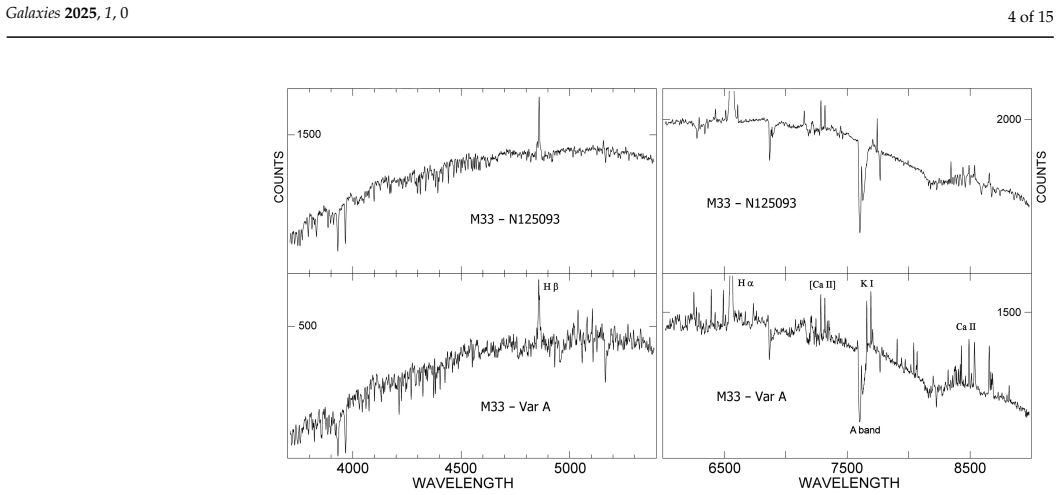
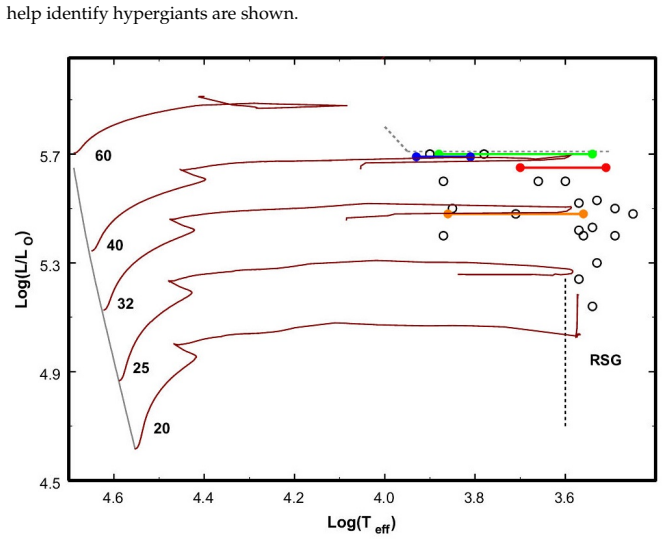
The review sets out to establish that the red and yellow hypergiants are a coherent group of the most luminous cool stars, with bolometric luminosities above $\log(L/L_\odot)\approx 5.4$ and effective temperatures below 8000 K, clustered just below the empirical luminosity ceiling for such stars. It argues that their defining property is not the ordinary, quasi-steady wind seen in normal red supergiants but extreme, episodic mass loss, including discrete ejections of roughly $10^{-2}\,M_\odot$ on timescales of order a century. The central interpretive claim is that many apparent spectral-type changes are not evolutionary: during a high mass-loss episode an optically thick wind forms a cooler 'pseudo-photosphere' whose M-type spectrum masks the underlying warmer star. On this reading, ρ Cas's three recorded outbursts, Var A's four-decade M-type state, and the recently observed red-to-yellow transition of WOH G64 are all manifestations of a single mechanism. The paper further argues that many yellow hypergiants are immediate successors of the most luminous red supergiants, currently on a blueward evolutionary loop, and that the fastest and most massive of them, such as IRC+10420, may be the immediate pre-supernova state of the most massive stars that still become red supergiants.
Load-bearing premise
The load-bearing premise is that an M-type appearance during these events is an opaque wind, not the true stellar surface; if the M-type state is a genuine photosphere, then WOH G64's transition does not demonstrate a post-red-supergiant yellow state.
Editorial extensions
If this is right
- If the pseudo-photosphere picture is right, a star classified as an M-type red hypergiant may actually be a yellow hypergiant shrouded in its own ejected wind, so population counts of true red supergiants need revisiting.
- The three documented transitions (ρ Cas, Var A, WOH G64) imply that massive stars can swing between yellow and red states on human timescales, and monitoring campaigns should catch more such events.
- Post-RSG yellow hypergiants with heavy mass loss, like IRC+10420, are plausible immediate precursors to some core-collapse supernovae, and their bipolar ejecta could be the ring structures seen around SN 1987A.
- If the most massive red supergiants skip Type II-P explosions, their absence as detected progenitors is explained without invoking a dust bias.
- Discrete outflows ejecting roughly $10^{-2}$ solar masses per event over about 100-year timescales can dominate the total mass budget of the most extreme cool supergiants.
Reading between the lines
- A testable extension: measure the apparent stellar radius at near-infrared wavelengths during a cool episode; a compact warm photosphere inside a larger cool molecular layer would support the pseudo-photosphere picture, while a genuinely enlarged cool surface would refute it.
- The review leaves implicit that if pseudo-photospheres are common, M-type classifications alone may overcount true red supergiants, because some 'M' states are yellow hypergiants hidden inside their own ejecta.
- One could look for past warm states of WOH G64 in archival photographic plates; finding an earlier yellow phase would strengthen the claim that the current red state was an eruption, not the star's normal state.
Editorial analysis
A structured set of objections, weighed in public.
Referee Report
Summary. This manuscript is a review of the observational properties, evolution, and mass-loss behavior of red and yellow hypergiants. The author proposes that the rapid spectral-type changes observed in these stars, particularly in rho Cas, Var A, and WOH G64, arise from episodic mass-loss events that form a pseudo-photosphere rather than from true stellar evolution. The paper also argues that many yellow hypergiants are immediate successors to the most luminous red supergiants, using circumstellar dust and emission-line evidence, and compiles a representative table of hypergiants with their positions on the HR diagram. It discusses recent high-resolution imaging, interferometric, and maser observations, and critically summarizes the uncertain energy source for episodic outflows.
Significance. If the pseudo-photosphere interpretation is correct, the paper offers a unified explanation for the rapid spectral variability of the most luminous cool stars and a framework for understanding post-red-supergiant evolution. It is a useful synthesis of a broad observational literature, including HST and ALMA imaging, VLBI astrometry, and long-term photometric and spectroscopic monitoring. The paper is honest about open questions, explicitly labels its more speculative suggestions, and identifies a concrete test (archival plate material for WOH G64). These strengths make it a valuable contribution to the special issue, provided the central hypothesis is presented with the appropriate caveats.
major comments (2)
- [Section 3] The discussion of WOH G64's recent transition from M-type to yellow hypergiant is presented as evidence for the pseudo-photosphere mechanism, but the paper does not demonstrate that the M-type state was an optically thick wind rather than a true photosphere. The text states that 'evidence for a warmer prior state would require examination of the earlier plate material [92],' yet then asserts 'We suggest that WHO-G64 is similar to Var A... producing a pseudo-photosphere with a cooler M type spectrum.' Since the abstract generalizes that spectral changes are 'probably due to the formation of a pseudo photopsphere,' this unsupported suggestion becomes load-bearing. Please either examine the archival plates or explicitly label the WOH G64 interpretation as tentative in the abstract and summary, and discuss the alternative that the red state was a genuine photosphere.
- [Abstract and Section 1] The term 'pseudo-photosphere' is central to the paper's thesis, but it is never defined or physically justified. The abstract states that spectral changes are 'probably due to the formation of a pseudo photopsphere during a high mass-loss episode,' yet the paper does not explain what a pseudo-photosphere is, how it differs from a true photosphere, or under what conditions an optically thick wind can mimic a cool stellar surface. This is a load-bearing concept for the review; please add a definition and a brief discussion of the physical mechanism, with references to the relevant literature on pseudo-photospheres in other contexts (e.g., LBVs or novae).
minor comments (12)
- [Abstract] The phrase 'pseudo photopsphere' should be 'pseudo-photosphere.'
- [Section 2.1] The phrase 'structure structure' is a duplicate; it should be 'structure.'
- [Section 2.3] The phrase 'he VLT/AMBER' should be 'the VLT/AMBER.'
- [Section 2.3] The word 'hyperegiants' should be 'hypergiants.'
- [Section 2.4] The word 'tmeperatures' should be 'temperatures.'
- [Section 3] The manuscript uses 'WHO G64' and 'WHO-G64' inconsistently; the correct designation, as in reference [27], is 'WOH G64.'
- [Section 3] The range '1985–11986' should be '1985–1986.'
- [Section 3] The designation 'IRC +10240' should be 'IRC +10420.'
- [Section 3] The phrase 'sill visually faint' should be 'still visually faint.'
- [Section 2.2] The expression 'L⊙ ∼ 3 × 10⁵' appears without a unit for luminosity; it should read 'L ≈ 3 × 10^5 L⊙.'
- [Throughout] The in-text mentions of 'the review by Ekström and Gregory,' 'the review by Van Loon,' 'the review by Wittkowski,' 'the review by Dupree & Montarges,' and 'the review by Van Dyk' are not accompanied by citations; if these are separate contributions to the special issue, please add explicit cross-references.
- [References] Reference [11] lists the year as '20005'; this should be '2005.'
Circularity Check
No significant circularity: the paper is a review whose interpretive claims are explicitly labeled suggestions and rest on external observations, not on self-referential definitions or fitted inputs.
full rationale
This is a review paper without a quantitative derivation chain, fitted parameters, or a uniqueness theorem, so the main circularity hazards are absent. The central interpretive step concerning WOH G64 is explicitly presented as a suggestion: 'We suggest that WHO-G64 is similar to Var A with a normal or quiescent state as a yellow hypergiant, and a probable post-RSG, that undergoes large mass-loss events producing a pseudo-photosphere with a cooler M type spectrum.' This is not a prediction derived from a fitted quantity; it is an interpretation of externally cited observations (Munoz-Sanchez et al. 2024 for the spectral transition; Humphreys et al. 2006 for Var A's behavior). The paper also honestly flags the limitation: 'Evidence for a warmer prior state would require examination of the earlier plate material.' The frequent self-citations (e.g., Jones et al. 1993, Shenoy et al. 2016, Humphreys et al. 2022) point to prior observational studies and do not reduce an argument to an unverified self-referential claim. No equation in the paper is equivalent to an input by construction, and no fitted parameter is renamed as a prediction. Thus the circularity score is 0.
Assumptions & free parameters
free parameters (1)
- Hypergiant selection threshold =
Log(Mbol) = 5.4 and Teff < 8000 K
assumptions (4)
- domain assumption MK luminosity classes and absolute magnitude calibrations identify hypergiants reliably.
- domain assumption Published evolutionary tracks for 20 to 60 solar mass, non-rotating, solar metallicity stars correctly describe post-RSG blue loops.
- domain assumption An optically thick episodic wind can create a pseudo-photosphere whose spectrum mimics a cooler star.
- domain assumption Magnetic field strengths measured in circumstellar masers and dust polarization can be extrapolated back to the stellar surface.
Cite this review
Pith. "Pith review of The Red and Yellow Hypergiants." pith.science (2026). https://pith.science/paper/UUERUBH3
@misc{pith2026250715962,
  author       = {Pith},
  title        = {Pith review of: The Red and Yellow Hypergiants},
  year         = {2026},
  howpublished = {\url{https://pith.science/paper/UUERUBH3}},
  note         = {Machine review of arXiv:2507.15962}
}
read the original abstract
The red and yellow hypergiants are a rare and important phase in the evolution of the most massive stars that can reach the cool part of the HR Diagram. The hypergiant phase is commonly characterized by high, often episodic mass-loss rates and significant changes in spectral type, probably due to the formation of a pseudo photopsphere during a high mass-loss episode. Many of the yellow hypergiants are the immediate successors to the most luminous red supergiants, and often show evidence in their dusty, circumstellar envelopes from past red supergiant activity. In this paper we review the yellow and red hypergiants with an emphasis on how they differ from more normal red supergiants.
Figures


Figures from the paper (3 more)


Reference graph
Works this paper leans on
-
[92]
Supergiant and giant M type stars in the Large Magellanic Cloud
Westerlund, B.E.; Olander, N.; Hedin, B. Supergiant and giant M type stars in the Large Magellanic Cloud. A&A Supp. 1981, 43, 267–295
1981
-
[1]
Keenan, P . C. Luminosities of the M-Type Variables of Small Range ApJ 1942, 95, 461. https://doi.org/10.1086/144418
-
[2]
Red supergiants in the Large Magellanic Cloud
Feast, M.W.; Thackeray, A.D. Red supergiants in the Large Magellanic Cloud. Mon. Not. R. Astron. Soc. 1956, 116, 587. https://doi.org/10.1093/mnras/116.5.587
-
[3]
The yellow hypergiants A&A Rev
de Jager, C. The yellow hypergiants A&A Rev. 1998, 8, 145. https://doi.org/10.1007/s001590050009
-
[4]
Classification of supergiants of types G, K, and M
Keenan, P .C. Classification of supergiants of types G, K, and M. Contrib. Kitt Peak Natl. Obs. 1971, 554, 35
1971
-
[5]
Humphreys, R.M.; Davidson, K. ApJ 1979, 232, 409. https://doi.org/10.1086/157301
doi:10.1086/157301 1979
-
[6]
Studies of luminous stars in nearby galaxies
Humphreys, R.M. Studies of luminous stars in nearby galaxies. I. Supergiants and O stars in the Milky Way. ApJ Supp. 1978, 38,
1978
-
[7]
Shenoy, D.; Humphreys, R.M.; Jones, T.J.; et al. Searching for Cool Dust in the Mid-to-Far Infrared: The Mass-Loss Histories of the Hypergiants µ Cep, VY CMa, IRC+10420, and ρ Cas. AJ 2016, 151, 51. https://doi.org/10.3847/0004-6256/151/3/51
Show all 111 references
-
[8]
Luminous and Variable Stars in M31 and M33
Gordon, M.S.; Humphreys, R.M.; Jones, T.J. Luminous and Variable Stars in M31 and M33. III. The Yellow and Red Supergiants and Post-red Supergiant Evolution. ApJ 2016, 825, 50. https://doi.org/10.3847/0004-637X/825/1/50
2016 doi
-
[9]
Thermal Emission in the Southwest Clump of VY CMa
Gordon, M.S.; Jones, T.J.; Humphreys, R.M.; et al. Thermal Emission in the Southwest Clump of VY CMa. AJ 2019, 157, 57. https://doi.org/10.3847/1538-3881/aaf5cb
2019 doi
-
[10]
The Asymmetric Nebula Surrounding the Extreme Red Supergiant Vy Canis Majoris
Smith, N.; Humphreys, R.M.; Davidson, K.; et al. The Asymmetric Nebula Surrounding the Extreme Red Supergiant Vy Canis Majoris. AJ 2001, 121, 1111. https://doi.org/10.1086/318748
2001 doi
-
[11]
High-Resolution, Long-Slit Spectroscopy of VY Canis Majoris: The Evidence for Localized High Mass Loss Events
Humphreys, R.M.; Davidson, K.; Ruch, G.; et al. High-Resolution, Long-Slit Spectroscopy of VY Canis Majoris: The Evidence for Localized High Mass Loss Events. AJ 20005, 129, 492. https://doi.org/10.1086/426565
-
[12]
The Three-Dimensional Morphology of VY Canis Majoris
Humphreys, R.M.; Helton, L.A.; Jones, T.J. The Three-Dimensional Morphology of VY Canis Majoris. I. The Kinematics of the Ejecta. AJ 2007, 133, 2716. https://doi.org/10.1086/517609
2007 doi
-
[13]
HST and Infrared Images of the Circumstellar Environment of the Cool Hypergiant IRC + 10420
Humphreys, R.M.; Smith, N.; Davidson, K.; et al. HST and Infrared Images of the Circumstellar Environment of the Cool Hypergiant IRC + 10420. AJ 1997, 114, 2778. https://doi.org/10.1086/118686
1997 doi
-
[14]
The Morphology of IRC+10420’s Circumstellar Ejecta
Tiffany, C.; Humphreys, R.M.; Jones, T.J.; et al. The Morphology of IRC+10420’s Circumstellar Ejecta. AJ 2010, 140, 339. https://doi.org/10.1088/0004-6256/140/2/339
2010 doi
-
[15]
Imaging the Cool Hypergiant NML Cygni’s Dusty Circumstellar Envelope with Adaptive Optics
Schuster, M.T., Marengo, M., Hora, J.L.; et al. Imaging the Cool Hypergiant NML Cygni’s Dusty Circumstellar Envelope with Adaptive Optics. ApJ 2009, 699, 1423. https://doi.org/10.1088/0004-637X/699/2/1423
2009 doi
-
[16]
Molecules and Outflows in NML Cygni: New Insights from a 1 mm Spectral Line Survey
Singh, A.P .; Edwards, J.L.; Humphreys, R.M.; et al. Molecules and Outflows in NML Cygni: New Insights from a 1 mm Spectral Line Survey. ApJ 2021, 920, L38. https://doi.org/10.3847/2041-8213/ac2c7c
2021 doi
-
[17]
Multiple shell ejections on a 100 yr timescale from a massive yellow hypergiant.Orig
Oudmaijer, R.D.; Koumpia, E. Multiple shell ejections on a 100 yr timescale from a massive yellow hypergiant.Orig. Outflows Evolved Stars 2022, 366, 132. https://doi.org/10.1017/S1743921322000114
2022 doi
-
[18]
Crossing the Yellow Void: Spatially Resolved Spectroscopy of the Post-Red Supergiant IRC +10420 and Its Circumstellar Ejecta
Humphreys, R.M.; Davidson, K.; Smith, N. Crossing the Yellow Void: Spatially Resolved Spectroscopy of the Post-Red Supergiant IRC +10420 and Its Circumstellar Ejecta. AJ 2002, 124, 1026. https://doi.org/10.1086/341380
2002 doi
-
[19]
High resolution spectroscopy of the post-red supergiant IRC+10420: I
Oudmaijer, R.D. High resolution spectroscopy of the post-red supergiant IRC+10420: I. The data. A&A Supp. 1998, 129, 541. https://doi.org/10.1051/aas:1998404
1998 doi
-
[20]
Exploring the Mass-loss Histories of the Red Supergiants
Humphreys, R.M.; Helmel, G.; Jones, T.J.; et al. Exploring the Mass-loss Histories of the Red Supergiants. AJ 2020, 160, 145. https://doi.org/10.3847/1538-3881/abab15
2020 doi
-
[21]
Luminous and Variable Stars in M31 and M33
Humphreys, R.M.; Davidson, K.; Grammer, S.; et al. Luminous and Variable Stars in M31 and M33. I. The Warm Hypergiants and Post-red Supergiant Evolution. ApJ 2013, 773, 46. https://doi.org/10.1088/0004-637X/773/1/46
2013 doi
-
[22]
Grids of stellar models with rotation
Ekström, S.; Georgy, C.; Eggenberger, P .; et al. Grids of stellar models with rotation. I. Models from 0.8 to 120 Modot at solar metallicity (Z = 0.014) A&A 2012 537, A146. https://doi.org/10.1051/0004-6361/201117751
2012 doi
-
[23]
Red Supergiants, Yellow Hypergiants, and Post-RSG Evolution
Gordon, M.S.; Humphreys, R.M. Red Supergiants, Yellow Hypergiants, and Post-RSG Evolution. Galaxies 2019, 7, 92. https: //doi.org/10.3390/galaxies7040092
2019 doi
-
[24]
Radiation-Driven Stellar Eruptions
Davidson, K. Radiation-Driven Stellar Eruptions. Galaxies 2020 8, 10. https://doi.org/10.3390/galaxies8010010
2020 doi
-
[25]
IRC +10420: A Cool Hypergiant near the Top of the H-R Diagram
Jones, T.J.; Humphreys, R.M.; Gehrz, R.D.; et al. IRC +10420: A Cool Hypergiant near the Top of the H-R Diagram. ApJ 1993, 411,
1993
-
[26]
M33’s Variable A: A Hypergiant Star More Than 35 YEARS in Eruption
Humphreys, R.M.; Jones, T.J.; Polomski, E.; et al. M33’s Variable A: A Hypergiant Star More Than 35 YEARS in Eruption. AJ 2006, 131, 2105. https://doi.org/10.1086/500811
2006 doi
-
[27]
The dramatic transition of the extreme Red Supergiant WOH G64 to a Yellow Hypergiant
Munoz-Sanchez, G.; Kalitsounaki, M.; de Wit, S.; et al. The dramatic transition of the extreme Red Supergiant WOH G64 to a Yellow Hypergiant. arXiv 2024, arXiv:2411.19329. https://doi.org/10.48550/arXiv.2411.19329
2024 doi
-
[28]
The death of massive stars—I
Smartt, S.J.; Eldridge, J.J.; Crockett, R.M.; et al. The death of massive stars—I. Observational constraints on the progenitors of Type II-P supernovae. Mon. Not. R. Astron. Soc. 2009, 395, 1409. https://doi.org/10.1111/j.1365-2966.2009.14506.x
2009
-
[29]
The evolution of red supergiants to supernova in NGC 2100
Beasor, E.R.; Davies, B. The evolution of red supergiants to supernova in NGC 2100. Mon. Not. R. Astron. Soc. 2016, 463, 1269. https://doi.org/10.1093/mnras/stw2054
2016 doi
- [30]
-
[31]
Circumstellar dust as a solution to the red supergiant supernova progenitor problem
Walmswell, J.J.; Eldridge, J.J. Circumstellar dust as a solution to the red supergiant supernova progenitor problem. Mon. Not. R. Astron. Soc. 2012, 419, 2054. https://doi.org/10.1111/j.1365-2966.2011.19860.x. Galaxies 2025, 1, 0 13 of 15
2012
-
[32]
The dusty progenitor star of the Type II supernova 2017eaw.Mon
Kilpatrick, C.D.; Foley, R.J. The dusty progenitor star of the Type II supernova 2017eaw.Mon. Not. R. Astron. Soc. 2018, 481, 2536. https://doi.org/10.1093/mnras/sty2435
2018 doi
-
[33]
Discrepancies in the ages of young star clusters; evidence for mergers? MNRAS 2019, em 486, 266
Beasor, E.R.; Davies, B.; Smith, N.; et al. Discrepancies in the ages of young star clusters; evidence for mergers? MNRAS 2019, em 486, 266. https://doi.org/10.1093/mnras/stz732
2019 doi
-
[34]
The yellow hypergiant HR 5171 A: Resolving a massive interacting binary in the common envelope phase
Chesneau, O.; Meilland, A.; Chapellier, E.; et al. The yellow hypergiant HR 5171 A: Resolving a massive interacting binary in the common envelope phase. A&A 2014, 563, A71. https://doi.org/10.1051/0004-6361/201322421
2014 doi
-
[35]
Hubble Space Telescope Snapshot Survey of Post-AGB Objects
Siódmiak, N.; Meixner, M.; Ueta, T.; et al. Hubble Space Telescope Snapshot Survey of Post-AGB Objects. ApJ 2008, 677, 382. https://doi.org/10.1086/529115
2008 doi
-
[36]
Optical and near-infrared observations of the Fried Egg Nebula
Koumpia, E.; Oudmaijer, R.D.; Graham, V .; et al. Optical and near-infrared observations of the Fried Egg Nebula. Multiple shell ejections on a 100 yr timescale from a massive yellow hypergiant. A&A 2020, 635, A183. https://doi.org/10.1051/0004-6361/20 1936177
2020 doi
-
[37]
MIRAC: A mid-infrared array camera for astronomy.Proc
Hoffmann, W.F.; Fazio, G.G.; Shivanandan, K.; et al. MIRAC: A mid-infrared array camera for astronomy.Proc. SPIE 1993, 1946,
1993
-
[38]
The Recent Mass Loss History of the Hypergiant RW Cep
Jones, T.J.; Shenoy, D.; Humphreys, R. The Recent Mass Loss History of the Hypergiant RW Cep. Res. Notes Am. Astron. Soc. 2023, 7, 92. https://doi.org/10.3847/2515-5172/acd37f
2023 doi
-
[39]
Adaptive Optics Imaging of VY Canis Majoris at 2–5µm with LBT/LMIRCam
Shenoy, D.P .; Jones, T.J.; Humphreys, R.M.; et al. Adaptive Optics Imaging of VY Canis Majoris at 2–5µm with LBT/LMIRCam. AJ 2013, 146, 90. https://doi.org/10.1088/0004-6256/146/4/90
2013 doi
-
[40]
Investigating mass loss from RSG and AGB stars using the new VLTI-MATISSE imaging instrument
Wittkowski, M.; Chiavassa, A.; Baron, F.; et al. Investigating mass loss from RSG and AGB stars using the new VLTI-MATISSE imaging instrument. In Proceedings of the 20.5th Cambridge Workshop on Cool Stars, Stellar Systems, and the Sun (CS20.5), Online, 2–4 March 2021; Volume 3...
2021 doi
-
[41]
Imaging the innermost circumstellar environment of the red supergiant WOH G64 in the Large Magellanic Cloud
Ohnaka, K., Hofmann, K.-H., Weigelt, G., et al. Imaging the innermost circumstellar environment of the red supergiant WOH G64 in the Large Magellanic Cloud. A&A 2024, 691, L15. doi:10.1051/0004-6361/202451820
2024 doi
-
[42]
Large dust grains in the wind of VY Canis Majoris
Scicluna, P .; Siebenmorgen, R.; Wesson, R.; et al. Large dust grains in the wind of VY Canis Majoris. A&A 2015, 584, L10. https://doi.org/10.1051/0004-6361/201527563
2015 doi
-
[43]
Fundamental properties and atmospheric structure of the red supergiant VY Canis Majoris based on VLTI/AMBER spectro-interferometry.A&A 2012, 540, L12
Wittkowski, M.; Hauschildt, P .H.; Arroyo-Torres, B.; et al. Fundamental properties and atmospheric structure of the red supergiant VY Canis Majoris based on VLTI/AMBER spectro-interferometry.A&A 2012, 540, L12. https://doi.org/10.1051/0004-6361/2012 19126
2012 doi
-
[44]
Tracing a decade of activity towards a yellow hypergiant
Koumpia, E.; Oudmaijer, R.D.; de Wit, W.-J.; et al. Tracing a decade of activity towards a yellow hypergiant. The spectral and spatial morphology of IRC+10420 at au scales. Mon. Not. R. Astron. Soc. 2022, 515, 2766. https://doi.org/10.1093/mnras/stac1998
2022 doi
-
[45]
Optical Interferometry of Giants and Supergiants
Kloppenborg, B.; van Belle, G. Optical Interferometry of Giants and Supergiants. In Giants of Eclipse: Theζ Aurigae Stars and Other Binary Systems; Springer: Cham, Switzerland, 2015; Volume 408, pp. 157–168. https://doi.org/10.1007/978-3-319-09198-3_6
2015 doi
-
[46]
First 2.2 micron Results From the IOTA Interferometer
Dyck, H.M.; Benson, J.A.; Carleton, N.P .; et al. First 2.2 micron Results From the IOTA Interferometer. AJ 1995, 109, 378. https://doi.org/10.1086/117282
1995 doi
-
[47]
First Surface-resolved Results with the Infrared Optical Telescope Array Imaging Interferometer: Detection of Asymmetries in Asymptotic Giant Branch Stars
Ragland, S.; Traub, W.A.; Berger, J.-P .; et al. First Surface-resolved Results with the Infrared Optical Telescope Array Imaging Interferometer: Detection of Asymmetries in Asymptotic Giant Branch Stars. ApJ 2006, 652, 650. https://doi.org/10.1086/507453
2006 doi
-
[48]
Time Evolution Images of the Hypergiant RW Cephei during the Rebrightening Phase Following the Great Dimming
Anugu, N.; Gies, D.R.; Roettenbacher, R.M.; et al. Time Evolution Images of the Hypergiant RW Cephei during the Rebrightening Phase Following the Great Dimming. ApJ 2024, 973, L5. https://doi.org/10.3847/2041-8213/ad736c
2024 doi
-
[49]
Long Term Evolution of Surface Features on the Red Supergiant AZ Cyg
Norris, R.P .; Baron, F.R.; Monnier, J.D.; et al. Long Term Evolution of Surface Features on the Red Supergiant AZ Cyg. ApJ 2021, 919, 124. https://doi.org/10.3847/1538-4357/ac0c7e
2021 doi
-
[50]
CHARA Near-infrared Imaging of the Yellow Hypergiant Starρ Cassiopeiae: Convection Cells and Circumstellar Envelope
Anugu, N.; Baron, F.; Monnier, J.D.; et al. CHARA Near-infrared Imaging of the Yellow Hypergiant Starρ Cassiopeiae: Convection Cells and Circumstellar Envelope. ApJ 2024, 974, 113. https://doi.org/10.3847/1538-4357/ad6b2b
2024 doi
-
[51]
Massive dust clumps in the envelope of the red supergiant VY Canis Majoris
Kami ´ nski, T. Massive dust clumps in the envelope of the red supergiant VY Canis Majoris. A&A 2019, 627, A114. https: //doi.org/10.1051/0004-6361/201935408
2019 doi
-
[52]
ALMA observations of TiO 2 around VY Canis Majoris
De Beck, E.; Vlemmings, W.; Muller, S.; et al. ALMA observations of TiO 2 around VY Canis Majoris. A&A 2015, 580, A36. https://doi.org/10.1051/0004-6361/201525990
2015 doi
-
[53]
ALMA Reveals Hidden Morphologies in the Molecular Envelope of VY Canis Majoris
Singh, A.P .; Richards, A.M.S.; Humphreys, R.M.; et al. ALMA Reveals Hidden Morphologies in the Molecular Envelope of VY Canis Majoris. ApJ 2023, 954, L1. https://doi.org/10.3847/2041-8213/ace7cb
2023 doi
-
[54]
ALMA Compact Array observations of the Fried Egg nebula
Wallström, S.H.J.; Lagadec, E.; Muller, S.; et al. ALMA Compact Array observations of the Fried Egg nebula. Evidence for large-scale asymmetric mass-loss from the yellow hypergiant IRAS 17163-3907. A&A 2017, 597, A99. https://doi.org/10.1051/00 04-6361/201628416
2017 doi
-
[55]
Probing the Mass-Loss History of the Yellow Hypergiant IRC+10420.ApJ 2009, 697, 409
Muller, S.; Lim, J.; Kwok, S.; Muthu, C. Probing the Mass-Loss History of the Yellow Hypergiant IRC+10420.ApJ 2009, 697, 409. https://doi.org/10.1088/0004-637X/697/1/409
2009 doi
-
[56]
ALMA-resolved salt emission traces the chemical footprint and inner wind morphology of VY Canis Majoris
Decin, L.; Richards, A.M.S.; Millar, T.J.; et al. ALMA-resolved salt emission traces the chemical footprint and inner wind morphology of VY Canis Majoris. A&A 2016, 592, A76. https://doi.org/10.1051/0004-6361/201527934
2016 doi
-
[57]
Simultaneous VLBA polarimetric observations of the v = {1,2} J = 1–0 and v = 1, J = 2–1 SiO maser emission towards VY CMa: Maser morphology and pumping
Richter, L.; Kemball, A.; Jonas, J. Simultaneous VLBA polarimetric observations of the v = {1,2} J = 1–0 and v = 1, J = 2–1 SiO maser emission towards VY CMa: Maser morphology and pumping. Mon. Not. R. Astron. Soc. 2013, 436, 1708. https: //doi.org/10.1093/mnras/stt1686
2013 doi
-
[58]
MERLIN observations of water maser proper motions in VY Canis Majoris
Richards, A.M.S.; Yates, J.A.; Cohen, R.J. MERLIN observations of water maser proper motions in VY Canis Majoris. Mon. Not. R. Astron. Soc. 1998, 299, 319. https://doi.org/10.1046/j.1365-8711.1998.01386.x. Galaxies 2025, 1, 0 14 of 15
1998
-
[59]
The radially expanding molecular outflow of VX Sagittarii
Murakawa, K.; Yates, J.A.; Richards, A.M.S.; et al. The radially expanding molecular outflow of VX Sagittarii. Mon. Not. R. Astron. Soc. 2003, 344, 1. https://doi.org/10.1046/j.1365-8711.2003.06626.x
2003
-
[60]
Dense Molecular Clumps in the Envelope of the Yellow Hypergiant IRC+10420
tat Wong, K.; Lim, J. Dense Molecular Clumps in the Envelope of the Yellow Hypergiant IRC+10420. ApJ 2017, 851, 65. https://doi.org/10.3847/1538-4357/aa932b
2017 doi
-
[61]
Distance and Kinematics of the Red Hypergiant VY CMa: Very Long Baseline Array and Very Large Array Astrometry.ApJ 2012, 744, 23
Zhang, B.; Reid, M.J.; Menten, K.M.; et al. Distance and Kinematics of the Red Hypergiant VY CMa: Very Long Baseline Array and Very Large Array Astrometry.ApJ 2012, 744, 23. https://doi.org/10.1088/0004-637X/744/1/23
2012 doi
-
[62]
Distance to VY Canis Majoris with VERA
Choi, Y.K.; Hirota, T.; Honma, M.; et al. Distance to VY Canis Majoris with VERA. Publ. Astron. Soc. Jpn. 2008, 60, 1007–1012. https://doi.org/10.1093/pasj/60.5.1007
2008 doi
-
[63]
Measuring the Distance of VX Sagittarii with SiO Maser Proper Motions
Chen, X.; Shen, Z.-Q.; Xu, Y. Measuring the Distance of VX Sagittarii with SiO Maser Proper Motions. Chin. J. Astron. Astrophys. 2007, 7, 531. https://doi.org/10.1088/1009-9271/7/4/09
2007 doi
-
[64]
Evolved massive stars at low-metallicity V
Yang, M.; Bonanos, A.Z.; Jiang, B.; et al. Evolved massive stars at low-metallicity V . Mass-loss rate of red supergiant stars in the Small Magellanic Cloud. A&A 2023, 676, A84. https://doi.org/10.1051/0004-6361/202244770
2023 doi
-
[65]
Mass-loss Rate of Highly Evolved Stars in the Magellanic Clouds
Wen, J.; Yang, M.; Gao, J.; et al. Mass-loss Rate of Highly Evolved Stars in the Magellanic Clouds. ApJ Supp. 2024, 275, 33. https://doi.org/10.3847/1538-4365/ad7b33
2024 doi
-
[66]
ALMA observations of anisotropic dust mass loss in the inner circumstellar environment of the red supergiant VY Canis Majoris
O’Gorman, E.; Vlemmings, W.; Richards, A.M.S.; et al. ALMA observations of anisotropic dust mass loss in the inner circumstellar environment of the red supergiant VY Canis Majoris. A&A 2015, 573, L1. https://doi.org/10.1051/0004-6361/201425101
2015 doi
-
[67]
The Hidden Clumps in VY CMa Uncovered by the Atacama Large Millimeter/submillimeter Array
Humphreys, R.M.; Richards, A.M.S.; Davidson, K.; et al. The Hidden Clumps in VY CMa Uncovered by the Atacama Large Millimeter/submillimeter Array. AJ 2024, 167, 94. https://doi.org/10.3847/1538-3881/ad1dd7
2024 doi
-
[68]
OH/IR Stars in the Magellanic Clouds.ApJ 1992 397, 552
Wood, P .R.; Whiteoak, J.B.; Hughes, S.M.G.; et al. OH/IR Stars in the Magellanic Clouds.ApJ 1992 397, 552. https://doi.org/10.1 086/171812
1992
-
[69]
Instabilities in the yellow hypergiant domain
Glatzel, W.; Kraus, M. Instabilities in the yellow hypergiant domain. Mon. Not. R. Astron. Soc. 2024, 529, 4947–4957. https: //doi.org/10.1093/mnras/stae861
2024 doi
-
[70]
https://doi.org/10.1111/j.1745-3933.2012.01264.x
Quataert, E.; Shiode, J.Wave-driven mass loss in the last year of stellar evolution: Setting the stage for the most luminous core-collapse supernovae MNRAS 2012 423, L92. https://doi.org/10.1111/j.1745-3933.2012.01264.x
2012
-
[71]
A Diversity of Wave-driven Presupernova OutburstsApJ 2021, 906, 3
Wu, S.; Fuller, J. A Diversity of Wave-driven Presupernova OutburstsApJ 2021, 906, 3. https://doi.org/10.3847/1538-4357/abc87c
2021 doi
-
[72]
2022, Episodic Gaseous Outflows and Mass Loss from Red Supergiants
Humphreys, R.M.; Jones, T.J. 2022, Episodic Gaseous Outflows and Mass Loss from Red Supergiants. AJ 2022, 163, 103. https://doi.org/10.3847/1538-3881/ac46ff
2022 doi
-
[73]
The close circumstellar environment of Betelgeuse
Kervella, P .; Perrin, G.; Chiavassa, A.; et al. The close circumstellar environment of Betelgeuse. II. Diffraction-limited spectro- imaging from 7.76 to 19.50 µm with VLT/VISIR. A&A 2011, 531, A117. https://doi.org/10.1051/0004-6361/201116962
2011 doi
-
[74]
The Great Dimming of Betelgeuse: The photosphere as revealed by tomography over the past 15 yr
Jadlovský, D.; Granzer, T.; Weber, M.; et al. The Great Dimming of Betelgeuse: The photosphere as revealed by tomography over the past 15 yr. A&A 2024, 685, A124. https://doi.org/10.1051/0004-6361/202348846
2024 doi
-
[75]
Three-dimensional imaging of convective cells in the photosphere of Betelgeuse
López Ariste, A.; Georgiev, S.; Mathias, P .; et al. Three-dimensional imaging of convective cells in the photosphere of Betelgeuse. A&A 2022, 661, A91. https://doi.org/10.1051/0004-6361/202142271
2022 doi
-
[76]
The Three-Dimensional Morphology of VY Canis Majoris
Jones, T.J.; Humphreys, R.M.; Helton, L.A.; et al. The Three-Dimensional Morphology of VY Canis Majoris. II. Polarimetry and the Line-of-Sight Distribution of the Ejecta. AJ 2007 133, 2730. https://doi.org/10.1086/517610
2007 doi
-
[77]
Global Energetics of Thirty-Eight Large Solar Eruptive Events
Emslie, A.G.; Dennis, B.R.; Shih, A.Y.; et al. Global Energetics of Thirty-Eight Large Solar Eruptive Events. ApJ 2012, 759, 71. https://doi.org/10.1088/0004-637X/759/1/71
2012 doi
-
[78]
Constraints on the Surface Magnetic Fields and Age of a Cool Hypergiant: Xmm-Newton X-ray Observations of VY CMa
Montez, R.; Kastner, J.H.; Humphreys, R.M.; et al. Constraints on the Surface Magnetic Fields and Age of a Cool Hypergiant: Xmm-Newton X-ray Observations of VY CMa. ApJ 2015, 800, 4. https://doi.org/10.1088/0004-637X/800/1/4
2015 doi
-
[79]
Images of Betelgeuse with VLTI/MATISSE across the Great Dimming.Mon
Drevon, J.; Millour, F.; Cruzalèbes, P .; et al. Images of Betelgeuse with VLTI/MATISSE across the Great Dimming.Mon. Not. R. Astron. Soc. 2024, 527, L88. https://doi.org/10.1093/mnrasl/slad138
2024 doi
-
[80]
Non-detection of Betelgeuse in X-rays
Kashyap, V .L.; Drake, J.J.; Patnaude, D. Non-detection of Betelgeuse in X-rays. InThe Astronomer’s Telegram; SAO Astrophysics Data System: Cambridge, MA, USA, 2020; p. 13501
2020
-
[81]
Magnetic fields of red giants and supergiants: A review of spectropolarimetric observations
Plachinda, S.; Butkovskaya, V .; Shulyak, D.; et al. Magnetic fields of red giants and supergiants: A review of spectropolarimetric observations. Acta Astrophys. Taurica 2022, 3, 6. https://doi.org/10.31059/aat.vol3.iss1.pp6-11
2022 doi
-
[82]
Circular polarization of water masers in the circumstellar envelopes of late type stars
Vlemmings, W.H.T.; Diamond, P .J.; van Langevelde, H.J. Circular polarization of water masers in the circumstellar envelopes of late type stars. A&A 2002, 394, 589. https://doi.org/10.1051/0004-6361:20021166
2002 doi
-
[83]
The magnetic field around late-type stars revealed by the circumstellar H2O masers
Vlemmings, W.H.T.; van Langevelde, H.J.; Diamond, P .J. The magnetic field around late-type stars revealed by the circumstellar H2O masers. A&A 2005, 434, 1029. https://doi.org/10.1051/0004-6361:20042488
2005 doi
-
[84]
Magnetically aligned dust and SiO maser polarisation in the envelope of the red supergiant VY Canis Majoris
Vlemmings, W.H.T.; Khouri, T.; Martí-Vidal, I.; et al. Magnetically aligned dust and SiO maser polarisation in the envelope of the red supergiant VY Canis Majoris. A&A 2017, 603, A92. https://doi.org/10.1051/0004-6361/201730735
2017 doi
-
[85]
Interstellar Dust Grain Alignment
Andersson, B.-G.; Lazarian, A.; Vaillancourt, J.E. Interstellar Dust Grain Alignment. ARAA 2015, 53, 501. https://doi.org/10.114 6/annurev-astro-082214-122414
2015
-
[86]
The magnetic field of Betelgeuse: A local dynamo from giant convection cells? A&A 2010, 516, L2
Aurière, M.; Donati, J.-F.; Konstantinova-Antova, R.; et al. The magnetic field of Betelgeuse: A local dynamo from giant convection cells? A&A 2010, 516, L2. https://doi.org/10.1051/0004-6361/201014925
2010 doi
-
[87]
Double Lines in the Spectrum of ρ Cassiopeiae
Bidelman, W.P .; McKellar, A. Double Lines in the Spectrum of ρ Cassiopeiae. Publ. Astron. Soc. Pac. 1957, 69, 31. https: //doi.org/10.1086/127009
1957 doi
-
[88]
Spectral variability of the supergiant rho CAS in 1985–1986.Tartu Astrofuus
Boyarchuk, A.A.; Boyarchuk, M.E.; Petrov, P .P . Spectral variability of the supergiant rho CAS in 1985–1986.Tartu Astrofuus. Obs. Teated 1998, 92, 40. Galaxies 2025, 1, 0 15 of 15
1985
-
[89]
High-Resolution Spectroscopy of the Yellow Hypergiantρ Cassiopeiae from 1993 through the Outburst of 2000–2001
Lobel, A.; Dupree, A.K.; Stefanik, R.P .; et al. High-Resolution Spectroscopy of the Yellow Hypergiantρ Cassiopeiae from 1993 through the Outburst of 2000–2001. ApJ 2003, 583, 923. https://doi.org/10.1086/345503
1993 doi
-
[90]
The Enigmatic Object Variable A in M33
Humphreys, R.M.; Jones, T.J.; Gehrz, R.D. The Enigmatic Object Variable A in M33. AJ 1987, 94, 315. https://doi.org/10.1086/11 4473
1987 doi
-
[91]
Two Supergiants in the Large Magellanic Cloud with Thick Dust Shells.ApJ 1986, 302,
Elias, J.H.; Frogel, J.A.; Schwering, P .B.W. Two Supergiants in the Large Magellanic Cloud with Thick Dust Shells.ApJ 1986, 302,
1986
-
[93]
Yellow Supergiants and Post-red Supergiant Evolution in the Large Magellanic Cloud
Humphreys, R.M.; Jones, T.J.; Martin, J.C. Yellow Supergiants and Post-red Supergiant Evolution in the Large Magellanic Cloud. AJ 2023 166, 50. https://doi.org/10.3847/1538-3881/acdd6c
2023 doi
-
[94]
The Properties of Fast Yellow Pulsating Supergiants: FYPS Point the Way to Missing Red Supergiants ApJ 2022, 940, 27–51
Dorn-Wallenstein, T.Z.; Levesque, E.M.; Davenport, J.R.A.; et al. The Properties of Fast Yellow Pulsating Supergiants: FYPS Point the Way to Missing Red Supergiants ApJ 2022, 940, 27–51. https://doi.org/10.3847/1538-4357/ac79b2
2022 doi
-
[95]
Short-term Variability of Evolved Massive Stars with TESS
Dorn-Wallenstein, T.Z.; Levesque, E.M.; Neugent, K.F.; et al. Short-term Variability of Evolved Massive Stars with TESS. II. A New Class of Cool, Pulsating Supergiants. ApJ 2020, 902, 24. https://doi.org/10.3847/1538-4357/abb318
2020 doi
-
[96]
Mitteilungen über neuentdeckte Veränderliche Sterne
Hoffmeister, C. Mitteilungen über neuentdeckte Veränderliche Sterne. Astron. Nachrichten 1964, 288, 49. https://doi.org/10.1002/ asna.19652880402
1964
-
[97]
Photometric histories of six infrared objects and three highly reddened blue supergiants
Gottlieb, E.W.; Liller, W. Photometric histories of six infrared objects and three highly reddened blue supergiants. ApJ 1978, 225,
1978
-
[98]
IRC+10420—Another Eta Carinae?ApJ 1973, 179, L49
Humphreys, R.M.; Strecker, D.W.; Murdock, T.L.; et al. IRC+10420—Another Eta Carinae?ApJ 1973, 179, L49. https://doi.org/10 .1086/181114
1973
-
[99]
Discovery of near-infrared hydrogen line emission in the peculiar F8 hypergiant IRC +10420
Oudmaijer, R.D.; Geballe, T.R.; Waters, L.B.F.M.; et al. Discovery of near-infrared hydrogen line emission in the peculiar F8 hypergiant IRC +10420. A&A 1994, 281, L33
1994
-
[100]
Integral-Field Spectroscopy of the Post-Red Supergiant IRC +10420: Evidence for an Axisymmetric Wind
Davies, B.; Oudmaijer, R.D.; Sahu, K.C. Integral-Field Spectroscopy of the Post-Red Supergiant IRC +10420: Evidence for an Axisymmetric Wind. ApJ 2007, 671, 2059. https://doi.org/10.1086/523692
2007 doi
-
[101]
Probing Hypergiant Mass Loss with Adaptive Optics Imaging and Polarimetry in the Infrared: MMT-Pol and LMIRCam Observations of IRC +10420 and VY Canis Majoris
Shenoy, D.P .; Jones, T.J.; Packham, C.; et al. Probing Hypergiant Mass Loss with Adaptive Optics Imaging and Polarimetry in the Infrared: MMT-Pol and LMIRCam Observations of IRC +10420 and VY Canis Majoris. AJ 2015, 150, 15. https://doi.org/10.1088/ 0004-6256/150/1/15
2015
-
[102]
Deep JWST/NIRCam imaging of Supernova 1987A
Matsuura, M.; Boyer, M.; Arendt, R.G.; et al. Deep JWST/NIRCam imaging of Supernova 1987A. Mon. Not. R. Astron. Soc. 2024, 532, 3625. https://doi.org/10.1093/mnras/stae1032
2024 doi
-
[103]
Velocity structure of the ring nebula around supernova 1987A
Crotts, A.P .; Heathcote, S.R. Velocity structure of the ring nebula around supernova 1987A. Nature 1991, 350, 683. https: //doi.org/10.1038/350683a0
1991 doi
-
[104]
Multiple ring nebulae around blue supergiants
Chita, S.M.; Langer, N.; van Marle, A.J.; et al. Multiple ring nebulae around blue supergiants. A&A 2008, 488, L37. https: //doi.org/10.1051/0004-6361:200810087
2008 doi
-
[105]
Forming equatorial rings around dying stars.Mon
Akashi, M.; Sabach, E.; Yogev, O.; et al. Forming equatorial rings around dying stars.Mon. Not. R. Astron. Soc. 2015, 453, 2115. https://doi.org/10.1093/mnras/stv1666
2015 doi
-
[106]
The Progenitor of SN 1987A P ASP1992 104, 717
Podsiadlowski, P . The Progenitor of SN 1987A P ASP1992 104, 717. https://doi.org/10.1086/133043. Disclaimer/Publisher’s Note: The statements, opinions and data contained in all publications are solely those of the individual author(s) and contributor(s) and not of MDPI and/or...
-
[309]
https://doi.org/10.1086/190559
-
[323]
https://doi.org/10.1086/172832
-
[449]
https://doi.org/10.1117/12.158697
-
[488]
https://doi.org/10.1086/156509
-
[675]
https://doi.org/10.1086/164028
Reviewed August 6, 2026 · model on record in the stance chip above.
Discussion (0). Continue with ORCID to comment.