A further investigation on covering systems with odd moduli
Pith reviewed 2026-05-19 04:18 UTC · model grok-4.3
The pith
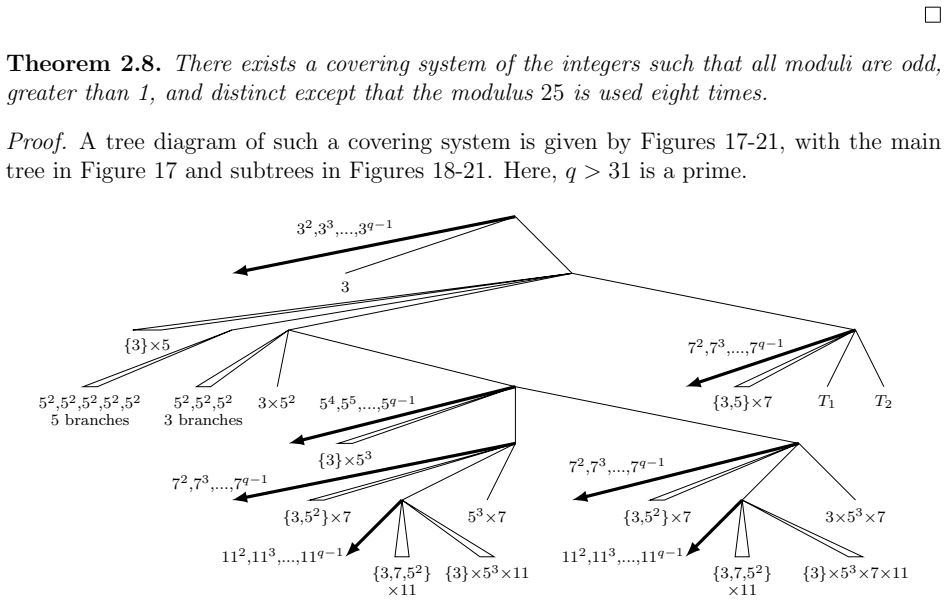
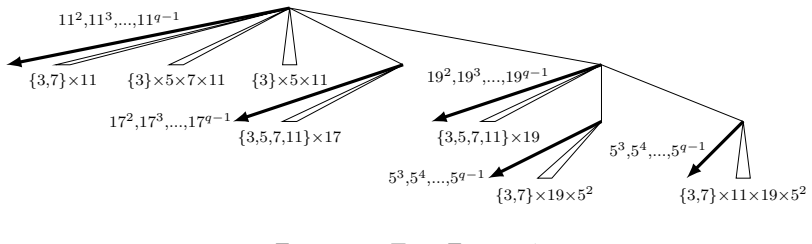
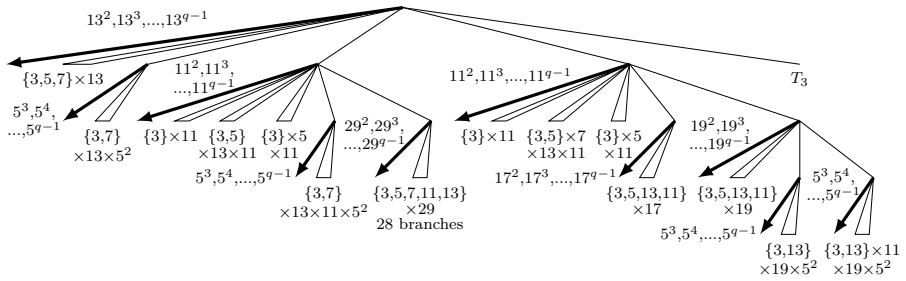
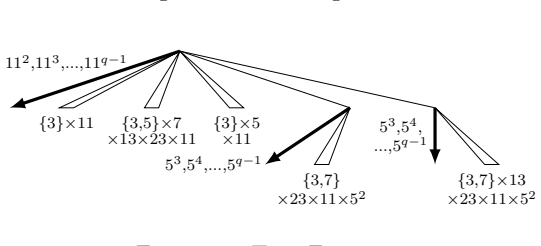
Covering systems with odd moduli exist when exactly one modulus is repeated and the rest are distinct odds greater than 1.
A machine-rendered reading of the paper's core claim, the machinery that carries it, and where it could break.
Core claim
The authors exhibit a finite list of odd moduli, one of which is repeated, together with a residue for each, such that the union of the corresponding arithmetic progressions covers every integer.
What carries the argument
The union of residue classes a_i mod m_i where the m_i are odd, exactly one m appears twice, and all other m_i are distinct odd integers greater than 1.
If this is right
- Coverings of the integers are possible using only odd moduli once one repetition is permitted.
- The single repeated modulus eliminates the gaps that appear when all moduli must be distinct.
- The explicit moduli and residues provide a verifiable example that can be checked directly by modular arithmetic.
- The variant of the covering problem with exactly one allowed repetition admits a positive solution.
Where Pith is reading between the lines
- If one repetition is enough, the minimal number of repetitions required for an all-odd covering could be determined by further constructions.
- The same method of selective repetition might be applied to coverings that obey additional constraints on the size or distribution of the moduli.
- Computational searches could locate similar systems with smaller largest modulus or fewer total congruences.
Load-bearing premise
The chosen list of odd moduli with one repetition and their residues actually covers every integer without leaving any uncovered.
What would settle it
Finding an integer that satisfies none of the stated congruences in the explicit system would disprove the covering.
Figures



read the original abstract
Erd\H{o}s first introduced the idea of covering systems in 1950. Since then, much of the work in this area has concentrated on identifying covering systems that meet specific conditions on their moduli. Among the central open problems in this field is the well-known odd covering problem. In this paper, we investigate a variant of that problem, where one odd integer is permitted to appear multiple times as a modulus in the covering system, while all remaining moduli are distinct odd integers greater than 1.
Editorial analysis
A structured set of objections, weighed in public.
Referee Report
Summary. The paper constructs an explicit covering system consisting of odd moduli in which exactly one modulus appears twice and all others are distinct odd integers greater than 1; the union of the corresponding residue classes is asserted to cover every integer.
Significance. If the explicit list is correct, the result supplies a concrete positive instance for a natural relaxation of the odd covering problem, demonstrating that a single repetition suffices to produce an odd covering. This narrows the search space for the classical problem and supplies a falsifiable finite object that can be checked directly.
major comments (1)
- [Section describing the constructed system] The load-bearing step is the verification that the listed system covers every residue class modulo L = lcm(m_i). The manuscript asserts coverage but does not exhibit the enumeration of residues mod L or an independent certificate (e.g., a short program or table of covered classes). A single uncovered residue would falsify the central existence claim.
minor comments (1)
- [Construction section] Notation for the repeated modulus and the corresponding residues should be made uniform across the construction and any accompanying table.
Simulated Author's Rebuttal
We thank the referee for their careful reading of the manuscript and for identifying the need for explicit verification of the covering property. This is a valid and important point that improves the clarity and rigor of the presentation. We address the comment below and will revise the manuscript accordingly.
read point-by-point responses
-
Referee: The load-bearing step is the verification that the listed system covers every residue class modulo L = lcm(m_i). The manuscript asserts coverage but does not exhibit the enumeration of residues mod L or an independent certificate (e.g., a short program or table of covered classes). A single uncovered residue would falsify the central existence claim.
Authors: We agree that the current manuscript asserts the covering property without supplying an explicit enumeration or computational certificate, which leaves the central claim less immediately verifiable. The system is given by an explicit finite list of odd moduli (with exactly one repeated) and corresponding residues, so the lcm L is well-defined and finite; in principle the coverage can be checked by determining whether the union of the residue classes meets every integer modulo L. To address the referee's concern directly, the revised version will include a short, self-contained Python script (or equivalent pseudocode) that computes L, generates all residues modulo L, and confirms that each is covered by at least one congruence in the system. This addition supplies the requested independent certificate without altering the mathematical content or the explicit construction itself. We have performed the verification internally and are confident the system is correct, but we accept that the manuscript should make this verification transparent to the reader. revision: yes
Circularity Check
Explicit construction supplies an independent existence witness with no self-referential reduction.
full rationale
The paper advances an existence claim for a covering system by exhibiting a concrete finite collection of odd moduli (with exactly one repeated) together with residues. Verification that the union of the corresponding residue classes equals Z is a finite, externally decidable check over the lcm of the moduli and does not rely on any fitted parameter, self-definition, or load-bearing self-citation whose justification collapses back into the present manuscript. No equation or derivation step equates the claimed covering property to a quantity defined inside the paper itself; the construction therefore stands as self-contained evidence against external benchmarks.
Axiom & Free-Parameter Ledger
axioms (1)
- standard math Every integer belongs to at least one arithmetic progression in the collection.
Lean theorems connected to this paper
-
IndisputableMonolith/Foundation/AlexanderDuality.leanalexander_duality_circle_linking unclear?
unclearRelation between the paper passage and the cited Recognition theorem.
We investigate a variant of that problem, where one odd integer is permitted to appear multiple times as a modulus in the covering system, while all remaining moduli are distinct odd integers greater than 1.
-
IndisputableMonolith/Foundation/ArithmeticFromLogic.leanembed_strictMono_of_one_lt unclear?
unclearRelation between the paper passage and the cited Recognition theorem.
A tree diagram of such a covering system when p=17 is given by Figures 1-6...
What do these tags mean?
- matches
- The paper's claim is directly supported by a theorem in the formal canon.
- supports
- The theorem supports part of the paper's argument, but the paper may add assumptions or extra steps.
- extends
- The paper goes beyond the formal theorem; the theorem is a base layer rather than the whole result.
- uses
- The paper appears to rely on the theorem as machinery.
- contradicts
- The paper's claim conflicts with a theorem or certificate in the canon.
- unclear
- Pith found a possible connection, but the passage is too broad, indirect, or ambiguous to say the theorem truly supports the claim.
Reference graph
Works this paper leans on
-
[1]
P. Balister, B. Bollab´ as, R. Morris, J. Sahasrabudhe, and M. Tiba, On the Erd˝ os covering problem: the density of the uncovered set, Invent. Math. 228 (228), 377–414
-
[2]
Erd˝ os, On integers of the form 2k +p and some related problems, Summa Brasil
P. Erd˝ os, On integers of the form 2k +p and some related problems, Summa Brasil. Math. 2 (1950), 113–123
work page 1950
-
[3]
M. Filaseta and W. Harvey, Covering subsets of the integers by congruences, Acta Arith. 182 (2018), 43–72
work page 2018
-
[4]
Harrington, Two questions concerning covering systems, Int
J. Harrington, Two questions concerning covering systems, Int. J. Number Theory 11 (2015), 1739–1750
work page 2015
- [5]
-
[6]
J. Harrington, Y. Sun, T.W.H. Wong, Covering systems with odd moduli, Discrete Math. 345 (2022), Paper No. 112936
work page 2022
-
[7]
Touchard, On prime numbers and perfect numbers, Scripta Math
J. Touchard, On prime numbers and perfect numbers, Scripta Math. 19 (1953), 35–39. 14
work page 1953
discussion (0)
Sign in with ORCID, Apple, or X to comment. Anyone can read and Pith papers without signing in.