Genus Zero Kashiwara-Vergne Solutions from Braids
Pith reviewed 2026-05-19 04:08 UTC · model grok-4.3
The pith
Equivalences between braid and chord diagram moperads produce genus zero KV solutions
A machine-rendered reading of the paper's core claim, the machinery that carries it, and where it could break.
Core claim
Using the language of moperads, any equivalence between the moperad of parenthesized braids with a frozen strand and the moperad of chord diagrams gives rise to a family of genus zero KV solutions operadically generated by a single classical KV solution. The Grothendieck-Teichmüller module groups act on the latter, intertwining the actions of the KV symmetry groups. In the other direction, any symmetric KV solution gives rise to a module map from parenthesized braids with a frozen strand to tangential automorphisms of free Lie algebras, which factors through the moperad of chord diagrams if and only if the associated KV associator is a Drinfeld associator.
What carries the argument
Equivalences between the moperad of parenthesized braids with a frozen strand and the moperad of chord diagrams, which operadically generate families of genus zero KV solutions from a classical one.
Load-bearing premise
The prior Alekseev-Enriquez-Torossian construction of KV solutions from associators holds, and there exist equivalences between the moperads of parenthesized braids with a frozen strand and chord diagrams.
What would settle it
An explicit equivalence between the two moperads that fails to produce KV solutions satisfying the defining equations, or a symmetric KV solution whose module map factors through chord diagrams even though its associated KV associator is not Drinfeld.
Figures






read the original abstract
Using the language of moperads -- monoids in the category of right modules over an operad -- we reinterpret the Alekseev--Enriquez--Torossian construction of Kashiwara--Vergne (KV) solutions from associators. We show that any equivalence between the moperad of parenthesized braids with a frozen strand and the moperad of chord diagrams gives rise to a family of genus zero KV solutions operadically generated by a single classical KV solution. We show that the Grothendieck--Teichm\"uller module groups act on the latter, intertwining the actions of the KV symmetry groups. In the other direction, we show that any symmetric KV solution gives rise to a module map from parenthesized braids with a frozen strand to tangential automorphisms of free Lie algebras. This map factors through the moperad of chord diagrams if and only if the associated KV associator is a Drinfeld associator.
Editorial analysis
A structured set of objections, weighed in public.
Referee Report
Summary. Using the language of moperads, the paper reinterprets the Alekseev--Enriquez--Torossian construction of Kashiwara--Vergne (KV) solutions from associators. It shows that any equivalence between the moperad of parenthesized braids with a frozen strand and the moperad of chord diagrams gives rise to a family of genus zero KV solutions operadically generated by a single classical KV solution. The Grothendieck--Teichmüller module groups act on the latter, intertwining the actions of the KV symmetry groups. In the converse direction, any symmetric KV solution gives rise to a module map from parenthesized braids with a frozen strand to tangential automorphisms of free Lie algebras; this map factors through the moperad of chord diagrams if and only if the associated KV associator is a Drinfeld associator.
Significance. If the results hold, the manuscript supplies a coherent operadic reinterpretation that clarifies how moperad equivalences generate families of genus-zero KV solutions and how GT-module actions intertwine KV symmetries. The conditional statements on factorization through chord diagrams precisely when the associator is Drinfeld are cleanly stated and build directly on the Alekseev--Enriquez--Torossian framework together with standard operad theory. The work does not claim new equivalences or constructions but organizes existing ones into module maps and operadic generation, which is a useful structural contribution.
minor comments (2)
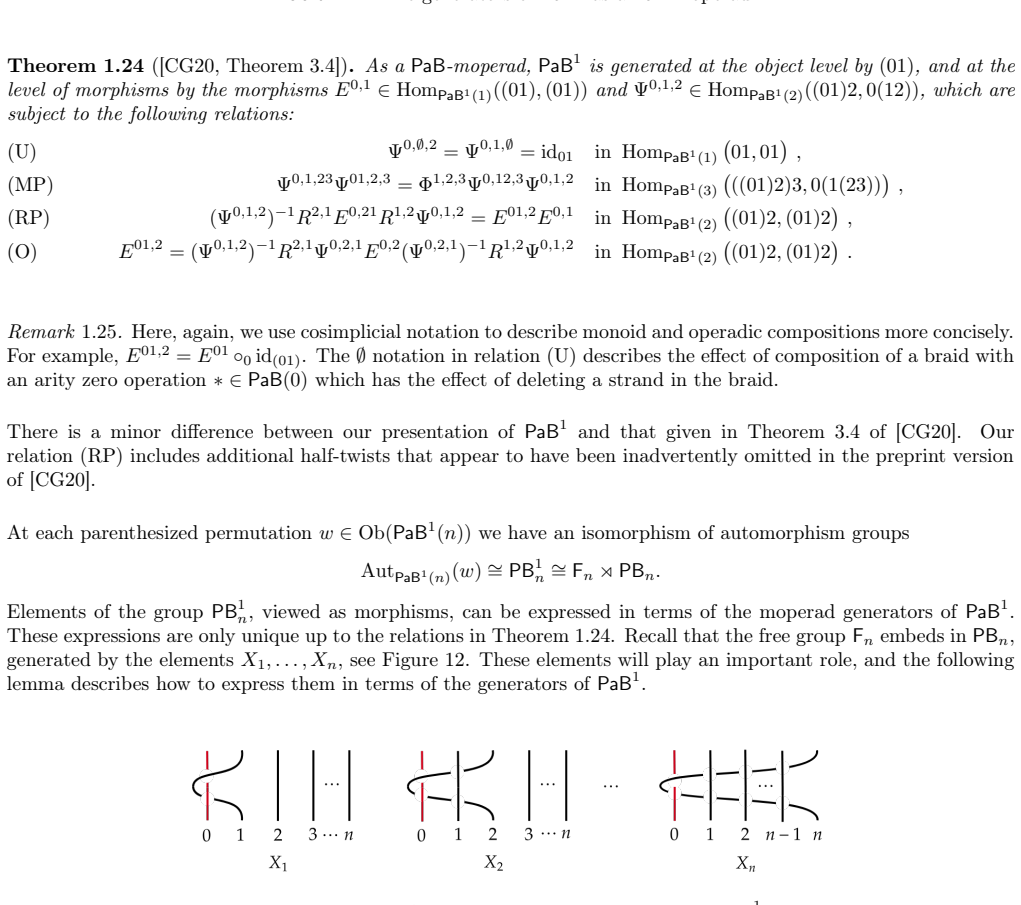
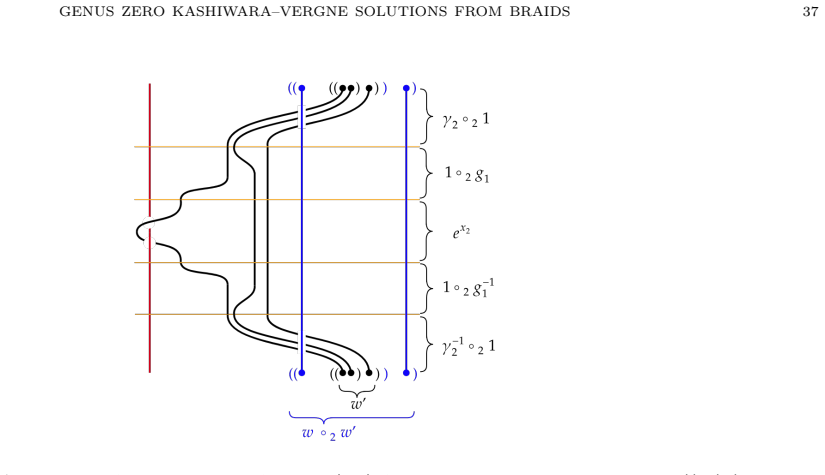
- [Introduction] The introduction would benefit from an explicit diagram or short computation illustrating the composition in the moperad of parenthesized braids with a frozen strand (cf. the definition preceding the main statements).
- [§3] A brief remark on how the tangential automorphism moperad is equipped with its module structure over the parenthesized braid moperad would help readers unfamiliar with the precise conventions used in §3.
Simulated Author's Rebuttal
We thank the referee for their positive assessment of the manuscript, the clear summary of our results, and the recommendation for minor revision. We appreciate the recognition that the work provides a coherent operadic reinterpretation building on the Alekseev--Enriquez--Torossian framework. We will prepare a revised version incorporating any minor clarifications or corrections as needed.
Circularity Check
No significant circularity
full rationale
The paper reinterprets the prior Alekseev-Enriquez-Torossian construction of KV solutions via moperads and derives conditional implications from assumed equivalences between parenthesized braids and chord diagrams moperads. These statements rely on external prior results and standard operad theory without any self-definitional loops, fitted inputs renamed as predictions, or load-bearing self-citations that reduce the central claims to the paper's own inputs by construction. The derivation chain consists of logical implications that remain independent once the referenced moperad equivalences and module maps are granted from outside the present work.
Axiom & Free-Parameter Ledger
axioms (1)
- standard math Standard definitions and properties of operads, moperads, parenthesized braids, chord diagrams, and Kashiwara-Vergne solutions hold as in prior literature.
Forward citations
Cited by 1 Pith paper
-
Drinfeld associators and Kashiwara-Vergne associators in higher genera
Direct construction of higher-genus KV associators from Gonzalez-Drinfeld associators via generalization of Massuyeau's genus-0 proof, determining framings with genus-1 restrictions.
Reference graph
Works this paper leans on
-
[1]
A. Alekseev, B. Enriquez, and C. Torossian, Drinfeld associators, braid groups and explicit solutions of the K ashiwara- V ergne equations , Publ. Math. Inst. Hautes \' E tudes Sci. (2010), no. 112, 143--189. 2737979
work page 2010
- [2]
-
[3]
, The G oldman- T uraev L ie bialgebra in genus zero and the K ashiwara- V ergne problem , Adv. Math. 326 (2018), 1--53. 3758425
work page 2018
-
[4]
, Goldman- T uraev formality implies K ashiwara- V ergne , Quantum Topol. 11 (2020), no. 4, 657--689. 4191651
work page 2020
-
[5]
A. Alekseev and E. Meinrenken, On the K ashiwara- V ergne conjecture , Invent. Math. 164 (2006), no. 3, 615--634. 2221133
work page 2006
-
[6]
Anton Alekseev and Charles Torossian, The K ashiwara- V ergne conjecture and D rinfeld's associators , Ann. of Math. (2) 175 (2012), no. 2, 415--463. 2877064
work page 2012
-
[7]
Clemens Berger and Ieke Moerdijk, Resolution of coloured operads and rectification of homotopy algebras, Categories in algebra, geometry and mathematical physics, Contemp. Math., vol. 431, Amer. Math. Soc., Providence, RI, 2007, pp. 31--58. 2342815
work page 2007
-
[8]
Dror Bar-Natan, On associators and the G rothendieck- T eichmuller group. I , Selecta Math. (N.S.) 4 (1998), no. 2, 183--212. 1669949
work page 1998
-
[9]
Dror Bar-Natan and Zsuzsanna Dancso, Finite type invariants of w-knotted objects ii: tangles, foams and the kashowara-vergne problem, Mathematische Annalen 367 (2017), 1517--1586
work page 2017
-
[10]
David Ben-Zvi, Adrien Brochier, and David Jordan, Quantum character varieties and braided module categories, Selecta Mathematica 24 (2018), no. 5, 4711--4748
work page 2018
-
[11]
Damien Calaque and Martin Gonzalez, A moperadic approach to cyclotomic associators, 2020
work page 2020
-
[12]
Ricardo Campos, Najib Idrissi, and Thomas Willwacher, Configuration Spaces of Surfaces , Ast \'e risque (2024)
work page 2024
-
[13]
211--291, Springer Nature Switzerland, Cham, 2025
Damien Calaque and Victor Roca i Lucio, Associators from an operadic point of view, pp. 211--291, Springer Nature Switzerland, Cham, 2025
work page 2025
-
[14]
Zsuzsanna Dancso, Iva Halacheva, and Marcy Robertson, A topological characterisation of the K ashiwara- V ergne groups , Trans. Amer. Math. Soc. 376 (2023), no. 5, 3265--3317. 4577332
work page 2023
-
[15]
V. G. Drinfel'd, On quasitriangular quasi- H opf algebras and on a group that is closely connected with Gal ( Q / Q ) , Algebra i Analiz 2 (1990), no. 4, 149--181. 1080203
work page 1990
-
[16]
Michel Duflo, Sur la classification des id\'eaux primitifs dans l'alg\`ebre enveloppante d'une alg\`ebre de L ie semi-simple , Ann. of Math. (2) 105 (1977), no. 1, 107--120. 430005
work page 1977
-
[17]
Benjamin Enriquez, Quasi-reflection algebras and cyclotomic associators, Selecta Math. (N.S.) 13 (2007), no. 3, 391--463. 2383601
work page 2007
-
[18]
Edward Fadell and Lee Neuwirth, Configuration spaces, Mathematica Scandinavica 10 (1962), 111--118
work page 1962
-
[19]
1967, Springer, Berlin, Heidelberg, 2009
Benoit Fresse, Modules over Operads and Functors , Lecture Notes in Mathematics , vol. 1967, Springer, Berlin, Heidelberg, 2009
work page 1967
-
[20]
Fresse, Homotopy of operads and G rothendieck- T eichm\" u ller groups
B. Fresse, Homotopy of operads and G rothendieck- T eichm\" u ller groups. P art 1 , Mathematical Surveys and Monographs, vol. 217, American Mathematical Society, Providence, RI, 2017, The algebraic theory and its topological background. 3643404
work page 2017
-
[21]
Toshitake Kohno, S\'erie de P oincar\'e- K oszul associ\'ee aux groupes de tresses pures , Invent. Math. 82 (1985), no. 1, 57--75. 808109
work page 1985
- [22]
- [23]
-
[24]
, Deformation quantization of Poisson manifolds , Letters in Mathematical Physics 66 (2003), no. 3, 157--216
work page 2003
-
[25]
Masaki Kashiwara and Mich\`ele Vergne, The C ampbell- H ausdorff formula and invariant hyperfunctions , Invent. Math. 47 (1978), no. 3, 249--272. 492078
work page 1978
-
[26]
Pierre Lochak and Leila Schneps, Every acyclotomic element of the profinite G rothendieck- T eichm\"uller group is a twist , Romanian Journal of Pure and Applied Mathematics LX (2015), no. 2, 117--128
work page 2015
- [27]
-
[28]
Dan Petersen, The operad structure of admissible G -covers , Algebra Number Theory 7 (2013), no. 8, 1953--1975. 3134040
work page 2013
-
[29]
Marcy Robertson and Chandan Singh, Genus zero kashiwara-vergne solutions and ribbon braided module categories, In preparation (2025)
work page 2025
-
[30]
Pavol Severa and Thomas Willwacher, The cubical complex of a permutation group representation - or however you want to call it, March 2011
work page 2011
-
[31]
Pavol S evera and Thomas Willwacher, Equivalence of formalities of the little discs operad, Duke Mathematical Journal 160 (2011), no. 1, 175--206
work page 2011
-
[32]
( Sur la conjecture combinatoire de Kashiwara-Vergne .) , Journal of Lie Theory 12 (2002), no
Charles Torossian, On the combinatorial Kashiwara-Vergne conjecture. ( Sur la conjecture combinatoire de Kashiwara-Vergne .) , Journal of Lie Theory 12 (2002), no. 2, 597--616
work page 2002
- [33]
-
[34]
Thomas Willwacher, M. Kontsevich 's graph complex and the Grothendieck-Teichm \"u ller Lie algebra , Inventiones Mathematicae 200 (2015), no. 3, 671--760
work page 2015
-
[35]
, The homotopy braces formality morphism, Duke Math. J. 165 (2016), no. 10, 1815--1964. 3522653
work page 2016
-
[36]
170, American Mathematical Society, Providence, RI, 2016
Donald Yau, Colored operads, Graduate Studies in Mathematics, vol. 170, American Mathematical Society, Providence, RI, 2016. 3444662
work page 2016
discussion (0)
Sign in with ORCID, Apple, or X to comment. Anyone can read and Pith papers without signing in.