REVIEW 3 major objections 4 minor 79 references
The Solid-state Physics of Rydberg-dressed Bosonic Mixtures
T0 review · 3 major / 4 minor · reviewed 2026-08-06 · deepseek-v4-flash
Pith's one-line read Two-component Rydberg-dressed Bose-Einstein condensates with imbalanced inter- and intra-component blockade radii have a ground-state sequence that goes from face-centered-cubic crystals through segregated tubes to segregated planes as…
desk verdict A solid extension of RdBEC phase diagrams to 3D binary mixtures with real new phases, but the ground-state claim outruns the variational search. read the letter →
The pith
A machine-rendered reading of the paper's core claim, the machinery that carries it, and where it could break.
The reading
What carries the argument
The central object is the coupled Gross-Pitaevskii energy functional for two components interacting through contact terms and soft-core potentials $V_{\alpha\beta}(r) = \tilde{C}_6 / (1 + (r/R_c^{(\alpha\beta)})^6)$, with the ratio $R_c^{(12)}/R_c$ as the key control parameter. The argument is carried by a Gaussian variational ansatz in which each lattice site is an anisotropic Gaussian with widths $\sigma_x$, $\sigma_y$, $\sigma_z$; the divergence of one or two widths signals the transition from three-dimensional crystals to segregated tubes or planes. The roton minimum of the lower Bogoliubov branch $\omega_-(k)$ provides the length scale of the density modulation, and imaginary-time evolution in a periodic box confirms the variational phase boundaries.
What would settle it
At parameters where the paper predicts an SC ground state (for example $R_c^{(12)}/R_c = 0.8$ and $a_s/R_c = 1.0 \times 10^{-3}$), run imaginary-time Gross-Pitaevskii evolution in boxes of at least two different sizes and test trial densities for hexagonal and tetragonal lattices; if any alternative structure has lower energy, or the SC state is not reproduced, the phase diagram needs revision.
Extended reading notes
Core claim
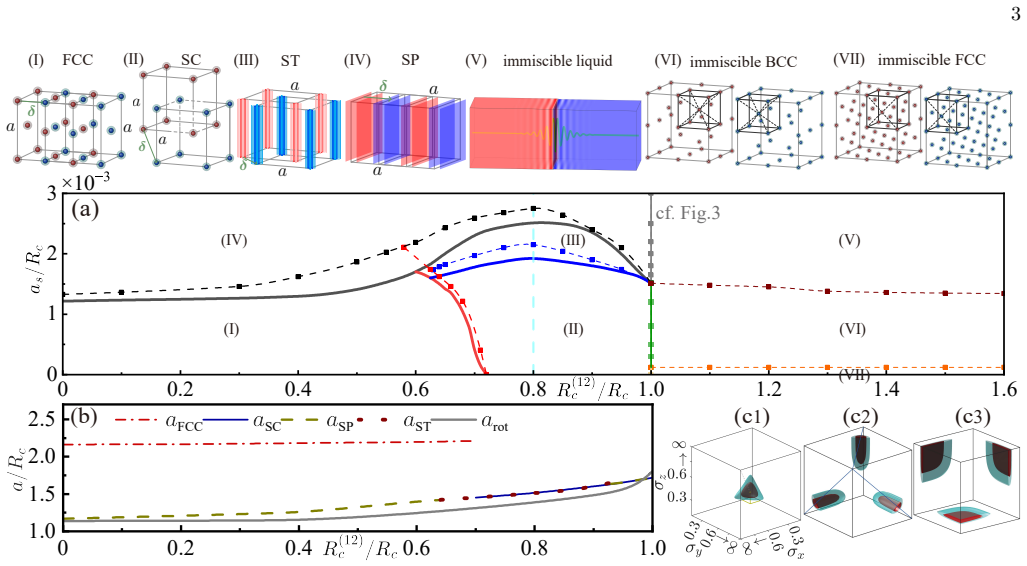
The paper claims that a 3D binary Rydberg-dressed BEC with symmetric intra-component interactions but an imbalanced inter-component blockade radius, $R_c^{(12)} \neq R_c$, has a ground-state phase diagram controlled by the s-wave scattering length $a_s$. For $R_c^{(12)} < R_c$ and small $a_s$, each component forms a face-centered-cubic lattice displaced by half a lattice constant from the other, so the two-species density is a simple cubic crystal. Increasing $a_s$ makes large local densities energetically costly, and the system responds not by melting into a uniform state but by reducing the dimensionality of its symmetry breaking: it first forms segregated tubes, where the density is modulated in a plane and uniform along the tube axis, and then segregated planes, modulated along one direction only. The modulation period of these lower-dimensional states is set by the roton minimum of the out-of-phase Bogoliubov branch of the miscible mixture. When $R_c^{(12)} > R_c$ the two species phase-separate, and at $R_c^{(12)} = R_c$ the model reduces to a single-component RdBEC with a first-order FCC-to-BCC transition followed by a plane-wave state. The paper also shows that all these states can be reached dynamically from a homogeneous condensate seeded with noise.
Load-bearing premise
The phase diagram is only as reliable as the assumption that the five trial crystal families plus the periodic-box imaginary-time search exhaust all lower-energy density patterns, so an omitted lattice could change the boundaries.
Editorial extensions
If this is right
- Binary Rydberg-dressed BECs become a tunable 3D platform for supersolidity, with crystal structures (FCC, SC, BCC) and lower-dimensional density-modulated states all exhibiting a finite superfluid fraction.
- The SC-to-ST-to-SP sequence gives a cold-atom analogue of the 'pasta' phases proposed for neutron-star crusts, with the scattering length playing the role of pressure.
- Because the states form dynamically from a uniform condensate with noise, experimental realization only requires preparing a miscible binary mixture and then ramping the scattering length, rather than engineering the target lattice.
- At equal blockade radii the model reproduces the single-component FCC-to-BCC transition, so the binary system provides a new route to study BCC supersolidity in 3D.
- The multicritical point at $R_c^{(12)}/R_c = 1$ and $a_s/R_c \approx 1.51 \times 10^{-3}$ ties together all the crystalline, tubular, planar, and phase-separated phases, offering a single parameter setting to test the whole diagram.
Reading between the lines
- If the variational ansatz were extended to other Bravais lattices (for example hexagonal close-packed or tetragonal) at the same parameters, some of the phase boundaries could move, but the qualitative dimension-reduction mechanism (3D crystal to tubes to planes under increasing contact repulsion) would likely survive.
- The same imbalance mechanism should operate in other long-range interacting binary condensates, such as dipolar mixtures, whenever the inter- and intra-species interaction ranges differ, suggesting that planar and tubular supersolid phases are generic rather than specific to Rydberg dressing.
- A testable prediction from the paper's Bogoliubov analysis is that the planar and tubular periodicity should equal $2\pi/k_{\rm rot}$ of the out-of-phase branch; a measurement of the density correlation function during the dynamic evolution could verify this directly.
- The claim that the superfluid fraction drops at the SC-ST and ST-SP transitions could be tested by time-of-flight or Bragg spectroscopy, giving a clear experimental signature of the lower-dimensional phases.
Editorial analysis
A structured set of objections, weighed in public.
Referee Report
Summary. The manuscript studies a three-dimensional two-component Bose-Einstein condensate with Rydberg-dressed soft-core interactions. The authors derive an effective mean-field model from a coupled light-atom Hamiltonian in the Supplemental Material, including explicit formulas for the soft-core potential parameters and a table of feasible atomic configurations. Within this model, they combine imaginary-time GPE evolution and a Gaussian variational ansatz restricted to SC, FCC, BCC, ST, and SP density profiles. The central claim is a ground-state phase diagram in which, for imbalanced inter-component versus intra-component blockade radii, the sequence FCC → SC → SP and FCC/SC → ST → SP occurs as the s-wave scattering length increases, while for equal radii the single-component-like FCC → BCC → plane-wave sequence is recovered. The paper also presents real-time GPE simulations showing spontaneous formation of SC, ST, and SP structures.
Significance. If the phase diagram is correct, the paper identifies a new family of three-dimensional supersolid and smectic-like phases in an experimentally accessible platform and strengthens the analogy to pasta phases in neutron-star matter. Strengths include the microscopic derivation of the effective soft-core potentials in Supplement I, the concrete Cs/Rb implementation schemes in Table I, the variational energy landscapes that make the ST/SP mechanisms transparent, and the independent roton-wavelength estimate of the SP periodicity. The dynamical-formation simulations are a useful addition. However, because the ground-state claim rests on a restricted variational basis and on numerical searches whose convergence and completeness are not documented, the significance is currently conditional on strengthening the global-minimum evidence.
major comments (3)
- [Ground-state phase diagram (Fig. 2(a)) and Supplemental Material Sec. II] The global-minimum claim is not established by the evidence presented. The Gaussian variational ansatz is explicitly described as "a relatively rough estimation" (Supplemental Sec. II) and is restricted to SC, FCC, BCC, ST, and SP trial profiles; the imaginary-time GPE is run in a periodic box that cannot represent non-cubic Bravais lattices or aperiodic patterns without distortion. No box-size or aspect-ratio convergence tests and no comparison against alternative structures (e.g., HCP, diamond, or larger supercells allowing incommensurate modulations) are reported. Since the abstract and conclusion state that these are the ground states and the solid phase boundaries in Fig. 2(a) are variational, the present evidence only establishes optimality within the considered ansatz. I request either (i) an expanded numerical search over a wider class of candidate unit cells with convergence checks, or (ii) a revised, more cautious claim of stable phases within the considered variational and numerical space, with corresponding changes to the abstract and conclusion.
- [Fig. 2(a) and the numerical 'Ground-state phase diagram'] The quantitative relationship between the numerical GPE results and the variational phase boundaries is not documented. The text states that the solid lines are in "reasonable agreement" with the accurate full GPE simulation results, but the figure shows numerical points only along one path, and the manuscript does not report the numerical energies per particle, the numerical critical scattering lengths, or the grid resolution used. Without this information it is not possible to judge the accuracy of the variational phase boundaries, which carry the phase diagram, or the location of the claimed multicritical point at as/Rc ≈ 1.5 × 10^-3. Please provide representative numerical energy comparisons and critical values along cuts such as Rc^(12)/Rc = 0.95, and state explicitly what the dashed line in Fig. 2(a) denotes.
- [Fig. 2(b) and the roton-wavelength comparison] The roton-wavelength comparison in Fig. 2(b) mixes parameters: the caption fixes as/Rc = 0.5 × 10^-3 for the FCC state and as/Rc = 2.3 × 10^-3 for the SC, ST, and SP states. The comparison of arot with the SP lattice constant is therefore not made at a single set of interaction parameters across the phases, and it is unclear whether arot is computed at the same value of as for all Rc^(12)/Rc. To make this consistency check meaningful, the authors should plot arot and the lattice constants along the same parameter path used for the phase boundaries, and specify explicitly which value of as each curve corresponds to.
minor comments (4)
- [Supplemental Material Sec. I] The adiabatic elimination of the third-order correlators in Eqs. (6)–(8) neglects several terms without stating the ordering assumption; a sentence identifying the small parameters (e.g., ratios of Rabi frequencies to detunings and the dilute-gas mean-field conditions) would help readers assess the validity of the derivation.
- [Ground-state phase diagram] The phrase "second-order phase transition" for the SC→ST and ST→SP transitions appears without an order parameter or quantitative numerical evidence; please either define the order parameter and show its behavior across the transitions or describe these as continuous-looking transitions.
- [Fig. 4] Please label which species is shown in each density panel and define the color scale; currently the figure is difficult to read in the accessible version.
- [Fig. 2(a)] The axis labels and the meaning of the dashed line and of the label "cf. Fig. 3" are not explained in the caption; please define the vertical and horizontal axes explicitly, including the scaling of as by 10^-3.
Circularity Check
No circularity identified: the reported phases are obtained from GPE imaginary-time evolution and variational energy minimization, with the Gaussian ansatz explicitly labeled an approximation and no fitted parameter entering the predicted quantities.
full rationale
The derivation chain is self-contained. The soft-core interaction V_alpha beta(r) = C~6/(1 + (r/Rc)^6) is derived from the coupled light-atom Heisenberg equations in Supplemental Sec. I (SM Eqs. 1-12) under stated adiabatic-elimination assumptions, and the coupled GPE (main-text Eq. 1) is then minimized by imaginary-time evolution to obtain the phase diagram. The Gaussian variational analysis (main-text Eq. 3; SM Sec. II) is explicitly described by the authors as 'a relatively rough estimation' and 'inspired by the numerical results,' so it functions as an interpretive and corroborating tool rather than as an input that forces the reported phases. In that variational family, the ST and SP states are not assumed by fiat: they appear as computed minima of the energy functional when one or two Gaussian widths diverge (Figs. 2(c2)-(c3)), and the independent real-time GPE dynamics of Fig. 4 forms SC, ST, and SP density patterns from a homogeneous noisy initial condition. The roton wavelength a_rot = 2*pi/k_rot from Bogoliubov spectrum Eq. (2) is an independent length scale compared with the lattice constants, not a fitted parameter. The equal-blockade-radius limit is checked against independent single-component results (Refs. [22,23]). No parameter is fitted to the predicted phases, no equation reduces by construction to its own output, and no external self-citation carries the central claim; the only self-references are to the paper's own Supplemental Material and an outlook citation (Ref. [67]) involving one of the authors, neither of which is load-bearing. The absence of box-size convergence details and the restriction of the variational family to SC/FCC/BCC/ST/SP are robustness limitations on the global-minimum claim, but they are correctness risks, not circularity.
Assumptions & free parameters
free parameters (4)
- Soft-core interaction strength tilde C6 =
0.15 hbar^2/(M Rc^2)
- Average density rho Rc^3 =
1.5e3
- s-wave scattering length a_s/R_c =
0 to about 3e-3
- Blockade radius ratio Rc^(12)/Rc =
0.2 to 1.15
assumptions (4)
- domain assumption Mean-field Gross-Pitaevskii description with contact plus soft-core interactions is valid at the densities used.
- domain assumption Large-detuning adiabatic elimination justifies the effective two-body soft-core potential V(r) = C6/(1 + (r/Rc)^6).
- ad hoc to paper Infinite-system ground states can be obtained by imaginary-time evolution in a periodic box and by Gaussian variational profiles.
- ad hoc to paper Equal intra-component parameters and N1 = N2 are representative of the physics.
Cite this review
Pith. "Pith review of The Solid-state Physics of Rydberg-dressed Bosonic Mixtures." pith.science (2026). https://pith.science/paper/MRJLIZ2Z
@misc{pith2026250716277,
  author       = {Pith},
  title        = {Pith review of: The Solid-state Physics of Rydberg-dressed Bosonic Mixtures},
  year         = {2026},
  howpublished = {\url{https://pith.science/paper/MRJLIZ2Z}},
  note         = {Machine review of arXiv:2507.16277}
}
read the original abstract
We explore phases of two-component Rydberg-dressed Bose-Einstein condensates in three spatial dimensions. The competition between the effective ranges of inter- and intra-component soft-core interactions leads to a rich variety of ground states. These include states resembling ionic compounds with face-centered cubic or simple cubic lattice structure. Upon increasing the scattering length, the dimensionality of the symmetry-breaking is lower due to the suppression of large densities, leading to segregated planar or tubular density profiles. We also show that these states are not only stable ground states, but can also emerge dynamically upon time evolution.
Figures


Figures from the paper (1 more)

Reference graph
Works this paper leans on
-
[23]
Ancilotto, M
F. Ancilotto, M. Rossi, and F. Toigo, Phys. Rev. A 88, 033618 (2013)
2013
-
[1]
Bloch, J
I. Bloch, J. Dalibard, and W. Zwerger, Rev. Mod. Phys. 80, 885 (2008)
2008
-
[2]
Saffman, T
M. Saffman, T. G. Walker, and K. Mølmer, Rev. Mod. Phys. 82, 2313 (2010)
2010
- [3]
-
[4]
Gross and I
C. Gross and I. Bloch, Science 357, 995 (2017)
2017
-
[5]
Kadau, M
H. Kadau, M. Schmitt, M. Wenzel, C. Wink, T. Maier, I. Ferrier-Barbut, and T. Pfau, Nature 530, 194 (2016)
2016
-
[6]
Schmitt, M
M. Schmitt, M. Wenzel, F. B¨ ottcher, I. Ferrier-Barbut, and T. Pfau, Nature 539, 259 (2016)
2016
- [7]
Show all 79 references
-
[8]
Chomaz, D
L. Chomaz, D. Petter, P. Ilzh¨ ofer, G. Natale, A. Traut- mann, C. Politi, G. Durastante, R. M. W. van Bijnen, A. Patscheider, M. Sohmen, M. J. Mark, and F. Fer- laino, Phys. Rev. X 9, 021012 (2019)
2019
-
[9]
B¨ ottcher, J.-N
F. B¨ ottcher, J.-N. Schmidt, M. Wenzel, J. Hertkorn, M. Guo, T. Langen, and T. Pfau, Phys. Rev. X 9, 011051 (2019)
2019
-
[10]
Tanzi, J
L. Tanzi, J. G. Maloberti, G. Biagioni, A. Fioretti, C. Gabbanini, and G. Modugno, Science 371, 1162 (2021)
2021
-
[11]
T. Koch, T. Lahaye, J. Metz, B. Fr¨ ohlich, A. Griesmaier, and T. Pfau, Nature Physics 4, 218 (2008)
2008
-
[12]
Lahaye, C
T. Lahaye, C. Menotti, L. Santos, M. Lewenstein, and T. Pfau, Reports on Progress in Physics 72, 126401 (2009)
2009
-
[13]
Chomaz, I
L. Chomaz, I. Ferrier-Barbut, F. Ferlaino, B. Laburthe- Tolra, B. L. Lev, and T. Pfau, Reports on Progress in Physics 86, 026401 (2023)
2023
-
[14]
M. A. Norcia, C. Politi, L. Klaus, E. Poli, M. Sohmen, M. J. Mark, R. N. Bisset, L. Santos, and F. Ferlaino, Nature 596, 357 (2021)
2021
-
[15]
Jaksch, J
D. Jaksch, J. I. Cirac, P. Zoller, S. L. Rolston, R. Cˆ ot´ e, and M. D. Lukin, Phys. Rev. Lett. 85, 2208 (2000)
2000
-
[16]
J. E. Johnson and S. L. Rolston, Phys. Rev. A 82, 033412 6 (2010)
2010
-
[17]
Honer, H
J. Honer, H. Weimer, T. Pfau, and H. P. B¨ uchler, Phys. Rev. Lett. 105, 160404 (2010)
2010
-
[18]
J. B. Balewski, A. T. Krupp, A. Gaj, S. Hofferberth, R. L¨ ow, and T. Pfau, New Journal of Physics 16, 063012 (2014)
2014
-
[19]
Henkel, F
N. Henkel, F. Cinti, P. Jain, G. Pupillo, and T. Pohl, Phys. Rev. Lett. 108, 265301 (2012)
2012
-
[20]
Pupillo, A
G. Pupillo, A. Micheli, M. Boninsegni, I. Lesanovsky, and P. Zoller, Phys. Rev. Lett. 104, 223002 (2010)
2010
-
[21]
Cinti, T
F. Cinti, T. Macr ` ı, W. Lechner, G. Pupillo, and T. Pohl, Nature Communications 5, 3235 (2014)
2014
-
[22]
Henkel, R
N. Henkel, R. Nath, and T. Pohl, Phys. Rev. Lett. 104, 195302 (2010)
2010
-
[24]
[26–29] that are not mentioned in the main text
See Supplemental Material at URL for more details on the derivation of the inter- and intra-component soft-core interactions, the potential Rydberg atom configurations that can satisfy the constraints regarding the interaction strength and blockade radius, the variational metho...
-
[25]
Hsueh, Y.-C
C.-H. Hsueh, Y.-C. Tsai, K.-S. Wu, M.-S. Chang, and W. C. Wu, Phys. Rev. A 88, 043646 (2013)
2013
-
[26]
ˇSibali´ c, J
N. ˇSibali´ c, J. Pritchard, C. Adams, and K. Weatherill, Computer Physics Communications 220, 319 (2017)
2017
-
[27]
Robertson, N
E. Robertson, N. ˇSibali´ c, R. Potvliege, and M. Jones, Computer Physics Communications 261, 107814 (2021)
2021
-
[28]
Henkel, Rydberg-dressed Bose-Einstein condensates , Phd thesis (2013)
N. Henkel, Rydberg-dressed Bose-Einstein condensates , Phd thesis (2013)
2013
-
[29]
Chaudhuri, S
P. Chaudhuri, S. Karmakar, C. Dasgupta, H. R. Krish- namurthy, and A. K. Sood, Phys. Rev. Lett. 95, 248301 (2005)
2005
-
[30]
ˇCopar, J
S. ˇCopar, J. Aplinc, i. c. v. Kos, S. ˇZumer, and M. Ravnik, Phys. Rev. X 9, 031051 (2019)
2019
-
[31]
Biagioni, N
G. Biagioni, N. Antolini, A. Ala˜ na, M. Modugno, A. Fioretti, C. Gabbanini, L. Tanzi, and G. Modugno, Physical Review X 12, 021019 (2022)
2022
-
[32]
Pu and N
H. Pu and N. P. Bigelow, Phys. Rev. Lett. 80, 1130 (1998)
1998
-
[33]
Coen and M
S. Coen and M. Haelterman, Phys. Rev. Lett. 87, 140401 (2001)
2001
-
[34]
A. S. Schneider, D. K. Berry, C. M. Briggs, M. E. Caplan, and C. J. Horowitz, Phys. Rev. C 90, 055805 (2014)
2014
-
[35]
E. Levi, J. Min´ aˇ r, J. P. Garrahan, and I. Lesanovsky, New Journal of Physics 17, 123017 (2015)
2015
-
[36]
Pu and N
H. Pu and N. P. Bigelow, Phys. Rev. Lett. 80, 1134 (1998)
1998
-
[37]
Shoji, K
H. Shoji, K. Yamada, D. Ueyama, and T. Ohta, Physical Review E 75, 046212 (2007)
2007
-
[38]
Kirkby, A.-C
W. Kirkby, A.-C. Lee, D. Baillie, T. Bland, F. Ferlaino, P. B. Blakie, and R. N. Bisset, Phys. Rev. Lett. 133, 103401 (2024)
2024
-
[39]
Han, X.-F
W. Han, X.-F. Zhang, D.-S. Wang, H.-F. Jiang, W. Zhang, and S.-G. Zhang, Phys. Rev. Lett. 121, 030404 (2018)
2018
-
[40]
Kittel, Introduction to Solid State Physics , 8th ed
C. Kittel, Introduction to Solid State Physics , 8th ed. (Wiley, 2004)
2004
-
[41]
Y. V. Kudryavtsev, A. E. Perekos, N. V. Uvarov, M. R. Kolchiba, K. Synoradzki, and J. Dubowik, Journal of Applied Physics 119, 205103 (2016)
2016
-
[42]
Michmerhuizen, K
A. Michmerhuizen, K. Rose, W. Annankra, and D. A. Vander Griend, Journal of Chemical Education 94, 1480 (2017)
2017
-
[43]
K. Yuan, Z. Xu, X. Huang, and W. Li, Chemistry – A European Journal 29, e202301043 (2023)
2023
-
[45]
Guti´ errez, J
R. Guti´ errez, J. P. Garrahan, and I. Lesanovsky, New Journal of Physics 18, 093054 (2016)
2016
-
[48]
Baillie and P
D. Baillie and P. B. Blakie, Phys. Rev. Lett. 121, 195301 (2018)
2018
-
[49]
C. K. Park and N. C. Horton, Biophysical reviews 11, 927—994 (2019)
2019
-
[50]
A. S. Schneider, C. J. Horowitz, J. Hughto, and D. K. Berry, Phys. Rev. C 88, 065807 (2013)
2013
-
[51]
C. J. Horowitz, D. K. Berry, C. M. Briggs, M. E. Caplan, A. Cumming, and A. S. Schneider, Phys. Rev. Lett. 114, 031102 (2015)
2015
-
[52]
M. E. Caplan and C. J. Horowitz, Rev. Mod. Phys. 89, 041002 (2017)
2017
-
[53]
Caplan, A
M. Caplan, A. Schneider, and C. Horowitz, Physical Review Letters 121, 132701 (2018)
2018
-
[54]
E. Poli, T. Bland, S. J. M. White, M. J. Mark, F. Fer- laino, S. Trabucco, and M. Mannarelli, Phys. Rev. Lett. 131, 223401 (2023)
2023
-
[58]
230, 00008 (2020)
Prestipino, Santi, Sergi, Alessandro, Bruno, Ezio, and Giaquinta, Paolo V., EPJ Web Conf. 230, 00008 (2020)
2020
-
[59]
Prestipino, A
S. Prestipino, A. Sergi, and E. Bruno, Journal of Physics A: Mathematical and Theoretical 52, 015002 (2018)
2018
-
[60]
P. B. Blakie, D. Baillie, and S. Pal, Communications in Theoretical Physics 72, 085501 (2020)
2020
-
[61]
E. A. Goldschmidt, T. Boulier, R. C. Brown, S. B. Koller, J. T. Young, A. V. Gorshkov, S. L. Rolston, and J. V. Porto, Phys. Rev. Lett. 116, 113001 (2016)
2016
-
[62]
Festa, N
L. Festa, N. Lorenz, L.-M. Steinert, Z. Chen, P. Oster- holz, R. Eberhard, and C. Gross, Phys. Rev. A 105, 013109 (2022)
2022
-
[63]
Guardado-Sanchez, B
E. Guardado-Sanchez, B. M. Spar, P. Schauss, R. Belyan- sky, J. T. Young, P. Bienias, A. V. Gorshkov, T. Iadecola, and W. S. Bakr, Phys. Rev. X 11, 021036 (2021)
2021
-
[64]
A. D. Bounds, N. C. Jackson, R. K. Hanley, R. Faoro, E. M. Bridge, P. Huillery, and M. P. A. Jones, Phys. Rev. Lett. 120, 183401 (2018)
2018
-
[65]
J. A. Hines, S. V. Rajagopal, G. L. Moreau, M. D. Wahrman, N. A. Lewis, O. Markovi´ c, and M. Schleier- Smith, Phys. Rev. Lett. 131, 063401 (2023)
2023
-
[66]
Realiza- tion of a rydberg-dressed extended bose hubbard model,
P. Weckesser, K. Srakaew, T. Blatz, D. Wei, D. Adler, S. Agrawal, A. Bohrdt, I. Bloch, and J. Zeiher, “Realiza- tion of a rydberg-dressed extended bose hubbard model,” (2024), arXiv:2405.20128 [cond-mat.quant-gas]
2024 arXiv
-
[67]
Maucher, N
F. Maucher, N. Henkel, M. Saffman, W. Kr´ olikowski, S. Skupin, and T. Pohl, Phys. Rev. Lett. 106, 170401 (2011)
2011
-
[68]
The Solid-state Physics of Rydberg-dressed Bo sonic Mixtures
L.-M. Steinert, P. Osterholz, R. Eberhard, L. Festa, N. Lorenz, Z. Chen, A. Trautmann, and C. Gross, Phys. Rev. Lett. 130, 243001 (2023). Supplemental Material for “The Solid-state Physics of Rydberg-dressed Bo sonic Mixtures” Yi-Ming Duan 1,∗ Liang-Jun He 1,∗ Fabian Maucher 2...
2023
-
[69]
ˇSibali´ c, J
N. ˇSibali´ c, J. Pritchard, C. Adams, and K. Weatherill, Computer P hysics Communications 220, 319 (2017)
2017
-
[70]
Robertson, N
E. Robertson, N. ˇSibali´ c, R. Potvliege, and M. Jones, Computer Physics Comm unications 261, 107814 (2021)
2021
-
[71]
Henkel, Rydberg-dressed Bose-Einstein condensates, Phd thesis (2013)
N. Henkel, Rydberg-dressed Bose-Einstein condensates, Phd thesis (2013)
2013
-
[72]
E. Levi, J. Min´ aˇ r, J. P. Garrahan, and I. Lesanovsky, New Jo urnal of Physics 17, 123017 (2015)
2015
-
[73]
J. Qian, L. Zhang, J. Zhai, and W. Zhang, Phys. Rev. A 92, 063407 (2015)
2015
-
[74]
Guti´ errez, J
R. Guti´ errez, J. P. Garrahan, and I. Lesanovsky, New Journal o f Physics 18, 093054 (2016)
2016
-
[75]
Z. Lan, W. Li, and I. Lesanovsky, Phys. Rev. A 94, 051603 (2016)
2016
-
[76]
Guti´ errez, J
R. Guti´ errez, J. P. Garrahan, and I. Lesanovsky, Phys. Rev. E 100, 012110 (2019)
2019
-
[77]
Prestipino, A
S. Prestipino, A. Sergi, and E. Bruno, Phys. Rev. B 98, 104104 (2018)
2018
-
[78]
230, 00008 (2020)
Prestipino, Santi, Sergi, Alessandro, Bruno, Ezio, and Gia quinta, Paolo V., EPJ Web Conf. 230, 00008 (2020)
2020
-
[79]
Prestipino, A
S. Prestipino, A. Sergi, and E. Bruno, Journal of Physics A: M athematical and Theoretical 52, 015002 (2018)
2018
-
[80]
Chaudhuri, S
P. Chaudhuri, S. Karmakar, C. Dasgupta, H. R. Krishnamurthy, a nd A. K. Sood, Phys. Rev. Lett. 95, 248301 (2005)
2005
-
[81]
A. J. Leggett, Phys. Rev. Lett. 25, 1543 (1970)
1970
-
[82]
A. J. Leggett, Journal of Statistical Physics 93, 927 (1998)
1998
-
[83]
Tanzi, E
L. Tanzi, E. Lucioni, F. Fam` a, J. Catani, A. Fioretti, C. Gabbanini, R. N. Bisset, L. Santos, and G. Modugno, Phys. Rev . Lett. 122, 130405 (2019)
2019
-
[84]
Chomaz, D
L. Chomaz, D. Petter, P. Ilzh¨ ofer, G. Natale, A. Trautmann, C. Politi, G. Durastante, R. M. W. van Bijnen, A. Patscheider, M. Sohmen, M. J. Mark, and F. Ferlaino, Phys. Rev. X 9, 021012 (2019)
2019
-
[85]
B¨ ottcher, J.-N
F. B¨ ottcher, J.-N. Schmidt, M. Wenzel, J. Hertkorn, M. Guo , T. Langen, and T. Pfau, Phys. Rev. X 9, 011051 (2019)
2019
Reviewed August 6, 2026 · model on record in the stance chip above.
Discussion (0). Continue with ORCID to comment.