REVIEW 4 major objections 5 minor 16 references
Planar Tur\'an number of disjoint union of $C_3$ and $C_5$
T0 review · 4 major / 5 minor · reviewed 2026-08-06 · deepseek-v4-flash
Pith's one-line read For every $n \geq 295660$, the maximum number of edges in an $n$-vertex planar graph with no vertex-disjoint triangle and pentagon is $\lfloor (8n-13)/3 \rfloor$, attained by a unique extremal graph.
desk verdict Fills the C3∪C5 row in the planar Turán table, but the proof hinges on Lemma 3.4, which is under-proved. read the letter →
The pith
A machine-rendered reading of the paper's core claim, the machinery that carries it, and where it could break.
The reading
What carries the argument
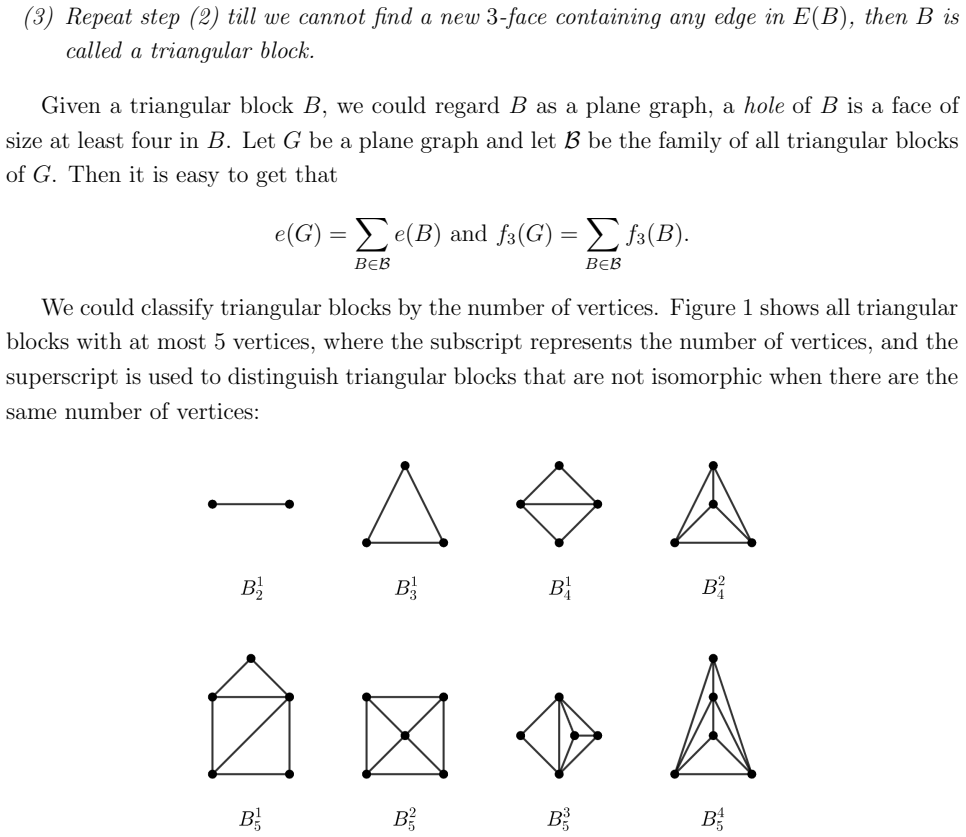
The proof is carried by the triangular block: a maximal union of $3$-faces glued edge-to-edge, into which every plane graph decomposes, with edges and $3$-faces summing over blocks. The pivotal mechanism is Lemma 3.4, which asserts that a triangular block with at least $521$ vertices in a $C_3 \cup C_5$-free plane graph must be a wheel or a fan, so that all of its $3$-cycles pass through one vertex. In the complementary case, Lemma 3.1 forces many small triangular blocks containing pentagons through a fixed two-vertex set, and Lemma 3.3 restricts each such block to six small types satisfying $f_3(B_i) \leq e(B_i)/2$; summing this over blocks and applying Euler's formula yields $e(G) \leq (8n-13)/3$, with equality pinning down the extremal blocks that form the $K_2$-joined copies of $P_3$.
What would settle it
Either of two observations would refute Theorem 1.1: an explicit $C_3 \cup C_5$-free plane graph on $n \geq 295660$ vertices with more than $\lfloor (8n-13)/3 \rfloor$ edges, or a triangular block with at least $521$ vertices that is neither a wheel nor a fan but is embeddable in a plane graph without creating a vertex-disjoint triangle and pentagon.
Extended reading notes
Core claim
The central claim is exact and structural. For every $n \geq 295660$, $\mathrm{ex}_{\mathcal{P}}(n, C_3 \cup C_5) = \lfloor (8n-13)/3 \rfloor$, and the only graph attaining it is $K_2$ joined to $\lfloor (n-2)/3 \rfloor$ disjoint copies of $P_3$ plus a path on the remaining $0$, $1$, or $2$ vertices. To prove this, the paper shows that any $C_3 \cup C_5$-free plane graph with enough edges must fall into one of three configurations: many small triangular blocks each carrying a pentagon through a common two-vertex set, one triangular block of size at least $521$, or many blocks carrying pentagons through a single shared vertex. In the second and third configurations a structural lemma forces all $3$-cycles through one vertex, which Euler's formula shows is too sparse to reach the bound; in the first configuration the blocks are so restricted that the edge count cannot exceed the claimed value, and equality forces the $K_2$-to-$P_3$ construction.
Load-bearing premise
The upper bound rests on Lemma 3.4, which says that any triangular block with at least $521$ vertices in a $C_3 \cup C_5$-free plane graph must be a wheel or a fan; if a large block can take another shape without producing the forbidden pair, the contradiction in the proof no longer follows.
Editorial extensions
If this is right
- Any $n$-vertex planar graph with more than $\lfloor (8n-13)/3 \rfloor$ edges, for $n \geq 295660$, must contain a triangle and a pentagon that are vertex-disjoint.
- The unique extremal graph has a two-vertex cut: one shared edge joined to many disjoint three-vertex path components, with the remainder path determined by $n$ modulo $3$.
- The extremal density is $8/3$ edges per vertex for all sufficiently large $n$, exactly $1/3$ below the trivial maximal planar density of $3$.
- The theorem converts an avoidance problem into a sharp forcing statement: at that edge count, a disjoint triangle and pentagon are unavoidable in every planar graph.
Reading between the lines
- The $295660$ threshold comes from the counting constants inside Lemma 3.1 and is almost certainly not sharp; the same formula may hold for much smaller $n$, and exact search for $n$ below the threshold could test this.
- The $521$-vertex cutoff in Lemma 3.4 is likewise an artifact of the proof's counting rather than of the extremal phenomenon, so a sharper structural argument might lower it substantially.
- The proof pattern (force a pentagon, decompose into triangular blocks, apply Euler's formula) is a plausible template for $C_3 \cup C_k$ with larger odd $k$, though the extremal graph would likely replace the $P_3$ components by longer sparse pieces.
- A natural next question is stability: whether planar graphs just below the extremal edge count must be close to the $K_2$-joined $P_3$ construction, and how many edges must be deleted from a maximal planar graph to kill every disjoint triangle-pentagon pair.
Editorial analysis
A structured set of objections, weighed in public.
Referee Report
Summary. This paper studies the planar Turán number of the disjoint union of a triangle and a 5-cycle. The main result (Theorem 1.1) states that for n ≥ 295660, ex_P(n, C3 ∪ C5) = floor((8n − 13)/3), with the unique extremal graph being K2 joined to floor((n − 2)/3) copies of P3 plus one additional short path depending on n mod 3. The proof proceeds by decomposing the graph into triangular blocks, using the Dowden bound for C5-free planar graphs to force many C5-containing blocks (Lemma 3.1), then showing structural restrictions on the blocks (Lemmas 3.2–3.5), and finally applying Euler's formula to bound the edge count.
Significance. If correct, the result would be a valuable addition to the emerging theory of planar Turán numbers for disjoint cycles, complementing the C3 ∪ C4 and 2C4 results. The extremal construction is clean and the lower bound is straightforward, and the paper gives an extremal characterization, which is stronger than most results in this area. The overall strategy—using Dowden's C5 benchmark and the triangular-block decomposition—is coherent and appropriate. However, the proof as written contains several unproved structural assertions at load-bearing points: the high-degree case of Lemma 3.4 and the block-classification claims in Lemma 3.1 need substantial repair before the upper bound is established. The manuscript does not provide machine-checked proofs or code, so the verification burden rests entirely on the written arguments.
major comments (4)
- [§3, Lemma 3.4] The proof of the high-degree case is a chain of assertions with no justification. First, the claim that every 5-cycle must contain v, because otherwise a 5-cycle C* avoiding v would intersect at least one vertex of each fan F^i, is asserted but not proved; it is not evident why a 5-cycle avoiding v must meet every fan of 3-faces around v. Second, the statements that the extended 3-faces 'must intersect with C' and that planarity implies at most three fans have at least two neighbours in C \ {v} are given without derivation. Most seriously, after finding the 3-face u1wx with x not in C, the proof says one of {u1x, wx, u2w} must belong to two 3-faces and 'let y be the new vertex'; the second 3-face could close on an existing vertex (u1, u2, w, or x), and no argument is provided that a new vertex is forced. Consequently, the asserted 5-cycle u1u2wxy need not have five distinct vertices. Since Lemma 3.4 underpins Lemma 3.5 and the entire upper-bound proof in Section 4, this gap is load-bearing.
- [§3, Claim 3.2 in Lemma 3.1] The proof asserts that every triangular block that does not contain C5 and is not isomorphic to B2_4 must be one of B1_2, B1_3, B1_4. This is equivalent to asserting that every triangular block with at least five vertices contains a 5-cycle, but no proof is given, and the claim is not immediate from the definition of a triangular block. The inequality f3(G) ≤ (2/5)e(G) + 1037α + 30, which is essential for the contradiction in Claim 3.2, relies entirely on this classification. If a C5-free triangular block with five or more vertices exists, the ratio f3/e for such a block can be much larger than 2/5, and the resulting Euler-based contradiction would not follow. This missing classification is a second load-bearing gap in the proof of Lemma 3.1.
- [§3, Lemma 3.3] The proof of Lemma 3.3 is only a few lines. It asserts that if B1 is not one of the listed blocks, then 'we could find a C5 in B1 that only intersects at most one vertex of {u,v}', and then 'we could find C3 ∪ C5 in B1 and B2'. The first assertion requires a structural result about triangular blocks that is not proved; Lemma 3.2 only applies to nonadjacent vertices lying in a hole of a block, and the manuscript does not verify that u and v (after deleting euv, if it exists) are nonadjacent vertices in a hole of B1. The second assertion also needs the existence of a triangle in B2 that is vertex-disjoint from the chosen C5, which is not automatic. Since Lemma 3.3 is used in Section 4 to derive the bound e(G') ≤ (8n − 16)/3 in Case (1) of Lemma 3.1, this gap directly affects the main theorem.
- [§4, extremal characterization] The uniqueness part of Theorem 1.1 is not proved in the same detail as the upper bound. For the case 3 | (n − 2), the argument is a single sentence asserting that the existence of a B3_5 creates a triangle inside it that does not intersect the 5-cycle containing u and v, and the cases 3 | (n − 1) and 3 | n are dismissed with 'by a similar discussion'. Since Theorem 1.1 explicitly claims the unique extremal graph for all three residue classes, the extremal characterization requires a written proof, including a verification of the graphs in Figure 9 for each residue class.
minor comments (5)
- [§1, Theorem 1.1] The notation P_{ {n−2}/3 } is undefined; the fractional part of (n − 2)/3 is not a number of vertices. Please specify the final path as P_r for a small integer r, with the value of r determined by n mod 3.
- [§3, Lemma 3.5] The sentence 'B is a wheel {u} ∨ P_{t−1} or a fan {u} ∨ C_{t−1}' reverses the definitions from Section 2, where W_k = K1 ∨ C_{k−1} and F_k = K1 ∨ P_{k−1}; the text later also switches between u and v. Please correct the notation and the vertex names.
- [§3, Claim 3.1] The proof states that any two blocks of B2_4 intersect in at most one vertex, and hence there are at most 10 such blocks, but this structural fact is not justified. Since Claim 3.2 uses the bound of 10, this step should be spelled out.
- [§4] There is a typo in 'all 3-faces in G incidenct with v'; it should read 'incident with v'.
- [§3, Claim 3.2] The inequalities in Claim 3.2 treat the number α of triangular blocks containing C5 as a real number; the floor and ceiling details in the counting argument should be clarified, especially since the final threshold n ≥ 295660 is derived from real-valued estimates.
Circularity Check
No circularity: the proof derives the upper bound from the independent Dowden C5 bound and an external triangular-block decomposition; the P. Li self-citations are contextual only.
full rationale
The derivation is not circular. Theorem 1.1 is proved by a standard contradiction argument: Lemma 3.1 assumes e(G) ≥ (8n−13)/3 and uses the external bound ex_P(n,C5)=(12n−33)/5 to force a C5, then counts triangular blocks using Definition 2.1 from Ghosh et al. Claim 3.2 converts the resulting bound on f3 into e ≤ (8n−16)/3, which contradicts the assumed lower bound; this is algebraic bookkeeping, not an importation of the target value into the input. The two self-citations to P. Li ([12], [13]) appear only in the introduction as background on adjacent cases (C3∪C4 and 2Ck) and are not used in any lemma of the proof, so they are not load-bearing. The least detailed step is Lemma 3.4, where the fan-partition, the extension of 3-faces, and the existence of the new vertex y are asserted rather than fully derived; however, a missing or under-proved structural argument is a correctness risk, not circularity, because the lemma is not defined in terms of the theorem's conclusion and does not assume the target value. No fitted parameter is renamed as a prediction, no known result is simply renamed, and no step reduces by construction to the claimed extremal value. Accordingly, no significant circularity is present.
Assumptions & free parameters
assumptions (4)
- standard math Euler's formula for connected plane graphs: n - e + f = 2, and the face-count inequality 2e = Σ i f_i ≥ 3f3 + 4(f−f3)
- domain assumption Dowden's theorem: ex_P(n,C5) = (12n−33)/5 for n ≥ 11
- domain assumption Triangular block decomposition: for a plane graph G, e(G)=Σ_{B∈B} e(B) and f3(G)=Σ_{B∈B} f3(B)
- domain assumption The enumeration of all triangular blocks with at most 6 vertices as shown in Figures 1-6
Cite this review
Pith. "Pith review of Planar Tur\'an number of disjoint union of $C_3$ and $C_5$." pith.science (2026). https://pith.science/paper/ANQB3I3N
@misc{pith2026250716351,
  author       = {Pith},
  title        = {Pith review of: Planar Tur\'an number of disjoint union of $C_3$ and $C_5$},
  year         = {2026},
  howpublished = {\url{https://pith.science/paper/ANQB3I3N}},
  note         = {Machine review of arXiv:2507.16351}
}
abstract
The planar Tur\'an number of $H$, denoted by $ex_{\mathcal{P}}(n,H)$, is the maximum number of edges in an $n$-vertex $H$-free planar graph. The planar Tur\'an number of $k\geq 3$ vertex-disjoint union of cycles is the trivial value $3n-6$. Let $C_{\ell}$ denote the cycle of length $\ell$ and $C_{\ell}\cup C_t$ denote the union of disjoint cycles $C_{\ell}$ and $C_t$. The planar Tur\'an number $ex_{\mathcal{P}}(n,H)$ is known if $H=C_{\ell}\cup C_k$, where $\ell,k\in \{3,4\}$. In this paper, we determine the value $ex_{\mathcal{P}}(n,C_3\cup C_5)=\lfloor\frac{8n-13}{3}\rfloor$ and characterize the extremal graphs when $n$ is sufficiently large.
Figures


Figures from the paper (6 more)


Reference graph
Works this paper leans on
- [1]
-
[2]
D. W. Cranston, B. Lidick´ y, X. Liu, and A. Shantanam. Planar Tur´ an numbers of cycles: a counterexample. Electronic Journal of Combinatorics, 29(3):Paper No. 3.31, 10, 08 2022
work page 2022
-
[3]
C. Dowden. Extremal C4-free/C5-free planar graphs. Journal of Graph Theory, 83(3):213– 230, 2016
work page 2016
-
[4]
P. Erd˝ os and A. H. Stone. On the structure of linear graphs. Bulletin of the American Mathematical Society, 52(12):1087–1091, 1946
work page 1946
-
[5]
L. Fang, H. Lin, and Y. Shi. Extremal spectral results of planar graphs without vertex- disjoint cycles. Journal of Graph Theory , 106(3):496–524, 2024
work page 2024
- [6]
-
[7]
E. Gy˝ ori, K. Varga, and X. Zhu. A new construction for the planar Tur´ an number of cycles. Graphs and Combinatorics , 40(6):124, 2024
work page 2024
-
[8]
E. Gy˝ ori, A. Li, and R. Zhou. The planar Tur´ an number of the seven-cycle. arXiv preprint, arxiv: 2307.06909, 2023
arXiv 2023
Show all 16 references
-
[9]
Y. Lan, Y. Shi, and Z.-X. Song. Extremal H-free planar graphs. Electronic Journal of Combinatorics, 26(2):No. 2.11, 17, 2019
2019
-
[10]
Y. Lan, Y. Shi, and Z.-X. Song. Planar Tur´ an numbers of cubic graphs and disjoint union of cycles. Graphs and Combinatorics , 40(2):No. 28, 2024
2024
-
[11]
Lan and Z.-X
Y. Lan and Z.-X. Song. An improved lower bound for the planar Tur´ an number of cycles. arXiv preprint, arxiv: 2209.01312, 2022
2022 arXiv
-
[12]
P. Li. Planar Tur´ an number of the disjoint union of cycles.Discrete Applied Mathematics, 342:260–274, 2024
2024
-
[13]
P. Li. Dense 2-connected planar graphs and the planar Tur´ an number of 2 Ck. arXiv preprint, arXiv: 2503.09367, 2025. 10
2025 arXiv
-
[14]
R. Shi, Z. Walsh, and X. Yu. Dense circuit graphs and the planar Tur´ an number of a cycle. Journal of Graph Theory , 108(1):27–38, 2025
2025
-
[15]
R. Shi, Z. Walsh, and X. Yu. Planar Tur´ an number of the 7-cycle. European Journal of Combinatorics, 126:104134, 2025
2025
-
[16]
P. Tur´ an. On an extremal problem in graph theory. Matematikai ´ es Fizikai Lapok, 48:436–452, 1941. (Luyi Li) Academy of Mathematics and Systems Science, Chinese Academy of Sciences, Beijing 100190, China. Email address: liluyiplus@gmail.com (Ping Li) School of Mathematics a...
1941
Reviewed August 6, 2026 · model on record in the stance chip above.
Discussion (0). Continue with ORCID to comment.