REVIEW 4 major objections 5 minor 39 references
Entropic approximations of the semigeostrophic shallow water equations
T0 review · 4 major / 5 minor · reviewed 2026-08-06 · deepseek-v4-flash
Pith's one-line read An entropy-regularised optimal transport iteration solves the semigeostrophic shallow water equations with energy conserved to about 1e-4.
desk verdict Solid entropic OT extension to semigeostrophic shallow water, but the abstract's convergence claim is disclaimed in the body and should be fixed. read the letter →
The pith
A machine-rendered reading of the paper's core claim, the machinery that carries it, and where it could break.
The reading
What carries the argument
The central object is the entropy-regularised dual functional (3.1), in which the hard constraint $\varphi(X)+\psi(Y)\le \frac12\|Y-X\|^2$ is softened by a heat-kernel term $K_\varepsilon(X,Y)=e^{-\|X-Y\|^2/\varepsilon}$ and the potential energy is a squared $L^2$ penalty on the height $h$. Its optimality conditions produce the log-update for $\psi$, the Lambert-$W$ update for $\varphi$, and the debiasing variable $u$ in (3.29)--(3.31); the geostrophic velocity is then evaluated without derivatives from the barycentric map $\nabla\psi_\varepsilon$ in (3.6), optionally debiased by subtracting the self-transport potential $\nabla\psi^S_\varepsilon$ from (3.14). The iteration is what converts the variational problem into a finite-dimensional Sinkhorn loop on a fixed Cartesian grid, and the equations (3.16)--(3.23) are what make the debiasing and the height recoverable from the same iteration.
What would settle it
Compute the velocity error $\|\nabla\psi_\varepsilon-\nabla\psi\|_{L^2(\sigma)}$ against a high-resolution reference in the perturbed jet while refining $\varepsilon$ with $N=1/\varepsilon^2$, and simultaneously estimate the Lipschitz constant of the discrete Brenier map near the front; if the error stops decreasing as predicted or the Lipschitz estimate diverges before convergence, the central convergence premise fails.
Extended reading notes
Core claim
The core discovery is that the semigeostrophic shallow water dynamics can be computed from a debiased entropic optimal transport problem: given the geostrophic measure $\sigma_t$ and the physical volume measure $\mu$, the height $h$ is recovered from the optimal potential $\varphi$ by $h = -f^2\varphi/g$, and the geostrophic velocity is the barycentric map $\nabla\psi_\varepsilon$, with the symmetric $\sigma$-$\sigma$ term subtracted to remove the entropic bias. The paper derives the saddle-point system for the debiased energy (3.16)--(3.23) and proposes the Sinkhorn-like relaxation (3.29)--(3.31) that alternates updates of the two Kantorovich potentials and a debiasing variable $u$. In the numerical tests the scheme reproduces stationary jet equilibria, develops fronts in a perturbed jet, conserves energy to about $10^{-4}$, and shows pseudoconvergence of the height at roughly $O(\varepsilon^{3/2})$ and of the velocity at roughly $O(\varepsilon^{3/4})$, with debiasing reducing errors without changing the rates.
Load-bearing premise
The convergence argument for the entropic velocity field assumes the transport map between the water-height measure and the geostrophic measure is globally Lipschitz, meaning it never develops arbitrarily steep gradients; near the fronts the method is designed to capture, this can fail, and the numerical tests do not check the condition.
Editorial extensions
If this is right
- If the iteration converges as observed, semigeostrophic shallow water fronts can be simulated without added numerical diffusion, using a Sinkhorn loop that is well suited to GPU acceleration.
- Energy conservation at the $10^{-4}$ level across Heun and RK4 time stepping means the method can be used for long balanced-flow integrations, with smaller time steps improving stability of the energy error.
- Debiasing improves height accuracy but leaves the measured convergence order unchanged, so the practical error is governed by $\varepsilon$ with grid resolution tied to $N=1/\varepsilon^2$.
- Because the height is transported by a continuity equation rather than constrained to be divergence-free, the scheme is a direct stepping stone to an entropic optimal transport solver for the compressible Euler semigeostrophic equations.
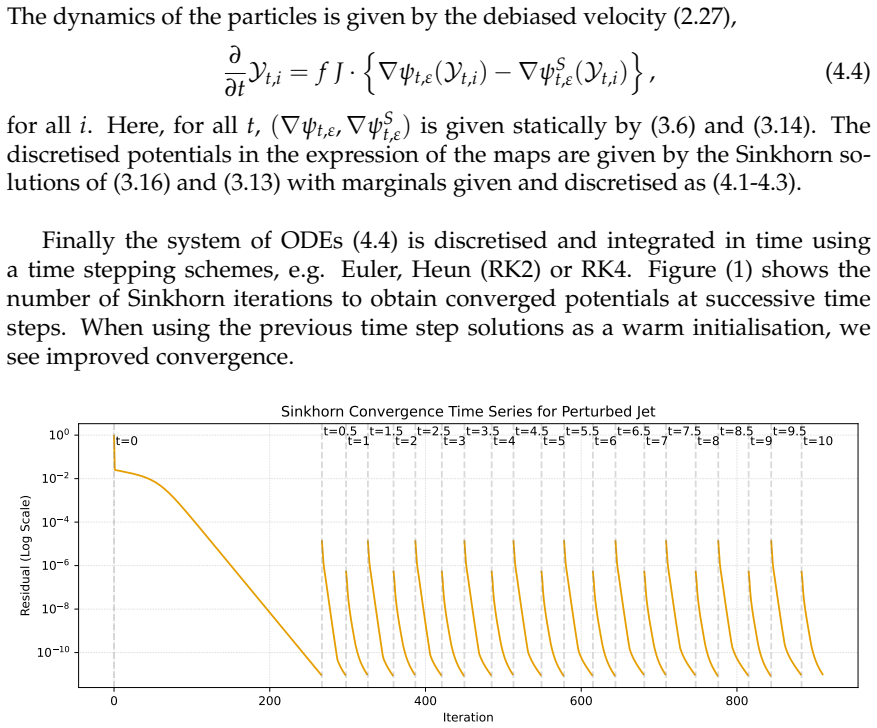
- Warm-starting the Sinkhorn iterations with potentials from the previous time step reduces iteration counts substantially, which is what makes the time-dependent computation affordable.
Reading between the lines
- A natural next test is to estimate the local Lipschitz constant of the reconstructed Brenier map in the perturbed jet as the front sharpens; if it diverges, the $L^2$ velocity convergence of Proposition 5(iii) has no guarantee and front capture is empirical rather than proven.
- The 'hole' that appears in the Lagrangian diagnostic point cloud at late times is a sign that the contractive barycentric map, amplified by entropic regularisation, is the weak point for tracking individual parcels near fronts; an adaptive $\varepsilon$ schedule or a different debiasing of the map might repair this diagnostic.
- Since the Sinkhorn divergence cost is $O(\varepsilon^2)$ accurate while the entropic map is only $O(\varepsilon)$ accurate, the attainable velocity error may be set by the map rather than the cost; comparing against a semi-discrete optimal transport solver at matched resolution would show where the remaining error enters.
Editorial analysis
A structured set of objections, weighed in public.
Referee Report
Summary. The paper develops a fully discrete entropic optimal transport (OT) discretisation of the semigeostrophic rotating shallow water (SGSW) equations. The authors revisit the OT formulation of the SGSW equations, introduce an entropic regularisation of the underlying OT problem, and then incorporate the Sinkhorn divergence debiasing correction. For the resulting saddle-point system they propose a Sinkhorn-like iterative algorithm. The paper provides several analytic results: convergence of the entropic value and height as epsilon tends to zero (Proposition 5), and a convergence result for the entropic velocity field under a global Lipschitz condition on the Brenier map. The numerical section demonstrates the method on stationary and perturbed jet test cases, reporting energy conservation to about 1e-4, convergence of the Sinkhorn iterations, and pseudoconvergence against a fine-grid solution. The abstract claims that the paper both proposes the iterative method and analyses its convergence.
Significance. If the numerical method and the associated convergence statements are reliable, this work is a useful step toward applying entropic OT and Sinkhorn-type algorithms to the semigeostrophic equations, potentially enabling GPU-accelerated simulations of fronts in geophysical flows. The paper builds on a well-established line of work (Benamou et al., 2024; Feydy et al., 2019; Cullen and Gangbo, 2001) and extends it to the shallow-water setting with a nontrivial potential energy term. The numerical experiments are extensive and include several diagnostics: height and velocity errors against analytic initial data, energy conservation, pseudoconvergence with grid refinement, and ageostrophic-to-geostrophic velocity ratios. The paper also honestly acknowledges several limitations, including the lack of a proof of concavity in the debiased problem. However, the main advertised contribution, the convergence analysis of the iterative solver, is not delivered in the body of the paper.
major comments (4)
- [Abstract and Section 3.4] The abstract states: 'We propose an iterative method to solve the discrete optimisation problem relating the two measures, and analyse its convergence.' This claim is directly contradicted by Section 3.4, which states: 'We do not have proof of concavity in φε of this new problem. The convergence of a coordinatewise ascent in (φε, ψε) algorithm similar to Sinkhorn is unclear and is left for further research.' The paper instead presents a 'heuristic iterative relaxation method' with 'experimental evidence of convergence'. Since the convergence analysis is a central advertised contribution, the authors must either provide a rigorous convergence analysis of the iterative scheme (3.29)-(3.31) or revise the abstract and the introduction to clearly state that convergence is only heuristic and supported by numerical experiments. This is a load-bearing discrepancy because the abstract's promise is not fulfilled by the body.
- [Proposition 5(iii) and Section 4.2] Proposition 5(iii) asserts convergence of ∇ψε to ∇ψ under the assumption that the Brenier map from σ to h is globally Lipschitz. The numerical examples are specifically designed to capture front-like structures (Section 4.2, Figure 3), where the transport map is expected to lose smoothness. The paper provides no numerical check of the global Lipschitz condition, and the convergence result therefore does not cover the regime of primary interest. The authors should either prove convergence under weaker assumptions (e.g., only local Lipschitz or with a quantitative control of the singular set) or explicitly state that the ε→0 velocity convergence is established only in the smooth regime and may fail or require further analysis near fronts.
- [Section 3.4, equations (3.16)-(3.31)] The saddle-point problem (3.16) and the optimality system (3.20)-(3.23) are motivated by the strict convexity/concavity of F, and standard gradient methods (3.18)-(3.19) are cited for convergence. However, the actual algorithm proposed, equations (3.29)-(3.31), is a different coordinate-wise iterative scheme for which no convergence proof is given. The text states 'Numerically, we observe a better convergence compared with (3.18-3.19)', but no comparison data or figures are presented to substantiate this claim. The authors should either provide a comparison of (3.29)-(3.31) with (3.18)-(3.19) or remove the comparative claim and justify the algorithm solely as a heuristic with its own convergence evidence (e.g., Figure 1).
- [Section 4.3, Figures 6-9] The error metrics Eh, EU, Eσ, and the height pseudoconvergence all use the Sinkhorn divergence S0.01 as the loss function. Since S0.01 is also the debiased objective used in the method, there is a risk of circularity, particularly when comparing debiased against biased results. The comparison against the exact initial height h0 and a fine-grid solution partially mitigates this concern, but the choice ε=0.01 for the metric is not justified and could mask systematic biases. The authors should discuss how the choice of metric affects the reported convergence rates and, if possible, include a metric with a different ε or a direct L2-height comparison for the fine-grid solution.
minor comments (5)
- [Section 4.3, paragraph 4] The text reads 'the system appears to converse its energy'; this should be 'conserve its energy'. Similarly, 'in terms of the normalised energy' and the following display are clear, but the word 'default energy conservation' in Figure 4 is ambiguous; consider using 'total energy error'.
- [Section 3.4, near equation (3.20)] The sentence 'Since (3.22-3.23) arise from a strictly convex problem, ithe system has a unique solution' contains a typo: 'ithe' should be 'the'. Also, the display of equation (3.15) appears to have a dangling '- 1/2 +' term; please check the algebra and formatting.
- [Section 3.3, after equation (3.16)] The parenthetical statement 'where the Coriolis parameter is set to f = 1' is introduced abruptly in the definition of F. Since the derivation up to that point uses a general f, this scaling should be justified in the model setup or clearly separated as a nondimensionalisation.
- [Section 4.3, energy conservation discussion] The claim 'The spatial semidiscretisation conserves energy exactly, so any energy errors will arise from time discretisation, or by truncation of the iterative scheme' is not fully supported, because the spatial discretisation also includes the approximation of the optimal transport solve and the debiasing correction. Consider clarifying that this statement refers to the exact solution of the semidiscrete ODE system, not to the fully discretised algorithm.
- [Section 2.3, equation (2.19)] In equation (2.19), the notation J is used for the rotation matrix, but in the same section J is also used as a subindex in 'J1,NK' (though the latter appears in Section 4.1). Please ensure consistent notation.
Circularity Check
No significant circularity: the central scheme is an application of standard entropic optimal transport theory, and the main numerical checks compare against an analytic initial height and a fine-grid reference; the abstract's convergence promise is contradicted in the body, but that is an unsupported claim, not a circular reduction.
full rationale
The derivation chain is not circular. The entropic regularisation, Sinkhorn iteration, Sinkhorn divergence debiasing, and epsilon-convergence statements are imported from or proved against external sources (Carlier et al. 2017; Feydy et al. 2019; Chizat et al. 2018; Berman 2020; Li & Nochetto 2020; Gigli 2011), and the paper's own Propositions 4 and 5 state the regularized optimality system and its convergence properties rather than assuming them. The new heuristic relaxation (3.29)-(3.31) is not obtained by fitting a parameter to the quantities later reported. The numerical validation uses the analytically prescribed initial height h0 and a fine-grid reference solution (N0 = 2^16) as independent targets; the fact that the same family of Sinkhorn divergences S0.01 is used as an error metric is not a construction-level identity, since h_epsilon is a saddle point of F in (3.16), not the minimiser of S0.01 against h0. The energy-conservation test is a consistency check of a Hamiltonian formulation, but it is supplemented by front formation and pseudoconvergence tests. Two caveats should be flagged. First, Section 3.4 explicitly says 'We do not have proof of concavity in φε of this new problem. The convergence of a coordinatewise ascent in (φε, ψε) algorithm similar to Sinkhorn is unclear and is left for further research,' which contradicts the abstract's phrase 'analyse its convergence'; that is a reporting/correctness gap, not circularity. Second, Proposition 5(iii) assumes a globally Lipschitz Brenier map, which is precisely the smoothness lost in the front-like regime targeted in Section 4.2, and the paper does not check this condition; again this is a validity gap, not a circular step. The reliance on the authors' prior work (Benamou et al. 2024; Carlier and Malamut 2024) is for background, notation, and problems explicitly left open, so it is not load-bearing. Score 2 reflects the minor self-referential flavour (shared Sinkhorn-divergence technology in method and metrics, and self-citations for tools) without any reduction of the central claim to its own inputs.
Assumptions & free parameters
free parameters (3)
- epsilon (entropic regularization parameter) =
0.01 in experiments; varied over 0.05 to 0.003125
- N (number of Dirac masses / grid size) =
N = 1/epsilon^2 in pseudoconvergence tests (up to 2^16)
- dt (time step) =
0.1 default; varied 0.05 to 0.4 in energy tests
assumptions (6)
- domain assumption Cullen Stability Principle: Pt = ||X||^2/2 + (g/f^2) h_t(X) remains a strictly convex potential for all t in [0,T].
- standard math Strong Fenchel-Rockafellar duality holds for the OT energy (2.22).
- domain assumption The Brenier map from sigma to h is globally Lipschitz in Prop 5(iii).
- domain assumption The O(epsilon^2) Sinkhorn divergence asymptotics require compact support and smoothness of marginals.
- ad hoc to paper The iterative scheme (3.29)-(3.31) converges to the saddle point.
- ad hoc to paper The discretisation error is balanced by N = 1/epsilon^2.
Cite this review
Pith. "Pith review of Entropic approximations of the semigeostrophic shallow water equations." pith.science (2026). https://pith.science/paper/IPUHCLKL
@misc{pith2026250716415,
  author       = {Pith},
  title        = {Pith review of: Entropic approximations of the semigeostrophic shallow water equations},
  year         = {2026},
  howpublished = {\url{https://pith.science/paper/IPUHCLKL}},
  note         = {Machine review of arXiv:2507.16415}
}
read the original abstract
We develop a discretisation of the semigeostrophic rotating shallow water equations, based upon their optimal transport formulation. This takes the form of a Moreau-Yoshida regularisation of the Wasserstein metric. Solutions of the optimal transport formulation provide the shallow water layer depth represented as a measure, which is itself the push forward of an evolving measure under the semigeostrophic coordinate transformation. First, we propose and study an entropy regularised version of the rotating shallow water equations. Second, we discretise the regularised problem by replacing both measures with weighted sums of Dirac measures, and approximate the (squared) L2 norm of the layer depth, which defines the potential energy. We propose an iterative method to solve the discrete optimisation problem relating the two measures, and analyse its convergence. The iterative method is demonstrated numerically and applied to the solution of the time-dependent shallow water problem in numerical examples.
Figures


Figures from the paper (6 more)


Reference graph
Works this paper leans on
-
[1]
Hamiltonian ODE s in the W asserstein space of probability measures
Ambrosio, L., Gangbo, W., 2008. Hamiltonian ODE s in the W asserstein space of probability measures. Communications on Pure and Applied Mathematics 61 (1), 18--53
work page 2008
-
[2]
Entropic optimal transport solutions of the semigeostrophic equations
Benamou, J.-D., Cotter, C., Malamut, H., 2024. Entropic optimal transport solutions of the semigeostrophic equations. Journal of Computational Physics 500, 112745. ://www.sciencedirect.com/science/article/pii/S0021999123008410
work page 2024
-
[3]
Berman, R. J., Dec. 2020 a . Convergence rates for discretized M onge A mp \` e re equations and quantitative stability of optimal transport. Foundations of Computational Mathematics 21 (4), 1099--1140. ://doi.org/10.1007/s10208-020-09480-x
-
[4]
Berman, R. J., aug 2020 b . The S inkhorn algorithm, parabolic optimal transport and geometric M onge-- A mp\` e re equations. Numerische Mathematics 145 (4), 771--836. ://doi.org/10.1007/s00211-020-01127-x
-
[5]
Semi-discrete optimal transport methods for the semi-geostrophic equations
Bourne, D., Egan, C., Pelloni, B., Wilkinson, M., 2022. Semi-discrete optimal transport methods for the semi-geostrophic equations. Calculus of Variations and Partial Differential Equations 61, cvgmt preprint. ://cvgmt.sns.it/paper/4811/
work page 2022
-
[6]
Semi-discrete optimal transport techniques for the compressible semi-geostrophic equations
Bourne, D. P., Egan, C. P., Lavier, T., Pelloni, B., 2025. Semi-discrete optimal transport techniques for the compressible semi-geostrophic equations. arXiv preprint arXiv:2504.20807
work page Pith review arXiv 2025
-
[7]
Convergence of entropic schemes for optimal transport and gradient flows
Carlier, G., Duval, V., Peyr \'e , G., Schmitzer, B., 2017. Convergence of entropic schemes for optimal transport and gradient flows. SIAM Journal on Mathematical Analysis 49 (2), 1385--1418
work page 2017
-
[8]
Well-posedness and convergence of entropic approximation of semi-geostrophic equations
Carlier, G., Malamut, H., 2024. Well-posedness and convergence of entropic approximation of semi-geostrophic equations. ://arxiv.org/abs/2404.17387
work page Pith review arXiv 2024
Show all 39 references
-
[9]
Unbalanced optimal transport: Models, numerical methods, applications
Chizat, L., 2017. Unbalanced optimal transport: Models, numerical methods, applications. Ph.D. thesis, Universit \'e Paris sciences et lettres
2017
-
[10]
Scaling algorithms for unbalanced optimal transport problems
Chizat, L., Peyr \'e , G., Schmitzer, B., Vialard, F.-X., 2018. Scaling algorithms for unbalanced optimal transport problems. Mathematics of computation 87 (314), 2563--2609
2018
-
[11]
Faster W asserstein distance estimation with the S inkhorn divergence
Chizat, L., Roussillon, P., L \'e ger, F., Vialard, F.-X., Peyr \'e , G., 2020. Faster W asserstein distance estimation with the S inkhorn divergence. Advances in Neural Information Processing Systems 33, 2257--2269
2020
-
[12]
A formula for the time derivative of the entropic cost and applications
Conforti, G., Tamanini, L., 2021. A formula for the time derivative of the entropic cost and applications. ://www.sciencedirect.com/science/article/pii/S002212362100046X
2021
-
[13]
The use of semigeostrophic theory to diagnose the behaviour of an atmospheric GCM
Cullen, M., 2018. The use of semigeostrophic theory to diagnose the behaviour of an atmospheric GCM . Fluids 3 (4), 72
2018
-
[14]
A variational approach for the 2-dimensional semi-geostrophic shallow water equations
Cullen, M., Gangbo, W., 2001. A variational approach for the 2-dimensional semi-geostrophic shallow water equations. Archive for rational mechanics and analysis 156, 241--273
2001
-
[15]
The fully compressible semi-geostrophic system from meteorology
Cullen, M., Maroofi, H., 2003. The fully compressible semi-geostrophic system from meteorology. Archive for rational mechanics and analysis 167, 309--336
2003
-
[16]
Properties of the L agrangian semigeostrophic equations
Cullen, M., Purser, R., 1989. Properties of the L agrangian semigeostrophic equations. Journal of Atmospheric Sciences 46 (17), 2684--2697
1989
-
[17]
A geometric model of the nonlinear equilibration of two-dimensional E ady waves
Cullen, M., Roulstone, I., 1993. A geometric model of the nonlinear equilibration of two-dimensional E ady waves. Journal of Atmospheric Sciences 50 (2), 328--332
1993
-
[18]
Cullen, M. J. P., 2006. A mathematical theory of large-scale atmosphere/ocean flow. World Scientific
2006
-
[19]
Cullen, M. J. P., 2007. Modelling atmospheric flows. Acta Numerica 16, 67--154
2007
-
[20]
Sinkhorn distances: Lightspeed computation of optimal transport
Cuturi, M., 2013. Sinkhorn distances: Lightspeed computation of optimal transport. Advances in neural information processing systems 26
2013
-
[21]
An optimal transport approach for the S chr \"o dinger bridge problem and convergence of S inkhorn algorithm
DiMarino, S., Gerolin, A., 2019. An optimal transport approach for the S chr \"o dinger bridge problem and convergence of S inkhorn algorithm. Journal of Scientific Computing 85. ://api.semanticscholar.org/CorpusID:208139296
2019
-
[22]
P., Bourne, D
Egan, C. P., Bourne, D. P., Cotter, C. J., Cullen, M. J., Pelloni, B., Roper, S. M., Wilkinson, M., 2022. A new implementation of the geometric method for solving the E ady slice equations. Journal of Computational Physics 469, 111542
2022
-
[23]
Convex Analysis and Variational Problems
Ekeland, I., Temam, R., 1976. Convex Analysis and Variational Problems. Vol. 1 of Studies in Mathematics and its Applications. North-Holland, Amsterdam
1976
-
[24]
Interpolating between optimal transport and MMD using Sinkhorn divergences
Feydy, J., S \'e journ \'e , T., Vialard, F.-X., Amari, S.-i., Trouv \'e , A., Peyr \'e , G., 16--18 Apr 2019. Interpolating between optimal transport and MMD using Sinkhorn divergences. In: Chaudhuri, K., Sugiyama, M. (Eds.), Proceedings of the 22nd International Conference o...
2019
-
[25]
Learning generative models with S inkhorn divergences
Genevay, A., Peyre, G., Cuturi, M., 09--11 Apr 2018. Learning generative models with S inkhorn divergences. In: Storkey, A., Perez-Cruz, F. (Eds.), Proceedings of the Twenty-First International Conference on Artificial Intelligence and Statistics. Vol. 84 of Proceedings of Mac...
2018
-
[26]
Gigli, N., Mar. 2011. On H \" o lder continuity-in-time of the optimal transport map towards measures along a curve. Proceedings of the Edinburgh Mathematical Society 54 (2), 401--409. ://doi.org/10.1017/s001309150800117x
2011 doi
-
[27]
J., 1971
Hoskins, B. J., 1971. Atmospheric frontogenesis models: Some solutions. Quarterly Journal of the Royal Meteorological Society 97 (412), 139--153
1971
-
[28]
J., 1975
Hoskins, B. J., 1975. The geostrophic momentum approximation and the semi-geostrophic equations. Journal of Atmospheric Sciences 32 (2), 233--242
1975
-
[29]
Convergence of a N ewton algorithm for semi-discrete optimal transport
Kitagawa, J., M \'e rigot, Q., Thibert, B., 2019. Convergence of a N ewton algorithm for semi-discrete optimal transport. Journal of the European Mathematical Society 21 (9), 2603--2651
2019
-
[30]
A semi-discrete optimal transport scheme for the 3 D incompressible semi-geostrophic equations
Lavier, T., 2024. A semi-discrete optimal transport scheme for the 3 D incompressible semi-geostrophic equations. arXiv preprint arXiv:2411.00575
2024
-
[31]
Li, W., Nochetto, R. H., Jul. 2020. Quantitative stability and error estimates for optimal transport plans. IMA Journal of Numerical Analysis 41 (3), 1941--1965. ://doi.org/10.1093/imanum/draa045
2020 doi
-
[32]
A multiscale approach to optimal transport
M \'e rigot, Q., 2011. A multiscale approach to optimal transport . Computer Graphics Forum 30 (5), 1584--1592. ://hal.archives-ouvertes.fr/hal-00604684
2011
-
[33]
A unified analysis of extra-gradient and optimistic gradient methods for saddle point problems: Proximal point approach
Mokhtari, A., Ozdaglar, A., Pattathil, S., 26--28 Aug 2020. A unified analysis of extra-gradient and optimistic gradient methods for saddle point problems: Proximal point approach. In: Chiappa, S., Calandra, R. (Eds.), Proceedings of the Twenty Third International Conference o...
2020
-
[34]
On the difference between entropic cost and the optimal transport cost
Pal, S., 2019. On the difference between entropic cost and the optimal transport cost. arXiv: Probability. ://api.semanticscholar.org/CorpusID:168170192
2019
-
[35]
Computational optimal transport: with applications to data science
Peyr \'e , G., Cuturi, M., et al., 2019. Computational optimal transport: with applications to data science. Foundations and Trends in Machine Learning 11 (5-6), 355--607
2019
-
[36]
Debiaser beware: pitfalls of centering regularized transport maps
Pooladian, A.-A., Cuturi, M., Niles-Weed, J., 2022. Debiaser beware: pitfalls of centering regularized transport maps. ://arxiv.org/abs/2202.08919
2022 arXiv
-
[37]
Lagrangian discretization of variational problems in W asserstein spaces
Sarrazin, C., 2022. Lagrangian discretization of variational problems in W asserstein spaces. Ph.D. thesis, Universit \'e Paris-Saclay
2022
-
[38]
Stabilized sparse scaling algorithms for entropy regularized transport problems
Schmitzer , B., 2019. Stabilized sparse scaling algorithms for entropy regularized transport problems. SIAM J. Sci. Comput. 41 (3)
2019
-
[39]
Parcel stability and its relation to semigeostrophic theory
Shutts, G., Cullen, M., 1987. Parcel stability and its relation to semigeostrophic theory. Journal of Atmospheric Sciences 44 (9), 1318--1330
1987
Reviewed August 6, 2026 · model on record in the stance chip above.
Discussion (0). Continue with ORCID to comment.