REVIEW 3 major objections 6 minor 22 references
Miniaturized and robust tunable monochromatic magneto-optical platform for pulsed magnetic fields
T0 review · 3 major / 6 minor · reviewed 2026-08-06 · deepseek-v4-flash
Pith's one-line read A laser-driven white lamp feeding a mini monochromator can replace the bulky, costly Ti:sapphire/OPO laser system in pulsed-field magneto-optics, reproducing known phase transitions to within 1 T.
desk verdict Useful compact alternative to laser-based tunable magneto-optics, but the headline 'within 1 T' validation claim is contradicted by the paper's own Table I for HC1. read the letter →
The pith
A machine-rendered reading of the paper's core claim, the machinery that carries it, and where it could break.
The reading
What carries the argument
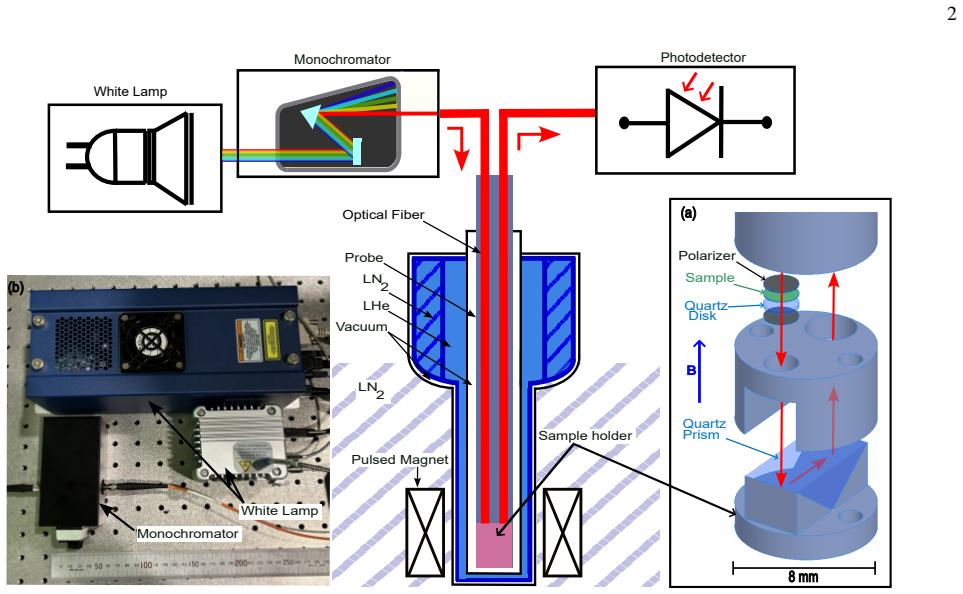
The load-bearing pieces are three. First, the source: a laser-driven broadband white lamp (400-900 nm) coupled through a 400-micrometre fibre into a mini monochromator with a 1200 lines/mm grating, whose output-slit width sets a ~2.5 nm FWHM at ~30 micro-watts across a unit shorter than 30 cm — the replacement for the tunable laser. Second, the detector chain: a 100 kHz avalanche photodetector sampling the transmitted light once per 10 microseconds, giving about 100 field points per millisecond against 0.8 points per millisecond for the comparison CCD spectrometer. Third, the differential Faraday-rotation method: because the measured Faraday angle $\theta$ changes sign when the field $\mathbf{B}$ or the propagation vector $\mathbf{k}$ is reversed, two acquisitions under reversed conditions are subtracted to cancel common-mode optical and mechanical artifacts, leaving the pure rotation even though the compact probe cannot host the usual beam-splitter and two-polarizer arrangement. Faraday rotation here is the rotation of a light beam's linear polarization while the beam travels through the sample along the magnetic field.
What would settle it
Run the same CdCr2O4 measurement at 635 nm while reversing the light-propagation direction (swapping the roles of the two optical fibres) instead of the magnetic field: the extracted Faraday rotation near 28 T must match the field-reversed result within the quoted error, or the differential method is contaminated by field-dependent artifacts. Separately, measure a sample with a spectral feature narrower than the instrument's ~2.5 nm bandpass and step the monochromator slit width from ~1 nm to ~5 nm: if the inferred critical fields shift by more than 1 T, the claimed accuracy is limited by spectral convolution rather than by the physics.
Extended reading notes
Core claim
The central claim is that a combination of a laser-driven white-light source and a mini monochromator is a high-accuracy, cost-effective, compact substitute for Ti:sapphire/OPO systems in tunable monochromatic magneto-transmission under non-destructive pulsed fields. The paper argues that low probe power is sufficient because millisecond-scale pulses give the detector ample time, and that the source's stability and small footprint remove the main barriers to wider use of the technique. To extract Faraday rotation in a probe too small for a conventional beam-splitter polarimeter, the authors introduce a differential scheme: reversing the magnetic field (or the light-propagation direction) changes only the sign of the Faraday angle, so subtracting two such measurements isolates the pure rotation. Validated on CdCr2O4 and SrCu2(BO3)2, the setup reproduces literature magnetization curves and critical fields to within 1 T, and its 100 kHz sampling resolves plateau features that whole-spectrum (spectrally resolved) acquisition misses.
Load-bearing premise
The load-bearing premise is that reversing the magnetic field (or the light-propagation direction) changes only the sign of the Faraday rotation, so that subtracting two reversed measurements cancels every other optical, mechanical, and electronic artifact; any field-dependent asymmetry in the probe optics, polarizers, or sample position would contaminate the extracted signal. The procedural details of this subtraction and of the linear-background removal are deferred to the Supplementary Information, whose cross-references appear in the manuscript as unresolved placeholders ('Fig.??', 'Sec.,??') in Section III.
Editorial extensions
If this is right
- Within the 1 T accuracy demonstrated on CdCr2O4 and SrCu2(BO3)2, field-induced transitions and magnetization-plateau sequences can be mapped out at arbitrary probe wavelengths from a single 36 ms pulse.
- The ~100 points/ms sampling resolves plateau features (e.g., SCBO between 39 and 42 T) that spectrally resolved acquisition at 0.8 points/ms misses.
- The low probe power (~30 micro-watts) reduces sample heating relative to broadband illumination, improving fidelity at cryogenic temperatures.
- The source's compactness and stability remove the cost, alignment-drift, and temperature-sensitivity barriers that have confined tunable monochromatic magneto-transmission to specialized laser laboratories.
- The demonstrated scope is millisecond-range non-destructive pulses: the paper notes that destructive magnets with sub-10 microsecond pulses still need the high power of laser systems.
Reading between the lines
- The subtract-two-reversed-runs recipe generalizes: any polarization measurement where the field or beam direction can be inverted — reflection Kerr, magnetic circular dichroism, microscopy — could cancel common-mode artifacts without a balanced-detector layout.
- The 2.5 nm bandpass sets an explicit spectral-resolution floor; for materials with sub-2.5 nm spectral features the traces will be slit-convolved, so sweeping the output-slit width from ~1 nm to ~5 nm on a sharp-line sample directly tests where inferred critical fields begin to shift.
- Pairing this optics unit with the compact 40 T pulsed magnet cited in the paper — a combination not demonstrated here — would put a tunable-wavelength high-field magneto-optical station on a benchtop.
Editorial analysis
A structured set of objections, weighed in public.
Referee Report
Summary. The paper reports a compact, low-cost tunable monochromatic magneto-transmission system for pulsed magnetic fields, based on a laser-driven white-light source coupled to a mini monochromator, with 100 kHz photodetection and a total source length under 30 cm. To validate the setup, the authors perform Faraday rotation measurements on CdCr2O4 at 4.2 K and monochromatic magneto-transmission on SrCu2(BO3)2 at 1.5 K, comparing the extracted critical fields with published magnetization and magnetostriction data. The central claim is that the setup reproduces the known phase transitions of both materials 'with an error bar of 1 T', while offering higher data density and lower sample heating than spectrally-resolved methods.
Significance. If the validation claim holds, this is a useful technical advance: it makes tunable monochromatic magneto-optical experiments in non-destructive pulsed magnets substantially more accessible by replacing bulky Ti:sapphire/OPO lasers with a compact white-light-plus-monochromator unit, while retaining high temporal resolution. The choice of two well-characterized frustrated magnets as test cases is appropriate, and the demonstrated 100 kHz acquisition rate is a genuine practical advantage. However, the quantitative support for the headline 'within 1 T' agreement is currently undermined by the authors' own Table I, and several load-bearing procedural details are relegated to a missing Supplementary file. The significance of the paper therefore depends on whether these issues can be resolved; as submitted, the central accuracy claim is not sustained by the data shown.
major comments (3)
- [Section III.B, Table I] The statement that the magneto-transmission critical fields agree with the magnetization results 'with an error bar of 1 T' is directly contradicted by Table I. The table lists HC1 = 24 T (Pulse 1) and 23 T (Pulse 2) from dI/dB, versus 27 T from the magnetization data of Onizuka et al. (Ref. 18), a difference of 3–4 T. HC2 agrees (34 T) and HC3 differs by 1 T (40 vs 39 T), but the discrepancy in HC1 is far outside the claimed ±1 T. The text gives no explanation for this offset. Because the derivative curves from which HC1 was extracted are placed in the missing Supplementary Fig. ??, the reader cannot check whether the derivative peak was misidentified, whether it corresponds to a different physical threshold such as an optical onset of band-edge shift, or whether the field calibration differed. This needs to be corrected or explicitly qualified before the validation claim can be accepted.
- [Supplementary Information references throughout (Sec. II, III.A, III.B)] The manuscript repeatedly cites 'Supplementary Information Sec. ??', 'Fig. ??', and 'Table ??' without providing the actual supplementary material. These references cover the detailed description of the differential Faraday rotation method, the linear background subtraction for CdCr2O4, the derivative curves used to extract the SCBO critical fields, and the spectrally-resolved comparison data. All of these items are load-bearing for the paper's accuracy claims, and their absence makes the manuscript incomplete. The authors should supply the supplementary file and replace the placeholders with correct citations.
- [Section III.A, differential Faraday rotation method] The differential method assumes that reversing the magnetic field direction and/or the light propagation vector changes only the sign of the Faraday rotation while leaving all other optical and mechanical factors unchanged, so that subtracting the two measurements isolates the Faraday signal. This assumption is not verified in the text. No raw intensity traces, zero-field checks, or control experiments with reversed k are shown to demonstrate that polarizer alignment, sample position, strain, or field-dependent artifacts indeed cancel. If any of these factors differ between the two scans, the extracted Faraday rotation would be contaminated. Please provide evidence for the cancellation, or state the limitation explicitly.
minor comments (6)
- [Section III.B and Conclusion] The manuscript uses both 'spectro-resolved' and 'spectrally-resolved' to describe the comparison method; please use one term consistently throughout.
- [Section II] The output power is given as '∼30 µw' but the standard unit symbol is µW; please correct the capitalization.
- [Conclusion] The phrase 'derivativedI (B)/dB' appears with a missing space and the notation dI(B)/dB is not defined at first use; please clarify in Section III.B where the derivative is introduced.
- [Figure 4(a)] The caption does not specify which plotted curves correspond to the magnetization data (Ref. 18) and the transverse magnetostriction data (Ref. 19), nor whether the transmission signal is shown on a linear scale; please clarify.
- [Abstract and Section II] The abstract refers to a 'millisecond-range pulsed magnetic field condition' while Section II states the pulse duration is 36 ms; please make the description consistent.
- [Table I] The statement that the error bar is 'estimated to be ±1 T' is given without any derivation; if this is a field-calibration uncertainty, please explain how it was obtained, especially in view of the 3–4 T discrepancy in HC1.
Circularity Check
No circularity: the validation compares directly measured transmission/Faraday features against independent prior experimental benchmarks; the Table I discrepancy is a correctness issue, not circularity.
full rationale
The paper's derivation chain is an instrumental demonstration, not a parameter fit. A white-light lamp and mini monochromator produce tunable monochromatic light; the transmitted intensity or Faraday rotation is measured on CdCr2O4 and SrCu2(BO3)2; field-sweep traces are plotted and differentiated; and the resulting transition fields are compared with published magnetization/magnetostriction data (Refs. 15, 18, 19). No parameter appearing in the final comparison is fitted to the benchmark values: the HC1-HC3 values in Table I are read directly from dI(B)/dB peak positions, and the CdCr2O4 curve is obtained by subtracting a linear diamagnetic background. The differential Faraday method reverses B or k and subtracts two traces, which is a measurement protocol rather than an equation whose output is defined by the desired result. Refs. 15 and 18 include some present co-authors, but they are previously published, parameter-free experimental results with stated conditions (e.g., B parallel to [111] at 4.2 K; magnetization of SCBO), and they do not incorporate the present data, so they are legitimate external benchmarks under the review rules. The claim of 'excellent agreement with an error bar of 1 T' is quantitatively at odds with Table I for HC1 (23-24 T versus 27 T from magnetization), but that is an evidentiary/accuracy contradiction, not a circular reduction of a prediction to its input. Therefore no circularity is present.
Assumptions & free parameters
free parameters (1)
- linear background subtraction coefficients for Faraday rotation =
not reported
assumptions (3)
- domain assumption Faraday rotation angle is proportional to the sample magnetization.
- domain assumption Reversing magnetic field direction or light propagation changes only the sign of the Faraday rotation, leaving all other optical factors unchanged.
- domain assumption The band-edge shift of SrCu2(BO3)2 is sensitive to spin correlations and field-induced phase transitions.
Cite this review
Pith. "Pith review of Miniaturized and robust tunable monochromatic magneto-optical platform for pulsed magnetic fields." pith.science (2026). https://pith.science/paper/XCFLVTXD
@misc{pith2026250716445,
  author       = {Pith},
  title        = {Pith review of: Miniaturized and robust tunable monochromatic magneto-optical platform for pulsed magnetic fields},
  year         = {2026},
  howpublished = {\url{https://pith.science/paper/XCFLVTXD}},
  note         = {Machine review of arXiv:2507.16445}
}
read the original abstract
Tunable monochromatic magneto-transmission is one of the most established magneto-optical techniques, particularly well suited for pulsed magnetic fields. It employs fixed-wavelength monochromatic light as the probe, while the magnetic field is swept to bring the sample into resonance with the photon energy. The key component of this setup is a tunable laser system, typically consisting of a Ti:sapphire laser coupled with an optical parametric oscillator. However, such laser systems are often bulky, expensive, and inherently unstable, which significantly limits their widespread application in magneto-optical laboratories. In this work, we develop a high-accuracy, cost-effective, and compact tunable monochromatic magneto-transmission system based on a combination of a laser-driven white light source and a mini monochromator, and demonstrate its feasibility and performance in a millisecond-range pulsed magnetic field condition. To verify the accuracy of this new and simplified setup, we performed Faraday rotation measurements on the geometrically frustrated spin system CdCr2O4, as well as magneto-transmission experiments on the Shastry-Sutherland lattice antiferromagnet SrCu2(BO3)2. These results show excellent agreement with previous reports, confirming the reliability and precision of the new setup.
Figures


Figures from the paper (1 more)

Reference graph
Works this paper leans on
-
[1]
author author R. Nicholas , author P. Solane ,\ and\ author O. Portugall ,\ title title Ultrahigh magnetic field study of layer split bands in graphite , \ @noop journal journal Physical Review Letters \ volume 111 ,\ pages 096802 ( year 2013 ) NoStop
work page 2013
-
[2]
author author Z. Yang , author A. Surrente , author K. Galkowski , author A. Miyata , author O. Portugall , author R. J. \ Sutton , author A. A. \ Haghighirad , author H. J. \ Snaith , author D. K. \ Maude , author P. Plochocka ,\ and\ author R. J. \ Nicholas ,\ title title Impact of the Halide Cage on the Electronic Properties of Fully Inorganic Cesium L...
-
[3]
author author A. Miyata , author A. Mitioglu , author P. Plochocka , author O. Portugall , author J. T.-W. \ Wang , author S. D. \ Stranks , author H. J. \ Snaith ,\ and\ author R. J. \ Nicholas ,\ title title Direct measurement of the exciton binding energy and effective masses for charge carriers in organic--inorganic tri-halide perovskites , \ @noop jo...
work page 2015
-
[4]
author author Z. Yang , author A. Surrente , author K. Galkowski , author N. Bruyant , author D. K. \ Maude , author A. A. \ Haghighirad , author H. J. \ Snaith , author P. Plochocka ,\ and\ author R. J. \ Nicholas ,\ title title Unraveling the exciton binding energy and the dielectric constant in single-crystal methylammonium lead triiodide perovskite , ...
work page 2017
-
[5]
author author I. Crassee , author J. Levallois , author A. L. \ Walter , author M. Ostler , author A. Bostwick , author E. Rotenberg , author T. Seyller , author D. van der Marel ,\ and\ author A. B. \ Kuzmenko ,\ title title Giant faraday rotation in single- and multilayer graphene , \ https://doi.org/10.1038/nphys1816 journal journal Nature Physics \ vo...
-
[6]
Higo , author H
author author T. Higo , author H. Man , author D. B. \ Gopman , author L. Wu , author T. Koretsune , author O. M. J. \ van ’t Erve , author Y. P. \ Kabanov , author D. Rees , author Y. Li , author M.-T. \ Suzuki , author S. Patankar , author M. Ikhlas , author C. L. \ Chien , author R. Arita , author R. D. \ Shull , author J. Orenstein ,\ and\ author S. N...
-
[7]
author author O. Fedchenko , author J. Minar , author A. Akashdeep , author S. W. \ D'Souza , author D. Vasilyev , author O. Tkach , author L. Odenbreit , author Q. L. \ Nguyen , author D. Kutnyakhov , author N. Wind , author L. Wenthaus , author M. Scholz , author K. Rossnagel , author M. Hoesch , author M. Aeschlimann , author B. Stadtmueller , author M...
arXiv 2023
-
[8]
author author Q. Song , author C. A. \ Occhialini , author E. Ergeçen , author B. Ilyas , author D. Amoroso , author P. Barone , author J. Kapeghian , author K. Watanabe , author T. Taniguchi , author A. S. \ Botana , author S. Picozzi , author N. Gedik ,\ and\ author R. Comin ,\ title title Evidence for a single-layer van der waals multiferroic , \ https...
Show all 22 references
-
[9]
Jiang , author Y
author author Y. Jiang , author Y. Wu , author J. Zhang , author J. Wei , author B. Peng ,\ and\ author C.-W. \ Qiu ,\ title title Dilemma in optical identification of single-layer multiferroics , \ https://doi.org/10.1038/s41586-023-06107-3 journal journal Nature \ volume 619...
-
[10]
Huang , author G
author author B. Huang , author G. Clark , author E. Navarro-Moratalla , author D. R. \ Klein , author R. Cheng , author K. L. \ Seyler , author D. Zhong , author E. Schmidgall , author M. A. \ McGuire , author D. H. \ Cobden , author W. Yao , author D. Xiao , author P. Jarill...
-
[11]
Tabataba-Vakili , author H
author author F. Tabataba-Vakili , author H. P. G. \ Nguyen , author A. Rupp , author K. Mosina , author A. Papavasileiou , author K. Watanabe , author T. Taniguchi , author P. Maletinsky , author M. M. \ Glazov , author Z. Sofer , author A. S. \ Baimuratov ,\ and\ author A. H...
2024
-
[12]
\ Zhou , author Z
author author X.-G. \ Zhou , author Z. Yang , author Y. Lee , author J. Park , author Y. Kohama , author K. Kindo , author Y. H. \ Matsuda , author J.-G. \ Park , author O. Janson ,\ and\ author A. Miyata ,\ title title Giant Linear Dichroism Controlled by Magnetic Field in Fe...
2024 arXiv
-
[13]
Yao , author X
author author J. Yao , author X. Ding , author J. Qiao , author C. Yang , author I. Hsu ,\ and\ author C. Hsu ,\ title title Pump-tuning optical parametric oscillation and sum-frequency mixing with KTP pumped by a Ti:sapphire laser , \ https://doi.org/https://doi.org/10.1016/S...
-
[14]
Galkowski , author A
author author K. Galkowski , author A. Mitioglu , author A. Miyata , author P. Plochocka , author O. Portugall , author G. E. \ Eperon , author J. T.-W. \ Wang , author T. Stergiopoulos , author S. D. \ Stranks , author H. J. \ Snaith ,\ and\ author R. J. \ Nicholas ,\ title t...
-
[15]
Kojima , author A
author author E. Kojima , author A. Miyata , author S. Miyabe , author S. Takeyama , author H. Ueda ,\ and\ author Y. Ueda ,\ title title Full-magnetization of geometrically frustrated CdCr _ 2 O _ 4 determined by Faraday rotation measurements at magnetic fields up to 140 T , ...
-
[16]
author author Matsuda, Y. H. and Abe, N. and Takeyama, S. and Kageyama, H. and Corboz, P. and Honecker, A. and Manmana, S. R. and Foltin, G. R. and Schmidt, K. P. and Mila, F. ,\ title title Magnetization of SrCu _ 2 ( BO _ 3 ) _ 2 in Ultrahigh Magnetic Fields up to 118 T , \ ...
2013
-
[17]
Miura ,\ @noop title Physics of Semiconductors in High Magnetic Fields \ ( publisher Oxford University Press ,\ year 2007 ) NoStop
author author N. Miura ,\ @noop title Physics of Semiconductors in High Magnetic Fields \ ( publisher Oxford University Press ,\ year 2007 ) NoStop
2007
-
[18]
Onizuka , author H
author author K. Onizuka , author H. Kageyama , author Y. Narumi , author K. Kindo , author Y. Ueda ,\ and\ author T. Goto ,\ title title 1/3 magnetization plateau in SrCu _2 (BO _3 ) _2 -stripe order of excited triplets , \ @noop journal journal Journal of the Physical Societ...
2000
-
[19]
Radtke , author A
author author G. Radtke , author A. Sa \'u l , author H. A. \ Dabkowska , author M. B. \ Salamon ,\ and\ author M. Jaime ,\ title title Magnetic nanopantograph in the SrCu _2 (BO _3 ) _2 Shastry--Sutherland lattice , \ @noop journal journal Proceedings of the National Academy ...
1971
-
[20]
author author J. G. \ Cherian , author T. D. \ Tokumoto , author H. Zhou ,\ and\ author S. A. \ McGill ,\ title title Short-range magnetic interactions and optical band-edge physics in SrCu _ 2 ( BO _ 3 ) _ 2 , \ https://doi.org/10.1103/PhysRevB.90.014405 journal journal Physi...
-
[21]
Kodama , author M
author author K. Kodama , author M. Takigawa , author M. Horvatic , author C. Berthier , author H. Kageyama , author Y. Ueda , author S. Miyahara , author F. Becca ,\ and\ author F. Mila ,\ title title Magnetic superstructure in the two-dimensional quantum antiferromagnet srcu...
2002
-
[22]
Ikeda , author K
author author A. Ikeda , author K. Noda , author K. Shimbori , author K. Seki , author D. Bhoi , author A. Ishita , author J. Nakamura , author K. Matsubayashi ,\ and\ author K. Akiba ,\ title title A concise 40 T pulse magnet for condensed matter experiments , \ @noop journal...
2024
Reviewed August 6, 2026 · model on record in the stance chip above.
Discussion (0). Continue with ORCID to comment.