REVIEW 3 major objections 5 minor 64 references
A Conservative and Positivity-Preserving Discontinuous Galerkin Method for the Population Balance Equation
T0 review · 3 major / 5 minor · reviewed 2026-08-06 · deepseek-v4-flash
Pith's one-line read For the population balance equation, a discontinuous Galerkin scheme conserves mass to round-off and keeps number densities nonnegative.
desk verdict Strong numerics and a genuinely useful scheme, but the positivity theorem is not proven as written—several steps are dimensionally inconsistent, including a division by zero on the first cell. read the letter →
The pith
A machine-rendered reading of the paper's core claim, the machinery that carries it, and where it could break.
The reading
What carries the argument
The load-bearing mechanism is a symmetric common refinement of the integration regions for the birth and death integrals. On the aggregation region $\Omega_a$, the birth regions $A_i$ and death regions $B_i$ are subdivided into a single triangular partition $T$; on the breakage region $\Omega_b$, a common refinement $E_0$ is built from the regions $C_i$ and $D_i$. The quadrature operators $Q_T$ and $Q_E$ are chosen so that, after the change of variables, the same quadrature points evaluate the birth mass term and the death mass term, and the rules are invariant under exchanging $u$ and $w$; with test function $v$, the two sums cancel exactly, independent of polynomial degree and mesh. The companion mechanism is a moment-conserving scaling limiter: given a cell polynomial with nonnegative $s$-th moment, the limiter shifts the polynomial up by a constant and rescales it, preserving $\int_{I_i} v^s n_h(v)\,dv$ while clipping negative values to zero.
What would settle it
Implement the aggregation-only scheme on a highly nonuniform mesh where the common refinement is triangulated without enforcing $u$-$w$ symmetry, or with a triangle quadrature rule that is not symmetric, and track the total mass over a long run: a mass drift away from its initial value at a rate proportional to the asymmetry would refute the central conservation claim. A positive control uses the symmetric refinement and shows the drift staying at round-off.
Extended reading notes
Core claim
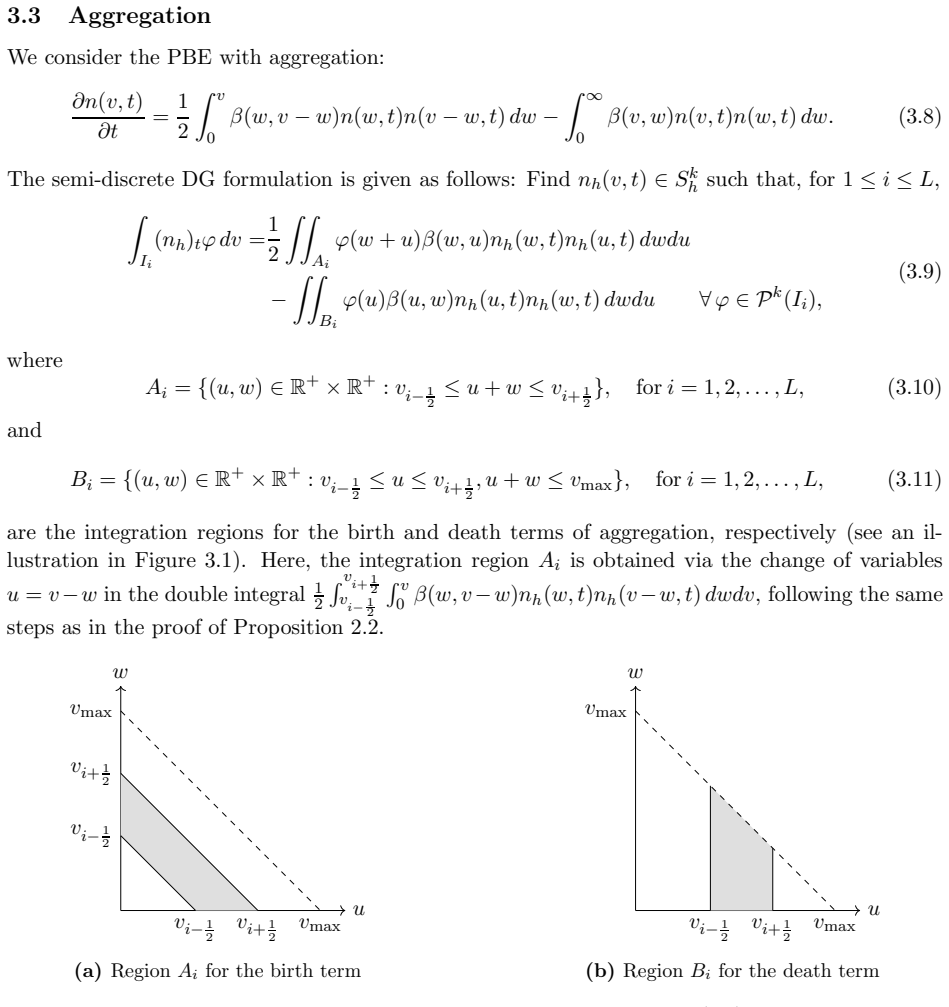
The paper claims that both goals can be met simultaneously in a DG framework that works directly with the number density $n(v,t)$, not with a mass-density reformulation. For aggregation and breakage, the birth and death integrals are evaluated on the same triangulated common refinement of their integration regions, using quadrature rules that are symmetric under swapping the two particle sizes $u$ and $w$; as a result, when the test function is $v$, the discrete birth and death contributions to the total mass cancel exactly, so the numerical mass $M_h(t)$ satisfies $dM_h/dt = 0$ up to rounding. For positivity, the paper proves that after one forward Euler step the first moment on each cell is nonnegative under the CFL bounds $\Delta t \leq 1/(v_{\max}\|\beta(u,w)n_h(w)\|_\infty)$ for aggregation and $\Delta t \leq 1/\|u\,p(u,w)\gamma(w)\|_\infty$ for breakage. A new scaling limiter then replaces a cell polynomial $n_h$ by $\theta(n_h + m)$, choosing $m$ and $\theta\in[0,1]$ so that the $s$-th moment is conserved while all point values become nonnegative; taking $s=1$ conserves mass, and the same construction is valid for any moment. Numerical benchmarks with analytical solutions and with physical aggregation kernels show third-order convergence and mass deviations around $10^{-16}$.
Load-bearing premise
The exact mass cancellation requires the triangulated common refinement and the quadrature rules to remain symmetric when the two particle sizes $u$ and $w$ are swapped, including after the geometric transformation that places quadrature points on physical cells; if that symmetry is lost, the birth and death quadrature errors no longer cancel.
Editorial extensions
If this is right
- Aggregation and breakage can be simulated on arbitrary nonuniform meshes with high-order polynomials while total particle mass stays constant to round-off, without reformulating the equation in mass-density variables.
- The positivity limiter is not tied to the cell average: any physically meaningful moment can be conserved during limiting, including particle mass or, in length coordinates, the third moment that represents mass.
- The proven CFL conditions give a computable guarantee that local mass on each cell remains nonnegative per forward Euler stage, and the fallback strategy of halving the time step terminates after finitely many halvings.
- Because the time integration uses SSP-RK stages, which are convex combinations of forward Euler steps, the conservation and positivity properties carry over to high-order fully discrete time stepping.
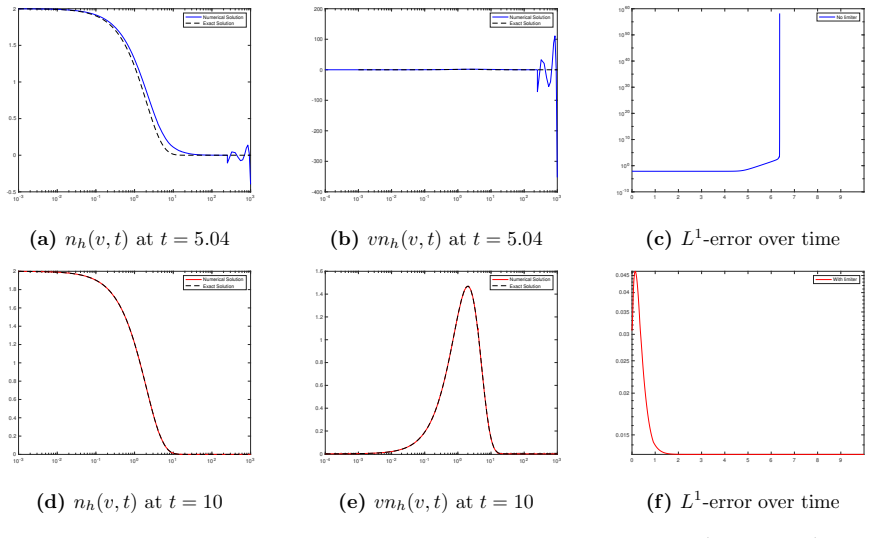
- In positivity-challenging examples, the limiter allows time steps about ten times larger than the unlimited scheme before the computation becomes unstable, while preserving the accurate solution.
Reading between the lines
- The moment-conserving limiter should transfer to other kinetic and population models in which a weighted moment, rather than the cell average, is the conserved physical quantity, such as coagulation models formulated in particle-length coordinates.
- The common-refinement cancellation suggests a general recipe for conservative discretization of integral birth-death operators: refine all integration domains into one symmetric partition before applying quadrature; this may extend to two-dimensional internal coordinates or multi-particle collision integrals.
- The swap-symmetry assumption can be probed directly: running the aggregation scheme with an intentionally non-symmetric triangulation or non-symmetric quadrature rule should produce mass drift at the level of the asymmetry, whereas the symmetric construction should stay at round-off.
- The fallback time-step halving could be replaced by an adaptive controller that monitors the proven moment-positivity condition and adjusts the step before negative moments appear.
Editorial analysis
A structured set of objections, weighed in public.
Referee Report
Summary. This paper develops a discontinuous Galerkin method for the population balance equation (PBE) in the number-density formulation. The aggregation and breakage operators are rewritten as double integrals over symmetric regions A_i, B_i and C_i, D_i, respectively, and are evaluated by quadrature on common refinements of the integration domains. The authors prove exact mass conservation for the semi-discrete scheme, derive CFL-type conditions under which the first cell moment remains nonnegative after forward Euler steps, and introduce a scaling limiter that preserves an arbitrary prescribed moment while enforcing pointwise nonnegativity. Numerical tests for pure aggregation, pure breakage, aggregation--breakage, and aggregation--growth report third-order accuracy, mass conservation to round-off, and improved robustness with the limiter.
Significance. If the theoretical results hold, the paper's main contribution is a positivity-preserving DG framework in which the conserved quantity is a general moment rather than the cell average; this is exactly what is needed for the number-density form of the PBE, where mass, not particle number, is conserved. The numerical verification is unusually complete: order-of-accuracy studies, round-off-level mass conservation over long times, physical kernels, and a clear demonstration that the limiter prevents blow-up. The construction via common refinements is elegant and likely to be reusable. However, the proof of the first-moment positivity theorem (Theorem 4.1) as typeset contains unjustified and dimensionally inconsistent steps, and the conservation proof leaves the global symmetry of the quadrature rules implicit; these issues must be repaired before the central claim is fully supported.
major comments (3)
- [§4.1, Theorem 4.1 (aggregation case)] The aggregation part of the proof contains the displayed equality Q_Ii[v n_h] - Δt Σ_{T⊆B_i\A_i} Q_T[uβ(u,w)n_h(u)n_h(w)] = Σ_{T⊆B_i\A_i} Q_T[u n_h(u)(1/vmax - v_{i+1/2} - Δtβ(u,w)n_h(w))]. This equality is not derived and is dimensionally inconsistent: 1/vmax and v_{i+1/2} have different units, and a one-dimensional cell integral Q_Ii[v n_h] cannot be replaced by a sum of two-dimensional triangle quadratures without an argument. The claimed nonnegativity therefore does not follow from the written proof. A viable repair is to use the cancellation of birth and death over A_i, obtaining Q_Ii[v n_h] - Δt Σ_{T⊆B_i\A_i} Q_T[uβ(u,w)n_h(u)n_h(w)], and then bound the death term by Δt (vmax - v_{i+1/2}) ||β n_h||_{L∞(Ωa)} Q_Ii[u n_h] ≤ Δt vmax ||β n_h||_{L∞(Ωa)} Q_Ii[u n_h]; the stated CFL condition then yields the result. Please replace the displayed equality with this (or an equivalent) argument.
- [§4.1, Theorem 4.1 (breakage case)] The breakage proof uses the factor w/v_{i-1/2} and the inequality w/v_{i-1/2} ≥ 1. For i=1, v_{1/2}=0, so this step is undefined; this is not a harmless edge case because the theorem is stated for every cell. The displayed equality immediately before this step is also not justified. The first cell can be handled separately: parents in the first cell fragment only into daughters in the first cell, so the birth term cancels the death term and the first moment only increases. For i>1, a valid argument can use the mass-conservation identity (2.3) to bound ∫_0^{v_{i-1/2}} u p(u,w) du ≤ w. Please rewrite the proof accordingly.
- [§3.3, Proposition 3.1] The proof of Proposition 3.1 concludes by relying on the 'u–w symmetry of the integrand, the partition T, and the quadrature rule'. The quadrature rules of [57] are D3-symmetric on an equilateral reference triangle, but the triangles in T are arbitrary non-equilateral physical triangles after the affine mapping, and a D3-symmetric rule does not automatically remain invariant under (u,w)↦(w,u) on such a triangle. Please state explicitly how the global u–w symmetry of the full quadrature set is guaranteed (for example, by pairing each triangle with its reflection and using compatible rules on each pair), because the exact mass cancellation in (3.27) depends on this property.
minor comments (5)
- [Eqs. (3.6)–(3.7)] The displayed quadrature approximations contain a spurious minus sign; the same integrals appear with a plus sign in (3.4) and in the component form (3.30). Please remove the minus signs.
- [Figure 3.4 caption] The caption reads 'breakge region' and should read 'breakage region'.
- [§4, limiter definition] The symbol m denotes both the time level (dropped at the start of the proof of Theorem 4.1) and the limiter shift in (4.2)–(4.3); please use different symbols to avoid confusion.
- [Reference [57]] The first author of reference [57] is listed as 'S. Wandzurat'; the standard spelling is 'S. Wandzura'. Please verify.
- [§5.1, time-step choice] The practical time step Δt = 10Δv is much larger than the theoretical CFL restriction in Theorem 4.1; since Remark 4.1 introduces a fallback halving strategy, a sentence connecting the practical choice to the theory would improve clarity.
Circularity Check
No circularity: the conservation and positivity results are derived from the discretization and stated CFL conditions, not from fitted data or load-bearing self-citation.
full rationale
I walked the derivation chain and found no step in which a claimed prediction or first-principles result reduces by construction to its own inputs. The exact-conservation results in Propositions 3.1 and 3.2 are design consequences: the common-refinement quadrature is deliberately constructed so that birth and death contributions cancel when summed over the full domain. The proof rests on the stated u–w symmetry of the partition and quadrature, and the paper explicitly describes this as a construction rather than as an empirical prediction. No fitted parameter is renamed as a prediction. The positivity-preserving limiter (4.2)–(4.3) is likewise explicit about its construction: the scaling factor θ is defined precisely so that the s-th moment is preserved, so Theorem 4.2's conservation property is an identity following from the definition of θ, not a circular derivation of an independent claim. The positivity property follows directly from θ ≥ 0 and the definition of m. Self-citations [59, 60, 61] appear only for auxiliary extensions (Lax–Wendroff, implicit time marching, exponential time differencing) and are not load-bearing for the central conservation or positivity claims. The central external ingredients are the symmetric triangle quadrature rules of [57], the aggregation-map idea of [34, 42, 52], and the Zhang–Shu framework [63], none of which are self-citations. I did note two non-circular correctness concerns. First, the proof of Theorem 4.1 contains an asserted equality in which “1/v_max − v_{i+1/2}” is dimensionally inconsistent, and the breakage case divides by v_{1/2} = 0 on the first cell; as typeset, the proof does not establish the advertised first-moment positivity guarantee. Second, Proposition 3.1 assumes that the D3-symmetric quadrature rules of [57] preserve the u–w swap after affine mapping to non-equilateral physical triangles, which is asserted but not demonstrated. These are proof-gap and missing-support issues, not circularity, because the claimed results are not equivalent to their inputs by construction. The paper is otherwise self-contained with respect to its theoretical claims, and the numerical benchmarks are external analytical solutions rather than data fitted from the scheme itself.
Assumptions & free parameters
assumptions (4)
- domain assumption Kernels are bounded or mildly growing so all PBE integrals remain finite and no gelation occurs.
- domain assumption The common refinement T can be constructed by constrained Delaunay triangulation enforcing u-w symmetry, and the D3-symmetric quadrature rules of [57] can be mapped so that QT[f(u,w)] = QT[f(w,u)].
- standard math The Gauss-Lobatto and D3-symmetric triangle quadrature rules are exact for the polynomial degrees appearing in the moment identities.
- standard math SSP-RK time integration is a convex combination of forward Euler stages, so positivity and conservation proven for forward Euler transfer to the full time discretization.
Cite this review
Pith. "Pith review of A Conservative and Positivity-Preserving Discontinuous Galerkin Method for the Population Balance Equation." pith.science (2026). https://pith.science/paper/KQ4WD6W7
@misc{pith2026250716631,
  author       = {Pith},
  title        = {Pith review of: A Conservative and Positivity-Preserving Discontinuous Galerkin Method for the Population Balance Equation},
  year         = {2026},
  howpublished = {\url{https://pith.science/paper/KQ4WD6W7}},
  note         = {Machine review of arXiv:2507.16631}
}
read the original abstract
We develop a conservative, positivity-preserving discontinuous Galerkin (DG) method for the population balance equation (PBE), which models the distribution of particle numbers across particle sizes due to growth, nucleation, aggregation, and breakage. To ensure number conservation in growth and mass conservation in aggregation and breakage, we design a DG scheme that applies standard treatment for growth and nucleation, and introduces a novel discretization for aggregation and breakage. The birth and death terms are discretized in a symmetric double-integral form, evaluated using a common refinement of the integration domain and carefully selected quadrature rules. Beyond conservation, we focus on preserving the positivity of the number density in aggregation-breakage. Since local mass corresponds to the first moment, the classical Zhang-Shu limiter, which preserves the zeroth moment (cell average), is not directly applicable. We address this by proving the positivity of the first moment on each cell and constructing a moment-conserving limiter that enforces nonnegativity across the domain. To our knowledge, this is the first work to develop a positivity-preserving algorithm that conserves a prescribed moment. Numerical results verify the accuracy, conservation, and robustness of the proposed method.
Figures


Figures from the paper (8 more)



Reference graph
Works this paper leans on
-
[31]
H. Liu, R. Gr¨ opler, and G. Warnecke, A high-order posit ivity-preserving DG method for coagulation–fragmentation equations, SIAM Journal on Scientific Computing , 41 (2019), B448–B465
work page 2019
-
[57]
S. Wandzurat and H. Xiao, Symmetric quadrature rules on a triangle, Computers & Mathe- matics with Applications , 45 (2003), 1829–1840
work page 2003
-
[1]
U.M. Ascher, S.J. Ruuth and R.J. Spiteri, Implicit-expl icit Runge-Kutta methods for time- dependent partial differential equations, Applied Numerica l Mathematics, 25 (1997), pp.151- 167. 29 10-3 10-2 10-1 100 101 102 103 -0.5 0 0.5 1 1.5 2 Numerical Solution Exact Solution (a) nh(v, t) at t = 5.04 10-4 10-3 10-2 10-1 100 101 102 103 -400 -300 -200 -100 0...
work page 1997
-
[2]
M.M. Attarakih, C. Drumm and H.J. Bart, Solution of the po pulation balance equation using the sectional quadrature method of moments (SQMOM), Chemical Engineering Science , 64 (2009), pp.742-752
work page 2009
-
[3]
R. Bleck, A fast, approximative method for integrating t he stochastic coalescence equation, Journal of Geophysical Research , 75 (1970), 5165-5171
work page 1970
-
[4]
J.P. Bourgade and F. Filbet, Convergence of a finite volum e scheme for coagulation- fragmentation equations, Mathematics of Computation , 77 (2008), 851-882
work page 2008
-
[5]
Y. Cheng and C.-W. Shu, A discontinuous Galerkin finite el ement method for directly solving the Hamilton–Jacobi equations, Journal of Computational Physics , 223 (2007), 398–415
work page 2007
-
[6]
Y. Cheng and C.-W. Shu, A discontinuous Galerkin finite el ement method for time-dependent partial differential equations with higher-order derivativ es, Mathematics of Computation , 77 (2008), 699–730
work page 2008
Show all 64 references
-
[7]
Chew, Constrained Delaunay triangulations, Proce edings of the Third Annual Symposium on Computational Geometry, (1987), 215–222
L.P. Chew, Constrained Delaunay triangulations, Proce edings of the Third Annual Symposium on Computational Geometry, (1987), 215–222
1987
-
[8]
Cockburn, S
B. Cockburn, S. Hou, and C.-W. Shu, The Runge–Kutta local projection discontinuous Galerkin finite element method for conservation laws IV: the multidimensional case, Math- ematics of Computation , 54 (1990), 545–581
1990
-
[9]
Cockburn, F
B. Cockburn, F. Li, and C.-W. Shu, Locally divergence-fr ee discontinuous Galerkin methods for the Maxwell equations, Journal of Computational Physics , 194 (2004), 588–610
2004
-
[10]
Cockburn and C.-W
B. Cockburn and C.-W. Shu, TVB Runge–Kutta local projec tion discontinuous Galerkin finite element method for conservation laws II: general framework , Mathematics of Computation , 52 (1989), 411–435
1989
-
[11]
Cockburn and C.-W
B. Cockburn and C.-W. Shu, The Runge–Kutta local projec tion-discontinuous-Galerkin finite element method for scalar conservation laws, ESAIM: Mathematical Modelling and Numerical Analysis, 25 (1991), 337–361
1991
-
[12]
Cockburn and C.-W
B. Cockburn and C.-W. Shu, The local discontinuous Gale rkin method for time-dependent convection–diffusion systems, SIAM Journal on Numerical Analysis , 35 (1998), 2440–2463
1998
-
[13]
Diemer and J.H
R.B. Diemer and J.H. Olson, A moment methodology for coa gulation and breakage problems: Part 2—moment models and distribution reconstruction, Chemical Engineering Science , 57 (2002), pp.2211-2228
2002
-
[14]
R. L. Drake, A general mathematical survey of the coagul ation equation, Topics in Current Aerosol Research, Pergamon Press, Oxford, 1972, 201–376
1972
-
[15]
Filbet and P
F. Filbet and P. Lauren¸ cot, Numerical simulation of th e Smoluchowski coagulation equation, SIAM Journal on Scientific Computing , 25 (2004), 2004-2028
2004
-
[16]
S. K. Friedlander, Smoke, Dust, and Haze: Fundamentals of Aerosol Dynamics , 2nd ed., Oxford University Press, Oxford, 2000
2000
-
[17]
Gabriel and L.M
P. Gabriel and L.M. Tine, High-order WENO scheme for pol ymerization-type equations, ESAIM: Proceedings, 30 (2010), 53-69. 31
2010
-
[18]
Gelbard and J.H
F. Gelbard and J.H. Seinfeld, Numerical solution of the dynamic equation for particulate systems, Journal of Computational Physics , 28 (1978), 357-375
1978
-
[19]
Gottlieb, D.I
S. Gottlieb, D.I. Ketcheson, and C.-W. Shu, High-order strong-stability-preserving time dis- cretizations, Journal of Scientific Computing , 38 (2009), 251–289
2009
-
[20]
Gottlieb, C.-W
S. Gottlieb, C.-W. Shu, and E. Tadmor, Strong stability preserving high-order time discretiza- tion methods, SIAM Review, 43 (2001), 89–112
2001
-
[21]
Hasseine and H.J
A. Hasseine and H.J. Bart, Adomian decomposition metho d solution of population balance equations for aggregation, nucleation, growth and breakup processes, Applied Mathematical Modelling, 39 (2015), 1975-1984
2015
-
[22]
Hidy and J.R
G.M. Hidy and J.R. Brock, The dynamics of aerocolloidal systems, Pergamon (1970)
1970
-
[23]
Ketcheson, C.B
D.I. Ketcheson, C.B. Macdonald and S. Gottlieb, Optima l implicit strong stability preserving Runge–Kutta methods, Applied Numerical Mathematics , 59 (2009), 373-392
2009
-
[24]
Kolewe, S.C
M.E. Kolewe, S.C. Roberts and M.A. Henson, A population balance equation model of ag- gregation dynamics in Taxus suspension cell cultures, Biotechnology and bioengineering , 109 (2012), 472-482
2012
-
[25]
Kumar and D
S. Kumar and D. Ramkrishna, On the solution of populatio n balance equations by discretiza- tion—I. A fixed pivot technique, Chemical Engineering Science , 51 (1996), 1311-1332
1996
-
[26]
Kumar and D
S. Kumar and D. Ramkrishna, On the solution of populatio n balance equations by discretiza- tion—II. A moving pivot technique, Chemical Engineering Science , 51 (1996), 1333-1342
1996
-
[27]
Kumar and D
S. Kumar and D. Ramkrishna, On the solution of populatio n balance equations by discretiza- tion—III. Nucleation, growth and aggregation of particles , Chemical Engineering Science , 52 (1997), 4659-4679
1997
-
[28]
P.L.C. Lage, Comments on the” An analytical solution to the population balance equation with coalescence and breakage-the special case with constant nu mber of particles” by DP Patil and JRG Andrews [Chemical Engineering Science 53 (3) 599-601], Chemical Engineering Science , ...
2002
-
[29]
Leyvraz and H.R
F. Leyvraz and H.R. Tschudi, Singularities in the kinet ics of coagulation processes, Journal of Physics A: Mathematical and General , 14 (1981), 3389
1981
-
[30]
Lim, J.M
Y.I. Lim, J.M. Le Lann, X.M. Meyer, X. Joulia, G. Lee and E .S. Yoon, On the solution of population balance equations (PBE) with accurate front t racking methods in practical crystallization processes, Chemical Engineering Science , 57 (2002), 3715-3732
2002
-
[32]
Liu and X
C. Liu and X. Zhang, A positivity-preserving implicit- explicit scheme with high order polyno- mial basis for compressible Navier–Stokes equations, Journal of Computational Physics , 493 (2023), 112496. 32
2023
-
[33]
Liu and S
X.D. Liu and S. Osher, Non-oscillatory high-order accu rate self-similar maximum-principle- satisfying shock-capturing schemes I, SIAM Journal on Numerical Analysis , 33 (1996), 760–779
1996
-
[34]
Liu and S
A. Liu and S. Rigopoulos, A conservative method for nume rical solution of the population balance equation, and application to soot formation, Combustion and Flame , 205 (2019), 506- 521
2019
-
[35]
Lombart and G
M. Lombart and G. Laibe, Grain growth for astrophysics w ith discontinuous Galerkin schemes, Monthly Notices of the Royal Astronomical Society , 501 (2021), 4298-4316
2021
-
[36]
Lombart, Grain growth by the Galerkin method for the f ormation of planets, Doctoral dissertation, Universit´ e de Lyon, (2020)
M. Lombart, Grain growth by the Galerkin method for the f ormation of planets, Doctoral dissertation, Universit´ e de Lyon, (2020)
2020
-
[37]
Maisels, F.E
A. Maisels, F.E. Kruis and H. Fissan, Direct simulation Monte Carlo for simultaneous nucle- ation, coagulation, and surface growth in dispersed system s, Chemical Engineering Science , 59 (2004), 2231-2239
2004
-
[38]
Marchisio, J.T
D.L. Marchisio, J.T. Pikturna, R.O. Fox, R.D. Vigil and A.A. Barresi, Quadrature method of moments for population-balance equations, AIChE Journal , 49 (2003), 1266-1276
2003
-
[39]
McLeod, On an infinite set of non-linear differential equations, The Quarterly Journal of Mathematics, 13 (1962), pp.119-128
J.B. McLeod, On an infinite set of non-linear differential equations, The Quarterly Journal of Mathematics, 13 (1962), pp.119-128
1962
-
[40]
Melzak, A scalar transport equation, Transactions of the American Mathematical Society , 85 (1957), 547-560
Z. Melzak, A scalar transport equation, Transactions of the American Mathematical Society , 85 (1957), 547-560
1957
-
[41]
Myerson, Handbook of industrial crystallization, B utterworth-Heinemann, (2002)
A. Myerson, Handbook of industrial crystallization, B utterworth-Heinemann, (2002)
2002
-
[42]
O’Sullivan and S
D. O’Sullivan and S. Rigopoulos, A conservative finite v olume method for the population bal- ance equation with aggregation, fragmentation, nucleatio n and growth, Chemical Engineering Science, 263 (2022), 117925
2022
-
[43]
Patil and J.R.G
D.P. Patil and J.R.G. Andrews, An analytical solution t o continuous population balance model describing floc coalescence and breakage—a special case, Chemical Engineering Science , 53 (1998), 599-601
1998
-
[44]
Patterson, W
R.I. Patterson, W. Wagner and M. Kraft, Stochastic weig hted particle methods for population balance equations, Journal of Computational Physics , 230 (2011), 7456-7472
2011
-
[45]
Qamar and G
S. Qamar and G. Warnecke, Numerical solution of populat ion balance equations for nucleation, growth and aggregation processes, Computers & Chemical Engineering , 31 (2007), 1576-1589
2007
-
[46]
Ramabhadran, T.W
T.E. Ramabhadran, T.W. Peterson and J.H. Seinfeld, Dyn amics of aerosol coagulation and condensation, AIChE Journal , 22 (1976), 840-851
1976
-
[47]
Reed and T
W.H. Reed and T. Hill, Triangular mesh methods for the ne utron transport equation, Technical Report, Los Alamos Scientific Laboratory, 1973
1973
-
[48]
Rigopoulos, Population balance of particles in flows : From aerosols to crystallisation, Cam- bridge University Press, 2024
S. Rigopoulos, Population balance of particles in flows : From aerosols to crystallisation, Cam- bridge University Press, 2024
2024
-
[49]
Rigopoulos and A.G
S. Rigopoulos and A.G. Jones, Finite-element scheme fo r solution of the dynamic population balance equation, AIChE Journal , 49 (2003), 1127-1139. 33
2003
-
[50]
Rivi` ere, Discontinuous Galerkin Methods for Solvi ng Elliptic and Parabolic Equations: Theory and Implementation, SIAM, 2008
B. Rivi` ere, Discontinuous Galerkin Methods for Solvi ng Elliptic and Parabolic Equations: Theory and Implementation, SIAM, 2008
2008
-
[51]
Scott, Analytic studies of cloud droplet coalesce nce I, Journal of the Atmospheric Sci- ences, 25 (1968), 54–65
W.T. Scott, Analytic studies of cloud droplet coalesce nce I, Journal of the Atmospheric Sci- ences, 25 (1968), 54–65
1968
-
[52]
F. Sewerin, An efficient implementation of a conservativ e finite volume scheme with constant and linear reconstructions for solving the coagulation equ ation, Chemical Engineering Science, 280 (2023), 119020
2023
-
[53]
Shu, Total-Variation-Diminishing time discret izations, SIAM Journal on Scientific and Statistical Computing, 9 (1988), 1073–1084
C.-W. Shu, Total-Variation-Diminishing time discret izations, SIAM Journal on Scientific and Statistical Computing, 9 (1988), 1073–1084
1988
-
[54]
Shu, Discontinuous Galerkin methods: general ap proach and stability, in Numerical Solutions of Partial Differential Equations , 201 (2009), 1–44
C.-W. Shu, Discontinuous Galerkin methods: general ap proach and stability, in Numerical Solutions of Partial Differential Equations , 201 (2009), 1–44
2009
-
[55]
Shu and S
C.-W. Shu and S. Osher, Efficient implementation of essen tially non-oscillatory shock-capturing schemes, Journal of Computational Physics , 77 (1988), 439–471
1988
-
[56]
von Smoluchowski, Versuch einer mathematischen The orie der Koagulationskinetik kolloi- der L¨ osungen,Zeitschrift f¨ ur physikalische Chemie, 92 (1918), 129–168
M. von Smoluchowski, Versuch einer mathematischen The orie der Koagulationskinetik kolloi- der L¨ osungen,Zeitschrift f¨ ur physikalische Chemie, 92 (1918), 129–168
1918
-
[58]
Xu and C.-W
Y. Xu and C.-W. Shu, Local discontinuous Galerkin metho ds for high-order time-dependent partial differential equations, Communications in Computational Physics , 7 (2010), 1–46
2010
-
[59]
Xu and C.-W
Z. Xu and C.-W. Shu, Third-order maximum-principle-sa tisfying and positivity-preserving Lax–Wendroff discontinuous Galerkin methods for hyperboli c conservation laws, Journal of Computational Physics , 470 (2022), 111591
2022
-
[60]
Xu and C.-W
Z. Xu and C.-W. Shu, On the conservation property of posi tivity-preserving discontinuous Galerkin methods for stationary hyperbolic equations, Journal of Computational Physics , 490 (2023), 112304
2023
-
[61]
Z. Xu, Z. Sun, and Y.-T. Zhang, Stability and time-step c onstraints of exponential time- differencing Runge–Kutta discontinuous Galerkin methods fo r advection–diffusion equations, arXiv:2503.03019 (2025)
2025 arXiv
-
[62]
Z. Xu, H. Zhao and C. Zheng, Accelerating population bal ance-Monte Carlo simulation for coagulation dynamics from the Markov jump model, stochasti c algorithm and GPU parallel computing, Journal of Computational Physics , 281 (2015), 844-863
2015
-
[63]
Zhang and C.-W
X. Zhang and C.-W. Shu, On maximum-principle-satisfyi ng high-order schemes for scalar conservation laws, Journal of Computational Physics , 229 (2010), 3091–3120
2010
-
[64]
Ziff and E.D
R.M. Ziff and E.D. McGrady, The kinetics of cluster fragm entation and depolymerisation, Journal of Physics A: Mathematical and General , 18 (1985), 3027. 34
1985
Reviewed August 6, 2026 · model on record in the stance chip above.
Discussion (0). Continue with ORCID to comment.