REVIEW 3 major objections 4 minor 89 references
Galactokinetics II: Spiral structure
T0 review · 3 major / 4 minor · reviewed 2026-08-06 · deepseek-v4-flash
Pith's one-line read A single linear-response kernel unifies the classic mechanisms of spiral structure in stellar disks, recovering them as limiting cases on different wavelength scales.
desk verdict A serious, careful unification of linear spiral theory from a single global response kernel, with the one load-bearing gap being the unverified bridge across the intermediate wavelength regime where observed spirals actually live. read the letter →
The pith
A machine-rendered reading of the paper's core claim, the machinery that carries it, and where it could break.
The reading
What carries the argument
The central object is the Volterra kernel $M_{pp'}(\tau)$, with units of frequency, which measures how much a potential fluctuation of spatial structure $p$ at time $t$ remembers a fluctuation of structure $p'$ from time $t-\tau$ through the disk's self-gravity. In the long-wavelength regime the kernel reduces to equation (56), with contributions concentrated at the Lindblad-Kalnajs frequency, and in the short-wavelength regime it reduces to equation (83), which further reduces to the shearing-sheet kernel (89) and the tightly wound kernel (92). These reduced kernels carry each classic result: the Laplace-transformed kernel gives the Landau dispersion relation behind global instabilities, while the short-wavelength forms give swing amplification and the Lin-Shu-Kalnajs modes.
What would settle it
Evaluate the full Volterra kernel $M_{pp'}(\tau)$ of equation (49) by direct numerical integration for a Schwarzschild disk and compare it with the glued long- and short-wavelength approximations across $ka\in(0.3,2.3)$; if the fractional difference is not of order $\epsilon$ at $ka\sim 1$, the claimed smooth connection fails. Alternatively, compute exact global Landau modes for a grooved disk and compare their growth rates with the long-wavelength dispersion relation (72).
Extended reading notes
Core claim
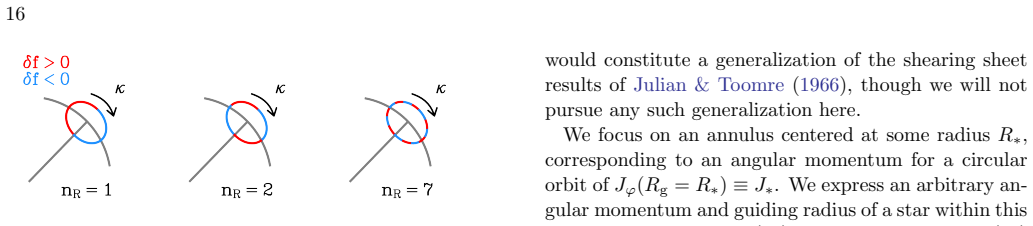
The paper's central claim is that all of the classic linear mechanisms for spiral structure follow from one object: the disk's Volterra response kernel $M_{pp'}(\tau)$. At long wavelengths the kernel reduces to a form dominated by the Lindblad-Kalnajs frequency $\Omega_{\mathrm{LK}}=\Omega-\kappa/2$, which produces the nearly rigid, naturally two-armed kinematic density waves and, through a Landau mode, global instabilities including the groove instability. At short wavelengths the same kernel reduces to the shearing-sheet kernel of Julian and Toomre, yielding swing amplification, and in the tightly wound limit it reduces to the Lin-Shu-Kalnajs dispersion relation. The same asymptotic approximations connect smoothly in the intermediate regime $ka\sim 1$, so the paper argues that the analytic theory covers the scales of real spirals, although with formal errors of order $\epsilon$ rather than $\epsilon^2$. The authors are explicit that nonlinear physics, gas, and live halos are beyond the paper's scope.
Load-bearing premise
The argument assumes the approximate stellar-orbit expansions stay accurate at the intermediate wavelengths where real spirals are actually seen; this is the regime where the paper's formal errors grow larger, and it is not checked against a brute-force calculation.
Editorial extensions
If this is right
- The classic spiral mechanisms are not physically separate: they are competing labels for different wavelength limits of one response kernel.
- The asymptotic kernels connect smoothly through $ka\sim 1$, so the analytic theory is expected to apply to most observed spirals, whose pitch angles put them in $ka\in(0.4,1.2)$.
- The shearing-sheet equations of Julian and Toomre are derived from global linear theory rather than assumed, and they acquire a Dehnen-drift correction.
- The groove-instability dispersion relation is recovered without gravitational softening, and an analogous instability is predicted for sharp features in the radial-action profile.
- For disks with Toomre $Q\sim 1$, no spiral instability grows faster than about the orbital frequency.
Reading between the lines
- A brute-force numerical evaluation of the full kernel at $ka\sim 1$ would show whether the claimed smooth connection is quantitative enough for real spirals, since observed pitch angles put most galaxies in exactly the regime where formal errors are largest.
- If the unification holds, asking whether a given intermediate-wavelength spiral is 'swing amplification' or an 'LSK mode' may be an ill-posed question; a sharper discriminator would be whether the response is a temporary amplified wake or an exponentially growing global mode.
- The Dehnen-drift correction to the shearing-sheet kernel could be tested in local shearing-box simulations with finite epicyclic amplitude, where the ideal shearing sheet is the zero-drift limit and real disks may deviate once $m\tau$ is large.
Signed reviews
Editorial analysis
A structured set of objections, weighed in public.
Referee Report
Summary. The paper develops a unified linear response theory for spiral structure in thin stellar disks. Starting from the general Volterra equation (38), the authors use the asymptotic angle-action results of Paper I to simplify the response kernel in the long- and short-wavelength regimes. They then recover, as limiting cases, Lindblad-Kalnajs kinematic density waves, the groove instability, swing amplification (including the Julian-Toomre equation), and the Lin-Shu-Kalnajs dispersion relation. A central claim is that the asymptotic kernels connect smoothly through the intermediate regime ka~1, and that this bridge covers the wavelength range where real spirals are observed. The paper also discusses representation degeneracy, the relation of the results to earlier literature, and nonlinear extensions that remain outside the linear framework.
Significance. If the central claim holds, this is a valuable synthesis: it provides a single global linear-response framework from which several classic spiral mechanisms follow as well-defined limits, with no fitted parameters. The paper's careful algebra and its recovery of the Binney (2020) JT kernel, the LSK dispersion relation, and the Sellwood-Kahn groove dispersion relation are concrete strengths that make the asymptotic limits credible. The main significance, however, is conditional on the intermediate-wavelength regime: observed spirals lie at ka in roughly (0.4,1.2), yet the smooth connection through that regime is asserted from asymptotic extrapolation rather than demonstrated by evaluating the full kernel. Thus the unification is convincing at the extremes but its applicability to the spirals one actually observes needs verification.
major comments (3)
- [§3.3.1, Fig. 1, Fig. 3] The full Volterra kernel (49) is never evaluated numerically; the red and blue curves in Figure 1 and the curves in Figure 3 are the asymptotic approximations (56) and (83), and Figure 3 is glued by hand at ka=0.5. The smooth transition claimed in the text (“somewhere in the range ka∈(0.3,0.5)”) is therefore a property of the approximations, not of the full kernel. Since the observed-spiral regime is ka∈(0.4,1.2) from equation (8), this is the load-bearing regime for the paper’s central claim. I ask the authors to evaluate (49) directly for a small set of basis elements with the DF (50) and compare it with (56), (83), and the replacement (95), reporting the error as a function of ka and epsilon. This is a feasible check and would convert the smooth-connection claim from an extrapolation heuristic into a demonstrated result.
- [§6, Eq. (95)] The key bridging replacement ξ^ℓqq'_±(Rg,a) → −(a^2/4)[k^q_R]^* k^{q'}_R is stated without derivation or independent validation. This replacement is what makes the long- and short-wavelength kernels connect through ka~1, and the text immediately concedes that errors in the intermediate regime are formally O(epsilon). Because this is precisely the regime relevant to observed spirals, equation (95) is not a minor technical shortcut but a load-bearing step. Please either derive (95) from the Paper I expansions or validate it against a brute-force evaluation of (49), and give the resulting accuracy statement. Without this, the claim that the theory covers “the range of scales where real spirals are observed” is not established.
- [Footnote 7] Footnote 7 states that the Paper I verification was performed for the nearly-logarithmic basis (51) without providing details or results. The quantitative content of Figures 1–3 and the derivations of Sections 4–5 all use this basis, so the assertion is currently unverifiable. Please include the verification, for example a table of relative errors in the Fourier coefficients u^q_n(J) or in the kernel components as a function of epsilon and ka for the basis (51). If such verification has not been performed, the claim should be removed and the paper’s quantitative statements restricted to the pure logarithmic spirals verified in Paper I.
minor comments (4)
- [Eq. (8)] The numerical factor appears to be γ/√2 rather than γ√2; as written, the fiducial values give ka ≈ 1.3 rather than the stated 0.9, affecting the quoted observed range. Please check the normalization.
- [Intro, §3.2] There are minor typographical issues: “maintainence” should be “maintenance,” and “Langrangian representation” in §3.2 should be “Lagrangian representation.”
- [Fig. 3 caption] The caption identifies red, green, and blue vertical dashed lines as the formal definitions of the long, intermediate, and short wavelength regimes, but it does not give the corresponding ka values; please state them explicitly.
- [General] In the sentence “In fact even thehistory of this subject is contentious,” there is a missing space; this is a trivial typesetting error.
Circularity Check
No circular reduction found; the synthesis is anchored in prior parameter-free asymptotics and external benchmark matches.
full rationale
I walked the claimed derivation chain from the Volterra equation (38)/(49) to the recovered Lindblad–Kalnajs kinematic waves, the groove-instability dispersion relation, the JT shearing-sheet equation, and the LSK dispersion relation. No step exhibits the required kind of reduction: the recovered classic relations are not inputs renamed as outputs, no parameter is fitted and then called a prediction, and no uniqueness theorem is imported to forbid alternatives. The long- and short-wavelength kernels (56) and (83) are inherited from Paper I, but that is prior work by the same authors with stated assumptions and its own numerical verification; the present paper does not assume the conclusions it claims to derive. Where external benchmarks exist, the paper matches them explicitly: Appendix F reproduces Binney's JT kernel, §4.3.2 recovers the Sellwood–Kahn groove relation, and §5.3.1 recovers Binney's form of the LSK dispersion relation. The weakest point is the intermediate-regime smooth connection via replacement (95), because the full kernel (49) is never evaluated near ka~1 and the paper concedes O(epsilon) errors there; footnote 7 also asserts, without details, the same numerical verification for the nearly-logarithmic basis. These are verification and accuracy gaps, not circular constructions. I therefore find no significant circularity.
Assumptions & free parameters
assumptions (6)
- domain assumption The disk is a razor-thin, two-dimensional stellar disk and vertical motions are adiabatically separated.
- domain assumption Perturbations are linear: spiral surface density contrasts are roughly 10 percent and nonlinear coupling is negligible for times much less than the nonlinear timescale.
- domain assumption Stars orbit in an axisymmetric background potential with angle-action variables and near-circular epicyclic motion with small epsilon, and Paper I's asymptotic Fourier coefficients are accurate.
- domain assumption The background distribution function is Schwarzschild in radial action, f0(J) = g0(J_phi) exp(-J_R/<J_R>).
- domain assumption The dark halo is frozen; spiral backreaction on the halo is negligible for these instabilities.
- standard math Laplace transforms and Bessel function identities, including Graf's addition theorem, provide the analytic continuation used in the Landau representation.
Cite this review
Pith. "Pith review of Galactokinetics II: Spiral structure." pith.science (2026). https://pith.science/paper/GPVLXI3Q
@misc{pith2026250716950,
  author       = {Pith},
  title        = {Pith review of: Galactokinetics II: Spiral structure},
  year         = {2026},
  howpublished = {\url{https://pith.science/paper/GPVLXI3Q}},
  note         = {Machine review of arXiv:2507.16950}
}
read the original abstract
We present a unified theory of linear spiral structure in stellar disks. We begin by identifying the characteristic scales involved in the spiral structure problem and listing some quantitative requirements of a successful theory. We then write down the general linear response theory for thin disks, making clear the equivalence between different representations (e.g., Volterra, Landau, van Kampen) of the theory. Next, using the asymptotic expansions developed in our previous galactokinetics paper, we consider spiral structure on different spatial scales and thereby show how several classic results - including Lindblad-Kalnajs density waves, swing amplification, Lin-Shu-Kalnajs modes, and groove instabilities - emerge as limiting cases. In addition, many of our asymptotic results connect smoothly when extrapolated to intermediate regimes, rendering the analytic theory valid over a larger range of scales than naively expected. Finally, we identify situations in which nonlinear physics is unavoidable. Though many nonlinear questions remain unanswered, we hope that the theoretical synthesis developed here will allow us to both connect and distinguish the plethora of ideas that have accumulated over the last six decades of spiral structure studies, and will provide a foundation upon which a comprehensive theory might ultimately be built.
Figures


Figures from the paper (2 more)

Reference graph
Works this paper leans on
-
[1]
Abramowitz, M., & Stegun, I. A. 1965, Handbook of mathematical functions: with formulas, graphs, and mathematical tables, Vol. 55 (Courier Corporation)
1965
-
[2]
1984, Phys
Athanassoula, E. 1984, Phys. Rep., 114, 319 —. 2012, MNRAS: Letters, 426, L46
1984
-
[3]
A., & Hawley, J
Balbus, S. A., & Hawley, J. F. 1992, ApJ, 392, 662 Barr´ e, J., & Y Yamaguchi, Y. 2013, J. Phys. A, 46, 225501
1992
-
[4]
1996, Spiral Structure in Galaxies: A density wave theory (MIT press) —
Bertin, G. 1996, Spiral Structure in Galaxies: A density wave theory (MIT press) —. 2014, Dynamics of galaxies (Cambridge University Press)
1996
-
[5]
C., Lowe, S., & Thurstans, R
Bertin, G., Lin, C. C., Lowe, S., & Thurstans, R. P. 1989, ApJ, 338, 104
1989
-
[6]
2013, New Astron
Binney, J. 2013, New Astron. Rev., 57, 29 —. 2020, MNRAS, 496, 767 —. 2024, MNRAS, 535, 1898
2013
-
[7]
1988, MNRAS, 230, 597
Binney, J., & Lacey, C. 1988, MNRAS, 230, 597
1988
-
[8]
2008, Galactic Dynamics: Second Edition (Princeton Univ
Binney, J., & Tremaine, S. 2008, Galactic Dynamics: Second Edition (Princeton Univ. Press)
2008
Show all 89 references
-
[9]
2021, MNRAS, 504, 3168
Bland-Hawthorn, J., & Tepper-Garcia, T. 2021, MNRAS, 504, 3168
2021
-
[10]
2021, MNRAS, 505, 2412 De Rijcke, S., Fouvry, J.-B., & Pichon, C
Chiba, R., & Sch¨ onrich, R. 2021, MNRAS, 505, 2412 De Rijcke, S., Fouvry, J.-B., & Pichon, C. 2019, MNRAS, 484, 3198 De Rijcke, S., & Voulis, I. 2016, MNRAS, 456, 2024
2021
-
[11]
1974, A&A, 34, 255 —
Dekker, E. 1974, A&A, 34, 255 —. 1976, Phys. Rep., 24, 315
1974
-
[12]
2014, Publ
Dobbs, C., & Baba, J. 2014, Publ. Astron. Soc. Aust., 31, e035
2014
-
[13]
2010, MNRAS, 403, 625
Dobbs, C., Theis, C., Pringle, J., & Bate, M. 2010, MNRAS, 403, 625
2010
-
[14]
2023, PhD thesis, University of Oxford
Dootson, D. 2023, PhD thesis, University of Oxford
2023
- [15]
-
[16]
Drury, L. O. 1980, MNRAS, 193, 337 D’Onghia, E., Vogelsberger, M., & Hernquist, L. 2013, ApJ, 766, 34
1980
-
[17]
W., Rix, H.-W., et al
Eilers, A.-C., Hogg, D. W., Rix, H.-W., et al. 2020, ApJ, 900, 186
2020
-
[18]
Evans, N. W. 1994, MNRAS, 267, 333
1994
-
[19]
P., & Caruana, J
Fiteni, K., De Rijcke, S., Debattista, V. P., & Caruana, J. 2024, MNRAS, 529, 4879
2024
-
[20]
2015, MNRAS, 449, 1982
Fouvry, J.-B., & Pichon, C. 2015, MNRAS, 449, 1982
2015
-
[21]
2015d, MNRAS, 449, 1967
Fouvry, J.-B., Pichon, C., & Prunet, S. 2015d, MNRAS, 449, 1967
1967
-
[22]
2001b, in Galaxy Disks and Disk Galaxies, Vol
Fuchs, B. 2001b, in Galaxy Disks and Disk Galaxies, Vol. 230, 205–206 —. 2004, A&A, 419, 941
2004
-
[23]
2025, arXiv e-prints, arXiv:2502.05304
George, K., & Sch¨ onrich, R. 2025, arXiv e-prints, arXiv:2502.05304
2025 arXiv
-
[24]
2025, ApJ, 980, 24
Gilman, D., Bovy, J., Frankel, N., & Benson, A. 2025, ApJ, 980, 24
2025
-
[25]
1965, MNRAS, 130, 125
Goldreich, P., & Lynden-Bell, D. 1965, MNRAS, 130, 125
1965
-
[26]
1978, ApJ, 222, 850
Goldreich, P., & Tremaine, S. 1978, ApJ, 222, 850
1978
-
[27]
2000, PRL, 84, 4280
Griv, E., Gedalin, M., Eichler, D., & Yuan, C. 2000, PRL, 84, 4280
2000
-
[28]
2024, MNRAS, 528, 5286
Hamilton, C. 2024, MNRAS, 528, 5286
2024
-
[29]
2024, Physics of Plasmas, 31
Hamilton, C., & Fouvry, J.-B. 2024, Physics of Plasmas, 31
2024
-
[30]
2025, arXiv e-prints, arXiv:2408.03366
Hamilton, C., Modak, S., & Tremaine, S. 2025, arXiv e-prints, arXiv:2408.03366
2025
-
[31]
F., & Quataert, E
Hopkins, P. F., & Quataert, E. 2011, MNRAS, 415, 1027
2011
-
[32]
Jalali, M. A. 2007, ApJ, 669, 218 —. 2008, ApJ, 689, 134
2007
-
[33]
A., & Hunter, C
Jalali, M. A., & Hunter, C. 2005, ApJ, 630, 804
2005
-
[34]
H., & Toomre, A
Julian, W. H., & Toomre, A. 1966, ApJ, 146, 810
1966
-
[35]
Kalnajs, A. J. 1965, PhD thesis, Harvard University, Massachusetts
1965
-
[36]
Kalnajs, A. J. 1971, ApJ, 166, 275 32 —. 1973, Publications of the Astronomical Society of Australia, 2, 174 —. 1976, ApJ, 205, 745 —. 1977, ApJ, 212, 637
1971
-
[37]
Kaufman, A. N. 1971, Phys. Fluids, 14, 387 —. 1972, Phys. Fluids, 15, 1063
1971
-
[38]
N., & Nakayama, T
Kaufman, A. N., & Nakayama, T. 1970, Phys. Fluids, 13, 956
1970
-
[39]
Kim, W.-T., & Ostriker, E. C. 2007, ApJ, 660, 1232
2007
-
[40]
Kormendy, J., & Kennicutt, R. C. 2004, ARA&A, 42, 603
2004
-
[41]
2024, ApJL, 968, L15
Kuhn, V., Guo, Y., Martin, A., et al. 2024, ApJL, 968, L15
2024
-
[42]
Landau, L. D. 1946, Zh. Eksp. Teor. Fiz., 16, 574
1946
-
[43]
Layzer, A. J. 1963, Phys. Rev., 129, 897
1963
-
[44]
Lin, C. C. 1970, in Symposium-International Astronomical
1970
-
[45]
C., & Shu, F
Lin, C. C., & Shu, F. H. 1964, ApJ, 140, 646 —. 1966, Proceedings of the National Academy of Sciences, 55, 229
1964
-
[46]
C., & Thurstans, R
Lin, C. C., & Thurstans, R. P. 1987, in Selected Papers of CC Lin with Commentary: Vol. 2: Astrophysics (World Scientific), 996–1005
1987
-
[47]
1978, ApJ, 221, 51
Lovelace, R., & Hohlfeld, R. 1978, ApJ, 221, 51
1978
-
[48]
Lynden-Bell, D., & Kalnajs, A. J. 1972, MNRAS, 157, 1
1972
-
[49]
T., Bovy, J., Leung, H
Mackereth, J. T., Bovy, J., Leung, H. W., et al. 2019, MNRAS, 489, 176
2019
-
[50]
Mark, J. W. K. 1974, ApJ —. 1976a, ApJ, 205, 363 —. 1976b, ApJ, 206, 418 —. 1976c, ApJ, 203, 81 —. 1977, ApJ, 212, 645
1974
-
[51]
2005, arXiv preprint astro-ph/0501170
Marochnik, L. 2005, arXiv preprint astro-ph/0501170
2005 arXiv
-
[52]
1969, Astrophysics and Space Science, 4, 317 —
Marochnik, L., & Suchkov, A. 1969, Astrophysics and Space Science, 4, 317 —. 1974, Soviet Physics Uspekhi, 17, 85
1969
-
[53]
1997, A&A, 322, 442
Masset, F., & Tagger, M. 1997, A&A, 322, 442
1997
-
[54]
E., & van der Wel, A
Meidt, S. E., & van der Wel, A. 2024, ApJ, 966, 62
2024
-
[55]
2016a, ApJ, 821, 35 —
Michikoshi, S., & Kokubo, E. 2016a, ApJ, 821, 35 —. 2016b, ApJ, 823, 121 —. 2020, ApJ, 897, 65
2020
-
[56]
C., Hamilton, C., & Tremaine, S
Modak, S., Ostriker, E. C., Hamilton, C., & Tremaine, S. 2025, arXiv e-prints, arXiv:2506.17387
2025
-
[57]
1999, ApJ, 519, 580
Murali, C. 1999, ApJ, 519, 580
1999
-
[58]
S., & Bhattacharjee, A
Ng, C. S., & Bhattacharjee, A. 2021, ApJ, 923, 271
2021
-
[59]
1994, Stability of collisionless stellar systems (Springer)
Palmer, P. 1994, Stability of collisionless stellar systems (Springer)
1994
-
[60]
2004a, arXiv preprint astro-ph/0406142 —
Pasha, I. 2004a, arXiv preprint astro-ph/0406142 —. 2004b, arXiv preprint astro-ph/0406143
-
[61]
2024, MNRAS, 530, 4378
Tep, K. 2024, MNRAS, 530, 4378
2024
-
[62]
2006, MNRAS, 368, 1657
Pichon, C., & Aubert, D. 2006, MNRAS, 368, 1657
2006
-
[63]
1997, MNRAS, 291, 616
Pichon, C., & Cannon, R. 1997, MNRAS, 291, 616
1997
-
[64]
Polyachenko, E. V. 2004, MNRAS, 348, 345
2004
-
[65]
2004, Astronomy reports, 48, 877
Polyachenko, V., & Polyachenko, E. 2004, Astronomy reports, 48, 877
2004
-
[66]
Rafikov, R. R. 2001, MNRAS, 323, 445
2001
-
[67]
1968, JPP, 2, 33
Rogister, A., & Oberman, C. 1968, JPP, 2, 33
1968
-
[68]
1977, Lectures on density wave theory (Springer) Romero-G´ omez, M., Athanassoula, E., Masdemont, J., & Garc ´ ıa-G´ omez, C
Rohlfs, K. 1977, Lectures on density wave theory (Springer) Romero-G´ omez, M., Athanassoula, E., Masdemont, J., & Garc ´ ıa-G´ omez, C. 2007, A&A, 472, 63
1977
-
[69]
2025, arXiv preprint arXiv:2502.07342
Roule, M., Fouvry, J.-B., Pichon, C., & Chavanis, P.-H. 2025, arXiv preprint arXiv:2502.07342
2025 arXiv
-
[70]
2022, ApJ, 933, 113
Rozier, S., Famaey, B., Siebert, A., et al. 2022, ApJ, 933, 113
2022
-
[71]
Seigar, M. S. 2017, Spiral structure in galaxies (Morgan & Claypool Publishers)
2017
-
[72]
Sellwood, J. A. 2012, ApJ, 751, 44 —. 2021, MNRAS, 506, 3018
2012
-
[73]
A., & Binney, J
Sellwood, J. A., & Binney, J. J. 2002, MNRAS, 336, 785
2002
-
[74]
A., & Carlberg, R
Sellwood, J. A., & Carlberg, R. G. 1984, ApJ —. 2019, MNRAS, 489, 116 —. 2020, MNRAS, 500, 5043 —. 2022, MNRAS, 517, 2610
1984
-
[75]
A., & Kahn, F
Sellwood, J. A., & Kahn, F. D. 1991, MNRAS, 250, 278
1991
-
[76]
A., & Lin, D
Sellwood, J. A., & Lin, D. 1989, MNRAS, 240, 991
1989
-
[77]
A., & Masters, K
Sellwood, J. A., & Masters, K. L. 2022, ARA&A, 60, 73
2022
-
[78]
A., Trick, W
Sellwood, J. A., Trick, W. H., Carlberg, R. G., Coronado, J., & Rix, H.-W. 2019, MNRAS, 484, 3154
2019
-
[79]
Shu, F. H. 1970a, ApJ, 160, 89 —. 1970b, ApJ, 160, 99 —. 2016, ARA&A, 54, 667
2016
-
[80]
H., Laughlin, G., Lizano, S., & Galli, D
Shu, F. H., Laughlin, G., Lizano, S., & Galli, D. 2000, ApJ, 535, 190
2000
-
[81]
J., Giroux, M
Smith, B. J., Giroux, M. L., & Struck, C. 2022, The Astronomical Journal, 164, 146
2022
-
[82]
1988, MNRAS, 232, 733
Sygnet, J.-F., Tagger, M., Athanassoula, E., & Pellat, R. 1988, MNRAS, 232, 733
1988
-
[83]
1987, ApJL, 318, L43
Tagger, M., Sygnet, J.-F., Athanassoula, E., & Pellat, R. 1987, ApJL, 318, L43
1987
-
[84]
1964, ApJ, 139, 1217 —
Toomre, A. 1964, ApJ, 139, 1217 —. 1969, ApJ, 158, 899 —. 1977, ARA&A, 15, 437
1964
-
[85]
1981, in Structure and evolution of normal Galaxies, 111–136
Toomre, A. 1981, in Structure and evolution of normal Galaxies, 111–136
1981
-
[86]
Tremaine, S., & Weinberg, M. D. 1984, MNRAS, 209, 729 Vall´ ee, J. P. 2017, Astronomical Review, 13, 113
1984
-
[87]
2021, ApJ, 913, 121 33 —
Yoshida, Y., & Kokubo, E. 2021, ApJ, 913, 121 33 —. 2023, MNRAS, 521, 4091
2021
-
[88]
Yu, S.-Y., & Ho, L. C. 2020, ApJ, 900, 150
2020
-
[89]
2001, Stellar Dynamics: From Classic to Modern, 344
Yuan, C. 2001, Stellar Dynamics: From Classic to Modern, 344
2001
Reviewed August 6, 2026 · model on record in the stance chip above.
Discussion (0). Continue with ORCID to comment.