REVIEW 3 major objections 5 minor 1 cited by
Matrix-Free Evaluation of High-Order Shifted Boundary Finite Element Operators
T0 review · 3 major / 5 minor · reviewed 2026-08-06 · deepseek-v4-flash
Pith's one-line read A matrix-free implementation of the shifted boundary method evaluates high-order finite element operators without assembling global matrices, with a complexity of $O(p^{2d-1})$ per surrogate boundary face, and outperforms matrix-free…
desk verdict Clear, useful matrix-free engineering for SBM with a mismatch between the stated operator and Algorithm 3 that needs fixing before publication. read the letter →
The pith
A machine-rendered reading of the paper's core claim, the machinery that carries it, and where it could break.
The reading
What carries the argument
The load-bearing machinery is sum factorization on tensor-product elements combined with precomputed geometric shift data. For each quadrature point on a surrogate boundary face, the paper stores the reference coordinates of the corresponding closest point on the true boundary and the shift vector, so that the extension operator $E u_h$ can be evaluated by pointwise interpolation at arbitrary shifted locations rather than by integrating over cut cells. Interior cells and interior DG faces are evaluated in $O(d p^{d+1})$ and $O(d p^d)$ operations respectively via standard sum factorization; the shifted-point evaluations do not align with the tensor-product grid and cost $O((p+1)^d)$ each, producing the overall $O(p^{2d-1})$ per-face complexity that dominates the boundary cost.
What would settle it
Run a distributed-memory operator-application benchmark that actually exchanges the precomputed shifted-point coordinates across ranks and measure wall time per surrogate boundary face while increasing polynomial degree $p$ at fixed mesh size. If per-face time grows faster than $O(p^{2d-1})$ or is dominated by memory traffic for the stored coordinates, the paper's complexity claim is wrong.
Extended reading notes
Core claim
The central claim is that the shifted boundary operator can be evaluated on-the-fly from the variational form, without assembling global matrices, for both continuous and discontinuous Galerkin discretizations on Cartesian background meshes. Because SBM integrates only over the surrogate boundary face rather than over the irregular intersection of the mesh with the true domain, the boundary contribution reduces to evaluating the solution at precomputed shifted points (closest point projections onto the true boundary) and testing those values against basis functions using sum factorization. The dominant boundary-face cost is the point evaluation at shifted locations, which costs $O((p+1)^d)$ per quadrature point and therefore $O(p^{2d-1})$ per face; this is lower than the $O(p^{2d})$ per-cell cost of matrix-free CutFEM, which must integrate over arbitrarily cut cells and apply ghost penalty stabilization. The paper demonstrates with microbenchmarks and problem-scale tests that SBM matches or beats CutFEM in throughput, memory, and initialization time, with the advantage growing at higher polynomial degree.
Load-bearing premise
The complexity advantage assumes that evaluating $u_h$ at each shifted point costs $O((p+1)^d)$ and that looking up the precomputed reference coordinates does not introduce memory or communication overhead that erases the arithmetic savings; the paper's benchmarks run on one node or in an emulated parallel setting, so distributed-memory behavior is not demonstrated.
Editorial extensions
If this is right
- SBM operator application becomes memory-bound-free: no global matrix storage is needed, and the cost per cell scales polynomially with degree rather than as the square of the local matrix size.
- The $O(p^{2d-1})$ boundary-face cost is asymptotically below CutFEM's $O(p^{2d})$ cut-cell cost, so SBM's computational advantage over CutFEM grows with polynomial degree and spatial dimension.
- Precomputed geometric data for SBM is much smaller per quadrature point than CutFEM's cut-cell quadrature data, which improves cache use and reduces data movement on modern hardware.
- Initialization for a changed geometry reduces to level-set Newton solves for closest point projections and is roughly an order of magnitude faster than recomputing cell-domain intersections and quadrature rules, which matters for moving-boundary and shape-optimization workflows.
- Efficient matrix-free operator evaluation is the missing kernel for developing scalable geometric multigrid solvers for DG-SBM systems, since such solvers require many cheap operator applications.
Reading between the lines
- The complexity gap versus CutFEM could widen further on true distributed-memory machines, because CutFEM's cut-cell cost scales as $p^{2d}$ while SBM's boundary cost scales as $p^{2d-1}$; the paper's single-node and emulated parallel benchmarks do not directly test communication of the precomputed shift data.
- The same per-face structure should carry over to vector-valued problems such as elasticity and Stokes flow, where the shifted-point interpolation and sum-factorized integration apply componentwise; the paper demonstrates only the scalar Poisson operator.
- A testable optimization is to generate shifted-point coordinates on the fly from the level-set representation instead of storing them, trading arithmetic for memory traffic; if arithmetic is cheap enough, the $O(p^{2d-1})$ bound could be approached without the lookup overhead.
- For axis-aligned or otherwise structured boundaries, shifted points may occasionally align with tensor-product grids, in which case a hybrid sum-factorized evaluation could beat the $O(p^{2d-1})$ bound; measuring that special case would isolate the worst-case assumption in the complexity analysis.
Editorial analysis
A structured set of objections, weighed in public.
Referee Report
Summary. The paper proposes a matrix-free evaluation strategy for high-order Shifted Boundary Method (SBM) finite element operators on Cartesian background meshes. The approach splits the operator application into volumetric cell kernels, interior-face kernels for discontinuous Galerkin discretizations, and surrogate-boundary-face kernels, and uses sum factorization on tensor-product elements. The paper's central complexity claim is that the shifted-boundary contribution costs O(p^{2d-1}) per surrogate boundary face because the extension Euh is evaluated by point evaluation of uh at the shifted point on the true boundary, which does not admit tensor-product factorization. Numerical microbenchmarks, a single-ball parallel benchmark, a multi-ball geometric-complexity study, and a comparison against a matrix-free CutFEM implementation are reported, together with a convergence check in Appendix A. The main issue is that the boundary-evaluation algorithm as written does not implement the Taylor extension operator defined earlier in the paper, and this discrepancy is load-bearing for the complexity claim and for the numerical validation.
Significance. If the technical issue with the extension operator is resolved, the paper addresses a genuinely important practical problem: unfitted high-order methods are often memory-bound, and a matrix-free formulation for SBM would be a useful step toward scalable solvers. The paper gives a clear decomposition of the operator application into volumetric, interior-face, and boundary-face kernels, and the use of sum factorization for the regular interior entities is sound. The convergence check in Appendix A is a helpful sanity check, and the memory-footprint comparison in Section 4.4 addresses a practically relevant quantity. However, because the boundary-face kernel described in Algorithm 3 appears to evaluate uh at a true-boundary point instead of applying the Taylor extension from Section 2.1, the headline complexity O(p^{2d-1}) and the benchmark comparisons are not yet established for the SBM operator defined in the paper. The contribution is potentially significant, but the central numerical claim needs to be corrected and revalidated.
major comments (3)
- [§3.3, Algorithm 3, and Eq. (2.1)] Algorithm 3 (lines 5–7) specifies Euh as the point value uh(xq), where xq is the closest-point projection of the face quadrature point x̃q onto the true boundary Γ. This is not the Taylor extension Eu⋆(x̃)=u⋆(x)−d·∇u(x̃)+... defined in Section 2.1. The Taylor extension requires the gradient of uh on the cell adjacent to the surrogate face Fs, not the value of uh in a generally different cell containing xq. Moreover, the weak form (2.1) involves Euh and vh both evaluated on Γ̃, whereas Algorithm 3 forms Ivalue and Igrad using Euh(xq) and then submits them for integration against vh and ∇vh·ñ at x̃q; this mixes evaluation points in a way not represented by the variational formulation. As a result, the operator benchmarked in Section 4 need not be the SBM operator defined in Section 2. This discrepancy is load-bearing: the O((p+1)^{2d-1}) cost in Section 3.3 is created by the non-tensor-product point evaluation at xq, whereas a Taylor extension computed from the face trace of uh and ∇uh can be evaluated by sum factorization at cost O(d(p+1)^d) per surrogate face, the same order as the interior DG face term in Algorithm 2. The complexity claim and Algorithm 3 must be corrected, or the paper must explicitly identify the point-evaluation version as a different approximation and justify it against the SBM weak form.
- [§4, first paragraph of 'Numerical Results'] The numerical validation is stated to build on the software framework of reference [33], to use finite element operators identical to those in [33], and to reproduce sparse-matrix products, but [33] is an unreviewed arXiv preprint and no code or complete operator description is provided in this manuscript. This gap is now directly relevant because Algorithm 3 as printed cannot produce the SBM operator of Section 2.1. If the actual implementation follows Section 2.1, then the SBM-face timings in Figures 3, 6, and 7 are not described by Algorithm 3 and the complexity in Section 3.3 is not what was measured. If the implementation follows Algorithm 3, then the experiments validate a different operator. The author should provide the implementation, a complete pseudocode for the actually evaluated boundary kernel, or a reproducible description of the operator, and rerun the microbenchmarks with the corrected boundary-face kernel.
- [§4.3 and Figure 6] The multi-ball benchmark is run in serial with 32 matrix-vector products synchronized, and the single-core throughput is then multiplied by 32 to estimate parallel throughput. This emulated parallel setting does not measure communication, load-balancing, memory-access contention, or the overhead of retrieving precomputed reference coordinates for shifted points, all of which are relevant to the paper's scalability claims. The paper should either present genuine distributed-memory results for the multi-ball setting or restrict the scalability claim to the single-node MPI benchmark of Section 4.2 and clearly label the emulated results as kernel-only estimates.
minor comments (5)
- [§1, penultimate paragraph] The sentence ending '...make matrix-free CutFEM more challenging and potentially less efficient than' is incomplete and should be finished.
- [§3.3, Algorithm 3 and surrounding text] The notation for quadrature points is inconsistent: Algorithm 3 uses xq for both the face quadrature point in line 2 and the true-boundary shifted point in lines 4–7. Use x̃q for face points and xq for the shifted point throughout, and write Euh(x̃q) rather than Euh(xq) wherever the extension is intended.
- [§4.1] The text states that a full matrix evaluation has 'the highest asymptotic complexity of O(N_c^2)'; this appears to be a typo, since the relevant quantity is the local matrix-vector cost O(p^{2d}) per cell. The global sparse matrix-vector product is not O(N_c^2).
- [Figures 3 and 4 captions] The captions use inconsistent notation for the polynomial degree ('k0' in Figure 3, 'k' in Figure 4) instead of the p used throughout the text, and the caption of Figure 3 contains a duplicate fragment that should be cleaned up.
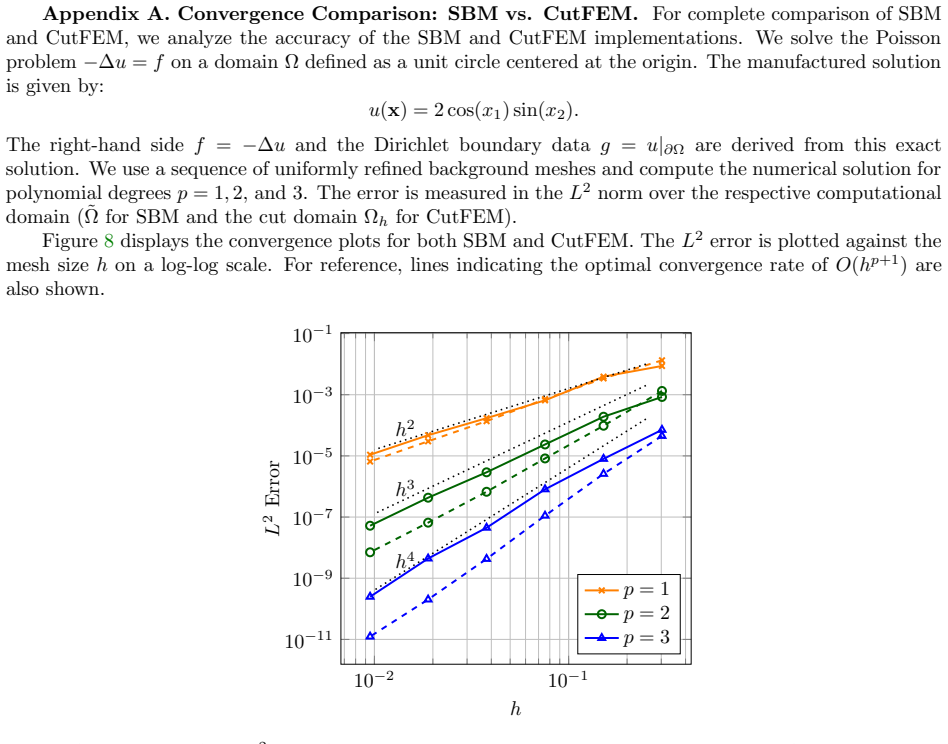
- [Appendix A] The L2 error for SBM is measured over the surrogate domain Ω̃ and for CutFEM over the cut domain Ωh, which are different domains; a brief statement of why this comparison is meaningful, or a common-domain comparison, would be helpful.
Circularity Check
No significant circularity: the O(p^{2d-1}) complexity is a direct operation count, and the self-citations [33,34] are implementation context, not load-bearing for the central claim.
full rationale
The central claim—O(p^{2d-1}) per surrogate-boundary face for evaluating shifted boundary contributions—is derived in Section 3.3 by an explicit, self-contained operation count: each of O((p+1)^{d-1}) quadrature points requires a standard point evaluation of uh summing over (p+1)^d basis functions. This is arithmetic, not a fitted parameter, and it does not reduce to a prediction of its own input. The paper's self-citations [33] and [34] are used for the DG-SBM solver framework and for the CutFEM comparator implementation, respectively; they are not invoked to justify the complexity bound, and the benchmarks are code-based and externally checkable. The main concern raised by a careful reading is an internal consistency issue rather than circularity: Section 2.1 defines the extension operator E through a Taylor expansion Eu(x̃) = u(x) - d·∇u(x̃) + ..., whereas Section 3.3 and Algorithm 3 state that 'Euh(x̃q) is taken as the value of the solution uh at a corresponding shifted point xq on the true boundary Γ.' If so, the benchmarked operator may not be the SBM operator appearing in the weak form (2.1), and the O(p^{2d-1}) cost is then an artifact of this point-evaluation choice rather than an inherent property of the Taylor-based SBM extension. This is a correctness/consistency concern, not a demonstration that the derivation is equivalent to its inputs by construction. There is no fitted-input-called-prediction step, no imported uniqueness theorem, and no ansatz smuggled in solely via self-citation. Accordingly, the circularity score is 2, reflecting self-citations that are present but not load-bearing for the paper's central complexity and performance claims.
Assumptions & free parameters
free parameters (1)
- Penalty parameters (e.g., β, σΓ, σF)
assumptions (4)
- domain assumption The solution is smooth in a neighborhood of the surrogate boundary so the Taylor expansion for the shift is valid.
- domain assumption Closest point projections from surrogate boundary to true boundary are computable and precomputed without dominating cost.
- domain assumption The background mesh is Cartesian, so basis functions are tensor products and sum factorization applies.
- standard math The SBM discretization is stable and convergent, as established in prior work (e.g., [6,17]).
Cite this review
Pith. "Pith review of Matrix-Free Evaluation of High-Order Shifted Boundary Finite Element Operators." pith.science (2026). https://pith.science/paper/OTD4U7CJ
@misc{pith2026250717053,
  author       = {Pith},
  title        = {Pith review of: Matrix-Free Evaluation of High-Order Shifted Boundary Finite Element Operators},
  year         = {2026},
  howpublished = {\url{https://pith.science/paper/OTD4U7CJ}},
  note         = {Machine review of arXiv:2507.17053}
}
abstract
This paper presents a matrix-free approach for implementing the shifted boundary method (SBM) in finite element analysis. The SBM is a versatile technique for solving partial differential equations on complex geometries by shifting boundary conditions to nearby surrogate boundaries. We focus on the efficient evaluation of shifted boundary operators using precomputed data and tensor-product structures. The proposed method avoids the explicit assembly of global matrices, achieving a computational complexity of $O(p^{2d-1})$ per face for the evaluation of shifted boundary contributions on elements of polynomial degree $p$ in $d$ dimensions. Numerical experiments validate the accuracy and efficiency of the approach, demonstrating its scalability and applicability to high-order finite element methods for both continuous and discontinuous Galerkin formulations. We compare the performance of the proposed method with a matrix-free CutFEM implementation.
Figures


Figures from the paper (5 more)


Forward citations
Cited by 1 Pith paper
-
Coalesced Matrix-Free Geometric Multigrid on Persistent Cell-Wise Storage
Cell-wise unassembled multigrid algebraically equals classical local multigrid, so hanging-node machinery vanishes and a structured GPU kernel runs unchanged on adaptive meshes.
Reference graph
Works this paper leans on
-
[33]
M. Wichrowski , A Geometric Multigrid Preconditioner for Discontinuous Galerkin Shifted Boundary Method , arXiv preprint, (2025)
work page 2025
- [1]
-
[2]
D. N. Arnold , An interior penalty finite element method with discontinuous elements , SIAM journal on numerical analysis, 19 (1982), pp. 742–760
work page 1982
-
[3]
N. Atallah, C. Canuto, and G. Scovazzi , Analysis of the shifted boundary method for the Stokes problem , Computer Methods in Applied Mechanics and Engineering, 358 (2020), p. 112609
work page 2020
-
[4]
N. Atallah, C. Canuto, and G. Scovazzi, Analysis of the shifted boundary method for the Poisson problem in domains with corners, Mathematics of Computation, 90 (2021), pp. 2041–2069
work page 2021
-
[5]
N. Atallah, C. Canuto, and G. Scovazzi , The shifted boundary method for solid mechanics , International Journal for Numerical Methods in Engineering, 122 (2021), pp. 5935–5970
work page 2021
-
[6]
N. Atallah, C. Canuto, and G. Scovazzi, The high-order shifted boundary method and its analysis , Computer Methods in Applied Mechanics and Engineering, 394 (2022), p. 114885
work page 2022
-
[7]
N. Atallah and G. Scovazzi , Nonlinear elasticity with the shifted boundary method , Computer Methods in Applied Mechanics and Engineering, 426 (2024), p. 116988
work page 2024
Show all 42 references
-
[8]
Badia, E
S. Badia, E. Neiva, and F. Verdugo , Linking ghost penalty and aggregated unfitted methods , Computer Methods in Applied Mechanics and Engineering, 388 (2022), p. 114232
2022
-
[9]
Bergbauer, P
M. Bergbauer, P. Munch, W. A. W all, and M. Kronbichler , High-performance matrix-free unfitted finite element operator evaluation, arXiv preprint arXiv:2404.07911, (2024)
2024 arXiv
-
[10]
Brandt, Multi-level adaptive solutions to boundary-value problems , Mathematics of computation, 31 (1977), pp
A. Brandt, Multi-level adaptive solutions to boundary-value problems , Mathematics of computation, 31 (1977), pp. 333– 390
1977
-
[11]
Burman, Ghost penalty, Comptes Rendus
E. Burman, Ghost penalty, Comptes Rendus. Math´ ematique, 348 (2010), pp. 1217–1220
2010
-
[12]
Burman, S
E. Burman, S. Claus, P. Hansbo, M. G. Larson, and A. Massing , CutFEM: discretizing geometry and partial differ- ential equations, International Journal for Numerical Methods in Engineering, 104 (2015), pp. 472–501
2015
-
[13]
Burman and P
E. Burman and P. Hansbo , Fictitious domain methods using cut elements: III. A stabilized Nitsche method for Stokes’ problem, ESAIM: Mathematical Modelling and Numerical Analysis, 48 (2014), pp. 859–874
2014
-
[14]
Burman, P
E. Burman, P. Hansbo, and M. G. Larson , On the design of locking free ghost penalty stabilization and the relation to CutFEM with discrete extension , arXiv preprint arXiv:2205.01340, (2022)
2022 arXiv
-
[15]
Claus and P
S. Claus and P. Kerfriden, A CutFEM method for two-phase flow problems , Computer Methods in Applied Mechanics and Engineering, 348 (2019), pp. 185–206
2019
-
[16]
Cockburn, G
B. Cockburn, G. E. Karniadakis, and C.-W. Shu , The development of discontinuous Galerkin methods , in Discontin- uous Galerkin methods: theory, computation and applications, Springer, 2000, pp. 3–50
2000
-
[17]
J. H. Collins, A. Lozinski, and G. Scovazzi , A penalty-free shifted boundary method of arbitrary order , Computer Methods in Applied Mechanics and Engineering, 417 (2023), p. 116301
2023
-
[18]
Davydov, J.-P
D. Davydov, J.-P. Pelteret, D. Arndt, M. Kronbichler, and P. Steinmann, A matrix-free approach for finite-strain hyperelastic problems using geometric multigrid , International Journal for Numerical Methods in Engineering, 121 (2020), pp. 2874–2895
2020
-
[19]
Gross and A
S. Gross and A. Reusken , Optimal preconditioners for a Nitsche stabilized fictitious domain finite element method , arXiv preprint arXiv:2107.01182, (2021)
2021 arXiv
-
[20]
Gross and A
S. Gross and A. Reusken, Analysis of optimal preconditioners for CutFEM, Numerical Linear Algebra with Applications, 30 (2023), p. e2486
2023
-
[21]
G¨urkan and A
C. G¨urkan and A. Massing, A stabilized cut discontinuous Galerkin framework for elliptic boundary value and interface problems, Computer Methods in Applied Mechanics and Engineering, 348 (2019), pp. 466–499
2019
-
[22]
Hackbusch and W
W. Hackbusch and W. Hackbusch, The Multi-Grid Method of the Second Kind , Multi-Grid Methods and Applications, (1985), pp. 305–353
1985
-
[23]
Hansbo, M
P. Hansbo, M. G. Larson, and K. Larsson , Cut finite element methods for linear elasticity problems , in Geometrically Unfitted Finite Element Methods and Applications: Proceedings of the UCL Workshop 2016, Springer, 2017, pp. 25– 63
2016
-
[24]
Kronbichler and K
M. Kronbichler and K. Kormann , A generic interface for parallel cell-based finite element operator application , Com- puters & Fluids, 63 (2012), pp. 135–147
2012
-
[25]
Kronbichler and K
M. Kronbichler and K. Kormann, Fast matrix-free evaluation of discontinuous Galerkin finite element operators, ACM Transactions on Mathematical Software (TOMS), 45 (2019), pp. 1–40
2019
-
[26]
Kuzmin and J.-P
D. Kuzmin and J.-P. B¨acker, An unfitted finite element method using level set functions for extrapolation into deformable diffuse interfaces, Journal of Computational Physics, 461 (2022), p. 111218
2022
-
[27]
K. Li, N. Atallah, A. Main, and G. Scovazzi , The shifted interface method: a flexible approach to embedded interface computations, International Journal for Numerical Methods in Engineering, 121 (2020), pp. 492–518
2020
-
[28]
Main and G
A. Main and G. Scovazzi, The shifted boundary method for embedded domain computations. Part I: Poisson and Stokes problems, Journal of Computational Physics, 372 (2018), pp. 972–995
2018
-
[29]
Main and G
A. Main and G. Scovazzi, The shifted boundary method for embedded domain computations. Part II: Linear advection– diffusion and incompressible Navier–Stokes equations , Journal of Computational Physics, 372 (2018), pp. 996–1026
2018
-
[30]
J. A. Nitsche , ¨Uber ein Variationsprinzip zur L¨ osung von Dirichlet-Problemen bei Verwendung von Teilr¨ aumen, die keinen Randbedingungen unterworfen sind , Abhandlungen aus dem Mathematischen Seminar der Universit¨ at Ham- burg, 36 (1971), pp. 9–15
1971
-
[31]
W. H. Reed and T. R. Hill , Triangular mesh methods for the neutron transport equation , tech. rep., Los Alamos Scientific Lab., N. Mex.(USA), 1973
1973
-
[32]
Schussnig, N
R. Schussnig, N. Fehn, P. Munch, and M. Kronbichler , Matrix-free higher-order finite element methods for hypere- 16 lasticity, Computer Methods in Applied Mechanics and Engineering, 435 (2025), p. 117600
2025
-
[34]
Wichrowski , Matrix-Free Ghost Penalty Evaluation via Tensor Product Factorization , arXiv preprint arXiv:2503.00246, (2025)
M. Wichrowski , Matrix-Free Ghost Penalty Evaluation via Tensor Product Factorization , arXiv preprint arXiv:2503.00246, (2025)
2025
-
[35]
Wichrowski, P
M. Wichrowski, P. Krzy ˙zanowski, L. Heltai, and S. Stupkiewicz, Exploiting high-contrast stokes preconditioners to efficiently solve incompressible fluid–structure interaction problems , International Journal for Numerical Methods in Engineering, 124 (2023), pp. 5446–5470
2023
-
[36]
Wichrowski, M
M. Wichrowski, M. Rezaee-Hajidehi, J. Korelc, M. Kronbichler, and S. Stupkiewicz , Matrix-Free Meth- ods for Finite-Strain Elasticity: Automatic Code Generation with No Performance Overhead , arXiv preprint arXiv:2505.15535, (2025)
2025 arXiv
-
[37]
Witte, D
J. Witte, D. Arndt, and G. Kanschat , Fast tensor product Schwarz smoothers for high-order discontinuous Galerkin methods, Computational Methods in Applied Mathematics, 21 (2021), pp. 709–728
2021
-
[38]
D. Xu, O. Colom ´es, A. Main, K. Li, N. Atallah, N. Abboud, and G. Scovazzi , A weighted shifted boundary method for immersed moving boundary simulations of Stokes’ flow , Journal of Computational Physics, 510 (2024), p. 113095
2024
-
[39]
T. Xue, W. Sun, S. Adriaenssens, Y. Wei, and C. Liu , A new finite element level set reinitialization method based on the shifted boundary method , Journal of Computational Physics, 438 (2021), p. 110360
2021
-
[40]
C.-H. Yang, K. Saurabh, G. Scovazzi, C. Canuto, A. Krishnamurthy, and B. Ganapathysubramanian , Optimal surrogate boundary selection and scalability studies for the shifted boundary method on octree meshes , Computer Methods in Applied Mechanics and Engineering, 419 (2024), p. 116686
2024
-
[41]
O. C. Zienkiewicz, R. L. Taylor, S. J. Sherwin, and J. Peir ´o, On discontinuous Galerkin methods , International journal for numerical methods in engineering, 58 (2003), pp. 1119–1148
2003
-
[42]
Zorrilla, R
R. Zorrilla, R. Rossi, G. Scovazzi, C. Canuto, and A. Rodr ´ıguez-Ferran, A shifted boundary method based on extension operators, Computer Methods in Applied Mechanics and Engineering, 421 (2024), p. 116782. 17 Appendix A. Convergence Comparison: SBM vs. CutFEM. For complete c...
2024
Reviewed August 6, 2026 · model on record in the stance chip above.
Discussion (0). Continue with ORCID to comment.