REVIEW 2 major objections 3 minor 126 references
Lectures on SL(3) foams and link homology
T0 review · 2 major / 3 minor · reviewed 2026-08-06 · deepseek-v4-flash
Pith's one-line read For every oriented SL(3) web, the state space of the foam TQFT is a free graded abelian group whose graded rank is the Kuperberg invariant, so the quantum sl3 link invariant lifts to a functorial homology theory.
desk verdict Solid, useful lecture notes on SL(3) foams; the main caveat is that the TQFT assertion in Theorem 3.1 is deferred to the literature rather than proved in the text. read the letter →
The pith
A machine-rendered reading of the paper's core claim, the machinery that carries it, and where it could break.
The reading
What carries the argument
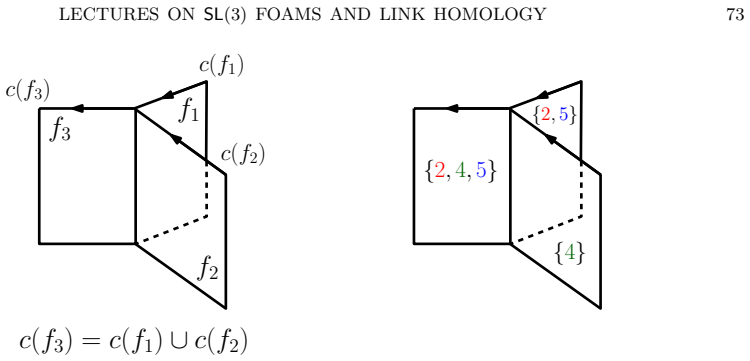
The load-bearing machinery is the universal construction applied to a multiplicative evaluation of closed foams. A Tait coloring labels every facet by one of three colors so that the three facets along each seam have distinct colors; the colored evaluation is a product over dot decorations and over the bicolored surfaces $F_{ij}(c)$, with exponents $\chi(F_{ij}(c))/2$, and the total evaluation is the sum over all Tait colorings. In the oriented case the evaluation can be computed by surgery along seam circles using two Frobenius algebras, the cohomology rings $H^*(\mathbb{CP}^2)$ and $H^*(\mathrm{Fl}_3)$, and the universal construction then defines the state space $\langle\Gamma\rangle$ as the quotient of the free module spanned by foams with boundary $\Gamma$ by the kernel of the gluing-pairing form. What carries the argument is that oriented foams have no vertices, only seam circles, which makes the surgery evaluation finite and explicit.
What would settle it
Take a single closed oriented foam with two seam circles arranged so that the surgery formula can be applied in either order; if the two orders produce different integers, the evaluation is not well-defined and the TQFT of Theorem 3.1 does not exist. Alternatively, compute $\operatorname{grk}\langle\Gamma\rangle$ for an oriented web $\Gamma$ in two different skein-reduction orders and check that the graded ranks agree with $P(\Gamma)$.
Extended reading notes
Core claim
The paper's core claim is Theorem 3.1: for every oriented $\mathrm{SL}(3)$ web $\Gamma$, the state space $\langle\Gamma\rangle$ is a free graded abelian group with graded rank $\operatorname{grk}\langle\Gamma\rangle = P(\Gamma)$, where $P(\Gamma)$ is the Kuperberg invariant, and the foam-induced maps define a TQFT from the category of oriented webs and foams to graded abelian groups. For an oriented link $L$, the complex built from the cube of web resolutions has homology $H(L)$ satisfying $P(L)=\sum_{i,j}(-1)^i q^j \operatorname{rk} H^{i,j}(L)$, so the homology categorifies the quantum $\mathfrak{sl}_3$ link invariant. In the unoriented characteristic-2 setting, the same universal construction gives free graded modules over the ring of symmetric polynomials in three variables, with rank equal to the number of Tait colorings for every reducible web, and the general foam evaluation extends the story to $\mathrm{GL}(N)$ webs.
Load-bearing premise
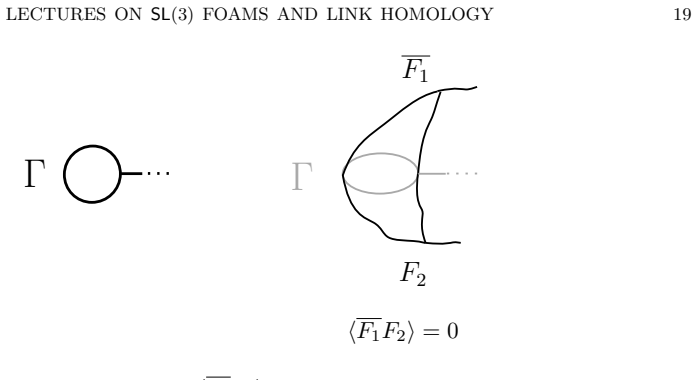
The construction depends on the topological fact that every two-colored slice of a foam embedded in $\mathbb{R}^3$ is a closed orientable surface, which makes its Euler characteristic even and the exponents in the evaluation formula integers.
Editorial extensions
If this is right
- The Kuperberg invariant of a link becomes the Euler characteristic of a bigraded homology, so the polynomial is accompanied by algebraic structure that is functorial under link cobordisms.
- The tangle extension yields a 2-functor from tangle cobordisms to complexes of graded bimodules up to homotopy, making the theory a fully functorial invariant rather than a diagram-dependent construction.
- For unoriented webs, reducible webs have free state spaces whose rank equals the number of Tait colorings, giving a categorified, graded version of the coloring count.
- The same universal-construction method, applied to the general $\mathrm{GL}(N)$ foam evaluation described in the notes, gives a TQFT for $\mathrm{GL}(N)$ webs and categorifies the quantum $\mathrm{GL}(N)$ invariants colored by exterior powers of the fundamental representation.
- Conditional on the conjectures stated in the notes, the characteristic-2 state-space ranks would imply the Four-Color Theorem.
Reading between the lines
- A testable extension would be to compute the characteristic-2 state space of the smallest non-reducible web, the dodecahedron graph, and compare its graded dimension with its number of Tait colorings; the notes report this as an open problem, so an affirmative computation would strengthen the conjectural route to the Four-Color Theorem.
- An editor's inference is that the oriented theory's reliance on exactly two Frobenius algebras suggests a hierarchy: link homology for higher-rank spiders or for non-fundamental colors may require a chain of flag-variety cohomology rings, one per fundamental weight.
- Because the unoriented evaluation is defined only in characteristic 2, a natural next step is to find an integral lift with vertices present; the paper's comparison with the oriented, vertex-free theory indicates where sign conventions would have to be introduced.
Editorial analysis
A structured set of objections, weighed in public.
Referee Report
Summary. These lecture notes, based on three talks at Tsinghua University in 2023, provide an introduction to SL(3) foams and their use in link homology. The first part develops unoriented SL(3) foams, their evaluation by Tait colorings, and the universal construction of state spaces, following Khovanov--Robert. The second part treats oriented SL(3) foams and states a categorification of the Kuperberg quantum sl_3 invariant, including a TQFT assertion for oriented webs and foams. Later sections review SL(3)-web algebras, tangle invariants, oriented GL(N) foams and the Robert--Wagner evaluation, and the connection to Kronheimer--Mrowka gauge theory and the Four-Color Theorem. The notes are expository: most substantial theorems are drawn from the existing literature, especially Khovanov's sl(3) link homology paper, Khovanov--Robert, Mackaay--Vaz, and Robert--Wagner, and proofs are often only sketched or cited.
Significance. If its statements are accurate, these notes are a useful service to the community: they collect the unoriented and oriented SL(3) foam evaluations, the universal construction, the categorification of the Kuperberg invariant, the web-algebra approach to tangles, and the Robert--Wagner GL(N) evaluation into a single readable document, with instructive examples such as the sphere, theta-foam, and digon relations. The notes also helpfully situate the Kronheimer--Mrowka conjecture and the open Problem 2.1. However, the paper is a review rather than a new research paper, and its value depends on the precision with which the cited results are presented. The main technical weakness is that Theorem 3.1, the central categorification statement, is asserted without an actual proof or an exact citation for the monoidality part. The orientability of bicolored surfaces in Proposition 1.1 is adequately justified for foams embedded in R^3, so I do not regard that topological point as a serious gap; the load-bearing unsupported step is the TQFT/monoidality assertion in the oriented theory.
major comments (2)
- [§3.2, Theorem 3.1] Theorem 3.1 asserts that the oriented state-space functor is a TQFT, which in particular requires the monoidality map ⟨Γ1⟩⊗⟨Γ2⟩→⟨Γ1⊔Γ2⟩ to be an isomorphism for all oriented webs. The text preceding the theorem only says that the direct-sum decompositions categorifying Kuperberg's skein rules are 'straightforward to derive' and cites [46, Section 3.4]. Freeness and the graded-rank formula do not by themselves imply monoidality: in the unoriented theory the analogous map (16) is proved only when at least one web is reducible (Proposition 2.7) and is left open in general (Problem 2.1). Since the TQFT assertion is precisely what upgrades the construction from a lax TQFT to a TQFT, the manuscript should either supply a proof of the monoidality isomorphism or state Theorem 3.1 as a theorem of a specific cited work, with a precise reference. As written, the theorem overstates what is demonstrated in these notes.
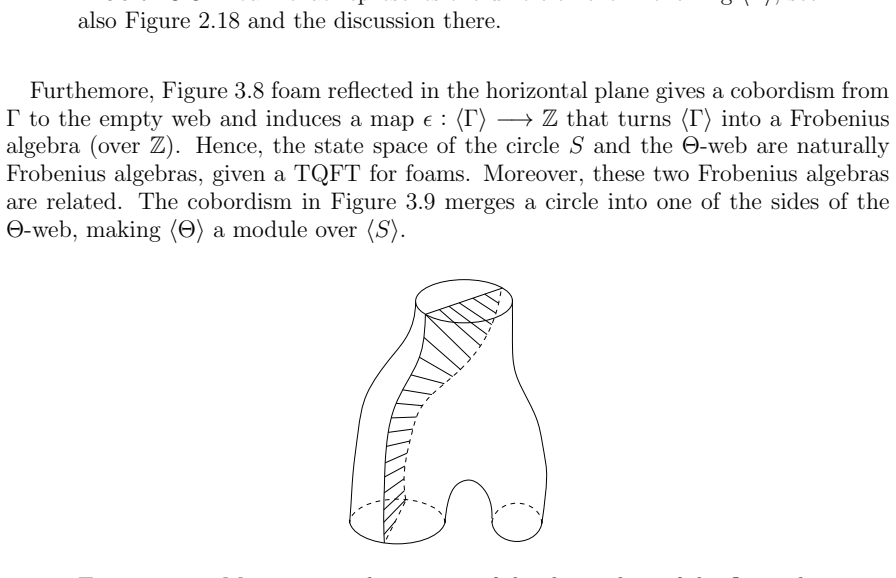
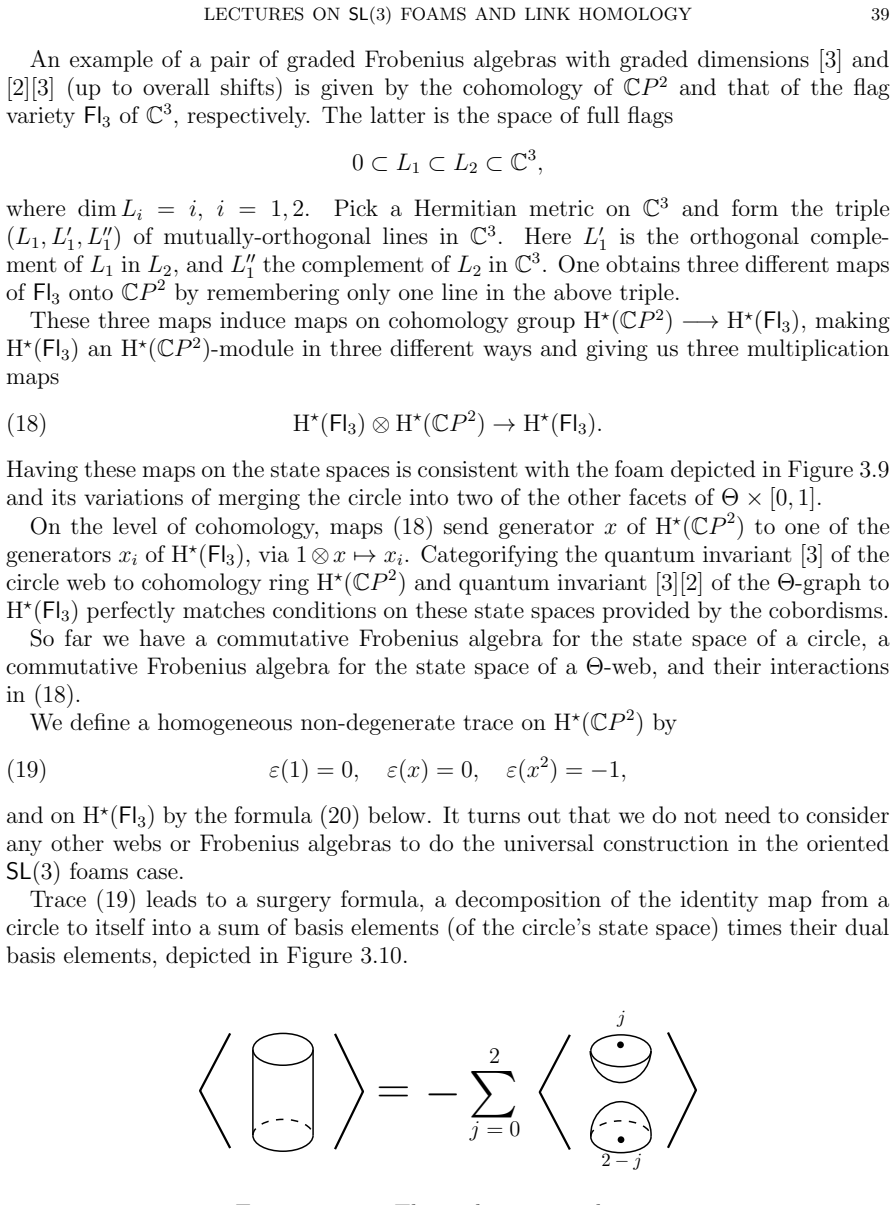
- [§3.2, evaluation of closed oriented foams] The oriented evaluation is defined by a surgery procedure: one pushes a circle off each seam circle, applies the neck-cutting relation (Figure 3.10), and evaluates the resulting surfaces and theta-foams using the traces (19) and (20). The text says that 'using the rules above, an arbitrary closed foam F in R^3 can be evaluated to an integer', but it does not prove that the result is independent of the choices involved (choice of push-off circles, order of surgeries) or invariant under isotopy of the foam. This well-definedness is a load-bearing ingredient for both Theorem 3.1 and the link invariant in Section 3.3. A precise reference to the original proof in [46] or [78] should be given, or a proof should be sketched; otherwise the evaluation underlying the TQFT is not fully established in these notes.
minor comments (3)
- [§2.1, proof of Proposition 2.2] In the paragraph after equations (13) and (14), 'combined with (1314)' should read 'combined with (13)–(14)' or 'with (14)'.
- [§2.1, proof of Theorem 1.1] After the phrase 'for some l ∈ 2Z', the symbol ℓ appears in the displayed formulas without being defined; it appears to denote l/2, and this should be stated explicitly.
- [§3.2, formula (20)] In the definition of the trace ε on H^*(Fl_3), the third case '0, for (a,b,c) ≠ (2,1,0)' is confusing because (2,1,0) is a cyclic permutation of (0,2,1), which is already handled by the second case. The intended wording is presumably '0 otherwise'.
Circularity Check
No significant circularity: the notes are a review whose central theorems are cited to published independent sources, and the universal-construction setup does not define the Kuperberg ranks into the state spaces by construction.
full rationale
The paper is a lecture-note survey, and its central claims are presented as reviews of established results. Theorem 3.1, asserting grk<Γ> = P(Γ) and TQFT-ness, is justified by direct sum decompositions that the text says are 'straightforward to derive' and cites [46, Section 3.4]; this is a citation to a published proof by one of the present authors, not a redefinition. The universal construction of Section 1.3 defines state spaces from a multiplicative evaluation of closed foams, and the oriented evaluation of Section 3.2 is built from the Frobenius algebras H*(CP^2) and H*(Fl_3) with traces (19) and (20). The Kuperberg invariant P(Γ) is not fed into the evaluation as an input; matching its skein rules requires the nontrivial direct-sum decompositions. The reader's flagged Euclidean-topology point (Proposition 1.1, even Euler characteristic of bicolored surfaces) is proved geometrically in the text and is a hypothesis used to make the exponents in (2) integral; it is not an assumption of the desired conclusion. The only genuinely unsupported point is the monoidality assertion in Theorem 3.1, which the notes do not prove and instead attribute to prior work; that is a proof-gap or rigor concern, not a circular reduction. Under the rules, self-citation with independent published content and external verification (e.g., Lewark's computations, Mackaay--Vaz comparison) does not raise the circularity score.
Assumptions & free parameters
assumptions (2)
- domain assumption The Kuperberg web invariant P(Γ) is well-defined via the skein relations in Figure 3.3 (Kuperberg [64]).
- domain assumption The Robert-Wagner evaluation for GL(N) foams is well-defined and lands in symmetric polynomials, and the state spaces of MOY webs are free graded modules with graded rank equal to the MOY invariant (Propositions 5.2 and 5.3 from [103]).
Cite this review
Pith. "Pith review of Lectures on SL(3) foams and link homology." pith.science (2026). https://pith.science/paper/3E2TLX3I
@misc{pith2026250717119,
  author       = {Pith},
  title        = {Pith review of: Lectures on SL(3) foams and link homology},
  year         = {2026},
  howpublished = {\url{https://pith.science/paper/3E2TLX3I}},
  note         = {Machine review of arXiv:2507.17119}
}
abstract
These notes are based on the three lectures that one of the authors gave at Tsinghua University in the summer of 2023 as part of the workshop on Geometric Representation Theory and Applications. They contain an introduction to the evaluation of $\mathsf{SL}(3)$ foams and the associated topological theory of trivalent planar graphs and foam cobordisms between them. A categorification of the Kuperberg quantum $\mathfrak{sl}_3$ web and link invariant and the Robert-Wagner $\mathsf{SL}(N)$ foam evaluation are reviewed as well.
Figures


Figures from the paper (74 more)














Reference graph
Works this paper leans on
-
[46]
, sl(3) link homology , Algebr. Geom. Topol. 4 (2004), 1045–1081, https://doi.org/10. 2140/agt.2004.4.1045. MR2100691
2004
-
[78]
Marco Mackaay and Pedro Vaz, The universal sl3-link homology, Algebr. Geom. Topol. 7 (2007), 1135–1169, https://doi.org/10.2140/agt.2007.7.1135. MR2336253
-
[1]
Mohammed Abouzaid and Ivan Smith, Khovanov homology from Floer cohomology , J. Amer. Math. Soc. 32 (2019), no. 1, 1–79, https://doi.org/10.1090/jams/902. MR3867999
-
[2]
Ian Agol and Vyacheslav Krushkal, Structure of the flow and Yamada polynomials of cubic graphs 102 (2019), 1–20, https://doi.org/10.1090/pspum/102/01. MR3967356
-
[3]
Knot Theory Ramifications 32 (2023), no
Rostislav Akhmechet, Equivariant annular Khovanov homology , J. Knot Theory Ramifications 32 (2023), no. 2, Paper No. 2350002, 31, https://doi.org/10.1142/S0218216523500025. MR4564614
-
[4]
Rostislav Akhmechet and Mikhail Khovanov, Anchored foams and annular homology , Algebr. Geom. Topol. 23 (2023), no. 7, 3129–3204, https://doi.org/10.2140/agt.2023.23.3129. MR4647674
-
[5]
Rostislav Akhmechet, Mikhail Khovanov, and Melissa Zhang, Annular sl(3) web algebras (in preparation)
-
[6]
Rina Anno, Affine tangles and irreducible exotic sheaves, arXiv preprint 0802.1070 (2008),https: //doi.org/10.48550/arXiv.0802.1070
work page Pith review arXiv doi:10.48550/arxiv.0802.1070 2008
Show all 126 references
-
[7]
Rina Anno and Vinoth Nandakumar, Exotic t-structures for two-block Springer fibres , Trans. Amer. Math. Soc. 376 (2023), no. 3, 1523–1552, https://doi.org/10.1090/tran/8765. MR4549684
2023 doi
-
[9]
Appel, W
K. Appel, W. Haken, and J. Koch, Every planar map is four colorable. II. Reducibility , Illi- nois J. Math. 21 (1977), no. 3, 491–567, http://projecteuclid.org/euclid.ijm/1256049012. MR543793
1977
-
[10]
Scott Baldridge and Ben McCarty, A new way to prove configuration reducibility using gauge theory, arXiv preprint 2412.18558 (2024), https://arxiv.org/abs/2412.18558
2024 arXiv
-
[11]
Dror Bar-Natan, Khovanov’s homology for tangles and cobordisms, Geom. Topol. 9 (2005), 1443– 1499, https://doi.org/10.2140/gt.2005.9.1443. MR2174270
2005 doi
-
[12]
Anna Beliakova and Stephan Wehrli, Categorification of the colored Jones polynomial and Ras- mussen invariant of links , Canad. J. Math. 60 (2008), no. 6, 1240–1266, https://doi.org/10. 4153/CJM-2008-053-1 . MR2462446
2008
-
[13]
(N.S.) 5 (1999), no
Joseph Bernstein, Igor Frenkel, and Mikhail Khovanov, A categorification of the Temperley-Lieb algebra and Schur quotients of U (sl2) via projective and Zuckerman functors , Selecta Math. (N.S.) 5 (1999), no. 2, 199–241, https://doi.org/10.1007/s000290050047. MR1714141
1999 doi
-
[14]
Blanchet, N
C. Blanchet, N. Habegger, G. Masbaum, and P. Vogel, Topological quantum field theories derived from the Kauffman bracket , Topology 34 (1995), no. 4, 883–927, https://doi.org/10.1016/ 0040-9383(94)00051-4. MR1362791
1995
-
[15]
Knot Theory Ramifications 19 (2010), no
Christian Blanchet, An oriented model for Khovanov homology , J. Knot Theory Ramifications 19 (2010), no. 2, 291–312, https://doi.org/10.1142/S0218216510007863. MR2647055
2010 doi
-
[16]
Elijah Bodish, Ben Elias, and David E. V. Rose, Spin link homology , arXiv preprint 2407.00189 (2024), https://arxiv.org/abs/2407.00189
2024 arXiv
-
[17]
David Boozer, Computer bounds for Kronheimer-Mrowka foam evaluation, Exp. Math. 32 (2023), no. 4, 615–630, https://doi.org/10.1080/10586458.2021.1982078. MR4669283
2023
-
[18]
, The combinatorial and gauge-theoretic foam evaluation functors are not the same , Math. Ann. 392 (2025), no. 1, 47–56, https://doi.org/10.1007/s00208-024-03064-8 . MR4887753
2025 doi
-
[19]
Chris Bowman, Maud De Visscher, Alice Dell’Arciprete, Amit Hazi, Rob Muth, and Catharina Stroppel, Quiver presentations and Schur–Weyl duality for Khovanov arc algebras, arXiv preprint 2411.15520 (2024), https://arxiv.org/abs/2411.15520
2024 arXiv
-
[20]
Jonathan Brundan, On the definition of Kac-Moody 2-category , Math. Ann. 364 (2016), no. 1-2, 353–372, https://doi.org/10.1007/s00208-015-1207-y . MR3451390
2016 doi
-
[21]
Theory 15 (2011), 170–243, https://doi.org/10
Jonathan Brundan and Catharina Stroppel, Highest weight categories arising from Khovanov’s diagram algebra III: category O, Represent. Theory 15 (2011), 170–243, https://doi.org/10. 1090/S1088-4165-2011-00389-7 . MR2781018
2011
-
[22]
Freedman, and Kevin Walker, Positivity of the universal pairing in 3 dimensions , J
Danny Calegari, Michael H. Freedman, and Kevin Walker, Positivity of the universal pairing in 3 dimensions , J. Amer. Math. Soc. 23 (2010), no. 1, 107–188, https://doi.org/10.1090/ S0894-0347-09-00642-0 . MR2552250
2010
-
[23]
Carmen Livia Caprau, sl(2) tangle homology with a parameter and singular cobordisms , Al- gebr. Geom. Topol. 8 (2008), no. 2, 729–756, https://doi.org/10.2140/agt.2008.8.729. MR2443094
2008 doi
-
[24]
Scott Carter, Daniel E
J. Scott Carter, Daniel E. Flath, and Masahico Saito, The classical and quantum 6 j-symbols, Mathematical Notes, vol. 43, Princeton University Press, Princeton, NJ, 1995. MR1366832
1995
-
[25]
Scott Carter and Masahico Saito, Knotted surfaces and their diagrams , Mathematical Surveys and Monographs, vol
J. Scott Carter and Masahico Saito, Knotted surfaces and their diagrams , Mathematical Surveys and Monographs, vol. 55, American Mathematical Society, Providence, RI, 1998. MR1487374
1998
-
[26]
Sabin Cautis, Clasp technology to knot homology via the affine Grassmannian , Math. Ann. 363 (2015), no. 3-4, 1053–1115, https://doi.org/10.1007/s00208-015-1196-x . MR3412353
2015 doi
-
[27]
Sabin Cautis and Joel Kamnitzer, Knot homology via derived categories of coherent sheaves. I. The sl(2)-case, Duke Math. J. 142 (2008), no. 3, 511–588, https://doi.org/10.1215/ 00127094-2008-012. MR2411561
2008
-
[28]
, Knot homology via derived categories of coherent sheaves. II. slm case, Invent. Math. 174 (2008), no. 1, 165–232, https://doi.org/10.1007/s00222-008-0138-6 . MR2430980 LECTURES ON SL(3) FOAMS AND LINK HOMOLOGY 81
2008 doi
-
[29]
Sabin Cautis, Joel Kamnitzer, and Scott Morrison, Webs and quantum skew Howe duality , Math. Ann. 360 (2014), no. 1-2, 351–390, https://doi.org/10.1007/s00208-013-0984-4 . MR3263166
2014 doi
-
[30]
Joseph Chuang and Rapha¨ el Rouquier, Derived equivalences for symmetric groups and sl2- categorification, Ann. of Math. (2) 167 (2008), no. 1, 245–298, https://doi.org/10.4007/ annals.2008.167.245. MR2373155
2008
-
[31]
David Clark, Functoriality for the su3 Khovanov homology, Algebr. Geom. Topol. 9 (2009), no. 2, 625–690, https://doi.org/10.2140/agt.2009.9.625. MR2482322
2009 doi
-
[32]
David Clark, Scott Morrison, and Kevin Walker, Fixing the functoriality of Khovanov homol- ogy, Geom. Topol. 13 (2009), no. 3, 1499–1582, https://doi.org/10.2140/gt.2009.13.1499. MR2496052
2009 doi
-
[33]
3 (2012), no
Benjamin Cooper and Vyacheslav Krushkal, Categorification of the Jones-Wenzl projectors , Quantum Topol. 3 (2012), no. 2, 139–180, https://doi.org/10.4171/QT/27. MR2901969
2012 doi
-
[34]
Frenkel, Four-dimensional topological quantum field theory, Hopf cate- gories, and the canonical bases , 1994, pp
Louis Crane and Igor B. Frenkel, Four-dimensional topological quantum field theory, Hopf cate- gories, and the canonical bases , 1994, pp. 5136–5154. Topology and physics. MR1295461
1994
-
[35]
Michael Ehrig, Daniel Tubbenhauer, and Paul Wedrich, Functoriality of colored link homologies, Proc. Lond. Math. Soc. (3) 117 (2018), no. 5, 996–1040, https://doi.org/10.1112/plms. 12154. MR3877770
2018 doi
-
[36]
Freedman, Alexei Kitaev, Chetan Nayak, Johannes K
Michael H. Freedman, Alexei Kitaev, Chetan Nayak, Johannes K. Slingerland, Kevin Walker, and Zhenghan Wang, Universal manifold pairings and positivity , Geom. Topol. 9 (2005), 2303– 2317, https://doi.org/10.2140/gt.2005.9.2303. MR2209373
2005 doi
-
[37]
Freyd, D
P. Freyd, D. Yetter, J. Hoste, W. B. R. Lickorish, K. Millett, and A. Ocneanu, A new polynomial invariant of knots and links , Bull. Amer. Math. Soc. (N.S.) 12 (1985), no. 2, 239–246, https: //doi.org/10.1090/S0273-0979-1985-15361-3 . MR776477
1985 doi
-
[38]
Eugene Gorsky and Paul Wedrich, Evaluations of annular Khovanov-Rozansky homology , Math. Z. 303 (2023), no. 1, Paper No. 25, 57, https://doi.org/10.1007/s00209-022-03163-9 . MR4526088
2023 doi
-
[39]
Elisenda Grigsby, Anthony M
J. Elisenda Grigsby, Anthony M. Licata, and Stephan M. Wehrli, Annular Khovanov homology and knotted Schur-Weyl representations , Compos. Math. 154 (2018), no. 3, 459–502, https: //doi.org/10.1112/S0010437X17007540. MR3731256
2018 doi
-
[40]
Mee Seong Im, Mikhail Khovanov, and Victor Ostrik, Universal construction in monoidal and non-monoidal settings, the Brauer envelope, and pseudocharacters , Theory Appl. Categ. 44 (2025), Paper No. 2, 15–83. MR4851408
2025
-
[41]
Vaughan F. R. Jones, A polynomial invariant for knots via von Neumann algebras , Bull. Amer. Math. Soc. (N.S.) 12 (1985), no. 1, 103–111, https://doi.org/10.1090/ S0273-0979-1985-15304-2 . MR766964
1985
-
[42]
Kauffman, State models and the Jones polynomial , Topology 26 (1987), no
Louis H. Kauffman, State models and the Jones polynomial , Topology 26 (1987), no. 3, 395–407, https://doi.org/10.1016/0040-9383(87)90009-7. MR899057
1987 doi
-
[43]
Kauffman and S´ ostenes L
Louis H. Kauffman and S´ ostenes L. Lins, Temperley-Lieb recoupling theory and invariants of 3-manifolds, Annals of Mathematics Studies, vol. 134, Princeton University Press, Princeton, NJ, 1994. MR1280463
1994
-
[44]
Mikhail Khovanov, A categorification of the Jones polynomial , Duke Math. J. 101 (2000), no. 3, 359–426, https://doi.org/10.1215/S0012-7094-00-10131-7 . MR1740682
2000 doi
-
[45]
, A functor-valued invariant of tangles , Algebr. Geom. Topol. 2 (2002), 665–741, https: //doi.org/10.2140/agt.2002.2.665. MR1928174
2002 doi
-
[47]
Knot Theory Ramifications 14 (2005), no
, Categorifications of the colored Jones polynomial , J. Knot Theory Ramifications 14 (2005), no. 1, 111–130, https://doi.org/10.1142/S0218216505003750. MR2124557 82 MIKHAIL KHOV ANOV AND DMITRY SOLOVYEV
2005 doi
-
[48]
, An invariant of tangle cobordisms, Trans. Amer. Math. Soc. 358 (2006), no. 1, 315–327, https://doi.org/10.1090/S0002-9947-05-03665-2 . MR2171235
2006 doi
- [49]
-
[50]
Mikhail Khovanov and Greg Kuperberg, Web bases for sl(3) are not dual canonical , Pacific J. Math. 188 (1999), no. 1, 129–153, https://doi.org/10.2140/pjm.1999.188.129. MR1680395
1999 doi
-
[51]
Lauda, A diagrammatic approach to categorification of quantum groups
Mikhail Khovanov and Aaron D. Lauda, A diagrammatic approach to categorification of quantum groups. I , Represent. Theory 13 (2009), 309–347, https://doi.org/10.1090/ S1088-4165-09-00346-X . MR2525917
2009
-
[52]
Mikhail Khovanov and Robert Lipshitz, Categorical lifting of the Jones polynomial: a survey , Bull. Amer. Math. Soc. (N.S.)60 (2023), no. 4, 483–506,https://doi.org/10.1090/bull/1772. MR4642116
2023 doi
-
[53]
Przytycki, Louis-Hadrien Robert, and Marithania Silvero, A topo- logical theory for unoriented SL(4) foams, Mediterr
Mikhail Khovanov, J´ ozef H. Przytycki, Louis-Hadrien Robert, and Marithania Silvero, A topo- logical theory for unoriented SL(4) foams, Mediterr. J. Math. 21 (2024), no. 2, Paper No. 62, 33, https://doi.org/10.1007/s00009-024-02591-7 . MR4715397
2024 doi
-
[54]
Mikhail Khovanov and You Qi, Categorification course notes , Lecture notes (2012), https: //you-qi2121.github.io/mypage/categorificationnotes.html
2012
-
[55]
Mikhail Khovanov and Louis-Hadrien Robert, Foam evaluation and Kronheimer-Mrowka theo- ries, Adv. Math. 376 (2021), Paper No. 107433, 59, https://doi.org/10.1016/j.aim.2020. 107433. MR4178907
2021 doi
-
[56]
Mikhail Khovanov, Louis-Hadrien Robert, and Emmanuel Wagner, Foams and Soergel bimodules (in preparation)
-
[57]
Mikhail Khovanov and Lev Rozansky, Topological Landau-Ginzburg models on the world-sheet foam, Adv. Theor. Math. Phys. 11 (2007), no. 2, 233–259, https://doi.org/10.4310/atmp. 2007.v11.n2.a2. MR2322554
2007 doi
-
[58]
, Matrix factorizations and link homology , Fund. Math. 199 (2008), no. 1, 1–91, https: //doi.org/10.4064/fm199-1-1. MR2391017
2008 doi
-
[59]
II , Geom
, Matrix factorizations and link homology. II , Geom. Topol. 12 (2008), no. 3, 1387–1425, https://doi.org/10.2140/gt.2008.12.1387. MR2421131
2008 doi
-
[60]
Kirillov and Nicolai Reshetikhin, Representations of the algebra Uq(sl(2)), q-orthogonal polynomials and invariants of links , Adv
Anatol. Kirillov and Nicolai Reshetikhin, Representations of the algebra Uq(sl(2)), q-orthogonal polynomials and invariants of links , Adv. Ser. Math. Phys., vol. 7, World Sci. Publ., Teaneck, NJ, 1989. MR1026957
1989
-
[61]
P. B. Kronheimer and T. S. Mrowka, Exact triangles for SO(3) instanton homology of webs , J. Topol. 9 (2016), no. 3, 774–796, https://doi.org/10.1112/jtopol/jtw010. MR3551837
2016 doi
-
[62]
, Tait colorings, and an instanton homology for webs and foams , J. Eur. Math. Soc. (JEMS) 21 (2019), no. 1, 55–119, https://doi.org/10.4171/JEMS/831. MR3880205
2019 doi
-
[63]
Kronheimer and Tomasz S
Peter B. Kronheimer and Tomasz S. Mrowka, A deformation of instanton homology for webs , Geom. Topol. 23 (2019), no. 3, 1491–1547, https://doi.org/10.2140/gt.2019.23.1491. MR3956896
2019 doi
-
[64]
Greg Kuperberg, Spiders for rank 2 Lie algebras, Comm. Math. Phys. 180 (1996), no. 1, 109–151, http://projecteuclid.org/euclid.cmp/1104287237. MR1403861
1996
-
[65]
Lauda, A categorification of quantum sl(2), Adv
Aaron D. Lauda, A categorification of quantum sl(2), Adv. Math. 225 (2010), no. 6, 3327–3424, https://doi.org/10.1016/j.aim.2010.06.003. MR2729010
2010 doi
-
[66]
, An introduction to diagrammatic algebra and categorified quantum sl2, Bull. Inst. Math. Acad. Sin. (N.S.) 7 (2012), no. 2, 165–270. MR3024893
2012
-
[67]
Lauda, Hoel Queffelec, and David E
Aaron D. Lauda, Hoel Queffelec, and David E. V. Rose, Khovanov homology is a skew Howe 2-representation of categorified quantum slm, Algebr. Geom. Topol. 15 (2015), no. 5, 2517–2608, https://doi.org/10.2140/agt.2015.15.2517. MR3426687 LECTURES ON SL(3) FOAMS AND LINK HOMOLOGY 83
2015 doi
-
[68]
Thang T. Q. Le, Integrality and symmetry of quantum link invariants , Duke Math. J. 102 (2000), no. 2, 273–306, https://doi.org/10.1215/S0012-7094-00-10224-4 . MR1749439
2000 doi
-
[69]
Lukas Lewark, Foamho, an sl3-homology calculator (2012), https://people.math.ethz.ch/ ~llewark/foamho.php
2012
-
[70]
, sl3-foam homology calculations , Algebr. Geom. Topol. 13 (2013), no. 6, 3661–3686, https://doi.org/10.2140/agt.2013.13.3661. MR3248745
2013 doi
-
[71]
, Rasmussen ’s spectral sequences and the slN -concordance invariants, Adv. Math. 260 (2014), 59–83, https://doi.org/10.1016/j.aim.2014.04.003. MR3209349
2014 doi
-
[72]
Lukas Lewark and Andrew Lobb, Upsilon-like concordance invariants from sln knot cohomol- ogy, Geom. Topol. 23 (2019), no. 2, 745–780, https://doi.org/10.2140/gt.2019.23.745. MR3939052
2019 doi
-
[73]
Andrew Lobb, A note on Gornik’s perturbation of Khovanov-Rozansky homology , Algebr. Geom. Topol. 12 (2012), no. 1, 293–305, https://doi.org/10.2140/agt.2012.12.293. MR2916277
2012 doi
-
[74]
110, Birkh¨ auser Boston, Inc., Boston, MA, 1993
George Lusztig, Introduction to quantum groups , Progress in Mathematics, vol. 110, Birkh¨ auser Boston, Inc., Boston, MA, 1993. MR1227098
1993
-
[75]
Algebra 409 (2014), 54–100, https://doi.org/10.1016/j.jalgebra.2014.02.036
Marco Mackaay, The slN -web algebras and dual canonical bases , J. Algebra 409 (2014), 54–100, https://doi.org/10.1016/j.jalgebra.2014.02.036. MR3198835
2014 doi
-
[76]
Marco Mackaay, Weiwei Pan, and Daniel Tubbenhauer,The sl3-web algebra, Math. Z. 277 (2014), no. 1-2, 401–479, https://doi.org/10.1007/s00209-013-1262-6 . MR3205780
2014 doi
-
[77]
Marco Mackaay, Marko Stoˇ si´ c, and Pedro Vaz,sl(N )-link homology (N ≥ 4) using foams and the Kapustin-Li formula , Geom. Topol. 13 (2009), no. 2, 1075–1128, https://doi.org/10.2140/ gt.2009.13.1075. MR2491657
2009
-
[79]
, The foam and the matrix factorization sl3 link homologies are equivalent, Algebr. Geom. Topol. 8 (2008), no. 1, 309–342, https://doi.org/10.2140/agt.2008.8.309. MR2443231
2008 doi
-
[80]
, The diagrammatic Soergel category and sl(N )-foams, for N ≥ 4, Int. J. Math. Math. Sci. (2010), Art. ID 468968, 20, https://doi.org/10.1155/2010/468968. MR2671770
2010 doi
-
[81]
Marco Mackaay and Ben Webster, Categorified skew Howe duality and comparison of knot ho- mologies, Adv. Math. 330 (2018), 876–945, https://doi.org/10.1016/j.aim.2018.03.034. MR3787560
2018 doi
-
[82]
Pure Appl
Marco Mackaay and Yasuyoshi Yonezawa,slN -web categories and categorified skew Howe duality, J. Pure Appl. Algebra 223 (2019), no. 5, 2173–2229, https://doi.org/10.1016/j.jpaa.2018. 07.013. MR3906545
2019 doi
-
[83]
Ciprian Manolescu, Link homology theories from symplectic geometry , Adv. Math. 211 (2007), no. 1, 363–416, https://doi.org/10.1016/j.aim.2006.09.007. MR2313538
2007 doi
-
[84]
, Khovanov homology and 4-manifolds (2025), https://viasm.edu.vn/Cms_Data/ Contents/viasm/Media/2025/bvchinh/VIASM-ICTP/04_Manolescu_Khovanov4M.pdf
2025
-
[85]
Volodymyr Mazorchuk and Catharina Stroppel, A combinatorial approach to functorial quantum slk knot invariants , Amer. J. Math. 131 (2009), no. 6, 1679–1713, https://doi.org/10.1353/ ajm.0.0082. MR2567504
2009
-
[86]
Knot Theory Ramifications 17 (2008), no
Scott Morrison and Ari Nieh, On Khovanov’s cobordism theory for su3 knot homology , J. Knot Theory Ramifications 17 (2008), no. 9, 1121–1173, https://doi.org/10.1142/ S0218216508006555. MR2457839
2008
-
[87]
Scott Morrison, Kevin Walker, and Paul Wedrich, Invariants of 4-manifolds from Khovanov- Rozansky link homology, Geom. Topol. 26 (2022), no. 8, 3367–3420, https://doi.org/10.2140/ gt.2022.26.3367. MR4562565
2022
-
[88]
Hitoshi Murakami, Tomotada Ohtsuki, and Shuji Yamada, Homfly polynomial via an invariant of colored plane graphs , Enseign. Math. (2) 44 (1998), no. 3-4, 325–360. MR1659228 84 MIKHAIL KHOV ANOV AND DMITRY SOLOVYEV
1998
-
[89]
Alexei Oblomkov, Notes on matrix factorizations and knot homology , Geometric Representation Theory and Gauge Theory, (2019), pp. 83–127. MR4286062
2019
-
[90]
Alexei Oblomkov and Lev Rozansky, Soergel bimodules and matrix factorizations, arXiv preprint 2010.14546 (2020), https://arxiv.org/abs/2010.14546
2020 arXiv
-
[91]
Przytycki and Pawe l Traczyk, Invariants of links of Conway type , Kobe J
J´ ozef H. Przytycki and Pawe l Traczyk, Invariants of links of Conway type , Kobe J. Math. 4 (1988), no. 2, 115–139. MR945888
1988
-
[92]
You Qi, Louis-Hadrien Robert, Joshua Sussan, and Emmanuel Wagner, Symmetries of equivari- ant Khovanov-Rozansky homology, arXiv preprint 2306.10729 (2023), https://arxiv.org/abs/ 2306.10729
2023 arXiv
-
[93]
(2024), https://ems.press/journals/qt/ articles/14297777, available at 2212.10106
, Symmetries of gln-foams, Quantum Topol. (2024), https://ems.press/journals/qt/ articles/14297777, available at 2212.10106
2024
-
[94]
Hoel Queffelec and David E. V. Rose, The sln foam 2-category: a combinatorial formulation of Khovanov-Rozansky homology via categorical skew Howe duality , Adv. Math. 302 (2016), 1251– 1339, https://doi.org/10.1016/j.aim.2016.07.027. MR3545951
2016 doi
-
[95]
, Sutured annular Khovanov-Rozansky homology , Trans. Amer. Math. Soc. 370 (2018), no. 2, 1285–1319, https://doi.org/10.1090/tran/7117. MR3729501
2018 doi
-
[96]
Hoel Queffelec, David E. V. Rose, and Antonio Sartori, Annular evaluation and link homology , arXiv preprint 1802.04131 (2018), https://arxiv.org/abs/1802.04131
2018 arXiv
-
[97]
Jacob Rasmussen, Khovanov homology and the slice genus , Invent. Math. 182 (2010), no. 2, 419–447, https://doi.org/10.1007/s00222-010-0275-6 . MR2729272
2010 doi
-
[98]
Nicolai Reshetikhin, Quantized universal enveloping algebras, the Yang-Baxter equation and invariants of links. 1. , LOMI preprint, LOMI-E-4-87 (1988), https://math.berkeley.edu/ ~reshetik/Publications/QGInv-1-1987.pdf
1988
-
[99]
, Quantized universal enveloping algebras, the Yang-Baxter equation and invariants of links. 2. , LOMI preprint, LOMI-E-17-87 (1988), https://math.berkeley.edu/~reshetik/ Publications/QGInv-2-1987.pdf
1988
-
[100]
Nicolai Reshetikhin and Vladimir Turaev, Ribbon graphs and their invariants derived from quan- tum groups, Comm. Math. Phys. 127 (1990), no. 1, 1–26, http://projecteuclid.org/euclid. cmp/1104180037. MR1036112
1990
-
[101]
Karim Ritter von Merkl, Computing colored Khovanov homology , arXiv preprint 2505.03916 (2025), https://arxiv.org/abs/2505.03916
2025
-
[102]
(103 p.), http://www.theses.fr/2013PA077240
Louis-Hadrien Robert, Sur l’homologie sl3 des enchevˆ etrements : alg` ebres de Khovanov– Kuperberg (2013), 1 vol. (103 p.), http://www.theses.fr/2013PA077240. In English with an introduction in French
2013
-
[103]
11 (2020), no
Louis-Hadrien Robert and Emmanuel Wagner, A closed formula for the evaluation of foams , Quantum Topol. 11 (2020), no. 3, 411–487, https://doi.org/10.4171/qt/139. MR4164001
2020 doi
-
[104]
, Symmetric Khovanov-Rozansky link homologies , J. ´Ec. polytech. Math. 7 (2020), 573– 651, https://doi.org/10.5802/jep.124. MR4086581
2020 doi
-
[105]
Sanders, Paul Seymour, and Robin Thomas, A new proof of the four- colour theorem, Electron
Neil Robertson, Daniel P. Sanders, Paul Seymour, and Robin Thomas, A new proof of the four- colour theorem, Electron. Res. Announc. Amer. Math. Soc. 2 (1996), no. 1, 17–25, https:// doi.org/10.1090/S1079-6762-96-00003-0 . MR1405965
1996 doi
-
[106]
David E. V. Rose and Paul Wedrich, Deformations of colored slN link homologies via foams , Geom. Topol. 20 (2016), no. 6, 3431–3517, https://doi.org/10.2140/gt.2016.20.3431. MR3590355
2016 doi
-
[107]
org/abs/0812.5023
Rapha¨ el Rouquier, 2-Kac-Moody algebras, arXiv preprint 0812.5023 (2008), https://arxiv. org/abs/0812.5023
2008 arXiv
-
[108]
Lev Rozansky, An infinite torus braid yields a categorified Jones-Wenzl projector , Fund. Math. 225 (2014), no. 1, 305–326, https://doi.org/10.4064/fm225-1-14. MR3205575 LECTURES ON SL(3) FOAMS AND LINK HOMOLOGY 85
2014 doi
-
[109]
Knot The- ory Ramifications 30 (2021), no
Taketo Sano, Fixing the functoriality of Khovanov homology: a simple approach , J. Knot The- ory Ramifications 30 (2021), no. 11, Paper No. 2150074, 12, https://doi.org/10.1142/ S0218216521500747. MR4376719
2021
-
[110]
Dirk Schuetz, On variations of s-invariants from sl(3)-link homology, arXiv preprint 2504.07806 (2025), https://arxiv.org/abs/2504.07806
2025 arXiv
-
[111]
Paul Seidel and Ivan Smith, A link invariant from the symplectic geometry of nilpo- tent slices , Duke Math. J. 134 (2006), no. 3, 453–514, https://doi.org/10.1215/ S0012-7094-06-13432-4 . MR2254624
2006
-
[112]
Steinberger, An unavoidable set of D-reducible configurations, Trans
John P. Steinberger, An unavoidable set of D-reducible configurations, Trans. Amer. Math. Soc. 362 (2010), no. 12, 6633–6661, https://doi.org/10.1090/S0002-9947-2010-05092-5 . MR2678989
2010 doi
-
[113]
Catharina Stroppel, Categorification of the Temperley-Lieb category, tangles, and cobordisms via projective functors, Duke Math. J. 126 (2005), no. 3, 547–596, https://doi.org/10.1215/ S0012-7094-04-12634-X . MR2120117
2005
-
[114]
Pure Appl
Catharina Stroppel and Joshua Sussan, A Lie theoretic categorification of the coloured Jones polynomial, J. Pure Appl. Algebra 226 (2022), no. 10, Paper No. 107043, 43, https://doi.org/ 10.1016/j.jpaa.2022.107043. MR4385197
2022
-
[115]
proquest.com/openurl?url_ver=Z39.88-2004&rft_val_fmt=info:ofi/fmt:kev:mtx: dissertation&res_dat=xri:pqdiss&rft_dat=xri:pqdiss:3267369
Joshua Sussan, Category O and sl(k) link invariants (2007), 131, http://gateway. proquest.com/openurl?url_ver=Z39.88-2004&rft_val_fmt=info:ofi/fmt:kev:mtx: dissertation&res_dat=xri:pqdiss&rft_dat=xri:pqdiss:3267369. Thesis (Ph.D.)–Yale University. MR2710319
2007
-
[116]
Thesis (Ph.D.)–Columbia Univer- sity
Mrudul Madhav Thatte, Webs and foams of simple Lie algebras (2023), 87, https:// academiccommons.columbia.edu/doi/10.7916/h5nw-0a73. Thesis (Ph.D.)–Columbia Univer- sity
2023 doi
-
[117]
Vladimir Turaev, The Yang-Baxter equation and invariants of links , Invent. Math. 92 (1988), no. 3, 527–553, https://doi.org/10.1007/BF01393746. MR939474
1988 doi
-
[118]
Pedro Vaz, The diagrammatic Soergel category and sl(2) and sl(3) foams, Int. J. Math. Math. Sci. (2010), Art. ID 612360, 23, https://doi.org/10.1155/2010/612360. MR2652384
2010 doi
-
[119]
Knot Theory Ramifications 29 (2020), no
Pierre Vogel, Functoriality of Khovanov homology , J. Knot Theory Ramifications 29 (2020), no. 4, 2050020, 66, https://doi.org/10.1142/S0218216520500200. MR4096813
2020 doi
-
[120]
MR3591642
Ben Webster, Tensor product algebras, Grassmannians and Khovanov homology 680 (2016), 23– 58, https://doi.org/10.1090/conm/680. MR3591642
2016 doi
-
[121]
, Knot invariants and higher representation theory , Mem. Amer. Math. Soc. 250 (2017), no. 1191, v+141, https://doi.org/10.1090/memo/1191. MR3709726
2017 doi
-
[122]
Paul Wedrich, Exponential growth of colored HOMFLY-PT homology , Adv. Math. 353 (2019), 471–525, https://doi.org/10.1016/j.aim.2019.06.023. MR3982970
2019 doi
-
[123]
, A note on general linear link homology , arXiv preprint 2504.20745 (2025), https:// arxiv.org/abs/2504.20745
2025 arXiv
-
[124]
499 (2014), 217, https: //doi.org/10.4064/dm499-0-1
Hao Wu, A colored sl(N ) homology for links in S3, Dissertationes Math. 499 (2014), 217, https: //doi.org/10.4064/dm499-0-1. MR3234803
2014 doi
-
[125]
Graph Theory 13 (1989), no
Shuji Yamada, An invariant of spatial graphs , J. Graph Theory 13 (1989), no. 5, 537–551, https://doi.org/10.1002/jgt.3190130503. MR1016274
1989 doi
-
[126]
Yasuyoshi Yonezawa, Quantum (sln, ∧Vn) link invariant and matrix factorizations, Nagoya Math. J. 204 (2011), 69–123, https://doi.org/10.1215/00277630-1431840. MR2863366
2011 doi
-
[127]
86 MIKHAIL KHOV ANOV AND DMITRY SOLOVYEV M.K.: Department of Mathematics, Johns Hopkins University, 3400 N
Melissa Zhang, Notes on Khovanov homology , arXiv preprint 2501.03115 (2025), https:// arxiv.org/abs/2501.03115. 86 MIKHAIL KHOV ANOV AND DMITRY SOLOVYEV M.K.: Department of Mathematics, Johns Hopkins University, 3400 N. Charles Street, Baltimore, MD 21218, USA Email address :...
2025 arXiv
Reviewed August 6, 2026 · model on record in the stance chip above.
Discussion (0). Sign in to comment.