Energy-Efficient State Estimation with 1-Bit Sensing: A Bussgang-Kalman Framework for Internet of Things
Pith reviewed 2026-05-19 03:18 UTC · model grok-4.3
The pith
A Bussgang-aided Kalman filter incorporates 1-bit quantization distortion directly into recursive state estimation for IoT devices.
A machine-rendered reading of the paper's core claim, the machinery that carries it, and where it could break.
Core claim
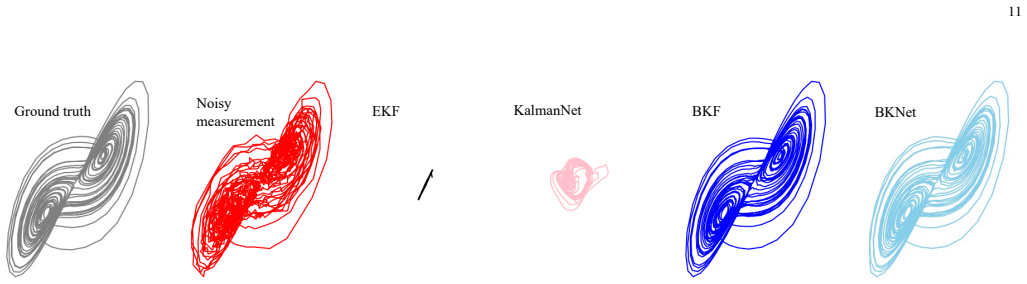
For fully known system models, the Bussgang-aided Kalman Filter (BKF) explicitly incorporates quantization distortion into recursive estimation by deriving an equivalent linear model of the 1-bit quantizer and adjusting the prediction and update equations accordingly, together with a reduced-complexity variant (reduced-BKF) for computationally efficient implementation. For partially known models, the Bussgang-aided KalmanNet (BKNet) combines adaptive dithering with gated recurrent units to mitigate severe quantization effects and model mismatch. Experiments on the Lorenz attractor and the Michigan NCLT dataset, both under 1-bit front-end quantization, demonstrate accurate and robust state估计.
What carries the argument
Bussgang-aided Kalman Filter (BKF), which uses the Bussgang theorem to replace the nonlinear 1-bit quantizer with a linear gain and additive distortion term whose statistics are inserted into the Kalman covariance and gain recursions.
If this is right
- State estimates remain consistent because the filter equations now treat quantization as a known additive noise source rather than ignoring it.
- A reduced-complexity version achieves nearly the same accuracy while lowering the number of matrix operations per time step.
- The same linearization principle extends to a learning-based architecture that handles both quantization and unknown dynamics.
- Tracking performance holds on both chaotic nonlinear oscillators and real-world location data collected with low-resolution sensors.
Where Pith is reading between the lines
- The same linearization step could be applied to other common sensor nonlinearities such as clipping or saturation to create analogous filters.
- In large sensor networks the reduction in data volume per node could compound into substantial savings in transmission energy and channel usage.
- One could examine whether the method stays stable when the quantization threshold itself changes with time or signal strength.
Load-bearing premise
The Bussgang theorem must supply a linear approximation of the 1-bit quantization effect that is accurate enough to be inserted into the Kalman update equations without breaking the recursion or producing inconsistent covariance estimates.
What would settle it
Generate Monte Carlo trajectories from a known linear system, quantize the observations to one bit, run the BKF, and check whether the filter's reported error covariance matches the empirical mean-squared error; a large or growing mismatch would show the approximation fails to preserve filter consistency.
Figures




read the original abstract
Accurate state estimation from heavily quantized measurements is a key challenge in resource-constrained Internet of Things (IoT) sensing and tracking, where battery-powered devices may employ low-resolution analog-to-digital converters (ADCs) to simplify sensor hardware and reduce the amount of data. Existing model-based and hybrid learning-based estimators, however, typically assume high-resolution observations and therefore degrade severely under 1-bit quantization. In this paper, we study nonlinear state estimation with 1-bit observations and develop a Bussgang-aided filtering framework for IoT sensing front-ends with 1-bit quantization. For fully known system models, we propose a Bussgang-aided Kalman Filter (BKF) that explicitly incorporates quantization distortion into recursive estimation, together with a reduced-complexity variant (reduced-BKF) for computationally efficient implementation. For partially known models, we further propose Bussgang-aided KalmanNet (BKNet), a model-based deep learning architecture that combines adaptive dithering with gated recurrent units (GRUs) to mitigate severe quantization effects and model mismatch. Experiments on the Lorenz attractor and the Michigan NCLT dataset, both under 1-bit front-end quantization, demonstrate accurate and robust state estimation under highly nonlinear dynamics, imperfect models, and extreme quantization. These results support the potential of the proposed framework for reliable state estimation in resource-constrained IoT sensing and tracking applications with low-resolution front-ends.
Editorial analysis
A structured set of objections, weighed in public.
Referee Report
Summary. The manuscript proposes a Bussgang-aided Kalman Filter (BKF) that incorporates 1-bit quantization distortion into the recursive state estimation equations for fully known system models, together with a reduced-complexity reduced-BKF variant. For partially known models it introduces Bussgang-aided KalmanNet (BKNet) that combines adaptive dithering with GRUs. Experiments on the Lorenz attractor and Michigan NCLT dataset under 1-bit front-end quantization are reported to demonstrate accurate estimation under nonlinear dynamics and model mismatch.
Significance. If the central Bussgang-Kalman recursion remains consistent, the framework offers a practical, low-complexity route to state estimation for battery-constrained IoT nodes that employ 1-bit ADCs. The explicit treatment of quantization noise via the Bussgang linearization and the provision of both model-based and hybrid learning variants are constructive contributions. The choice of standard benchmarks (Lorenz, NCLT) is appropriate, yet the absence of reported error metrics or covariance-consistency diagnostics limits the immediate impact.
major comments (2)
- [BKF derivation and update equations] The derivation of the BKF update (replacing the measurement equation with effective gain αH and inflated noise covariance) rests on the assumption that the Bussgang distortion d remains uncorrelated with the estimation error at every time step. Because the predictor computes the measurement from the previous posterior and the filter is closed-loop, the sign nonlinearity can create a feedback path that violates the white-noise assumption underlying the Riccati recursion. This correlation risk is load-bearing for the optimality and consistency claims and must be either proved or validated by comparing the filter-reported covariance against Monte-Carlo error statistics.
- [Experiments] The abstract states that experiments on the Lorenz attractor and NCLT dataset demonstrate accurate estimation, yet no quantitative error metrics, baseline comparisons (e.g., against standard EKF, quantized EKF, or particle filters), or covariance-consistency plots are supplied. Without these data it is impossible to judge whether the reported accuracy is meaningful or whether the reduced-BKF approximation preserves filter consistency.
minor comments (2)
- [Preliminaries] Notation for the Bussgang gain α and the effective measurement matrix should be introduced with an explicit equation reference when first used.
- [Reduced-BKF] The reduced-BKF section should clarify the precise approximation made to the gain and its computational saving relative to the full BKF.
Simulated Author's Rebuttal
We thank the referee for the constructive and detailed comments, which have helped us identify areas for improvement in the manuscript. We address each major comment point by point below and have revised the manuscript to incorporate the suggested enhancements.
read point-by-point responses
-
Referee: [BKF derivation and update equations] The derivation of the BKF update (replacing the measurement equation with effective gain αH and inflated noise covariance) rests on the assumption that the Bussgang distortion d remains uncorrelated with the estimation error at every time step. Because the predictor computes the measurement from the previous posterior and the filter is closed-loop, the sign nonlinearity can create a feedback path that violates the white-noise assumption underlying the Riccati recursion. This correlation risk is load-bearing for the optimality and consistency claims and must be either proved or validated by comparing the filter-reported covariance against Monte-Carlo error statistics.
Authors: We thank the referee for this insightful observation regarding the correlation assumptions in the BKF recursion. The Bussgang linearization is applied under the standard Gaussianity assumption for the input to the quantizer, which ensures uncorrelated distortion with the input at each step. We acknowledge that the closed-loop feedback through the sign nonlinearity in the recursive setting may introduce additional correlations not fully captured by the white-noise model. To address this rigorously, we will add Monte-Carlo validation experiments in the revised manuscript, comparing the filter-reported covariances against empirical error statistics over multiple independent runs for both the full BKF and reduced-BKF variants. This will provide empirical support for the consistency claims. revision: yes
-
Referee: [Experiments] The abstract states that experiments on the Lorenz attractor and NCLT dataset demonstrate accurate estimation, yet no quantitative error metrics, baseline comparisons (e.g., against standard EKF, quantized EKF, or particle filters), or covariance-consistency plots are supplied. Without these data it is impossible to judge whether the reported accuracy is meaningful or whether the reduced-BKF approximation preserves filter consistency.
Authors: We agree that quantitative metrics, baseline comparisons, and consistency diagnostics are essential to substantiate the performance claims. While the current manuscript focuses on qualitative demonstrations of tracking accuracy under 1-bit quantization, we will substantially expand the experimental section in the revision. This will include reporting RMSE values, direct comparisons against the standard EKF, a quantized EKF implementation, and particle filters, as well as covariance-consistency plots (e.g., normalized estimation error squared) for the Lorenz attractor and Michigan NCLT dataset under 1-bit observations. These additions will allow readers to better assess both accuracy and filter consistency, including for the reduced-BKF variant. revision: yes
Circularity Check
Bussgang-Kalman framework applies standard Bussgang linearization to Kalman recursion with no self-referential reduction or fitted-input predictions
full rationale
The derivation inserts the Bussgang decomposition y_q = α y + d (with d uncorrelated to y by theorem) into the standard Kalman measurement update, replacing H with αH and inflating R. This is a direct substitution of an external 1952 result into the Riccati equations; the paper does not define α from its own outputs, fit it to the target performance metric, or rely on self-citations for the uniqueness or validity of the recursion. Experiments on Lorenz and NCLT provide external empirical checks rather than internal consistency proofs that loop back to the same fitted values. Minor self-citation risk exists only in the usual sense of citing prior Bussgang applications, but it is not load-bearing for the central claim.
Axiom & Free-Parameter Ledger
axioms (2)
- domain assumption System dynamics and observation model are either fully known or partially known but amenable to neural adaptation.
- domain assumption Bussgang theorem provides a usable linear gain approximation for the quantized measurement process.
Lean theorems connected to this paper
-
IndisputableMonolith/Cost/FunctionalEquation.leanwashburn_uniqueness_aczel unclear?
unclearRelation between the paper passage and the cited Recognition theorem.
r_t = Q(z_t) = B_t z_t + η_t where B_t = sqrt(2/π) diag(P_{t|t-1})^{-1/2} and η uncorrelated with z and r (Section III-B)
What do these tags mean?
- matches
- The paper's claim is directly supported by a theorem in the formal canon.
- supports
- The theorem supports part of the paper's argument, but the paper may add assumptions or extra steps.
- extends
- The paper goes beyond the formal theorem; the theorem is a base layer rather than the whole result.
- uses
- The paper appears to rely on the theorem as machinery.
- contradicts
- The paper's claim conflicts with a theorem or certificate in the canon.
- unclear
- Pith found a possible connection, but the passage is too broad, indirect, or ambiguous to say the theorem truly supports the claim.
Reference graph
Works this paper leans on
-
[1]
A new approach to linear filtering and prediction problems,
R. E. Kalman, “A new approach to linear filtering and prediction problems,” J. of Basic Engineering , vol. 82, no. 1, pp. 35–45, 1960
work page 1960
-
[2]
Simon, Optimal state estimation: Kalman, H infinity, and nonlinear approaches
D. Simon, Optimal state estimation: Kalman, H infinity, and nonlinear approaches. John Wiley & Sons, 2006
work page 2006
-
[3]
The Kalman filter-Its recognition and development for aerospace applications,
S. F. Schmidt, “The Kalman filter-Its recognition and development for aerospace applications,” J. of Guidance and Control , vol. 4, no. 1, pp. 4–7, 1981
work page 1981
-
[4]
J. Durbin and S. Koopman, Time series analysis by state space methods. Oxford; New York: Oxford University Press, 2001
work page 2001
-
[5]
The unscented Kalman filter for nonlinear estimation,
E. Wan and R. Van Der Merwe, “The unscented Kalman filter for nonlinear estimation,” in Proc. of the IEEE Adaptive Systems for Signal Process., Commun., and Control Symp. , 2000, pp. 153–158
work page 2000
-
[6]
N. Shlezinger, G. Revach, A. Ghosh, S. Chatterjee, S. Tang, T. Imbiriba, J. Dunik, O. Straka, P. Closas, and Y . C. Eldar, “AI-aided Kalman filters,” arXiv preprint arXiv:2410.12289 , 2024
-
[7]
Recurrent Kalman networks: Factorized inference in high-dimensional deep feature spaces,
P. Becker, H. Pandya, G. Gebhardt, C. Zhao, C. J. Taylor, and G. Neumann, “Recurrent Kalman networks: Factorized inference in high-dimensional deep feature spaces,” in Proceedings of the 36th International Conference on Machine Learning , ser. Proceedings of Machine Learning Research, vol. 97, 09–15 Jun 2019, pp. 544–552
work page 2019
-
[8]
KalmanNet: Neural network aided Kalman filtering for partially known dynamics,
G. Revach, N. Shlezinger, X. Ni, A. L. Escoriza, R. J. G. van Sloun, and Y . C. Eldar, “KalmanNet: Neural network aided Kalman filtering for partially known dynamics,” IEEE Trans. Signal Process. , vol. 70, pp. 1532–1547, 2022
work page 2022
-
[9]
Split- KalmanNet: A robust model-based deep learning approach for state estimation,
G. Choi, J. Park, N. Shlezinger, Y . C. Eldar, and N. Lee, “Split- KalmanNet: A robust model-based deep learning approach for state estimation,”IEEE Trans. Veh. Technol., vol. 72, no. 9, pp. 12 326–12 331, 2023
work page 2023
-
[10]
Latent-KalmanNet: Learned Kalman filtering for tracking from high-dimensional signals,
I. Buchnik, G. Revach, D. Steger, R. J. G. van Sloun, T. Routtenberg, and N. Shlezinger, “Latent-KalmanNet: Learned Kalman filtering for tracking from high-dimensional signals,” IEEE Trans. Signal Process. , vol. 72, pp. 352–367, 2024
work page 2024
-
[11]
Cholesky-KalmanNet: Model-based deep learning with positive definite error covariance structure,
M. Ko and A. Shafieezadeh, “Cholesky-KalmanNet: Model-based deep learning with positive definite error covariance structure,” IEEE Trans. Signal Process., vol. 32, pp. 326–330, 2025
work page 2025
-
[12]
Kalmanformer: Using transformer to model the Kalman gain in Kalman filters,
S. Shen, J. Chen, G. Yu, Z. Zhai, and P. Han, “Kalmanformer: Using transformer to model the Kalman gain in Kalman filters,” Front. in Neurorobotics, vol. 18, p. 1460255, 2025
work page 2025
-
[13]
Ex- plainable gated Bayesian recurrent neural network for non-Markov state estimation,
S. Yan, Y . Liang, L. Zheng, M. Fan, X. Wang, and B. Wang, “Ex- plainable gated Bayesian recurrent neural network for non-Markov state estimation,” IEEE Trans. Signal Process., vol. 72, pp. 4302–4317, 2024
work page 2024
-
[14]
Optimization of mixed- ADC multi-antenna systems for cloud-RAN deployments,
J. Park, S. Park, A. Yazdan, and R. W. Heath, “Optimization of mixed- ADC multi-antenna systems for cloud-RAN deployments,” IEEE Trans. Commun., vol. 65, no. 9, pp. 3962–3975, 2017
work page 2017
-
[16]
Downlink NOMA for short-packet internet of things communications with low-resolution ADCs,
S. Kim, J. Choi, and J. Park, “Downlink NOMA for short-packet internet of things communications with low-resolution ADCs,” vol. 10, no. 7, pp. 6126–6139, 2023
work page 2023
-
[18]
Low SNR asymptotic rates of vector channels with one-bit outputs,
A. Mezghani, J. A. Nossek, and A. L. Swindlehurst, “Low SNR asymptotic rates of vector channels with one-bit outputs,” IEEE Trans. Inform. Theory, vol. 66, no. 12, pp. 7615–7634, 2020
work page 2020
-
[19]
J. Choi, J. Mo, and R. W. Heath, “Near maximum-likelihood detector and channel estimator for uplink multiuser massive MIMO systems with one-bit ADCs,” IEEE Trans. Commun. , vol. 64, no. 5, pp. 2005–2018, 2016
work page 2005
-
[20]
One-bit sphere decoding for uplink massive MIMO systems with one-bit ADCs,
Y .-S. Jeon, N. Lee, S.-N. Hong, and R. W. Heath, “One-bit sphere decoding for uplink massive MIMO systems with one-bit ADCs,” IEEE Trans. Wireless Commun., vol. 17, no. 7, pp. 4509–4521, 2018
work page 2018
-
[21]
The Bussgang decomposition of nonlin- ear systems: Basic theory and MIMO extensions [lecture notes],
O. T. Demir and E. Bjornson, “The Bussgang decomposition of nonlin- ear systems: Basic theory and MIMO extensions [lecture notes],” IEEE Signal Process. Mag. , vol. 38, no. 1, pp. 131–136, 2021
work page 2021
-
[22]
Channel estimation and performance analysis of one-bit massive MIMO systems,
Y . Li, C. Tao, G. Seco-Granados, A. Mezghani, A. L. Swindlehurst, and L. Liu, “Channel estimation and performance analysis of one-bit massive MIMO systems,” IEEE Trans. Signal Process., vol. 65, no. 15, pp. 4075–4089, 2017
work page 2017
-
[23]
Generalized Bussgang LMMSE channel estimation for one-bit massive MIMO systems,
Q. Wan, J. Fang, H. Duan, Z. Chen, and H. Li, “Generalized Bussgang LMMSE channel estimation for one-bit massive MIMO systems,” IEEE Trans. Wireless Commun., vol. 19, no. 6, pp. 4234–4246, 2020
work page 2020
-
[24]
On optimal MMSE channel estimation for one-bit quantized MIMO systems,
M. Ding, I. Atzeni, A. T ¨olli, and A. L. Swindlehurst, “On optimal MMSE channel estimation for one-bit quantized MIMO systems,” IEEE Trans. Signal Process., vol. 73, pp. 617–632, 2025
work page 2025
-
[25]
Uplink coordinated pilot design for 1-bit massive MIMO in correlated channel,
H. Yun, J. Han, K. Shen, and J. Park, “Uplink coordinated pilot design for 1-bit massive MIMO in correlated channel,” arXiv preprint arXiv:2502.13429, 2025
-
[26]
N. Shlezinger and Y . C. Eldar, “Model-based deep learning,” Foundations and Trends® in Signal Processing, vol. 17, no. 4, pp. 291– 416, 2023. [Online]. Available: http://dx.doi.org/10.1561/2000000113
-
[27]
University of Michigan North Campus long-term vision and lidar dataset,
N. Carlevaris-Bianco, A. K. Ushani, and R. M. Eustice, “University of Michigan North Campus long-term vision and lidar dataset,” Int. J. of Robotics Research, vol. 35, no. 9, pp. 1023–1035, 2015
work page 2015
-
[28]
Cross-correlation Functions of Amplitude-Distorted Gaussian Signals,
J. J. Bussgang, “Cross-correlation Functions of Amplitude-Distorted Gaussian Signals,” Research Laboratory of Electronics, Massachusetts Institute of Technology, Cambridge, MA, Technical Report 216, Mar. 1952
work page 1952
-
[29]
Capacity analysis of one-bit quantized MIMO systems with transmitter channel state information,
J. Mo and R. W. Heath, “Capacity analysis of one-bit quantized MIMO systems with transmitter channel state information,” IEEE Trans. Signal Process., vol. 63, no. 20, pp. 5498–5512, 2015
work page 2015
-
[30]
On the limits of communication with low-precision analog-to-digital conversion at the receiver,
J. Singh, O. Dabeer, and U. Madhow, “On the limits of communication with low-precision analog-to-digital conversion at the receiver,” IEEE Trans. Commun., vol. 57, no. 12, pp. 3629–3639, 2009
work page 2009
-
[31]
A general version of price’s theorem,
F. V oigtlaender, “A general version of price’s theorem,” 2020. [Online]. Available: https://arxiv.org/abs/1710.03576
-
[32]
On low-resolution ADCs in practical 5G millimeter-wave massive MIMO systems,
J. Zhang, L. Dai, X. Li, Y . Liu, and L. Hanzo, “On low-resolution ADCs in practical 5G millimeter-wave massive MIMO systems,” IEEE Commun. Mag., vol. 56, no. 7, pp. 205–211, 2018
work page 2018
-
[33]
Energy efficiency maximization precoding for quantized massive MIMO systems,
J. Choi, J. Park, and N. Lee, “Energy efficiency maximization precoding for quantized massive MIMO systems,” IEEE Trans. Wireless Commun., vol. 21, no. 9, pp. 6803–6817, 2022
work page 2022
-
[34]
Adam: A Method for Stochastic Optimization
D. P. Kingma, “Adam: A method for stochastic optimization,” arXiv preprint arXiv:1412.6980, 2014
work page internal anchor Pith review Pith/arXiv arXiv 2014
discussion (0)
Sign in with ORCID, Apple, or X to comment. Anyone can read and Pith papers without signing in.