REVIEW 4 major objections 5 minor 28 references
Mobile Manipulation with Active Inference for Long-Horizon Rearrangement Tasks
T0 review · 4 major / 5 minor · reviewed 2026-08-06 · deepseek-v4-flash
Pith's one-line read A fully hierarchical active inference agent outperforms trained RL baselines on long-horizon mobile manipulation tasks in the Habitat benchmark, reaching 66.5% average success versus 54.7%.
desk verdict Real extension of HAIF to whole-body mobile manipulation, but the benchmark claim is confounded by privileged information. read the letter →
The pith
A machine-rendered reading of the paper's core claim, the machinery that carries it, and where it could break.
The reading
What carries the argument
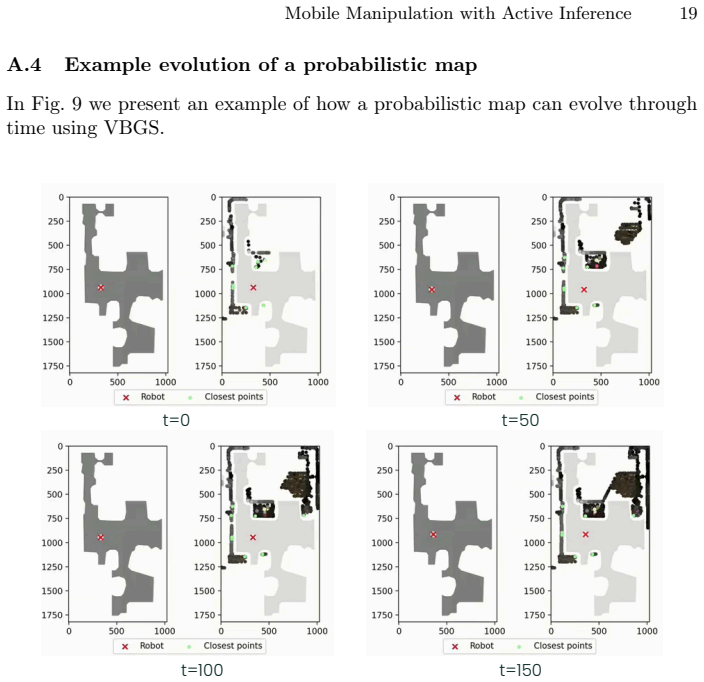
The central object is a hierarchy of generative models, each minimizing variational free energy, with actions of one level becoming the preferences of the level below. At the top, a partially observed Markov decision process sequences discrete skills (Pick, Place, Move, PickFromDrawer, PickFromFridge) by tracking the robot's relation to pick and place locations and the object's inventory state; a retry model switches approach directions on pick/place failure. The Navigation model uses A* pathfinding over a probabilistic world map built online with Variational Bayes Gaussian Splatting (VBGS), which represents free and occupied space as a 6D Gaussian mixture over 3D points with color. At the bottom, a whole-body hierarchical active inference (HAIF) controller solves for joint- and base-level controls: the arm uses a quaternion-based kinematic generative model, the mobile base uses a differential-drive generative model, and the two are linked by propagating base and arm extrinsic prediction errors into each other's belief updates, letting the base extend the arm's reach by moving to minimize the arm's errors. Goals act as linear attractors and obstacles as repulsive forces in the dynamics function, and the control signal minimizes the proprioceptive component of free energy.
What would settle it
Give the Multi-skill RL baseline the same global map and oracle knowledge of articulated object states, rerun the 100-episode evaluation on the three tasks, and check whether its combined success rises to match or beat 66.5%; or remove those privileges from the active inference agent and check whether its success falls to or below 54.7%. Either outcome would settle whether active inference itself, rather than the extra information, is responsible for the reported outperformance.
Extended reading notes
Core claim
On the paper's own terms, the central claim is that a fully hierarchical active inference architecture outperforms state-of-the-art baselines on all three long-horizon tasks of the Habitat benchmark. The agent combines a high-level active inference model that selects among discrete whole-body skills with a continuous whole-body controller based on hierarchical active inference, in which the mobile base and the arm minimize each other's prediction errors. Over five seeds and 100 episodes per task, the method achieves 72.5% success on TidyHouse, 77% on PrepareGroceries, and 50% on SetTable, for a combined 66.5%, versus 71%, 64%, and 29% (54.7% combined) for the multi-skill RL baseline. The method requires no offline training; skills are hand-tuned over a handful of episodes, and the agent can recover from pick and place failures online by switching approach directions. The paper acknowledges that it currently relies on privileged information—a global floor map for path planning and ground-truth knowledge of drawer and fridge states—which the baselines do not receive, and states that these assumptions will be removed in future work.
Load-bearing premise
The comparison assumes the measured advantage comes from the active inference architecture itself and not from privileged information: the agent is given a global floor map for path planning and ground-truth drawer/fridge states that the RL baselines do not receive; if a baseline were given the same information, or the agent had to operate from raw RGBD, the reported gap could shrink, vanish, or reverse.
Editorial extensions
If this is right
- Long-horizon mobile manipulation no longer necessarily requires offline RL training: the skills are hand-tuned and the high-level plan is recomputed online, avoiding reward shaping and millions of training steps.
- Failures can be absorbed online: the retry model switches approach parameters on pick/place failures and the high-level model can re-sequence remaining subtasks, unlike the open-loop chained-RL baseline.
- The whole-body coupling lets the base absorb the arm's prediction errors, extending the arm's reachable workspace and relaxing the need to dock the base precisely before manipulation.
- The 11.8-point combined success advantage indicates that free-energy-minimizing model-based control is competitive with trained policies on established robotics benchmarks, rather than limited to simple 2D settings.
Reading between the lines
- If the performance gap persists under equal information, the practical consequence is that composing cheap, hand-tuned model-based skills with online replanning is a data-efficient alternative to large RL pipelines for rearrangement, not just on this benchmark but on comparable long-horizon tasks.
- The paper's own admission that it uses a global map and oracle object states implies perception is currently the bottleneck; a natural extension is measuring how success degrades as each privilege is removed, or how it rises when a baseline is given the same privileges.
- The base-arm coupling mechanism is a generic control principle that could transfer to other redundant mobile manipulators; a direct test would be to port the whole-body controller to a different platform and compare reach and success on the same skills.
- The authors hint at adding an intermediate hierarchical level to smooth transitions between subgoals; if that layer were learned, the architecture would test whether a learned skill level can combine with the hand-tuned core to push success further.
Editorial analysis
A structured set of objections, weighed in public.
Referee Report
Summary. The paper proposes a hierarchical active inference architecture for long-horizon mobile manipulation and evaluates it on three Habitat Benchmark tasks: TidyHouse, PrepareGroceries, and SetTable. The architecture combines a discrete high-level POMDP planner, a navigation module based on A* pathfinding, a Variational Bayes Gaussian Splatting (VBGS) world map, and a continuous whole-body hierarchical active inference controller. The authors report average success rates of 72.5%, 77%, and 50% on the three tasks, compared with 71%, 64%, and 29% for the Multi-skill RL mobile manipulation baseline from Gu et al. (2022), and an aggregate success rate of 66.5% versus 54.7%. They conclude that this is the first demonstration that active inference can scale to modern robotics benchmarks. The paper explicitly discloses reliance on privileged information, namely a global floor map for path planning and ground-truth articulated object states, and states that these assumptions will be removed in future work.
Significance. If the empirical comparison were clean, this result would be significant: a hand-tuned, non-trained hierarchical active inference controller outperforming RL-based mobile manipulation policies on a standard benchmark would challenge the prevailing assumption that long-horizon rearrangement tasks require extensive offline training. The paper also makes a useful technical contribution by extending hierarchical active inference to whole-body differential-drive control, particularly the coupling of base and arm prediction errors in Eq. (12), and by demonstrating online probabilistic mapping with VBGS in a benchmark setting. The authors are transparent about the privileged information and the manual tuning involved, which is a strength. However, the central claim that the method 'outperforms state-of-the-art baselines' is not yet supported because the baselines do not receive the same oracle information, the baseline evaluation protocol is incompletely specified, and the sensitivity to manually chosen parameters is not assessed.
major comments (4)
- [Sec. 3.2 and Sec. 2.1] The central comparison is confounded by privileged information. In Sec. 2.1 the navigation component uses A* pathfinding with 'prior knowledge about the object location,' and Sec. 3.2 concedes that the method 'still rely[ies] on privileged information, such as the floor map for path planning and articulated object states.' The Multi-skill RL baseline from [10] is trained from egocentric observations and does not receive these oracle signals. Consequently, the reported aggregate advantage (66.5% vs. 54.7%) and the per-task differences in Fig. 4 cannot be attributed to the active inference architecture itself. Please add a controlled comparison in which the RL baselines receive the same global map and articulated-object-state information, or remove these privileged inputs from the proposed method, and report both configurations.
- [Sec. 3.2, Fig. 4] The evaluation protocol is not sufficiently specified for a fair comparison. The manuscript does not state whether the MM and Monolithic RL results were rerun by the authors on the same 100 episodes or taken directly from [10]; if the latter, episode-level comparability is not guaranteed. In addition, no error bars, confidence intervals, or per-seed breakdowns are reported, and the text says results are averaged 'over five seeds' while Fig. 4 says 'averaged over 100 episodes.' Please reconcile these statements, report variance across seeds, and describe exactly how each baseline was evaluated.
- [App. A.2 and Sec. 2.4] The claim that the method requires no offline training is qualified by a large set of manually chosen parameters. App. A.2 lists repulsion and threshold gains (kr,theta, kr,obst, gamma_theta, gamma_obst) and states that parameters are 'manually chosen to achieve sufficient performance in the test cases'; Sec. 2.4 and Sec. 3.2 refer to hand-tuned skill sequences and goals. Since the reported success rates may depend strongly on these choices, please report the tuning budget, the sensitivity of the results to parameter variations, or both, so that the generalization claim can be assessed.
- [Sec. 3.1, Baselines] The statement that the method 'outperforms state-of-the-art baselines' is based on a comparison with only two methods from [10]. The Habitat Benchmark paper [28] itself proposes a hierarchical baseline, and other published results may exist on these tasks. Please either include a broader set of baseline methods or justify explicitly why the two methods from [10] constitute the current state of the art on this benchmark.
minor comments (5)
- [App. A.1, Eq. (17)] Equation (17) prints the same expression for all four quaternion components; based on the orientation expressions that follow, the components should be [cos(theta/2)cos(alpha/2), cos(theta/2)sin(alpha/2), sin(theta/2)sin(alpha/2), sin(theta/2)cos(alpha/2)]. Please correct this typo, as it affects the reproducibility of the kinematic model.
- [Fig. 4] The heading 'Average Sucess Rate' contains a typo; it should read 'Average Success Rate.'
- [App. A.1] The first sentence of App. A.1 reads 'To generative model in eq. (4)'; it should read 'The generative model in Eq. (4).'
- [Sec. 2.1] The Navigation Model is implemented with A* pathfinding, which is not an active inference component. The abstract and introduction should describe the system as a hybrid active inference architecture that includes classical planning, to avoid overclaiming that the entire system is active inference.
- [Sec. 3.2] The transition from results to the statement 'demonstrating for the first time that active inference can scale to the complexity of modern robotics benchmarks' is too strong given the privileged information and the narrow baseline set; please qualify the conclusion accordingly.
Circularity Check
No significant circularity: the benchmark results are empirical measurements, and the disclosed privileged-information and manual-tuning issues are external-validity concerns rather than reductions of predictions to inputs.
full rationale
The paper's central claim is empirical: a hierarchical active inference agent reaches 66.5% average success versus 54.7% for the MM baseline on three Habitat Benchmark tasks (Sec 3.2). Those percentages are measured outcomes from evaluation episodes, not quantities derived from the model's equations, so they cannot be circular in the sense of being identical to model inputs by construction. The control equations (1)-(2) follow the externally published HAIF derivation [22], and the arm generative model in Eq. (4) is taken from [20] with the kinematic chain specified in Appendix A.1, so the controller is not justified solely by self-citation. Navigation explicitly uses A* rather than the cited discrete active-inference work [4], so that self-citation is not load-bearing. The appendix admits that precision, gain, and collision-avoidance parameters are 'manually chosen to achieve sufficient performance in the test cases' (A.2) and that skills are hand-tuned over a handful of episodes (Sec 3.2); however, the paper reports these as evaluation results and discloses the tuning, and it does not present them as predictions derived from first principles, so this does not fit the 'fitted input called prediction' pattern. Similarly, the reliance on privileged information, namely the floor map for A* and ground-truth articulated object states (Secs 2.1 and 3.2), is a legitimate fairness threat to the 'outperforms state-of-the-art' comparison, since the RL baselines may not receive the same signals, but this concerns whether the benchmark comparison isolates the active-inference contribution, not whether any result reduces to its own inputs. No uniqueness theorem, ansatz smuggled via citation, or renaming of a known result is used to make the central claim. The derivation is self-contained as a systems paper, so the correct circularity finding is none.
Assumptions & free parameters
free parameters (4)
- HAIF precisions and gains (πp, πe, πv, πμi, πμe, κa, κbase, κarm) =
not reported
- Repulsion and threshold gains (kr,θ, kr,obst, γθ, γobst) =
not reported
- Per-skill waypoint and goal parameters =
e.g., Move reach thresholds 0.8 m and 0.3 rad
- High-level POMDP priors and preferences =
not reported
assumptions (4)
- standard math The free energy principle and HAIF belief update equations (1)-(2) from [22,20] correctly implement active inference for kinematic control.
- domain assumption The VBGS map from [15] yields an accurate enough 3D occupancy representation for obstacle avoidance and object localization.
- domain assumption Privileged information (global floor map for A* pathfinding and ground-truth articulated object states) is available and accurate.
- domain assumption The Habitat simulator's abstract grasping and object-snapping model (15 cm snap) is given as the task interface.
Cite this review
Pith. "Pith review of Mobile Manipulation with Active Inference for Long-Horizon Rearrangement Tasks." pith.science (2026). https://pith.science/paper/54O5Q2WD
@misc{pith2026250717338,
  author       = {Pith},
  title        = {Pith review of: Mobile Manipulation with Active Inference for Long-Horizon Rearrangement Tasks},
  year         = {2026},
  howpublished = {\url{https://pith.science/paper/54O5Q2WD}},
  note         = {Machine review of arXiv:2507.17338}
}
read the original abstract
Despite growing interest in active inference for robotic control, its application to complex, long-horizon tasks remains untested. We address this gap by introducing a fully hierarchical active inference architecture for goal-directed behavior in realistic robotic settings. Our model combines a high-level active inference model that selects among discrete skills realized via a whole-body active inference controller. This unified approach enables flexible skill composition, online adaptability, and recovery from task failures without requiring offline training. Evaluated on the Habitat Benchmark for mobile manipulation, our method outperforms state-of-the-art baselines across the three long-horizon tasks, demonstrating for the first time that active inference can scale to the complexity of modern robotics benchmarks.
Figures


Figures from the paper (6 more)


Reference graph
Works this paper leans on
-
[10]
arXiv preprint arXiv:2209.02778 (2022)
Gu, J., Chaplot, D.S., Su, H., Malik, J.: Multi-skill mobile manipulation for object rearrangement. arXiv preprint arXiv:2209.02778 (2022)
arXiv 2022
-
[28]
Szot, A., Clegg, A., Undersander, E., Wijmans, E., Zhao, Y., Turner, J., Maestre, N.,Mukadam,M.,Chaplot,D.S.,Maksymets,O.,etal.:Habitat2.0:Traininghome assistants to rearrange their habitat. Advances in neural information processing systems 34, 251–266 (2021) Mobile Manipulation with Active Inference 15 A Appendix A.1 Kinematic generative model To generat...
work page 2021
-
[1]
Beal, M.J.: Variational Algorithms for Approximate Bayesian Inference. Ph.D. the- sis, University College London (2003)
work page 2003
-
[2]
Bishop, C.M.: Pattern Recognition and Machine Learning. Springer (2006)
work page 2006
-
[3]
Blei, D.M., Kucukelbir, A., McAuliffe, J.D.: Variational inference: A review for statisticians. Journal of the American Statistical Association112(518), 859–877 Mobile Manipulation with Active Inference 13 (2017). https://doi.org/10.1080/01621459.2017.1285773, https://doi.org/ 10.1080/01621459.2017.1285773
arXiv 2017
-
[4]
Çatal, O., Van de Maele, T., Pitliya, R.J., Albarracin, M., Pattisapu, C., Verbelen, T.: Belief sharing: A blessing or a curse. In: Buckley, C.L., Cialfi, D., Lanillos, P., Pitliya, R.J., Sajid, N., Shimazaki, H., Verbelen, T., Wisse, M. (eds.) Active Inference. pp. 121–133. Springer Nature Switzerland, Cham (2025)
work page 2025
-
[5]
In: Proceedings of the IEEE/CVF conference on computer vision and pattern recog- nition
Ehsani, K., Han, W., Herrasti, A., VanderBilt, E., Weihs, L., Kolve, E., Kembhavi, A., Mottaghi, R.: Manipulathor: A framework for visual object manipulation. In: Proceedings of the IEEE/CVF conference on computer vision and pattern recog- nition. pp. 4497–4506 (2021)
work page 2021
-
[6]
Biological Psychology 193, 108891 (2024)
Friston, K.J., Da Costa, L., Tschantz, A., Kiefer, A., Salvatori, T., Neacsu, V., Koudahl, M., Heins, C., Sajid, N., Markovic, D., Parr, T., Verbelen, T., Buckley, C.L.: Supervised structure learning. Biological Psychology 193, 108891 (2024). https://doi.org/https://doi.org/10.1016/j.biopsycho.2024.108891, https://www.sciencedirect.com/science/article/pii...
arXiv 2024
Show all 28 references
-
[7]
Network neuroscience1(4), 381–414 (2017)
Friston, K.J., Parr, T., de Vries, B.: The graphical brain: Belief propagation and active inference. Network neuroscience1(4), 381–414 (2017)
2017
-
[8]
In: 2022 International conference on robotics and automation (ICRA)
Gan,C.,Zhou,S.,Schwartz,J.,Alter,S.,Bhandwaldar,A.,Gutfreund,D.,Yamins, D.L., DiCarlo, J.J., McDermott, J., Torralba, A., et al.: The threedworld trans- port challenge: A visually guided task-and-motion planning benchmark towards physically realistic embodied ai. In: 2022 Inte...
2022
-
[9]
In: Proceedings of the international conference on automated planning and scheduling
Garrett, C.R., Lozano-Pérez, T., Kaelbling, L.P.: Pddlstream: Integrating symbolic planners and blackbox samplers via optimistic adaptive planning. In: Proceedings of the international conference on automated planning and scheduling. vol. 30, pp. 440–448 (2020)
2020
-
[11]
IEEE Transactions on Systems Science and Cyber- netics 4(2), 100–107 (1968).https://doi.org/10.1109/TSSC.1968.300136
Hart, P.E., Nilsson, N.J., Raphael, B.: A formal basis for the heuristic determina- tion of minimum cost paths. IEEE Transactions on Systems Science and Cyber- netics 4(2), 100–107 (1968).https://doi.org/10.1109/TSSC.1968.300136
1968
-
[12]
In: 2011 IEEE International Conference on Robotics and Automation
Kaelbling, L.P., Lozano-Pérez, T.: Hierarchical task and motion planning in the now. In: 2011 IEEE International Conference on Robotics and Automation. pp. 1470–1477. IEEE (2011)
2011
-
[13]
The International Journal of Robotics Research32(9-10), 1194–1227 (2013)
Kaelbling, L.P., Lozano-Pérez, T.: Integrated task and motion planning in belief space. The International Journal of Robotics Research32(9-10), 1194–1227 (2013)
2013
-
[14]
ACM Transactions on Graphics 42(4) (July 2023), https://repo-sam.inria.fr/fungraph/3d-gaussian-splatting/
Kerbl, B., Kopanas, G., Leimkühler, T., Drettakis, G.: 3d gaussian splatting for real-time radiance field rendering. ACM Transactions on Graphics 42(4) (July 2023), https://repo-sam.inria.fr/fungraph/3d-gaussian-splatting/
2023
-
[15]
Van de Maele, T., Çatal, O., Tschantz, A., Buckley, C.L., Verbelen, T.: Variational bayes gaussian splatting (2024)
2024
-
[16]
Neu- ropsychologia 111, 334–343 (2018)
Parr, T., Friston, K.J.: Active inference and the anatomy of oculomotion. Neu- ropsychologia 111, 334–343 (2018)
2018
-
[17]
Neural computation30(9), 2319–2347 (2018)
Parr, T., Friston, K.J.: The discrete and continuous brain: from decisions to move- ment—and back again. Neural computation30(9), 2319–2347 (2018)
2018
-
[18]
MIT Press (2022)
Parr, T., Pezzulo, G., Friston, K.J.: Active inference: the free energy principle in mind, brain, and behavior. MIT Press (2022)
2022
-
[19]
Springer Nature Link (2023) 14 C
Parr, T., Pezzulo, Friston, K.J., Giovanni: Generative models for sequential dy- namics in active inference. Springer Nature Link (2023) 14 C. Pezzato et al
2023
-
[20]
In: The First Workshop on NeuroAI@ NeurIPS2024 (2024)
Pezzato, C., Buckley, C., Verbelen, T.: Why learn if you can infer? robot arm control with hierarchical active inference. In: The First Workshop on NeuroAI@ NeurIPS2024 (2024)
2024
-
[21]
Entropy 27, 570 (2025)
Priorelli, M., Stoianov, I.P.: Deep hybrid models: Infer and plan in a dynamic world. Entropy 27, 570 (2025). https://doi.org/10.3390/e27060570, https: //doi.org/10.3390/e27060570
2025 doi
-
[22]
Proceedings of the National Academy of Sciences 120(51), e2309058120 (Dec 2023)
Priorelli, M., Pezzulo, G., Stoianov, I.P.: Deep kinematic inference affords efficient and scalable control of bodily movements. Proceedings of the National Academy of Sciences 120(51), e2309058120 (Dec 2023). https://doi.org/10.1073/pnas. 2309058120, https://pnas.org/doi/10.1...
2023 doi
-
[23]
Heliyon10(20) (2024)
Priorelli, M., Stoianov, I.P.: Slow but flexible or fast but rigid? discrete and con- tinuous processes compared. Heliyon10(20) (2024)
2024
-
[24]
Neural Networks p
Priorelli, M., Stoianov, I.P.: Dynamic planning in hierarchical active inference. Neural Networks p. 107075 (2025)
2025
-
[25]
Machines10(2), 97 (2022)
Sandakalum, T., Ang Jr, M.H.: Motion planning for mobile manipulators—a sys- tematic review. Machines10(2), 97 (2022)
2022
-
[26]
PubMed (2022)
Smith, R., Friston, K.J., Whyte, C.J.: A step-by-step tutorial on active inference and its application to empirical data. PubMed (2022)
2022
-
[27]
In: 2014 IEEE international conference on robotics and automation (ICRA)
Srivastava, S., Fang, E., Riano, L., Chitnis, R., Russell, S., Abbeel, P.: Combined task and motion planning through an extensible planner-independent interface layer. In: 2014 IEEE international conference on robotics and automation (ICRA). pp. 639–646. IEEE (2014)
2014
Reviewed August 6, 2026 · model on record in the stance chip above.
Discussion (0). Sign in to comment.