REVIEW 2 major objections 6 minor 43 references
Discovery of 146.8 s pulsations from EP J005146.9-730930, a new transient Be/X-ray binary in the SMC
T0 review · 2 major / 6 minor · reviewed 2026-08-06 · deepseek-v4-flash
Pith's one-line read The discovery of 146.79-second X-ray pulsations from EP J005146.9-730930 establishes it as a new Be/X-ray binary pulsar in the Small Magellanic Cloud, with a magnetic field lower limit above 3.3 trillion gauss.
desk verdict A solid SMC BeXRB pulsar discovery whose key detection significance is missing; fix that and it's an easy accept. read the letter →
The pith
A machine-rendered reading of the paper's core claim, the machinery that carries it, and where it could break.
The reading
What carries the argument
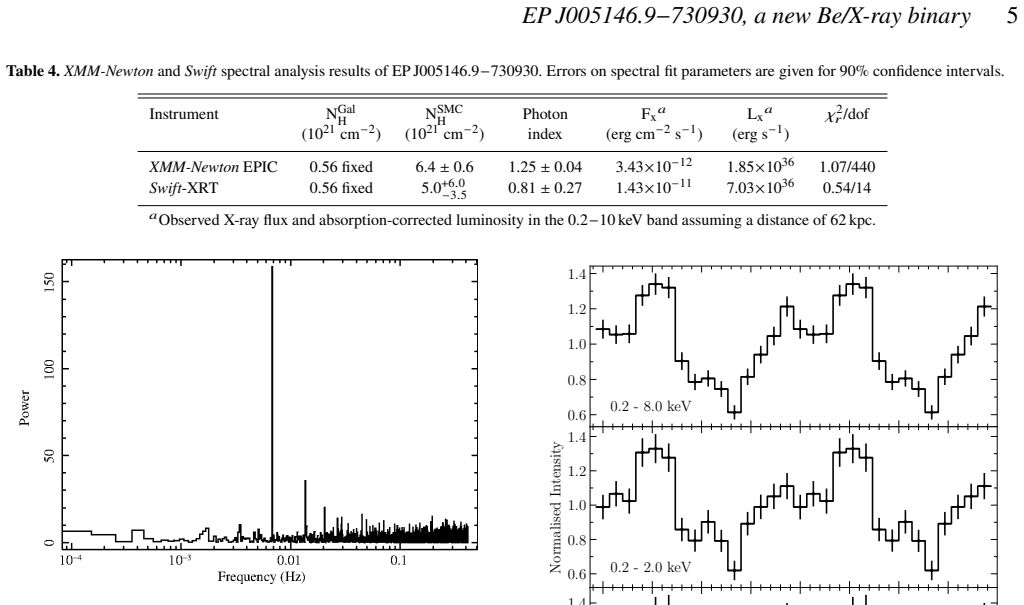
The load-bearing object is the coherent $146.79$ s pulsation signal in the EPIC-pn data; it identifies the compact object as a neutron star and pins down the spin period. The period is measured with a Bayesian approach (Gregory & Loredo 1996) applied in a narrow frequency range around the power-spectrum peak, and its harmonic at $13.6$ mHz confirms the double-peaked pulse shape. The interpretative machinery for the magnetic field limit is the critical luminosity concept: below a luminosity set by the field strength, the infalling flow is decelerated by Coulomb interactions rather than radiation pressure, and an increase in luminosity lowers the emission height in the accretion column, producing harder spectra. The paper uses the Becker et al. (2012) relation $L_{\rm crit} \simeq 1.5\times 10^{37} B_{12}^{16/15}$ erg s$^{-1}$, combined with a bolometric correction factor of 3, to convert the peak luminosity into the limit $B > 3.3 \times 10^{12}$ G.
What would settle it
Take high signal-to-noise X-ray spectra of EP J005146.9-730930 at two or more brightness levels during a future outburst, fitting the absorbing column and power-law slope simultaneously; if the power-law slope is unchanged once absorption is accounted for, the sub-critical accretion interpretation and the $B > 3.3\times 10^{12}$ G limit are falsified, while the pulsation detection remains intact.
Extended reading notes
Core claim
The central claim is that EP J005146.9-730930, a transient X-ray source discovered by Einstein Probe in the Small Magellanic Cloud, is a new Be/X-ray binary pulsar (SXP 146.8). The proof rests on the detection of coherent pulsations at $146.79 \pm 0.03$ s in the XMM-Newton EPIC-pn light curve, determined via a Bayesian period search around the power-spectrum peak. The pulse period falls near the second maximum of the SMC Be/X-ray pulsar period distribution, and the double-peaked profile and $36 \pm 8\%$ pulsed fraction are typical for this class. The EPIC spectrum is an absorbed power law with photon index $1.25 \pm 0.04$ and an intrinsic SMC column density of $6.4 \pm 0.6\times 10^{21}$ cm$^{-2}$. The paper further argues that the fast-rise-slow-decay outburst, which peaked at about $2\times 10^{37}$ erg s$^{-1}$ and lasted more than 90 days, is a type II outburst, and that the observed spectral hardening toward higher luminosity—shown to be model-independent via a hardness-intensity diagram—indicates accretion below the critical luminosity. Using the relation between critical luminosity and magnetic field from Becker et al. (2012), the authors derive a lower limit of $B > 3.3 \times 10^{12}$ G. The corrected X-ray position, coincident with the Gaia position of the candidate Be star within $0.1''$, confirms OGLE J005147.58-730924.7 as the optical counterpart.
Load-bearing premise
The magnetic-field lower limit depends on the assumption that the X-ray spectrum hardens because the neutron star's accretion physics changes with brightness, not because we are seeing more or less absorbing gas along the way.
Editorial extensions
If this is right
- The source becomes the newest member of the SMC's Be/X-ray binary pulsar population, with a pulse period near the second peak of that population's period distribution, supporting the existence of a distinct group of slow rotators in the SMC.
- The magnetic field lower limit of $B > 3.3\times 10^{12}$ G can be tested by searching for cyclotron resonance scattering features in future high-signal spectra, which would measure the field directly.
- A firm pulse period now enables measurement of the spin-up/down rate during future outbursts, which under accretion-torque models can independently constrain the magnetic field and the binary orbital parameters.
- The type II outburst classification and the confirmation of the optical counterpart make the system a candidate for multi-wavelength follow-up to study the disk-star interaction in Be/X-ray binaries.
Reading between the lines
- If the tentative anti-correlation between the absorption column density and luminosity is real, the observed hardening could be at least partly due to changing line-of-sight absorption rather than intrinsic changes in the accretion column; this would weaken the sub-critical accretion case and the derived magnetic field limit, although the pulsation discovery itself would stand.
- The absence of any significant detection before 2024, despite decades of X-ray monitoring of the SMC, suggests that such transients are rare enough that Einstein Probe's continuing SMC survey could be expected to find only a handful of similar systems, which would place interesting constraints on the transient Be/X-ray binary population.
- Because the source's period is near the second maximum of the SMC period distribution, comparing this system's orbital parameters with other slow-rotator BeXRBs could test whether the second period peak corresponds to a group of systems with systematically different magnetic fields or accretion histories.
- If upcoming X-ray observations during quiescence detect the neutron star's thermal emission, the surface temperature could give an independent handle on the neutron star's age and cooling history, complementing the magnetic field estimate.
Editorial analysis
A structured set of objections, weighed in public.
Referee Report
Summary. This manuscript reports the discovery of 146.79 +/- 0.03 s coherent X-ray pulsations from the transient source EP J005146.9-730930, using a triggered XMM-Newton observation during an outburst detected by Einstein Probe. The X-ray spectrum is well described by an absorbed power law with photon index 1.25 +/- 0.04, and the folded pulse profile is double-peaked with a pulsed fraction of 36 +/- 8%. Combining XMM-Newton, EP-FXT, Swift, and archival upper limits, the authors characterize the outburst as a type-II event lasting over 90 days with a peak luminosity near 2 x 10^37 erg/s. They also report a tentative spectral hardening toward higher luminosities and interpret this as evidence for sub-critical accretion, yielding a magnetic field lower limit of B > 3.3 x 10^12 G. The improved X-ray position identifies the candidate Be star OGLE J005147.58-730924.7 as the optical counterpart, and the authors conclude that EP J005146.9-730930 = SXP 146.8 is a new Be/X-ray binary pulsar in the SMC.
Significance. If the pulsation detection is secure, this is a valuable addition to the SMC BeXRB census, particularly near the 147 s period range, and the multi-wavelength coverage from EP-FXT, Swift, and XMM-Newton provides a well-characterized outburst. The paper is careful in its astrometric correction using SXP172, in its treatment of the EPIC background flares, and in its use of both C-statistics for low-count EP-FXT spectra and chi-squared for EPIC spectra. The claimed pulsation, the double-peaked pulse profile, and the association with a likely Be star are internally consistent. The main weakness is that the central discovery claim lacks a quantitative detection significance; the magnetic field lower limit is also more model-dependent than the abstract suggests. These issues are repairable and do not undermine the likely reality of the pulsations.
major comments (2)
- [Section 2.2.2 and Section 3] The pulsation detection is reported without any quantitative significance. The text states that the power spectrum 'revealed pulsations' at about 6.8 mHz and a first harmonic, and quotes a Bayesian period of 146.79 +/- 0.03 s, but no false-alarm probability, normalization of the power spectrum, epoch-folding chi-square, H-test statistic, or Bayesian odds is given. The Discussion's claim that the signal is 'highly significant' is therefore unsupported by a number. Because the classification of EP J005146.9-730930 as a new BeXRB pulsar rests entirely on this detection, please add a detection significance (e.g., from Monte Carlo simulations over the searched frequency range, or via the H-test) and state the number of independent frequencies searched.
- [Section 3 and footnote 4] The lower limit B > 3.3 x 10^12 G rests on two model-dependent steps that are not quantified. First, the 0.2-10 keV luminosity is multiplied by an ad hoc bolometric correction factor of 3 with no uncertainty or justification. Second, the conclusion that the source accretes below L_crit relies on interpreting the spectral hardening with luminosity as intrinsic, whereas the paper's own analysis finds only a tentative anti-correlation between N_H^SMC and L_x (p = 0.005, about 2.8 sigma) and the N_H measurements have large uncertainties. Please present B as an order-of-magnitude estimate with a range covering plausible bolometric corrections (e.g., factors of 2-5) and explicitly state that the sub-critical accretion interpretation is not uniquely determined by the data. This does not affect the pulsar discovery, but the current abstract presents the value as a firm lower limit.
minor comments (6)
- [Section 2.2.2 and Figure 5] The y-axis normalization of the power spectrum is not defined; state whether it is Leahy-normalized, in units of fractional rms squared, or otherwise, so the reader can interpret the peak height.
- [Section 2.2.2] The uncertainty on the pulsed fraction (36 +/- 8%) is not defined; specify how it was propagated from the folded light curve.
- [Section 2.1.1] The statement that the EP-FXT parameters on MJD 60565.7 are 'roughly consistent' with the XMM-Newton results would benefit from a quantitative comparison, since the two observations are separated by only three days.
- [Section 2.3] The description of the eROSITA background extraction should state explicitly how the SXP172 point-spread-function contribution was modeled or subtracted, to demonstrate that the upper limits are not biased.
- [Section 2.3] The text contains the typo 'HIGLIGT' for 'HILIGT'.
- [Abstract and Section 3] The claimed spectral hardening trend should be accompanied by a significance (e.g., Pearson r and p-value) in the abstract or at least in Section 3, given its role in the B-field argument.
Circularity Check
No circularity: the 146.8 s pulsation is a direct observed timing quantity and the B-field estimate uses an external published relation, not a fitted parameter relabeled as a prediction.
full rationale
The paper's central result is an observational measurement, not a derivation from its own assumptions. Section 2.2.2 states that the EPIC-pn power spectrum 'revealed pulsations at a frequency of about 6.8 mHz' and that a Gregory-Loredo Bayesian analysis 'results in a pulse period of 146.79±0.03 s'; this period is a measured quantity, not an output of a model fitted to the same data. The spectral parameters (Γ=1.25±0.04, N_H^SMC=6.4±0.6×10^21 cm^-2) are obtained from an independent spectral fit, and the luminosity follows from flux plus a stated distance, so no fitted input is later renamed as a prediction. The magnetic-field lower limit in Section 3 is computed from the published Becker et al. (2012) relation L_crit=1.5×10^37 B_12^(16/15) erg/s using the paper's measured peak luminosity; the sub-critical accretion assumption is an interpretation, not a circular reduction. Self-citations, including Haberl & Sturm (2016) for the SMC HMXB catalogue and Haberl et al. (2022) or Vasilopoulos et al. (2017) for the timing method, are contextual or methodological and do not carry the paper's conclusion. The paper's tentative N_H-Lx anti-correlation (Pearson r=-0.746, p=0.005) is itself flagged as tentative and only affects the accretion-regime interpretation. One reporting gap is that Section 2.2.2 does not quote a quantitative detection significance (false-alarm probability, H-test, or Bayesian odds) for the 6.8 mHz peak; however, this is a missing support issue, not a circularity, because the detection claim is not defined in terms of the paper's own conclusions.
Assumptions & free parameters
free parameters (3)
- Photon index Gamma (XMM-Newton EPIC) =
1.25 +/- 0.04
- Intrinsic SMC absorption column N_H_SMC (XMM-Newton EPIC) =
6.4 +/- 0.6 x 10^21 cm^-2
- Pulsed fraction =
36% +/- 8%
assumptions (5)
- domain assumption The SMC distance is 62 kpc (Graczyk et al. 2020).
- domain assumption Critical luminosity relation Lcrit = 1.5e37 B12^(16/15) erg/s (Becker et al. 2012).
- ad hoc to paper Bolometric correction factor of 3 applied to the 0.2-10 keV luminosity.
- domain assumption X-ray spectrum described by absorbed power law with two absorption components (tbabs*tbvarabs*powerlaw) and SMC abundances (Russell & Dopita 1992).
- domain assumption The 146.79 s coherent modulation is the neutron star spin period.
Cite this review
Pith. "Pith review of Discovery of 146.8 s pulsations from EP J005146.9-730930, a new transient Be/X-ray binary in the SMC." pith.science (2026). https://pith.science/paper/DLYU6C2W
@misc{pith2026250717380,
  author       = {Pith},
  title        = {Pith review of: Discovery of 146.8 s pulsations from EP J005146.9-730930, a new transient Be/X-ray binary in the SMC},
  year         = {2026},
  howpublished = {\url{https://pith.science/paper/DLYU6C2W}},
  note         = {Machine review of arXiv:2507.17380}
}
read the original abstract
Recent observations of the Small Magellanic Cloud (SMC) with Einstein Probe (EP) revealed a new transient X-ray source, most likely identified as Be/X-ray binary. To characterise the X-ray properties of EP J005146.9-730930 and in particular to look for pulsations in the X-ray flux, we triggered an XMM-Newton anticipated target of opportunity observation. To follow the flux evolution during the outburst we monitored the source for about three months with the Follow-up X-ray Telescope of EP. The XMM-Newton observation was performed on 2024 September 15 and we used the data from the European Photon Imaging Camera (EPIC) for detailed spectral and timing analyses. The EPIC X-ray spectrum is well described by an absorbed power law with photon index of 1.25 +/- 0.04 and the timing analysis revealed pulsations with 146.79 +\- 0.03 s. The source flux had decreased by a factor of about 10 since the observed maximum about one month before the XMM-Newton observation. EP J005146.9-730930 was never detected significantly during serendipitous observations before September 2024. The characteristics of the X-ray brightening suggest the source was discovered during a type II outburst reaching an X-ray peak luminosity of ~2 x 10^37 erg/s. The trend of spectral hardening towards higher luminosities observed by EP suggests that the source is accreting below the critical luminosity, yielding an estimated lower limit for the pulsar magnetic field strength of 3.3 x 10^12 G. The improved X-ray position confirms the candidate Be star OGLE J005147.58-730924.7 as optical counterpart. We conclude that EP J005146.9-730930 = SXP 146.8 is a new Be/X-ray binary pulsar in the SMC.
Figures


Figures from the paper (5 more)


Reference graph
Works this paper leans on
-
[1]
Antoniou V., Hatzidimitriou D., Zezas A., Reig P., 2009, @doi [ ] 10.1088/0004-637X/707/2/1080 , http://adsabs.harvard.edu/abs/2009ApJ...707.1080A 707, 1080
-
[2]
Antoniou V., Zezas A., Hatzidimitriou D., Kalogera V., 2010, @doi [ ] 10.1088/2041-8205/716/2/L140 , http://adsabs.harvard.edu/abs/2010ApJ...716L.140A 716, L140
-
[3]
Arnaud K. A., 1996, in ASP Conf. Ser. 101: Astronomical Data Analysis Software and Systems V. p. 17
work page 1996
-
[4]
Basko M. M., Sunyaev R. A., 1976, @doi [ ] 10.1093/mnras/175.2.395 , https://ui.adsabs.harvard.edu/abs/1976MNRAS.175..395B 175, 395
-
[5]
Becker P. A., et al., 2012, @doi [ ] 10.1051/0004-6361/201219065 , https://ui.adsabs.harvard.edu/abs/2012A&A...544A.123B 544, A123
-
[6]
Cash W., 1979, @doi [ ] 10.1086/156922 , https://ui.adsabs.harvard.edu/abs/1979ApJ...228..939C 228, 939
doi:10.1086/156922 1979
-
[7]
Coe M. J., Kennea J. A., Gaudin T. M., Monageng I., Townsend L., Buckley D. A., Udalski A., Evans P., 2023, The Astronomer's Telegram, https://ui.adsabs.harvard.edu/abs/2023ATel16321....1C 16321, 1
work page 2023
-
[8]
Dickey J. M., Lockman F. J., 1990, @doi [ ] 10.1146/annurev.aa.28.090190.001243 , http://adsabs.harvard.edu/abs/1990ARA
arXiv 1990
Show all 43 references
-
[9]
A., et al., 2009, @doi [ ] 10.1111/j.1365-2966.2009.14913.x , https://ui.adsabs.harvard.edu/abs/2009MNRAS.397.1177E 397, 1177
Evans P. A., et al., 2009, @doi [ ] 10.1111/j.1365-2966.2009.14913.x , https://ui.adsabs.harvard.edu/abs/2009MNRAS.397.1177E 397, 1177
2009
-
[10]
Ferrigno C., D'A \` A., Ambrosi E., 2023, @doi [ ] 10.1051/0004-6361/202347062 , https://ui.adsabs.harvard.edu/abs/2023A&A...677A.103F 677, A103
2023 doi
-
[11]
Main source (Gaia Collaboration, 2022) , VizieR On-line Data Catalog: I/355
Gaia Collaboration 2022, VizieR Online Data Catalog: Gaia DR3 Part 1. Main source (Gaia Collaboration, 2022) , VizieR On-line Data Catalog: I/355. Originally published in: Astron. Astrophys., in prep. (2022), @doi 10.26093/cds/vizier.1355
2022 doi
-
[12]
Gehrels N., et al., 2004, @doi [ ] 10.1086/422091 , https://ui.adsabs.harvard.edu/abs/2004ApJ...611.1005G 611, 1005
2004 doi
-
[13]
Graczyk D., et al., 2020, @doi [ ] 10.3847/1538-4357/abbb2b , https://ui.adsabs.harvard.edu/abs/2020ApJ...904...13G 904, 13
2020 doi
-
[14]
C., Loredo T
Gregory P. C., Loredo T. J., 1996, , 473, 1059
1996
-
[15]
Haberl F., Sturm R., 2016, @doi [ ] 10.1051/0004-6361/201527326 , http://adsabs.harvard.edu/abs/2016A
2016 doi
-
[16]
Haberl F., et al., 2019, The Astronomer's Telegram, https://ui.adsabs.harvard.edu/abs/2019ATel13312....1H 13312, 1
2019
-
[17]
M., Buckley D
Haberl F., Maitra C., Vasilopoulos G., Maggi P., Udalski A., Monageng I. M., Buckley D. A. H., 2022, @doi [ ] 10.1051/0004-6361/202243301 , https://ui.adsabs.harvard.edu/abs/2022A&A...662A..22H 662, A22
2022 doi
-
[18]
A., Coe M
Kennea J. A., Coe M. J., Evans P. A., Monageng I. M., Townsend L. J., Siegel M. H., Udalski A., Buckley D. A. H., 2020, The Astronomer's Telegram, https://ui.adsabs.harvard.edu/abs/2020ATel13823....1K 13823, 1
2020
-
[19]
A., Gaudin T
Kennea J. A., Gaudin T. M., Evans P. A., Coe M. J., 2024, The Astronomer's Telegram, https://ui.adsabs.harvard.edu/abs/2024ATel16796....1K 16796, 1
2024
-
[20]
K \"o nig O., et al., 2022, @doi [Astronomy and Computing] 10.1016/j.ascom.2021.100529 , https://ui.adsabs.harvard.edu/abs/2022A&C....3800529K 38, 100529
2022
-
[21]
J., Antoniou V., 2010, @doi [ ] 10.1088/0004-637X/716/2/1217 , http://adsabs.harvard.edu/abs/2010ApJ...716.1217L 716, 1217
Laycock S., Zezas A., Hong J., Drake J. J., Antoniou V., 2010, @doi [ ] 10.1088/0004-637X/716/2/1217 , http://adsabs.harvard.edu/abs/2010ApJ...716.1217L 716, 1217
2010 doi
-
[22]
Lazzarini M., et al., 2019, @doi [ ] 10.3847/1538-4357/ab3f32 , https://ui.adsabs.harvard.edu/abs/2019ApJ...884....2L 884, 2
2019 doi
-
[23]
Maitra C., Haberl F., Kaltenbrunner D., Doroshenko V., Ducci L., Udalski A., 2023, The Astronomer's Telegram, https://ui.adsabs.harvard.edu/abs/2023ATel15886....1M 15886, 1
2023
-
[24]
Merloni A., et al., 2024, @doi [ ] 10.1051/0004-6361/202347165 , https://ui.adsabs.harvard.edu/abs/2024A&A...682A..34M 682, A34
2024 doi
-
[25]
Predehl P., et al., 2021, @doi [ ] 10.1051/0004-6361/202039313 , https://ui.adsabs.harvard.edu/abs/2021A&A...647A...1P 647, A1
2021 doi
-
[26]
Reig P., 2008, @doi [ ] 10.1051/0004-6361:200810021 , https://ui.adsabs.harvard.edu/abs/2008A&A...489..725R 489, 725
2008 doi
-
[27]
Reig P., 2011, @doi [ ] 10.1007/s10509-010-0575-8 , http://adsabs.harvard.edu/abs/2011Ap
2011 doi
-
[28]
Reig P., Nespoli E., 2013, @doi [ ] 10.1051/0004-6361/201219806 , https://ui.adsabs.harvard.edu/abs/2013A&A...551A...1R 551, A1
2013 doi
-
[29]
C., Dopita M
Russell S. C., Dopita M. A., 1992, , 384, 508
1992
-
[30]
D., et al., 2022, @doi [Astronomy and Computing] 10.1016/j.ascom.2021.100531 , https://ui.adsabs.harvard.edu/abs/2022A&C....3800531S 38, 100531
Saxton R. D., et al., 2022, @doi [Astronomy and Computing] 10.1016/j.ascom.2021.100531 , https://ui.adsabs.harvard.edu/abs/2022A&C....3800531S 38, 100531
2022
-
[31]
Str \"u der L., et al., 2001, , 365, L18
2001
-
[32]
C., 2022, @doi [ ] 10.1093/mnras/stac2135 , https://ui.adsabs.harvard.edu/abs/2022MNRAS.515.5407T 515, 5407
Tamang R., Ghising M., Tobrej M., Rai B., Paul B. C., 2022, @doi [ ] 10.1093/mnras/stac2135 , https://ui.adsabs.harvard.edu/abs/2022MNRAS.515.5407T 515, 5407
2022 doi
-
[33]
Thalhammer P., et al., 2024, @doi [ ] 10.1051/0004-6361/202348594 , https://ui.adsabs.harvard.edu/abs/2024A&A...688A.213T 688, A213
2024 doi
-
[34]
Turner M. J. L., et al., 2001, , 365, L27
2001
-
[35]
Vasilopoulos G., Haberl F., Antoniou V., Zezas A., 2016, The Astronomer's Telegram, https://ui.adsabs.harvard.edu/abs/2016ATel.9229....1V 9229, 1
2016
-
[36]
Vasilopoulos G., Zezas A., Antoniou V., Haberl F., 2017, @doi [ ] 10.1093/mnras/stx1507 , https://ui.adsabs.harvard.edu/#abs/2017MNRAS.470.4354V 470, 4354
2017 doi
-
[37]
Vasilopoulos G., et al., 2020, @doi [ ] 10.1093/mnras/staa991 , https://ui.adsabs.harvard.edu/abs/2020MNRAS.494.5350V 494, 5350
2020 doi
-
[38]
A., Ferland G
Verner D. A., Ferland G. J., Korista K. T., Yakovlev D. G., 1996, @doi [ ] 10.1086/177435 , https://ui.adsabs.harvard.edu/abs/1996ApJ...465..487V 465, 487
1996 doi
-
[39]
Wilms J., Allen A., McCray R., 2000, , http://adsabs.harvard.edu/cgi-bin/nph-bib_query?bibcode=2000ApJ...542..914W&db_key=AST 542, 914
2000
-
[40]
J., et al., 2024, The Astronomer's Telegram, https://ui.adsabs.harvard.edu/abs/2024ATel16795....1X 16795, 1
Xu Y. J., et al., 2024, The Astronomer's Telegram, https://ui.adsabs.harvard.edu/abs/2024ATel16795....1X 16795, 1
2024
-
[41]
N., et al., 2025, @doi [ ] 10.1093/mnras/stae2676 , https://ui.adsabs.harvard.edu/abs/2025MNRAS.536.1357Y 536, 1357
Yang H. N., et al., 2025, @doi [ ] 10.1093/mnras/stae2676 , https://ui.adsabs.harvard.edu/abs/2025MNRAS.536.1357Y 536, 1357
2025 doi
-
[42]
Yuan W., Zhang C., Chen Y., Ling Z., 2022, in Bambi C., Sangangelo A., eds, , Handbook of X-ray and Gamma-ray Astrophysics. p. 86, @doi 10.1007/978-981-16-4544-0_151-1
2022 doi
-
[43]
Zhang J., et al., 2025, @doi [Radiat. Detect. Technol. Methods] 10.1007/s41605-024-00519-z
2025 doi
Reviewed August 6, 2026 · model on record in the stance chip above.
Discussion (0). Continue with ORCID to comment.