REVIEW 2 major objections 4 minor 151 references
Normal stable degenerations of Noether-Horikawa surfaces
T0 review · 2 major / 4 minor · reviewed 2026-08-06 · deepseek-v4-flash
Pith's one-line read This paper classifies all normal stable Horikawa surfaces with only $\mathbb{Q}$-Gorenstein smoothable log canonical singularities, proves a local-to-global criterion for their $\mathbb{Q}$-Gorenstein smoothability, and describes the…
desk verdict A large, mostly credible classification of stable Horikawa degenerations, but the proof of the key good-involution reduction has a real gap for non-standard surfaces, so the headline theorem is not yet fully established. read the letter →
The pith
A machine-rendered reading of the paper's core claim, the machinery that carries it, and where it could break.
The reading
What carries the argument
The argument is carried by four objects. The log Noether inequality (Theorem 4.2) is a logarithmic version of Noether's inequality for normal stable surfaces: it replaces the surface by its minimal resolution together with the reduced exceptional divisor over its elliptic singularities, and it forces every non-standard Horikawa surface's minimal model to be an elliptic fibration over a rational or elliptic curve, organized by the trichotomy $(g,n_X,l_{Eh})=(0,1,0),(0,2,0),(1,1,1)$. Extended T-chains are combinatorial records of exceptional curves that arise by contracting T-chains separated by $(-1)$-curves; their P-admissibility test decides which singularity configurations can actually occur. A good involution is the unique involution that a smoothable normal stable Horikawa surface inherits as the limit of the covering involution of the canonical map on smooth fibers, and it lets the paper replace the surface by the quotient pair $(W,\frac{1}{2}B)$. An anti-P-resolution is a birational modification $W^-\to W$ with $\mathbb{Q}$-Gorenstein smoothable slc singularities and ample relative anticanonical divisor; it is the device that makes the relevant cohomology vanish and turns local equivariant smoothability into a global smoothing.
What would settle it
Compute the invariant triple $(g,n_X,l_{Eh})$ for the minimal resolution of any purported counterexample: Proposition 5.3(2) says a Q-Gorenstein smoothable normal stable Horikawa surface must fall into exactly three cases, so a surface with an elliptic fibration over $\mathbb{P}^1$ with one horizontal component and one elliptic singularity would immediately refute the classification. A second check is the singularity list: any Q-Gorenstein smoothable normal stable Horikawa surface whose non-Gorenstein singularities are not among the seven configurations in Theorem 1.3 would also refute it.
Extended reading notes
Core claim
The central claim is Theorem 1.3: every $\mathbb{Q}$-Gorenstein smoothable normal stable Horikawa surface belongs to exactly one of seven families. They are the Gorenstein standard surfaces whose canonical map is a double cover of a minimal-degree surface; the $p_g=4$ Gorenstein surfaces whose bicanonical map is a double cover of an elliptic cone; Lee-Park type surfaces with two T-singularities of type $\frac{1}{(p_g-1)^2}(1,p_g-2)$; and four $p_g=3$ configurations assembled from the T-singularity $\frac{1}{50}(1,29)$, the strictly lc singularity $(2,2,2,2)$, and two $\frac{1}{4}(1,1)$ T-singularities. The companion Theorem 1.4 says a surface in this list is globally $\mathbb{Q}$-Gorenstein smoothable exactly when all its elliptic double cone singularities are equivariantly smoothable with respect to the good involution; in particular, surfaces with no elliptic double cone singularity are automatically smoothable. From this the paper derives an explicit stratification of the boundary of the moduli space of $\mathbb{Q}$-Gorenstein smoothable normal stable Horikawa surfaces, and proves that the moduli space is connected precisely when $p_g=6$, $p_g=10$, or $p_g-2$ is not divisible by $4$.
Load-bearing premise
The load-bearing premise is the log Noether inequality for normal stable surfaces: if some log canonical surface with elliptic singularities escapes the trichotomy it imposes, the seven-family list would be incomplete.
Editorial extensions
If this is right
- Because Theorem 1.4 reduces global smoothability to a local condition, a Horikawa surface with no elliptic double cone singularity is automatically Q-Gorenstein smoothable, and one with such a singularity is smoothable exactly when that singularity is equivariantly smoothable.
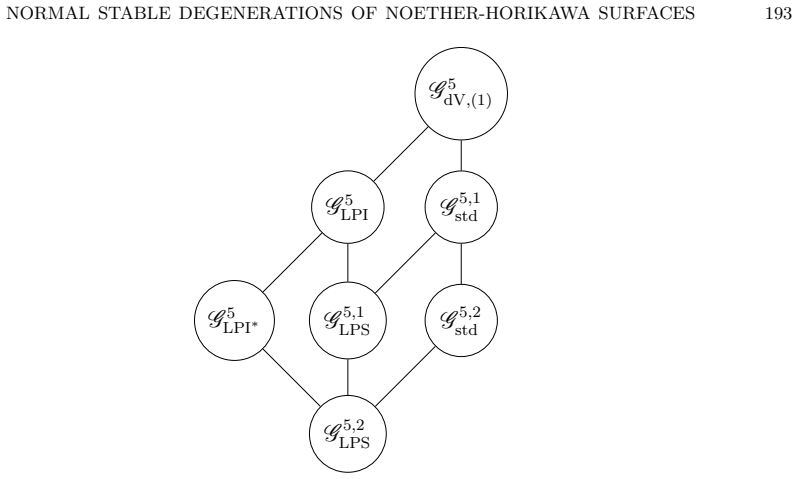
- The seven-family classification means that the boundary of the moduli space of Q-Gorenstein smoothable normal stable Horikawa surfaces is stratified in the explicit way the paper diagrams, with the degeneration behavior of Lee-Park and standard type surfaces depending on the geometric genus.
- The moduli space is connected exactly for $p_g=6$, $p_g=10$, or $p_g-2$ not divisible by $4$; in particular, the two Gieseker components for $p_g=10$ are joined through supersingular standard Horikawa surfaces.
- The list includes the first known stable Horikawa surface with a strictly lc singularity of type $(2,4,4)[3]$, constructed through the paper's recipe from an elliptic fibration with prescribed singular fibers.
- For $p_g\geq 4$, among non-Gorenstein klt Horikawa surfaces only those of Lee-Park type can be Q-Gorenstein smoothable, sharpening earlier classifications of the klt case.
Reading between the lines
- The same log Noether inequality and extended T-chain analysis should classify normal stable surfaces on the next line above the Horikawa line, namely surfaces with $K^2=2p_g-3$; the paper sketches this as its planned continuation.
- Anti-P-resolutions give a general technique for equivariant cusp smoothing when a finite group acts non-freely outside the singularity, a setting broader than the free-action cases treated in earlier deformation theory.
- The $p_g=10$ connectedness result reopens the Horikawa problem: the two Gieseker components can now be joined through lc degenerations, so the remaining question is whether such lc degenerations preserve diffeomorphism type in the same way that degenerations through T-singularities do.
- Because the good involution is unique on every smoothable normal stable Horikawa surface, the quotient-pair viewpoint is intrinsic rather than a choice: any smoothable surface must carry this symmetry, so no surface is missed by studying double covers of quotients.
Editorial analysis
A structured set of objections, weighed in public.
Referee Report
Summary. The paper classifies normal stable Horikawa surfaces (surfaces of general type with K^2 = 2p_g - 4) whose singularities are log canonical and Q-Gorenstein smoothable. The main theorem (Theorem 1.3) asserts that every such Q-Gorenstein smoothable surface falls into one of seven families: standard double covers of minimal degree surfaces; pg=4 Gorenstein surfaces with bicanonical double cover of an elliptic cone; Lee-Park type surfaces with two T-singularities; and four pg=3 configurations involving the T-singularity 1/50(1,29), the strictly lc singularity (2,2,2,2), and two 1/4(1,1) T-singularities. Theorem 1.4 reduces global Q-Gorenstein smoothability to equivariant smoothability of elliptic double cone singularities with respect to the good involution. The paper also describes the KSBA boundary strata (Theorem 1.14) and proves connectedness of the moduli space for pg=6, pg=10, and pg-2 not divisible by 4 (Theorem 1.17). The technical machinery includes a log Noether inequality, extended T-chains, good involutions, and anti-P-resolutions. The paper is very long (212 pages), with the classification and deformation proofs concentrated in Section 7, Section 9, and Appendices A-C.
Significance. If the classification is correct, it is a substantial advance: explicit descriptions of KSBA boundary strata for surface moduli are rare, and the paper gives a complete normal-locus boundary description for Horikawa surfaces except for one explicitly flagged supersingular pg=10 case. The reduction in Theorem 1.4 to local equivariant smoothability is clean and useful, and the anti-P-resolution machinery appears to be a new and potentially transferable tool. The paper is also honest about its limitations: Remark 1.2(2) states that existence is not verified for most candidates in the broader non-standard classification, and the pg=10 supersingular case is explicitly left partially open. The extensive case analysis is not mechanically verified, which sets a ceiling on confidence, but the parts I could check are careful in their attributions and caveats. The main weakness is a load-bearing gap in the proof of Proposition 5.7, on which the reduction to good involutions depends.
major comments (2)
- [Section 5.2, Proposition 5.7] The proof of Proposition 5.7 states: 'Let W° denote the image of X° under φ_{X°/C}. Then φ_{X°/C}: X° → W° is a double covering.' This is valid only for standard Horikawa surfaces. For a non-standard Horikawa surface, Definition 5.1 says the canonical linear system is composed with a pencil, so the relative canonical morphism over C\{0} has positive-dimensional generic fibers and one-dimensional image; it is not a finite double cover and does not define a covering involution σ°. The later portion of the proof treats the non-standard case, but it appears to assume the existence of the involution (for example, in forming W := X/σX and the fiberwise involution eσ) rather than constructing it from the smoothing family. Since Proposition 5.7 is the basis for the assertions in Section 1.4 and Theorem 1.3 that every Q-Gorenstein smoothable normal stable Horikawa surface admits a unique good involution, the reduction of the classification to surfaces with a good involution is incomplete as written.
- [Section 1.4 and Theorem 1.3] Section 1.4 asserts that every Q-Gorenstein smoothable normal stable Horikawa surface carries the good involution 'as the limit of the good involutions of smooth Horikawa surfaces.' For smooth non-standard Horikawa surfaces the relevant involution is the hyperelliptic involution of the canonical pencil, not the covering involution of the canonical map; the text does not prove that this involution extends to the limit in the singular family. This is not merely a presentation issue: if the extended involution fails to exist or is not the one induced by the smoothing, then the list in Theorem 1.3, which is obtained by interspersing the good-involution classification with the smoothability analysis, could miss a family. The authors should either supply a direct construction of σ for the non-standard case or prove separately that every Q-Gorenstein smoothing of a non-standard Horikawa surface is equivariant with respect to the hyperelliptic involution of the general fibers.
minor comments (4)
- [Throughout] There are several typographical errors: 'Quenstion' in Section 1.6, 'toransform' in the proof of Proposition 6.2, 'suffces' in Lemma 2.7, and the running title contains 'NOETHER-HORIKA W A' with a broken spacing. These should be corrected in the final version.
- [Notation 3.1(2)] The operation 'a, 2^{-1}, b' in a string is defined as a+b-2, but the example '[3,2^{-1},3] denotes [4]' is correct; however, the discussion would be clearer if the operation were described as a legal substring replacement rather than as a separate number inserted into the chain.
- [Figures 1-7] Several figures, especially Figures 2, 6, and 7, are difficult to read in the arXiv version because of small labels and dense decorations. Since the stratification results in Section 9 refer to these figures repeatedly, higher-resolution or vector versions would materially help the reader.
- [Remark 1.2(2)] The statement 'Except for a few cases, we do not verify the existence of a non-standard Horikawa surface whose set of non-Du Val singularities coincides with a given candidate' could be misunderstood as applying to Theorem 1.3. It applies to the broader classification Theorem 7.49; the text would be clearer if this distinction were repeated at the point of Theorem 7.49.
Circularity Check
The derivation chain is anchored to external classification and smoothing results; the good-involution reduction is a substantive proof step, not a circular definition, and the flagged non-standard case is a correctness concern rather than circularity.
full rationale
The paper's central claim, Theorem 1.3, is derived from Theorem 6.8 (quoted from Chen [32]) and Theorem 7.52, which in turn rests on the log Noether inequality (Theorem 4.2, adapted from [32]) and on the independent classification of non-standard surfaces (Theorem 7.49). The external anchors—Horikawa [76], Kollár–Shepherd-Barron [97], Wahl [125], Pinkham [124], and the KSBA framework [2, 72, 94]—do not depend on the conclusions of this paper. The notion of a good involution is introduced ad hoc (Definition 5.4), but the paper proves, rather than assumes, that every Q-Gorenstein smoothable Horikawa surface admits one (Proposition 5.7). Even if the proof of Proposition 5.7 is incomplete for non-standard surfaces, as the skeptic's objection suggests, that is a potential correctness gap, not a circular reduction: the statement is not equivalent to its inputs by construction. The internal forward reference to Theorem 7.42/7.44 is explicitly acknowledged in Remark 5.6 and is stated to be independent of the involution classification. The vanishing theorem of the second author [48] is used as a parameter-free external theorem whose assumptions do not include the target classification, so it does not constitute load-bearing self-citation. No fitted parameter is renamed as a prediction, no result is defined in terms of another result in the same paper, and no uniqueness claim is imported solely from the authors' prior work. I therefore find no significant circularity.
Assumptions & free parameters
free parameters (4)
- pg (geometric genus) =
integer, pg >= 3
- Type index d for standard Horikawa surfaces =
0 <= d <= min(pg-4, pg/2+1), pg-d even; type (d)' has d = pg-2
- Double cone singularity indices (k1, k2) =
k1, k2 >= 0 integers
- Kodaira fiber index n and blow-up count beta =
n >= 0, 0 <= beta <= n+8 (varies by case)
assumptions (7)
- standard math Log resolutions, discrepancy formalism, and the surface MMP for log pairs
- domain assumption Q-Gorenstein smoothable strictly lc rational surface singularities are exactly the four families (2,2,2,2)[b1..bn] with sum(bi-3) <= 3, (3,3,3)[b] with b=2,3,4, (2,4,4)[b] with b=2,3, and (2,3,6)[2]
- domain assumption A simple elliptic singularity of type Ell_b is smoothable if and only if b <= 9
- domain assumption The KSBA moduli functor is a proper Deligne-Mumford stack, and automorphism group schemes of stable surfaces are finite
- domain assumption Fujino's vanishing theorem for slc schemes [60] and the Z-positivity vanishing theorem of the second author [48]
- standard math Classification of minimal degree surfaces in projective space: P2, Hirzebruch surfaces, and cones over rational normal curves
- standard math Kodaira's classification of singular fibers and the canonical bundle formula for elliptic surfaces
invented entities (4)
-
Good involution (Definition 5.4)
independent evidence
-
Anti-P-resolution (Section 8.4, Definition 8.17, Theorem 8.21)
independent evidence
-
Extended T-chains and T-trains with P-admissibility (Definition 3.6)
independent evidence
-
Mild singularities and double cone singularities (Definitions 6.1 and 6.4)
independent evidence
Cite this review
Pith. "Pith review of Normal stable degenerations of Noether-Horikawa surfaces." pith.science (2026). https://pith.science/paper/AWAXN4SO
@misc{pith2026250717633,
  author       = {Pith},
  title        = {Pith review of: Normal stable degenerations of Noether-Horikawa surfaces},
  year         = {2026},
  howpublished = {\url{https://pith.science/paper/AWAXN4SO}},
  note         = {Machine review of arXiv:2507.17633}
}
abstract
We classify all normal stable Horikawa surfaces with only $\mathbb{Q}$-Gorenstein smoothable log canonical singularities. Furthermore, we provide a criterion for their global $\mathbb{Q}$-Gorenstein smoothability and describe the boundary strata of the moduli space of $\mathbb{Q}$-Gorenstein smoothable normal stable Horikawa surfaces.
Figures


Figures from the paper (9 more)




Reference graph
Works this paper leans on
-
[3]
Alexeev, Complete moduli in the presence of semiabelian group action, Ann
V. Alexeev, Complete moduli in the presence of semiabelian group action, Ann. of Math., (2), 155, no. 3 (2002), 611–708
2002
-
[1]
On the Gonality type invariants and the slope of a fibered $3$-fold
H. Akaike, On the Gonality type invariants and the slope of a fibered 3-fold, arXiv:2404.05216
-
[2]
Alexeev, Boundedness and K 2 for log surfaces, Internat
V. Alexeev, Boundedness and K 2 for log surfaces, Internat. J. Math., 5 (6), (1994), 779–810
1994
-
[4]
Alexeev, Kappa classes on KSBA spaces, Moduli, 2 (2025), e4
V. Alexeev, Kappa classes on KSBA spaces, Moduli, 2 (2025), e4
2025
-
[5]
Alexeev, A
V. Alexeev, A. Brunyate, P. Engel, Compactifications of moduli of elliptic K3 surfaces: stable pair and toroidal, Geom. Topol. 26 (2022) 3525–3588
2022
-
[6]
Compactifications of moduli spaces of K3 surfaces with a higher-order nonsymplectic automorphism
V. Alexeev, A. Deopurkar, C. Han. Compactifications of moduli spaces of K3 surfaces with a higher-order nonsymplectic automorphism, arXiv:2412.11256
-
[7]
Alexeev, P
V. Alexeev, P. Engel, Compact moduli of K3 surfaces, Ann. of Math. (2) 198, no. 2 (2023), 727-789
2023
-
[8]
Compactifications of moduli spaces of K3 surfaces with a nonsymplectic involution
V. Alexeev, P. Engel, Compactifications of moduli spaces of K3 surfaces with a nonsymplectic involution, arXiv:2208.10383
Show all 151 references
-
[9]
Alexeev, P
V. Alexeev, P. Engel, D. Z. Garza, L. Schaffler, Compact moduli of Enriques surfaces with a numerical polarization of degree 2, to appear in Nagoya Math. J
-
[10]
Alexeev, P
V. Alexeev, P. Engel, A. Thompson, Stable pair compactification of moduli of K3 surfaces of degree 2, J. Reine. Angew. Math. 799 (2023), 1–56
2023
-
[11]
Alexeev, X
V. Alexeev, X. Hu, Explicit compactifications of moduli spaces of secondary Burniat surfaces, arXiv:2309.11397
-
[12]
Alexeev, R
V. Alexeev, R. Pardini, Non-normal abelian covers, Compositio Math. 148 (2012), 1051–1084
2012
-
[13]
Alexeev, R
V. Alexeev, R. Pardini, Explicit compactifications of moduli spaces of Campedelli and Burniat surfaces, accepted by Annali della Scuola Normale Superiore di Pisa - Classe di Scienze, it is available online. DOI: 10.2422/2036-2145.202312 008
-
[14]
Anthes, Gorenstein stable surfaces with K 2 X = 2 and χ(OX ) = 4, Annali SNS di Pisa Vol
B. Anthes, Gorenstein stable surfaces with K 2 X = 2 and χ(OX ) = 4, Annali SNS di Pisa Vol. XXI, issue special (pp. 1137-1186) 2020
2020
-
[15]
Artin, Some numerical criteria for contractability of curves on algebraic surfaces
M. Artin, Some numerical criteria for contractability of curves on algebraic surfaces. Am. J. Math. 84 (1962), 485–496
1962
-
[16]
Ascher, D
K. Ascher, D. Bejleri, Moduli of weighted stable elliptic surfaces and invariance of log plurigenera, Proc. Lond. Math. Soc. (3) 122 (2021), no. 5, 617–677. With an appendix by G. Inchiostro
2021
-
[17]
Ascher and D
K. Ascher and D. Bejleri, Compact moduli of elliptic K3 surfaces. Geom. Topol., 27, (5) (2023), 1891–1946. NORMAL STABLE DEGENERATIONS OF NOETHER-HORIKA W A SURF ACES 213
2023
-
[18]
Ascher, D
K. Ascher, D. Bejleri, G. Inchiostro, Zs. Patakfalvi, Wall crossing for moduli of stable log pairs, Ann. of Math. (2) 198 no. 2 (2023), 825–866
2023
-
[19]
Ascher, K
K. Ascher, K. DeVleming, and Y. Liu, Wall crossing for K-moduli spaces of plane curves. Proc. Lond. Math. Soc. (3), 128(6):Paper No. e12615, 113, 2024
2024
-
[20]
Ascher, K
K. Ascher, K. DeVleming, Y. Liu, and X. Wang. Hassett–Keel Program in genus four. arXiv:2504.20312
-
[21]
Ashikaga and K
T. Ashikaga and K. Konno, Global and local properties of pencils of algebraic curves, in: Algebraic Geometry 2000 Azumino, S. Usui et al. eds, 1–49 Adv. Stud. Pure Math. 36, math. Soc. Japan, Tokyo, 2002
2000
-
[22]
Auroux, The canonical pencils on Horikawa surfaces, Geom
D. Auroux, The canonical pencils on Horikawa surfaces, Geom. Topol.(4), 10 (2006), 2173–2217
2006
-
[23]
M. A. Barja, Lower bounds of the slope of fibred threefolds, Internat. J. Math. 11 (2000), no 4, 461–491
2000
-
[24]
M. A. Barja, Generalized Clifford-Severi inequality and the volume of irregular varieties, Duke. Math. J 164 (2015), no 3, 541–568
2015
-
[25]
Barth, K
W. Barth, K. Hulek, C. Peters, and A. Van de Ven, Compact complex surfaces, second edition, Springer-Verlag, Berlin, 2004
2004
-
[26]
Behnke, J
K. Behnke, J. A. Christophersen, M-resolutions and deformations of quotient singularities, Amer. J. Math. 116 (1994), no.4, 881–903
1994
-
[27]
Bejleri, J
D. Bejleri, J. Foster, A. Fernandez Herrero, G. Inchiostro, S. Makarova, J. Zhao, Moduli of elliptic surfaces of Kodaira dimension one fibered over rational curves, arXiv:2407.05539
-
[28]
Catanese, Surfaces with K 2 = pg = 1, and their period mapping, in Algebraic Geometry, Lect
F. Catanese, Surfaces with K 2 = pg = 1, and their period mapping, in Algebraic Geometry, Lect. Notes in Math., 732 (1979), 1–29
1979
-
[29]
Catanese, The moduli and the global period mapping of surfaces with K 2 = pg = 1: A counter example to the global Torelli problem, Compositio Math., 41, (1980), no.3, 401–414
F. Catanese, The moduli and the global period mapping of surfaces with K 2 = pg = 1: A counter example to the global Torelli problem, Compositio Math., 41, (1980), no.3, 401–414
1980
-
[30]
Catanese, Generalized Kummer surfaces and differentiable invariants of Noether-Horikawa surfaces
F. Catanese, Generalized Kummer surfaces and differentiable invariants of Noether-Horikawa surfaces. I, Manifolds and geometry (Pisa, 1993), 132–177. Sympos. Math., XXXVI Cambridge University Press, Cambridge, 1996
1993
-
[31]
Catanese, S
F. Catanese, S. Manfredini, The orbifold fundamental group of Persson-Noether-Horikawa sur- faces, Geometric theory of singular phenomena in partial differential equations (Cortona, 1995), 71–90. Sympos. Math., XXXVIII Cambridge University Press, Cambridge, 1998
1995
-
[32]
Chen, The minimal and next minimal volumes of normal KSBA stable surfaces with pg ≥ 2, arXiv:2308.01473
J. Chen, The minimal and next minimal volumes of normal KSBA stable surfaces with pg ≥ 2, arXiv:2308.01473
-
[33]
J. A. Chen, M. Chen, and C. Jiang, The Noether inequality for algebraic 3-folds, with an appendix by J. Koll´ ar, Duke Math. J.169 (9) (2020), 1603–1645
2020
-
[34]
J. A. Chen, M. Chen, and C. Jiang, Addendum to ”The Noether inequality for algebraic 3-folds”, Duke Math. J. 169 (11) (2020), 2199–2204
2020
-
[35]
M. Chen, Y. Hu, and C. Jiang, On the moduli spaces of canonical threefolds with small genera and minimal volumes, arXiv:2407.01276
-
[36]
Ciliberto, R
C. Ciliberto, R. Pardini, On some boundary divisors in the moduli spaces of stable Horikawa surfaces with K 2 = 2pg − 3, arXiv:2502.16322
-
[37]
Codogni, L
G. Codogni, L. Tasin and F. Viviani, Slope inequalities for KSB-stable and K-stable families, Proc. London Math Soc. (3) 126 (2023), 1394–1465
2023
-
[38]
Cornalba and J
M. Cornalba and J. Harris, Divisor classes associated to families of stable varieties, with applica- tions to the moduli space of curves, Annales Sci. ´Ecole Norm. Sup. (4) 21 (1988), 455–475
1988
-
[39]
Coughlan, M
S. Coughlan, M. Franciosi, R. Pardini, J. Rana, and S. Rollenske, On T-divisors and intersections in the moduli space of stable surfaces M1,3. J. Lond. Math. Soc. (2), 107 (2023), 750–776
2023
-
[40]
Coughlan, M
S. Coughlan, M. Franciosi, R. Pardini, and S. Rollenske, Degeneration of Hodge structures on I- surfaces, to appear in the volume ”Current developments in Hodge theory. Proceedings of Hodge theory at IMSA”, Simons Symposia series, Springer
-
[41]
Coughlan, Y
S. Coughlan, Y. Hu, R. Pignatelli, and T. Zhang, Threefolds on the Noether line and their moduli spaces, 2024. arXiv:2409.17847. 214 HIROTO AKAIKE, MAKOTO ENOKIZONO, MASAFUMI HATTORI, AND YUKI KOTO
2024
-
[42]
Cox, J.B
D.A. Cox, J.B. Little, H.K. Schenck, Toric varieties, Graduate Studies in Mathematics 124, American Mathematical Society, 2011
2011
-
[43]
Deligne, D
P. Deligne, D. Mumford, The irreducibility of the space of curves of given genus, Publ. Math. Inst. Hautes ´Etudes Sci. 36 (1969), 75–109
1969
-
[44]
Demazure, Surfaces de del Pezzo II–V, in S´ eminaire sur les Singularit´ es des Surfaces, Lecture Notes in Math
M. Demazure, Surfaces de del Pezzo II–V, in S´ eminaire sur les Singularit´ es des Surfaces, Lecture Notes in Math. 777, Springer, 1980, 23–69
1980
-
[45]
DeVleming, L
K. DeVleming, L. Ji, P. Kennedy-Hunt, and M. H. Quek, The K-moduli space of a family of conic bundle threefolds, arXiv:2403.09557
-
[46]
DeVleming, D
K. DeVleming, D. Stapleton, Smooth limits of plane curves of prime degree and Markov numbers, J. ´Ec. polytech. Math. 11 (2024), 683–731
2024
-
[47]
Engel, A proof of Looijenga’s conjecture via integral-affine geometry, J
P. Engel, A proof of Looijenga’s conjecture via integral-affine geometry, J. Differential Geom. 109 (3), (2018) 467-495
2018
-
[48]
Enokizono, An integral version of Zariski decompositions on normal surfaces, Eur
M. Enokizono, An integral version of Zariski decompositions on normal surfaces, Eur. J. Math. 10 (2024), no. 38
2024
-
[49]
Enokizono, Slope inequality of fibered surfaces, Morsification conjecture and moduli of curves, arXiv:2307.04311
M. Enokizono, Slope inequality of fibered surfaces, Morsification conjecture and moduli of curves, arXiv:2307.04311
-
[50]
Enriques, Le Superficie Algebriche
F. Enriques, Le Superficie Algebriche. Zanichelli, Bologna (1949)
1949
-
[51]
Evans, A
J. Evans, A. Simonetti, G. Urz´ ua, Tropical methods for stable octic double planes, arXiv:2405.02735
-
[52]
Fantechi, et
B. Fantechi, et. al. Fundamental Algebraic Geometry: Grothendieck’s FGA Explained. Amer. Math. Soc. 2005
2005
-
[53]
Figueroa, J
F. Figueroa, J. Rana and G. Urz´ ua, Optimal bounds for many T-singularities in stable surfaces, arXiv:2308.05624
-
[54]
Fintushel, R
R. Fintushel, R. Stern, Rational blowdowns of smooth 4-manifolds, J. Differential Geom. 46 (1997), no.2, 181–235
1997
-
[55]
Franciosi, R
M. Franciosi, R. Pardini, and S. Rollenske, Gorenstein stable surfaces with K 2 X = 1 and pg > 0. Math. Nachr., 290 (2017), 794–814
2017
-
[56]
Franciosi, R
M. Franciosi, R. Pardini, J. Rana and S. Rollenske. I-surfaces with one T-singularity. Bollettino dell’Unione Matematica Italiana, 15 (2022), 173–190
2022
-
[57]
Friedman, A new proof of the global Torelli theorem for K3 surfaces, Ann
R. Friedman, A new proof of the global Torelli theorem for K3 surfaces, Ann. of Math. 120 (1984), 237-269
1984
-
[58]
Friedman, P
R. Friedman, P. Griffiths, Deformations of I-surfaces with elliptic singularities, arXiv:2402.17677
-
[59]
Friedman, P
R. Friedman, P. Griffiths, Limiting mixed Hodge structures associated to I-surfaces with simple elliptic singularities, arXiv:2408.02062
-
[60]
Fujino, Fundamental theorems for semi log canonical pairs, Algebraic Geometry 1 (2) (2014) 194–228
O. Fujino, Fundamental theorems for semi log canonical pairs, Algebraic Geometry 1 (2) (2014) 194–228
2014
-
[61]
Fujino, Some remarks on the minimal model program for log canonical pairs, J
O. Fujino, Some remarks on the minimal model program for log canonical pairs, J. Math. Sci. Univ. Tokyo. 22 (2015), 149–192
2015
-
[62]
Fujino, Foundations of the minimal model program, MSJ Mem
O. Fujino, Foundations of the minimal model program, MSJ Mem. 35, (Mathematical Society of Japan, 2017)
2017
-
[63]
Fujino, Semipositivity theorems for moduli problems, Ann
O. Fujino, Semipositivity theorems for moduli problems, Ann. of Math., 187 (2018), no. 3, 639– 665
2018
-
[64]
Gallardo, G
P. Gallardo, G. Pearlstein, L. Schaffler, Z. Zhang, Unimodal singularities and boundary divisors in the KSBA moduli of a class of Horikawa surfaces, Math. Nachr. 297, No. 2, (2024) 595–628
2024
-
[65]
Gieseker, Global Moduli for Surfaces of General Type, Invent
D. Gieseker, Global Moduli for Surfaces of General Type, Invent. Math. 47 (1977), 233-282
1977
-
[66]
D. Greb, S. Kebekus, S. Kov´ acs, Extension theorems for differential forms and Bogomolov- Sommese vanishing on log canonical varieties, Compositio Math. 146 (1) (2010), 193–219
2010
-
[67]
Greco, C
S. Greco, C. Traverso, On seminormal schemes, Compositio Math. 40, no. 3 (1980), 325–365
1980
-
[68]
Griffiths, Topics in Transcendental Algebraic Geometry, Ann
P. Griffiths, Topics in Transcendental Algebraic Geometry, Ann. Math. Studies, Princeton Univ. Press, Princeton, NJ, (1984). NORMAL STABLE DEGENERATIONS OF NOETHER-HORIKA W A SURF ACES 215
1984
-
[69]
Gross, P
M. Gross, P. Hacking and S. Keel, Mirror symmetry for log Calabi-Yau surfaces I, Publ. Math. Inst. Hautes ´Etudes Sci., 122 (2015), 65-168
2015
-
[70]
Hacking, Compact moduli of plane curves, Duke Math
P. Hacking, Compact moduli of plane curves, Duke Math. J. 124 (2004), 213–257
2004
-
[71]
Hacking, Y
P. Hacking, Y. Prokhorov, Smoothable del Pezzo surfaces with quotient singularities, Compositio Math. 146 (2010), 169–192
2010
-
[72]
C. D. Hacon, J. M cKernan, C. Xu, Boundedness of moduli of varieties of general type, J. Eur. Math. Soc. 20 (2018), no. 4, 865–901
2018
-
[73]
Hartshorne, Algebraic geometry, Graduate Texts in Mathematics, No
R. Hartshorne, Algebraic geometry, Graduate Texts in Mathematics, No. 52. Springer-Verlag, New York-Heidelberg, 1977
1977
-
[74]
Hashizume, A note on lc-trivial fibrations, Bull
K. Hashizume, A note on lc-trivial fibrations, Bull. London Math. Soc. 56 (2024), no. 2, 551-565
2024
-
[75]
Horikawa, On deformations of quintic surfaces, Invent
E. Horikawa, On deformations of quintic surfaces, Invent. Math. 31 (1975), 43–85
1975
-
[76]
Horikawa, Algebraic surfaces of general type with small c2 1, I
E. Horikawa, Algebraic surfaces of general type with small c2 1, I. Ann. of Math. 104 (1976), no. 2, 357–387
1976
-
[77]
Horikawa, Algebraic surfaces of general type with small c2 1, II, Invent
E. Horikawa, Algebraic surfaces of general type with small c2 1, II, Invent. Math. 37 (1976), no. 2, 121–155
1976
-
[79]
III. Invent. Math. 47 (1978), no. 3, 209–248
1978
-
[81]
IV. Invent. Math. 50 (1978), no. 2, 103–128
1978
-
[82]
Horikawa, Algebraic surfaces of general type with small c2
E. Horikawa, Algebraic surfaces of general type with small c2
-
[83]
V. J. Fac. Sci. Univ. Tokyo Sect. IA Math., 28, (1981), 745–755
1981
-
[84]
Horikawa, On algebraic surfaces with pencils of curves of genus 2, In: Complex Analysis and Algebraic Geometry, a volume dedicated to K
E. Horikawa, On algebraic surfaces with pencils of curves of genus 2, In: Complex Analysis and Algebraic Geometry, a volume dedicated to K. Kodaira, Tokyo and Cambridge, Iwanami Shoten Publishers and Cambridge University Press, (1977), 79–90
1977
-
[85]
Hu and T
Y. Hu and T. Zhang, Fibered varieties over curves with low slope and sharp bounds in dimension three, J. Algebraic Geom. 30 (2021), 57–95
2021
-
[86]
Hu and T
Y. Hu and T. Zhang, Relative Severi inequality for fibrations of maximal Albanese dimension over curves, Forum of Math. Sigma 10 e45 (2022), 1–31
2022
-
[87]
Illusie, Complexe Cotangent et Deformations, I,Lecture Notes in Math
L. Illusie, Complexe Cotangent et Deformations, I,Lecture Notes in Math. 239, Springer, Berlin, 1971
1971
-
[88]
Illusie, Complexe Cotangent et Deformations, II,Lecture Notes in Math
L. Illusie, Complexe Cotangent et Deformations, II,Lecture Notes in Math. 283, Springer, Berlin, 1972
1972
-
[89]
Ishii, Introduction to singularities, Springer, 2018
S. Ishii, Introduction to singularities, Springer, 2018
2018
-
[90]
Jiang, Equivariant smoothing of cusp singularities, arXiv:2302.00637
Y. Jiang, Equivariant smoothing of cusp singularities, arXiv:2302.00637
-
[91]
Kawakita, Inversion of adjunction on log canonicity
M. Kawakita, Inversion of adjunction on log canonicity. Invent. Math. 167 (2007), 129-133
2007
-
[92]
Kawakita, Complex Algebraic Threefolds, Cambridge Studies in Advanced Mathematics 209, Cambridge University Press, 2023
M. Kawakita, Complex Algebraic Threefolds, Cambridge Studies in Advanced Mathematics 209, Cambridge University Press, 2023
2023
-
[93]
Kawamata, Crepant blowings-up of three-dimensional canonical singularities and its application to degenerations of surfaces
Y. Kawamata, Crepant blowings-up of three-dimensional canonical singularities and its application to degenerations of surfaces. Ann. of Math. 127, no. 1 (1988), 93–163
1988
-
[94]
Kobayashi, On the Noether inequality for 3-folds, J
M. Kobayashi, On the Noether inequality for 3-folds, J. Math. Soc. Japan 44 (1992), 145–156
1992
-
[95]
S. Keel, K. Matsuki, and J. M cKernan, Log abundance theorem for threefolds, Duke Math. J. 75 (1994), 99–119
1994
-
[96]
Koll´ ar,Singularities of the Minimal Model Program,Cambridge Tracts in Mathematics 200
J. Koll´ ar,Singularities of the Minimal Model Program,Cambridge Tracts in Mathematics 200. Cambridge University Press, Cambridge, 2015
2015
-
[97]
Koll´ ar,Families of varieties of general type, Cambridge Tracts in Mathematics 231
J. Koll´ ar,Families of varieties of general type, Cambridge Tracts in Mathematics 231. Cambridge University Press, Cambridge, 2024
2024
-
[98]
Koll´ ar and S
J. Koll´ ar and S. Mori, Classification of Three-Dimensional Flips, J. Amer. Math. Soc., 5 (1992), 533–703
1992
-
[99]
Koll´ ar and S
J. Koll´ ar and S. Mori,Birational geometry of algebraic varieties, With the collaboration of C. H. Clemens and A. Corti. Translated from the 1998 Japanese original. Cambridge Tracts in Mathe- matics, 134, Cambridge University Press, Cambridge, 1998. 216 HIROTO AKAIKE, MAKOTO ...
1998
-
[100]
Koll´ ar and N
J. Koll´ ar and N. Shepherd-Barron, Threefolds and deformations of surface singularities, Invent. Math. 91 (1988), 299–338
1988
-
[101]
J. Koll´ ar et al., Flips and abundance for algebraic threefolds, Papers from the Second Summer Seminar on Algebraic Geometry held at the University of Utah, Salt Lake City, Utah, August
-
[102]
V. I. Kynev, An example of a simply connected surface of general type for which the local Torelli theorem does not hold, C. R. Acad. Bulgare Sci. 30 (1977), no. 3, 323–325
1977
-
[103]
Konno, Non-hyperelliptic fibrations of small genus and certain irregular canonical surfaces, Ann
K. Konno, Non-hyperelliptic fibrations of small genus and certain irregular canonical surfaces, Ann. Sc. Norm. Sup. Pisa ser. IV, 20 (1993), 575–595
1993
-
[104]
Konno, Chain-connected component decomposition of curves on surfaces, J
K. Konno, Chain-connected component decomposition of curves on surfaces, J. Math. Soc. Japan 62 (2010), 467–486
2010
-
[105]
Kov´ acs, Zs
S. Kov´ acs, Zs. Patakfalvi, Projectivity of the moduli space of stable log-varieties and subaddi- tivity of log-Kodaira dimension. J. Amer. Math. Soc. 30 (2017), 959–1021
2017
-
[106]
Liu, Stable degenerations of surfaces isogenous to a product II, Trans
W. Liu, Stable degenerations of surfaces isogenous to a product II, Trans. Amer. Math. Soc. 364 (2012), no. 5, 2411–2427
2012
-
[107]
Lee, Numerical bounds for degenerations of surfaces of general type, Internat
Y. Lee, Numerical bounds for degenerations of surfaces of general type, Internat. J. Math. 10 (1999), 79–92
1999
-
[108]
Y. Lee, J. Park, A construction of Horikawa surface via Q-Gorenstein smoothings, Math. Z. 267 (2011), no.1–2, 15–25
2011
-
[109]
Liu, The minimal volume of surfaces of log general type with positive geometric genus, arXiv:1706.03716
W. Liu, The minimal volume of surfaces of log general type with positive geometric genus, arXiv:1706.03716
-
[110]
Manetti, Normal degenerations of the complex projective plane, J
M. Manetti, Normal degenerations of the complex projective plane, J. Reine Angew. Math. 419 (1991), 89–118
1991
-
[111]
W. Liu, S. Rollenske, Geography of Gorenstein stable log surfaces, Trans. Amer. Math. Soc. 368 (2016), 2563-2588
2016
-
[112]
Y. Liu, C. Zhou. Non-proportional wall crossing for K-stability, arXiv:2412.15725
-
[113]
Looijenga, Rational surfaces with an anticanonical cycle
E. Looijenga, Rational surfaces with an anticanonical cycle. Ann. of Math. (2) 114 (1981), no. 2, 267–322
1981
-
[114]
Monreal, J
V. Monreal, J. Negrete, G. Urz´ ua, Classification of Horikawa surfaces with T-singularities, arXiv:2410.02943
-
[115]
Manetti, On the moduli space of diffeomorphic algebraic surfaces
M. Manetti, On the moduli space of diffeomorphic algebraic surfaces. Invent. Math. 143, (2001), 29–76
2001
-
[116]
Miranda, The moduli of Weierstrass fibrations overP1, Math
R. Miranda, The moduli of Weierstrass fibrations overP1, Math. Ann. 255 (1981), no. 3, 379–394
1981
-
[117]
F. Meng, Z. Zhuang, MMP for locally stable families and wall crossing for moduli of stable pairs, arXiv:2311.01319
-
[118]
Nagata, On rational surfaces I, Mem
M. Nagata, On rational surfaces I, Mem. Coll. Sci. Univ. Kyoto, Ser. A, 32 (1960), 351-370
1960
-
[119]
Moriwaki, Relative Bogomolov’s inequality and the cone of positive divisors on the moduli space of stable curves, J
A. Moriwaki, Relative Bogomolov’s inequality and the cone of positive divisors on the moduli space of stable curves, J. Amer. Math. Soc. 11 no.3 (1998), 569–600
1998
-
[120]
Mumford, Abelian varieties, Oxford university press, (1974)
D. Mumford, Abelian varieties, Oxford university press, (1974)
1974
-
[121]
Murakami, Infinitesimal Torelli theorem for surfaces of general type with certain invariants, Manuscripta Math
M. Murakami, Infinitesimal Torelli theorem for surfaces of general type with certain invariants, Manuscripta Math. 118 (2005), 151–160
2005
-
[122]
Pardini, The Severi inequality K 2 ≥ 4χ for surfaces of maximal Albanese dimension, Invent
R. Pardini, The Severi inequality K 2 ≥ 4χ for surfaces of maximal Albanese dimension, Invent. Math. 159 (2005), 669–672
2005
-
[123]
Ohno, Some inequalities for minimal fibrations of surfaces of general type over curves, J
K. Ohno, Some inequalities for minimal fibrations of surfaces of general type over curves, J. Math. Soc. Japan, 44 (1992), no 4, 643–666
1992
-
[124]
Olsson, Algebraic spaces and stacks
M. Olsson, Algebraic spaces and stacks. Colloquium Publications 62, American Mathematical Society (2016)
2016
-
[125]
Pardini, On the period map for abelian covers of projective varieties, Annali della Scuola Normale Superiore di Pisa - Classe di Scienze 26 (4) (1998), 719–735
R. Pardini, On the period map for abelian covers of projective varieties, Annali della Scuola Normale Superiore di Pisa - Classe di Scienze 26 (4) (1998), 719–735
1998
-
[126]
Rana, A boundary divisor in the moduli space of stable quintic surfaces
J. Rana, A boundary divisor in the moduli space of stable quintic surfaces. Int. J. Math, 28, No. 4 (2017)
2017
-
[127]
Pearlstein, Z
G. Pearlstein, Z. Zhang, A generic global Torelli theorem for certain Horikawa surfaces, Algebraic Geometry 6 (2), (2019) 132–147
2019
-
[128]
Pinkham, Deformations of algebraic varieties with Gm-actions, Ast´ erisque,20, (1974)
H. Pinkham, Deformations of algebraic varieties with Gm-actions, Ast´ erisque,20, (1974). NORMAL STABLE DEGENERATIONS OF NOETHER-HORIKA W A SURF ACES 217
1974
-
[129]
Prokhorov, Log-canonical degenerations of del Pezzo surfaces in Q-Gorenstein families, Kyoto J
Y. Prokhorov, Log-canonical degenerations of del Pezzo surfaces in Q-Gorenstein families, Kyoto J. Math. 59, no.4 (2019), 1041–1073
2019
-
[130]
Reid, Problems on pencils of small genus, Preprint (1990) (see his home page)
M. Reid, Problems on pencils of small genus, Preprint (1990) (see his home page)
1990
-
[131]
J. Rana, S. Rollenske, Standard stable Horikawa surfaces, Algebraic Geometry 11 (4) (2024), 569–592
2024
-
[132]
J. Rana, G. Urz´ ua, Optimal bounds for T-singularities in stable surfaces, Adv. Math.345 (2019), 814–844
2019
-
[133]
Reyes and G
J. Reyes and G. Urz´ ua, Exotic surfaces, Math. Ann. 391 (2025), no. 1, 227–254
2025
-
[134]
van Opstall, Stable degenerations of surfaces isogenous to a product of curves, Proc
M. van Opstall, Stable degenerations of surfaces isogenous to a product of curves, Proc. Amer. Math. Soc. 134 (2006), no. 10, 2801–2806
2006
-
[135]
Reider, On the Infinitesimal Torelli Theorem for certain irregular surfaces of general type, Math
I. Reider, On the Infinitesimal Torelli Theorem for certain irregular surfaces of general type, Math. Ann. 280 (1988), 285–302
1988
-
[136]
Reider, Infinitesimal Torelli theorem for double coverings of surfaces of general type
I. Reider, Infinitesimal Torelli theorem for double coverings of surfaces of general type. (English summary), J. Algebraic Geom. 14, no. 4 (2005), 691–704
2005
-
[137]
Rollenske, Compact moduli for certain Kodaira fibrations, Ann
S. Rollenske, Compact moduli for certain Kodaira fibrations, Ann. Sc. Norm. Super. Pisa Cl. Sci. (5) 9 (2010), no. 4, 851–874
2010
-
[138]
Tevelev, G
J. Tevelev, G. Urz´ ua, Categorical aspects of the Koll´ ar–Shepherd-Barron correspondence, arXiv: 2204.13225
-
[139]
Simonetti, Z/2Z-Equivariant smoothings of cusp singularities, arXiv:2201.02871
A. Simonetti, Z/2Z-Equivariant smoothings of cusp singularities, arXiv:2201.02871
-
[140]
Steenbrink, Mixed Hodge structures associated with isolated singularities, in Singularities, Arcata 1981, Proc
J. Steenbrink, Mixed Hodge structures associated with isolated singularities, in Singularities, Arcata 1981, Proc. Sympos. Pure Math. 40, A.M.S. (1983), vol. 2, 513–536
1983
-
[141]
Stevens, Degenerations of elliptic curves and equations for cusp singularities, Math
J. Stevens, Degenerations of elliptic curves and equations for cusp singularities, Math. Ann. 311 (1998), 199–222
1998
-
[142]
Usui, Local Torelli theorem for some nonsingular weighted complete intersections, Proc
S. Usui, Local Torelli theorem for some nonsingular weighted complete intersections, Proc. of the Int. Symp. on Algebraic Geometry (Kyoto Univ., Kyoto, 1977) (Kinokuniya Book Store, Tokyo, 1978), 723–734
1977
-
[143]
The authors of stacks project, Stacks project
-
[144]
Tsunoda and D
S. Tsunoda and D. Q. Zhang. Noether’s inequality for noncomplete algebraic surfaces of general type. Publ. Res. Inst. Math. Sci., 28(1):21–38, 1992
1992
-
[145]
Urz´ ua, N
G. Urz´ ua, N. Vilches, On wormholes in the moduli space of surfaces. Algebr. Geom.9 (1), (2022), 39–68
2022
-
[146]
Xu, K-stability of Fano varieties, New Mathematical Monographs 50 Cambridge University Press, Cambridge, 2025
C. Xu, K-stability of Fano varieties, New Mathematical Monographs 50 Cambridge University Press, Cambridge, 2025
2025
-
[147]
Usui, The problem of Torelli type, Sugaku (3), 49 (1997), 235–252
S. Usui, The problem of Torelli type, Sugaku (3), 49 (1997), 235–252
1997
-
[148]
Wahl, Smoothings of normal surface singularities, Topology 20 (1981), 219–246
J. Wahl, Smoothings of normal surface singularities, Topology 20 (1981), 219–246
1981
-
[149]
Xiao, Fibred algebraic surfaces with low slope, Math
G. Xiao, Fibred algebraic surfaces with low slope, Math. Ann. 276 (1987), 449–466
1987
-
[151]
Zhao, Log canonical models for moduli of genus six curves and K-stability, arXiv:2304.13259
J. Zhao, Log canonical models for moduli of genus six curves and K-stability, arXiv:2304.13259
-
[152]
Zhou, On wall-crossing for K-stability, Adv
C. Zhou, On wall-crossing for K-stability, Adv. Math. 413 (2023), Paper No. 108857
2023
-
[153]
Zhou, On the Shape of the K-semistable Domain and Wall Crossing for K-stability
C. Zhou, On the Shape of the K-semistable Domain and Wall Crossing for K-stability. Peking Math. J. (2024). 218 HIROTO AKAIKE, MAKOTO ENOKIZONO, MASAFUMI HATTORI, AND YUKI KOTO Institute of Mathematics, Tohoku University,6-3 Aramaki Aza, Aoba, Aoba W ard, Sendai, Miyagi 980-85...
2024
-
[1991]
Soci´ et´ e Math´ ematique de France, Paris, 1992
Ast´ erisque No.211 (1992). Soci´ et´ e Math´ ematique de France, Paris, 1992
1992
Reviewed August 6, 2026 · model on record in the stance chip above.
Discussion (0). Continue with ORCID to comment.