REVIEW 4 major objections 3 minor 1 cited by
Frame-Based Zero-Shot Semantic Channel Equalization for AI-Native Communications
T0 review · 4 major / 3 minor · reviewed 2026-08-06 · deepseek-v4-flash
Pith's one-line read A receiver can equalize an unseen AI encoder's latent space with zero training.
desk verdict Solid engineering extension of relative representations with a load-bearing unitary-alignment assumption that is only tested on near-homogeneous ViT encoders; deserves review but needs broader experiments and toned-down claims. read the letter →
The pith
A machine-rendered reading of the paper's core claim, the machinery that carries it, and where it could break.
The reading
What carries the argument
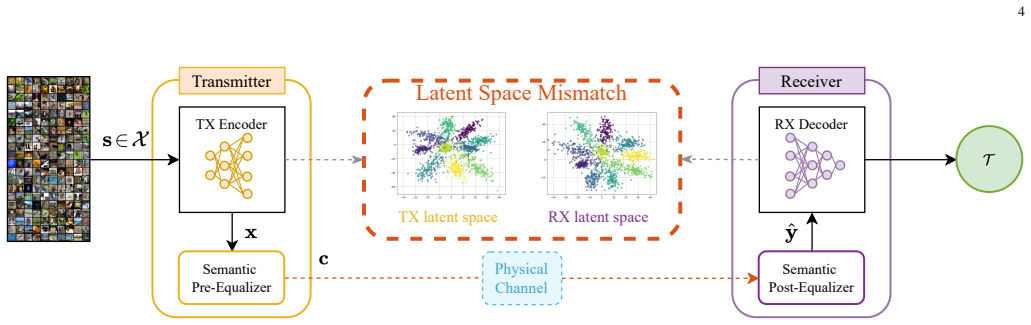
The load-bearing object is the Parseval frame equalizer: a pair of private analysis and synthesis operators built from anchor representations, one on each side of the link. The transmitter sends the inner-product code $\mathbf{F}\mathbf{x} = \{\langle \mathbf{x}, \mathbf{f}_n \rangle\}_n$, and the receiver forms $\sum_n \langle \mathbf{x}, \mathbf{f}_n \rangle \mathbf{g}_n$ with its own frame vectors. The Parseval property, enforced by whitening any frame via $\tilde{\mathbf{F}} = \mathbf{F}(\mathbf{F}^H\mathbf{F})^{-1/2}$ so that the frame operator becomes the identity, makes the reconstruction operator numerically stable and reduces the pseudoinverse to the adjoint. The relational consistency condition of Remark 4, namely the existence of a single global angle-preserving linear map between TX and RX latent spaces, carries the semantic alignment, while the frame structure carries the compression and redundancy trade-off.
What would settle it
Take two encoders whose latent spaces are known not to be related by a global unitary or angle-preserving map, such as a CNN transmitter and a ViT receiver trained on different data, and measure the maximum discrepancy $|\langle \mathbf{x}, \mathbf{f}_n \rangle - \langle \mathbf{y}, \mathbf{g}_n \rangle|$ over the shared anchors; if this discrepancy is large and PFE's reconstruction accuracy on the RX decoder falls far below the supervised UPE baseline, the zero-shot equalization claim is refuted.
Extended reading notes
Core claim
The paper claims that semantic channel equalization can be done zero-shot at the receiver via Eq. (9): given the transmitted code $\mathbf{c} = \mathbf{F}\mathbf{x}$ with coefficients $[\mathbf{c}]_n = \langle \mathbf{x}, \mathbf{f}_n \rangle$ computed against the TX's private Parseval frame $\{\mathbf{f}_n\}$, the RX synthesizes $\hat{\mathbf{y}} \approx \sum_n [\mathbf{c}]_n \mathbf{g}_n$ using only its own local frame $\{\mathbf{g}_n\}$. If the two encoders are related by a global angle-preserving linear transformation $T$ such that $\langle \mathbf{x}, \mathbf{f}_n \rangle \approx \langle \mathbf{y}, \mathbf{g}_n \rangle$, then $\hat{\mathbf{y}}$ lies in the RX latent space and is semantically aligned, so a fixed RX decoder can perform the downstream task. This removes the need for paired semantic pilots, joint training, and relative decoders. The paper further claims that when $N < d$ the operator becomes an orthogonal projection onto the anchor span, giving compression, while when $N > d$ the Parseval redundancy gives robustness, and that quantizing the transmitted coefficients adds a rate-control degree of freedom. The reported experiments support the claim that PFE's zero-shot accuracy approaches the supervised UPE baseline across three image classification datasets.
Load-bearing premise
The receiver's reconstruction is only as good as the assumption that the two independently trained encoders are related by a single global angle-preserving linear map; if their latent spaces differ by more than that, the shared coefficients do not correspond and the equalizer cannot align them.
Editorial extensions
If this is right
- Without any paired data, a receiver can reconstruct a usable latent vector from an unseen encoder's frame coefficients, enabling interoperability across multi-vendor networks without exchanging models.
- The same operator handles both compression and expansion: $N < d$ projects onto the anchor span, while $N > d$ spreads coefficients across a redundant basis, giving a rate-reliability knob at the semantic layer.
- Quantization of the transmitted coefficients becomes an additional optimization degree of freedom, letting the system trade payload size against task accuracy.
- The Lyapunov-based per-slot policy keeps long-term average latency and accuracy constraints while minimizing power consumption, adapting coefficient count and quantization level to channel and load conditions.
- PFE's zero-shot accuracy nearly matches the supervised unitary Procrustes equalizer on CIFAR-10, CIFAR-100, and Tiny-ImageNet with ViT-family encoders.
Reading between the lines
- Editorial inference: If the relational consistency of Eq. (8) holds broadly, the PFE identity turns latent-space alignment into a purely local receiver computation, so the next practical bottleneck becomes the overhead of transmitting and maintaining the shared anchor set, which the paper itself lists as future work.
- Editorial inference: Because inner-product similarity ignores vector norms, encoders that differ by a global scaling may still align; this suggests PFE could extend to settings with different latent dimensions, though the reported experiments only cover equal-dimension ViT latents.
- Editorial inference: A natural stress test is heterogeneous architecture families, such as a CNN transmitter and a ViT receiver; if the global angle-preserving premise fails there, the zero-shot property would be limited to the ViT family rather than general heterogeneous encoders.
- Editorial inference: The frame perspective suggests replacing fixed data-anchors with learned or channel-adaptive frames, turning anchor selection into an optimization over the frame itself rather than a subsampling of the data distribution.
Editorial analysis
A structured set of objections, weighed in public.
Referee Report
Summary. The paper proposes the Parseval Frame Equalizer (PFE), a zero-shot semantic channel equalization scheme for AI-native communications. The transmitter projects its latent vector onto a frame of anchor-derived directions and transmits the resulting coefficients; the receiver reconstructs a compatible latent vector in its own space by synthesizing with its own anchor frame, without access to the transmitter encoder, joint training, or additional optimization. The authors extend this idea to joint alignment and compression, study the effect of quantization, and embed the scheme in a Lyapunov-based dynamic resource allocation framework for multi-agent edge inference. Numerical experiments on CIFAR-10, CIFAR-100, and Tiny-ImageNet compare PFE with a plain frame equalizer (FE) and a supervised unitary Procrustes equalizer (UPE), reporting that zero-shot PFE nearly matches supervised UPE, and that the dynamic resource allocator meets long-term latency and accuracy constraints while minimizing power.
Significance. The core idea of using Parseval frames to make relative-representation inversion perfectly conditioned is clean, and the observation that a carefully chosen anchor frame can replace pseudoinversion by a simple synthesis operation is a useful engineering contribution. The reported zero-shot accuracy being close to a supervised Procrustes upper bound is an encouraging empirical result, and the Lyapunov resource-allocation formulation with closed-form per-slot subproblems is a competent and relevant extension. The main caveat is that the central alignment premise is assumed rather than verified for genuinely heterogeneous encoder families, and several technical derivations contain errors that need correction; if those are fixed and the alignment premise is tested more broadly, the paper could be a solid contribution to semantic communications.
major comments (4)
- [Section III-A, Eqs. (8)–(10)] The entire zero-shot reconstruction in Eq. (9) rests on the approximate relational consistency (8), yet (8) is assumed, not derived. Remark 4 correctly identifies this as equivalent to postulating a single global angle-preserving linear map T between the TX and RX latent spaces, but the paper provides no independent evidence that independently trained encoders satisfy this premise, and the experiments only pair ViT-family encoders (ViT-S/16, ViT-B/16, ViT-B/32-CLIP) against a ViT-B/ResNet50 receiver, all ImageNet-pretrained. The claim of alignment across heterogeneous AI-native agents is therefore not demonstrated outside this restricted family; an experiment with a structurally different encoder (e.g., a pure ResNet, ConvNeXt, or MLP-Mixer) and an explicit verification of the unitary consistency of Eq. (10) is needed. In addition, Eq. (10) as written is scale-inconsistent: if Tx = λQx with Q unitary, then ⟨Ty,Tg_n⟩ = |λ|²⟨y,g_n⟩, so the equality requires |λ|=1, and ordinary ℓ2-normalization of the latent vectors does not remove this factor unless the inner product is cosine-normalized and T is applied to normalized vectors; this should be clarified.
- [Section III-B, Eq. (12)] The compression derivation is algebraically inconsistent. With F the N×d analysis matrix, \tilde F = S^{†1/2}F does not imply \tilde F \tilde F^H = I_N; \tilde F \tilde F^H = S^{†1/2}FF^H S^{†1/2}, which is not the identity in general. Furthermore, the matrix F^H(F^H F)^†F is the orthogonal projection onto the row space of F and equals I_d only if F has full row rank, not full column rank as stated; for N < d this is impossible. The subsequent identification of F with \tilde F in Eq. (13) should be made explicit, or the whitening step should be rederived, because as written Eq. (13) does not follow from the preceding definitions.
- [Contributions and Section III] The paper claims that the frame design 'achieves an optimal rate–reliability trade-off in the semantic channel,' but no rate–reliability problem is formulated and no optimality theorem, converse, or bound is provided. The numerical results show trade-offs, not optimality. Either remove the word 'optimal' or supply a formal optimization statement with proof.
- [Section IV-C.4] The assertion that the greedy integer search is a C-additive approximation is unsupported. Boundedness of the objective and feasible set alone does not imply that a coordinate-descent greedy procedure stays within a constant additive gap of the global optimum; such a result would require a property such as submodularity (or an explicit bound on the greedy regret), which is not given. Please either prove the claim or soften it to a heuristic statement.
minor comments (3)
- [Section IV-C, Eq. (26)] The Lyapunov function sums Q_n^2 over n = 1, ..., N, but there are K virtual queues Q_k for k = 1, ..., K; the sum should be over k = 1, ..., K.
- [Algorithm 2] Algorithm 2 lists γ as an input parameter, but γ never appears in the pseudocode or in the surrounding text; it should be removed or used.
- [Section IV-D] The text refers to 'vit base patch16 244' while Table I lists 'vit base patch16 224'; the typo should be corrected.
Circularity Check
No significant circularity: Eq. (9) is a conditional Parseval reconstruction under the explicitly stated relative-representation alignment premise (8), and that premise is empirically tested against independent downstream accuracy.
full rationale
The derivation chain is: Eq. (7) defines the transmitted semantic code as TX frame coefficients; Eq. (8) states the relative-representation alignment assumption (<x, f_n> ≈ <y, g_n>); Eq. (9) then applies the RX synthesis operator to those coefficients. If the RX frame is Parseval, Prop. 2 gives y = Σ <y, g_n> g_n, so substituting (8) into (9) yields the reconstruction. This is a conditional mathematical derivation, not a circular one: Eq. (9) is a consequence of the stated assumption plus the Parseval identity, and the paper explicitly labels the alignment capability as 'unknown a priori' in Remark 4. The empirical sections do not use the target result as an input; they measure downstream classification accuracy on CIFAR-10/100 and Tiny-ImageNet using a decoder trained on RX absolute representations, which is an external benchmark for whether the unitary-alignment premise holds for the tested ViT-family encoders. The comparison with supervised unitary Procrustes equalization is also independent: UPE fits a unitary map from paired pilots, whereas PFE uses no pilots, so the reported closeness is an empirical result rather than an identity forced by construction. Self-citations appear ([1] for the dynamic optimization framework and [43] for prototypical anchors), but they are not load-bearing for the core equalizer identity, which rests on the external relative-representations framework [37] and standard frame theory [46], [47]. No fitted parameter is renamed as a prediction, no uniqueness theorem is imported from the authors' prior work, and no ansatz is smuggled in via citation. The main weakness is that the unitary-alignment premise is only tested across ViT-family encoders, but that is a generality/correctness risk, not circularity.
Assumptions & free parameters
free parameters (4)
- Lyapunov penalty weight V =
grid-searched per (L_bar, G_bar); value not reported
- Queue step sizes epsilon_z, epsilon_q =
grid-searched; values not reported
- Bandwidth exponents alpha, beta =
grid-searched; values not reported
- Prototypical anchor matrix A (clustering and support size M) =
N x d matrix from data; M and clustering details not reported
assumptions (5)
- domain assumption Cosine-similarity relative representations are approximately equal across encoders that differ by an angle-preserving transformation (Eq. (2), Remark 1).
- domain assumption A single global unitary (or scaled orthogonal) transformation T aligns the TX and RX latent spaces (Eq. (10), Remark 4).
- standard math Finite-dimensional frame reconstruction and Parseval whitening formulas (Propositions 1-3).
- domain assumption Capacity-achieving digital link with perfect CSI and Shannon-capacity transmit power (Eq. (15)).
- standard math Lyapunov stochastic optimization framework (Neely [44]) provides mean-rate stability and drift-plus-penalty guarantees.
Cite this review
Pith. "Pith review of Frame-Based Zero-Shot Semantic Channel Equalization for AI-Native Communications." pith.science (2026). https://pith.science/paper/HIN3HOA6
@misc{pith2026250717835,
  author       = {Pith},
  title        = {Pith review of: Frame-Based Zero-Shot Semantic Channel Equalization for AI-Native Communications},
  year         = {2026},
  howpublished = {\url{https://pith.science/paper/HIN3HOA6}},
  note         = {Machine review of arXiv:2507.17835}
}
read the original abstract
In future AI-native wireless networks, the presence of mismatches between the latent spaces of independently designed and trained deep neural network (DNN) encoders may impede mutual understanding due to the emergence of semantic channel noise. This undermines the receiver's ability to interpret transmitted representations, thereby reducing overall system performance. To address this issue, we propose the Parseval Frame Equalizer (PFE), a zero-shot, frame-based semantic channel equalizer that aligns latent spaces of heterogeneous encoders without requiring system retraining. PFE enables dynamic signal compression and expansion, mitigating semantic noise while preserving performance on downstream tasks. Building on this capability, we introduce a dynamic optimization strategy that coordinates communication, computation, and learning resources to balance energy consumption, end-to-end (E2E) latency, and task performance in multi-agent semantic communication scenarios. Extensive simulations confirm the effectiveness of our approach in maintaining semantic consistency and meeting long-term constraints on latency and accuracy under diverse and time-varying network conditions.
Figures


Figures from the paper (5 more)


Forward citations
Cited by 1 Pith paper
-
Compositional Semantic Communication for Physical AI: Category Theory Meets Game Theory
A category-theoretic and game-theoretic framework for compositional semantic communication is proposed, but its key measure is defined via learned functions and its existence theorems rest on unverified assumptions.
Reference graph
Works this paper leans on
-
[42]
Latent space translation via inverse relative projection,
V . Maiorca, L. Moschella, M. Fumero, F. Locatello, and E. Rodol `a, “Latent space translation via inverse relative projection,” arXiv preprint arXiv:2406.15057, 2024
arXiv 2024
-
[1]
Dynamic Relative Representations for Goal-Oriented Semantic Communications
S. Fiorellino, C. Battiloro, E. Calvanese Strinati, and P. Di Lorenzo, “Dynamic relative representations for goal-oriented semantic communi- cations,” arXiv preprint arXiv:2403.16986 , 2024
work page Pith review arXiv 2024
-
[2]
Survey on 6g frontiers: Trends, applications, require- ments, technologies and future research,
C. D. Alwis, A. Kalla, Q.-V . Pham, P. Kumar, K. Dev, W.-J. Hwang, and M. Liyanage, “Survey on 6g frontiers: Trends, applications, require- ments, technologies and future research,” IEEE Open Journal of the Communications Society, vol. 2, pp. 836–886, 2021
work page 2021
-
[3]
A new communication paradigm: From bit accuracy to semantic fidelity,
G. Shi, D. Gao, X. Song, J. Chai, M. Yang, X. Xie, L. Li, and X. Li, “A new communication paradigm: From bit accuracy to semantic fidelity,” arXiv preprint arXiv:2101.12649 , 2021
arXiv 2021
-
[4]
Towards a new internet for the year 2030 and beyond,
R. Li, “Towards a new internet for the year 2030 and beyond,” Proc. 3rd Annu. ITU IMT-2020/5G Workshop Demo Day , pp. 1–21, 2018
work page 2020
-
[5]
A vision of 6g wireless systems: Applications, trends, technologies, and open research problems,
W. Saad, M. Bennis, and M. Chen, “A vision of 6g wireless systems: Applications, trends, technologies, and open research problems,” IEEE network, vol. 34, no. 3, pp. 134–142, 2019
2019
-
[6]
A mathematical theory of communication,
C. E. Shannon, “A mathematical theory of communication,” The Bell system technical journal , vol. 27, no. 3, pp. 379–423, 1948
1948
-
[7]
6G networks: Beyond shannon towards semantic and goal-oriented communications,
E. Calvanese Strinati and S. Barbarossa, “6G networks: Beyond shannon towards semantic and goal-oriented communications,” Computer Net- works, vol. 190, p. 107930, 2021
work page 2021
Show all 58 references
-
[8]
Goal-oriented and semantic communication in 6G AI-native networks: The 6G-goals approach,
E. Calvanese Strinati, P. Di Lorenzo et al., “Goal-oriented and semantic communication in 6G AI-native networks: The 6G-goals approach,” arXiv preprint arXiv:2402.07573 , 2024
2024 arXiv
-
[9]
Rethinking modern communication from semantic coding to semantic communication,
K. Lu, Q. Zhou, R. Li, Z. Zhao, X. Chen, J. Wu, and H. Zhang, “Rethinking modern communication from semantic coding to semantic communication,” IEEE Wireless Communications , vol. 30, no. 1, pp. 158–164, 2022
2022
-
[10]
Deep learning enabled semantic communication systems,
H. Xie, Z. Qin, G. Y . Li, and B.-H. Juang, “Deep learning enabled semantic communication systems,” IEEE Transactions on Signal Pro- cessing, vol. 69, pp. 2663–2675, 2021
2021
-
[11]
Beyond transmitting bits: Context, semantics, and task-oriented communications,
D. G ¨und¨uz, Z. Qin, I. E. Aguerri, H. S. Dhillon, Z. Yang, A. Yener, K. K. Wong, and C.-B. Chae, “Beyond transmitting bits: Context, semantics, and task-oriented communications,” IEEE Journal on Selected Areas in Communications, vol. 41, no. 1, pp. 5–41, 2022
2022
-
[12]
Semantic communication: A survey on research landscape, challenges, and future directions,
T. Getu, G. Kaddoum, and M. Bennis, “Semantic communication: A survey on research landscape, challenges, and future directions,” Authorea Preprints, 2023
2023
-
[13]
Goal-oriented communications for the IoT: System design and adaptive resource optimization,
P. Di Lorenzo, M. Merluzzi, F. Binucci, C. Battiloro, P. Banelli, E. Cal- vanese Strinati, and S. Barbarossa, “Goal-oriented communications for the IoT: System design and adaptive resource optimization,” IEEE Internet of Things Magazine , vol. 6, no. 4, pp. 26–32, 2023
2023
-
[14]
Goal-oriented communications for the iot and application to data compression,
C. Zhang, H. Zou, S. Lasaulce, W. Saad, M. Kountouris, and M. Bennis, “Goal-oriented communications for the iot and application to data compression,” IEEE Internet of Things Magazine , vol. 5, no. 4, pp. 58– 63, 2023
2023
-
[15]
The role of fidelity in goal-oriented semantic communication: A rate distortion approach,
P. A. Stavrou and M. Kountouris, “The role of fidelity in goal-oriented semantic communication: A rate distortion approach,” IEEE Transac- tions on Communications , 2023
2023
-
[16]
Multi- user goal-oriented communications with energy-efficient edge resource management,
F. Binucci, P. Banelli, P. Di Lorenzo, and S. Barbarossa, “Multi- user goal-oriented communications with energy-efficient edge resource management,” IEEE Transactions on Green Communications and Net- working, vol. 7, no. 4, pp. 1709–1724, 2023
2023
-
[17]
6g goal-oriented communications: How to coexist with legacy systems?
M. Merluzzi, M. C. Filippou, L. Gomes Baltar, M. D. Mueck, and E. Calvanese Strinati, “6g goal-oriented communications: How to coexist with legacy systems?” in Telecom, vol. 5, no. 1. MDPI, 2024, pp. 65– 97
2024
-
[18]
Learning task-oriented communication for edge inference: An information bottleneck approach,
J. Shao, Y . Mao, and J. Zhang, “Learning task-oriented communication for edge inference: An information bottleneck approach,” IEEE Journal on Selected Areas in Communications, vol. 40, no. 1, pp. 197–211, 2021
2021
-
[19]
Semantics-empowered communication for networked intelligent systems,
M. Kountouris and N. Pappas, “Semantics-empowered communication for networked intelligent systems,” IEEE Communications Magazine , vol. 59, no. 6, pp. 96–102, 2021
2021
-
[20]
Wireless edge machine learning: Resource allocation and trade-offs,
M. Merluzzi, P. Di Lorenzo, and S. Barbarossa, “Wireless edge machine learning: Resource allocation and trade-offs,” IEEE Access , vol. 9, pp. 45 377–45 398, 2021
2021
-
[21]
Deep task-based quantization,
N. Shlezinger and Y . C. Eldar, “Deep task-based quantization,” Entropy, vol. 23, no. 1, p. 104, 2021
2021
-
[22]
Dynamic resource allocation for multi-user goal-oriented communications at the wireless edge,
F. Binucci, P. Banelli, P. Di Lorenzo, and S. Barbarossa, “Dynamic resource allocation for multi-user goal-oriented communications at the wireless edge,” in 2022 30th European Signal Processing Conference (EUSIPCO). IEEE, 2022, pp. 697–701
2022
-
[23]
Adaptive resource optimization for edge inference with goal- oriented communications,
——, “Adaptive resource optimization for edge inference with goal- oriented communications,” EURASIP J. on Advances in Signal Proc. , no. 1, p. 123, 2022
2022
-
[24]
Language-oriented communication with semantic coding and knowledge distillation for text-to-image generation,
H. Nam, J. Park, J. Choi, M. Bennis, and S.-L. Kim, “Language-oriented communication with semantic coding and knowledge distillation for text-to-image generation,” in ICASSP 2024-2024 IEEE International Conference on Acoustics, Speech and Signal Processing (ICASSP) . IEEE, 202...
2024
-
[25]
Generative model based highly efficient semantic communication approach for im- age transmission,
T. Han, J. Tang, Q. Yang, Y . Duan, Z. Zhang, and Z. Shi, “Generative model based highly efficient semantic communication approach for im- age transmission,” in ICASSP 2023-2023 IEEE International Conference on Acoustics, Speech and Signal Processing (ICASSP) . IEEE, 2023, pp. 1–5
2023
-
[26]
Semantic communications based on adaptive generative models and information bottleneck,
S. Barbarossa, D. Comminiello, E. Grassucci, F. Pezone, S. Sardellitti, and P. Di Lorenzo, “Semantic communications based on adaptive generative models and information bottleneck,” IEEE Communications Magazine, vol. 61, no. 11, pp. 36–41, 2023
2023
-
[27]
Generative semantic communication: Diffusion models beyond bit recovery,
E. Grassucci, S. Barbarossa, and D. Comminiello, “Generative semantic communication: Diffusion models beyond bit recovery,” arXiv preprint arXiv:2306.04321, 2023
2023 arXiv
-
[28]
Personalized neural speech codec,
I. Jang, H. Yang, W. Lim, S. Beack, and M. Kim, “Personalized neural speech codec,” in ICASSP 2024-2024 IEEE International Conference on Acoustics, Speech and Signal Processing (ICASSP) . IEEE, 2024, pp. 991–995
2024
-
[29]
Dif- fusion models for audio semantic communication,
E. Grassucci, C. Marinoni, A. Rodriguez, and D. Comminiello, “Dif- fusion models for audio semantic communication,” in ICASSP 2024- 2024 IEEE International Conference on Acoustics, Speech and Signal Processing (ICASSP). IEEE, 2024, pp. 13 136–13 140
2024
-
[30]
Wireless image re- trieval at the edge,
M. Jankowski, D. G ¨und¨uz, and K. Mikolajczyk, “Wireless image re- trieval at the edge,” IEEE Journal on Selected Areas in Communications, vol. 39, no. 1, pp. 89–100, 2020
2020
-
[31]
Semantic communications: Overview, open issues, and future research directions,
X. Luo, H.-H. Chen, and Q. Guo, “Semantic communications: Overview, open issues, and future research directions,” IEEE Wireless Communi- cations, vol. 29, no. 1, pp. 210–219, 2022
2022
-
[32]
Manifold alignment without correspon- dence
C. Wang and S. Mahadevan, “Manifold alignment without correspon- dence.” in IJCAI, vol. 2, 2009, p. 3
2009
-
[33]
The pyramid match kernel: Discriminative classification with sets of image features,
K. Grauman and T. Darrell, “The pyramid match kernel: Discriminative classification with sets of image features,” in Tenth IEEE International Conference on Computer Vision (ICCV’05) Volume 1 , vol. 2. IEEE, 2005, pp. 1458–1465
2005
-
[34]
Feature correspondence via graph matching: Models and global optimization,
L. Torresani, V . Kolmogorov, and C. Rother, “Feature correspondence via graph matching: Models and global optimization,” in Computer Vision–ECCV 2008: 10th European Conference on Computer Vision, Marseille, France, October 12-18, 2008, Proceedings, Part II 10 . Springer, 2008...
2008
-
[35]
Semantic channel equalizer: Mod- elling language mismatch in multi-user semantic communications,
M. Sana and E. Calvanese Strinati, “Semantic channel equalizer: Mod- elling language mismatch in multi-user semantic communications,” in IEEE Global Communications Conference (GLOBECOM). IEEE, 2023, pp. 2221–2226
2023
-
[36]
Soft partition- ing of latent space for semantic channel equalization,
T. Huttebraucker, M. Sana, and E. Calvanese Strinati, “Soft partition- ing of latent space for semantic channel equalization,” arXiv preprint arXiv:2405.20085, 2024
2024 arXiv
-
[37]
Relative representations enable zero-shot latent space com- munication,
L. Moschella, V . Maiorca, M. Fumero, A. Norelli, F. Locatello, and E. Rodol `a, “Relative representations enable zero-shot latent space com- munication,” arXiv preprint arXiv:2209.15430 , 2022
2022 arXiv
-
[38]
Zero-shot stitching in reinforcement learning using relative representations,
A. P. Ricciardi, V . Maiorca, L. Moschella, and E. Rodol `a, “Zero-shot stitching in reinforcement learning using relative representations,” in Sixteenth European Workshop on Reinforcement Learning , 2023
2023
-
[39]
From bricks to bridges: Product of invariances to enhance latent space communication,
I. Cannistraci, L. Moschella, M. Fumero, V . Maiorca, and E. Rodol `a, “From bricks to bridges: Product of invariances to enhance latent space communication,” in The Twelfth International Conference on Learning Representations, 2023
2023
-
[40]
From charts to atlas: Merging latent spaces into one,
D. Crisostomi, I. Cannistraci, L. Moschella, P. Barbiero, M. Ciccone, P. Li`o, and E. Rodol `a, “From charts to atlas: Merging latent spaces into one,” CoRR, 2023
2023
-
[41]
Asif: Coupled data turns unimodal models to multimodal without training,
A. Norelli, M. Fumero, V . Maiorca, L. Moschella, E. Rodola, and F. Locatello, “Asif: Coupled data turns unimodal models to multimodal without training,” Advances in Neural Information Processing Systems , vol. 36, pp. 15 303–15 319, 2023
2023
-
[43]
Relative representations of latent spaces enable efficient semantic channel equalization,
T. H ¨uttebr¨aucker, S. Fiorellino, M. Sana, P. Di Lorenzo, and E. Cal- vanese Strinati, “Relative representations of latent spaces enable efficient semantic channel equalization,” arXiv preprint arXiv:2411.19719, 2024
2024 arXiv
-
[44]
M. J. Neely, Stochastic Network Optimization with Application to Communication and Queueing Systems . Morgan & Claypool Publ., 2010
2010
-
[45]
Latent communication in artificial neural networks,
L. Moschella, “Latent communication in artificial neural networks,” arXiv preprint arXiv:2406.11014 , 2024. 15
2024 arXiv
-
[46]
S. F. Waldron, An introduction to finite tight frames . Springer, 2018
2018
-
[47]
Han, Frames for undergraduates
D. Han, Frames for undergraduates . American Mathematical Soc., 2007, vol. 40
2007
-
[48]
J. C. Gower and G. B. Dijksterhuis, Procrustes problems . Oxford University Press, USA, 2004, vol. 30
2004
-
[49]
Ten pairs to tag- multilingual pos tagging via coarse mapping between embeddings
Y . Zhang, D. Gaddy, R. Barzilay, and T. Jaakkola, “Ten pairs to tag- multilingual pos tagging via coarse mapping between embeddings.” Association for Computational Linguistics, 2016
2016
-
[50]
Learning bilingual word embed- dings with (almost) no bilingual data,
M. Artetxe, G. Labaka, and E. Agirre, “Learning bilingual word embed- dings with (almost) no bilingual data,” in Proceedings of the 55th Annual Meeting of the Association for Computational Linguistics (Volume 1: Long Papers), 2017, pp. 451–462
2017
-
[51]
Towards optimal transport with global invariances,
D. Alvarez-Melis, S. Jegelka, and T. S. Jaakkola, “Towards optimal transport with global invariances,” in The 22nd International Conference on Artificial Intelligence and Statistics . PMLR, 2019, pp. 1870–1879
2019
-
[52]
R. A. Horn and C. R. Johnson, Matrix analysis. Cambridge university press, 2012
2012
-
[53]
A generalized solution of the orthogonal procrustes problem,
P. H. Sch ¨onemann, “A generalized solution of the orthogonal procrustes problem,” Psychometrika, vol. 31, no. 1, pp. 1–10, 1966
1966
-
[54]
Processor design for portable systems,
T. D. Burd and R. W. Brodersen, “Processor design for portable systems,” Journal of VLSI signal processing systems for signal, image and video technology , vol. 13, no. 2, pp. 203–221, 1996
1996
-
[55]
Brochard, V
L. Brochard, V . Kamath, J. Corbal ´an, S. Holland, W. Mittelbach, and M. Ott, Energy-efficient computing and data centers . John Wiley & Sons, 2019
2019
-
[56]
S. P. Boyd and L. Vandenberghe, Convex optimization . Cambridge university press, 2004
2004
-
[57]
Pytorch image models,
R. Wightman, “Pytorch image models,” https://github.com/rwightman/ pytorch-image-models, 2019
2019
-
[58]
Hugging face’s tiny-imagenet repository,
“Hugging face’s tiny-imagenet repository,” https://huggingface.co/ datasets/zh-plus/tiny-imagenet, accessed: 07/08/2024
2024
Reviewed August 6, 2026 · model on record in the stance chip above.
Discussion (0). Sign in to comment.