REVIEW 4 major objections 6 minor 64 references
Unlock the Potential of Fine-grained LLM Serving via Dynamic Module Scaling
T0 review · 4 major / 6 minor · reviewed 2026-08-06 · deepseek-v4-flash
Pith's one-line read Fine-grained module-level scaling lets an LLM serving system track fluctuating traffic by replicating and migrating individual decoder layers, cutting cost by over 46% while holding availability.
desk verdict A genuinely new scaling granularity with a plausible system, but the evaluation's unspecified GPU counts and unfair baselines make the headline gains unreliable; worth a serious referee, not acceptance as-is. read the letter →
The pith
A machine-rendered reading of the paper's core claim, the machinery that carries it, and where it could break.
The reading
What carries the argument
The central mechanism is module-level replication and migration, implemented as pre- and post-hook data redirection so that the original model graph is untouched. Replication duplicates selected decoder layers on other devices, adding scatter and all-gather only at the boundaries of the replicated sequence; migration moves a layer, a projection, or the KV cache, letting compute-heavy modules (attention and FFN) and memory-heavy modules (KV cache) be placed on devices that match their resource profiles. The auto-scaling controller wraps these primitives in a generalized Amdahl-style speedup estimator $S_{\mathrm{homo}}(P) = 1/(\gamma + (1-\gamma)/n \cdot \sum_{i=1}^n 1/p_i)$ and a continuity-preserving greedy scale-up search, with a three-phase scale-down fallback that goes from migration to replica eviction to batch-size reduction.
What would settle it
Count the GPUs actually used per logical instance in the Section 6.2 single-instance experiments; if CoCoServe's instance spans more A100s than the baseline's one, re-running the same workload with identical GPU counts and observing whether the 14%-75% latency and 1.16x-4x throughput gaps persist would settle the claim.
Extended reading notes
Core claim
The central claim is that scaling at the module level changes the economics of LLM serving. CoCoServe copies a subset of a model's decoder layers onto other GPUs to create partial data parallelism, splitting batches across replicas while keeping most layers sequential; it also migrates layers, projection matrices, or KV caches to redistribute compute and memory pressure. The paper's measurements attribute to this mechanism a 17x reduction in OOM occurrence, SLO attainment held to the paper's threshold up to roughly 50 RPS, a memory footprint only about 53.5% of a 4-instance baseline deployment (hence the 46% cost reduction), and consistent latency and throughput advantages over both standard serving baselines across 13B and 70B models.
Load-bearing premise
The reported efficiency gains assume CoCoServe and the baselines are compared under equal GPU resources, and the paper never states how many GPUs each configuration uses in the single-instance evaluation.
Editorial extensions
If this is right
- Autoscaling no longer needs a spare full model: replicating a handful of decoder layers onto a partially idle GPU can absorb a workload spike at sub-second timescales.
- A single migrated layer or KV cache can be enough to pull a serving instance back from the OOM cliff, extending the request rate at which SLOs hold.
- Deployments can be right-sized to a fraction of a model, so GPU fragments that would otherwise be idle become usable capacity; at the measured scale this is a greater-than-46% memory and cost reduction for near-equivalent performance.
- Because the primitives are hook-based and operate without modifying the model architecture, the mechanism can be layered onto existing serving engines that already provide continuous batching.
- The speedup model implies a predictable trade-off curve among replication depth, parallelism degree, and communication overhead, which a controller can search at runtime instead of committing to a static parallelism plan.
Reading between the lines
- The same primitives could support multi-tenant packing: several logical models could share one GPU by co-locating complementary modules, something the paper's single-cluster evaluation does not measure.
- The per-module compute and memory classification suggests a natural next experiment: on a heterogeneous cluster, route compute-heavy modules to fast devices and memory-heavy modules to memory-rich devices; the paper states heterogeneous-device compatibility but does not test it.
- The reported 0.3-second operation time implies the control loop could run far faster than typical instance-level autoscalers, possibly adapting to bursty traffic within one or two scheduling intervals; a trace-driven study of burst recovery time would make this explicit.
- The Amdahl-style model could be inverted to estimate the marginal value of each additional replica, turning the continuity heuristic into a principled marginal-gain ranking that also accounts for heterogeneous device speeds.
Editorial analysis
A structured set of objections, weighed in public.
Referee Report
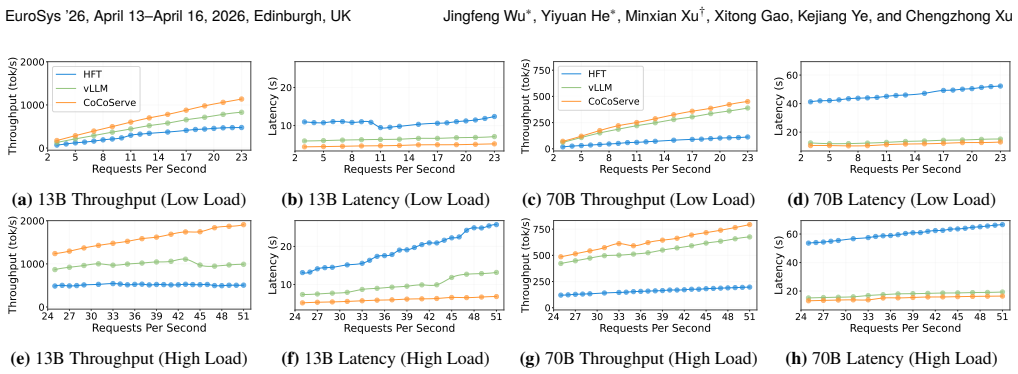
Summary. The manuscript proposes CoCoServe, an elastic LLM serving system that performs fine-grained module-level replication and migration of decoder layers, projections, and KV caches across GPUs, together with an auto-scaling controller based on a speedup model and a graduated scale-down algorithm. The paper claims sub-second scaling operations, a 46% cost reduction, 14%-75% latency reduction, and 1.16x-4x throughput improvements over Hugging Face Transformers (HFT) and vLLM on LLaMA-13B and LLaMA-70B under request rates from 3 to 61 RPS.
Significance. If the reported results hold under fair resource accounting, module-level scaling is a promising complement to instance-level autoscaling: it can exploit idle resource fragments, mitigate SLO violations and OOM failures, and reduce operational cost. The paper contributes a concrete system design, open-source code, operation-level cost measurements, and an extensive RPS-sweep evaluation. However, the central efficiency claims currently hinge on an unstated GPU allocation across configurations, and the speedup model has a structural monotonicity issue that makes the scale-up algorithm's greedy condition vacuous. These issues must be resolved before the headline advantages can be accepted.
major comments (4)
- [§6.2, Fig. 8; §6.1] The paper never states how many GPUs each configuration uses. Figure 8's caption claims a single LLaMA-13B and LLaMA-70B instance deployed on an A100 GPU, but a BF16 LLaMA-70B has roughly 140 GB of weights, which exceeds one A100-40GB GPU, and Section 3.2 describes layer replication experiments on 4 NVIDIA A100 GPUs. The reported 14%-75% latency reduction and 1.16x-4x throughput gains are only meaningful if CoCoServe and the baselines use equal GPU resources; as written, the advantages could reflect additional hardware rather than module scaling. Please report exact GPU counts, tensor/pipeline/data parallelism settings, per-device memory usage, and any CPU offload for every configuration in Sections 6.2 and 6.3.
- [§6.3, Fig. 10] The multi-instance cost comparison is not apples-to-apples. The 46% cost reduction is computed by comparing CoCoServe's 2 instances (64,015 MiB) against HFT's 4 instances (119,573 MiB), but the paper does not state whether CoCoServe's 2 logical instances span all 4 GPUs while HFT's 2 instances span only 2 GPUs. If CoCoServe occupies all 4 GPUs, the cost claim collapses and the comparison should instead credit CoCoServe with 4 GPU instances. Please provide a per-configuration table of GPU counts and per-GPU memory, and include a matched-resource comparison in which all systems have the same total GPU allocation.
- [§4.1, Eq. (4); Algorithm 1] The speedup model has a built-in monotonicity problem: for any 0<γ<1, decreasing any p_i strictly decreases ∥1⊘P∥1 and hence strictly increases S_homo(P), so Algorithm 1's condition sp > sp_best is satisfied by every admissible replica addition. This makes the greedy filter vacuous and does not encode the continuity-versus-communication trade-off that Section 4.1 motivates. The constant γ is a free parameter and is never calibrated against the Section 3.2 measurements; the paper also does not explain how Eq. (4) is derived from Eq. (3). Please calibrate γ or replace the objective with one that penalizes non-contiguous replication, and show that the resulting algorithm can reject some candidate strategies.
- [§6.1, Figs. 6, 8, 10] Although Section 6.1 states that each request rate was repeated five times, no error bars, confidence intervals, or variance statistics are shown for any throughput or latency point. Several reported differences are small (for example, 13.65% latency advantage over vLLM for the 70B model under low load), so without variance information it is impossible to assess whether these differences are statistically meaningful. Please report the full distribution or at least standard deviations for all repeated measurements.
minor comments (6)
- [Table 1] The entry 'ffn.gate/up/dwon_proj' contains a typo; it should be 'down_proj'.
- [Fig. 9] The metric 'External Frag.' is not defined; please state how memory fragmentation is measured and why the unused memory in HFT and vLLM is classified as external fragmentation.
- [§6.3] The text states that CoCoServe delivers 'approximately 90% of its performance' compared with the 4-instance HFT configuration, but the reported differences are 11.28% latency and 9.59% throughput; please clarify what the 90% figure refers to.
- [Reference [39]] Reference [39] still contains the placeholder arXiv identifier 2402.XXXXX; a complete citation is needed.
- [§6.2 and Algorithm 2] The thresholds T_up and T_down described in Section 5 and the SLO threshold θ used in Algorithm 2 are never given values in the experimental setup; please state them.
- [§3.2, Fig. 6] The baseline configuration in Fig. 6 is described as 'a completely unmodified serial execution environment without any parallelism or layer replication,' but it is unclear whether it runs on one GPU or on all four A100 GPUs; please clarify.
Circularity Check
No significant circularity: the speedup model is an explicit Amdahl-style model stated before evaluation, the headline results are measured against external baselines, and the only self-citations are peripheral.
full rationale
CoCoServe's derivation chain is not circular in the sense defined here. Section 3.2 empirically measures the effect of layer replication on throughput and latency; Section 4.1 then builds an explicit model with W(P), T(P), and S(P), using Amdahl's law as an external starting point. The model contains no parameter fitted to the replication measurements that it is later said to 'align with.' Equation 4 is monotonically increasing in the p_i by construction (adding a replica always reduces the denominator), but the paper does not present this monotonicity as an empirical prediction; it states that the formulation is 'consistent' with the Section 3.2 observations, which is a validation statement, not a fitted-input-as-prediction step. Algorithm 1's greedy check is a design choice based on the model, and it is the end-to-end measurements of Section 6 (latency, throughput, memory, cost against HFT and vLLM) that carry the headline claims. Those measurements are external and not produced by Equation 4. The author self-citations [16] and [51] support prior SLO-related work and batching/scheduling mechanisms inherited from backend engines; they are not load-bearing, and no uniqueness theorem or prior result by the same authors is invoked to force the design. The serious resource-accounting ambiguity in Section 6.2 (a BF16 LLaMA-70B instance 'deployed on an A100 GPU' cannot fit in 40 GB, and the GPU count per configuration is never fixed) is a correctness and fairness threat to the experimental comparison, but it is not a circularity under the required definitions: it does not make the claimed results equivalent to the paper's inputs by definition or by self-citation.
Assumptions & free parameters
free parameters (5)
- gamma (configuration coefficient) =
not given (input to Algorithm 1)
- T_up and T_down thresholds =
not specified
- SLO threshold theta =
not specified
- batch size adjustment step Δbs =
e.g., 5
- replica size r =
estimated per layer (e.g., 605 MB for a LLaMA-13B decoder layer from Table 1)
assumptions (5)
- standard math Amdahl's law applies to module replication speedup.
- domain assumption Each decoder layer has identical compute time and evenly splitting batches is optimal.
- domain assumption The cluster is homogeneous with uniform bandwidth and compute.
- domain assumption Module replication and migration preserve model semantics and correctness.
- ad hoc to paper The communication constant delta is independent of replica contiguity.
Cite this review
Pith. "Pith review of Unlock the Potential of Fine-grained LLM Serving via Dynamic Module Scaling." pith.science (2026). https://pith.science/paper/LCUY72C2
@misc{pith2026250718006,
  author       = {Pith},
  title        = {Pith review of: Unlock the Potential of Fine-grained LLM Serving via Dynamic Module Scaling},
  year         = {2026},
  howpublished = {\url{https://pith.science/paper/LCUY72C2}},
  note         = {Machine review of arXiv:2507.18006}
}
read the original abstract
The rise of large language models (LLMs) has created new opportunities across various fields but has also introduced significant challenges in resource management. Current LLM serving systems face a fundamental tension: balancing serving demands with limited resources while adapting to unpredictable traffic patterns. Static deployments lead to suboptimal resource utilization and performance degradation under dynamic workloads. Furthermore, the high cost of adjusting instances hinders dynamic scaling, limiting the true potential of efficient LLM serving. To address this, we propose CoCoServe, an elastic system that facilitates dynamic and fine-grained scaling. Its key innovation lies in the module-level operations for the replication and migration of LLM modules, such as decoder layers and projections. Through a comprehensive analysis of the trade-offs associated with these operations, we develop an auto-scaling mechanism that dynamically regulates module-level resource allocation and performance optimization, enabling a more cost-effective deployment of LLMs. Our evaluation demonstrates that the scaling operations employed by CoCoServe exhibit excellent scalability and can reduce costs by 46% while maintaining availability. Compared to state-of-the-art LLM serving systems (e.g., Hugging Face Transformers and vLLM), our approach reduces latency by 14%-75% and achieves 1.16x-4x throughput on average across different model sizes and workloads.
Figures


Figures from the paper (8 more)




Reference graph
Works this paper leans on
-
[1]
Josh Achiam, Steven Adler, Sandhini Agarwal, Lama Ahmad, Ilge Akkaya, and Florencia Leoni et al. Aleman. Gpt-4 technical report. arXiv preprint arXiv:2303.08774, 2023
arXiv 2023
-
[2]
Llama 2: Open foundation and fine- tuned chat models.https://arxiv.org/abs/2307.09288, 2023
HugoTouvron,ThibautLavril,GautierIzacard,XavierMartinet,Marie- AnneLachaux,TimothéeLacroix,BaptisteRozière,NamanGoyal,Eric Hambro, and Faisal Azhar et al. Llama 2: Open foundation and fine- tuned chat models.https://arxiv.org/abs/2307.09288, 2023. Accessed: 2025-05-04
arXiv 2023
-
[3]
Deepseek-v3 technical report.ArXiv, abs/2412.19437, 2024
DeepSeek-AI, Aixin Liu, Bei Feng, Bing Xue, and Bing-Li Wang et al. Deepseek-v3 technical report.ArXiv, abs/2412.19437, 2024
arXiv 2024
-
[4]
Black-box tuning for language-model-as-a-service.ArXiv, abs/2201.03514, 2022
Tianxiang Sun, Yunfan Shao, Hong Qian, Xuanjing Huang, and Xipeng Qiu. Black-box tuning for language-model-as-a-service.ArXiv, abs/2201.03514, 2022
arXiv 2022
-
[5]
Lianmin Zheng, Wei-Lin Chiang, Ying Sheng, Siyuan Zhuang, Zhang- hao Wu, Yonghao Zhuang, Zi Lin, Zhuohan Li, Dacheng Li, Eric P. Xing, Hao Zhang, Joseph E. Gonzalez, and Ion Stoica. Judging llm-as- a-judge with mt-bench and chatbot arena. InProceedings of the 37th International Conference on Neural Information Processing Systems, NIPS ’23, Red Hook, NY, U...
work page 2023
-
[6]
Yihan Cao, Siyu Li, Yixin Liu, Zhiling Yan, Yutong Dai, Philip S. Yu, and Lichao Sun. A comprehensive survey of ai-generated content aigc: A history of generative ai from gan to chatgpt.ArXiv, abs/2303.04226, 2023
arXiv 2023
-
[7]
Evaluatinglarge language models trained on code.ArXiv, abs/2107.03374, 2021
MarkChen,JerryTworek,HeewooJun,QimingYuan,HenriquePondé, JaredKaplan,HarrisonEdwards,andYuraBurdaetal. Evaluatinglarge language models trained on code.ArXiv, abs/2107.03374, 2021
arXiv 2021
-
[8]
Code llama: Open foundation models for code.ArXiv, abs/2308.12950, 2023
Baptiste Rozière, Jonas Gehring, Fabian Gloeckle, Sten Sootla, Itai Gat, Xiaoqing Tan, Yossi Adi, Jingyu Liu, and Tal Remez et al. Code llama: Open foundation models for code.ArXiv, abs/2308.12950, 2023
arXiv 2023
Show all 64 references
-
[9]
Accessed: Apr
Dall·e 3.https://openai.com/dall-e-3, 2025. Accessed: Apr. 23, 2025
2025
-
[10]
Accessed: Apr
Openai api.https://openai.com/blog/openai-api, 2025. Accessed: Apr. 23, 2025
2025
-
[11]
Smoothquant: Accurate and efficient post-training quantization for large language models, 2024
Guangxuan Xiao, Ji Lin, Mickael Seznec, Hao Wu, Julien Demouth, and Song Han. Smoothquant: Accurate and efficient post-training quantization for large language models, 2024
2024
-
[12]
Plug-and-play: An efficient post-training pruningmethodforlargelanguagemodels
Yingtao Zhang, Haoli Bai, Haokun Lin, Jialin Zhao, Lu Hou, and Carlo Vittorio Cannistraci. Plug-and-play: An efficient post-training pruningmethodforlargelanguagemodels. In TheTwelfthInternational Conference on Learning Representations, 2024
2024
-
[13]
Awq: Activation-aware weight quantization for llm compression and acceleration, 2024
Ji Lin, Jiaming Tang, Haotian Tang, Shang Yang, Wei-Ming Chen, Wei- Chen Wang, Guangxuan Xiao, Xingyu Dang, Chuang Gan, and Song Han. Awq: Activation-aware weight quantization for llm compression and acceleration, 2024
2024
-
[14]
Zico Kolter
Mingjie Sun, Zhuang Liu, Anna Bair, and J. Zico Kolter. A simple and effective pruning approach for large language models, 2024
2024
-
[15]
Multiplexing dynamic deep learning workloads with slo-awareness in gpu clusters
Wenyan Chen, Chengzhi Lu, Huanle Xu, Kejiang Ye, and Chengzhong Xu. Multiplexing dynamic deep learning workloads with slo-awareness in gpu clusters. InProceedings of the Twentieth European Conference on Computer Systems, EuroSys ’25, page 589–604, New York, NY, USA, 2025. Asso...
2025
-
[16]
Cloudnativesim: A toolkit for modeling and simulation of cloud-native applications
JingfengWu,MinxianXu,YiyuanHe,KejiangYe,andChengzhongXu. Cloudnativesim: A toolkit for modeling and simulation of cloud-native applications. Software: Practice and experience, 2025
2025
-
[17]
Llminaflash:Efficientlargelanguagemodelinferencewith limited memory, 2024
KeivanAlizadeh,ImanMirzadeh,DmitryBelenko,KarenKhatamifard, Minsik Cho, Carlo C Del Mundo, Mohammad Rastegari, and Mehrdad Farajtabar. Llminaflash:Efficientlargelanguagemodelinferencewith limited memory, 2024
2024
-
[18]
Spotserve: Serving generative large language models on preemptible instances
Xupeng Miao, Chunan Shi, Jiangfei Duan, Xiaoli Xi, Dahua Lin, Bin Cui, and Zhihao Jia. Spotserve: Serving generative large language models on preemptible instances. InProceedings of the 29th ACM International Conference on Architectural Support for Programming Languages and Op...
2024
-
[19]
Llumnix:Dynamicschedulingforlargelanguage model serving
Biao Sun, Ziming Huang, Hanyu Zhao, Wencong Xiao, Xinyi Zhang, YongLi,andWeiLin. Llumnix:Dynamicschedulingforlargelanguage model serving. In 18th USENIX Symposium on Operating Systems Design and Implementation (OSDI 24), pages 173–191, Santa Clara, CA, July 2024. USENIX Association
2024
-
[20]
Serving heterogeneous machine learning models on multi-gpu servers with spatio-temporal sharing
Seungbeom Choi, Sunho Lee, Yeonjae Kim, Jongse Park, Youngjin Kwon, and Jaehyuk Huh. Serving heterogeneous machine learning models on multi-gpu servers with spatio-temporal sharing. In2022 USENIX Annual Technical Conference (USENIX ATC 22), pages 199– 216, 2022
2022
-
[21]
Inferline:latency-aware provisioningandscalingforpredictionservingpipelines.In Proceedings of the 11th ACM Symposium on Cloud Computing, pages 477–491, 2020
Daniel Crankshaw, Gur-Eyal Sela, Xiangxi Mo, Corey Zumar, Ion Stoica,JosephGonzalez,andAlexeyTumanov. Inferline:latency-aware provisioningandscalingforpredictionservingpipelines.In Proceedings of the 11th ACM Symposium on Cloud Computing, pages 477–491, 2020
2020
-
[22]
Optimizing llm inference throughput via memory-aware and sla-constrained dynamic batching, 2025
Bowen Pang, Kai Li, and Feifan Wang. Optimizing llm inference throughput via memory-aware and sla-constrained dynamic batching, 2025
2025
-
[23]
Alloystack: A library operating system for serverless workflow applications.Pro- ceedings of the Twentieth European Conference on Computer Systems, 2025
JianingYou,KangChen,LaipingZhao,YimingLi,YichiChen,Yuxuan Du, Yanjie Wang, Luhang Wen, Keyang Hu, and Keqiu Li. Alloystack: A library operating system for serverless workflow applications.Pro- ceedings of the Twentieth European Conference on Computer Systems, 2025
2025
-
[24]
Lora-flow: Dynamic lora fusion for large lan- guage models in generative tasks
Hanqing Wang, Bowen Ping, Shuo Wang, Xu Han, Yun Chen, Zhiyuan Liu, and Maosong Sun. Lora-flow: Dynamic lora fusion for large lan- guage models in generative tasks. InAnnual Meeting of the Association for Computational Linguistics, 2024
2024
-
[25]
Accessed: Apr
Ollama - get up and running with large language models.https: //ollama.com/, 2025. Accessed: Apr. 23, 2025
2025
-
[26]
ThomasWolf,LysandreDebut,VictorSanh,JulienChaumond,Clement Delangue,AnthonyMoi,PierricCistac,TimRault,RémiLouf,Morgan Funtowicz, Joe Davison, Sam Shleifer, Patrick von Platen, Clara Ma, Yacine Jernite, Julien Plu, Canwen Xu, Teven Le Scao, Sylvain Gugger, Mariama Drame, Quenti...
2020
-
[27]
Woosuk Kwon, Zhuohan Li, Siyuan Zhuang, Ying Sheng, and Lianmin et al. Zheng. Efficient memory management for large language model serving with pagedattention. InProceedings of the 29th Symposium 13 EuroSys ’26, April 13–April 16, 2026, Edinburgh, UK Jingfeng Wu ∗, Yiyuan He∗,...
2026
-
[28]
Attention is all you need.Advances in neural information processing systems, 30, 2017
Ashish Vaswani, Noam Shazeer, Niki Parmar, Jakob Uszkoreit, Llion Jones, Aidan N Gomez, Łukasz Kaiser, and Illia Polosukhin. Attention is all you need.Advances in neural information processing systems, 30, 2017
2017
-
[29]
Llm inference serving: Survey of recent advances and opportunities, 2024
Baolin Li, Yankai Jiang, Vijay Gadepally, and Devesh Tiwari. Llm inference serving: Survey of recent advances and opportunities, 2024
2024
-
[30]
Optimizing mixture-of-experts inference time combining model deployment and communication scheduling, 2024
Jialong Li, Shreyansh Tripathi, Lakshay Rastogi, Yiming Lei, Rui Pan, and Yiting Xia. Optimizing mixture-of-experts inference time combining model deployment and communication scheduling, 2024
2024
-
[31]
Mooncake: A kvcache-centric disag- gregated architecture for llm serving, 2024
Ruoyu Qin, Zheming Li, Weiran He, Mingxing Zhang, Yongwei Wu, Weimin Zheng, and Xinran Xu. Mooncake: A kvcache-centric disag- gregated architecture for llm serving, 2024
2024
-
[32]
Spinfer: Leveraging low-level sparsity for efficient large language model inference on gpus
Ruibo Fan, Xiangrui Yu, Peijie Dong, Zeyu Li, Gu Gong, Qiang Wang, Wei Wang, and Xiaowen Chu. Spinfer: Leveraging low-level sparsity for efficient large language model inference on gpus. InProceedings of theTwentiethEuropeanConferenceonComputerSystems ,EuroSys’25, page 243–260,...
2025
-
[33]
H2o:Heavy-hitteroracleforefficientgenerativeinference of large language models.Advances in Neural Information Processing Systems, 36:34661–34710, 2023
Zhenyu Zhang, Ying Sheng, Tianyi Zhou, Tianlong Chen, Lianmin Zheng, Ruisi Cai, Zhao Song, Yuandong Tian, Christopher Ré, Clark Barrett,etal. H2o:Heavy-hitteroracleforefficientgenerativeinference of large language models.Advances in Neural Information Processing Systems, 36:34...
2023
-
[34]
Splitwise: Efficient gen- erative llm inference using phase splitting.2024 ACM/IEEE 51st Annual International Symposium on Computer Architecture (ISCA), pages 118–132, 2023
Pratyush Patel, Esha Choukse, Chaojie Zhang, Inigo Goiri, Aashaka Shah, Saeed Maleki, and Ricardo Bianchini. Splitwise: Efficient gen- erative llm inference using phase splitting.2024 ACM/IEEE 51st Annual International Symposium on Computer Architecture (ISCA), pages 118–132, 2023
2024
-
[35]
Piotr Nawrot, Adrian Lncucki, Marcin Chochowski, David Tarjan, and Edoardo M. Ponti. Dynamic memory compression: retrofitting llms for accelerated inference. InProceedings of the 41st International Conference on Machine Learning, ICML’24. JMLR.org, 2024
2024
-
[36]
Inference without interference: Disaggregate llm inference for mixed downstream workloads, 2024
Cunchen Hu, Heyang Huang, Liangliang Xu, Xusheng Chen, Jiang Xu, ShuangChen,HaoFeng,ChenxiWang,SaWang,YungangBao,Ninghui Sun, and Yizhou Shan. Inference without interference: Disaggregate llm inference for mixed downstream workloads, 2024
2024
-
[37]
Dynamollm:Designingllminferenceclustersforperformance and energy efficiency, 2024
Jovan Stojkovic, Chaojie Zhang, Íñigo Goiri, Josep Torrellas, and Esha Choukse. Dynamollm:Designingllminferenceclustersforperformance and energy efficiency, 2024
2024
-
[38]
Skyserve:Servingaimodels across regions and clouds with spot instances
Ziming Mao, Tian Xia, Zhanghao Wu, Wei-Lin Chiang, Tyler Griggs, RomilBhardwaj,andZonghengYangetal. Skyserve:Servingaimodels across regions and clouds with spot instances. InProceedings of the 20thEuropeanConferenceonComputerSystems(EuroSys2025) ,pages 159–175, 2025
2025
-
[39]
Towardsefficientandreliablellmserving: A real-world workload study.arXiv preprint arXiv:2402.XXXXX, 2024
Yuxin Wang, Yuhan Chen, Zeyu Li, Zhenheng Tang, Rui Guo, Xin Wang,andQiangWangetal. Towardsefficientandreliablellmserving: A real-world workload study.arXiv preprint arXiv:2402.XXXXX, 2024
2024
-
[40]
Usher: Holistic interference avoidance for resource optimized ML inference
Sudipta Saha Shubha, Haiying Shen, and Anand Iyer. Usher: Holistic interference avoidance for resource optimized ML inference. In18th USENIX Symposium on Operating Systems Design and Implementation (OSDI 24), pages 947–964, Santa Clara, CA, July 2024. USENIX Association
2024
-
[41]
Bingya Wu, Shengyu Liu, Yinmin Zhong, Peng Sun, Xuanzhe Liu, and Xin Jin. Loongserve: Efficiently serving long-context large language models with elastic sequence parallelism.Proceedings of the ACM SIGOPS 30th Symposium on Operating Systems Principles, 2024
2024
-
[42]
Distserve: Disaggregating prefill and decoding for goodput-optimized large language model serving
Yinmin Zhong, Shengyu Liu, Junda Chen, Jianbo Hu, Yibo Zhu, and Xuanzhe Liu et al. Distserve: Disaggregating prefill and decoding for goodput-optimized large language model serving. In18th USENIX Symposium on Operating Systems Design and Implementation (OSDI 24), pages 193–210...
2024
-
[43]
Alpaserve: Statistical multiplexing with model parallelism for deep learning serving
Zhuohan Li, Lianmin Zheng, Yinmin Zhong, Vincent Liu, Ying Sheng, Xin Jin, and Yanping Huang et al. Alpaserve: Statistical multiplexing with model parallelism for deep learning serving. In17th USENIX Symposium on Operating Systems Design and Implementation (OSDI 23), pages 663...
2023
-
[44]
Aditya Dhakal, Sameer G Kulkarni, and K. K. Ramakrishnan. Gslice: controlled spatial sharing of gpus for a scalable inference platform. In Proceedings of the 11th ACM Symposium on Cloud Computing, SoCC ’20, page 492–506, New York, NY, USA, 2020. Association for Computing Machinery
2020
-
[45]
Yadwadkar, and Christos Kozyrakis
Francisco Romero, Qian Li, Neeraja J. Yadwadkar, and Christos Kozyrakis. Infaas: Automated model-less inference serving. In2021 USENIX Annual Technical Conference (USENIX ATC 21), pages 397–
-
[46]
McAfee,MichaelAndersch,MohammadShoeybi,andBryanCatanzaro
Vijay Anand Korthikanti, Jared Casper, Sangkug Lym, Lawrence C. McAfee,MichaelAndersch,MohammadShoeybi,andBryanCatanzaro. Reducing activation recomputation in large transformer models.ArXiv, abs/2205.05198, 2022
2022 arXiv
-
[47]
On parallel processing systems: Amdahl’s law generalized and some results on optimal design
Leonard Kleinrock and Jau-Hsiung Huang. On parallel processing systems: Amdahl’s law generalized and some results on optimal design. IEEE Trans. Software Eng., 18:434–447, 1992
1992
-
[48]
xformers: A modular and hackable transformer modelling library.https://github.com/facebookresearch/ xformers, 2022
Benjamin Lefaudeux, Francisco Massa, Diana Liskovich, Wenhan Xiong,VittorioCaggiano,SeanNaren,MinXu,JieruHu,MartaTintore, Susan Zhang, Patrick Labatut, Daniel Haziza, Luca Wehrstedt, Jeremy Reizenstein, and Grigory Sizov. xformers: A modular and hackable transformer modelling ...
2022
-
[49]
https://developer.nvidia.com/management-library-nvml, 2025
Nvml. https://developer.nvidia.com/management-library-nvml, 2025. Accessed: Apr. 23, 2025
2025
-
[50]
Orca: A distributed serving system for transformer- based generative models
Gyeong-In Yu, Joo Seong Jeong, Geon-Woo Kim, Soojeong Kim, and Byung-Gon Chun. Orca: A distributed serving system for transformer- based generative models. In16th USENIX Symposium on Operating Systems Design and Implementation (OSDI 22), pages 521–538, Carls- bad, CA, July 202...
2022
-
[51]
Uellm: A unified and efficient approach for large language model inference serving
Yiyuan He, Minxian Xu, Jingfeng Wu, Wanyi Zheng, Kejiang Ye, and Chengzhong Xu. Uellm: A unified and efficient approach for large language model inference serving. InService-Oriented Computing: 22nd International Conference, ICSOC 2024, Tunis, Tunisia, December 3–6,2024,Procee...
2024
-
[52]
Stanford alpaca: An instruction- following llama model.https://github.com/tatsu-lab/stanford_alpaca,
RohanTaori,IshaanGulrajani,TianyiZhang,YannDubois,XuechenLi, Carlos Guestrin, and Percy Liang et al. Stanford alpaca: An instruction- following llama model.https://github.com/tatsu-lab/stanford_alpaca,
-
[53]
Mepipe: Democratizing llm training with memory- efficient slice-level pipeline scheduling on cost-effective accelerators
ZhenboSun,ShengqiChen,YuanweiWang,JianSha,GuanyuFeng,and Wenguang Chen. Mepipe: Democratizing llm training with memory- efficient slice-level pipeline scheduling on cost-effective accelerators. In Proceedings of the Twentieth European Conference on Computer Systems, EuroSys ’2...
2025
-
[54]
Le, and Z
Yanping Huang, Yonglong Cheng, Dehao Chen, HyoukJoong Lee, Jiquan Ngiam, Quoc V. Le, and Z. Chen. Gpipe: Efficient training of giantneuralnetworksusingpipelineparallelism. In NeuralInformation Processing Systems, 2018
2018
-
[55]
Mist:Efficientdistributedtrainingoflargelanguagemodelsviamemory- parallelism co-optimization
Zhanda Zhu, Christina Giannoula, Muralidhar Andoorveedu, Qidong Su, Karttikeya Mangalam, Bojian Zheng, and Gennady Pekhimenko. Mist:Efficientdistributedtrainingoflargelanguagemodelsviamemory- parallelism co-optimization. InProceedings of the Twentieth European Conference on Co...
2025
-
[56]
14 Unlock the Potential of Fine-grained LLM Serving via Dynamic Module Scaling EuroSys ’26, April 13–April 16, 2026, Edinburgh, UK
Mohammad Shoeybi, Mostofa Patwary, Raul Puri, Patrick LeGresley, JaredCasper,andBryanCatanzaro.Megatron-lm:Trainingmulti-billion parameter language models using model parallelism.arXiv preprint arXiv:1909.08053, 2019. 14 Unlock the Potential of Fine-grained LLM Serving via Dyn...
1909 arXiv
-
[57]
Alpa: Automating inter and intra- operator parallelism for distributed deep learning
Lianmin Zheng, Zhuohan Li, Hao Zhang, Yonghao Zhuang, Zhifeng Chen, and Yanping Huang et al. Alpa: Automating inter and intra- operator parallelism for distributed deep learning. In16th USENIX Symposium on Operating Systems Design and Implementation (OSDI 22), pages 559–578, C...
2022
-
[58]
Fast state restoration in llm serving with hcache
Shiwei Gao, Youmin Chen, and Jiwu Shu. Fast state restoration in llm serving with hcache. InProceedings of the Twentieth European Conference on Computer Systems, EuroSys ’25, page 128–143, New York, NY, USA, 2025. Association for Computing Machinery
2025
-
[59]
Fast and live model auto scaling with o(1) host caching, 2024
Dingyan Zhang, Haotian Wang, Yang Liu, Xingda Wei, Yizhou Shan, Rong Chen, and Haibo Chen. Fast and live model auto scaling with o(1) host caching, 2024
2024
-
[60]
Deepspeed: System optimizations enable training deep learning models with over 100 billion parameters
Jeff Rasley, Samyam Rajbhandari, Olatunji Ruwase, and Yuxiong He. Deepspeed: System optimizations enable training deep learning models with over 100 billion parameters. InProceedings of the 26th ACM SIGKDD International Conference on Knowledge Discovery & Data Mining, KDD ’20,...
2020
-
[61]
Infinigen: Efficientgenerativeinferenceoflargelanguagemodelswithdynamickv cache management
WonbeomLee,JungiLee,JunghwanSeo,andJaewoongSim. Infinigen: Efficientgenerativeinferenceoflargelanguagemodelswithdynamickv cache management. In18th USENIX Symposium on Operating Systems Design and Implementation (OSDI 24), pages 155–172, Santa Clara, CA, July 2024. USENIX Assoc...
2024
-
[411]
USENIX Association, July 2021
2021
-
[2020]
Association for Computational Linguistics
-
[2023]
GitHub repository, Accessed: 2025-05-04
2025
Reviewed August 6, 2026 · model on record in the stance chip above.
Discussion (0). Sign in to comment.