REVIEW 4 major objections 8 minor 211 references
A Survey on Methodological Approaches to Collaborative Embodiment in Virtual Reality
T0 review · 4 major / 8 minor · reviewed 2026-08-07 · deepseek-v4-flash
Pith's one-line read Collaborative embodiment in VR has no unified metrics, few longitudinal studies, and thin participant diversity.
desk verdict A useful first map of collaborative embodiment methods, with honest descriptive stats, but it overclaims an effectiveness assessment and needs an audit trail before the prevalence claims are trusted. read the letter →
The pith
A machine-rendered reading of the paper's core claim, the machinery that carries it, and where it could break.
The reading
What carries the argument
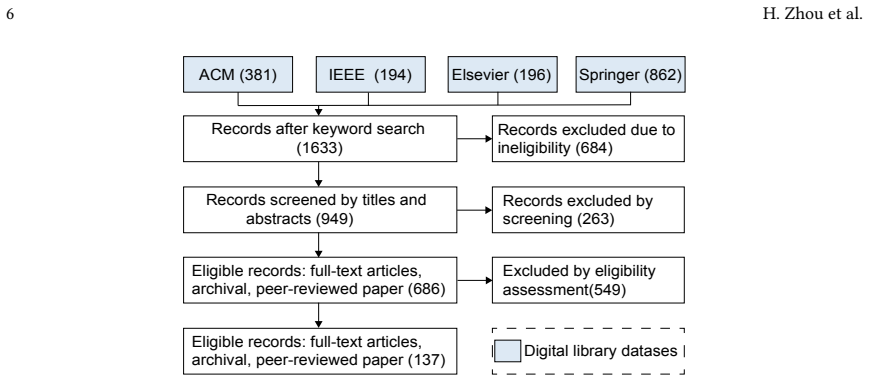
The carrying mechanism is a systematic review pipeline: a keyword query combining embodiment terms (embodiment, body ownership, agency, presence, co-embodiment) with collaboration terms (collaborative, multi-user, shared, co-presence, shared perspective) and VR terms, run across four publication databases and filtered through three inclusion criteria (peer-reviewed technical paper, involves virtual reality, involves collaborative embodiment). The resulting corpus of 137 papers and 150 studies is coded along four axes—measures and metrics, study tasks, collaboration methods, and study parameters—with interrater reliability of $\kappa = 0.91$ reported for task categorization. These coding axes do the argumentative work: they turn a scattered literature into prevalence figures and gap claims.
What would settle it
Re-run the same systematic protocol with an expanded query—adding terms such as joint action, interpersonal synchrony, shared avatar, and telepresence—across psychology and neuroscience databases, and check whether the headline prevalence figures shift, for example whether the 67% laboratory, 76% head-mounted-display, or 15% quality-of-experience estimates move materially. If the expanded corpus changes these numbers substantially or surfaces longitudinal studies the current search missed, the survey's central map would need revision.
Extended reading notes
Core claim
The central claim is that collaborative embodiment in VR has been operationalized through 23 distinguishable collaboration methods—from shared control and supernumerary limbs to asymmetric roles and AI-mediated collaboration—and measured mostly with subjective questionnaires (presence, social presence, workload, usability, simulator sickness) and objective performance metrics (quality of experience, gaze and gesture analysis, task accuracy, communication frequency, physiological synchrony, completion time, synchronization, success or error rates). Categorizing the 150 studies, the survey establishes the field's current shape: 67% of studies are laboratory-based, 76% use head-mounted displays, 62% assign shared-control roles, 23% lack a quantified task, and the median sample is 18 participants. The paper's contribution is this structured map itself: it shows that methodological variety is the norm and that this variety, together with the three named gaps, prevents cross-study comparison and generalization. The paper claims these gaps are the main obstacles to scalable and inclusive collaborative VR, and it positions the survey as a foundation for standardizing future studies.
Load-bearing premise
The survey's prevalence figures and gap analysis assume that the keyword query defined in the methodology and the four chosen databases captured the relevant literature; the authors note that alternative keywords and venues outside computer science, such as neuroscience and psychology, may have excluded relevant papers.
Editorial extensions
If this is right
- A unified evaluation battery for collaborative embodiment would combine the promising metrics already present—physiological synchrony, gaze coordination, shared workload, and social presence—with task accuracy and completion time.
- Standardized task categories and transparent reporting frameworks would make results comparable across studies and support replication.
- Longitudinal studies would reveal how teams refine synchronization and role distribution over repeated interactions, which short task-based designs cannot show.
- Recruiting expert and culturally diverse participants, with documented onboarding for novices, would improve the generalizability of findings.
- Field and hybrid studies should complement laboratory experiments to test whether embodiment findings survive real-world collaboration settings.
Reading between the lines
- Beyond the paper's claims, the same coding scheme could be applied to the excluded single-user and AR/XR literature to test whether the three gaps are specific to collaborative embodiment or generic across embodiment research.
- The scarcity of longitudinal designs suggests a benchmark opportunity: a shared multi-session collaborative task run across several sites for a fixed period would give the field its first comparable longitudinal dataset.
- Because 23% of studies had no quantified task, a testable next step is a reporting checklist requiring at least one behavioral measure tied to the collaboration method under study.
- The 23 collaboration-method categories could serve as a taxonomy for later reviews, but boundaries between categories such as Shared Control and Multi-User Embodiment may not be stable across studies.
Editorial analysis
A structured set of objections, weighed in public.
Referee Report
Summary. This manuscript presents a PRISMA-based systematic review of collaborative embodiment in virtual reality, analyzing 137 papers (150 studies) published between 2014 and 2024. The survey describes the field along four axes: subjective and objective measures, task types, collaboration methods, and study parameters (participants, hardware, software, settings). It reports prevalence claims such as 67% laboratory studies, 76% HMD use, and 15% QoE metrics, and argues that the literature suffers from three critical gaps: no unified metrics, few longitudinal studies, and poor participant diversity. The abstract promises a critical assessment of the effectiveness of the reviewed methodologies, but the Results and Discussion sections are descriptive and do not evaluate effectiveness in a comparative or evidence-based manner.
Significance. If the descriptive map is trustworthy, the survey fills a genuine gap: there is no prior structured overview of how collaborative embodiment has been operationalized and measured in VR. The paper reports several methodological strengths: it follows PRISMA, uses a pre-specified search query, reports interrater reliability for task categorization (Cohen's κ = 0.91), and provides a broad taxonomy of tasks, metrics, and collaboration methods. It also makes a useful contribution by identifying the prevalence of lab-based studies, HMD-based systems, and traditional metrics. However, the significance is currently conditional on resolving internal-validity concerns about the inclusion criteria and the missing audit trail; without a clear operational definition of collaborative embodiment and a list of included studies, the central percentages and gap analysis may describe collaborative VR generally rather than collaborative embodiment specifically.
major comments (4)
- [Sections 3.1 and 3.2, Table 4] Criterion 3 ('collaborative embodiment') is never operationally defined, and the search query in Section 3.1 includes 'presence' and 'co-presence' as surrogates for embodiment. The Results then classify methods such as Avatar-Based Collaboration, Gamified Collaboration, Real-World Context Integration, and AI-Mediated Collaboration (Table 4) that do not necessarily involve shared body ownership, agency, or self-location. This means the prevalence claims (e.g., 67% laboratory studies, 76% HMDs, 15% QoE) may be describing collaborative VR in general rather than collaborative embodiment specifically. The authors should provide a precise operational definition that lists which embodiment components (body ownership, agency, self-location, etc.) must be present, re-screen the corpus against that definition, and report how many of the 137 papers actually manipulate or measure each component.
- [Section 3.2, Figure 1] The manuscript does not provide the list of the 137 included studies or any per-paper coding data. PRISMA guidelines require an explicit list of included studies so that readers can audit screening decisions and categorization. Without such a list, the percentages in Sections 4.1-4.4 and the task and method categories in Tables 2 and 4 cannot be verified. The authors should provide a supplementary file with the full references of included studies, the coding scheme, and the codes assigned to each study (including which embodiment components were addressed).
- [Abstract and Sections 4-5] The abstract states that the survey will provide 'a critical assessment of the effectiveness of these methodologies,' but the Results (Sections 4.1-4.4) report only percentages and counts, and the Discussion (Sections 5.1-5.3) offers general reflections without comparing outcomes across methods, tasks, or settings. There are no effect sizes, no comparative analyses, and no evidence-based recommendations about which methods work better. The authors should either add a genuine critical synthesis that evaluates the reported evidence (e.g., compare task completion time or accuracy across collaboration methods) or substantially revise the abstract and introduction to describe the work as a descriptive scoping review rather than a critical effectiveness assessment.
- [Sections 4.1.2 and 4.4.2] The paper uses inconsistent denominators. Section 4.1.2 says 'From our analysis of the 113 studies' but then reports percentages that match a denominator of 137 papers (e.g., 20 studies for '15%' QoE; 20/137 ≈ 14.6%), not 113. Section 4.4.2 says '76% of the reviewed studies (106 out of 137)', but 106/137 ≈ 77.4%. The paper also alternates between '137 papers' and '150 studies' without defining whether the unit of analysis is a paper or a study. The authors should state a single unit of analysis and report every percentage with its explicit denominator and count, and they should reconcile the 113 vs. 137 discrepancy.
minor comments (8)
- [Abstract] The abstract says 'over 137 relevant research papers' but the review includes exactly 137; please change to '137'.
- [Figure 1] The text says duplicates were removed by title, but the flow chart does not show a 'duplicates removed' step; add the number of duplicates removed to make the PRISMA flow fully transparent.
- [Table 1] Table 1 lists percentages of papers using each questionnaire but does not give the raw counts; provide counts and clarify that one paper may use multiple questionnaires.
- [Section 4.1.2] The reference list for QoE contains duplicated citation numbers (e.g., [66,66,79,79,...]); please correct the citation list to have each reference appear once.
- [Section 5.2.1] The claim that longitudinal studies are scarce cites reference [164], which is a presence questionnaire paper (Schubert et al., 2001), not a study on longitudinal methodology; please re-check the citations in the Discussion and replace with appropriate references.
- [Table 4] The collaboration-methods taxonomy includes overlapping categories, such as Collaborative Decision-Making, Interactive Decision-Making, and Collaborative Problem-Solving, without clear discriminating criteria; consider merging or defining a hierarchical classification.
- [Section 2.2.3] The statement that both objective and subjective metrics are crucial is made without a supporting citation; add references from the background literature.
- [Section 6 (Limitations)] The Limitations section acknowledges that the classification may oversimplify hybrid frameworks and that prespecified keywords may exclude relevant papers, but it does not discuss how these limitations might affect the specific prevalence percentages (e.g., 67% laboratory studies); add a brief statement in the relevant Results subsections.
Circularity Check
No significant circularity; the survey's descriptive claims summarize its own corpus and do not reduce to self-citations or fitted inputs.
full rationale
The paper is a systematic literature review, not a derivation from first principles, and its central claims are descriptive summaries of the 137 included papers. The prevalence statements (67% lab studies, 76% HMDs, 15% QoE metrics, 10% longitudinal designs) are computed directly from the reviewed corpus, and no step renames a fitted parameter as a prediction. The search query in Section 3.1 includes 'presence' as a proxy for embodiment, which may broaden the corpus, but this is a selection-bias or construct-validity concern rather than a circular derivation: the paper does not define 'collaborative embodiment' in terms of the outcomes it later reports, nor does any equation make a reported prevalence equal to an input by construction. The authors cite several of their own prior papers (e.g., CoplayingVR [206], Juggling Extra Limbs [207], and co-embodiment work by Inami's group), and these papers are part of the analyzed corpus; however, the survey's conclusions about lab dominance, metric diversity, and research gaps do not depend on the truth of those self-cited results. The Limitations section explicitly concedes that alternative keywords and interdisciplinary venues could have excluded relevant work, which is a normal validity caveat, not a circularity admission. Overall, the derivation chain is self-contained as a literature map; the main risks are corpus representativeness and coding consistency, not circular reasoning.
Assumptions & free parameters
assumptions (4)
- domain assumption The search query and four database selection capture the relevant literature on collaborative embodiment in VR.
- domain assumption The inclusion criteria are applied consistently during title, abstract, and full-text screening.
- domain assumption The ten task categories and 23 collaboration methods are meaningful and non-overlapping enough to support the reported statistics.
- domain assumption Criterion 2 cleanly separates VR from AR, XR, and ER studies.
Cite this review
Pith. "Pith review of A Survey on Methodological Approaches to Collaborative Embodiment in Virtual Reality." pith.science (2026). https://pith.science/paper/SABGL5XG
@misc{pith2026250718877,
  author       = {Pith},
  title        = {Pith review of: A Survey on Methodological Approaches to Collaborative Embodiment in Virtual Reality},
  year         = {2026},
  howpublished = {\url{https://pith.science/paper/SABGL5XG}},
  note         = {Machine review of arXiv:2507.18877}
}
read the original abstract
The application and implementation of collaborative embodiment in virtual reality (VR) are a critical aspect of the computer science landscape, aiming to enhance multi-user interaction and teamwork in immersive environments. A notable and enduring area of collaborative embodiment research focuses on approaches that enable multiple users to share control, interact, and investigate scenarios involving supernumerary arms in virtual spaces. In this survey, we will present an extensive overview of the methodologies employed in the past decade to enable collaboration in VR environments, particularly through embodiment. Using the PRISMA guidelines, we plan to analyze the study details from over 137 relevant research papers. Through this analysis, a critical assessment of the effectiveness of these methodologies will be conducted, highlighting current challenges and limitations in implementing collaborative embodiment in VR. Lastly, we discuss potential future research directions and opportunities for enhancing collaboration embodiment in virtual environments.
Figures


Figures from the paper (1 more)

Reference graph
Works this paper leans on
-
[1]
Alex Adkins, Ryan Canales, and Sophie Jörg. 2024. Hands or Controllers? How Input Devices and Audio Impact Collaborative Virtual Reality. In Proceedings of the 30th ACM Symposium on Virtual Reality Software and Technology . 1–12
2024
-
[2]
Haya Almaree, Roland Fischer, René Weller, Verena Uslar, Dirk Weyhe, and Gabriel Zachmann. 2024. Enhancing anatomy learning through collaborative VR? An advanced investigation. Computers & Graphics 123 (2024), 104019
2024
-
[3]
Fitria Amastini, Cristin Purnama Sari Kaunang, Afifah Nefiratika, Dana Indra Sensuse, and Sofian Lusa. 2020. Collaborative Learning in Virtual Learning Environment using Social Network Analysis: Case study Universitas Terbuka. In2020 7th International Conference on Electrical Engineering, Computer Sciences and Informatics (EECSI) . IEEE, 262–269
2020
-
[4]
Sean Andrist, Michael Gleicher, and Bilge Mutlu. 2017. Looking coordinated: Bidirectional gaze mechanisms for collaborative interaction with virtual characters. In Proceedings of the 2017 CHI conference on human factors in computing systems . 2571–2582
2017
-
[5]
Dui Ardal, Simon Alexandersson, Mirko Lempert, and André Tiago Abelho Pereira. 2019. A collaborative previsualization tool for filmmaking in virtual reality. In Proceedings of the 16th ACM SIGGRAPH European Conference on Visual Media Production . 1–10
2019
-
[6]
Jonas Auda, Leon Busse, Ken Pfeuffer, Uwe Gruenefeld, Radiah Rivu, Florian Alt, and Stefan Schneegass. 2021. I’m in control! transferring object ownership between remote users with haptic props in virtual reality. In Proceedings of the 2021 ACM Symposium on Spatial User Interaction . 1–10
2021
-
[7]
Daniel Bachmann, Frank Weichert, and Gerhard Rinkenauer. 2018. Review of three-dimensional human-computer interaction with focus on the leap motion controller. Sensors 18, 7 (2018), 2194
2018
-
[8]
Allison Bayro, Yalda Ghasemi, and Heejin Jeong. 2022. Subjective and objective analyses of collaboration and co-presence in a virtual reality remote environment. In 2022 IEEE conference on virtual reality and 3d user interfaces abstracts and workshops (vrw) . IEEE, 485–487
2022
Show all 211 references
-
[9]
Frank Biocca. 1997. The cyborg’s dilemma: Progressive embodiment in virtual environments. Journal of computer-mediated communication 3, 2 (1997), JCMC324
1997
-
[10]
Frank Biocca, Chad Harms, and Jenn Gregg. 2001. The networked minds measure of social presence: Pilot test of the factor structure and concurrent validity. In 4th annual international workshop on presence, Philadelphia, PA . 1–9
2001
-
[11]
Pradipta Biswas, Pilar Orero, Manohar Swaminathan, Kavita Krishnaswamy, and Peter Robinson. 2021. Adaptive accessible AR/VR systems. In Extended Abstracts of the 2021 CHI Conference on Human Factors in Computing Systems . 1–7
2021
-
[12]
It Takes Two
Alberto Boem, Damian Dziwis, Matteo Tomasetti, Sascha Etezazi, and Luca Turchet. 2024. “It Takes Two”-Shared and Collaborative Virtual Musical Instruments in the Musical Metaverse. In 2024 IEEE 5th International Symposium on the Internet of Sounds (IS2) . IEEE, 1–10
2024
-
[13]
Felix Born, Philipp Sykownik, and Maic Masuch. 2019. Co-located vs. remote gameplay: The role of physical co-presence in multiplayer room-scale vr. In 2019 IEEE conference on games (CoG) . IEEE, 1–8
2019
-
[14]
Matthew Botvinick and Jonathan Cohen. 1998. Rubber hands ‘feel’touch that eyes see. Nature 391, 6669 (1998), 756–756
1998
-
[15]
Lal Lila Bozgeyikli. 2021. Give Me a Hand: Exploring Bidirectional Mutual Embodied Tangible Interaction in Virtual Reality. In 2021 IEEE International Conference on Consumer Electronics (ICCE) . IEEE, 1–6
2021
-
[16]
John Brooke et al. 1996. SUS-A quick and dirty usability scale. Usability evaluation in industry 189, 194 (1996), 4–7
1996
-
[17]
Isabelle Budin-Ljøsne, Nanna AG Fredheim, Charlotte Alison Jevne, Bojana Milanovic Kleven, Marie Aline Charles, Janine F Felix, Robin Flaig, María Paz García, Alexandra Havdahl, Shahid Islam, et al. 2024. Participant engagement and involvement in longitudinal cohort studies: q...
2024
-
[18]
Jhon Alexander Bueno-Vesga, Xinhao Xu, and Hao He. 2021. The effects of cognitive load on engagement in a virtual reality learning environment. In 2021 IEEE Virtual Reality and 3D User Interfaces (VR) . IEEE, 645–652
2021
-
[19]
Kelly Caine. 2016. Local standards for sample size at CHI. InProceedings of the 2016 CHI conference on human factors in computing systems . 981–992
2016
-
[20]
Francisco Cesário and Maria José Chambel. 2019. On-boarding new employees: a three-component perspective of welcoming. International Journal of Organizational Analysis 27, 5 (2019), 1465–1479
2019
-
[21]
Edwige Chauvergne, Martin Hachet, and Arnaud Prouzeau. 2023. User onboarding in virtual reality: An investigation of current practices. In Proceedings of the 2023 CHI Conference on Human Factors in Computing Systems . 1–15
2023
-
[22]
Meng-Xi Chen, Huicong Hu, Ruiqi Yao, Longhu Qiu, and Dongxu Li. 2024. A Survey on the Design of Virtual Reality Interaction Interfaces. Sensors 24, 19 (2024), 6204
2024
-
[23]
Francesco Chiossi, Changkun Ou, and Sven Mayer. 2023. Exploring physiological correlates of visual complexity adaptation: Insights from eda, ecg, and eeg data for adaptation evaluation in vr adaptive systems. In Extended Abstracts of the 2023 CHI Conference on Human Factors in...
2023
-
[24]
Chun-Hsiang Chuang, Po-Hsun Peng, and Yi-Chieh Chen. 2024. Leveraging Hyperscanning EEG and VR Omnidirectional Treadmill to Explore Inter-Brain Synchrony in Collaborative Spatial Navigation. arXiv preprint arXiv:2406.06327 (2024). Manuscript submitted to ACM A Survey on Method...
2024 arXiv
-
[25]
Damien Clergeaud, Joan Sol Roo, Martin Hachet, and Pascal Guitton. 2017. Towards seamless interaction between physical and virtual locations for asymmetric collaboration. In Proceedings of the 23rd ACM symposium on virtual reality software and technology . 1–4
2017
-
[26]
J Conesa, FJ Mula, Manuel Contero, and Jorge D Camba. 2023. A multi-agent framework for collaborative geometric modeling in virtual environments. Engineering Applications of Artificial Intelligence 123 (2023), 106257
2023
-
[27]
Chris Creed, Maadh Al-Kalbani, Arthur Theil, Sayan Sarcar, and Ian Williams. 2024. Inclusive AR/VR: accessibility barriers for immersive technologies. Universal Access in the Information Society 23, 1 (2024), 59–73
2024
-
[28]
Stephanie Elena Crowe, Bahareh Shahri, Thammathip Piumsomboon, Simon Hoermann, and Annalu Waller. 2024. Modelling Patient-Therapist Collaboration for Brain Injury Rehabilitation in Virtual Reality. In Adjunct Proceedings of the 32nd ACM Conference on User Modeling, Adaptation ...
2024
-
[29]
Carolina Cruz-Neira, Marcos Fernández, and Cristina Portalés. 2018. Virtual reality and games. , 8 pages
2018
-
[30]
AJ Cullen, NL Dowling, R Segrave, J Morrow, A Carter, and M Yücel. 2021. Considerations and practical protocols for using virtual reality in psychological research and practice, as evidenced through exposure-based therapy. Behavior Research Methods 53, 6 (2021), 2725–2742
2021
-
[31]
Eduardo Davalos, Yike Zhang, Joyce Horn Fonteles, Umesh Timalsina, and Gautam Biswas. 2024. 3D Gaze Tracking for Studying Collaborative Interactions in Mixed-Reality Environments. In Companion Proceedings of the 26th International Conference on Multimodal Interaction . 175–183
2024
-
[32]
Frédérique De Vignemont. 2011. Embodiment, ownership and disownership. Consciousness and cognition 20, 1 (2011), 82–93
2011
-
[33]
Yong Dich, Joseph Reilly, and Bertrand Schneider. 2018. Using physiological synchrony as an indicator of collaboration quality, task performance and learning. In Artificial Intelligence in Education: 19th International Conference, AIED 2018, London, UK, June 27–30, 2018, Proce...
2018
-
[34]
Tiffany D Do, Juanita Benjamin, Camille Isabella Protko, and Ryan P McMahan. 2024. Cultural Reflections in Virtual Reality: The Effects of User Ethnicity in Avatar Matching Experiences on Sense of Embodiment. IEEE transactions on visualization and computer graphics (2024)
2024
-
[35]
Georgiana Cristina Dobre, Marco Gillies, David C Ranyard, Russell Harding, and Xueni Pan. 2022. More than buttons on controllers: engaging social interactions in narrative VR games through social attitudes detection. In Proceedings of the 22nd ACM International Conference on I...
2022
-
[36]
James Dominic, Brock Tubre, Charles Ritter, Jada Houser, Colton Smith, and Paige Rodeghero. 2020. Remote pair programming in virtual reality. In 2020 IEEE International Conference on Software Maintenance and Evolution (ICSME) . IEEE, 406–417
2020
-
[37]
Shahin Doroudian. 2023. Collaboration in Immersive Environments: Challenges and Solutions. arXiv preprint arXiv:2311.00689 (2023)
2023 arXiv
-
[38]
Tomas Dorta, Gokce Kinayoglu, and Michael Hoffmann. 2014. Hyve-3D: a new embodied interface for immersive collaborative 3D sketching. In ACM SIGGRAPH 2014 Studio. 1–1
2014
-
[39]
Adam Drogemuller, Adrien Verhulst, Benjamin Volmer, Bruce H Thomas, Masahiko Inami, and Maki Sugimoto. 2019. Remapping a third arm in virtual reality. In 2019 IEEE Conference on Virtual Reality and 3D User Interfaces (VR) . IEEE, 898–899
2019
-
[40]
Charlotte Dubosc, Geoffrey Gorisse, Olivier Christmann, Sylvain Fleury, Killian Poinsot, and Simon Richir. 2021. Impact of avatar anthropomorphism and task type on social presence in immersive collaborative virtual environments. In 2021 IEEE Conference on Virtual Reality and 3...
2021
-
[41]
Isaac Dunmoye, Dominik May, and Nathaniel Hunsu. 2022. An exploratory study of social presence in a collaborative desktop virtual reality (VR) land surveying task. In 2022 IEEE Frontiers in Education Conference (FIE) . IEEE, 1–5
2022
-
[42]
Abderrahim El Mhouti, Azeddine Nasseh Mohamed Erradi, and Jose Marfa Vasquèz. 2016. Cloud-based VCLE: A virtual collaborative learning environment based on a cloud computing architecture. In 2016 Third International Conference on Systems of Collaboration (SysCo) . IEEE, 1–6
2016
-
[43]
Aida Erfanian and Yaoping Hu. 2017. Vibrotactile cues on multiuser collaboration within virtual environments. In2017 IEEE International Conference on Systems, Man, and Cybernetics (SMC) . IEEE, 3541–3546
2017
-
[44]
Stephen H Fairclough. 2017. Physiological computing and intelligent adaptation. In Emotions and affect in human factors and human-computer interaction. Elsevier, 539–556
2017
-
[45]
Hongxiang Fan, Martin Ferianc, Miguel Rodrigues, Hongyu Zhou, Xinyu Niu, and Wayne Luk. 2021. High-performance FPGA-based accelerator for Bayesian neural networks. In 2021 58th ACM/IEEE Design Automation Conference (DAC) . IEEE, 1063–1068
2021
-
[46]
Frowin Fasold, André Nicklas, Florian Seifriz, Karsten Schul, Benjamin Noël, Paula Aschendorf, and Stefanie Klatt. 2021. Gaze coordination of groups in dynamic events–a tool to facilitate analyses of simultaneous gazes within a team. Frontiers in psychology 12 (2021), 656388
2021
-
[47]
Martin Ferianc, Hongxiang Fan, Divyansh Manocha, Hongyu Zhou, Shuanglong Liu, Xinyu Niu, and Wayne Luk. 2021. Improving performance estimation for design space exploration for convolutional neural network accelerators. Electronics 10, 4 (2021), 520
2021
-
[48]
Jorge Askur Vazquez Fernandez, Jae Joong Lee, Santiago Andrés Serrano Vacca, Alejandra Magana, Bedrich Benes, and Voicu Popescu. 2024. Hands-Free VR. arXiv preprint arXiv:2402.15083 (2024)
2024 arXiv
-
[49]
Catarina G Fidalgo, Maurício Sousa, Daniel Mendes, Rafael Kuffner Dos Anjos, Daniel Medeiros, Karan Singh, and Joaquim Jorge. 2023. Magic: Manipulating avatars and gestures to improve remote collaboration. In 2023 IEEE Conference Virtual Reality and 3D User Interfaces (VR) . I...
2023
-
[50]
Guo Freeman, Dane Acena, Nathan J McNeese, and Kelsea Schulenberg. 2022. Working together apart through embodiment: Engaging in everyday collaborative activities in social Virtual Reality. Proceedings of the ACM on Human-Computer Interaction 6, GROUP (2022), 1–25
2022
-
[51]
Jann Philipp Freiwald, Lennart Diedrichsen, Alexander Baur, Oliver Manka, Pedram Berendjy Jorshery, and Frank Steinicke. 2020. Conveying perspective in multi-user virtual reality collaborations. In Proceedings of Mensch Und Computer 2020 . 137–144. Manuscript submitted to ACM ...
2020
-
[52]
Jann Philipp Freiwald, Julius Schenke, Nale Lehmann-Willenbrock, and Frank Steinicke. 2021. Effects of avatar appearance and locomotion on co-presence in virtual reality collaborations. In Proceedings of Mensch Und Computer 2021 . 393–401
2021
-
[53]
Rebecca Fribourg, Ferran Argelaguet, Ludovic Hoyet, and Anatole Lécuyer. 2018. Studying the sense of embodiment in VR shared experiences. In 2018 IEEE Conference on Virtual Reality and 3D User Interfaces (VR) . IEEE, 273–280
2018
-
[54]
Rebecca Fribourg, Nami Ogawa, Ludovic Hoyet, Ferran Argelaguet, Takuji Narumi, Michitaka Hirose, and Anatole Lécuyer. 2020. Virtual co- embodiment: evaluation of the sense of agency while sharing the control of a virtual body among two individuals.IEEE Transactions on Visualiz...
2020
-
[55]
Mara Fuchs, Florian Beckert, Jörn Biedermann, and Björn Nagel. 2022. A collaborative knowledge-based method for the interactive development of cabin systems in virtual reality. Computers in Industry 136 (2022), 103590
2022
-
[56]
Maia Garau, Mel Slater, David-Paul Pertaub, and Sharif Razzaque. 2005. The responses of people to virtual humans in an immersive virtual environment. Presence: Teleoperators & Virtual Environments 14, 1 (2005), 104–116
2005
-
[57]
Arturo S García, Terrence Fernando, David J Roberts, Christian Bar, Michele Cencetti, Wito Engelke, and Andreas Gerndt. 2019. Collaborative virtual reality platform for visualizing space data and mission planning. Multimedia Tools and Applications 78 (2019), 33191–33220
2019
-
[58]
for real
Adélaïde Genay, Anatole Lécuyer, and Martin Hachet. 2021. Being an avatar “for real”: a survey on virtual embodiment in augmented reality. IEEE Transactions on Visualization and Computer Graphics 28, 12 (2021), 5071–5090
2021
-
[59]
Ryan K Ghamandi, Yahya Hmaiti, Tam T Nguyen, Amirpouya Ghasemaghaei, Ravi Kiran Kattoju, Eugene M Taranta, and Joseph J LaViola. 2023. What and how together: A taxonomy on 30 years of collaborative human-centered xr tasks. In 2023 IEEE International Symposium on Mixed and Augm...
2023
-
[60]
Ryan Khushan Ghamandi, Ravi Kiran Kattoju, Yahya Hmaiti, Mykola Maslych, Eugene Matthew Taranta, Ryan P McMahan, and Joseph LaViola
-
[61]
Liang Gong, Henrik Söderlund, Leonard Bogojevic, Xiaoxia Chen, Anton Berce, Åsa Fast-Berglund, and Björn Johansson. 2020. Interaction design for multi-user virtual reality systems: An automotive case study. Procedia Cirp 93 (2020), 1259–1264
2020
-
[62]
Mar Gonzalez-Franco and Christopher C Berger. 2019. Avatar embodiment enhances haptic confidence on the out-of-body touch illusion. IEEE transactions on haptics 12, 3 (2019), 319–326
2019
-
[63]
Mar Gonzalez-Franco, Brian Cohn, Eyal Ofek, Dalila Burin, and Antonella Maselli. 2020. The self-avatar follower effect in virtual reality. In 2020 IEEE Conference on Virtual Reality and 3D User Interfaces (VR) . IEEE, 18–25
2020
-
[64]
Mar Gonzalez-Franco and Tabitha C Peck. 2018. Avatar embodiment. towards a standardized questionnaire. Frontiers in Robotics and AI 5 (2018), 74
2018
-
[65]
Mar Gonzalez-Franco, Rodrigo Pizarro, Julio Cermeron, Katie Li, Jacob Thorn, Windo Hutabarat, Ashutosh Tiwari, and P Bermell. 2017. Immersive mixed reality training for complex manufacturing. (2017)
2017
-
[66]
Simon NB Gunkel, Rick Hindriks, Karim M El Assal, Hans M Stokking, Sylvie Dijkstra-Soudarissanane, Frank ter Haar, and Omar Niamut. 2021. VRComm: an end-to-end web system for real-time photorealistic social VR communication. In Proceedings of the 12th ACM multimedia systems co...
2021
-
[67]
Nereida Hadziahmetovic and Nejla Salihovic. 2022. The role of transparent communication and leadership in employee engagement. International Journal of Academic Reserach in Economics and Management Sciences 11, 2 (2022)
2022
-
[68]
Takayoshi Hagiwara, Maki Sugimoto, Masahiko Inami, and Michiteru Kitazaki. 2019. Shared body by action integration of two persons: Body ownership, sense of agency and task performance. In 2019 ieee conference on virtual reality and 3d user interfaces (vr) . IEEE, 954–955
2019
-
[69]
Wen Hai, Nisha Jain, Andrzej Wydra, Nadia Magnenat Thalmann, and Daniel Thalmann. 2018. Increasing the feeling of social presence by incorporating realistic interactions in multi-party vr. In Proceedings of the 31st International Conference on Computer Animation and Social Age...
2018
-
[70]
Tae Young Han and Kevin J Williams. 2008. Multilevel investigation of adaptive performance: Individual-and team-level relationships. Group & Organization Management 33, 6 (2008), 657–684
2008
-
[71]
Harin Hapuarachchi and Michiteru Kitazaki. 2022. Knowing the intention behind limb movements of a partner increases embodiment towards the limb of joint avatar. Scientific Reports 12, 1 (2022), 11453
2022
-
[72]
Chris Harrison, Hrvoje Benko, and Andrew D Wilson. 2011. OmniTouch: wearable multitouch interaction everywhere. In Proceedings of the 24th annual ACM symposium on User interface software and technology . 441–450
2011
-
[73]
Sandra G Hart. 2006. NASA-task load index (NASA-TLX); 20 years later. In Proceedings of the human factors and ergonomics society annual meeting , Vol. 50. Sage publications Sage CA: Los Angeles, CA, 904–908
2006
-
[74]
Yangyang He, Xiaoyi Xue, Jingjing Zhang, and Xiongju Sun. 2024. MindMeld Cyclers: Exploring New Collaborative Motion Modes Using Virtual Co-embodiment in a Serious Game. In 2024 IEEE Conference on Games (CoG) . IEEE, 1–8
2024
-
[75]
Mincong Huang, Samuel Chabot, Carla Leitão, Ted Krueger, and Jonas Braasch. 2023. Spatially-aware group interaction design framework for collaborative room-oriented immersive systems. Applied Ergonomics 113 (2023), 104076
2023
-
[76]
Xincheng Huang, James Riddell, and Robert Xiao. 2023. Virtual reality telepresence: 360-degree video streaming with edge-compute assisted static foveated compression. IEEE Transactions on Visualization and Computer Graphics 29, 11 (2023), 4525–4534. Manuscript submitted to ACM...
2023
-
[77]
Natalie Hube, Katrin Angerbauer, Daniel Pohlandt, Krešimir Vidačković, and Michael Sedlmair. 2021. VR collaboration in large companies: An interview study on the role of avatars. In 2021 IEEE International Symposium on Mixed and Augmented Reality Adjunct (ISMAR-Adjunct) . IEEE...
2021
-
[78]
Masahiko Inami, Daisuke Uriu, Zendai Kashino, Shigeo Yoshida, Hiroto Saito, Azumi Maekawa, and Michiteru Kitazaki. 2022. Cyborgs, human augmentation, cybernetics, and JIZAI body. In Proceedings of the Augmented Humans International Conference 2022 . 230–242
2022
-
[79]
Jack Jansen, Thomas Röggla, Silvia Rossi, Irene Viola, and Pablo Cesar. 2024. Open-Sourcing VR2Gather: A Collaborative Social VR System for Adaptive Multi-Party Real Time Communication. In Proceedings of the 32nd ACM International Conference on Multimedia . 11210–11213
2024
-
[80]
Ana Javornik, Yvonne Rogers, Delia Gander, and Ana Moutinho. 2017. MagicFace: Stepping into character through an augmented reality mirror. In Proceedings of the 2017 CHI Conference on Human Factors in Computing Systems . 4838–4849
2017
-
[81]
Do you feel in control?
Camille Jeunet, Louis Albert, Ferran Argelaguet, and Anatole Lécuyer. 2018. “Do you feel in control?”: towards novel approaches to characterise, manipulate and measure the sense of agency in virtual environments. IEEE transactions on visualization and computer graphics 24, 4 (...
2018
-
[82]
Ziyi Jiang, Yanpei Huang, Jonathan Eden, Ekaterina Ivanova, Xiaoxiao Cheng, and Etienne Burdet. 2023. A virtual reality platform to evaluate the effects of supernumerary limbs’ appearance. In 2023 45th Annual International Conference of the IEEE Engineering in Medicine & Biolo...
2023
-
[83]
Wonse Jo, Ruiqi Wang, Baijian Yang, Daniel Foti, Mo Rastgaar, and Byung-Cheol Min. 2024. Cognitive Load-Based Affective Workload Allocation for Multihuman Multirobot Teams. IEEE Transactions on Human-Machine Systems (2024)
2024
-
[84]
Akinul Islam Jony and Sultanul Arifeen Hamim. 2024. Empowering virtual collaboration: harnessing AI for enhanced teamwork in higher education. Educational Technology Quarterly 2024, 3 (2024), 337–359
2024
-
[85]
M-Carmen Juan, Julen Elexpuru, Paulo Dias, Beatriz Sousa Santos, and Paula Amorim. 2023. Immersive virtual reality for upper limb rehabilitation: comparing hand and controller interaction. Virtual reality 27, 2 (2023), 1157–1171
2023
-
[86]
Sungchul Jung, Nawam Karki, Max Slutter, and Robert W Lindeman. 2021. On the use of multi-sensory cues in symmetric and asymmetric shared collaborative virtual spaces. Proceedings of the ACM on Human-Computer Interaction 5, CSCW1 (2021), 1–25
2021
-
[87]
Pekka Kallioniemi, Tomi Heimonen, Markku Turunen, Jaakko Hakulinen, Tuuli Keskinen, Laura Pihkala-Posti, Jussi Okkonen, and Roope Raisamo
-
[88]
Jari Kangas, Sriram Kishore Kumar, Helena Mehtonen, Jorma Järnstedt, and Roope Raisamo. 2022. Trade-off between task accuracy, task completion time and naturalness for direct object manipulation in virtual reality. Multimodal Technologies and Interaction 6, 1 (2022), 6
2022
-
[89]
Shunichi Kasahara, Mitsuhito Ando, Kiyoshi Suganuma, and Jun Rekimoto. 2016. Parallel eyes: Exploring human capability and behaviors with paralleled first person view sharing. In Proceedings of the 2016 chi conference on human factors in computing systems . 1561–1572
2016
-
[90]
Sam Kavanagh, Andrew Luxton-Reilly, Burkhard Wuensche, and Beryl Plimmer. 2017. A systematic review of virtual reality in education. Themes in science and technology education 10, 2 (2017), 85–119
2017
-
[91]
Robert S Kennedy, Norman E Lane, Kevin S Berbaum, and Michael G Lilienthal. 1993. Simulator sickness questionnaire: An enhanced method for quantifying simulator sickness. The international journal of aviation psychology 3, 3 (1993), 203–220
1993
-
[92]
Negar Khojasteh and Andrea Stevenson Won. 2021. Working together on diverse tasks: A longitudinal study on individual workload, presence and emotional recognition in collaborative virtual environments. Frontiers in Virtual Reality 2 (2021), 643331
2021
-
[93]
Konstantina Kilteni, Raphaela Groten, and Mel Slater. 2012. The sense of embodiment in virtual reality. Presence: Teleoperators and Virtual Environments 21, 4 (2012), 373–387
2012
-
[94]
Simon Kimmel, Frederike Jung, Andrii Matviienko, Wilko Heuten, and Susanne Boll. 2023. Let’s face it: Influence of facial expressions on social presence in collaborative virtual reality. In Proceedings of the 2023 CHI Conference on Human Factors in Computing Systems . 1–16
2023
-
[95]
Martin Kocur, Philipp Schauhuber, Valentin Schwind, Christian Wolff, and Niels Henze. 2020. The effects of self-and external perception of avatars on cognitive task performance in virtual reality. In Proceedings of the 26th ACM Symposium on Virtual Reality Software and Technol...
2020
-
[96]
Daiki Kodama, Takato Mizuho, Yuji Hatada, Takuji Narumi, and Michitaka Hirose. 2022. Enhancing the sense of agency by transitional weight control in virtual co-embodiment. In 2022 IEEE International Symposium on Mixed and Augmented Reality (ISMAR) . IEEE, 278–286
2022
-
[97]
Daiki Kodama, Takato Mizuho, Yuji Hatada, Takuji Narumi, and Michitaka Hirose. 2023. Effects of collaborative training using virtual co-embodiment on motor skill learning. IEEE Transactions on Visualization and Computer Graphics 29, 5 (2023), 2304–2314
2023
-
[98]
Anya Kolesnichenko, Joshua McVeigh-Schultz, and Katherine Isbister. 2019. Understanding emerging design practices for avatar systems in the commercial social vr ecology. In Proceedings of the 2019 on designing interactive systems conference . 241–252
2019
-
[99]
Oswald D Kothgassner and Anna Felnhofer. 2020. Does virtual reality help to cut the Gordian knot between ecological validity and experimental control? Annals of the International Communication Association 44, 3 (2020), 210–218
2020
-
[100]
Gunjan Kumari, Kathrin Knutzen, and Jacqueline Schuldt. 2023. Exploring the Use of Social Virtual Reality Conferences in Higher Education. In 2023 IEEE 2nd German Education Conference (GECon) . IEEE, 1–6
2023
-
[101]
Vincent Küszter, Guido Brunnett, and Daniel Pietschmann. 2014. Exploring stereoscopic multi-user interaction with individual views. In 2014 International Conference on Cyberworlds . IEEE, 101–106
2014
-
[102]
Vincent Küszter, Guido Brunnett, and Daniel Pietschmann. 2015. Cooperation in virtual environments with individual views. In 2015 IEEE Virtual Reality (VR). IEEE, 215–216. Manuscript submitted to ACM 26 H. Zhou et al
2015
-
[103]
Christos Kyrlitsias and Despina Michael-Grigoriou. 2022. Social interaction with agents and avatars in immersive virtual environments: A survey. Frontiers in Virtual Reality 2 (2022), 786665
2022
-
[104]
Jérémy Lacoche, Nico Pallamin, Thomas Boggini, and Jérôme Royan. 2017. Collaborators awareness for user cohabitation in co-located collaborative virtual environments. In Proceedings of the 23rd ACM Symposium on Virtual Reality Software and Technology . 1–9
2017
-
[105]
David Lakatos, Matthew Blackshaw, Alex Olwal, Zachary Barryte, Ken Perlin, and Hiroshi Ishii. 2014. T (ether) spatially-aware handhelds, gestures and proprioception for multi-user 3D modeling and animation. In Proceedings of the 2nd ACM symposium on Spatial user interaction . 90–93
2014
-
[106]
Edoardo Lamon, Fabio Fusaro, Elena De Momi, and Arash Ajoudani. 2023. A Unified Architecture for Dynamic Role Allocation and Collaborative Task Planning in Mixed Human-Robot Teams. arXiv preprint arXiv:2301.08038 (2023)
2023
-
[107]
Marc Erich Latoschik, Daniel Roth, Dominik Gall, Jascha Achenbach, Thomas Waltemate, and Mario Botsch. 2017. The effect of avatar realism in immersive social virtual realities. In Proceedings of the 23rd ACM symposium on virtual reality software and technology . 1–10
2017
-
[108]
Hugo Le Tarnec, Olivier Augereau, Elisabetta Bevacqua, and Pierre De Loor. 2022. Improving collaborative learning in virtual reality with facial expressions. In Adjunct Proceedings of the 2022 ACM International Joint Conference on Pervasive and Ubiquitous Computing and the 202...
2022
-
[109]
Hugo Le Tarnec, Olivier Augereau, Elisabetta Bevacqua, and Pierre De Loor. 2024. Impact of Augmented Engagement Model for Collaborative Avatars on a Collaborative Task in Virtual Reality. InProceedings of the 2024 International Conference on Advanced Visual Interfaces . 1–9
2024
-
[110]
Daniel H Lee and Tzyy-Ping Jung. 2020. A virtual reality game as a tool to assess physiological correlations of stress.arXiv preprint arXiv:2009.14421 (2020)
2020 arXiv
-
[111]
Dong-Yong Lee, Yong-Hun Cho, Dae-Hong Min, and In-Kwon Lee. 2020. Optimal planning for redirected walking based on reinforcement learning in multi-user environment with irregularly shaped physical space. In 2020 IEEE conference on virtual reality and 3D user interfaces (VR) . ...
2020
-
[112]
Bigna Lenggenhager, Tej Tadi, Thomas Metzinger, and Olaf Blanke. 2007. Video ergo sum: manipulating bodily self-consciousness. Science 317, 5841 (2007), 1096–1099
2007
-
[113]
Xiaotong Li, Yuji Hatada, and Takuji Narumi. 2024. Social Simon Effect in Virtual Reality: Investigating the Impact of Co-actor Avatar’s Visual Representation. In Proceedings of the Augmented Humans International Conference 2024 . 157–167
2024
-
[114]
Zhengqing Li, Theophilus Teo, Liwei Chan, Gun Lee, Matt Adcock, Mark Billinghurst, and Hideki Koike. 2020. Omniglobevr: A collaborative 360-degree communication system for vr. In Proceedings of the 2020 ACM Designing Interactive Systems Conference . 615–625
2020
-
[115]
Chun-Han Lin, Pei-Yu Sun, and Fang Yu. 2015. Space connection: a new 3D tele-immersion platform for web-based gesture-collaborative games and services. In 2015 IEEE/ACM 4th International Workshop on Games and Software Engineering . IEEE, 22–28
2015
-
[116]
Li Liu and Adam Kaplan. 2018. No longer alone: finding common ground in collaborative virtual environments. In Proceedings of the 33rd Annual ACM Symposium on Applied Computing . 240–246
2018
-
[117]
Xing Liu, Christina Vlachou, Feng Qian, and Kyu-Han Kim. 2019. Supporting untethered multi-user VR over enterprise wi-fi. In Proceedings of the 29th ACM Workshop on Network and Operating Systems Support for Digital Audio and Video . 25–30
2019
-
[118]
Yingtong Lu, Zhuying Li, and Ding Ding. 2024. Light Up Fireflies: Towards Understanding the Design of Interpersonal Bodily Intertwinement in Bodily Play. In Companion Proceedings of the 2024 Annual Symposium on Computer-Human Interaction in Play . 169–174
2024
-
[119]
Yedi Luo. 2021. Multi-user Steerable Virtual Reality Cycling System with 3D Virtual Explorable Environment. In Proceedings of the 2021 3rd International Conference on Video, Signal and Image Processing . 117–123
2021
-
[120]
Tiffany Luong, Yi Fei Cheng, Max Möbus, Andreas Fender, and Christian Holz. 2023. Controllers or Bare Hands? A Controlled Evaluation of Input Techniques on Interaction Performance and Exertion in Virtual Reality. IEEE Transactions on Visualization and Computer Graphics (2023)
2023
-
[121]
Duy-Nam Ly, Dinh-Thuan Duong-Le, Gia Huy Vuong, Van-Son Ho, Van-Tu Ninh, Minh-Triet Tran, and Khanh-Duy Le. 2024. CollaXRSearch: A Collaborative Virtual Reality System for Lifelog Retrieval. In Proceedings of the 7th Annual ACM Workshop on the Lifelog Search Challenge . 76–81
2024
-
[122]
accessibility research
Kelly Mack, Emma McDonnell, Dhruv Jain, Lucy Lu Wang, Jon E. Froehlich, and Leah Findlater. 2021. What do we mean by “accessibility research”? A literature survey of accessibility papers in CHI and ASSETS from 1994 to 2019. In Proceedings of the 2021 CHI Conference on Human Fa...
2021
-
[123]
Ochs Magalie, Jain Sameer, and Blache Philippe. 2018. Toward an automatic prediction of the sense of presence in virtual reality environment. In Proceedings of the 6th international conference on human-agent interaction . 161–166
2018
-
[124]
Christian Mai, Sarah Aragon Bartsch, and Lea Rieger. 2018. Evaluating shared surfaces for co-located mixed-presence collaboration. In Proceedings of the 17th International Conference on Mobile and Ubiquitous Multimedia . 1–5
2018
-
[125]
Martin Maunsbach, Kasper Hornbæk, and Hasti Seifi. 2023. Mediated Social Touching: Haptic Feedback Affects Social Experience of Touch Initiators. In 2023 IEEE World Haptics Conference (WHC) . IEEE, 93–100
2023
-
[126]
Yanni Mei, Jie Li, Huib De Ridder, and Pablo Cesar. 2021. Cakevr: A social virtual reality (vr) tool for co-designing cakes. In Proceedings of the 2021 CHI conference on human factors in computing systems . 1–14
2021
-
[127]
Destaw B Mekbib, Dereje Kebebew Debeli, Li Zhang, Shan Fang, Yuling Shao, Wei Yang, Jiawei Han, Hongjie Jiang, Junming Zhu, Zhiyong Zhao, et al. 2021. A novel fully immersive virtual reality environment for upper extremity rehabilitation in patients with stroke. Annals of the ...
2021
-
[128]
Bhagyabati Moharana, Conor Keighrey, and Niall Murray. 2023. Physiological Synchrony in a Collaborative Virtual Reality Task. In 2023 15th International Conference on Quality of Multimedia Experience (QoMEX) . IEEE, 288–293. Manuscript submitted to ACM A Survey on Methodologic...
2023
-
[129]
Jonas Moll and Eva-Lotta Sallnäs. 2009. Communicative functions of haptic feedback. In International Conference on Haptic and Audio Interaction Design. Springer, 1–10
2009
-
[130]
Florian Floyd Mueller, Pedro Lopes, Paul Strohmeier, Wendy Ju, Caitlyn Seim, Martin Weigel, Suranga Nanayakkara, Marianna Obrist, Zhuying Li, Joseph Delfa, et al. 2020. Next steps for human-computer integration. In Proceedings of the 2020 CHI Conference on human factors in com...
2020
-
[131]
Manisha Natarajan, Chunyue Xue, Sanne van Waveren, Karen Feigh, and Matthew Gombolay. 2024. Mixed-Initiative Human-Robot Teaming under Suboptimality with Online Bayesian Adaptation. arXiv preprint arXiv:2403.16178 (2024)
2024 arXiv
-
[132]
Michael Nebeling, Katy Lewis, Yu-Cheng Chang, Lihan Zhu, Michelle Chung, Piaoyang Wang, and Janet Nebeling. 2020. XRDirector: A role-based collaborative immersive authoring system. In Proceedings of the 2020 CHI Conference on Human Factors in Computing Systems . 1–12
2020
-
[133]
Quynh Nguyen, Daniele Pretolesi, and Katja Gallhuber. 2023. Collaborative scenario builder: A vr co-design tool for medical first responders. In Proceedings of the 2023 acm conference on information technology for social good . 342–350
2023
-
[134]
Vesna Dominika Novak, Theodoros Kostoulas, Michal Muszynski, Caterina Cinel, and Anton Nijholt. 2022. Harnessing physiological synchronization and hyperscanning to enhance collaboration and communication. , 956087 pages
2022
-
[135]
Catherine S Oh, Jeremy N Bailenson, and Gregory F Welch. 2018. A systematic review of social presence: Definition, antecedents, and implications. Frontiers in Robotics and AI 5 (2018), 409295
2018
-
[136]
Monsurat Olaosebikan, Claudia Aranda Barrios, Blessing Kolawole, Lenore Cowen, and Orit Shaer. 2022. Identifying cognitive and creative support needs for remote scientific collaboration using vr: Practices, affordances, and design implications. In Proceedings of the 14th Confe...
2022
-
[137]
Patrick Aggergaard Olin, Ahmad Mohammad Issa, Tiare Feuchtner, and Kaj Grønbæk. 2020. Designing for heterogeneous cross-device collaboration and social interaction in virtual reality. In Proceedings of the 32nd Australian Conference on Human-Computer Interaction . 112–127
2020
-
[138]
Jason A Ortiz and Carolina Cruz-Neira. 2023. Workspace VR: A Social and Collaborative Telework Virtual Reality Application. In Companion Publication of the 2023 Conference on Computer Supported Cooperative Work and Social Computing . 381–383
2023
-
[139]
Anya Osborne, Sabrina Fielder, Joshua Mcveigh-Schultz, Timothy Lang, Max Kreminski, George Butler, Jialang Victor Li, Diana R Sanchez, and Katherine Isbister. 2023. Being Social in VR Meetings: A Landscape Analysis of Current Tools. In Proceedings of the 2023 ACM Designing Int...
2023
-
[140]
Matthew J Page, Joanne E McKenzie, Patrick M Bossuyt, Isabelle Boutron, Tammy C Hoffmann, Cynthia D Mulrow, Larissa Shamseer, Jennifer M Tetzlaff, Elie A Akl, Sue E Brennan, et al. 2021. The PRISMA 2020 statement: an updated guideline for reporting systematic reviews. bmj 372 (2021)
2021
-
[141]
George Papanastasiou, Athanasios Drigas, Charalabos Skianis, and Miltiadis Lytras. 2020. Brain computer interface based applications for training and rehabilitation of students with neurodevelopmental disorders. A literature review. Heliyon 6, 9 (2020)
2020
-
[142]
Derek Parfit. 1971. Personal identity. The Philosophical Review 80, 1 (1971), 3–27
1971
-
[143]
Sarangi P Parikh, Joel M Esposito, and Jeremy Searock. 2014. The Role of Verbal and Nonverbal Communication in a Two-Person, Cooperative Manipulation Task. Advances in Human-Computer Interaction 2014, 1 (2014), 375105
2014
-
[144]
Thomas D Parsons. 2015. Virtual reality for enhanced ecological validity and experimental control in the clinical, affective and social neurosciences. Frontiers in human neuroscience 9 (2015), 660
2015
-
[145]
Tabitha C Peck, Kyla A McMullen, and John Quarles. 2021. Divrsify: Break the cycle and develop vr for everyone. IEEE Computer Graphics and Applications 41, 6 (2021), 133–142
2021
-
[146]
Gustav Bøg Petersen, Valdemar Stenberdt, Richard E Mayer, and Guido Makransky. 2023. Collaborative generative learning activities in immersive virtual reality increase learning. Computers & Education 207 (2023), 104931
2023
-
[147]
Roosa Piitulainen, Perttu Hämäläinen, and Elisa D Mekler. 2022. Vibing together: Dance experiences in social virtual reality. In Proceedings of the 2022 CHI Conference on Human Factors in Computing Systems . 1–18
2022
-
[148]
Galena Pisoni, Florian Daniel, Fabio Casati, Charles Callaway, and Oliviero Stock. 2019. Interactive remote museum visits for older adults: an evaluation of feelings of presence, social closeness, engagement, and enjoyment in an social visit. In 2019 IEEE International Symposi...
2019
-
[149]
Iana Podkosova and Hannes Kaufmann. 2018. Co-presence and proxemics in shared walkable virtual environments with mixed colocation. In Proceedings of the 24th ACM Symposium on Virtual Reality Software and Technology . 1–11
2018
-
[150]
Lauriane Pouliquen-Lardy, Isabelle Milleville-Pennel, Francois Guillaume, and Franck Mars. 2016. Remote collaboration in virtual reality: asymmetrical effects of task distribution on spatial processing and mental workload. Virtual Reality 20 (2016), 213–220
2016
-
[151]
K Pradeep, Rajalakshmi Sulur Anbalagan, Asha Priya Thangavelu, S Aswathy, VG Jisha, and VS Vaisakhi. 2024. Neuroeducation: understanding neural dynamics in learning and teaching. In Frontiers in Education, Vol. 9. Frontiers Media SA, 1437418
2024
-
[152]
Rabindra Ayyan Ratan and Béatrice Hasler. 2009. Self-presence standardized: Introducing the self-presence questionnaire (SPQ). In Proceedings of the 12th annual international workshop on presence , Vol. 81
2009
-
[153]
Thomas Rinnert, James Walsh, Cédric Fleury, Gilles Coppin, Thierry Duval, and Bruce H Thomas. 2023. How Can One Share a User’s Activity during VR Synchronous Augmentative Cooperation? Multimodal Technologies and Interaction 7, 2 (2023), 20
2023
-
[154]
David Roberts and Robin Wolff. 2004. Controlling consistency within collaborative virtual environments. In Eighth IEEE International Symposium on Distributed Simulation and Real-Time Applications . IEEE, 46–52. Manuscript submitted to ACM 28 H. Zhou et al
2004
-
[155]
Nina Rosa, Jean-Paul van Bommel, Wolfgang Hürst, Tanja Nijboer, Remco C Veltkamp, and Peter Werkhoven. 2019. Embodying an extra virtual body in augmented reality. In 2019 IEEE conference on virtual reality and 3D user interfaces (VR) . IEEE, 1138–1139
2019
-
[156]
Tyler Rose, Chang S Nam, and Karen B Chen. 2018. Immersion of virtual reality for rehabilitation-Review. Applied ergonomics 69 (2018), 153–161
2018
-
[157]
Daniel Roth, Constantin Klelnbeck, Tobias Feigl, Christopher Mutschler, and Marc Erich Latoschik. 2018. Beyond replication: Augmenting social behaviors in multi-user virtual realities. In 2018 IEEE Conference on Virtual Reality and 3D User Interfaces (VR) . IEEE, 215–222
2018
-
[158]
Mose Sakashita, Hyunju Kim, Brandon Woodard, Ruidong Zhang, and François Guimbretière. 2023. VRoxy: Wide-Area Collaboration From an Office Using a VR-Driven Robotic Proxy. In Proceedings of the 36th Annual ACM Symposium on User Interface Software and Technology . 1–13
2023
-
[159]
Mikko Salminen, Simo Järvelä, Antti Ruonala, Ville J Harjunen, Juho Hamari, Giulio Jacucci, and Niklas Ravaja. 2019. Evoking physiological synchrony and empathy using social VR with biofeedback. IEEE Transactions on Affective Computing 13, 2 (2019), 746–755
2019
-
[160]
Genki Sasaki and Hiroshi Igarashi. 2022. The Influence of Avatar Representation on Haptic Interaction in Virtual Environment. InIECON 2022–48th Annual Conference of the IEEE Industrial Electronics Society . IEEE, 1–6
2022
-
[161]
Prasanth Sasikumar, Yun Suen Pai, Huidong Bai, and Mark Billinghurst. 2022. Pscvr: Physiological sensing in collaborative virtual reality. In 2022 IEEE International Symposium on Mixed and Augmented Reality Adjunct (ISMAR-Adjunct) . IEEE, 663–666
2022
-
[162]
Feeling that I was Collaborating with Them
Niloofar Sayadi, Sadie Co, and Diego Gomez-Zara. 2024. " Feeling that I was Collaborating with Them": A 20 years Systematic Literature Review of Social Virtual Reality Leveraging Collaboration. arXiv preprint arXiv:2412.20266 (2024)
2024
-
[163]
Bertrand Schneider, Marcelo Worsley, and Roberto Martinez-Maldonado. 2021. Gesture and gaze: Multimodal data in dyadic interactions. International handbook of computer-supported collaborative learning (2021), 625–641
2021
-
[164]
Thomas Schubert, Frank Friedmann, and Holger Regenbrecht. 2001. The experience of presence: Factor analytic insights. Presence: Teleoperators & Virtual Environments 10, 3 (2001), 266–281
2001
-
[165]
Sven Seele, Sebastian Misztal, Helmut Buhler, Rainer Herpers, and Jonas Schild. 2017. Here’s looking at you anyway! How important is realistic gaze behavior in co-located social virtual reality games?. In Proceedings of the Annual Symposium on Computer-Human Interaction in Pla...
2017
-
[166]
Sharad Sharma and Wenhao Chen. 2014. Multi-user VR classroom with 3D interaction and real-time motion detection. In 2014 International conference on computational science and computational intelligence , Vol. 2. IEEE, 187–192
2014
-
[167]
Shubham Singh, Zengou Ma, Daniele Giunchi, and Anthony Steed. 2020. Real-time collaboration between mixed reality users in geo-referenced virtual environment. arXiv preprint arXiv:2010.01023 (2020)
2020 arXiv
-
[168]
Mel Slater. 2017. Implicit learning through embodiment in immersive virtual reality. Virtual, augmented, and mixed realities in education (2017), 19–33
2017
-
[169]
Mel Slater, Bernhard Spanlang, Maria V Sanchez-Vives, and Olaf Blanke. 2010. First person experience of body transfer in virtual reality. PloS one 5, 5 (2010), e10564
2010
-
[170]
Mel Slater and Sylvia Wilbur. 1997. A framework for immersive virtual environments (FIVE): Speculations on the role of presence in virtual environments. Presence: Teleoperators & Virtual Environments 6, 6 (1997), 603–616
1997
-
[171]
Harrison Jesse Smith and Michael Neff. 2018. Communication behavior in embodied virtual reality. In Proceedings of the 2018 CHI conference on human factors in computing systems . 1–12
2018
-
[172]
S Adam Smith. 2019. Virtual reality in episodic memory research: A review. Psychonomic bulletin & review 26 (2019), 1213–1237
2019
-
[173]
Maria Sounti, Caterina Antonopoulou, Penny Papageogopoulou, Dimitris Charitos, Louiza Katsarou, and George Anastassakis. 2022. Investigating the Process of Teaching the Creation of Interactive Art in a Collaborative Virtual Environmental Context. In 2022 International Conferen...
2022
-
[174]
Oleg Špakov, Howell Istance, Kari-Jouko Räihä, Tiia Viitanen, and Harri Siirtola. 2019. Eye gaze and head gaze in collaborative games. InProceedings of the 11th acm symposium on eye tracking research & applications . 1–9
2019
-
[175]
Mandayam A Srinivasan and Cagatay Basdogan. 1997. Haptics in virtual environments: Taxonomy, research status, and challenges. Computers & Graphics 21, 4 (1997), 393–404
1997
-
[176]
Gregory P Stone. 2013. Appearance and the self. In Human behavior and social processes . Routledge, 86–118
2013
-
[177]
Shishir Subramanyam, Irene Viola, Jack Jansen, Evangelos Alexiou, Alan Hanjalic, and Pablo Cesar. 2022. Evaluating the impact of tiled user-adaptive real-time point cloud streaming on VR remote communication. In Proceedings of the 30th ACM International Conference on Multimedi...
2022
-
[178]
Yuta Sugiura, Hikaru Ibayashi, Toby Chong, Daisuke Sakamoto, Natsuki Miyata, Mitsunori Tada, Takashi Okuma, Takeshi Kurata, Takashi Shinmura, Masaaki Mochimaru, et al. 2018. An asymmetric collaborative system for architectural-scale space design. In Proceedings of the 16th ACM...
2018
-
[179]
Yilu Sun, Omar Shaikh, and Andrea Stevenson Won. 2019. Nonverbal synchrony in virtual reality. PloS one 14, 9 (2019), e0221803
2019
-
[180]
Haruto Takita, Daiki Kodama, Yuji Hatada, Takuji Narumi, and Michitaka Hirose. 2024. Motor Skill Learning by Virtual Co-embodiment with an AI Teacher Trained in Human Teaching Behavior. InACM Symposium on Applied Perception 2024 . 1–9
2024
-
[181]
Ryo Takizawa, Adrien Verhulst, Katie Seaborn, Masaaki Fukuoka, Atsushi Hiyama, Michiteru Kitazaki, Masahiko Inami, and Maki Sugimoto. 2019. Exploring perspective dependency in a shared body with virtual supernumerary robotic arms. In 2019 IEEE international conference on artif...
2019
-
[182]
Hugo Le Tarnec, Elisabetta Bevacqua, Olivier Augereau, and Pierre De Loor. 2023. Effect of Avatar Facial Expressiveness on Team Collaboration in Virtual Reality. In Proceedings of the 23rd ACM International Conference on Intelligent Virtual Agents . 1–8. Manuscript submitted t...
2023
-
[183]
Yash Tomar, Ayushi Srivastava, Arindam Dey, and Ojaswa Sharma. 2019. Conformal redirected walking for shared indoor spaces. In Proceedings of the 17th International Conference on Virtual-Reality Continuum and its Applications in Industry . 1–8
2019
-
[184]
Martin Usoh, Ernest Catena, Sima Arman, and Mel Slater. 2000. Using presence questionnaires in reality. Presence 9, 5 (2000), 497–503
2000
-
[185]
Takuji Usui, Malcolm R Macleod, Sarah K McCann, Alistair M Senior, and Shinichi Nakagawa. 2021. Meta-analysis of variation suggests that embracing variability improves both replicability and generalizability in preclinical research. PLoS Biology 19, 5 (2021), e3001009
2021
-
[186]
JG Van Bommel. 2017. Presence and embodiment in augmented reality . Master’s thesis
2017
-
[187]
Sam Van Damme, Fangio Van de Velde, Mohammad Javad Sameri, Filip De Turck, and Maria Torres Vega. 2023. A haptic-enabled, distributed and networked immersive system for multi-user collaborative virtual reality. In Proceedings of the 2nd International Workshop on Interactive eX...
2023
-
[188]
Karthikeya Puttur Venkatraj, Wo Meijer, Monica Perusquía-Hernández, Gijs Huisman, and Abdallah El Ali. 2024. ShareYourReality: Investigating Haptic Feedback and Agency in Virtual Avatar Co-embodiment. In Proceedings of the CHI Conference on Human Factors in Computing Systems . 1–15
2024
-
[189]
Xianhui Wang, James Laffey, Wanli Xing, Yanfei Ma, and Janine Stichter. 2016. Exploring embodied social presence of youth with Autism in 3D collaborative virtual learning environment: A case study. Computers in Human Behavior 55 (2016), 310–321
2016
-
[190]
Xueyang Wang, Kewen Peng, Chonghao Hao, Wendi Yu, Xin Yi, and Hewu Li. 2025. VR Whispering: A Multisensory Approach for Private Conversations in Social Virtual Reality. IEEE Transactions on Visualization and Computer Graphics (2025)
2025
-
[191]
Chyanna Wee, Kian Meng Yap, and Woan Ning Lim. 2021. Haptic interfaces for virtual reality: Challenges and research directions. IEEE access 9 (2021), 112145–112162
2021
-
[192]
Xiaoying Wei, Yizheng Gu, Emily Kuang, Xian Wang, Beiyan Cao, Xiaofu Jin, and Mingming Fan. 2023. Bridging the generational gap: exploring how virtual reality supports remote communication between grandparents and grandchildren. In Proceedings of the 2023 CHI Conference on Hum...
2023
-
[193]
Carolin Wienrich, Kristina Schindler, Nina Döllinqer, Simon Kock, and Ole Traupe. 2018. Social presence and cooperation in large-scale multi-user virtual reality-the relevance of social interdependence for location-based environments. In 2018 IEEE Conference on Virtual Reality...
2018
-
[194]
Bob G Witmer and Michael J Singer. 1998. Measuring presence in virtual environments: A presence questionnaire. Presence 7, 3 (1998), 225–240
1998
-
[195]
Anna EM Wolf, Jens Reinhardt, Marco Kurzweg, and Katrin Wolf. 2022. Socialslider: Changing the transparency of avatars. In Proceedings of the Augmented Humans International Conference 2022 . 276–283
2022
-
[196]
Haijun Xia, Sebastian Herscher, Ken Perlin, and Daniel Wigdor. 2018. Spacetime: Enabling fluid individual and collaborative editing in virtual reality. In Proceedings of the 31st annual ACM symposium on user interface software and technology . 853–866
2018
-
[197]
Xiaoyi Xue, Yangyang He, Jingjing Zhang, and Xiongju Sun. 2024. Collaborative Motion Modes in Serious Game Using Virtual Co-Embodiment: A Pilot Study on Usability and User Perception. In 2024 IEEE Conference on Virtual Reality and 3D User Interfaces Abstracts and Workshops (VR...
2024
-
[198]
Tae-Heon Yang, Jin Ryong Kim, Hanbit Jin, Hyunjae Gil, Jeong-Hoi Koo, and Hye Jin Kim. 2021. Recent advances and opportunities of active materials for haptic technologies in virtual and augmented reality. Advanced Functional Materials 31, 39 (2021), 2008831
2021
-
[199]
Adriel Yeo, Benjamin WJ Kwok, Angelene Joshna, Kan Chen, and Jeannie SA Lee. 2024. Entering the Next Dimension: A Review of 3D User Interfaces for Virtual Reality. Electronics 13, 3 (2024), 600
2024
-
[200]
Haoran Yun, Jose Luis Ponton, Carlos Andujar, and Nuria Pelechano. 2023. Animation fidelity in self-avatars: impact on user performance and sense of agency. In 2023 IEEE Conference Virtual Reality and 3D User Interfaces (VR) . IEEE, 286–296
2023
-
[201]
Cagri Hakan Zaman, Asiya Yakhina, and Federico Casalegno. 2015. nRoom: an immersive virtual environment for collaborative spatial design. In Proceedings of the International HCI and UX Conference in Indonesia . 10–17
2015
-
[202]
Shuhao Zhang, Yue Li, Ka Lok Man, Yong Yue, and Jeremy Smith. 2023. Towards cross-reality interaction and collaboration: A comparative study of object selection and manipulation in reality and virtuality. In2023 IEEE Conference on Virtual Reality and 3D User Interfaces Abstrac...
2023
-
[203]
Yizhong Zhang, Zhiqi Li, Sicheng Xu, Chong Li, Jiaolong Yang, Xin Tong, and Baining Guo. 2023. Remotetouch: Enhancing immersive 3d video communication with hand touch. In 2023 IEEE Conference Virtual Reality and 3D User Interfaces (VR) . IEEE, 1–10
2023
-
[204]
Song Zhao, Shiwei Cheng, and Chenshuang Zhu. 2022. 3d gaze vis: Sharing eye tracking data visualization for collaborative work in vr environment. In CCF Conference on Computer Supported Cooperative Work and Social Computing . Springer, 610–621
2022
-
[205]
Yuetong Zhao, Shuo Yan, Xuanmiao Zhang, and Xukun Shen. 2023. A Comparison of Gesture-based Interaction and Controller-based Interaction for External Users in Co-located Asymmetric Virtual Reality. In 2023 IEEE Conference on Virtual Reality and 3D User Interfaces Abstracts and...
2023
-
[206]
Hongyu Zhou, Treshan Ayesh, Chenyu Fan, Zhanna Sarsenbayeva, and Anusha Withana. 2024. CoplayingVR: Understanding User Experience in Shared Control in Virtual Reality. Proceedings of the ACM on Interactive, Mobile, Wearable and Ubiquitous Technologies 8, 3 (2024), 1–25
2024
-
[207]
Hongyu Zhou, Tom Kip, Yihao Dong, Andrea Bianchi, Zhanna Sarsenbayeva, and Anusha Withana. 2025. Juggling Extra Limbs: Identifying Control Strategies for Supernumerary Multi-Arms in Virtual Reality. In Proceedings of the CHI Conference on Human Factors in Computing Systems . h...
2025
-
[208]
Qi Zhou, Wannapon Suraworachet, and Mutlu Cukurova. 2024. Detecting non-verbal speech and gaze behaviours with multimodal data and computer vision to interpret effective collaborative learning interactions. Education and Information Technologies 29, 1 (2024), 1071–1098
2024
-
[209]
Zhuoming Zhou, Elena Márquez Segura, Jared Duval, Michael John, and Katherine Isbister. 2019. Astaire: A collaborative mixed reality dance game for collocated players. In Proceedings of the annual symposium on computer-human interaction in play . 5–18. Manuscript submitted to ACM
2019
-
[2015]
In Proceedings of the 21st ACM Symposium on Virtual Reality Software and Technology
Collaborative navigation in virtual worlds: how gender and game experience influence user behavior. In Proceedings of the 21st ACM Symposium on Virtual Reality Software and Technology . 173–182
-
[2024]
In Proceedings of the CHI Conference on Human Factors in Computing Systems
Unlocking Understanding: An Investigation of Multimodal Communication in Virtual Reality Collaboration. In Proceedings of the CHI Conference on Human Factors in Computing Systems . 1–16
Reviewed August 7, 2026 · model on record in the stance chip above.
Discussion (0). Sign in to comment.