REVIEW 4 major objections 5 minor 52 references
Large Language Model-Based Task Offloading and Resource Allocation for Digital Twin Edge Computing Networks
T0 review · 4 major / 5 minor · reviewed 2026-08-15 · deepseek-v4-flash
Pith's one-line read The paper claims that a large language model using in-context learning from MARL examples can match or outperform the trained MARL controller for task offloading and resource allocation in a digital twin edge network.
desk verdict The idea is timely and the code is open, but the MARL baseline is not optimizing the stated problem and the Lyapunov bound is algebraically wrong, so the central LLM-beats-MARL claim does not hold up. read the letter →
The pith
A machine-rendered reading of the paper's core claim, the machinery that carries it, and where it could break.
The reading
What carries the argument
The load-bearing mechanism is the in-context learning pipeline, formalized as $D_{\mathrm{task}} \times \epsilon_{\mathrm{example}}^t \times s_t \times \mathrm{LLM} \Rightarrow A_t$: the LLM receives a natural-language task description, a set of example cases from MARL, and the current environment state, and it returns the action matrix. This pipeline is enabled by a Lyapunov drift-plus-penalty transformation that converts the long-term queue-stability constraint into the short-term objective $\beta\sum_k q_k(t)(Z_k(t)-f_E\sum_n\alpha_{n,k}^t/c_k)-U_{\mathrm{sys}}(t)+E_{\mathrm{sys}}(t)$, making the decision problem tractable at each time slot. The case set is produced by a multi-agent actor-critic algorithm whose reward is $U_n^{\mathrm{ave}}-\eta(f_E-(\sum_n\sum_k\alpha_{n,k}^t f_E+\Delta f_{\mathrm{est},n,k}))$; the LLM then uses these examples to make decisions for states it has not seen.
What would settle it
Recompute, for the reported converged MARL cases, both the reward in Eq. (27) and the P2 objective in Eq. (24a) across a range of states; if cases with higher reward consistently have worse (higher) P2 objective values, the examples are not good solutions and the LLM's success would need another explanation. A more direct check is to hold out a set of states, generate LLM actions and MARL actions for them, and compare the resulting queue backlogs and system energy: if the LLM's advantage disappears outside the training distribution of the case set, the 'comparable or superior' claim is specific to that particular set of examples.
Extended reading notes
Core claim
On its own terms, the paper's central discovery is that the large language model, guided only by in-context examples and a natural-language prompt, produces task offloading and resource allocation decisions that are as good as or better than those of a trained multi-agent reinforcement learning agent in the simulated digital twin edge network. The paper frames this as a practical replacement for MARL: the LLM draws on a case set of state-action-reward triples collected from converged MARL training, then generalizes to new states at inference time. The authors also show that the method behaves consistently under positive and negative digital twin estimation bias and as the number of vehicles grows, and that it tends to use more edge resources to achieve lower latency. The performance claim is specifically about the two metrics the network cares about: quality of service (delay relative to maximum latency) and system energy consumption.
Load-bearing premise
The method assumes that the reinforcement-learning reward used to create the example decisions actually rewards good solutions to the network's real objective of delay, energy, and queue stability; if the reward is misaligned, the examples handed to the LLM are not trustworthy.
Editorial extensions
If this is right
- If the claim holds, deploying an offloading controller reduces to prompt design and a small set of MARL-generated examples, eliminating model training and hyperparameter tuning at deployment time.
- The approach extends to a general digital twin edge network where each vehicle generates K heterogeneous task types per slot and the server maintains K queues, because the Lyapunov transform handles the queue stability part.
- Because the LLM is reported to perform well under both positive and negative digital twin estimation bias, the method can tolerate twin-model mismatch in resource estimates.
- The authors also report that the LLM can further refine the MARL solution, so the method is not merely a copy of the examples but can improve on them.
Reading between the lines
- Because the case set only has to come from somewhere good, the scheme could work with examples from any near-optimal solver or even expert demonstrations, not necessarily MARL; nothing in the prompt mechanism requires MARL specifically.
- A natural extension would be to select examples by similarity to the current state rather than using a fixed set, which could improve accuracy and cut token usage; the paper does not explore this.
- The same in-context pattern could be applied to other constrained resource-allocation problems with continuous actions, such as power control or spectrum sharing, provided a small set of good decisions is available.
- The reported dependence on LLM hardware suggests a testable trade: for real-time vehicular control, a smaller distilled model will trade decision quality for latency, and the paper's experiments do not yet quantify that frontier.
Signed reviews
Editorial analysis
A structured set of objections, weighed in public.
Referee Report
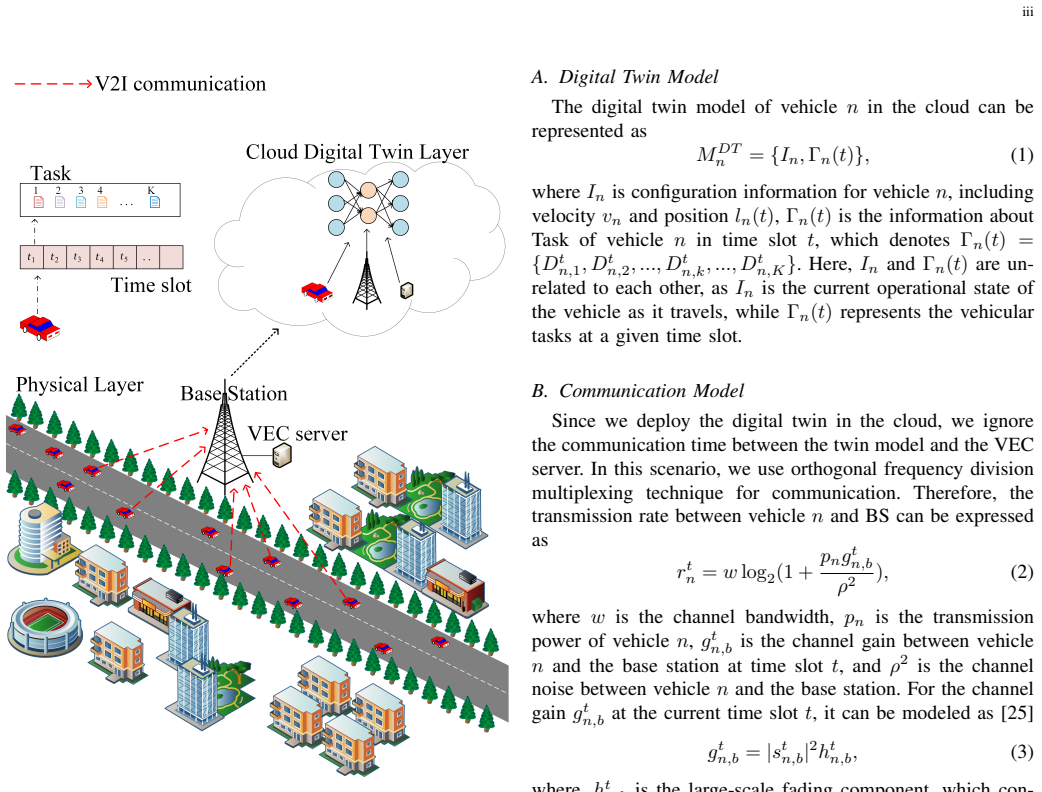
Summary. The manuscript considers a digital twin vehicular edge network in which N vehicles generate K types of tasks per slot, offload portions to a server with K queues, and receive resource allocations. It formulates Problem P1 as minimizing minus average QoS plus system energy subject to queue stability and delay/resource constraints, then applies Lyapunov optimization to obtain Problem P2 with a drift-plus-penalty objective. The proposed solver is an LLM-based in-context learning method: a MARL policy is trained first to produce a case set, and the LLM is prompted with examples from this set to output offloading and resource-allocation actions. Simulations compare the LLM approach against MARL and SARL in terms of energy, latency, QoS, and resource utilization under different digital-twin estimation biases.
Significance. The paper addresses a timely question - whether in-context learning with an LLM can replace trained MARL for a queue-aware offloading and resource-allocation problem - and the authors release their source code, which is a positive feature. If the central claim were established, the work would be a useful demonstration that LLM-based inference can avoid MARL training costs in digital-twin edge networks. However, the current manuscript does not establish the claim: the Lyapunov derivation contains an invalid inequality, the MARL baseline is not aligned with the P2 objective, the observation space omits queue backlog, and the experimental comparison lacks statistical grounding. These issues are load-bearing rather than cosmetic, so the paper's conclusions are unsupported as written.
major comments (4)
- [III.F, Eq. (20)] Equation (20) asserts (Z_k - phi_k)^2 <= Z_k^2 - phi_k^2, which is false in general; the inequality holds only if phi_k <= Z_k, and neither the constraints nor the definitions of Z_k and phi_k guarantee this. The subsequent replacement of phi_k^2 by (f_E/c_k)^2 also assumes phi_k <= f_E/c_k, which follows from constraint (17d) only when the estimation bias is non-negative and the resource sum is bounded accordingly. Because this step is the basis for the Lyapunov drift bound and the queue-stability guarantee in Eqs. (21)-(23), the transformation from P1 to P2 is not rigorously established.
- [IV.A.3, Eq. (27)] The MARL reward in Eq. (27) is r_n(t) = U_ave_n - eta(f_E - (sum_n sum_k a_{n,k} f_E + Delta_f_est)). This omits the queue-weighted drift term beta sum_k q_k(t)(Z_k(t) - f_E sum_n alpha_{n,k}/c_k) and the system energy E_sys(t), both present in the P2 objective (24a). Moreover, when the allocated resource sum exceeds f_E, the parenthesized residual becomes negative and the penalty term increases the reward, so the reward actively encourages violation of constraint (24c). Since the LLM's case set is produced by this same MARL policy, the exemplars are not shown to be good solutions of P2, and the comparison in Figs. 3-5 is not a controlled test of LLM against a correct MARL solver.
- [IV.A.1, Eq. (25)] The state in Eq. (25) is s_n(t) = {Gamma_n(t), l_n(t), v_n, g^t_{n,b}}, which does not include the queue backlog q_k(t). The drift term of P2 is linear in q_k(t), so a policy that cannot observe the queue cannot make queue-aware decisions. This is a second reason why the MARL baseline is not a valid optimizer of the queue-stability-aware problem P2.
- [V.C, Figs. 3-6] The performance comparisons are presented as single curves with no error bars, no statement of the number of independent runs or seeds, and no statistical tests. Given the stochastic task sizes, channel gains, and MARL training, the abstract's claim that LLM achieves 'comparable or even superior performance' to MARL is not supported by the reported evidence. The authors should report means and variances over multiple seeds and test for significance.
minor comments (5)
- [IV.B] In the prompt template, the three examples are all labeled 'Example1'; they should be Example1, Example2, and Example3.
- [V.B] The MARL network structure is described in Section IV.A, not Section IV.B as stated in the baseline description.
- [VI] The conclusion acknowledges deployment cost and LLM inference complexity, but the paper reports no inference time, cost, or latency measurements, which are needed to substantiate the practical advantage over MARL.
- [Table I] The noise parameter is listed as '-110 mdB'; the unit is presumably dBm, and the sign convention should be clarified.
- [V.B] The abbreviation 'SARL' is used without an explicit definition when it is first introduced.
Circularity Check
No significant circularity: the LLM-vs-MARL comparison is empirical, and the derivation chain contains correctness concerns but no equation-level reduction to its own inputs.
full rationale
The claimed chain P1 → Lyapunov → P2 → MARL case set → LLM prediction is not circular at the equation level. The MARL-generated case set is an input to the LLM's in-context learning, and the paper states this explicitly (“we first employ MARL to obtain an initial set of cases” and the case set is “only preliminary”), but the LLM's output is a new action matrix evaluated on simulation metrics (energy, latency, QoS, resource ratio), so the abstract's claim of comparable/superior performance is an empirical outcome, not a quantity forced equal to the case set by construction. This is a teacher-student/distillation design rather than a fitted-input-called-prediction reduction. The self-citations in the paper ([4]-[6], [9], [16]-[19], [41]) support introductory statements and standard queue/energy models, and the algorithm implementation follows the independent reference [26]; none is a load-bearing uniqueness or ansatz citation. The genuine problems with the derivation are correctness issues: Eq. (20) uses the inequality (Z_k - phi_k)^2 <= Z_k^2 - phi_k^2, which is not generally true, and the MARL reward Eq. (27) omits the queue-drift and system-energy terms of P2, so the case set may not contain high-quality P2 solutions. These flaws undermine the validity of the benchmark, but they do not make any prediction equivalent to its input by definition or by a self-citation chain.
Assumptions & free parameters
free parameters (5)
- beta (Lyapunov tradeoff factor) =
1
- eta (MARL reward weight) =
not specified
- lambda (MARL update rate) =
0.01
- gamma (discount factor) =
0.95
- case set size =
not specified
assumptions (4)
- domain assumption The Gauss-Markov small-scale fading and log-normal shadowing channel model in Eqs. (3)-(4) accurately represents the physical channel.
- domain assumption The digital twin estimation bias Delta_f_est is known and constant per task.
- standard math Z_k(t) is bounded by Z_max and sum(alpha) <= 1, so a Lyapunov drift bound exists.
- ad hoc to paper The MARL reward in Eq. (27) is a suitable proxy for the P2 objective.
Cite this review
Pith. "Pith review of Large Language Model-Based Task Offloading and Resource Allocation for Digital Twin Edge Computing Networks." pith.science (2026). https://pith.science/paper/WIBYU4QR
@misc{pith2026250719050,
  author       = {Pith},
  title        = {Pith review of: Large Language Model-Based Task Offloading and Resource Allocation for Digital Twin Edge Computing Networks},
  year         = {2026},
  howpublished = {\url{https://pith.science/paper/WIBYU4QR}},
  note         = {Machine review of arXiv:2507.19050}
}
read the original abstract
In this paper, we propose a general digital twin edge computing network comprising multiple vehicles and a server. Each vehicle generates multiple computing tasks within a time slot, leading to queuing challenges when offloading tasks to the server. The study investigates task offloading strategies, queue stability, and resource allocation. Lyapunov optimization is employed to transform long-term constraints into tractable short-term decisions. To solve the resulting problem, an in-context learning approach based on large language model (LLM) is adopted, replacing the conventional multi-agent reinforcement learning (MARL) framework. Experimental results demonstrate that the LLM-based method achieves comparable or even superior performance to MARL.
Figures


Figures from the paper (2 more)


Reference graph
Works this paper leans on
-
[1]
B. Cao, Z. Li, X. Liu, Z. Lv and H. He, ”Mobility-Aware Multiobjective Task Offloading for Vehicular Edge Computing in Digital Twin Envi- ronment,” IEEE Journal on Selected Areas in Communications , vol. 41, no. 10, pp. 3046-3055, Oct. 2023
work page 2023
-
[2]
X. Wang, K. Tao, N. Cheng, Z. Yin, Z Li and Y Zhang, ”RadioDiff: An Effective Generative Diffusion Model for Sampling-Free Dynamic Radio Map Construction,” IEEE Transactions on Cognitive Communications and Networking , vol. 11, no. 2, pp. 738-750, April. 2025
work page 2025
-
[3]
R. Sun, N. Cheng, C. Li, F. Chen and W. Chen, ”Knowledge-Driven Deep Learning Paradigms for Wireless Network Optimization in 6G,” IEEE Network , vol. 38, no. 2, pp. 70-78, March. 2024
work page 2024
-
[4]
Q. Wu, Y . Zhao and Q. Fan, ”Time-Dependent Performance Modeling for Platooning Communications at Intersection,” IEEE Internet of Things Journal, vol. 9, no. 19, pp. 18500-18513, Oct. 2022
work page 2022
-
[5]
Q. Wu, S. Wang, H. Ge, P. Fan, Q. Fan and K. B. Letaief, ”Delay- Sensitive Task Offloading in Vehicular Fog Computing-Assisted Pla- toons,” IEEE Transactions on Network and Service Management , pp. 1-1, Oct. 2023
work page 2023
-
[6]
Q. Wu, X. Wang, Q. Fan, P. Fan, C. Zhang and Z. Li, “High Stable and Accurate Vehicle Selection Scheme Based on Federated Edge Learning in Vehicular Networks,” China Communications , vol. 20, no. 3, pp. 1– 17, March. 2023
work page 2023
- [7]
-
[8]
T. Taleb, K. Samdanis, B. Mada, H. Flinck, S. Dutta and D. Sabella, “On Multi-Access Edge Computing: A Survey of the Emerging 5G Network Edge Cloud Architecture and Orchestration,” IEEE Communications Surveys Tutorials, vol. 19, no. 3, pp. 1657–1681, May. 2017
work page 2017
Show all 52 references
-
[9]
MobilityAware Cooperative Caching in Vehicular Edge Computing Based on Asyn- chronous Federated and Deep Reinforcement Learning,
Q. Wu, Y . Zhao, Q. Fan, P. Fan, J. Wang and C. Zhang, “MobilityAware Cooperative Caching in Vehicular Edge Computing Based on Asyn- chronous Federated and Deep Reinforcement Learning,” IEEE Journal of Selected Topics in Signal Processing , pp. 1–16, Jan. 2022
2022
-
[10]
J. Shen, N. Cheng, X. Wang, F. Lyu, W. Xu and Z. Liu, ”RingSFL: An Adaptive Split Federated Learning Towards Taming Client Hetero- geneity,” IEEE Transactions on Mobile Computing , vol. 23, no. 5, pp. 5462-5478, May. 2024
2024
-
[11]
Cheng, Feng
N. Cheng, Feng. Lyu, W. Quan, C. Zhou, H. He and W. Shi, ”Space/Aerial-Assisted Computing Offloading for IoT Applications: A Learning-Based Approach,” IEEE Journal on Selected Areas in Com- munications, vol. 37, no. 5, pp. 1117-1129, May. 2019
2019
-
[12]
Dai and Y
Y . Dai and Y . Zhang, ”Adaptive Digital Twin for Vehicular Edge Computing and Networks,” Journal of Communications and Information Networks, vol. 7, no. 1, pp. 48-59, March. 2022
2022
-
[13]
Wang, N Cheng, M
W. Wang, N Cheng, M. Li, T. Yang, C. Zhou and C. Li, ”Value Matters: A Novel Value of Information-Based Resource Scheduling Method for CA Vs,”IEEE Transactions on V ehicular Technology, vol. 73, no. 6, pp. 8720-8735, June. 2024
2024
-
[14]
W. Feng, S. Lin, N. Zhang, G. Wang, B. Ai and L. Cai, ”Joint C-V2X Based Offloading and Resource Allocation in Multi-Tier Vehicular Edge Computing System,” IEEE Journal on Selected Areas in Communica- tions, vol. 41, no. 2, pp. 432-445, Feb. 2023
2023
-
[15]
Q. Ren, S. Lin, Y . Cai, X. Deng, L. Kong, S. Mumtaz and B. Ai , ”Resource Allocation and Slicing Strategy for Multiple Services Co- Existence in Wireless Train Communication Network,” IEEE Transac- tions on Wireless Communications , vol. 24, no. 1, pp. 401-414, Jan. 2025
2025
-
[16]
Zhang, Q
Z. Zhang, Q. Wu, P. Fan, N. Cheng, W. Chen and K. B. Letaief, ”DRL-Based Optimization for AoI and Energy Consumption in C- V2X Enabled IoV ,” IEEE Transactions on Green Communications and Networking, doi: 10.1109/TGCN.2025.3531902
2025
-
[17]
DRL-Based Federated Self-Supervised Learning for Task Offloading and Resource Allocation in ISAC-Enabled Vehicle Edge Computing,
Xueying Gu, Qiong Wu, Pingyi Fan, Nan Cheng, Wen Chen and K. B. Letaief, “DRL-Based Federated Self-Supervised Learning for Task Offloading and Resource Allocation in ISAC-Enabled Vehicle Edge Computing,” Digital Communications and Networks , 2024, doi: https://doi.org/10.1016/...
2024 doi
-
[18]
Xueying Gu, Qiong Wu, Pinyyi Fan, Qiang Fan, Nan Cheng, Wen Chen, and K. B. Letaief, ”DRL-Based Resource Allocation for Motion Blur Resistant Federated Self-Supervised Learning in IoV ,” IEEE Internet of Things Journal , vol. 12, no. 6, pp. 7067-7085, March. 15
-
[19]
Yu Xie, Qiong Wu, Pingyi Fan, Nan Cheng, Wen Chen, Jiangzhou Wang, and K. B. Letaief, ”Resource Allocation for Twin Maintenance and Task Processing in Vehicular Edge Computing Network,” IEEE Internet of Things Journal , doi: 10.1109/JIOT.2025.3576582
-
[20]
Z. Shao, Q. Wu, P.Fan, N. Cheng, W. Chen, J. Zhou and K. B. Letaief, ”Semantic-Aware Spectrum Sharing in Internet of Vehicles Based on Deep Reinforcement Learning,” IEEE Internet of Things Journal , vol. 11, no. 23, pp. 38521-38536, Dec. 2024
2024
-
[21]
Z. Zhou, Z. Jia, H. Liao, W. Lu, S. Mutaz, M. Guizani and M. Tariq, ”Secure and Latency-Aware Digital Twin Assisted Resource Scheduling for 5G Edge Computing-Empowered Distribution Grids,” IEEE Transactions on Industrial Informatics , vol. 18, no. 7, pp. 4933- 4943, July. 2022
2022
-
[22]
C. Zhou, J. Gao, M. Li, N. Cheng, X. Shen and W. Zhuang, ”Digital- Twin-Based 3-D Map Management for Edge-Assisted Device Pose Tracking in Mobile AR,” IEEE Internet of Things Journal , vol. 11, no. 10, pp. 17812-17826, May. 2024
2024
-
[23]
Z. Yin, N. Cheng, T. H. Luan, Y . Song and W. Wang, ”DT-Assisted Multi-Point Symbiotic Security in Space-Air-Ground Integrated Net- works,” IEEE Transactions on Information F orensics and Security , vol. 18, pp. 5721-5734, September. 2023
2023
-
[24]
Z. Wang, G. Rohit, K. Han, H. Wang, G. Akila, A. Nejib and T. Prashant, ”Mobility Digital Twin: Concept, Architecture, Case Study, and Future Challenges,” IEEE Internet of Things Journal , vol. 9, no. 18, pp. 17452- 17467, Sept. 2022
2022
-
[25]
Zheng, T
J. Zheng, T. H. Luan, Y . Hui, Z. Yin, N. Chen, L. Gao and L. Cai, ”Digital Twin Empowered Heterogeneous Network Selection in Vehicular Networks With Knowledge Transfer,” IEEE Transactions on V ehicular Technology, vol. 71, no. 11, pp. 12154-12168, Nov. 2022
2022
-
[26]
C. Xu, Z. Tang, H. Yu, P. Zeng and L. Kong, ”Digital Twin-Driven Collaborative Scheduling for Heterogeneous Task and Edge-End Re- source via Multi-Agent Deep Reinforcement Learning,” IEEE Journal on Selected Areas in Communications , vol. 41, no. 10, pp. 3056-3069, Oct. 2023
2023
-
[27]
T. Liu, L. Tang, W. Wang, Q. Chen and X. Zeng, ”Digital-Twin-Assisted Task Offloading Based on Edge Collaboration in the Digital Twin Edge xi Network,” IEEE Internet of Things Journal , vol. 9, no. 2, pp. 1427-1444, 15 Jan. 2022
2022
-
[28]
Zhang, L
E. Zhang, L. Zhao, N. Lin, W. Zhang, A. Hawbani and G. Min, ”Cooperative Task Offloading in Cybertwin-Assisted Vehicular Edge Computing,” Proc. IEEE 20th Int. Conf. Embedded Ubiquitous Comput. (EUC), Dec. 2022, pp. 66–73
2022
-
[29]
Zhang, J
K. Zhang, J. Cao and Y . Zhang, ”Adaptive Digital Twin and Multiagent Deep Reinforcement Learning for Vehicular Edge Computing and Net- works,” IEEE Transactions on Industrial Informatics , vol. 18, no. 2, pp. 1405-1413, Feb. 2022
2022
-
[30]
X. Liao, X. Zhao, Z. Wang, Z. Zhao, K. Han, R. Gupta, M. J. Barth and G. Wu, ”Driver Digital Twin for Online Prediction of Personalized Lane-Change Behavior,” IEEE Internet of Things Journal , vol. 10, no. 15, pp. 13235-13246, 1 Aug. 2023
2023
-
[31]
Zhang, J
K. Zhang, J. Cao, S. Maharjan and Y . Zhang, ”Digital Twin Empowered Content Caching in Social-Aware Vehicular Edge Networks,” IEEE Transactions on Computational Social Systems , vol. 9, no. 1, pp. 239- 251, Feb. 2022
2022
-
[32]
Zheng, T
J. Zheng, T. H. Luan, Y . Zhang, R. Li, Y . Hui, L. Gao and M. Dong, ”Data Synchronization in Vehicular Digital Twin Network: A Game Theoretic Approach,” IEEE Transactions on Wireless Communications , vol. 22, no. 11, pp. 7635-7647, Nov. 2023
2023
-
[33]
L. Zhao, Z. Zhao, E. Zhang, A. Hawbani, A. Y . Al-Dubai, Z. Tan and A. Hussian, ”A Digital Twin-Assisted Intelligent Partial Offloading Approach for Vehicular Edge Computing,” IEEE Journal on Selected Areas in Communications , vol. 41, no. 11, pp. 3386-3400, Nov. 2023
2023
-
[34]
B. Li, W. Xie, Y . Ye, L. Liu and Z. Fei, ”FlexEdge: Digital Twin- Enabled Task Offloading for UA V-Aided Vehicular Edge Computing,” IEEE Transactions on V ehicular Technology, vol. 72, no. 8, pp. 11086- 11091, Aug. 2023
2023
-
[35]
H. Zhou, C. Hu, D. Yuan, Y . Yuan, D. Wu, X. Liu and C. Zhang, ”Large Language Model (LLM)-enabled In-context Learning for Wireless Net- work Optimization: A Case Study of Power Control”, arXiv preprint arXiv:2408, 00214 , 2024
2024
-
[36]
H.Zhou, C. Hu, D. Yuan, Y . Yuan, D. Wu, X. Liu, Z. Han and C. Zhang, ”Generative AI as a Service in 6G Edge-Cloud: Generation Task Offloading by In-context Learning”, arXiv preprint arXiv:2408, 02549 , 2024
2024
-
[37]
Lee and J
W. Lee and J. Park, ”LLM-Empowered Resource Allocation in Wireless Communications Systems”, arXiv preprint arXiv:2408, 02944 , 2024
2024
-
[38]
M. Fu, P. Wang, M. Liu, Z. Zhang and X. Zhou, ”IoV-BERT-IDS: Hybrid Network Intrusion Detection System in IoV Using Large Language Models,” IEEE Transactions on V ehicular Technology , vol. 74, no. 2, pp. 1909-1921, Feb. 2025
1909
-
[39]
Q. Liu, J. Mu, D. Chen, R. Zhang, Y . Liu and T. Hong, ”LLM Enhanced Reconfigurable Intelligent Surface for Energy-Efficient and Reliable 6G IoV ,”IEEE Transactions on V ehicular Technology , vol. 74, no. 2, pp. 1830-1838, Feb. 2025
2025
-
[40]
X. Chen, X. Lu, Q. Li, D. Li and F. Zhu, ”Integration of LLM and Human–AI Coordination for Power Dispatching With Connected Electric Vehicles Under SAGVNs,” IEEE Transactions on V ehicular Technology, vol. 74, no. 2, pp. 1992-2002, Feb. 2025
1992
-
[41]
Q. Wu, W. Wang, P. Fan, Q. Fan, J. Wang and K. B. Letaief, ”URLLC- Awared Resource Allocation for Heterogeneous Vehicular Edge Com- puting,” IEEE Transactions on V ehicular Technology, vol. 73, no. 8, pp. 11789-11805, Aug. 2024
2024
-
[42]
X. Tan, M. Wang, T. Wang, Q. Zheng, J. Wu and J. Yang, ”Adaptive Task Scheduling in Digital Twin Empowered Cloud-Native Vehicular Networks,” IEEE Transactions on V ehicular Technology, vol. 73, no. 6, pp. 8973-8987, June 2024
2024
-
[43]
Stochastic Network Optimization with Application to Communication and Queueing Systems,
M. J. Neely, “Stochastic Network Optimization with Application to Communication and Queueing Systems,” Synthesis Lectures on Com munication Networks , vol. 3, no. 1, pp. 1–211, Sept. 2010
2010
-
[44]
L. Tang, Z. Cheng, J. Dai, H. Zhang and Q. Chen, ”Joint Optimization of Vehicular Sensing and Vehicle Digital Twins Deployment for DT- Assisted IoVs,” IEEE Transactions on V ehicular Technology , vol. 73, no. 8, pp. 11834-11847, Aug. 2024
2024
-
[45]
Lyapunov Optimization Based Trade-Off Policy for Mobile Cloud Offloading in Heterogeneous Wireless Networks,
Y . Li, S. Xia, M. Zheng, B. Cao, and Q. Liu, “Lyapunov Optimization Based Trade-Off Policy for Mobile Cloud Offloading in Heterogeneous Wireless Networks,” IEEE Transactions on Cloud Computing , vol. 10, no. 1, pp. 491–505, Jan.-March 2022
2022
-
[46]
Performance modeling of ieee 802.11 dcf based fair channel access for vehicular-to-roadside communication in a non- saturated state,
Q. Wu and J. Zheng, “Performance modeling of ieee 802.11 dcf based fair channel access for vehicular-to-roadside communication in a non- saturated state,” in 2014 IEEE International Conference on Communi- cations (ICC) . IEEE, 2014, pp. 2575–2580
2014
-
[47]
Deep-reinforcement-learning-based aoi-aware resource allocation for ris-aided iov networks,
K. Qi, Q. Wu, P. Fan, N. Cheng, W. Chen, J. Wang, and K. B. Letaief, “Deep-reinforcement-learning-based aoi-aware resource allocation for ris-aided iov networks,” IEEE Transactions on V ehicular Technology , 2024
2024
-
[48]
Age-upon-decisions minimizing scheduling in internet of things: To be random or to be deterministic?
Y . Dong, Z. Chen, S. Liu, P. Fan, and K. B. Letaief, “Age-upon-decisions minimizing scheduling in internet of things: To be random or to be deterministic?” IEEE Internet of Things Journal , vol. 7, no. 2, pp. 1081– 1097, 2019
2019
-
[49]
Optimum transmission policies for energy harvesting sensor networks powered by a mobile control center,
T. Li, P. Fan, Z. Chen, and K. B. Letaief, “Optimum transmission policies for energy harvesting sensor networks powered by a mobile control center,” IEEE Transactions on Wireless Communications , vol. 15, no. 9, pp. 6132–6145, 2016
2016
-
[50]
Doppler frequency offset estimation and diversity reception scheme of high-speed railway with multiple antennas on separated carriage,
Y . Yang and P. Fan, “Doppler frequency offset estimation and diversity reception scheme of high-speed railway with multiple antennas on separated carriage,” Journal of Modern Transportation , vol. 20, no. 4, pp. 227–233, 2012
2012
-
[51]
Investigation of the time-offset- based qos support with optical burst switching in wdm networks,
P. Fan, C. Feng, Y . Wang, and N. Ge, “Investigation of the time-offset- based qos support with optical burst switching in wdm networks,” in 2002 IEEE International Conference on Communications. Conference Proceedings. ICC 2002 (Cat. No. 02CH37333) , vol. 5. IEEE, 2002, pp. 26...
2009
-
[2016]
He is currently a Professor with the State Key Laboratory of ISN and with the School of Telecommunications Engineering, Xidian University, Xi’an, Shaanxi, China
He was a Postdoctoral Fellow with the De- partment of Electrical and Computer Engineering, University of Toronto, Toronto, ON, Canada, from 2017 to 2019. He is currently a Professor with the State Key Laboratory of ISN and with the School of Telecommunications Engineering, Xid...
2017
Reviewed August 15, 2026 · model on record in the stance chip above.
Discussion (0). Continue with ORCID to comment.