REVIEW 3 major objections 3 minor 59 references
Transverse Spheres in Flag Manifolds
T0 review · 3 major / 3 minor · reviewed 2026-08-15 · deepseek-v4-flash
Pith's one-line read The paper proves that, in self-opposite flag manifolds of split real simple Lie groups, transverse circles are locally maximally transverse exactly for the pairs $(G,\Theta)$ listed in Table 1, and constructs transverse spheres of…
desk verdict A serious, innovative classification preprint that closes Question 0.1 for split real groups if the delegated coverage claims in Table 1 hold up. read the letter →
The pith
A machine-rendered reading of the paper's core claim, the machinery that carries it, and where it could break.
The reading
What carries the argument
The central object is the spinor representation of $\mathrm{Spin}(n)$ built from real Clifford algebras: for $n = 8k + r$ the irreducible spinor module has dimension $d(n)$ as stated, and its action on $\mathbb{R}^{d(n)}$ produces the transverse sphere via an orbit map on a full flag. Maximal transversality is certified by the Atiyah-Bott-Shapiro isomorphism, which identifies the stable homotopy class of the clutching map $S^{n-1} \to \mathrm{SO}(d)$ with a class in the Grothendieck group of Clifford modules; the calculation pins down the mod-8 condition $n \in \{0,1,2,4\}$. The classification is carried by two further tools: a direct-sum construction that combines transverse maps in smaller flag manifolds into transverse maps in larger ones, and transversality-preserving embeddings between flag manifolds of different Cartan types, such as $B_n \to A_{2n}$, $D_{2n} \to A_{4n-1}$, and $D_{2n} \to B_{2n}$. The equivalence theorem 0.19 reduces the circle question to the absence of transverse 2-spheres, which is what the constructions verify case by case.
What would settle it
The classification would collapse if one found a transverse 2-sphere in any flag manifold listed as positive in Table 1 (for instance $\mathrm{Flag}(\mathbb{R}^d)$ with $d \equiv 3,4,5 \pmod{8}$ or an $E_7$ flag with the marked root $7$ in $\Theta$), since Theorem 0.19 equates the positive answer with the absence of transverse 2-spheres. A direct check could also target a negative cell: exhibit a single transverse circle in a listed-negative flag manifold that is locally maximally transverse.
Extended reading notes
Core claim
The central discovery is a complete classification (Theorem 0.2): for a split real simple Lie group $G$ and a self-opposite flag manifold $F^\Theta$, every transverse circle in $F^\Theta$ is locally maximally transverse if and only if $(G,\Theta)$ appears in Table 1. The only new restriction is for type $E_7$, where the simple root labelled $7$ must belong to $\Theta$; the remaining entries verify that previously known positive answers are optimal, and the negative entries are realized by explicit transverse $m$-spheres with $m \geq 2$. Alongside the classification, the paper constructs transverse $(n-1)$-spheres in the full flag manifold $\mathrm{Iso}_{Jd-1K}(\mathbb{R}^{d-1,d})$ for every $n \geq 2$, with an explicit $d(n) \approx 2^{n/2}$, proves these spheres are maximally transverse precisely when $n \in \{0,1,2,4\} \pmod{8}$ (Theorem 0.9), and shows that the full flag manifolds of split $G_2$, $B_3$, and $D_4$ fibre over lower-dimensional flag manifolds with every fibre a maximally transverse 3-sphere. As a direct corollary, $\{7\}$-Anosov subgroups of split $E_7$—hence all Borel Anosov subgroups—are virtually free or surface groups.
Load-bearing premise
The completeness of the classification rests on the claim that every positive case in Table 1 is genuinely covered by prior theorems on local maximal transversality that the paper invokes; if any positive cell is uncovered, or if any inherited result is weaker than stated, the classification overreaches.
Editorial extensions
If this is right
- If Theorem 0.2 is correct, the positive-answer pairs $(G,\Theta)$ are exactly those in Table 1; in particular, the only split exceptional group with any locally maximally transverse circles is $E_7$, and only when the marked root $7$ lies in $\Theta$.
- Every $\{7\}$-Anosov subgroup of split $E_7$, hence every Borel Anosov subgroup, is virtually a free group or a surface group (Corollary 0.7).
- Full flag manifolds of split groups of type $A$, $B$, and $D$ contain transverse spheres of arbitrarily large dimension; for example, $\mathrm{Flag}(\mathbb{R}^{d})$ with $d = 2 \cdot 16^n$ contains a maximally transverse $8n$-sphere.
- For split real groups, local maximal transversality of transverse circles, Property (I), and the non-existence of transverse 2-spheres are three equivalent conditions (Theorem 0.19).
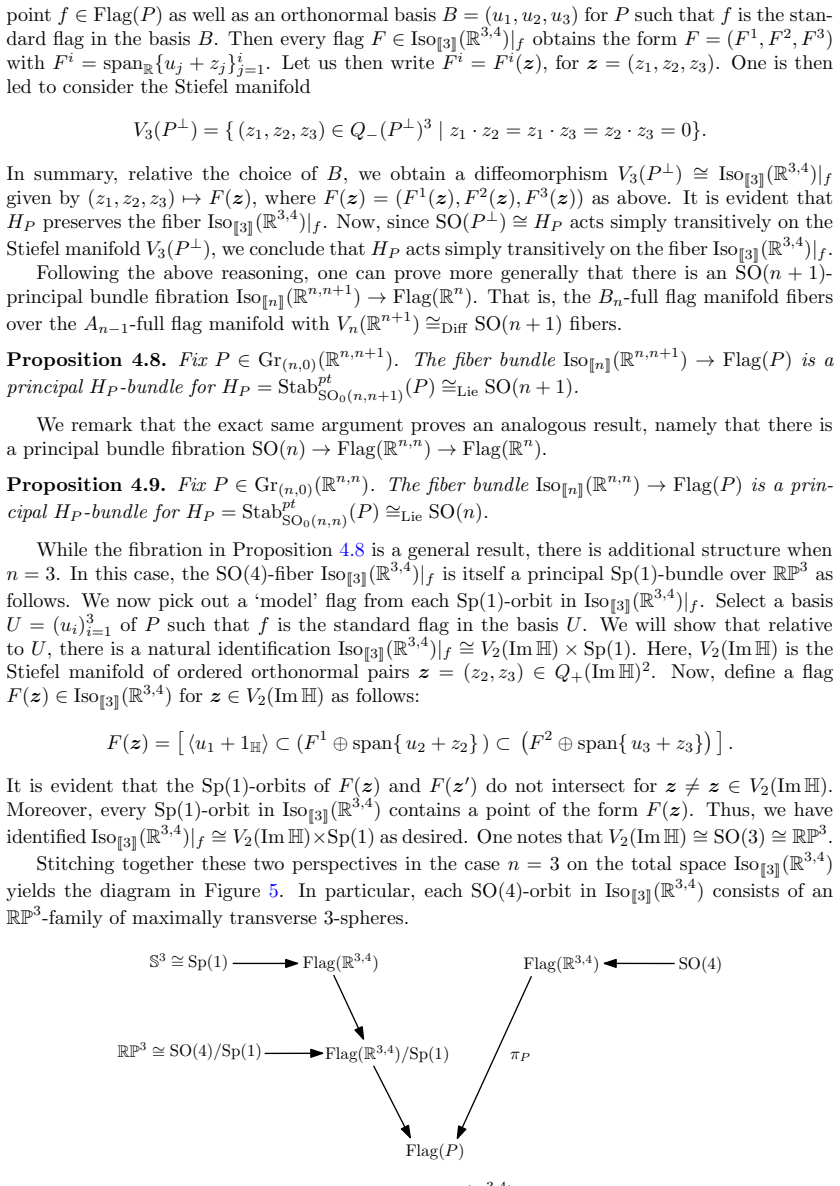
- The full flag manifolds of split $G_2$, $B_3$, and $D_4$ are principal $\mathrm{Sp}(1)$-bundles whose fibres are all maximally transverse 3-spheres.
Reading between the lines
- The mod-8 pattern in Theorem 0.9 looks like a geometric face of Bott periodicity, since the same residue classes control real $K$-theory of spheres; the paper uses the Atiyah-Bott-Shapiro isomorphism as a tool, but one could take this connection as evidence that any transverse-sphere construction in these flag manifolds will inherit an 8-periodic classification.
- The deformed spheres of Theorem 0.13 are not obstructed from being Anosov limit sets. If one of them is realised, it would give an irreducible Borel Anosov subgroup with boundary $S^3$ or $S^7$ in $\mathrm{SO}(8k,8k)$ or $\mathrm{SL}(16k,\mathbb{R})$, which current theory does not exclude; Question 0.20 is the concrete test case.
- The classification in Table 1 likely extends, with modifications, to non-split real forms via the maximal split subalgebra inclusion the paper mentions; a testable extension is to check whether any transverse 2-sphere in the split form survives the inclusion into the non-split flag manifold.
Signed reviews
Editorial analysis
A structured set of objections, weighed in public.
Referee Report
Summary. The paper studies Question 0.1 for self-opposite flag manifolds of split real simple Lie groups: when is every transverse circle locally maximally transverse. The main claim is Theorem 0.2 with Table 1, a complete classification, with the only new restriction for E7. The paper also constructs transverse spheres via spinor representations: Theorem 0.8 gives transverse (n-1)-spheres in type B/D full flag manifolds for explicit d(n) approximately 2^{n/2}, and Theorem 0.9 proves, via the Atiyah-Bott-Shapiro isomorphism, that these are maximally transverse for n congruent to 0,1,2,4 mod 8. Applications to Anosov subgroups include Corollary 0.7: {7}-Anosov subgroups of split E7 are virtually free or surface groups. The paper also constructs fibrations by maximally transverse 3-spheres in the G2, B3, and D4 cases.
Significance. If the classification and the maximal-transversality results are correct, this resolves a natural question for all split real groups and gives a striking connection between the mod-8 phenomenon for transverse spheres and Bott periodicity. The new negative constructions are explicit and self-contained, and the use of the Atiyah-Bott-Shapiro isomorphism to certify maximal transversality is concrete and, for the main cases, machine-checkable in principle. The deformation construction of Section 2.3 and the obstruction results of Section 9 are useful independent contributions. The main risk is not the internal constructions but the provenance of the positive direction of Table 1, which is delegated to several external papers.
major comments (3)
- [Theorem 0.19 / Table 1] The completeness of the positive direction of Table 1 is delegated to prior work without a case-by-case justification. In the proof of Theorem 0.19, the sentence 'we have applied results of [Tso20, Dey25, DGR24, KT24] to verify that Property (I) holds in the cases complementing our construction(s)' does not specify which external theorem verifies each positive row, nor how the notion of maximal transversality in those sources (global in some cases, local in others) matches the 'locally maximally transverse' wording of Table 1. Because Theorem 0.2 is a complete classification, this is load-bearing. Please add a table or paragraph that maps each positive row of Table 1 to the exact theorem in [Tso20, Dey25, DGR24, PT24, KT24, TZ24] and states the compatibility argument.
- [Theorem 8.2] The proof of the E7 restriction is too compressed for a new classification result. It cites a 56-dimensional minuscule representation of E7 and says proximality is straightforward from the weight multiplicities (3/2, 1/2, -1/2, -3/2 of multiplicities 1,27,27,1), then invokes [PT24] for maximality of the image circle in RP55. Please identify the equivariant map F^{7}(E7) to RP55 explicitly, show the proximality calculation for the coweight, and state the pullback argument that maximality of a transverse circle in the target implies maximality of its preimage in F^{7}. The pullback fact is true for transversality-preserving maps because a point of F^{7} transverse to all points of the circle would map to a point of RP55 transverse to all points of the image, but it should be written out.
- [Theorems 0.3(b,d), 0.4(b,c), 0.5(c), 8.2] Several positive assertions are transferred from a smaller flag manifold to a larger one by projections or equivariant maps without an explicit statement of the transfer principle. For example, Theorem 0.3(b) passes from Gr_{d/2}(R^d) to any Flag^Theta(R^d) with d/2 in Theta, and Theorem 0.6(c) passes from F^{7}(E7) to F^Theta(E7) with 7 in Theta. The needed fact is: if f: X to Y is a transversality-preserving map between self-opposite flag manifolds and S subset X is transverse with f(S) locally maximally transverse in Y, then S is locally maximally transverse in X. The proof is one line (a point of X transverse to all of S would have a transverse image), but the paper never states it. Please add this lemma and use it consistently, since the local-versus-global distinction is central to Question 0.1.
minor comments (3)
- [Theorem 5.1 proof] In the first paragraph of the proof of Theorem 5.1, the phrase 'contained in a transverse n-sphere' is dimensionally inaccurate for n congruent to 5,6,7 mod 8: the containing sphere supplied by Corollary 2.13 has dimension rho(d(n))-1, which equals n only in the n congruent to 3 mod 8 case. Please write 'a larger transverse sphere' and give its dimension explicitly.
- [Corollary 2.13 / Theorem 0.8] The symbol n is overloaded: in Theorem 0.8 it denotes the sphere dimension plus one, while in Corollary 2.13 it denotes the dimension of the spinor module and of the pseudo-Euclidean space R^{n,n+epsilon}. Using different letters would avoid confusion.
- [Section 0.4.1] The delegation sentence in the proof of Theorem 0.19 omits [PT24], which is used elsewhere in the paper for type C and for the E7 row. The revision should state explicitly which parts of the classification use [PT24] rather than [DGR24] alone.
Circularity Check
No significant circularity: the new constructions are explicit and independently verified, while the classification relies on external published results; minor self-citations are not used to smuggle the central conclusions.
full rationale
The paper's new constructions are self-contained derivations: the spinor spheres are defined by explicit formulas (0.3) and (0.4), their dimensions are fixed by the Clifford algebra representation theory of [LM89], and transversality is verified by direct matrix computations (Lemma 2.12 and Lemma 2.14) rather than by assuming the desired conclusion. Maximal transversality is checked against the external Atiyah-Bott-Shapiro isomorphism [ABS64], a classical and independent body of mathematics that is not tuned to produce the paper's theorem statements. The classification in Table 1 combines these new negative constructions (transverse m-spheres with m≥2) with previously published positive results from [Tso20, Dey25, DGR24, PT24, KT24, TZ24]; those cited results are independent and concern specific flag manifolds, not restatements of the present theorems. Self-citations do occur: [DGR24, Lemma 2.7] and [DGR24, Proposition 2.5] are used in the proof of Theorem 0.19, and [Eva24a, Eva24b] are cited for standard facts about G′2. However, these are prior background results with independent content, and they are not invoked as a uniqueness theorem or as an ansatz to force the classification; thus they do not make the derivation circular. The genuine soft spot is a delegation/reproducibility gap, not circularity: the proof of Theorem 0.19 says 'we have applied results of [Tso20, Dey25, DGR24, KT24] to verify that Property (I) holds in the cases complementing our construction(s)' without mapping each row of Table 1 to a specific external theorem, and Example 7.9 shows that even the paper's own direct-sum method can fail to certify maximal transversality. That is a verification and completeness concern for the correctness pass, not a reduction of a prediction to its input. Accordingly, no circular step is identified and the score is low.
Assumptions & free parameters
assumptions (6)
- standard math Atiyah-Bott-Shapiro isomorphism gKO(S^k) ≅ M_{k-1}/ι*M_k ([ABS64, Theorem 11.5])
- standard math Standard real Clifford algebra structure theory: periodicity Cl(n+8) ≅ Cl(n) ⊗ Cl(8), spin metrics, spinor irreducibility mod 8 [LM89]
- standard math Hurwitz theorem classification of composition algebras R, C, H, O, C', H', O' and existence of cross products only in signatures (3,0), (7,0), (1,2), (3,4)
- domain assumption External prior results: [Tso20], [Dey25], [DGR24], [PT24], [KT24], [TZ24], [CT20], [KP22], [GGKW17], [DGK23], [DGK18], [BK25]
- domain assumption Dey's observation (Fact 1.5): a transverse subset that is non-nullhomotopic in the flag manifold is maximally transverse
- standard math Fact 1.4: projections of flag manifolds to smaller parabolic subsets are transversality-preserving
Cite this review
Pith. "Pith review of Transverse Spheres in Flag Manifolds." pith.science (2026). https://pith.science/paper/TPPE3YUJ
@misc{pith2026250719306,
  author       = {Pith},
  title        = {Pith review of: Transverse Spheres in Flag Manifolds},
  year         = {2026},
  howpublished = {\url{https://pith.science/paper/TPPE3YUJ}},
  note         = {Machine review of arXiv:2507.19306}
}
abstract
For some partial flag manifolds of semisimple real Lie groups, including many full flag manifolds, transverse circles are known to be locally maximally transverse. We complete the classification of all partial flag manifolds of split real Lie groups with this property. As a consequence, $\{7\}$-Anosov subgroups of split $E_7$ are virtually free or surface groups. On the other hand, using spinors, we find transverse spheres of arbitrarily large dimension in certain full flag manifolds of Cartan-Killing types $A,B,D$. These transverse spheres are verified to be maximally transverse with tools from topological $K$-theory. The aforementioned classification follows from constructions of transverse $m$-spheres, $m \geq 2$, that complement the previously known restrictions as well as the new $E_7$ restriction. Additionally, when $G$ is split of type $G_2, B_3,$ or $D_4$, the full flag manifold admits a fibration by maximally transverse 3-spheres.
Figures


Figures from the paper (4 more)



Reference graph
Works this paper leans on
-
[1]
Michael Atiyah, Raul Bott, and Arnold Shapiro. Clifford modules. Topology , 3:3--38, 1964
work page 1964
-
[2]
J. F. Adams. On the Non-Existence of Elements of Hopf Invariant One . Ann. of Math. , 72(1):20--104, 1960
work page 1960
- [3]
-
[4]
John C. Baez and John Huerta. G_2 and the rolling ball. Trans. Amer. Math. Soc. , 366(10):5257--5293, 2014
work page 2014
-
[5]
H ^ p,q -convex cocompactness and higher higher Teichm\"uller spaces
Jonas Beyrer and Fanny Kassel. H ^ p,q -convex cocompactness and higher higher Teichm\"uller spaces. Geom. Func. Anal. (to appear) , 2025. https://arxiv.org/abs/2305.15031 arXiv:2305.15031
arXiv 2025
- [6]
-
[7]
Glen Bredon. Topology and Geometry . Springer New York, NY, 1993
work page 1993
-
[8]
Robert L. Bryant. Notes on spinors in low dimension, 2020. https://arxiv.org/abs/2011.05568 arXiv:2011.05568
arXiv 2020
Show all 59 references
-
[9]
Maximal surfaces and the universal T eichm \"u ller space
Francesco Bonsante and Jean-Marc Schlenker. Maximal surfaces and the universal T eichm \"u ller space. Invent. Math. , 182(2):279--333, 2010
2010
-
[10]
Les groupes r\'eels simples, finis et continus
Elie Cartan. Les groupes r\'eels simples, finis et continus. Ann. Sci. \'Ec Norm. Sup. (3) , 31:263--355, 1914
1914
-
[11]
Topological restrictions on Anosov representations
Richard Canary and Konstantinos Tsouvalas. Topological restrictions on Anosov representations. J. Topol. , 13(4):1497--1520, 2020
2020
-
[12]
Holomorphic curves in the 6-pseudosphere and cyclic surfaces
Brian Collier and J \'e r \'e my Toulisse. Holomorphic curves in the 6-pseudosphere and cyclic surfaces. Trans. Amer. Math. Soc. , pages 6465--6514, 2024
2024
-
[13]
Geometric structures for SO_0(p,p+1) and G_2' -representations (to appear), 2025
Colin Davalo and Parker Evans. Geometric structures for SO_0(p,p+1) and G_2' -representations (to appear), 2025
2025
-
[14]
On Borel Anosov subgroups of SL(d, R )
Subhadip Dey. On Borel Anosov subgroups of SL(d, R ) . Geom. Topol. , 29(1):171--192, 2025
2025
-
[15]
Convex cocompactness in pseudo- R iemannian hyperbolic spaces
Jeffrey Danciger, Fran c ois Gu\' e ritaud, and Fanny Kassel. Convex cocompactness in pseudo- R iemannian hyperbolic spaces. Geom. Dedicata , 192:87--126, 2018
2018
-
[16]
Convex cocompact actions in real projective geometry
Jeffrey Danciger, François Guéritaud, and Fanny Kassel. Convex cocompact actions in real projective geometry. Ann. Sci. \'Ec Sup. (to appear) , 2023. https://arxiv.org/abs/1704.08711 arXiv:1704.08711
2023 arXiv
-
[17]
Maxwell Riestenberg
Subhadip Dey, Zachary Greenberg, and J. Maxwell Riestenberg. Restrictions on A nosov subgroups of Sp (2n, R) . Trans. Amer. Math. Soc. , 377(10):6863--6882, 2024
2024
-
[18]
Klein–Maskit combination theorem for Anosov subgroups: free products
Subhadip Dey and Michael Kapovich. Klein–Maskit combination theorem for Anosov subgroups: free products. Math. Z. , 305:35, 2023
2023
-
[19]
A perspective on totally geodesic submanifolds of the symmetric space G_2/ (4) , 2025
Cristina Draper and Cándido Martín-González. A perspective on totally geodesic submanifolds of the symmetric space G_2/ (4) , 2025. URL: https://arxiv.org/abs/2504.07586, https://arxiv.org/abs/2504.07586 arXiv:2504.07586
2025 arXiv
-
[20]
Notes on G _2 : The Lie algebra and the Lie group
Cristina Draper Fontanals . Notes on G _2 : The Lie algebra and the Lie group. Differential Geom. Appl. , 57:23--74, 2018. (Non)-existence of complex structures on S ^6
2018
-
[21]
Affine actions with Hitchin linear part
Jeffrey Danciger and Tengren Zhang. Affine actions with Hitchin linear part . Geom. Func. Anal. , 29(5):1369--1439, 2019
2019
-
[22]
Eberlein
Patrick B. Eberlein. Geometry of nonpositively curved manifolds . Chicago Lectures in Mathematics. University of Chicago Press, Chicago, IL, 1996
1996
-
[23]
Eschenburg
J.H. Eschenburg. Geometry of Octonions , 2018. https://arxiv.org/abs/https://myweb.rz.uni-augsburg.de/ eschenbu/geomoct.pdf arXiv:https://myweb.rz.uni-augsburg.de/ eschenbu/geomoct.pdf
2018
-
[24]
Geometry of G _2' -Harmonic Maps and Representations
Parker Evans. Geometry of G _2' -Harmonic Maps and Representations . PhD thesis, Rice University, 2024
2024
-
[25]
Polynomial almost-complex curves in S ^ 2,4 , 2024
Parker Evans. Polynomial almost-complex curves in S ^ 2,4 , 2024. https://arxiv.org/abs/2208.14409 arXiv:2208.14409
2024 arXiv
-
[26]
Fock and A
V. Fock and A. Goncharov. Moduli spaces of local systems and higher Teichmüller theory. Publ. Math. IHES , 103:1–211, 2006
2006
-
[27]
Frobenius
G. Frobenius. Ueber lineare substitutionen und bilineare formen. J. Reine Angew. Math. , 84:1--63, 1877
-
[28]
Anosov representations and proper actions
Fran c ois Gu\' e ritaud, Olivier Guichard, Fanny Kassel, and Anna Wienhard. Anosov representations and proper actions. Geom. Topol. , 21(1):485--584, 2017
2017
-
[29]
The number of connected components in double B ruhat cells for nonsimply-laced groups
Michael Gekhtman, Michael Shapiro, and Alek Vainshtein. The number of connected components in double B ruhat cells for nonsimply-laced groups. Proc. Amer. Math. Soc. , 131(3):731--739, 2003
2003
-
[30]
Anosov representations: domains of discontinuity and applications
Olivier Guichard and Anna Wienhard. Anosov representations: domains of discontinuity and applications. Invent. Math. , 190(2):357--438, 2012
2012
-
[31]
Vector Bundles and K -theory, 2017
Alan Hatcher. Vector Bundles and K -theory, 2017. URL: https://pi.math.cornell.edu/ hatcher/VBKT/VB.pdf
2017
-
[32]
askyl\"a Department of Mathematics and Statistics . University of Jyv\
Juha Heinonen. Lectures on L ipschitz analysis , volume 100 of Report. University of Jyv\"askyl\"a Department of Mathematics and Statistics . University of Jyv\"askyl\"a, Jyv\"askyl\"a, 2005
2005
-
[33]
Blaine Lawson
Reese Harvey and H. Blaine Lawson. Calibrated geometries . Acta Math. , 148:47 -- 157, 1982
1982
-
[34]
Ueber die Composition der quadratischen Formen von belibig vielen Variablen
Adolf Hurwitz. Ueber die Composition der quadratischen Formen von belibig vielen Variablen . Nachr. Ges. Wiss. G\"ottingen , pages 309--316, 1898
-
[35]
F. I. Karpelevi c . Surfaces of transitivity of a semisimple subgroup of the group of motions of a symmetric space. Doklady Akad. Nauk SSSR (N.S.) , 93:401--404, 1953
1953
-
[36]
Introduction to G_2 geometry , pages 3--50
Spiro Karigiannis. Introduction to G_2 geometry , pages 3--50. Springer US, 2020
2020
-
[37]
Anosov subgroups: dynamical and geometric characterizations
Michael Kapovich, Bernhard Leeb, and Joan Porti. Anosov subgroups: dynamical and geometric characterizations. Eur. J. Math. , 3(4):808--898, 2017
2017
-
[38]
A M orse lemma for quasigeodesics in symmetric spaces and euclidean buildings
Michael Kapovich, Bernhard Leeb, and Joan Porti. A M orse lemma for quasigeodesics in symmetric spaces and euclidean buildings. Geom. Topol. , 22(7):3827--3923, 2018
2018
-
[39]
Eigenvalue gaps for hyperbolic groups and semigroups
Fanny Kassel and Rafael Potrie. Eigenvalue gaps for hyperbolic groups and semigroups. J. Mod. Dyn. , 18:161--208, 2022
2022
-
[40]
Orbits and representations associated with symmetric spaces
Bertram Kostant and Stephen Rallis. Orbits and representations associated with symmetric spaces. Amer. J. Math. , 93(3):753--809, 1971
1971
-
[41]
Connected components of the space of triples of transverse partial flags in SO_0(p,q) and A nosov representations, 2024
Clarence Kineider and Roméo Troubat. Connected components of the space of triples of transverse partial flags in SO_0(p,q) and A nosov representations, 2024. https://arxiv.org/abs/2411.08679 arXiv:2411.08679
2024
-
[42]
Anosov flows, surface groups and curves in projective space
Fran c ois Labourie. Anosov flows, surface groups and curves in projective space. Invent. Math. , 165(1):51--114, 2006
2006
-
[43]
Orthogonal complex structures on S ^6
Claude Lebrun. Orthogonal complex structures on S ^6 . Proc. Amer. Math. Soc. , 101, 1987
1987
-
[44]
Blaine Lawson and Marie-Louise Michelsohn
H. Blaine Lawson and Marie-Louise Michelsohn. Spin Geometry . Princeton University Press, 1989
1989
-
[45]
Lorentz spacetimes of constant curvature
G Mess. Lorentz spacetimes of constant curvature. Geom. Dedicata , pages 3--45, 2007
2007
-
[46]
The Geometry of Marked Contact Engel Structures
Gianni Manno, Pawe Nurowski, and Katja Sagerschnig. The Geometry of Marked Contact Engel Structures . J. Geom. Anal. , 31(8):7686--7708, 2021
2021
-
[47]
G. D. Mostow. Some new decomposition theorems for semi-simple groups. Mem. Amer. Math. Soc. , 14:31--54, 1955
1955
-
[48]
R. J. Marsh and K. Rietsch. The intersection of opposed big cells in the real flag variety of type G _2 . Proc. Lond. Math. Soc. , 85(1):22–42, 2002
2002
-
[49]
Cyclic H iggs bundles and minimal surfaces in pseudo-hyperbolic spaces
Xin Nie. Cyclic H iggs bundles and minimal surfaces in pseudo-hyperbolic spaces. Adv. Math. , 436:109402, 2024
2024
-
[50]
Conformality for a robust class of non-conformal attractors
Maria Beatrice Pozzetti, Andr\'es Sambarino, and Anna Wienhard. Conformality for a robust class of non-conformal attractors. J. Reine Angew. Math. , 774:1--51, 2021
2021
-
[51]
On projective A nosov subgroups of symplectic groups
Maria Beatrice Pozzetti and Konstantinos Tsouvalas. On projective A nosov subgroups of symplectic groups. Bull. Lond. Math. Soc. , 56(2):581--588, 2024
2024
-
[52]
Explicit Families of Spinor Representations , 2025
Jesus Sanchez. Explicit Families of Spinor Representations , 2025. https://arxiv.org/abs/2505.16203 arXiv:2505.16203
2025 arXiv
-
[53]
R.D. Schafer. Introduction to Non-Associative Algebras . Dover, 1995
1995
-
[54]
J. Tits. Représentations linéaires irréductibles d'un groupe réductif sur un corps quelconque. J. Reine Angew. Math. , 247:196--220, 1971
1971
-
[55]
On Borel Anosov representations in even dimensions
Konstantinos Tsouvalas. On Borel Anosov representations in even dimensions. Comment. Math. Helv. , 95(4):749--763, 2020
2020
-
[56]
Topological restrictions on relatively Anosov representations
Konstantinos Tsouvalas and Feng Zhu. Topological restrictions on relatively Anosov representations. Trans. Amer. Math. Soc. (to appear) , 2024. https://arxiv.org/abs/2401.03050 arXiv:2401.03050
2024 arXiv
-
[57]
Non-compact simple Lie group G_2' of type G_2
Ichiro Yokota. Non-compact simple Lie group G_2' of type G_2 . Jour. Fac. Sci., Shinsu University , 12(1), 1977
1977
-
[58]
Connected Components of Double Bruhat Cells
Andrei Zelevinsky. Connected Components of Double Bruhat Cells . Int. Math. Res. Not. , 2000(21):1131--1154, 2000
2000
-
[59]
Theorie der alternativen ringe
Max Zorn. Theorie der alternativen ringe. Abh. Math. Semin. Univ. Hambg. , pages 123--147, 1931
1931
Reviewed August 15, 2026 · model on record in the stance chip above.
Discussion (0). Continue with ORCID to comment.