REVIEW 3 major objections 4 minor 25 references
Deep Reinforcement Learning-Based Scheduling for Wi-Fi Multi-Access Point Coordination
T0 review · 3 major / 4 minor · reviewed 2026-08-15 · deepseek-v4-flash
Pith's one-line read Learned Wi-Fi scheduler cuts worst-case delay by up to 30%
desk verdict A solid DRL-for-Wi-Fi scheduling study whose headline claim is undercut by overload filtering; deserves a serious referee but needs a full-data evaluation. read the letter →
The pith
A machine-rendered reading of the paper's core claim, the machinery that carries it, and where it could break.
The reading
What carries the argument
The load-bearing machinery is the sequential decision-making formulation of MAPC scheduling as a Markov decision process, solved with PPO in an actor–critic architecture over a discrete action space of feasible spatial-reuse groups. Feasibility is precomputed by admitting a group only if, for every station in the group, the group throughput expression $|M_n|R^{\mathrm{CoSR}}_{i,n}/R^{\mathrm{ST}}_i$ is at least 1, so the agent never wastes decisions on groups that cannot beat single-user transmission. At each step the observation $s=[\bar{\delta},\bar{\varrho},\bar{h}]$ collects normalized per-STA head-of-line delays, queue sizes, and channel coefficients; a binary mask removes groups whose intended receivers have empty queues; and the reward $r=r_{sh}+r_{lg}$ shapes learning by rewarding dispatch of the oldest head-of-line packet while also penalizing growth of the maximum queueing delay.
What would settle it
Re-run the evaluation on all 100 deployments from Fig. 9 without excluding the 15% currently discarded as overloaded, and compute each scheduler's 99th-percentile delay; if ML-G's delay is not below TAT's on that full set, the claim that the learned scheduler outperforms the best baseline across loads fails on the excluded cases.
Extended reading notes
Core claim
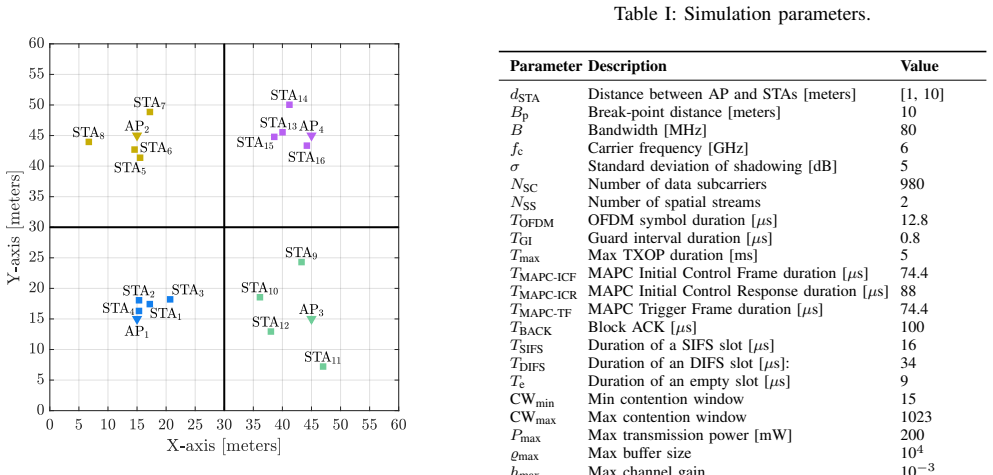
The paper's central claim is that a PPO-trained policy, choosing a valid coordinated-spatial-reuse group at every transmission opportunity from a masked action space, minimizes network-wide worst-case delay and generalizes across deployments and traffic types. The supporting evidence is a set of IEEE 802.11bn simulations: in a sample 4-AP, 16-STA deployment the deployment-specialized agent (ML-E) achieves a 99th-percentile delay of 72.98 ms versus 103.85 ms for the best heuristic TAT, while a generalist agent (ML-G) evaluated on 100 random deployments achieves 64.54 ms versus 75.92 ms for TAT under per-STA loads of 10–90 Mb/s. The paper argues that the learned policy's advantage comes from balancing delay reduction with transmission efficiency instead of always serving the oldest packet or the fullest queues, and that this advantage grows as the number of STAs increases from 8 to 20.
Load-bearing premise
The comparison keeps only deployments in which at least one scheduler already achieves a 99th-percentile delay below 100 ms, discarding up to 41% of high-load deployments, so the claimed advantage is established only on that non-overloaded subset.
Editorial extensions
If this is right
- Trained in simulation, the learned scheduler can run inside the sharing AP at each TXOP and issue the same MAPC trigger frames, so the 802.11bn control-plane exchange does not need to change for the scheme to be deployed.
- In random unseen deployments, ML-G keeps its 99th-percentile delay below roughly 100 ms including outliers under high load, while MNP and OP frequently exceed 100 ms, meaning the approach is most useful precisely where fixed heuristics become unreliable.
- As station count grows from 8 to 20 at fixed average network load, the gap between ML-G and the best heuristic widens, indicating learned scheduling becomes more valuable in denser scenarios.
- The trained policy deliberately serves a mix of delay-priority levels rather than always the highest-delay group, which is why it avoids the starvation patterns seen with the oldest-packet heuristic.
- Reward shaping makes training converge faster and reach slightly better final 99th-percentile delays than the same PPO setup without shaping.
Reading between the lines
- If the high-load deployments discarded in the paper (41% of cases in Fig. 8c and 15% in Fig. 9) were included in the comparison, the headline improvement over TAT could shrink or disappear; testing the trained agent on those discarded deployments is the cleanest extension of the reported results.
- Because the observation is already per-STA and the action masking is structural, the same recipe could likely be extended to jointly select transmit power or MCS along with the SR group, capabilities the paper lists as future work.
- In the low-load regime OP matches or beats ML-G, suggesting the realistic value of the learned scheduler is concentrated in medium-to-high load and bursty traffic, where queue and interference interactions are too complex for hand-coded rules.
- Since a separate ML-G model is trained for each network size, a broader claim about scaling to arbitrary WLANs would require a size-invariant observation and action space; the paper itself identifies this as an open direction.
Signed reviews
Editorial analysis
A structured set of objections, weighed in public.
Referee Report
Summary. The paper proposes a deep reinforcement learning (DRL) scheduler for multi-access point coordination (MAPC) in IEEE 802.11bn Wi-Fi networks. The channel access follows a contention-based MAPC scheme in which the sharing AP collects buffer-status reports and selects a spatially reusable group of AP-STA pairs. The authors formulate group selection as a sequential decision problem with a PPO agent, a normalized observation vector of queue sizes, head-of-line delays, and channel coefficients, action masking for feasible groups, and a shaped reward that combines immediate delay reduction with a long-term worst-case-delay term. The evaluation compares two trained agents (ML-G, a general agent, and ML-E, a deployment-specialized agent) against the heuristics MNP, OP, and TAT in a simulated 4-AP enterprise scenario, across random deployments and user counts. The headline results are a 30% worst-case delay reduction over TAT in the sample deployment and a 15% reduction over TAT at 99th-percentile across random deployments, together with qualitative claims that ML-G is more stable and scales better as the number of stations grows.
Significance. If the central claim is validated, the paper would make a useful contribution to the emerging IEEE 802.11bn MAPC literature: it extends the authors' earlier heuristic scheduling work [5] with a modern DRL pipeline, and it provides a detailed and openly available simulation environment, concrete training hyperparameters, and an explicit comparison against three baselines. The reward-shaping ablation and the action-masking scheme are also presented clearly. However, the current evidence is conditional rather than conclusive. The reported improvements are computed on a filtered subset of deployments from which all overloaded cases have been removed using the same delay metric that is being compared, no statistical significance tests are provided, and the low-load regime explicitly contradicts the abstract's 'consistently' claim. These issues are fixable with additional analysis, but they currently prevent the paper's main conclusion from being established at the strength stated.
major comments (3)
- [Section V-A and Figs. 8-10] The evaluation excludes every deployment in which no scheduler achieves a 99th-percentile delay below 100 ms, and the retained data are therefore selected on the outcome variable of interest. The scale of the removal is substantial: 41% of high-load deployments are discarded in Fig. 8c, 15% in Fig. 9, and 4-24% in Fig. 10. Since no results are reported for the discarded deployments, the claim that ML-G 'consistently' outperforms the heuristics is unverified in exactly the stressed regime where schedulers matter most. A load-bearing re-analysis is needed: include all deployments, report the discarded set separately, or at minimum report an appropriate conservative bound that shows the relative ordering is unchanged.
- [Fig. 8a and abstract] The abstract and conclusions state that the ML models 'consistently achieve lower 99th-percentile delays' across a wide range of loads, but the low-load panel of Fig. 8a shows that OP is the most effective scheduler and that ML-G does not outperform it, as the text itself acknowledges. The claim should be qualified to medium and high loads, or the low-load regime should be shown to be consistent with the stated conclusion through a more appropriate aggregate measure.
- [Section VI-B, Figs. 6, 8, 9, 10] The quantitative improvements (30% in the sample deployment, 15% across random deployments) are reported as point estimates with no confidence intervals, error bars, or statistical significance tests. Since each data point is an independent random deployment or traffic realization, the differences between ML-G and TAT could be evaluated with paired bootstrap intervals or a nonparametric test. Without such tests, the reader cannot assess whether the observed margins are distinguishable from simulation noise, especially in Fig. 9 where the mean delay of ML-G (16.87 ms) is actually higher than that of MNP (15.55 ms).
minor comments (4)
- [Eq. (2) and Section III-B] The feasibility condition in Eq. (2) is taken directly from the authors' prior work [5] and is self-cited, and TAT is also introduced as originally proposed in [5]. Since both the group-selection mechanism and one of the three baselines come from the same source, the authors should state more explicitly what is new in this paper beyond replacing the scheduler with a DRL agent, and should consider whether an independent reimplementation or a third-party baseline would strengthen the comparison.
- [Section IV-C, reward function] The reward shaping parameters beta and nu are fixed at 1e-3 and 1e-6 with no sensitivity analysis. A brief study of the sensitivity of the learned policy to these values would increase confidence that the reported gains are not an artifact of a particularly tuned shaping schedule.
- [Section V-C, retransmissions] The text states that retransmissions are not subject to any maximum attempt limit, which may cause unbounded queue build-up in overloaded conditions and interacts with the overload-exclusion rule. The authors should either justify this assumption or discuss its effect on the tail-delay metric.
- [Fig. 6 caption] The caption of Fig. 6 mentions that 10% of traffic realizations are discarded, but the main text does not explain why a different discard fraction applies here than in Fig. 9. This should be clarified, or the text and caption should be made consistent.
Circularity Check
No circularity: the central claim is an empirical simulation comparison, not an input-equivalent derivation.
full rationale
The paper's central claim—that PPO-trained schedulers (ML-G, ML-E) achieve lower 99th-percentile delays than MNP, OP, and TAT—is an empirical result obtained by running all schedulers in the same simulator, not a derivation that assumes its own conclusion. The reward function (r = r_sh + r_lg, Section IV-C-3) is explicitly designed to reduce queueing delay, but optimizing a stated objective and then measuring the same objective is standard RL practice, not circularity. The SR-group feasibility condition (Eq. 2) and the TAT baseline are taken from the authors' prior work [5]; however, both are fully specified in this paper and applied identically to the ML and heuristic schedulers, so the self-citation supplies implementation details rather than the predicted outcome. The only notable methodological concern is the exclusion of 'overloaded' deployments (Section V-A: 'only deployments in which at least one scheduling mechanism achieves a 99th-percentile delay below 100 ms are included... The remaining cases are considered overloaded and are excluded'), which conditions the evaluation on the outcome metric and limits the scope of the generalization claim; this is a selection-bias/correctness issue, not a circular step, because no parameter is fitted to the retained data and the comparison on the retained deployments is not forced by construction. No equation in the paper reduces to its own input, and no uniqueness theorem is imported from the authors' prior work.
Assumptions & free parameters
free parameters (4)
- Overload exclusion threshold =
100 ms
- Reward shaping constant beta =
10^-3
- Reward shaping offset nu =
10^-6
- DRL training hyperparameters =
Table II (learning rate 6.5e-4, gamma 0.99, GAE lambda 0.92, batch size 256, clip range 0.2)
assumptions (6)
- domain assumption SR group feasibility is determined by the throughput condition |M_n| * R_i^CoSR / R_i^ST >= 1 for every STA i in the group (Eq. 2), imported from the authors' prior work [5].
- domain assumption The TGax enterprise path loss model (Eq. 4) and log-normal shadowing (sigma = 5 dB) describe the office environment.
- domain assumption Pre-generated PER versus SNR curves from MATLAB (Ref. [23]) remain valid for the simulator's MCS selection and binomial decoding model.
- domain assumption The queueing dynamics follow FIFO with successful transmissions modeled as binomial per TXOP (Eq. 5 and mu_i ~ B(U_i, q)), and retransmissions have no attempt limit.
- domain assumption The MDP state consisting of normalized queue sizes, HoL delays, and channel coefficients is sufficient for optimal scheduling.
- domain assumption The proposed MAPC-ICF/ICR control exchange can carry per-STA buffer status and HoL timestamps without errors or protocol overhead beyond the modeled durations.
invented entities (1)
-
MAPC-ICF/ICR buffer-status solicitation handshake
Cite this review
Pith. "Pith review of Deep Reinforcement Learning-Based Scheduling for Wi-Fi Multi-Access Point Coordination." pith.science (2026). https://pith.science/paper/452FOLU4
@misc{pith2026250719377,
  author       = {Pith},
  title        = {Pith review of: Deep Reinforcement Learning-Based Scheduling for Wi-Fi Multi-Access Point Coordination},
  year         = {2026},
  howpublished = {\url{https://pith.science/paper/452FOLU4}},
  note         = {Machine review of arXiv:2507.19377}
}
read the original abstract
Multi-access point coordination (MAPC) is a key feature of IEEE 802.11bn, with a potential impact on future Wi-Fi networks. MAPC enables joint scheduling decisions across multiple access points (APs) to improve throughput, latency, and reliability in dense Wi-Fi deployments. However, implementing efficient scheduling policies under diverse traffic and interference conditions in overlapping basic service sets (OBSSs) remains a complex task. This paper presents a method to minimize the network-wide worst-case latency by formulating MAPC scheduling as a sequential decision-making problem and proposing a deep reinforcement learning (DRL) mechanism to minimize worst-case delays in OBSS deployments. Specifically, we train a DRL agent using proximal policy optimization (PPO) within an 802.11bn-compatible Gymnasium environment. This environment provides observations of queue states, delay metrics, and channel conditions, enabling the agent to schedule multiple AP-station pairs to transmit simultaneously by leveraging spatial reuse (SR) groups. Simulations demonstrate that our proposed solution outperforms state-of-the-art heuristic strategies across a wide range of network loads and traffic patterns. The trained machine learning (ML) models consistently achieve lower 99th-percentile delays, showing up to a 30% improvement over the best baseline.
Figures


Figures from the paper (7 more)


Reference graph
Works this paper leans on
-
[5]
Enabling Reliable Latency in Wi-Fi 8 Through Multi-AP Joint Scheduling,
D. Nunez, P. Imputato, S. Avallone, M. Smith, and B. Bellalta, “Enabling Reliable Latency in Wi-Fi 8 Through Multi-AP Joint Scheduling,” IEEE Open Journal of the Communications Society , vol. 6, pp. 2090–2101, 2025
work page 2025
-
[1]
Limita- tions of the IEEE 802.11 DCF, PCF, EDCA and HCCA to handle real- time traffic,
R. Costa, P. Portugal, F. Vasques, C. Montez, and R. Moraes, “Limita- tions of the IEEE 802.11 DCF, PCF, EDCA and HCCA to handle real- time traffic,” in 2015 IEEE 13th International Conference on Industrial Informatics (INDIN). IEEE, 2015, pp. 931–936
work page 2015
-
[2]
What will Wi-Fi 8 be? A primer on IEEE 802.11 bn ultra high reliability,
L. Galati-Giordano, G. Geraci, M. Carrascosa, and B. Bellalta, “What will Wi-Fi 8 be? A primer on IEEE 802.11 bn ultra high reliability,” IEEE Communications Magazine , vol. 62, no. 8, pp. 126–132, 2024
2024
-
[3]
Spatial Reuse in IEEE 802.11bn Coordinated Multi-AP WLANs: A Throughput Analysis,
D. Nunez, F. Wilhelmi, L. Galati-Giordano, G. Geraci, and B. Bellalta, “Spatial Reuse in IEEE 802.11bn Coordinated Multi-AP WLANs: A Throughput Analysis,” 2024. [Online]. Available: https://arxiv.org/abs/ 2407.16390
arXiv 2024
-
[4]
Wi-Fi 8 Unveiled: Key Features, Multi-AP Coordination, and the Role of C-TDMA,
I. Val, D. López-Pérez, A. Kijanka, S. Schelstraete, L. Muñoz, D. Ar- landis, and M. Martínez, “Wi-Fi 8 Unveiled: Key Features, Multi-AP Coordination, and the Role of C-TDMA,” 2025
work page 2025
-
[6]
Collaborative spatial reuse in wireless networks via selfish multi-armed bandits,
F. Wilhelmi, C. Cano, G. Neu, B. Bellalta, A. Jonsson, and S. Barrachina-Muñoz, “Collaborative spatial reuse in wireless networks via selfish multi-armed bandits,” Ad Hoc Networks, vol. 88, pp. 129–141, 2019
work page 2019
-
[7]
Potential and pitfalls of multi-armed bandits for decen- tralized spatial reuse in WLANs,
F. Wilhelmi, S. Barrachina-Munoz, B. Bellalta, C. Cano, A. Jonsson, and G. Neu, “Potential and pitfalls of multi-armed bandits for decen- tralized spatial reuse in WLANs,” Journal of Network and Computer Applications, vol. 127, pp. 26–42, 2019
work page 2019
-
[8]
Improving the spatial reuse in IEEE 802.11 ax WLANs: A multi-armed bandit approach,
A. Bardou, T. Begin, and A. Busson, “Improving the spatial reuse in IEEE 802.11 ax WLANs: A multi-armed bandit approach,” in Proceedings of the 24th International ACM Conference on Modeling, Analysis and Simulation of Wireless and Mobile Systems, 2021, pp. 135– 144
work page 2021
Show all 25 references
-
[9]
Reinforcement Learning Approaches to Improve Spatial Reuse in Wireless Local Area Networks,
Y . Huang, “Reinforcement Learning Approaches to Improve Spatial Reuse in Wireless Local Area Networks,” Ph.D. dissertation, University of Wollongong, 2022
2022
-
[10]
Machine Learning and Wi-Fi: Unveiling the Path Toward AI/ML-Native IEEE 802.11 Networks,
F. Wilhelmi, S. Szott, K. Kosek-Szott, and B. Bellalta, “Machine Learning and Wi-Fi: Unveiling the Path Toward AI/ML-Native IEEE 802.11 Networks,” IEEE Communications Magazine , 2024
2024
-
[11]
Coordinated Multi-Armed Bandits for Improved Spatial Reuse in Wi-Fi,
F. Wilhelmi, B. Bellalta, S. Szott, K. Kosek-Szott, and S. Barrachina- Muñoz, “Coordinated Multi-Armed Bandits for Improved Spatial Reuse in Wi-Fi,” 2025. [Online]. Available: https://arxiv.org/abs/2412.03076
2025 arXiv
-
[12]
IEEE 802.11bn Multi-AP Coordinated Spatial Reuse With Hierarchical Multi-Armed Bandits,
M. Wojnar, W. Ciezobka, K. Kosek-Szott, K. Rusek, S. Szott, D. Nunez, and B. Bellalta, “IEEE 802.11bn Multi-AP Coordinated Spatial Reuse With Hierarchical Multi-Armed Bandits,” IEEE Communications Let- ters, vol. 29, no. 3, pp. 428–432, 2025
2025
-
[13]
Coordinated Spatial Reuse Scheduling With Machine Learning in IEEE 802.11 MAPC Networks,
M. Wojnar, W. Ci˛ e ˙zobka, A. Tomaszewski, P. Chołda, K. Rusek, K. Kosek-Szott, J. Haxhibeqiri, J. Hoebeke, B. Bellalta, A. Zubow, F. Dressler, and S. Szott, “Coordinated Spatial Reuse Scheduling With Machine Learning in IEEE 802.11 MAPC Networks,” IEEE Journal on Selected Ar...
2025
-
[14]
ReinWiFi: Application-Layer QoS Optimization of WiFi Networks with Reinforcement Learning,
Q. Li, B. Lv, Y . Hong, and R. Wang, “ReinWiFi: Application-Layer QoS Optimization of WiFi Networks with Reinforcement Learning,”
-
[15]
Spatial Deep Learning for Wireless Scheduling,
Cui, Wei and Shen, Kaiming and Yu, Wei, “Spatial Deep Learning for Wireless Scheduling,” IEEE Journal on Selected Areas in Communications, vol. 37, no. 6, p. 1248–1261, Jun. 2019. [Online]. Available: http://dx.doi.org/10.1109/JSAC.2019.2904352
2019
-
[16]
Deep Reinforcement Learning Based Spatial Reuse for IEEE 802.11 bn,
M. Du, R. Yan, P. Liu, Z. Guo, and X. Sun, “Deep Reinforcement Learning Based Spatial Reuse for IEEE 802.11 bn,” in 2025 IEEE Wireless Communications and Networking Conference (WCNC). IEEE, 2025, pp. 1–6
2025
-
[17]
IEEE 802.11-25/0502r0: Details on the unified MAPC framework,
“IEEE 802.11-25/0502r0: Details on the unified MAPC framework,” 2025
2025
-
[18]
Gymnasium: A standard interface for reinforcement learning environments,
M. Towers, A. Kwiatkowski, J. Terry, J. U. Balis, G. De Cola, T. Deleu, M. Goulão, A. Kallinteris, M. Krimmel, A. KG et al. , “Gymnasium: A standard interface for reinforcement learning environments,” arXiv preprint arXiv:2407.17032, 2024
2024 arXiv
-
[19]
A Markovian Decision Process,
R. BELLMAN, “A Markovian Decision Process,” Journal of (a) N = 8 STAs (b) N = 12 STAs (c) N = 16 STAs (d) N = 20 STAs Figure 10: Worst-case delay distribution for a different number of users N∈{ 8, 12, 16, 20} across 100 random deployment realizations in each scenario. Mathema...
1957
-
[20]
Proximal Policy Optimization Algorithms,
J. Schulman, F. Wolski, P. Dhariwal, A. Radford, and O. Klimov, “Proximal Policy Optimization Algorithms,” 2017. [Online]. Available: https://arxiv.org/abs/1707.06347
2017 arXiv
-
[21]
Actor-Critic Algorithms,
V . Konda and J. Tsitsiklis, “Actor-Critic Algorithms,” in Advances in Neural Information Processing Systems , S. Solla and T. Leen and K. Müller, Ed., vol. 12. MIT Press, 1999. [Online]. Available: https://proceedings.neurips.cc/paper_files/paper/ 1999/file/6449f44a102fde8486...
1999
-
[22]
TGax Simulation Scenarios,
S. Merlin et al. , “TGax Simulation Scenarios,” Nov. 2015, doc.: IEEE 802.11-14/0980r16
2015
-
[23]
802.11be Packet Error Rate Simulation for an EHT MU Single-User Packet Format,
The MathWorks Inc., “802.11be Packet Error Rate Simulation for an EHT MU Single-User Packet Format,” Natick, Massachusetts, United States, 2024. [Online]. Available: https://www.mathworks.com/help/wlan/ug/ 802-11be-packet-error-rate-simulation-for-eht-mu-single-user-packet-for...
2024
-
[24]
Stable-Baselines3: Reliable Reinforcement Learning Implementations,
A. Raffin, A. Hill, A. Gleave, A. Kanervisto, M. Ernestus, and N. Dormann, “Stable-Baselines3: Reliable Reinforcement Learning Implementations,” Journal of Machine Learning Research , vol. 22, no. 268, pp. 1–8, 2021. [Online]. Available: http://jmlr.org/papers/v22/ 20-1364.html
2021
-
[2025]
Available: https://arxiv.org/abs/2405.03526
[Online]. Available: https://arxiv.org/abs/2405.03526
Reviewed August 15, 2026 · model on record in the stance chip above.
Discussion (0). Continue with ORCID to comment.