A non-iterative domain decomposition time integrator for linear wave equations
Pith reviewed 2026-05-19 03:01 UTC · model grok-4.3
The pith
A non-iterative domain decomposition integrator for the linear acoustic wave equation achieves second-order accuracy in time and global convergence of order O(h + τ²) under a CFL-type condition on subdomain overlap.
A machine-rendered reading of the paper's core claim, the machinery that carries it, and where it could break.
Core claim
The authors propose and analyze a non-iterative domain decomposition time integrator for the linear acoustic wave equation. By combining an implicit Crank-Nicolson step on spatial subdomains with a local prediction step at the subdomain interfaces the method enables parallelization across space while advancing sequentially in time without iterations. Using linear finite elements with mass lumping the method is shown to achieve second-order accuracy in time and global convergence of order O(h + τ²) under a CFL-type condition that depends on the overlap width between subdomains.
What carries the argument
The combination of implicit Crank-Nicolson steps on overlapping subdomains with local interface predictions, which allows non-iterative parallel time integration for the wave equation.
Load-bearing premise
The subdomains must overlap by a width large enough to satisfy the CFL-type condition required for stability and the stated convergence rate.
What would settle it
A numerical experiment in which the observed global error fails to decrease as O(h + τ²) when both mesh size h and time step τ are refined while keeping the required overlap width would falsify the convergence claim.
Figures


read the original abstract
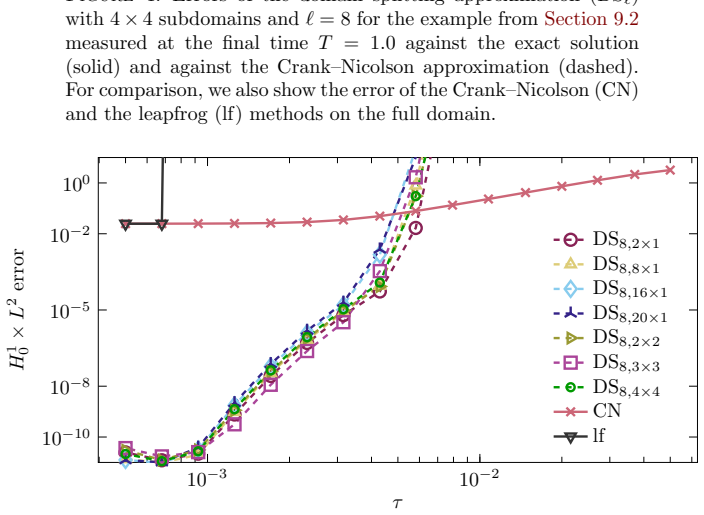
We propose and analyze a non-iterative domain decomposition integrator for the linear acoustic wave equation. The core idea is to combine an implicit Crank-Nicolson step on spatial subdomains with a local prediction step at the subdomain interfaces. This enables parallelization across space while advancing sequentially in time, without requiring iterations at each time step. The method is similar to the methods from Blum, Lisky and Rannacher (1992) or Dawson and Dupont (1992), which have been designed for parabolic problems. Our approach adapts them to the case of the wave equation in a fully discrete setting, using linear finite elements with mass lumping. Compared to explicit schemes, our method permits significantly larger time steps and retains high accuracy. We prove that the resulting method achieves second-order accuracy in time and global convergence of order $\mathcal{O}(h + \tau^2)$ under a CFL-type condition, which depends on the overlap width between subdomains. We conclude with numerical experiments which confirm the theoretical results.
Editorial analysis
A structured set of objections, weighed in public.
Referee Report
Summary. The manuscript proposes a non-iterative domain decomposition time integrator for the linear acoustic wave equation. It combines implicit Crank-Nicolson steps on overlapping spatial subdomains with a local prediction step at the interfaces, enabling parallel-in-space, sequential-in-time advancement without iterations per step. The method adapts parabolic DD schemes (Blum-Lisky-Rannacher 1992; Dawson-Dupont 1992) to the hyperbolic case using linear finite elements with mass lumping. The central claims are a proof of second-order temporal accuracy together with global convergence of order O(h + τ²) under a CFL-type condition that depends on the overlap width δ, plus numerical experiments that confirm the theory.
Significance. If the stability and convergence analysis holds, the approach could allow substantially larger time steps than standard explicit schemes for wave propagation while retaining accuracy and enabling spatial parallelism. This would be of practical value for large-scale acoustic simulations provided the overlap requirement does not force δ to grow with τ.
major comments (1)
- [stability and convergence analysis] The statement of the CFL-type condition (in the stability and convergence analysis following the method definition): the manuscript asserts that the condition depends on the overlap width δ, yet does not exhibit the explicit form of the restriction (e.g., whether δ ≳ τ or δ ≳ cτ with c>1 is required). Because the local interface prediction must transport information at finite speed for the wave equation, this detail is load-bearing for the claim that the scheme permits significantly larger τ than explicit methods for fixed-overlap decompositions.
minor comments (2)
- [introduction] The abstract and introduction cite the 1992 parabolic references but do not clarify which specific technical ingredients (e.g., the prediction step or the mass-lumping treatment) are new versus direct adaptations; a short paragraph contrasting the hyperbolic versus parabolic cases would improve readability.
- [numerical experiments] Numerical experiments section: the reported convergence rates are consistent with theory, but the tables or figures do not list the precise ratios δ/τ used in each run, making it harder for the reader to verify that the CFL condition is satisfied independently of the claimed advantage.
Simulated Author's Rebuttal
We thank the referee for their careful reading of the manuscript and for pointing out the need for a more explicit statement of the CFL-type condition. We address this comment below and will update the manuscript accordingly.
read point-by-point responses
-
Referee: The statement of the CFL-type condition (in the stability and convergence analysis following the method definition): the manuscript asserts that the condition depends on the overlap width δ, yet does not exhibit the explicit form of the restriction (e.g., whether δ ≳ τ or δ ≳ cτ with c>1 is required). Because the local interface prediction must transport information at finite speed for the wave equation, this detail is load-bearing for the claim that the scheme permits significantly larger τ than explicit methods for fixed-overlap decompositions.
Authors: We agree with the referee that an explicit form of the CFL condition would improve the clarity of the stability and convergence analysis. In our proof, the condition is derived to be δ ≥ τ (with the wave speed normalized to 1), ensuring that the interface prediction step can propagate the necessary information across the overlap without loss of accuracy. We will revise the manuscript to state this condition explicitly in the theorem and in the paragraph following the method definition. This explicit form confirms that for a fixed overlap width δ, the allowable time step τ is O(δ), which is independent of the mesh size h and thus significantly larger than the O(h) restriction of standard explicit schemes when h is small. revision: yes
Circularity Check
No significant circularity; derivation is a self-contained mathematical proof
full rationale
The paper derives a non-iterative domain decomposition scheme for the linear wave equation by adapting parabolic techniques from external 1992 references, then proves second-order temporal accuracy and O(h + τ²) global convergence via standard finite-element energy estimates under an explicitly stated CFL-type condition on overlap width. No step equates a claimed prediction or result to its own inputs by construction, renames a fitted quantity, or relies on a load-bearing self-citation whose content is unverified. The cited parabolic works are independent external sources; the hyperbolic adaptation and stability analysis are developed directly from the discrete scheme and mass-lumped linear elements without smuggling ansatzes or reducing the theorem to a tautology. The result is therefore self-contained against its stated assumptions.
Axiom & Free-Parameter Ledger
axioms (1)
- domain assumption Subdomains overlap by a width sufficient to satisfy the CFL-type condition for stability and convergence.
Lean theorems connected to this paper
-
IndisputableMonolith/Foundation/RealityFromDistinction.leanreality_from_one_distinction unclear?
unclearRelation between the paper passage and the cited Recognition theorem.
We prove … global convergence of order O(h + τ²) under a CFL-type condition, which depends on the overlap width between subdomains.
-
IndisputableMonolith/Cost/FunctionalEquation.leanwashburn_uniqueness_aczel unclear?
unclearRelation between the paper passage and the cited Recognition theorem.
CFL condition (18) τ²‖Lh‖_{Hh←Hh} ≤ 4ℓ²
What do these tags mean?
- matches
- The paper's claim is directly supported by a theorem in the formal canon.
- supports
- The theorem supports part of the paper's argument, but the paper may add assumptions or extra steps.
- extends
- The paper goes beyond the formal theorem; the theorem is a base layer rather than the whole result.
- uses
- The paper appears to rely on the theorem as machinery.
- contradicts
- The paper's claim conflicts with a theorem or certificate in the canon.
- unclear
- Pith found a possible connection, but the passage is too broad, indirect, or ambiguous to say the theorem truly supports the claim.
Reference graph
Works this paper leans on
-
[1]
Igor A. Baratta, Joseph P. Dean, Jørgen S. Dokken, Michal Habera, Jack S. Hale, Chris N. Richardson, Marie E. Rognes, Matthew W. Scroggs, Nathan Sime, and Garth N. Wells, DOLFINx: the next generation FEniCS problem solving environment , 2023
work page 2023
-
[2]
H. Blum, S. Lisky, and R. Rannacher, A domain splitting algorithm for parabolic problems , Computing 49 (1992), no. 1, 11–23. MR1182439
work page 1992
-
[3]
Susanne C. Brenner and L. Ridgway Scott, The mathematical theory of finite element meth- ods, Third, Texts in Applied Mathematics, vol. 15, Springer, New York, 2008. MR2373954
work page 2008
-
[4]
Luis A. Caffarelli and Michael G. Crandall, Distance functions and almost global solu- tions of eikonal equations , Comm. Partial Differential Equations 35 (2010), no. 3, 391–414. MR2748630
work page 2010
-
[5]
Philippe G. Ciarlet, The finite element method for elliptic problems , Studies in Mathemat- ics and its Applications, vol. Vol. 4, North-Holland Publishing Co., Amsterdam-New York- Oxford, 1978. MR520174
work page 1978
-
[6]
With a foreword by Patrick Joly
Gary Cohen and S´ ebastien Pernet, Finite element and discontinuous Galerkin methods for transient wave equations, Scientific Computation, Springer, Dordrecht, 2017. With a foreword by Patrick Joly. MR3526765
work page 2017
-
[7]
Clint N. Dawson and Todd F. Dupont, Explicit/implicit conservative Galerkin domain de- composition procedures for parabolic problems , Math. Comp. 58 (1992), no. 197, 21–34. MR1106964
work page 1992
-
[8]
, Noniterative domain decomposition for second order hyperbolic problems, Domain de- composition methods in science and engineering (Como, 1992), 1994, pp. 45–52. MR1262604
work page 1992
-
[9]
Willy D¨ orfler, Marlis Hochbruck, Jonas K¨ ohler, Andreas Rieder, Roland Schnaubelt, and Christian Wieners, Wave phenomena: Mathematical analysis and numerical approximation , Vol. 49, Springer Nature, 2023
work page 2023
-
[10]
Dow Drake, Jay Gopalakrishnan, Joachim Sch¨ oberl, and Christoph Wintersteiger, Conver- gence analysis of some tent-based schemes for linear hyperbolic systems , Math. Comp. 91 (2022), no. 334, 699–733. MR4379973
work page 2022
-
[11]
72, Springer, Cham, [2021] ©2021
Alexandre Ern and Jean-Luc Guermond, Finite elements I—Approximation and interpola- tion, Texts in Applied Mathematics, vol. 72, Springer, Cham, [2021] ©2021. MR4242224
work page 2021
-
[12]
73, Springer, Cham, [2021] ©2021
, Finite elements II—Galerkin approximation, elliptic and mixed PDEs , Texts in Applied Mathematics, vol. 73, Springer, Cham, [2021] ©2021. MR4269305
work page 2021
-
[13]
Dietmar Gallistl and Roland Maier, Localized implicit time stepping for the wave equation , SIAM J. Numer. Anal. 62 (2024), no. 4, 1589–1608. MR4772556 24 TIM BUCHHOLZ AND MARLIS HOCHBRUCK
work page 2024
-
[14]
M. J. Gander, L. Halpern, and F. Nataf, Optimal convergence for overlapping and non- overlapping Schwarz waveform relaxation , Eleventh International Conference on Domain Decomposition Methods (London, 1998), 1999, pp. 27–36. MR1827406
work page 1998
-
[15]
Martin J Gander and Laurence Halpern, Techniques for locally adaptive time stepping devel- oped over the last two decades , Domain decomposition methods in science and engineering xx, 2013, pp. 377–385
work page 2013
-
[16]
Martin J. Gander, Laurence Halpern, and Fr´ ed´ eric Nataf, Optimal Schwarz waveform re- laxation for the one dimensional wave equation , SIAM J. Numer. Anal. 41 (2003), no. 5, 1643–1681. MR2035001
work page 2003
-
[17]
Gander, Felix Kwok, and Bankim C
Martin J. Gander, Felix Kwok, and Bankim C. Mandal, Dirichlet-Neumann waveform relax- ation methods for parabolic and hyperbolic problems in multiple subdomains , BIT 61 (2021), no. 1, 173–207. MR4235305
work page 2021
-
[18]
Gander and Hui Zhang, Schwarz methods by domain truncation , Acta Numer
Martin J. Gander and Hui Zhang, Schwarz methods by domain truncation , Acta Numer. 31 (2022), 1–134. MR4436585
work page 2022
-
[19]
J. Gopalakrishnan, J. Sch¨ oberl, and C. Wintersteiger, Mapped tent pitching schemes for hyperbolic systems, SIAM J. Sci. Comput. 39 (2017), no. 6, B1043–B1063. MR3725284
work page 2017
-
[20]
Jay Gopalakrishnan, Peter Monk, and Paulina Sep´ ulveda,A tent pitching scheme motivated by Friedrichs theory, Comput. Math. Appl. 70 (2015), no. 5, 1114–1135. MR3378991
work page 2015
-
[21]
Laurence Halpern and J´ er´ emie Szeftel,Nonlinear nonoverlapping Schwarz waveform relax- ation for semilinear wave propgation, Math. Comp. 78 (2009), no. 266, 865–889. MR2476563
work page 2009
-
[22]
David Hipp, A unified error analysis for spatial discretizations of wave-type equations with applications to dynamic boundary conditions , Dissertation, 2017
work page 2017
-
[23]
David Hipp, Marlis Hochbruck, and Christian Stohrer, Unified error analysis for noncon- forming space discretizations of wave-type equations , IMA J. Numer. Anal. 39 (2019), no. 3, 1206–1245. MR3984056
work page 2019
-
[24]
M. Holst, Application of domain decomposition and partition of unity methods in physics and geometry, Domain decomposition methods in science and engineering, 2003, pp. 63–78. MR2093735
work page 2003
-
[25]
Patrick Joly, Variational methods for time-dependent wave propagation problems , Topics in computational wave propagation, 2003, pp. 201–264. MR2032871
work page 2003
- [26]
-
[27]
P.-A. Raviart, The use of numerical integration in finite element methods for solving parabolic equations, Topics in numerical analysis (Proc. Roy. Irish Acad. Conf., University Coll., Dublin, 1972), 1973, pp. 233–264. MR345428
work page 1972
-
[28]
Matthew W. Scroggs, Jørgen S. Dokken, Chris N. Richardson, and Garth N. Wells, Construc- tion of arbitrary order finite element degree-of-freedom maps on polygonal and polyhedral cell meshes, ACM Transactions on Mathematical Software 48 (2022), no. 2, 18:1–18:23
work page 2022
-
[29]
25, Springer-Verlag, Berlin, 1997
Vidar Thom´ ee,Galerkin finite element methods for parabolic problems , Springer Series in Computational Mathematics, vol. 25, Springer-Verlag, Berlin, 1997. MR1479170 Institute for Applied and Numerical Mathematics, Karlsruhe Institute of Technol- ogy, Englerstr. 2, 76131 Karlsruhe, Germany Email address: {tim.buchholz,marlis.hochbruck}@kit.edu
work page 1997
discussion (0)
Sign in with ORCID, Apple, or X to comment. Anyone can read and Pith papers without signing in.