REVIEW 3 major objections 3 minor 26 references
Odd Ramsey numbers of multipartite graphs and hypergraphs
T0 review · 3 major / 3 minor · reviewed 2026-08-15 · deepseek-v4-flash
Pith's one-line read Odd-Ramsey count for K_{2,t} is n/t asymptotically
desk verdict A likely-true pair of theorems, but the main boundedness claim for the conflict system in Theorem 1 is false as stated and needs a repair. read the letter →
The pith
A machine-rendered reading of the paper's core claim, the machinery that carries it, and where it could break.
The reading
What carries the argument
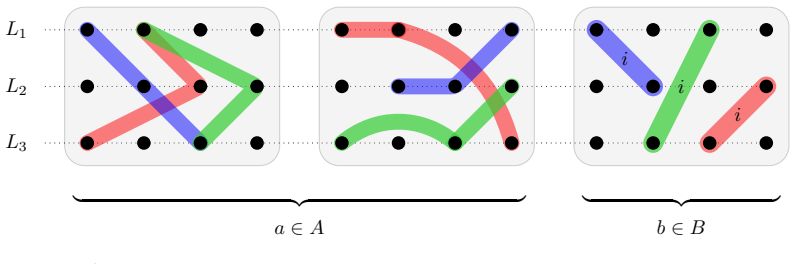
The load-bearing mechanism is the Tripartite Matching Theorem, a version of the conflict-free hypergraph matching method that produces a perfect matching of an auxiliary hypergraph while avoiding two prescribed families of forbidden configurations, called conflicts. In the graph proof, the edges of $H_1$ are monochromatic tiles, copies of $K_{t+1,t+1}$ with a perfect matching removed, and the edges of $H_2$ are single colored edges of $K_{n,n}$; a matching in $H=H_1\cup H_2$ corresponds to a well-defined edge-coloring. The conflict systems $C$ and $D$ collect inclusion-minimal irreducible configurations whose colored edges would contain a bad $K_{2,t}$, meaning a copy with no odd color class. The hypergraph proof uses the same architecture, with transversals of $K^{(k)}_{k+1,\ldots,k+1}$ as tiles and conflicts corresponding to bad copies of $\mathcal{K}_{1,\ldots,1,2,2}$. The whole argument works because the auxiliary hypergraphs and conflict systems satisfy the degree and codegree bounds required by the matching theorem.
What would settle it
Exhibit an irreducible bad coloring of $K_{2,t+1}$ built from the paper's tiles inside a matching of $H_1$, with every color class even, that cannot be split into two nonempty bad subcopies on the same pair of size-2 vertices. Such a configuration would violate the claimed bound $|C|\le 2t$ and the codegree calculation underlying condition (C3).
Extended reading notes
Core claim
On its own terms, the paper establishes that $r_{\mathrm{odd}}(K_{n,n}, K_{2,t}) = n/t + o(n)$ for all $t\ge 2$ and that $r_{\mathrm{odd}}(\mathcal{K}^{(k)}_{n,\ldots,n}, \mathcal{K}_{1,\ldots,1,2,2}) = n/2 + o(n)$ for all $k\ge 2$. The first statement generalizes the previously known case $t=2$; the second is the first asymptotically tight odd Ramsey result for hypergraphs. The lower-bound proof shows that fewer than $n/t$ (respectively $n/2$) colors force, by Cauchy–Schwarz and pigeonhole, a bad copy in which every color class has even size. The upper-bound proof encodes a coloring of most of the host graph as a matching in an auxiliary hypergraph and defines conflict systems that forbid exactly those configurations that would leave a target copy without an odd color class; a one-step matching theorem removes the separate recoloring step used by earlier arguments.
Load-bearing premise
The load-bearing premise is that every minimal irreducible bad configuration can be witnessed by a copy of $K_{2,r}$ with $r\le t$; if an irreducible bad copy with $r>t$ can occur in a matching, the bound $|C|\le 2t$ and the codegree estimates in Section 3.1.1 would need additional justification.
Editorial extensions
If this is right
- For every fixed $t\ge 2$, the asymptotic value $n/t$ determines the odd Ramsey number of $K_{2,t}$ inside $K_{n,n}$ up to an $o(n)$ error term.
- The hypergraph statement makes $n/2+o(n)$ the first known asymptotic odd Ramsey number for uniform hypergraphs, and it holds simultaneously for every uniformity $k\ge 2$.
- Through the graph-code inequality cited in the introduction, these upper bounds imply lower bounds on the maximum density of graph codes that avoid the corresponding subgraphs.
- The lower-bound counting argument identifies the constant $1/t$ as forced by pair counting: with fewer colors, two same-colored edges incident to one vertex necessarily produce a bad $K_{2,t}$.
Reading between the lines
- A natural next step is to apply the same one-step matching recipe to targets such as $K_{2,t}$ in other bipartite hosts or to hypergraph targets with three distinguished parts; the likely bottleneck is classifying irreducible bad colorings rather than the matching theorem itself.
- The proof does not make the $o(n)$ term explicit. A sharper analysis of the leaf-elimination counting in the star case could plausibly yield a polynomial error bound such as $O(n^{1-\varepsilon})$, which could be checked computationally for small $n$.
- The overall structure suggests a transfer principle: once a target's bad colorings are understood, the odd Ramsey number against a complete multipartite host may be governed by the largest side of the target, as $1/t$ and $1/2$ appear here.
Signed reviews
Editorial analysis
A structured set of objections, weighed in public.
Referee Report
Summary. The paper studies odd Ramsey numbers, the minimum number of colors in an edge-coloring of a host hypergraph such that every copy of a target subhypergraph has some color class of odd size. The main results are Theorem 1, r_odd(K_{n,n}, K_{2,t}) = n/t + o(n) for all t >= 2, and Theorem 2, r_odd(K^{(k)}_{n,...,n}, K_{1,...,1,2,2}) = n/2 + o(n) for all k >= 2. The lower bounds are simple averaging arguments. The upper bounds use the Tripartite Matching Theorem of Joos, Mubayi, and Smith: the authors construct hypergraphs H1 and H2 whose matchings encode colorings of the host graph/hypergraph, and then define conflict systems C and D that are supposed to forbid all bad copies of the target. The paper is organized as a bipartite-graph proof in Section 3 and a hypergraph proof in Section 4.
Significance. If the proofs were correct, these would be attractive tight asymptotic results. Theorem 1 generalizes the known K_{2,2} case, and Theorem 2 would be the first odd Ramsey result for hypergraphs. The lower-bound arguments are clean, and the intended use of the Tripartite Matching Theorem is appropriate. The paper gives explicit constructions rather than abstract existence arguments, and the overall strategy is well matched to the problem. However, the manuscript currently contains load-bearing gaps in the definition and boundedness of the conflict systems, both in the graph case and, more seriously, in the hypergraph case.
major comments (3)
- [Section 3.1 / Definition 5 / Section 3.1.1] The claim that every conflict in C satisfies 3 <= |C| <= 2t, and the accompanying assertion that for each C in C one may fix an irreducible bad copy G_C of K_{2,r} with 2 <= r <= t, are not justified and are in fact false for the conflict system as defined. For t = 3, take leaves y_1,...,y_8 and eight tiles: P_1 = {x_1, y_1, y_2}, P_2 = {x_1, y_3, y_4}, P_3 = {x_1, y_5, y_6}, P_4 = {x_1, y_7, y_8}, and Q_1 = {x_2, y_1, y_3}, Q_2 = {x_2, y_4, y_5}, Q_3 = {x_2, y_6, y_7}, Q_4 = {x_2, y_8, y_2}. Giving the eight tiles eight distinct colors makes K_{2,8} bad, since every color appears on exactly two edges. The incidence graph between the P_i and Q_j is an 8-cycle, so no proper subset of leaves has all color counts even; hence this bad K_{2,8} is irreducible and no smaller bad subcopy exists. For sufficiently large n the tiles can be completed to K_{4,4}-minus-perfect-matching tiles that form a matching in H1, because any two of them share at most one graph vertex and their colors are distinct. Thus C contains an inclusion-minimal irreducible conflict of size 8, contradicting (C1); using longer cycles gives arbitrarily large conflicts. Consequently the proof of (C1) and the choice of G_C with r <= t in Section 3.1.1 are invalid, and Claims 9 and 10, which rely on that choice, do not establish condition (C3) for the C that is actually defined. The proof can likely be repaired by redefining C to consist only of inclusion-minimal irreducible conflicts whose witness bad copy has r <= t, but this must be proved and the degree bounds must be re-checked for that system.
- [Section 3.2 / Definition 12] The conflict system D has the same defect as C. The text says that every conflict in D has at least two tiles from H2 and no more than 2t tiles, but Definition 12 does not restrict the parameter r of the irreducible bad K_{2,r} used as a witness. The same construction as in the previous comment can be repeated with H2 tiles: give each of the 16 edges of a K_{2,8} its own H2 tile and pair the colors so that each color appears twice; the resulting set is an inclusion-minimal irreducible conflict with arbitrarily many tiles when extended cyclically. Thus property (D1) is not established, and the degree counts in Sections 3.2.1-3.2.3, which explicitly assume 2 <= r <= t, do not apply to the D defined in the manuscript. The repair suggested for C should also be applied to D.
- [Section 4.1 / Figure 4] The proof of Theorem 2 does not handle a bad copy of K_{1,...,1,2,2} contained in a single H1 tile. A tile e_{S,i} contains every transversal of S, i.e. every k-tuple with one vertex from each part of S. If S has two vertices in each of two parts and one vertex in each of the remaining k-2 parts, then the four corresponding hyperedges form a copy of K_{1,...,1,2,2} and all four receive color i from that tile. Such a copy has no odd color class. However, the conflict system C in Section 4.1 consists only of conflicts of size 3 or 4 that use two distinct colors; there is no conflict for the one-tile case. Thus a P-perfect matching avoiding C union D can still contain a tile that by itself creates a bad copy of the target. The statement that 'the graph in Fig. 4 is colored in the only way that is allowed by a matching of H1' appears to overlook this possibility. The construction of H1 or the definition of the conflicts must be changed, for example by deleting from each S a suitable set of hyperedges so that no single tile contains a bad copy, and the degree computations would then need to be redone.
minor comments (3)
- [Section 3.1.1, Claim 10] Claim 10 writes 'GC ~= K_{2,t}', but the discussion at the start of Section 3.1.1 only guarantees 2 <= r <= t. The leaf-counting argument should be written for K_{2,r} with general r <= t, and the final equality L_{j-j'} = 0 should refer to r, not to t.
- [Section 4, after Claim 18] The displayed estimate d^epsilon = O(n^{(k^2+1)/(k^2+2)}) is missing a factor 1/2: from d = n^{(k^2+1)/2} and epsilon = 1/(k^2+2) one obtains d^epsilon = n^{(k^2+1)/(2(k^2+2))}. The subsequent inequality is still true, but the formula should be corrected.
- [Sections 3.2.1 and 4.2] The notation binom{n}{delta} is used for n^delta in several places. Since delta is not an integer, this is formally incorrect; use n^delta or lceil n^delta rceil consistently.
Circularity Check
No significant circularity: the main theorems are derived from the independent Tripartite Matching Theorem and fresh conflict-system estimates; prior self-citations are motivational only.
full rationale
I walked the derivation chain for Theorems 1 and 2. The lower bounds are elementary counting (Cauchy-Schwarz and pigeonhole), and the upper bounds are applications of the Tripartite Matching Theorem, Theorem 3, quoted from Joos, Mubayi, and Smith [21]. That theorem is external to the present authors, and the paper verifies its hypotheses by building the hypergraphs H1, H2 and conflict systems C, D from scratch. No fitted parameter is later renamed a prediction; no uniqueness theorem is imported from the authors' own prior work; and no ansatz is smuggled in via a self-citation. The self-citation to [9] (Bennett, Heath, Zerbib) is used only to state the result being generalized and to point to the conflict-free matching technique; it is not the evidence that Conditions (C1)-(C3) or (D1)-(D4) hold. The hypergraph result in Theorem 2 is a new application with its own conflict-system verification. The skeptic's concern about Section 3.1.1, where the paper fixes an irreducible bad copy GC of K2,r and asserts 2 <= r <= t, is a potential correctness gap in the proof that C is bounded, not a circularity: the boundedness is being asserted and counted, not derived from an equivalent input. Likewise, the appearance of GC ~= K2,t inside Claim 10's proof assumes the very bound that the skeptic challenges; that is an invalid or missing argument, but it is not a case of the conclusion being identical to an input by construction. Therefore the appropriate circularity score is 0.
Assumptions & free parameters
free parameters (2)
- epsilon
- delta
assumptions (3)
- domain assumption Tripartite Matching Theorem (Theorem 3, from Joos, Mubayi, Smith [21])
- standard math Cauchy-Schwarz and pigeonhole counting for lower bounds
- standard math Asymptotic binomial and polynomial estimates, with 'sufficiently large n'
Cite this review
Pith. "Pith review of Odd Ramsey numbers of multipartite graphs and hypergraphs." pith.science (2026). https://pith.science/paper/BBMW5WG6
@misc{pith2026250719456,
  author       = {Pith},
  title        = {Pith review of: Odd Ramsey numbers of multipartite graphs and hypergraphs},
  year         = {2026},
  howpublished = {\url{https://pith.science/paper/BBMW5WG6}},
  note         = {Machine review of arXiv:2507.19456}
}
abstract
Given a hypergraph $G$ and a subhypergraph $H$ of $G$, the \emph{odd Ramsey number} $r_{odd}(G,H)$ is the minimum number of colors needed to edge-color $G$ so that every copy of $H$ intersects some color class in an odd number of edges. Generalizing a result of \cite{BHZ} in two different ways, in this paper we prove $r_{odd} \left(K_{n,n}, K_{2,t} \right)=\frac{n}{t} + o(n)$ for all $t\geq 2$, and $r_{odd} \left(\mathcal{K}^{(k)}_{n,\dots,n}, \mathcal{K}_{1,\dots,1,2,2} \right) = \frac{n}{2} + o(n)$ for all $k\geq 2$. The latter is the first result studying odd Ramsey numbers for hypergraphs.
Figures


Figures from the paper (2 more)


Reference graph
Works this paper leans on
-
[1]
N. Alon. Graph-codes. European Journal of Combinatorics , 116:103880, 2024
work page 2024
-
[2]
M. Axenovich, Z. F¨ uredi, and D. Mubayi. On generalized Ramsey theory: The bipartite case. Journal of Combinatorial Theory, Series B , 79(1):66–86, 2000
work page 2000
-
[3]
Edge-coloring $K_{n, n}$ with no 2-colored $C_{2k}$
D. Bal and P. Bennett. Edge-coloring Kn,n with no 2-colored C2k. arXiv:2507.13329, 2025
work page Pith review arXiv 2025
-
[4]
D. Bal, P. Bennett, E. Heath, and S. Zerbib. Generalized Ramsey numbers of cycles, paths, and hypergraphs. arXiv:2405.15904, 2024
arXiv 2024
-
[5]
Balogh, S
J. Balogh, S. English, E. Heath, and R. A. Krueger. Lower bounds on the Erd˝ os–Gy´ arf´ as problem via color energy graphs. Journal of Graph Theory , 103(2):378–409, 2023
2023
-
[6]
P. Bennett, R. Cushman, A. Dudek, and P. Pra lat. The Erd˝ os–Gy´ arf´ as functionf(n, 4, 5) = 5 6n +o(n) – so Gy´ arf´ as was right.arXiv:2207.02920, 2022
arXiv 2022
-
[7]
On generalized Ramsey numbers in the non-integral regime
P. Bennett, M. Delcourt, L. Li, and L. Postle. On generalized Ramsey numbers in the sublinear regime. arXiv:2212.10542, 2022
work page Pith review arXiv 2022
-
[8]
P. Bennett, A. Dudek, and S. English. A random coloring process gives improved bounds for the Erd˝ os–Gy´ arf´ as problem on generalized Ramsey numbers.Electronic Journal of Combinatorics , 32:P2.21, 2025
work page 2025
Show all 26 references
-
[9]
Bennett, E
P. Bennett, E. Heath, and S. Zerbib. Edge-coloring a graph G so that every copy of a graph H has an odd color class. arXiv:2307.01314, 2023
2023 arXiv
-
[10]
Boyadzhiyska, S
S. Boyadzhiyska, S. Das, T. Lesgourgues, and K. Petrova. Odd-Ramsey numbers of complete bipartite graphs. arXiv:2410.05887, 2024
2024 arXiv
-
[11]
Cameron and E
A. Cameron and E. Heath. A (5 , 5)-colouring ofKn with few colours. Combinatorics, Probability and Computing, 27(6):892–912, 2018
2018
-
[12]
Cameron and E
A. Cameron and E. Heath. New upper bounds for the Erd˝ os–Gy´ arf´ as problem on generalized Ramsey numbers. Combinatorics, Probability and Computing , 32(2):349–362, 2023
2023
-
[13]
Conlon, J
D. Conlon, J. Fox, C. Lee, and B. Sudakov. The Erd˝ os–Gy´ arf´ as problem on generalized Ramsey numbers. Proceedings of the London Mathematical Society, 110(1):1–18, 2015
2015
-
[14]
Delcourt and L
M. Delcourt and L. Postle. Finding an almost perfect matching in a hypergraph avoiding forbidden submatchings. arXiv:2204.08981, 2022. 22
2022 arXiv
-
[15]
P. Erd˝ os. Problems and results on finite and infinite graphs. In Recent advances in graph theory (Proc. Second Czechoslovak Sympos., Prague, 1974) , pages 183–192. (loose errata). Academia, Prague, 1975
1974
-
[16]
Erd˝ os and A
P. Erd˝ os and A. Gy´ arf´ as. A variant of the classical Ramsey problem.Combinatorica, 17(4):459– 467, 1997
1997
-
[17]
G. Ge, Z. Xu, and Y. Zhang. A new variant of the Erd˝ os–Gy´ arf´ as problem on K5. arXiv:2306.14682, 2023
2023 arXiv
-
[18]
Glock, F
S. Glock, F. Joos, J. Kim, M. K¨ uhn, and L. Lichev. Conflict-free hypergraph matchings. Journal of the London Mathematical Society , 109(5):e12899, 2024
2024
-
[19]
Gomez-Leos, E
E. Gomez-Leos, E. Heath, A. Parker, C. Schwieder, and S. Zerbib. New bounds on the generalized Ramsey number f(n, 5, 8). Discrete Mathematics, 347(7):114012, 2024
2024
-
[20]
Joos and D
F. Joos and D. Mubayi. Ramsey theory constructions from hypergraph matchings. Proceedings of the American Mathematical Society , 152(11):4537–4550, 2024
2024
-
[21]
F. Joos, D. Mubayi, and Z. Smith. Conflict-free hypergraph matchings and coverings. arXiv:2407.18144, 2024
2024 arXiv
-
[22]
Lane and N
A. Lane and N. Morrison. Generalized Ramsey numbers via conflict-free hypergraph matchings. arXiv:2405.16653, 2024
2024 arXiv
-
[23]
D. Mubayi. Edge-coloring cliques with three colors on all 4-cliques. Combinatorica, 18(2):293–296, 1998
1998
-
[24]
D. Mubayi. An explicit construction for a Ramsey problem. Combinatorica, 24(2):313–324, 2004
2004
-
[25]
Versteegen
L. Versteegen. Upper bounds for linear graph codes. Random Structures & Algorithms , 66(1):e21263, 2025
2025
-
[26]
F. Yip. A variant of the Erd˝ os–Gy´ arf´ as problem forK8. arXiv:2409.16778, 2024. 23
2024
Reviewed August 15, 2026 · model on record in the stance chip above.
Discussion (0). Continue with ORCID to comment.