REVIEW 4 major objections 6 minor 11 references
From Bench to Bedside: A DeepSeek-Powered AI System for Automated Chest Radiograph Interpretation in Clinical Practice
T0 review · 4 major / 6 minor · reviewed 2026-08-07 · deepseek-v4-flash
Pith's one-line read A 1-billion-parameter chest X-ray AI matches larger rivals and helps junior radiologists in the clinic.
desk verdict A worthwhile prospective trial, but the authors never rule out that their three test hospitals were in the fine-tuning set, so the headline benefit could be style memorization. read the letter →
The pith
A machine-rendered reading of the paper's core claim, the machinery that carries it, and where it could break.
The reading
What carries the argument
The machinery is the two-stage supervised fine-tuning of the open DeepSeek Janus-Pro (1B) base model using Low-Rank Adaptation (LoRA, rank 64), first on 166,025 public MIMIC-CXR images to teach basic diagnosis and report writing, then on 5,267 images from a 27-hospital Chinese dataset (CXR-27) to adapt to local report style. This carries the whole argument: the same base model without the CXR-27 step scores far worse on the CXR-27 test set, and the paper attributes the model's report quality, finding detection (AUC > 0.8 for eight findings), and the prospective gains to this lightweight domain adaptation.
What would settle it
Check whether patient-level images from Union Hospital Wuhan, the First Affiliated Hospital of Zhengzhou University, or the First Affiliated Hospital of Henan University of Science and Technology appear in the CXR-27 fine-tuning set; if they do, rerun the prospective comparison at three centers never touched by training and see whether the 0.24-point report-quality gain and the 18.5% time reduction persist.
Extended reading notes
Core claim
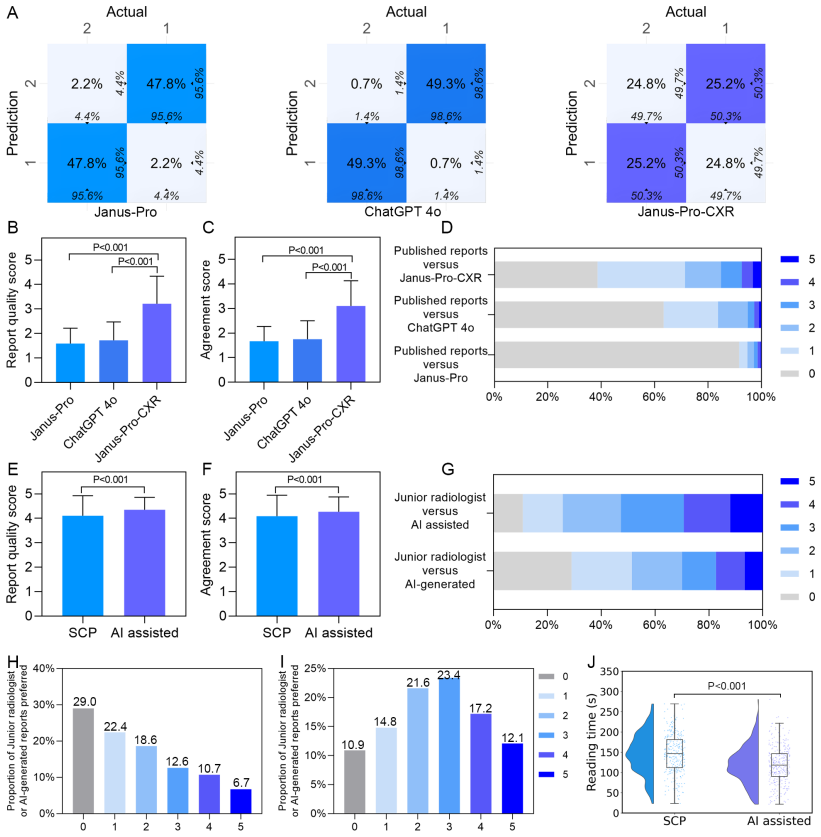
The central claim is that domain-specific supervised fine-tuning of a 1-billion-parameter multimodal large language model yields a chest X-ray interpretation system, Janus-Pro-CXR, whose generated reports are close to human-written reports and whose use as a reference improves junior radiologists' outputs. The paper reports retrospective results on two test sets: on MIMIC-CXR, macro-average F1-14 of 34.7 and RadGraph 26.4; on the 27-hospital CXR-27 set, ROUGE-L 60.5, BLEU-4 44, and RadGraph 61.1. Diagnostic classification reached AUC > 0.8 for eight findings, led by support devices (0.967), pleural effusion (0.927), and pneumothorax (0.916). In the prospective trial, AI-assisted junior radiologists scored 4.37 ± 0.50 vs. 4.11 ± 0.81 (P < 0.001) on report quality, wrote reports in 119.4 ± 45.3 s vs. 146.6 ± 49.8 s (an 18.5% reduction, P < 0.001), and 52.7% of AI-assisted reports were preferred by at least three of five experts. The authors position this as the first prospective validation of their system and argue that the lightweight architecture, with 1-2 s latency on a laptop GPU, makes clinical translation feasible in resource-limited settings.
Load-bearing premise
The strongest result rests on the assumption that the three hospitals where the prospective trial ran were not among the 27 hospitals whose images fine-tuned the model; the paper never states that they were excluded, so part of the measured improvement could be the model having already learned those hospitals' report style.
Editorial extensions
If this is right
- If the prospective results hold, deploying Janus-Pro-CXR as a reference draft for junior radiologists could raise report quality and cut per-report reading time by roughly a fifth in hospitals with similar workflows.
- A 1B-parameter model that runs on an 8GB laptop GPU would let under-resourced primary-care settings obtain near-specialist CXR report drafts without expensive infrastructure.
- The two-stage fine-tuning recipe, public dataset first and a small local dataset second, could generalize to other modalities such as CT, MRI, and ultrasound, and make institution-specific adaptation cheap.
- Open-sourcing the architecture and framework would allow other centers to verify the prospective gains independently and to fine-tune for their own patient populations.
- Subgroup analysis suggests the time saving is larger for complex cases with three or more imaging findings (a 21.5% reduction), so the benefit may concentrate where reports are hardest to write.
Reading between the lines
- The paper's automated metrics partly depend on a DeepSeek-based annotation labeler built by the authors themselves; an independent labeler such as CheXpert or CheXbert might yield different absolute F1 numbers, so cross-tool replication would sharpen the comparison.
- The higher pneumonia positive rate in the AI-assisted group (55.2% vs. 36.4%) implies the model shifts junior radiologists' diagnostic threshold; whether that shift improves care or adds overdiagnosis is not settled by this trial and would be worth tracking in follow-up.
- The 52.7% figure for reports preferred by a majority of experts depends on the 3-of-5 threshold and the specific panel; a larger and more varied reader pool would give a more stable estimate of clinician preference.
- The time saving was measured with a human editing AI drafts; more automated or voice-integrated workflows could change the magnitude of the benefit, a mode the paper does not test.
Editorial analysis
A structured set of objections, weighed in public.
Referee Report
Summary. The manuscript reports development and validation of Janus-Pro-CXR, a 1B-parameter fine-tuned version of DeepSeek's Janus-Pro model for chest radiograph interpretation and report generation. The authors evaluate the model retrospectively on MIMIC-CXR and a 27-hospital Chinese dataset (CXR-27) using automated metrics, subjective radiologist scoring, and disease classification AUCs. They then report a multicenter prospective trial (NCT06874647) in which junior radiologists with AI assistance produced higher-quality reports (4.37 vs. 4.11, P<0.001), had higher agreement scores, and read faster (18.5% time reduction) than radiologists using standard clinical practice. The central claim is that the AI system provides generalizable clinical benefit in real-world radiology workflow, supported by the prospective trial and by the model's lightweight, low-resource design.
Significance. If the prospective findings hold, this would be one of the few studies providing direct clinical-trial evidence for AI-assisted CXR reporting, with a realistic collaborative workflow and a lightweight model suitable for resource-limited settings. The paper's strengths include the multicenter prospective design with a pre-registered trial, the inclusion of actual reading time, the use of multiple evaluation perspectives (automated metrics, subjective scoring, preference tests, agreement), and the stated intention to open-source the model and code. These features make the study potentially influential for clinical translation of medical multimodal LLMs. However, the significance is conditional on resolving several methodological concerns, notably the lack of explicit confirmation that prospective sites were held out from fine-tuning and the validity of the automated labeler used for CXR-27 metrics.
major comments (4)
- [Methods (Trial design) and Supplementary Appendix 3] The prospective validation was conducted at three medical centers (Union Hospital Wuhan, First Affiliated Hospital of Zhengzhou University, First Affiliated Hospital of Henan University of Science and Technology), but the manuscript does not explicitly state that these centers were excluded from the CXR-27 fine-tuning dataset. Since CXR-27 is described as retrospective data from 27 Chinese hospitals and two of the prospective centers are the home institutions of several authors, overlap is plausible. If these centers contributed to fine-tuning, the reported quality gain and time saving could partly reflect the model's memorization of institutional report style rather than generalizable AI assistance. Please provide an explicit statement of non-overlap, ideally with a data audit or a description of how the hospital identities were managed during dataset construction.
- [Supplementary Appendix 4 and Results (Automated metrics)] The automated evaluation on the CXR-27 test set relies on a DeepSeek-based labeling tool developed by the authors as the reference standard. However, the appendix only compares this tool against CheXpert (e.g., pneumonia F1 0.992 vs. 0.126), not against a human-annotated gold standard. This makes the reported micro-/macro-F1 and AUC values difficult to interpret, since the labeler itself could introduce systematic bias. The claim that Janus-Pro-CXR outperforms ChatGPT 4o in automated generation metrics is also not directly supported by the presented tables: Supplementary Table 3 lists GPT-4V, not ChatGPT 4o, and the size and provenance of GPT-4V are unclear. Please clarify whether ChatGPT 4o was evaluated on the same test sets and with the same labeler, or clearly state that the comparison uses literature values for a differently named model.
- [Methods (Evaluation of collaboration) and Statistical analysis] In the prospective study, for each patient two junior radiologists from different groups independently produced reports, creating a patient-level paired structure. The statistical analysis, however, describes independent-sample t-tests without accounting for this correlation. Using independent t-tests for paired data can overstate precision or obscure the actual effect, depending on the intra-patient correlation. Please re-analyze the primary endpoints using a paired test or a mixed-effects model with patient and radiologist as random effects, and report the intra-cluster correlation or justify why independence is appropriate.
- [Results (Prospective validation) and Discussion] The discussion states that the pneumonia diagnosis rate was notably higher in the AI-assisted group (55.2% vs. 36.4%, P<0.001), but this result appears only in the Discussion and is not reported in the Results section or in any table. Since this is a potentially important clinical outcome that bears directly on the claim of improved diagnostic reliability, it should be reported in the Results with the appropriate denominator and statistical context, and its interpretation (e.g., whether higher pneumonia detection was confirmed by a reference standard) should be discussed.
minor comments (6)
- [General / Terminology] The abbreviation for Low-Rank Adaptation appears both as 'LoRA' and 'LORA'; please use one consistent spelling throughout.
- [Supplementary Appendix 7] The RADPEER categories presented (1=clinically significant discrepancy ... 5=complete agreement) appear reversed relative to the standard ACR RADPEER scale, where higher scores usually indicate worse disagreement. If the authors adapted the scale, they should cite the specific adaptation and clearly define the direction of scoring in the main text, since agreement score is a primary outcome.
- [Methods (Model Establishment) / Supplementary Appendix 1] The statement in the Discussion that the model 'requires only 6,000 images for domain adaptation fine-tuning' is not supported by the Methods or Supplementary Appendix 1, which describes fine-tuning on 166,025 MIMIC images and 5,267 CXR-27 images. Please clarify the basis for this claim.
- [Discussion (Limitations) and Methods (Prospective study)] The limitations section states that 'the model's fine-tuning phase did not incorporate such clinical background information,' but the Methods state that 'key patient medical history information was incorporated into the Prompts for the large language model.' These statements are not contradictory, but the distinction between training and prompting should be made explicit to avoid confusion about what information the model used in the prospective deployment.
- [Minor typos and formatting] There are several typographical and formatting errors, including 'Jacus-Pro-CXR' in the abstract, 'A E xample' in Supplementary Table 5, and repeated sentences in the legends of Figures 1 and 2. Also, some references (e.g., reference 9 and 10) omit conference/journal details or contain malformed author initials; the reference list should be cleaned.
- [Table 1 presentation] The P values in Table 1 are labeled as the result of Kendall's W concordance test, which assesses inter-rater agreement, not the significance of between-group differences. The between-group P values for the prospective comparisons (P<0.001) appear only in the text; including them in the table would improve clarity.
Circularity Check
No significant circularity; the core prospective and retrospective claims rest on empirical measurements, not on fitted parameters renamed as predictions or on load-bearing self-citations.
full rationale
The paper's central claims are empirical outcomes of a prospective randomized comparison and a retrospective held-out evaluation, not derivations from inputs. Janus-Pro-CXR is fine-tuned on MIMIC-CXR and the CXR-27 training subset, and the reported automated metrics are computed on separate test subsets (1,471 MIMIC-CXR images and 1,317 CXR-27 images), so the performance numbers are not equal by construction to the training objective. The prospective trial measures report-quality scores and reading times from two groups of junior radiologists; no parameter is fitted to these endpoints, and the AI-assisted versus SCP comparison is a direct experimental contrast. The DeepSeek annotation tool is used as a fixed labeling instrument for computing F1 scores across all compared models; it is not fitted to Janus-Pro-CXR's outputs and does not define the outcome being predicted, so it does not make the evaluation circular, although it is a potential measurement-bias concern. The only identifiable self-citation (EVA-X, ref 17) is contextual and not load-bearing. The possible overlap between CXR-27 training hospitals and the three prospective centers is a data-leakage and generalizability concern, not a circularity: the paper's limitation section explicitly notes the prospective validation involved a limited number of hospitals, and a missing exclusion statement would affect external validity rather than render the reported difference true by definition. Overall, the derivation chain is self-contained empirical evaluation, so the circularity score is 0.
Assumptions & free parameters
free parameters (5)
- LoRA rank =
64
- Stage 1 fine-tuning steps =
35K
- Stage 2 fine-tuning steps =
0.4K
- Image resolution =
384x384
- Batch size =
128
assumptions (4)
- domain assumption The MIMIC-CXR and CXR-27 datasets provide accurate ground truth for training and evaluation.
- domain assumption The DeepSeek-based annotation tool correctly extracts the 14 radiographic labels from free-text reports.
- domain assumption The three prospective hospitals are independent of the CXR-27 training set.
- domain assumption Subjective report quality scores by five radiologists were blinded and unbiased.
Cite this review
Pith. "Pith review of From Bench to Bedside: A DeepSeek-Powered AI System for Automated Chest Radiograph Interpretation in Clinical Practice." pith.science (2026). https://pith.science/paper/4UKJFD5J
@misc{pith2026250719493,
  author       = {Pith},
  title        = {Pith review of: From Bench to Bedside: A DeepSeek-Powered AI System for Automated Chest Radiograph Interpretation in Clinical Practice},
  year         = {2026},
  howpublished = {\url{https://pith.science/paper/4UKJFD5J}},
  note         = {Machine review of arXiv:2507.19493}
}
read the original abstract
A global shortage of radiologists has been exacerbated by the significant volume of chest X-ray workloads, particularly in primary care. Although multimodal large language models show promise, existing evaluations predominantly rely on automated metrics or retrospective analyses, lacking rigorous prospective clinical validation. Janus-Pro-CXR (1B), a chest X-ray interpretation system based on DeepSeek Janus-Pro model, was developed and rigorously validated through a multicenter prospective trial (NCT06874647). Our system outperforms state-of-the-art X-ray report generation models in automated report generation, surpassing even larger-scale models including ChatGPT 4o (200B parameters), while demonstrating robust detection of eight clinically critical radiographic findings (area under the curve, AUC > 0.8). Retrospective evaluation confirms significantly higher report accuracy than Janus-Pro and ChatGPT 4o. In prospective clinical deployment, AI assistance significantly improved report quality scores (4.37 vs. 4.11, P < 0.001), reduced interpretation time by 18.5% (P < 0.001), and was preferred by a majority of experts (3 out of 5) in 52.7% of cases. Through lightweight architecture and domain-specific optimization, Janus-Pro-CXR improves diagnostic reliability and workflow efficiency, particularly in resource-constrained settings. The model architecture and implementation framework will be open-sourced to facilitate the clinical translation of AI-assisted radiology solutions.
Figures


Figures from the paper (1 more)
Reference graph
Works this paper leans on
-
[1]
MIMIC-CXR, a de -identified publicly available database of chest radiographs with free-text reports
Johnson, A.E.W., et al. MIMIC-CXR, a de -identified publicly available database of chest radiographs with free-text reports. Scientific Data 6, 317 (2019)
work page 2019
-
[2]
Smit, A., et al. Combining Automatic Labelers and Expert Annotations for Accurate Radiology Report Labeling Using BERT. 1500 -1519 (Association for Computational Linguistics, Online, 2020)
work page 2020
-
[3]
Lin, T. , et al. HealthGPT: A Medical Large Vision -Language Model for Unifying Comprehension and Generation via Heterogeneous Knowledge Adaptation. arXiv:2502.09838 (2025)
arXiv 2025
-
[4]
Collaboration between clinicians and vision -language models in radiology report generation
Tanno, R., et al. Collaboration between clinicians and vision -language models in radiology report generation. Nat Med 31, 599-608 (2025)
work page 2025
-
[5]
Jin, H., Che, H., Lin, Y . & Chen, H.J.a.e. -p. PromptMRG: Diagnosis -Driven Prompts for Medical Report Generation. arXiv:2308.12604 (2023)
arXiv 2023
-
[6]
Toward expert-level medical question answering with large language models
Singhal, K., et al. Toward expert-level medical question answering with large language models. Nat Med 31, 943-950 (2025)
work page 2025
-
[7]
L L a VA-Med: Training a Large Language-and-Vision Assistant for Biomedicine in One Day
Li, C., et al. L L a VA-Med: Training a Large Language-and-Vision Assistant for Biomedicine in One Day. arXiv:2306.00890 (2023)
arXiv 2023
-
[8]
Nicolson, A., Dowling, J. & Koopman, B. Improving chest X -ray report generation by leveraging warm starting. Artificial Intelligence in Medicine 144, 102633 (2023)
work page 2023
Show all 11 references
-
[9]
& Rueckert, D.J.a.e.-p
Tanida, T., Müller, P., Kaissis, G. & Rueckert, D.J.a.e.-p. Interactive and Explainable Region - guided Radiology Report Generation. arXiv:2304.08295 (2023)
2023 arXiv
-
[10]
& Zhou, L.J.a.e.-p
Wang, Z., Liu, L., Wang, L. & Zhou, L.J.a.e.-p. R2GenGPT: Radiology Report Generation with Frozen LLMs. arXiv:2309.09812 (2023)
2023 arXiv
-
[11]
Learning to Exploit Temporal Structure for Biomedical Vision -Language Processing
Bannur, S., et al. Learning to Exploit Temporal Structure for Biomedical Vision -Language Processing. arXiv:2301.04558 (2023)
2023 arXiv
Reviewed August 7, 2026 · model on record in the stance chip above.
Discussion (0). Sign in to comment.