REVIEW 3 major objections 4 minor 1 cited by
Wardropian Cycles make traffic assignment both optimal and fair by eliminating price-of-anarchy with Cyclical User Equilibrium for compliant connected autonomous vehicles
T0 review · 3 major / 4 minor · reviewed 2026-08-06 · deepseek-v4-flash
Pith's one-line read This paper claims traffic assignment can be both fair and optimal if fairness is judged over a multi-day cycle: for any origin–destination pair, a finite sequence of daily route permutations equalizes every driver's average travel time…
desk verdict A genuinely new multi-day rotation idea with correct core math, but the advertised CUE stability under unilateral deviations is overstated and needs a clearer equilibrium definition. read the letter →
The pith
A machine-rendered reading of the paper's core claim, the machinery that carries it, and where it could break.
The reading
What carries the argument
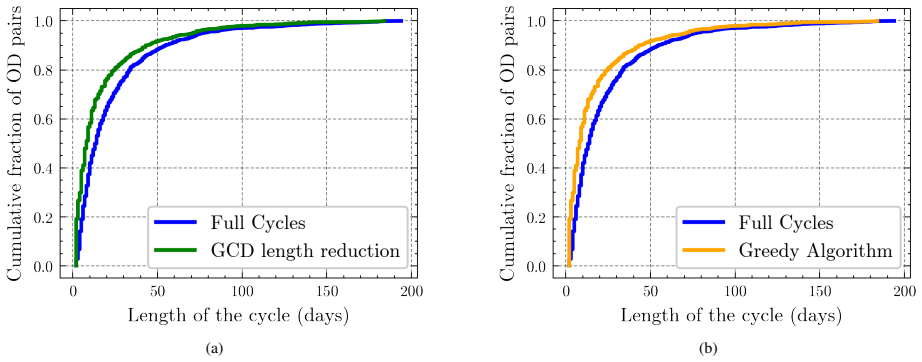
The central object is the Wardropian Cycle: a finite sequence of daily assignment matrices $(A_1,\dots,A_n)$, each preserving the system-optimal path flows, whose cumulative travel-time deviation vector $D_n = \sum_{j=1}^n D_j$ equals zero. Existence is shown via the shift matrix $P$, a permutation matrix that rotates drivers one position through the route list; after $Q$ days each driver has taken each route $Q_k$ times. The paper then shortens cycles using the greatest common divisor of path flows (reducing the cycle length to $Q/M$), partitions drivers into sub-cycles of equal mean travel time, bounds the worst per-day deviation by reordering route times, and introduces a greedy daily assignment rule that assigns the fastest routes to the drivers with the largest accumulated disadvantage. The greedy rule provably minimizes next-day inequity and drives average times toward equality, although it does not in general produce an exact finite cycle.
What would settle it
Run the Wardropian Cycle in a field or simulation study where each driver is free to switch to a faster route on any single day, with no penalty; if a nontrivial share of such daily-optimizing drivers breaks the equality of average travel times, the stability claim of Cyclical User Equilibrium is refuted.
Extended reading notes
Core claim
The central discovery is that the system-optimal assignment, which is normally unfair because drivers on different routes experience different travel times, can be embedded in a finite sequence of daily assignments (a Wardropian Cycle) such that every traveller's average travel time over the cycle equals the OD-average travel time, while each day's assignment still realizes the system-optimal path flows. Formally, for any OD pair and any assignment, there exists a finite sequence of daily assignments $A_1,\dots,A_n$ with cumulative deviation vector $D_n = \sum_{j=1}^n D_j = 0$. The paper proves existence by rotating drivers through the route list with a permutation matrix: after $Q$ days, each driver has taken each route exactly the number of times that route appears in the optimal flow, so every driver's mean travel time equals $\hat t$. This reconciles Wardrop's first principle (no user has a faster average route) with his second principle (system-optimal flows), in the multi-day average, and yields a new equilibrium notion, Cyclical User Equilibrium, in which no user wants to switch positions in the cycle or revert to User Equilibrium.
Load-bearing premise
The load-bearing assumption is that drivers evaluate their travel time over the whole multi-day cycle rather than day by day, so they will accept a slower day when the cycle as a whole is faster and fairer; if even a fraction of users optimize each single day, the equalization can unravel.
Editorial extensions
If this is right
- City-scale CAV fleets could run system-optimal routing every day while guaranteeing equal average travel times per OD pair over the cycle, so the Price of Anarchy can be removed without permanently selecting winners and losers.
- When exact cycles are too long, the greedy daily assignment rule still removes most inequity within days—less than 7% of initial inequity remains after 10 days in Barcelona, Anaheim, and Sioux Falls—making the scheme practical before full convergence.
- Because the cycle construction works for any assignment, not only travel-time System Optimum, the same mechanism can equalize average outcomes for other policy objectives such as mileage or CO$_2$ minimization.
- Cyclical User Equilibrium gives a precise sense in which no user wants to switch places with another user on the same OD pair and no user wants to revert to User Equilibrium, making the fair-optimal assignment an equilibrium in the multi-day average.
- The proposed OD-fair System Optimal extension would extend the benefit to all OD pairs, not just the 82.5% of Barcelona pairs that currently benefit, but its non-convex constraint remains an open implementation problem.
Reading between the lines
- The same 'rotate the unlucky slot' logic applies to any repeated allocation problem where agents care about long-run averages—shift work, queue serving, or computing jobs—though the paper only studies traffic.
- Introducing day-to-day travel-time noise would break the exact equality of the cycle; a stochastic version would likely need to replace fixed cycles with a feedback rule like the greedy assignment, which the paper develops but does not analyze probabilistically.
- Rather than relying on expulsion to deter single-day deviations, one could design the cycle so that faster routes on a given day go to those with the largest accumulated debt; such an incentive-compatible variant is not explored in the paper.
- The non-convex OD-fair SO constraint could be bypassed by allowing inter-OD compensation through credits, but the paper notes monetary transfers may be socially unacceptable, leaving a design gap.
Editorial analysis
A structured set of objections, weighed in public.
Referee Report
Summary. This paper proposes a multi-day traffic assignment framework in which, for each origin-destination (OD) pair, drivers are rotated among routes so that every daily assignment reproduces the System Optimal path flows while, over the cycle, each driver's average travel time equals the OD average. The authors define Wardropian Cycles, prove existence via cyclic shifts (Prop. 2.11), shorten cycles via the GCD of path flows (Prop. 2.12), give a reordering heuristic with a deviation bound (Prop. 2.15), and prove that a greedy rule minimizes next-day inequity (Prop. 2.17). They introduce Cyclical User Equilibrium (Def. 2.21) as a state in which all drivers receive lower average travel time than under User Equilibrium, and they propose an OD-fair System Optimal assignment (eq. 20) to extend the property to all OD pairs. Numerical experiments on Barcelona and four other networks report substantial price-of-anarchy reductions and rapid decay of inequity under the greedy rule.
Significance. The elementary existence proof for Wardropian Cycles is a genuine conceptual contribution: it shows that the dichotomy between User Equilibrium and System Optimum dissolves when the assignment horizon is extended to several days, and the construction is parameter-free in the sense that equalization follows from permutation cycles rather than from fitted quantities. The authors provide public code and large-scale experiments, and the greedy rule's one-step optimality is cleanly proved. The main caveat is that the equilibrium interpretation is weaker than advertised: the formal conditions (19) do not rule out profitable one-day deviations, and the system-wide 'every user benefits' claim is conditional on an OD-fair SO constraint (20) that is not implemented. These issues are fixable by rephrasing the stability claim and qualifying the numerical conclusions.
major comments (3)
- [Abstract and §2.9, Definition 2.21] The abstract and Definition 2.21 claim that Cyclical User Equilibrium 'ensures stability of optimal Wardropian Cycles under unilateral deviations', but this is not established by the model. Equation (19) only compares two whole-horizon strategies: following the assigned cycle AWC and travelling via User Equilibrium every day. It does not compare against a single-day deviation. Under the static BPR model, on any day a driver assigned to a slower route can switch to that day's fastest route and strictly reduce that day's travel time; because the assigned route was slower, the deviation pays immediately, and repeating this on every slow day yields an average below the OD mean. The paper concedes exactly this in Section 1.1 ('by deviating on a single day, a user of our framework may improve its travel time'). Therefore the stability claim in the abstract and the statement in Section 2.9 that 'no user has incentive to opt out of the cycle' are unsupported unless 'deviating' is redefined as abandoning the cycle for the entire period, or unless expulsion enforcement is made an explicit assumption of CUE. Please either weaken the claim to 'no incentive to abandon the cycle in the long run' and add the commitment assumption, or incorporate enforcement into Definition 2.21.
- [§2.10 and §3.2] Section 2.10 introduces the OD-fair constraint (20) but states that it 'cannot be easily implemented' due to non-convexity, and the experiments do not enforce it. Consequently, the claim in Section 3.2 that users on 82.5% of Barcelona OD pairs benefit from the cyclical assignment means that 17.5% of OD pairs are actually worse off than UE and hence fail condition (19b); the concluding statement that 'each participating user' benefits is not supported for those pairs. The system-wide voluntary-acceptance argument therefore rests on an optimization that is not solved. Please either provide a tractable formulation or approximation of (20) with computational results, or explicitly restrict the fairness/acceptance claims to OD pairs satisfying (19b) and discuss the implications for deployment.
- [§2.8] Section 2.8 states that rounding continuous Frank-Wolfe flows 'to the nearest integer yielded a sufficiently accurate approximation', but no error bound, sensitivity analysis, or validation is provided. Since the Wardropian Cycles and daily optimality claims are defined for integer path flows Qk satisfying (4b), the city-scale results in Section 3 are exact only if the rounded flows coincide with the SO solution; otherwise the daily assignment is only approximately system-optimal. Please quantify the rounding error in terms of total travel time (or bound the BPR function's sensitivity to flow perturbation), or present the discretized assignment as an approximate SO solution with measured suboptimality.
minor comments (4)
- [Throughout] The spelling 'Wardopian' appears in several places (e.g., Section 2.7 and Figure 2) instead of 'Wardropian'; please harmonize the terminology.
- [Table 3] Entries such as '8 .003' and '5 .2910' contain stray spaces and appear garbled; the table should be typeset so that numbers are clearly separated.
- [Definitions 2.3–2.4 and eq. (16)] The notation D_j for single-day deviations (Def. 2.3) and D^J for cumulative deviations (Def. 2.4) is visually confusing; in equations such as (16), the expression 'PJ j=1[DJ]i' should be written as a sum over D_j with a clear index, or a distinct symbol should be used for cumulative deviations.
- [Figure 7 caption] The caption says 'The cumulated differences in average travel time (Y-axis) cancel out over time (X-axis)' but the plot appears to show minimal and maximal average travel times per OD pair; please clarify what is plotted and what 'cancel out' means.
Circularity Check
No significant circularity: the central existence proof is constructive, the fairness result is an algebraic identity of the cycle definition, and the only self-citation (the authors' GitHub repository) is non-load-bearing.
full rationale
The paper's central derivation is self-contained. Proposition 2.11 constructs a cycle of length Q by cyclically shifting the assignment matrix; the proof shows algebraically that after Q days each driver has used route k exactly Qk times, so the mean travel time equals the OD average. This equalization is an identity following from the shift construction rather than a quantity fitted to make a prediction come true, and the paper does not disguise the definitional character of D_n = 0 (Def. 2.7) as an empirical discovery. The GCD and flow-partition reductions (Props. 2.12, 2.15) are separate mathematical constructions with their own proofs. The Greedy Assignment Rule is presented as a heuristic with a bounded-deviation proof (Prop. 2.18), not as a fitted parameter prediction. The numerical results are simulations on external networks (Stabler 2023) using an external Frank-Wolfe implementation (Bettini 2021), so the city-scale claims are not circular. The only self-citation, Hoffmann et al. 2024, is to the authors' own public code repository used to implement the method; it is not invoked to justify any theorem or to forbid alternatives, so it is not load-bearing. The paper explicitly concedes in §1.1 that a user may improve travel time by deviating on a single day and that expulsion is an optional enforcement measure; this is an admitted modeling limitation rather than a circular step. Likewise, the OD-fair SO constraint (eq. 20) is acknowledged in §2.10 as not easily implementable due to non-convexity and is left for future work, so it is not presented as a derived prediction. No step of the derivation reduces to re-labeling a fitted input or to importing an unverified self-citation; hence the circularity score is 0.
Assumptions & free parameters
assumptions (5)
- domain assumption Static traffic assignment with separable BPR travel time functions
- domain assumption Full daily compliance by drivers
- domain assumption Users evaluate outcomes by average travel time over the cycle
- ad hoc to paper Integer rounding of continuous SO flows is accurate enough
- ad hoc to paper OD-fair System Optimal assignment is achievable
Cite this review
Pith. "Pith review of Wardropian Cycles make traffic assignment both optimal and fair by eliminating price-of-anarchy with Cyclical User Equilibrium for compliant connected autonomous vehicles." pith.science (2026). https://pith.science/paper/RGSWOGVA
@misc{pith2026250719675,
  author       = {Pith},
  title        = {Pith review of: Wardropian Cycles make traffic assignment both optimal and fair by eliminating price-of-anarchy with Cyclical User Equilibrium for compliant connected autonomous vehicles},
  year         = {2026},
  howpublished = {\url{https://pith.science/paper/RGSWOGVA}},
  note         = {Machine review of arXiv:2507.19675}
}
read the original abstract
Connected and Autonomous Vehicles (CAVs) open the possibility for centralised routing with full compliance, making System Optimal traffic assignment attainable. However, as System Optimum makes some drivers better off than others, voluntary acceptance seems dubious. To overcome this issue, we propose a new concept of Wardropian cycles, which, in contrast to previous utopian visions, makes the assignment fair on top of being optimal, which amounts to satisfaction of both Wardrop's principles. Such cycles, represented as sequences of permutations to the daily assignment matrices, always exist and equalise, after a limited number of days, average travel times among travellers (like in User Equilibrium) while preserving everyday optimality of path flows (like in System Optimum). We propose exact methods to compute such cycles and reduce their length and within-cycle inconvenience to the users. As identification of optimal cycles turns out to be NP-hard in many aspects, we introduce a greedy heuristic efficiently approximating the optimal solution. Finally, we introduce and discuss a new paradigm of Cyclical User Equilibrium, which ensures stability of optimal Wardropian Cycles under unilateral deviations. We complement our theoretical study with large-scale simulations. In Barcelona, 670 vehicle-hours of Price-of-Anarchy are eliminated using cycles with a median length of 11 days-though 5% of cycles exceed 90 days. However, in Berlin, just five days of applying the greedy assignment rule significantly reduces initial inequity. In Barcelona, Anaheim, and Sioux Falls, less than 7% of the initial inequity remains after 10 days, demonstrating the effectiveness of this approach in improving traffic performance with more ubiquitous social acceptability.
Figures


Figures from the paper (4 more)



Forward citations
Cited by 1 Pith paper
-
Randomized routing strategies of fleets of CAVs may prove market efficient
In a simulated two-route city, randomized CAV routing beats system-optimal routing when fleets chase market share, but adding average travel time into the objective reverses that advantage.
Reference graph
Works this paper leans on
-
[4]
URL http://dx.doi.org/10.1287/opre.1040.0197
doi: 10.1287 /opre.1040.0197. URL http://dx.doi.org/10.1287/opre.1040.0197. B. Zhou and X. Li. User equilibrium with length constrained users. In 2012 Fifth International Joint Conference on Computational Sciences and Optimization, pages 494–499. IEEE,
-
[12]
W.l.o.g. we can assume that sum of this set is equal 0, in such approach we look for non-trivial solutions to such problem (not the one that takes all elements in the set). Observe that if A′ is a proper subset of A that sums up to 0, then its complement A′C is also such a set. Now, pick an arbitrary integer ˆt>|min a∈ A| and add it to every element of A....
work page 1952
-
[368]
22 Appendix Appendix A. Proof of the Claim 2.13 In this section, we prove that reduction of a Wardropian Cycle length by the flow partition method isNP-hard. Definition Appendix A.1. A MEAN-PARTITION Problem is defined as follows: For a given OD pair with Q daily drivers that travel on K routes with a given System Optimal assignment that assigns Qk agents...
work page 1979
-
[1951]
URL https://doi.org/10.2307/1969529
doi: 10.2307 /1969529. URL https://doi.org/10.2307/1969529. Andy HF Chow. Trip assignment–a literature review. California PATH, UC Berkeley. http: //path. berkeley. edu /topl/re- ports/071101 AndyChow DTAReview. pdf. Accessed June, 29:2010,
-
[2001]
Jos´e Correa and Nicolas E. Stier-Moses. Stackelberg routing in atomic network games. Working Paper DRO-2007-03, Columbia Business School, February
work page 2007
-
[2005]
O. Jahn, R. H. M ¨ohring, and A. S. Schulz. Optimal routing of tra ffic flows with length restrictions in networks with congestion. In Operations Research Proceedings 1999, pages 437–442. Springer,
work page 1999
-
[2007]
Differentiable Bilevel Programming for Stackelberg Congestion Games
Jiayang Li, Jing Yu, Qianni Wang, Boyi Liu, Zhaoran Wang, and Yu Marco Nie. Di fferentiable bilevel programming for stackelberg congestion games. arXiv preprint arXiv:2209.07618,
-
[2012]
Real-time urban tra ffic amount prediction models for dynamic route guidance systems
Zilu Liang and Yasushi Wakahara. Real-time urban tra ffic amount prediction models for dynamic route guidance systems. EURASIP Journal on Wireless Communications and Networking, 2014:1–13,
work page 2014
Show all 12 references
-
[2014]
Bagloee, M
S.A. Bagloee, M. Tavana, and M. Asadi. Autonomous vehicles: challenges, opportunities, and future implications for transportation policies. J. Mod. Transport. 24, 284–303 (2016),
2016
-
[2018]
A cooperative compliance control framework for socially optimal mixed traffic routing
Anni Li, Ting Bai, Yingqing Chen, Christos G Cassandras, and Andreas A Malikopoulos. A cooperative compliance control framework for socially optimal mixed traffic routing. arXiv preprint arXiv:2503.22837,
-
[2020]
doi: https: //doi.org/10.1016/j.cor.2020.105016
ISSN 0305-0548. doi: https: //doi.org/10.1016/j.cor.2020.105016. URL https://www.sciencedirect.com/science/article/pii/S0305054820301337. M Bettini. Traffic assignment with frank-wolfe algorithm.https://github.com/matteobettini/Traffic-Assignment-Frank-Wolfe-2021,
2020
-
[2023]
doi: https: //doi.org/10.1016/j.trpro.2023.02.186
ISSN 2352-1465. doi: https: //doi.org/10.1016/j.trpro.2023.02.186. URL https://www.sciencedirect.com/science/article/pii/S2352146523001965. AIIT 3rd International Conference on Trans- port Infrastructure and Systems (TIS ROMA 2022), 15th-16th September 2022, Rome, Italy. 21 Y ...
2023 doi
Reviewed August 6, 2026 · model on record in the stance chip above.
Discussion (0). Sign in to comment.