REVIEW 4 major objections 4 minor 74 references
Phase II of the LAMOST-Kepler/K2 Survey. II. Time Domain of Medium-resolution Spectroscopic Observations from 2018 to 2023
T0 review · 4 major / 4 minor · reviewed 2026-08-06 · deepseek-v4-flash
Pith's one-line read This paper releases a five-year, 36,588-star catalog of stellar parameters from repeated medium-resolution LAMOST spectra of the Kepler and K2 fields, with internal uncertainties calibrated by epoch scatter and external checks against…
desk verdict A useful five-year time-domain catalog for Kepler/K2 stellar science, but the abstract overstates the external agreement and the quoted error bars omit known systematics in [Fe/H] and [alpha/M]. read the letter →
The pith
A machine-rendered reading of the paper's core claim, the machinery that carries it, and where it could break.
The reading
What carries the argument
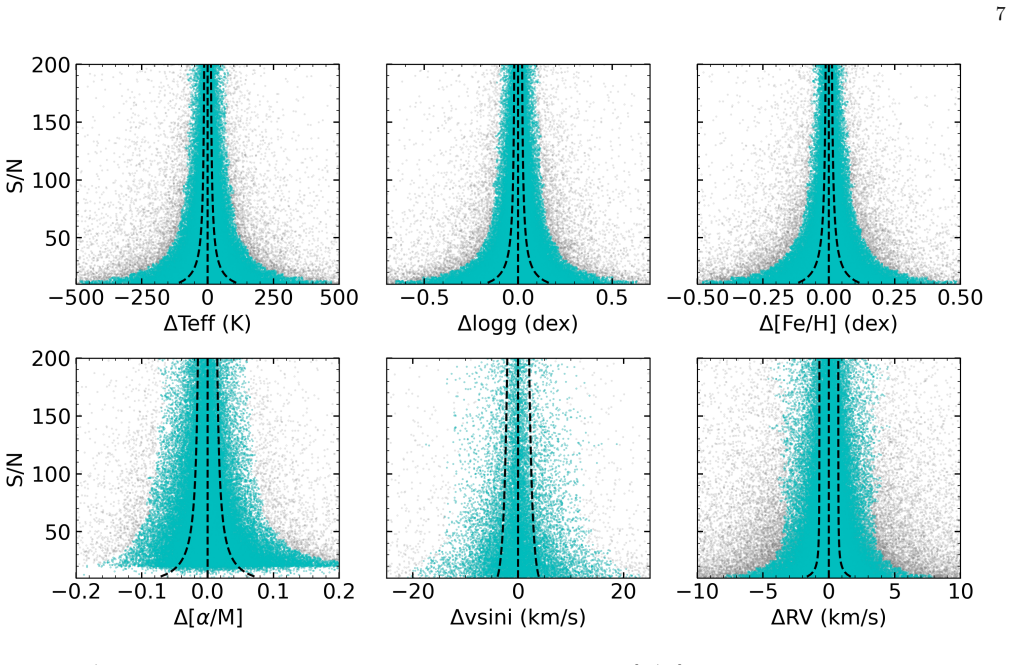
The load-bearing mechanism is the repeated-observation design combined with the LAMOST Stellar Parameter Pipeline (LASP), which fits each coadded medium-resolution spectrum to template libraries and reports effective temperature, surface gravity, metallicity, radial velocity, projected rotation, and $\alpha$-element abundance. Multiple epochs of the same star are combined into a signal-to-noise-weighted mean, and the internal uncertainty is calibrated from the scatter of individual measurements about that mean, modeled as $\sigma = a\,(\mathrm{S/N})^b + c$ after iteratively clipping 3-$\sigma$ outliers. External validation then checks these internal errors against independent high-resolution surveys, which is what supports the claim that the catalog is reliable outside its own pipeline.
What would settle it
Restrict the LK-MRS-I stars in common with APOGEE to S/N > 50 and refit the alpha-abundance regression: if the slope stays near 0.42 instead of moving toward 1, the compression is a pipeline systematic that the internal uncertainties miss; if the slope rises to unity, the low-S/N spectra were the cause.
Extended reading notes
Core claim
The central claim is that five years of repeated medium-resolution spectroscopy with LAMOST can produce homogeneous stellar parameters for 36,588 stars in the Kepler and K2 fields, with per-observation uncertainties of 120 K in effective temperature, 0.18 dex in surface gravity, 0.13 dex in metallicity, 0.08 dex in alpha-element abundance, 1.9 km/s in radial velocity, and 4.0 km/s in projected rotation at S/N = 10, validated against independent high-resolution surveys. The release includes weighted averages over all epochs, and the survey demonstrates its time-domain value by finding 2,333 stars whose radial velocity varies beyond three times its uncertainty; combining these with Kepler/K2 and TESS photometry yields 371 periodic variable stars of classified types. The paper also presents 764 metal-poor and 174 very metal-poor candidates plus 30 high-velocity candidates, including one star whose measured velocities exceed the Galactic escape velocity. The external comparisons show good agreement for radial velocity, effective temperature, and surface gravity but systematic offsets for metallicity and alpha abundance, with regression slopes of about 0.75 and 0.42, so the paper presents the latter quantities as useful but in need of caution.
Load-bearing premise
The quoted uncertainties are the scatter of repeated observations about a signal-to-noise-weighted mean after iterative 3-sigma clipping, and the paper assumes that internal scatter captures the full error budget even though external comparison shows a systematic compression in alpha-element abundance that these error bars do not include.
Editorial extensions
If this is right
- A reader can pull homogeneous effective temperature, surface gravity, metallicity, alpha abundance, radial velocity, and projected rotation for 36,588 stars in the Kepler/K2 footprints, 18,892 of them in the Kepler/K2 input catalogs, with uncertainties quoted as a function of signal-to-noise ratio.
- Stars with at least three valid coadded spectra, numbering 17,996, can be used for variability and rotation studies directly from the catalog's multi-epoch measurements.
- The 2,333 radial-velocity-variable candidates, of which 1,088 have Kepler/K2 photometry and 1,709 have TESS photometry, provide a ready target list for binary and pulsation follow-up.
- The 371 confirmed periodic variables, 194 newly reported, add classified delta Scuti, gamma Doradus, hybrid, RR Lyrae, eclipsing, RS Canum Venaticorum, and rotating variables to the known stellar populations in these fields.
- The catalog's external comparisons imply that effective temperature, surface gravity, and radial velocity can be used at face value across the sample, while metallicity and especially alpha abundance require calibration or caution.
Reading between the lines
- If the reported alpha-abundance compression is real, the survey's alpha abundances should be treated as relative indices rather than absolute abundances; anchoring them to the roughly 4,500 APOGEE cross-matches could produce a calibrated abundance scale for the full 36,588-star sample.
- The multi-epoch radial velocities, not just the 371 photometrically confirmed variables, are themselves a resource: combining them with Gaia astrometric orbits could reveal long-period binaries that the 3-sigma radial-velocity threshold misses.
- The 371 confirmed variables are likely a lower bound on the true variable population, because only about half the radial-velocity-variable candidates have Kepler/K2 or TESS light curves and the periodogram threshold of S/N = 5.6 is conservative.
- The unbound high-velocity candidate KIC 7881304, with five of seven epochs above the escape velocity, is a strong target for immediate high-resolution follow-up to rule out binary motion or template mismatch.
Editorial analysis
A structured set of objections, weighed in public.
Referee Report
Summary. The paper presents the LK-MRS-I catalog, derived from five years (2018–2023) of time-domain medium-resolution LAMOST spectroscopy of 20 plates in the Kepler and K2 fields. It releases stellar parameters (Teff, log g, [Fe/H], [α/M], radial velocity, v sin i) for 36,588 unique stars, with per-observation uncertainties quoted at S/N = 10, and validates the parameters against APOGEE, GALAH, and Gaia. It also identifies candidate metal-poor stars, very metal-poor stars, high-velocity stars, and radial-velocity variable stars, and uses Kepler/K2 or TESS photometry to confirm and classify 371 periodic variables.
Significance. If the catalog is reliable, it is a valuable community resource: it provides repeated-epoch, medium-resolution spectra in the Kepler/K2 fields, is processed with the updated LASP pipeline, and includes machine-readable tables. The external validation of Teff, log g, and radial velocity against APOGEE, GALAH, and Gaia is a genuine strength, and the photometric confirmation of variable-star candidates is a useful addition. However, the quoted uncertainties are derived only from internal scatter, and the paper's own external comparison shows substantial scale compressions for [Fe/H] and [α/M]. Because the catalog's headline uncertainties and the metal-poor candidate counts depend on these quantities, the uncertainty budget and the consistency of the text need revision before the catalog can be used as published.
major comments (4)
- [Section 3.3 and Section 5] The abstract and Section 3.3 describe the [Fe/H] and [α/M] comparisons as showing 'minor discrepancies' and 'generally good consistency,' yet Section 5 reports regression slopes of approximately 0.75 for [Fe/H] and 0.42 for [α/M] against APOGEE/GALAH. A slope of 0.75 is a 25% compression of the metallicity scale and 0.42 is a major compression of the α-element scale; these are calibration-level systematics, not random noise. Because the uncertainties quoted in Table 3 and the abstract (0.13 dex for [Fe/H], 0.08 dex for [α/M] at S/N = 10) are derived solely from internal scatter in Section 3.2, they do not include these external systematics. This is load-bearing because Section 4.1 selects metal-poor and very metal-poor candidates using [Fe/H] thresholds, and [α/M] is a headline catalog parameter. Please add explicit systematic uncertainty terms for [Fe/H] and [α/M], or substantially soften the abstract and Summary claims and add warnings to the catalog documentation.
- [Section 4.1, Abstract, Section 5] The number of metal-poor candidates is internally inconsistent: the abstract and Section 5 state 764 metal-poor stars, while Section 4.1 states 746 metal-poor stars (plus 174 very metal-poor stars). The abstract's total of 938 (764 + 174) also differs from the Section 4.1 total of 920 (746 + 174). Please correct the count and ensure the tables and text agree, because this is a headline result of the paper.
- [Table 3, Equation (4)] The v sin i uncertainty fit does not reproduce the tabulated values and is unphysical. With a = 41.52, b = -0.02, c = -36.0 in Equation (4), the predicted uncertainties are 3.65, 3.11, and 2.35 km/s at S/N = 10, 20, and 50, respectively, not the 4.0, 3.5, and 2.9 km/s listed in Table 3. Moreover, as S/N tends to infinity, the fitted curve approaches c = -36 km/s, so the relation becomes negative at sufficiently high S/N. This suggests an error in either the coefficients or the tabulated values. In addition, v sin i receives no external validation in Section 3.3, and Section 3.1 notes that values below 8 km/s are only upper limits; the quoted 4.0 km/s uncertainty therefore needs to be qualified.
- [Section 4.3] The radial-velocity variability selection uses the criterion that the standard deviation of RVs exceeds three times the mean RV uncertainty, but no minimum number of epochs is stated. For a star with only two visits, a single discrepant pair can satisfy this criterion, and Equation (2) gives large weight to such cases because of the N/(N-1) factor. The reported 2,333 RV-variable candidates therefore need either a minimum-epoch requirement (e.g., N >= 3 or 5), a demonstration that the false-positive rate is negligible, or a quantitative statement of the epoch distribution used.
minor comments (4)
- [Section 3.1 and Section 3.3] The cross-match radius is given as 3.75 arcsec in Section 3.1 and as 3.7 arcsec in Section 3.3 and Footnote 5; please unify the notation.
- [Appendix A heading] The heading 'PARAMETERS OF MELTA-POOR STAR CANDIDATES' contains a typo; it should read 'METAL-POOR'.
- [Section 2.2] The sentence 'This work presents a statistical analysis of LK-MRS based on the LAMOST DR11 3 Therefore, the current release...' appears garbled, with an orphaned footnote marker and missing punctuation; please rephrase.
- [Throughout] The notation for radial velocity is used inconsistently as 'R V', 'RV', and 'radial velocity'; please define a single notation and use it consistently.
Circularity Check
No significant circularity: the catalog is produced from spectra by an independent pipeline, the quoted uncertainties are calibrated internal scatter, and the key validations use external APOGEE/GALAH/Gaia data.
full rationale
The paper is an observational catalog release, not a derivation of a theory from first principles. The stellar parameters are produced by the LASP template-matching pipeline from individual coadded spectra (Section 3.1), so they are not defined in terms of the paper's own fitted outputs. The internal uncertainty relation, sigma_P = a*x^b + c (Eq. 4), is fitted to the scatter of repeated measurements about the weighted mean (Section 3.2); this is a calibration of repeatability rather than a prediction that is forced by construction. The external validation in Section 3.3 is genuinely external, using APOGEE, GALAH, and Gaia, and the paper openly reports regression slopes below unity for [Fe/H] (~0.75) and [alpha/M] (~0.42), with explicit caution about interpreting [alpha/M]; an incomplete error budget is an accuracy limitation, not circularity. The candidate samples (metal-poor, high-velocity, RV-variable) are threshold selections described as candidates with recommended follow-up, and the RV-variability criterion is a signal-to-noise cut relative to per-epoch uncertainties rather than a self-referential fit. Citations of Paper I for observing strategy and weighting equations are methodological continuity; the load-bearing content (pipeline parameters, external comparisons) does not reduce to those self-citations. No step was found in which an output equals an input by construction, so the circularity score is 0.
Assumptions & free parameters
free parameters (1)
- Uncertainty model coefficients a, b, c for Teff, log g, [Fe/H], [alpha/M], R V, v sin i =
e.g., Teff: a=1593, b=-1.16, c=9.5; v sin i: a=41.52, b=-0.02, c=-36.0
assumptions (4)
- domain assumption LASP pipeline template matching to ELODIE templates yields accurate parameters for late-A to K stars.
- domain assumption External surveys (APOGEE, GALAH, Gaia) provide accurate reference parameters for validation.
- domain assumption The iterative 3-sigma clipping and the power-law fit (Eq 4) describe true measurement uncertainty.
- domain assumption The Galactic potential model implemented in Galpy is appropriate for computing escape velocities.
Cite this review
Pith. "Pith review of Phase II of the LAMOST-Kepler/K2 Survey. II. Time Domain of Medium-resolution Spectroscopic Observations from 2018 to 2023." pith.science (2026). https://pith.science/paper/SES7D32C
@misc{pith2026250719751,
  author       = {Pith},
  title        = {Pith review of: Phase II of the LAMOST-Kepler/K2 Survey. II. Time Domain of Medium-resolution Spectroscopic Observations from 2018 to 2023},
  year         = {2026},
  howpublished = {\url{https://pith.science/paper/SES7D32C}},
  note         = {Machine review of arXiv:2507.19751}
}
read the original abstract
The LAMOST-Kepler/K2 Medium-Resolution Spectroscopic Survey (LK-MRS) conducted time-domain medium-resolution spectroscopic observations of 20 LAMOST plates in the Kepler and K2 fields from 2018 to 2023, a phase designated as LK-MRS-I. A catalog of stellar parameters for a total of 36,588 stars, derived from the spectra collected during these five years, including the effective temperature, the surface gravity, the metallicity, the {\alpha}-element abundance, the radial velocity, and v sin i of the target stars, is released, together with the weighted averages and uncertainties. At S/N = 10, the measurement uncertainties are 120 K, 0.18 dex, 0.13 dex, 0.08 dex, 1.9 km/s, and 4.0 km/s for the above parameters, respectively. Comparisons with the parameters provided by the APOGEE and GALAH surveys validate the effective temperature and surface gravity measurements, showing minor discrepancies in metallicity and {\alpha}-element abundance values. We identified some peculiar star candidates, including 764 metal-poor stars, 174 very metal-poor stars, and 30 high-velocity stars. Moreover, we found 2,333 stars whose radial velocity seems to be variable. Using Kepler/K2 or TESS photometric data, we confirmed 371 periodic variable stars among the radial velocity variable candidates and classified their variability types. LK-MRS-I provides spectroscopic data being useful for studies of the Kepler and K2 fields. The LK-MRS project will continue collecting time-domain medium-resolution spectra for target stars during the third phase of LAMOST surveys, providing data to support further scientific research.
Figures


Figures from the paper (6 more)


Reference graph
Works this paper leans on
-
[1]
thebibliography [1] 20pt to REFERENCES 6pt =0pt 10pt plus 3pt =0pt =0pt =1pt plus 1pt =0pt =0pt -12pt =13pt plus 1pt =20pt =13pt plus 1pt \@M =10000 =-1.0em =0pt =0pt 0pt =0pt =1.0em @enumiv\@empty 10000 10000 `\.\@m \@noitemerr \@latex@warning Empty `thebibliography' environment \@ifnextchar \@reference \@latexerr Missing key on reference command Each re...
arXiv 2019
-
[2]
2022, , 259, 35, 10.3847/1538-4365/ac4414
Abdurro'uf , Accetta , K., Aerts , C., et al. 2022, , 259, 35, 10.3847/1538-4365/ac4414
-
[3]
2018, , 238, 36, 10.3847/1538-4365/aadfe9
Abohalima , A., & Frebel , A. 2018, , 238, 36, 10.3847/1538-4365/aadfe9
-
[4]
Astropy Collaboration , Price-Whelan , A. M., Lim , P. L., et al. 2022, , 935, 167, 10.3847/1538-4357/ac7c74
-
[5]
Barentsen , G., Hedges , C., Saunders , N., et al. 2018, arXiv e-prints, arXiv:1810.12554, 10.48550/arXiv.1810.12554
work page Pith review arXiv doi:10.48550/arxiv.1810.12554 2018
-
[6]
Beers , T. C., & Christlieb , N. 2005, , 43, 531, 10.1146/annurev.astro.42.053102.134057
arXiv 2005
-
[7]
J., Koch , D., Basri , G., et al
Borucki , W. J., Koch , D., Basri , G., et al. 2010, Science, 327, 977, 10.1126/science.1185402
-
[8]
2015, , 216, 29, 10.1088/0067-0049/216/2/29
Bovy , J. 2015, , 216, 29, 10.1088/0067-0049/216/2/29
Show all 74 references
-
[9]
2021, , 506, 150, 10.1093/mnras/stab1242
Buder , S., Sharma , S., Kos , J., et al. 2021, , 506, 150, 10.1093/mnras/stab1242
2021 doi
-
[10]
2024, , 690, A367, 10.1051/0004-6361/202349106
Castro-Tapia , M., Aguilera-G \'o mez , C., & Chanam \'e , J. 2024, , 690, A367, 10.1051/0004-6361/202349106
2024 doi
-
[11]
2016, , 823, 102, 10.3847/0004-637X/823/2/102
Choi , J., Dotter , A., Conroy , C., et al. 2016, , 823, 102, 10.3847/0004-637X/823/2/102
2016 doi
-
[12]
N., Ren , A
De Cat , P., Fu , J. N., Ren , A. B., et al. 2015, , 220, 19, 10.1088/0067-0049/220/1/19
2015 doi
-
[13]
2016, , 222, 8, 10.3847/0067-0049/222/1/8
Dotter , A. 2016, , 222, 8, 10.3847/0067-0049/222/1/8
2016 doi
-
[14]
A., Grigahc \`e ne , A., Garrido , R., Gabriel , M., & Scuflaire , R
Dupret , M. A., Grigahc \`e ne , A., Garrido , R., Gabriel , M., & Scuflaire , R. 2005, , 435, 927, 10.1051/0004-6361:20041817
2005 doi
-
[15]
Y., Alonso-Santiago , J., et al
Frasca , A., Zhang , J. Y., Alonso-Santiago , J., et al. 2025, , 698, A7, 10.1051/0004-6361/202553673
2025 doi
-
[16]
2022, , 664, A78, 10.1051/0004-6361/202243268
Frasca , A., Molenda- \.Z akowicz , J., Alonso-Santiago , J., et al. 2022, , 664, A78, 10.1051/0004-6361/202243268
2022 doi
-
[17]
2020, Research in Astronomy and Astrophysics, 20, 167, 10.1088/1674-4527/20/10/167
Fu , J.-N., De Cat , P., Zong , W., et al. 2020, Research in Astronomy and Astrophysics, 20, 167, 10.1088/1674-4527/20/10/167
2020 doi
-
[18]
2022, VizieR Online Data Catalog: Gaia DR3 Part 4
Gaia Collaboration . 2022, VizieR Online Data Catalog: Gaia DR3 Part 4. Variability (Gaia Collaboration, 2022) , VizieR On-line Data Catalog: I/358. Originally published in: Astron. Astrophys., in prep. (2022)
2022
-
[19]
Gaia Collaboration , Prusti , T., de Bruijne , J. H. J., et al. 2016, , 595, A1, 10.1051/0004-6361/201629272
2016 doi
-
[20]
Gaia Collaboration , Vallenari , A., Brown , A. G. A., et al. 2023, , 674, A1, 10.1051/0004-6361/202243940
2023 doi
-
[21]
Green , G. M. 2018, The Journal of Open Source Software, 3, 695, 10.21105/joss.00695
2018 doi
-
[22]
2023, , 264, 12, 10.3847/1538-4365/ac9eac
Han , H., Wang , S., Bai , Y., et al. 2023, , 264, 12, 10.3847/1538-4365/ac9eac
2023 doi
-
[23]
A., et al
Hocd \'e , V., Moskalik , P., Gorynya , N. A., et al. 2024, , 689, A224, 10.1051/0004-6361/202347798
2024 doi
-
[24]
B., Sobeck , C., Haas , M., et al
Howell , S. B., Sobeck , C., Haas , M., et al. 2014, , 126, 398, 10.1086/676406
2014 doi
-
[25]
2024, , 168, 280, 10.3847/1538-3881/ad8913
Jin , M., Fu , J., Zhang , X., et al. 2024, , 168, 280, 10.3847/1538-3881/ad8913
2024 doi
-
[26]
2024, , 966, 69, 10.3847/1538-4357/ad3038
Li , X., Wang , S., Han , H., et al. 2024, , 966, 69, 10.3847/1538-4357/ad3038
2024 doi
-
[27]
2022, , 938, 78, 10.3847/1538-4357/ac8f29
Li , X., Wang , S., Zhao , X., et al. 2022, , 938, 78, 10.3847/1538-4357/ac8f29
2022 doi
-
[28]
L., Lu , Y.-J., et al
Li , Y.-B., Luo , A. L., Lu , Y.-J., et al. 2021, , 252, 3, 10.3847/1538-4365/abc16e
2021 doi
-
[29]
2024, , 167, 76, 10.3847/1538-3881/ad18c4
Liao , J., Du , C., Deng , M., et al. 2024, , 167, 76, 10.3847/1538-3881/ad18c4
2024 doi
- [30]
-
[31]
2025, , 978, L32, 10.3847/2041-8213/ad93cc
Lu , H.-P., Tian , H., Zhang , L.-Y., et al. 2025, , 978, L32, 10.3847/2041-8213/ad93cc
2025 doi
-
[32]
L., Zhao , Y.-H., Zhao , G., et al
Luo , A. L., Zhao , Y.-H., Zhao , G., et al. 2015, Research in Astronomy and Astrophysics, 15, 1095, 10.1088/1674-4527/15/8/002
2015 doi
-
[33]
Y., Zong , W., Fu , J
Ma , X. Y., Zong , W., Fu , J. N., et al. 2023, , 680, A11, 10.1051/0004-6361/202347410
2023 doi
-
[34]
R., Santos , \^A
Mathur , S., Claytor , Z. R., Santos , \^A . R. G., et al. 2023, , 952, 131, 10.3847/1538-4357/acd118
2023 doi
-
[35]
J., Hey , D., Van Reeth , T., & Bedding , T
Murphy , S. J., Hey , D., Van Reeth , T., & Bedding , T. R. 2019, , 485, 2380, 10.1093/mnras/stz590
2019 doi
-
[36]
2024, , 168, 253, 10.3847/1538-3881/ad84f5
Pan , Y., Frasca , A., Wang , J.-X., Fu , J.-N., & Zhang , X.-B. 2024, , 168, 253, 10.3847/1538-3881/ad84f5
2024 doi
-
[37]
2020, , 905, 67, 10.3847/1538-4357/abc250
Pan , Y., Fu , J.-N., Zong , W., et al. 2020, , 905, 67, 10.3847/1538-4357/abc250
2020 doi
-
[38]
G., Moharana , A., et al
Pawar , T., He miniak , K. G., Moharana , A., et al. 2024, , 691, A101, 10.1051/0004-6361/202451126
2024 doi
-
[39]
2011, , 192, 3, 10.1088/0067-0049/192/1/3
Paxton , B., Bildsten , L., Dotter , A., et al. 2011, , 192, 3, 10.1088/0067-0049/192/1/3
2011 doi
-
[40]
2013, , 208, 4, 10.1088/0067-0049/208/1/4
Paxton , B., Cantiello , M., Arras , P., et al. 2013, , 208, 4, 10.1088/0067-0049/208/1/4
2013 doi
-
[41]
2015, , 220, 15, 10.1088/0067-0049/220/1/15
Paxton , B., Marchant , P., Schwab , J., et al. 2015, , 220, 15, 10.1088/0067-0049/220/1/15
2015 doi
-
[42]
H., Elsworth , Y., Epstein , C., et al
Pinsonneault , M. H., Elsworth , Y., Epstein , C., et al. 2014, , 215, 19, 10.1088/0067-0049/215/2/19
2014 doi
-
[43]
H., Elsworth , Y
Pinsonneault , M. H., Elsworth , Y. P., Tayar , J., et al. 2018, , 239, 32, 10.3847/1538-4365/aaebfd
2018 doi
-
[44]
R., Winn , J
Ricker , G. R., Winn , J. N., Vanderspek , R., et al. 2014, in Society of Photo-Optical Instrumentation Engineers (SPIE) Conference Series, Vol. 9143, Space Telescopes and Instrumentation 2014: Optical, Infrared, and Millimeter Wave, ed. J. M. Oschmann , Jr., M. Clampin , G. G...
2014 doi
-
[45]
K., Bardalez-Gagliuffi , D., et al
Rothermich , A., Faherty , J. K., Bardalez-Gagliuffi , D., et al. 2024, , 167, 253, 10.3847/1538-3881/ad324e
2024 doi
-
[46]
2017, , 233, 23, 10.3847/1538-4365/aa97df
Serenelli , A., Johnson , J., Huber , D., et al. 2017, , 233, 23, 10.3847/1538-4365/aa97df
2017 doi
-
[47]
2011, Kepler/KIC, STScI/MAST, 10.17909/T9059R
STScI . 2011, Kepler/KIC, STScI/MAST, 10.17909/T9059R
2011 doi
-
[48]
2016 a , Kepler/EPIC, STScI/MAST, 10.17909/T93W28
---. 2016 a , Kepler/EPIC, STScI/MAST, 10.17909/T93W28
2016 doi
-
[49]
2016 b , Kepler LC+SC, Q0-Q17, STScI/MAST, 10.17909/T98304
---. 2016 b , Kepler LC+SC, Q0-Q17, STScI/MAST, 10.17909/T98304
2016 doi
-
[50]
2016 c , K2 Light Curves (all), STScI/MAST, 10.17909/T9WS3R
---. 2016 c , K2 Light Curves (all), STScI/MAST, 10.17909/T9WS3R
2016 doi
-
[51]
2018, TESS Input Catalog and Candidate Target List, STScI/MAST, 10.17909/FWDT-2X66
---. 2018, TESS Input Catalog and Candidate Target List, STScI/MAST, 10.17909/FWDT-2X66
2018 doi
-
[52]
2021 a , TESS Light Curves - All Sectors, STScI/MAST, 10.17909/T9-NMC8-F686
Team, M. 2021 a , TESS Light Curves - All Sectors, STScI/MAST, 10.17909/T9-NMC8-F686
2021 doi
-
[53]
2021 b , TESS "Fast" Light Curves - All Sectors, STScI/MAST, 10.17909/T9-ST5G-3177
---. 2021 b , TESS "Fast" Light Curves - All Sectors, STScI/MAST, 10.17909/T9-ST5G-3177
2021 doi
-
[54]
2021, , 506, 6117, 10.1093/mnras/stab1705
Wang , J., Fu , J.-N., Zong , W., Wang , J., & Zhang , B. 2021, , 506, 6117, 10.1093/mnras/stab1705
2021 doi
-
[55]
2024, , 690, A201, 10.1051/0004-6361/202449484
Wang , J., Pan , Y., Fu , J., et al. 2024, , 690, A201, 10.1051/0004-6361/202449484
2024 doi
-
[56]
2020, , 251, 27, 10.3847/1538-4365/abc1ed
Wang , J., Fu , J.-N., Zong , W., et al. 2020, , 251, 27, 10.3847/1538-4365/abc1ed
2020 doi
-
[57]
L., Zhang , S., et al
Wang , R., Luo , A. L., Zhang , S., et al. 2023, , 266, 40, 10.3847/1538-4365/acce36
2023 doi
-
[58]
L., Chen , J
Wang , R., Luo , A. L., Chen , J. J., et al. 2019, , 244, 27, 10.3847/1538-4365/ab3cc0
2019 doi
-
[59]
L., Henden , A
Watson , C. L., Henden , A. A., & Price , A. 2006, Society for Astronomical Sciences Annual Symposium, 25, 47
2006
-
[60]
2000, , 143, 9, 10.1051/aas:2000332
Wenger , M., Ochsenbein , F., Egret , D., et al. 2000, , 143, 9, 10.1051/aas:2000332
2000 doi
-
[61]
C., Hearty , F
Wilson , J. C., Hearty , F. R., Skrutskie , M. F., et al. 2019, , 131, 055001, 10.1088/1538-3873/ab0075
2019 doi
-
[62]
A., Sharma , S., Stello , D., et al
Wittenmyer , R. A., Sharma , S., Stello , D., et al. 2018, , 155, 84, 10.3847/1538-3881/aaa3e4
2018 doi
-
[63]
C., Jofr \'e , P., Rendle , B., et al
Worley , C. C., Jofr \'e , P., Rendle , B., et al. 2020, , 643, A83, 10.1051/0004-6361/201936726
2020 doi
-
[64]
2022, The Innovation, 3, 100224, 10.1016/j.xinn.2022.100224
Yan , H., Li , H., Wang , S., et al. 2022, The Innovation, 3, 100224, 10.1016/j.xinn.2022.100224
2022
-
[65]
R., Stello , D., et al
Yu , J., Bedding , T. R., Stello , D., et al. 2020, , 493, 1388, 10.1093/mnras/staa300
2020 doi
-
[66]
2021, , 256, 14, 10.3847/1538-4365/ac0834
Zhang , B., Li , J., Yang , F., et al. 2021, , 256, 14, 10.3847/1538-4365/ac0834
2021 doi
-
[67]
2022, , 258, 26, 10.3847/1538-4365/ac42d1
Zhang , B., Jing , Y.-J., Yang , F., et al. 2022, , 258, 26, 10.3847/1538-4365/ac42d1
2022 doi
-
[68]
2012, Research in Astronomy and Astrophysics, 12, 723, 10.1088/1674-4527/12/7/002
Zhao , G., Zhao , Y.-H., Chu , Y.-Q., Jing , Y.-P., & Deng , L.-C. 2012, Research in Astronomy and Astrophysics, 12, 723, 10.1088/1674-4527/12/7/002
2012 doi
-
[69]
2024, , 167, 227, 10.3847/1538-3881/ad3357
Zong , P., Fu , J.-N., Su , J., et al. 2024, , 167, 227, 10.3847/1538-3881/ad3357
2024 doi
-
[70]
2016, , 585, A22, 10.1051/0004-6361/201526300
Zong , W., Charpinet , S., Vauclair , G., Giammichele , N., & Van Grootel , V. 2016, , 585, A22, 10.1051/0004-6361/201526300
2016 doi
-
[71]
2018, , 238, 30, 10.3847/1538-4365/aadf81
Zong , W., Fu , J.-N., De Cat , P., et al. 2018, , 238, 30, 10.3847/1538-4365/aadf81
2018 doi
- [72]
-
[73]
L., Du , B., et al
Zuo , F., Luo , A. L., Du , B., et al. 2024, , 271, 4, 10.3847/1538-4365/ad1eeb
2024 doi
-
[74]
- [1] #1 = = ^ ^ ^ .\!\!^ d .\!\!^ h .\!\!^ m .\!\!^ s .\!\!^ @mss
thebibliography [1] 20pt to REFERENCES 6pt =0pt 10pt plus 3pt =0pt =0pt =1pt plus 1pt =0pt =0pt -12pt =13pt plus 1pt =20pt =13pt plus 1pt \@M =10000 =-1.0em =0pt =0pt 0pt =0pt =1.0em @enumiv\@empty 10000 10000 `\.\@m \@noitemerr \@latex@warning Empty `thebibliography' environm...
2019
Reviewed August 6, 2026 · model on record in the stance chip above.
Discussion (0). Sign in to comment.