REVIEW 4 major objections 5 minor 38 references
Anchoring Trends: Mitigating Social Media Popularity Prediction Drift via Feature Clustering and Expansion
T0 review · 4 major / 5 minor · reviewed 2026-08-06 · deepseek-v4-flash
Pith's one-line read The paper claims that concatenating original multimodal features with cluster-level statistical anchors and LLM-generated semantic anchors substantially reduces social media popularity prediction error under temporal distribution shift.
desk verdict The anchoring idea is worth a second look, but the paper's evaluation never actually tests temporal drift, and the statistical anchors are target encoding. read the letter →
The pith
A machine-rendered reading of the paper's core claim, the machinery that carries it, and where it could break.
The reading
What carries the argument
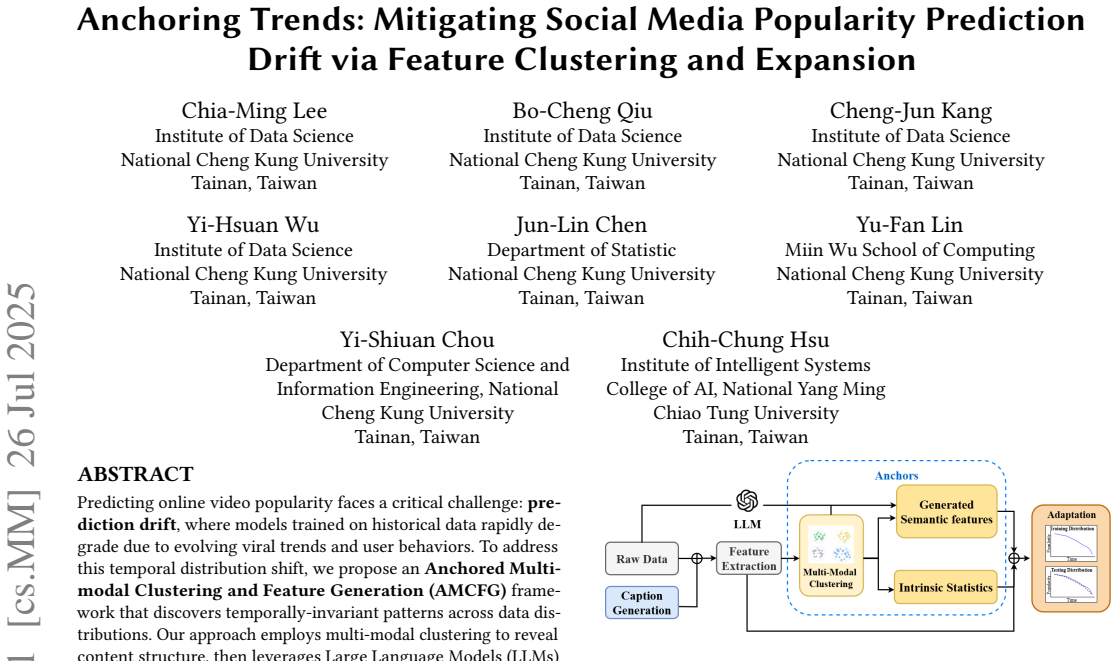
The carrying mechanism is the dual-anchoring feature expansion. Statistical anchors are computed per k-means cluster (k=300) for each of five modalities—text, video, audio, user, and post—as the cluster's mean popularity, popularity variance, and sample count, plus the cluster identity. Semantic anchors are generated by prompting VideoLLaMA3 and GPT-4o to describe cluster themes and audience or personality profiles, then embedding those descriptions with a SentenceTransformer. Both anchor types are concatenated with the original multimodal embeddings (BERT text, ViT visual, Open-L3 audio, metadata) into X_final, which is fed to a LightGBM regressor. The paper's stated target is the inequality Error(y, \tilde{y}) \ll Error(y, \hat{y}) in Eq. (1).
What would settle it
Run the same AMCFG pipeline with a strict temporal split—train on all posts before a cutoff date and test on all posts after—recomputing clusters and cluster statistics on the training portion only; if the anchored features do not beat raw features on the post-cutoff test set, the claimed drift mitigation is not supported.
Extended reading notes
Core claim
On the paper's own terms, the central discovery is that group-level behavioral patterns are more temporally stable than instance-level content features. The authors show that k-means clustering of multimodal embeddings yields coherent content cohorts, and that attaching each post's cluster identity plus the cluster's mean popularity, popularity variance, and count to the feature vector lowers MAPE from 27.17% to 22.53%, with a further drop to 22.31% when LLM-generated semantic anchor embeddings are added. They express this as the target inequality Error(y, \tilde{y}) \ll Error(y, \hat{y}) in their Eq. (1), where \tilde{y} uses the anchored feature set X_final and \hat{y} uses only original features. Their experiments report these gains under what they describe as temporal generalization assessment.
Load-bearing premise
The load-bearing premise is that cluster-level statistics and LLM-generated cluster themes computed from training posts stay stable enough to anchor predictions on future content, and that user-grouped cross-validation actually measures that temporal stability.
Editorial extensions
If this is right
- If the anchors are as temporally stable as claimed, popularity models can maintain accuracy on future content without retraining on newly labeled posts.
- The ablations show the bulk of the gain comes from cluster-level statistical anchors, with LLM semantic anchors contributing a smaller but consistent improvement.
- The SMP2025 challenge results, with a 2.11% gap between public and private test MAPE, indicate the anchored features carry over to a held-out competition setting.
- The paper's dual-anchoring design implies that both numerical group behavior and qualitative cluster themes are needed for full robustness against temporal variation.
Reading between the lines
- The reported evaluation does not actually separate time: grouping by user identifier in 5-fold Group K-Fold allows posts from the same time period to appear in both training and test folds, so the numbers do not measure prediction drift on future data.
- If cluster statistics are computed on the full dataset before splitting, each post's own popularity contributes to its cluster's mean, leaking the target into the features; the paper does not state that these statistics are computed within training folds only.
- The stability of clusters over time is asserted rather than measured; a straightforward test would compare cluster assignments and cluster-level popularity statistics between two date-separated halves of the dataset.
- The anchoring idea could transfer to other time-varying prediction tasks, such as sales or trending-topic forecasting, where a strict temporal split is standard practice.
Editorial analysis
A structured set of objections, weighed in public.
Referee Report
Summary. The paper proposes AMCFG, a framework that clusters multimodal features of social media videos, computes cluster-level statistics of the popularity target as "statistical anchors," and uses LLMs to generate "semantic anchors" from cluster content. These anchors are concatenated with the original features and fed to a LightGBM regressor. The central claim, stated in Eq. (1) and the abstract, is that this anchoring substantially reduces prediction error under temporal distribution shift. Experiments are reported on a 6K TikTok video dataset using 5-fold Group K-Fold cross-validation by user, plus a submission to the SMP2025 challenge. The paper also includes ablations over cluster count, feature modalities, and anchor types.
Significance. The problem addressed—temporal drift in social media popularity prediction—is practically important, and the idea of extracting stable cluster-level summaries and LLM-generated semantic concepts is creative and potentially valuable. However, the experimental protocol does not measure temporal drift at all: user-grouped cross-validation is not a temporal split. In addition, the statistical anchors are derived from the target variable (popularity) and the paper does not rule out target leakage or improper target encoding. As a result, the central claim is unsupported by the reported evidence. The paper does provide useful ablation studies and a real-world challenge submission, but these do not compensate for the invalid evaluation of the core claim.
major comments (4)
- [5.1] Section 5.1 states that 5-fold Group K-Fold cross-validation using user identifiers 'ensuring temporal generalization assessment.' This is incorrect. Grouping by user partitions the data by user identity, not by time; test videos may be posted before training videos, and the model is never forced to predict future content. Therefore, the experiments do not quantify prediction drift or temporal distribution shift, and the central inequality in Eq. (1) is not tested. A temporal split based on post timestamps or a fixed chronological train/test boundary is required to support the paper's claims.
- [4.2.1, Eq. (6)] The statistical anchors X_stat consist of cluster-level mean popularity, popularity variance, and sample count. The paper does not specify whether the k-means clustering and these statistics are recomputed on each training fold or computed once on the full 6K-video dataset. If computed on the full dataset before cross-validation, a test video's own popularity contributes to the anchor values of its assigned cluster, which is direct target leakage. Even if computed per training fold, the mean and variance of the target are being used as features in a target-encoding-like way; the paper provides no nested cross-validation or explicit per-fold procedure to rule out leakage. This confounds the MAPE improvement from 27.17% to 22.53% in Table 4.
- [5.2, Table 5] Table 5 shows that adding semantic anchors to statistical anchors improves MAPE only from 22.53% to 22.31%, while R² decreases from 0.5535 to 0.5369. The text claims 'consistent improvement' but gives no statistical significance or variance across folds. This is weak and inconsistent evidence for the 'dual-anchoring' mechanism, which is one of the paper's three stated contributions.
- [5.4, Table 6] The SMP2025 challenge results in Table 6 report only the anchors model's public and private MAPE values, with no comparison to a non-anchored baseline, other participants, or a standard SMP method. A 2.11% generalization gap alone does not demonstrate drift mitigation; it could simply reflect the difference in difficulty between the public and private test sets. Without a baseline, this table does not support the temporal robustness claim.
minor comments (5)
- [References] References [16] and [17] are identical (both list the same C-SFDA paper); one should be replaced with a distinct citation.
- [Table 7] The GPT-4o output in Table 7 contains a grammatical error: 'This cluster is belong to' should be 'This cluster belongs to.'
- [1 and 3] The paper repeatedly uses 'Test-Time Adaptation' terminology, but the proposed method performs offline feature generation rather than adaptation at test time. The distinction should be clarified to avoid misleading readers.
- [3, Eq. (1)] The symbol '≪' in Eq. (1) is undefined; the paper should state a quantitative criterion (e.g., relative improvement in MAPE) for what counts as 'much smaller error.'
- [5.1] The dataset description does not mention timestamps or posting dates, making it impossible to judge whether a temporal split could even be constructed; the paper should describe the temporal structure of the data.
Circularity Check
Statistical anchors are cluster-level statistics of the target variable, so the headline gain partly reduces to target encoding; the 'temporal' split is by user, not by time.
-
self definitional
[Section 4.2.1, Eq. (6); Section 4.3, Eq. (9); Section 3, Eq. (1); Table 4]
"For each cluster C^m_j (where j∈{1,2,...,300} is the cluster index and m denotes modality), we compute intrinsic statistics that quantify stable engagement patterns: mean popularity μ_pop(C^m_j), popularity variance σ²_pop(C^m_j), and sample count N_count(C^m_j). These metrics serve as numerical anchors analogous to TTA's neighborhood consistency measures: X^(i)_stat = concat({μ_pop(C^m_{L^m_i}), σ²_pop(C^m_{L^m_i}), N_count(C^m_{L^m_i}), L^m_i : m∈{text, video, audio, user, post}})."
X_stat is defined as a function of the popularity values being predicted: μ_pop and σ²_pop are the mean and variance of the target within each cluster. Equation (9) concatenates X_stat into X_final, and Eq. (1) then credits f(X_final) with much lower error than f(X_orig). The paper never says clusters or cluster popularity moments are recomputed on each training fold; Section 5.1 only defines a user-grouped K-Fold split. As written, a test item's own y enters its statistical anchor through its cluster's μ_pop and σ²_pop, so the reported MAPE drop (27.17% to 22.53%, Table 4) is partly the model reading target aggregates, not an independent temporally invariant feature.
full rationale
The semantic-anchor half of AMCFG is generated from content via VideoLLaMA3/GPT-4o and is not circular. The circularity is confined to the statistical-anchor path: Eq. (6) constructs X_stat directly from cluster-level popularity mean/variance, Eq. (9) feeds it to the predictor, and Eq. (1) presents the resulting error reduction as temporal anchoring. Because clustering and statistics are described globally and the evaluation split is by user ID rather than by time, the reported improvement over raw features can be explained by target leakage through the anchors. No load-bearing self-citation or imported uniqueness theorem was found; Section 5.4's SMP2025 numbers are external but lack a no-anchor baseline. The temporal-robustness conclusion is therefore not currently derived by the experiment. Score 6 reflects partial circularity: the statistical anchor component reduces by construction, while the semantic anchor component retains independent content.
Assumptions & free parameters
free parameters (2)
- Number of clusters k =
300
- SVD reduced dimensionality for textual embeddings =
not specified
assumptions (3)
- domain assumption TTA clustering-based anchoring insights transfer from spatial domain shift to temporal drift in social media content.
- domain assumption VideoLLaMA3 and GPT-4o generate semantic features that are temporally invariant and predictive of popularity.
- ad hoc to paper Group K-Fold by user identifiers simulates temporal distribution shift.
Cite this review
Pith. "Pith review of Anchoring Trends: Mitigating Social Media Popularity Prediction Drift via Feature Clustering and Expansion." pith.science (2026). https://pith.science/paper/NKITXIPJ
@misc{pith2026250719863,
  author       = {Pith},
  title        = {Pith review of: Anchoring Trends: Mitigating Social Media Popularity Prediction Drift via Feature Clustering and Expansion},
  year         = {2026},
  howpublished = {\url{https://pith.science/paper/NKITXIPJ}},
  note         = {Machine review of arXiv:2507.19863}
}
read the original abstract
Predicting online video popularity faces a critical challenge: prediction drift, where models trained on historical data rapidly degrade due to evolving viral trends and user behaviors. To address this temporal distribution shift, we propose an Anchored Multi-modal Clustering and Feature Generation (AMCFG) framework that discovers temporally-invariant patterns across data distributions. Our approach employs multi-modal clustering to reveal content structure, then leverages Large Language Models (LLMs) to generate semantic Anchor Features, such as audience demographics, content themes, and engagement patterns that transcend superficial trend variations. These semantic anchors, combined with cluster-derived statistical features, enable prediction based on stable principles rather than ephemeral signals. Experiments demonstrate that AMCFG significantly enhances both predictive accuracy and temporal robustness, achieving superior performance on out-of-distribution data and providing a viable solution for real-world video popularity prediction.
Figures


Figures from the paper (1 more)

Reference graph
Works this paper leans on
-
[2]
Xiaolu Chen, Weilong Chen, Chenghao Huang, Zhongjian Zhang, Lixin Duan, and Yanru Zhang. 2023. Double-Fine-Tuning Multi-Objective Vision-and-Language Transformer for Social Media Popularity Prediction. In Proceedings of the 31st ACM International Conference on Multimedia . 9462–9466
work page 2023
-
[3]
Aurora Linh Cramer, Ho-Hsiang Wu, Justin Salamon, and Juan Pablo Bello. 2019. Look, Listen, and Learn More: Design Choices for Deep Audio Embeddings. In ICASSP 2019 - 2019 IEEE International Conference on Acoustics, Speech and Signal Processing (ICASSP). 3852–3856. https://doi.org/10.1109/ICASSP.2019.8682475
arXiv 2019
-
[4]
Jacob Devlin, Ming-Wei Chang, Kenton Lee, and Kristina Toutanova. 2018. Bert: Pre-training of deep bidirectional transformers for language understanding.arXiv preprint arXiv:1810.04805 (2018)
arXiv 2018
-
[5]
Alexey Dosovitskiy, Lucas Beyer, Alexander Kolesnikov, Dirk Weissenborn, Xi- aohua Zhai, Thomas Unterthiner, Mostafa Dehghani, Matthias Minderer, Georg Heigold, Sylvain Gelly, Jakob Uszkoreit, and Neil Houlsby. 2021. An Image is Worth 16x16 Words: Transformers for Image Recognition at Scale. In Interna- tional Conference on Learning Representations . http...
work page 2021
-
[6]
Franziska Horn, Robert Pack, and Michael Rieger. 2019. The autofeat Python Library for Automated Feature Engineering and Selection. In Joint European Conference on Machine Learning and Knowledge Discovery in Databases . Springer, 111–120
work page 2019
-
[7]
Chih-Chung Hsu, Li-Wei Kang, Chia-Yen Lee, Jun-Yi Lee, Zhong-Xuan Zhang, and Shao-Min Wu. 2019. Popularity Prediction of Social Media Based on Multi- Modal Feature Mining. In Proceedings of the 27th ACM International Conference on Multimedia (Nice, France) (MM ’19). Association for Computing Machinery, New York, NY, USA, 2687–2691. https://doi.org/10.1145...
- [8]
-
[9]
Chih-Chung Hsu, Chia-Ming Lee, Xiu-Yu Hou, and Chi-Han Tsai. 2023. Gradient Boost Tree Network based on Extensive Feature Analysis for Popularity Predic- tion of Social Posts. Proceedings of the 31st ACM International Conference on Multimedia
work page 2023
Show all 38 references
-
[10]
Chih-Chung Hsu, Chia-Ming Lee, Yu-Fan Lin, Yi-Shiuan Chou, Chih-Yu Jian, and Chi-Han Tsai. 2024. Revisiting Vision-Language Features Adaptation and Inconsistency for Social Media Popularity Prediction. In Proceedings of the 32nd ACM International Conference on Multimedia (Melb...
2024
-
[11]
Chih-Chung Hsu, Chia-Yen Lee, Ting-Xuan Liao, Jun-Yi Lee, Tsai-Yne Hou, Ying- Chu Kuo, Jing-Wen Lin, Ching-Yi Hsueh, Zhong-Xuan Zhang, and Hsiang-Chin Chien. 2018. An iterative refinement approach for social media headline predic- tion. In Proceedings of the ACM International ...
2018
-
[12]
Chih-Chung Hsu, Ying-Chin Lee, Ping-En Lu, Shian-Shin Lu, Hsiao-Ting Lai, Chihg-Chu Huang, Chun Wang, Yang-Jiun Lin, and Weng-Tai Su. 2017. Social media prediction based on residual learning and random forest. In Proceedings of the ACM International Conference on Multimedia . ...
2017
-
[13]
Chih-Chung Hsu, Pi-Ju Tsai, Ting-Chun Yeh, and Xiu-Yu Hou. 2022. A Compre- hensive Study of Spatiotemporal Feature Learning for Social Medial Popularity Prediction. In Proceedings of the 30th ACM International Conference on Multimedia (Lisboa, Portugal) (MM ’22). Association f...
2022
-
[14]
Chih-Chung Hsu, Wen-Hai Tseng, Hao-Ting Yang, Chia-Hsiang Lin, and Chi- Hung Kao. 2020. Rethinking Relation between Model Stacking and Recurrent Neural Networks for Social Media Prediction. In Proceedings of the 28th ACM International Conference on Multimedia . Association for...
2020
-
[15]
Yu-Kai Hung, Yun-Chien Huang, Ting-Yu Su, Yen-Ting Lin, Lung-Pan Cheng, Bryan Wang, and Shao-Hua Sun. 2025. SimTube: Simulating Audience Feedback on Videos using Generative AI and User Personas. In Proceedings of the 30th International Conference on Intelligent User Interfaces...
2025
-
[16]
Nazmul Karim, Niluthpol Chowdhury Mithun, Abhinav Rajvanshi, Han-pang Chiu, Supun Samarasekera, and Nazanin Rahnavard. 2023. C-sfda: A curriculum Conference’17, July 2017, Washington, DC, USA Lee et al. learning aided self-training framework for efficient source free domain ad...
2023
-
[17]
Nazmul Karim, Niluthpol Chowdhury Mithun, Abhinav Rajvanshi, Han-pang Chiu, Supun Samarasekera, and Nazanin Rahnavard. 2023. C-sfda: A curriculum learning aided self-training framework for efficient source free domain adapta- tion. In Proceedings of the IEEE/CVF Conference on ...
2023
-
[18]
Guolin Ke, Qi Meng, Thomas Finley, Taifeng Wang, Wei Chen, Weidong Ma, Qiwei Ye, and Tie-Yan Liu. 2017. Lightgbm: A highly efficient gradient boosting decision tree. In Advances in Neural Information Processing Systems . 3146–3154
2017
-
[19]
Xin Lai, Yihong Zhang, and Wei Zhang. 2020. HyFea: Winning Solution to Social Media Popularity Prediction for Multimedia Grand Challenge 2020. In Proceedings of the 28th ACM International Conference on Multimedia . Association for Computing Machinery, New York, NY, USA, 4565–4...
2020
-
[20]
Chia-Ming Lee, Ching-Heng Cheng, Yu-Fan Lin, Yi-Ching Cheng, Wo-Ting Liao, Fu-En Yang, Yu-Chiang Frank Wang, and Chih-Chung Hsu. 2025. PromptHSI: Universal Hyperspectral Image Restoration with Vision-Language Modulated Frequency Adaptation. arXiv:2411.15922 [eess.IV] https://a...
2025 arXiv
-
[21]
Jian Liang, Dapeng Hu, and Jiashi Feng. 2020. Do we really need to access the source data? source hypothesis transfer for unsupervised domain adaptation. In Proceedings of the 37th International Conference on Machine Learning (ICML’20) . JMLR.org, Article 560, 12 pages
2020
-
[22]
Yu-Fan Lin, Chia-Ming Lee, and Chih-Chung Hsu. 2025. DenseSR: Image Shadow Removal as Dense Prediction. arXiv:2507.16472 [cs.CV] https://arxiv.org/abs/ 2507.16472
2025 arXiv
-
[23]
Jaehyun Nam, Kyuyoung Kim, Seunghyuk Oh, Jihoon Tack, Jaehyung Kim, and Jinwoo Shin. 2025. Optimized feature generation for tabular data via LLMs with decision tree reasoning. In Proceedings of the 38th International Conference on Neural Information Processing Systems (Vancouv...
2025
-
[24]
Hollmann Noah, Müller Samuel, and Hutter Frank. 2023. LLMs for Semi- Automated Data Science: Introducing CAAFE for Context-Aware Automated Feature Engineering. arXiv:2305.03403 [cs.AI]
2023 arXiv
-
[25]
Alec Radford, Jong Wook Kim, Chris Hallacy, Aditya Ramesh, Gabriel Goh, Sandhini Agarwal, Girish Sastry, Amanda Askell, Pamela Mishkin, Jack Clark, Gretchen Krueger, and Ilya Sutskever. 2021. Learning Transferable Visual Models From Natural Language Supervision. arXiv preprint...
2021 arXiv
-
[26]
Manogna Sreenivas, Goirik Chakrabarty, and Soma Biswas. 2024. pSTarC: Pseudo Source Guided Target Clustering for Fully Test-Time Adaptation. In2024 IEEE/CVF Winter Conference on Applications of Computer Vision (W ACV). 2690–2698. https: //doi.org/10.1109/WACV57701.2024.00268
2024
-
[27]
YunPeng Tan, Fangyu Liu, BoWei Li, Zheng Zhang, and Bo Zhang. 2022. An Efficient Multi-View Multimodal Data Processing Framework for Social Media Popularity Prediction. In Proceedings of the 30th ACM International Conference on Multimedia (Lisboa, Portugal) (MM ’22). Associati...
2022
-
[28]
Dequan Wang, Evan Shelhamer, Shaoteng Liu, Bruno Olshausen, and Trevor Darrell. 2021. Tent: Fully Test-Time Adaptation by Entropy Minimization. In International Conference on Learning Representations . https://openreview.net/ forum?id=uXl3bZLkr3c
2021
-
[29]
Bo Wu, Wen-Huang Cheng, Peiye Liu, Bei Liu, Zhaoyang Zeng, and Jiebo Luo
-
[30]
Bo Wu, Wen-Huang Cheng, Yongdong Zhang, Huang Qiushi, Li Jintao, and Tao Mei. 2017. Sequential Prediction of Social Media Popularity with Deep Temporal Context Networks. In International Joint Conference on Artificial Intelligence (IJCAI) (Melbourne, Australia)
2017
-
[31]
Bo Wu, Tao Mei, Wen-Huang Cheng, and Yongdong Zhang. 2016. Unfolding Temporal Dynamics: Predicting Social Media Popularity Using Multi-scale Tem- poral Decomposition. In Proceedings of the Thirtieth AAAI Conference on Artificial Intelligence (AAAI) (Phoenix, Arizona)
2016
-
[32]
Jianmin Wu, Liming Zhao, Dangwei Li, Chenwei Xie, Siyang Sun, and Yun Zheng
-
[33]
Shiqi Yang, Yaxing Wang, Joost van de weijer, Luis Herranz, and SHANGLING JUI
-
[34]
Boqiang Zhang, Kehan Li, Zesen Cheng, Zhiqiang Hu, Yuqian Yuan, Guanzheng Chen, Sicong Leng, Yuming Jiang, Hang Zhang, Xin Li, Peng Jin, Wenqi Zhang, Fan Wang, Lidong Bing, and Deli Zhao. 2025. VideoLLaMA 3: Frontier Multimodal Foundation Models for Image and Video Understandi...
2025 arXiv
-
[35]
Tianping Zhang, Zheyu Zhang, Zhiyuan Fan, Haoyan Luo, Fengyuan Liu, Qian Liu, Wei Cao, and Jian Li. 2023. OpenFE: automated feature generation with expert-level performance. In Proceedings of the 40th International Conference on Machine Learning (Honolulu, Hawaii, USA) (ICML’2...
2023
-
[36]
Zhizhen Zhang, Xiaohui Xie, Mengyu Yang, Ye Tian, Yong Jiang, and Yong Cui. 2023. Improving Social Media Popularity Prediction with Multiple Post Dependencies. arXiv:2307.15413 [cs.MM]
2023 arXiv
-
[2019]
In Proceedings of the 27th ACM International Conference on Multimedia
SMP Challenge: An Overview of Social Media Prediction Challenge 2019. In Proceedings of the 27th ACM International Conference on Multimedia
2019
-
[2021]
In Advances in Neural Information Processing Systems, A
Exploiting the Intrinsic Neighborhood Structure for Source-free Domain Adaptation. In Advances in Neural Information Processing Systems, A. Beygelzimer, Y. Dauphin, P. Liang, and J. Wortman Vaughan (Eds.). https://openreview.net/ forum?id=yhjpeuWepoj
-
[2022]
In Proceedings of ACM international conference on Multimedia (ACM MM)
Deeply Exploit Visual and Language Information for Social Media Popu- larity Prediction. In Proceedings of ACM international conference on Multimedia (ACM MM)
Reviewed August 6, 2026 · model on record in the stance chip above.
Discussion (0). Sign in to comment.