REVIEW 2 major objections 6 minor 1 cited by
Near-Wall Scaling and Separation Prediction of a Rotation-Based Subgrid-Scale Stress Model
T0 review · 2 major / 6 minor · reviewed 2026-08-06 · deepseek-v4-flash
Pith's one-line read A rotation-based eddy-viscosity model predicts separated hill flow within 6.9% of experiment.
desk verdict Useful validation of the Liutex SGS model with solid simulations, but the near-wall scaling claim is internally contradictory (O(y) vs O(y^2)) and must be resolved before the headline result is credible. read the letter →
The pith
A machine-rendered reading of the paper's core claim, the machinery that carries it, and where it could break.
The reading
What carries the argument
The load-bearing object is the Liutex vector $\mathbf{R}$, the rigid-rotation part of the velocity-gradient field; its magnitude $|\mathbf{R}|$ replaces the strain-rate magnitude in the classical eddy-viscosity formula, giving $\nu_t=(C_s\Delta)^2|\mathbf{R}|$ with $C_s=0.17$. Because rigid rotation is zero in pure shear, the formula has a built-in wall behavior: the viscous sublayer is nearly pure shear, so $\nu_t$ dies out there without a damping function. The paper uses this mechanism to explain the near-wall scaling, the correlation between eddy viscosity and visualized vortex structures, and the model's ability to predict separated-flow reattachment; the $-10/3$ dissipation-range spectrum of $|\mathbf{R}|$ is offered as evidence that the velocity scale has the correct small-scale content.
What would settle it
Rerun the periodic-hill case with $C_s=0.10$, $0.17$, and $0.25$ on the same grids and record the reattachment location; if reattachment moves by much more than the reported 6.9% error as $C_s$ changes, the claimed accuracy is a coefficient effect, not a property of the rotation-based velocity scale.
Extended reading notes
Core claim
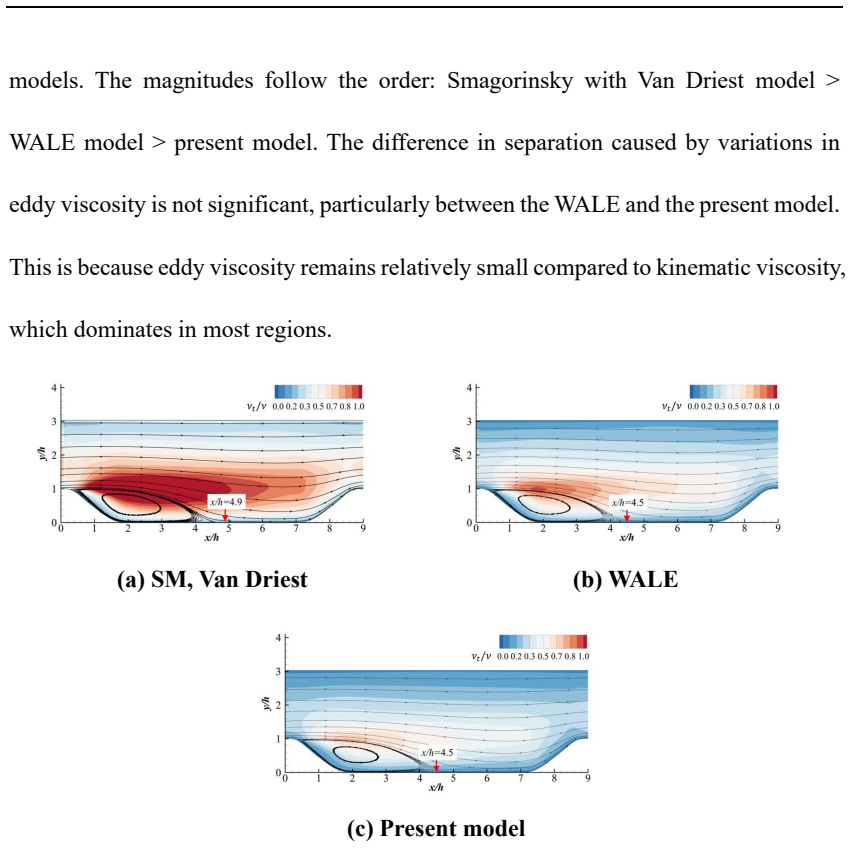
The central claim is that the 2022 rotation-based SGS model---$\nu_t = (C_s \Delta)^2 |\mathbf{R}|$, with $\mathbf{R}$ the Liutex vector (twice the local angular velocity of rigid rotation)---has the near-wall and separated-flow behavior that standard closures lack. In channel flow at $Re_\tau=395$, the paper reports that $\nu_t$ vanishes near the wall, with an asymptotic trend given as $O(y)$ in the abstract and as $O(y^2)$ in the conclusions, that the dimensionless eddy viscosity sits in the $10^{-2}$ to $10^{-4}$ range like WALE's, and that the power spectrum of $|\mathbf{R}|$ follows a $-10/3$ slope in the dissipation range; mean velocity profiles on fine grids match DNS. In periodic-hill flow at $Re_H=10595$, the model places reattachment at $x/h=4.5$, a 6.9% error against the experimental 4.21, the same as WALE and much better than the classical strain-rate-based model's 14.0%. At the separation core ($x/h=2$), the model's Reynolds-stress components are closer to experiment than WALE's in the near-wall region; downstream of reattachment the paper acknowledges its Reynolds stress is less developed. The paper also states that the model coefficient may need adjustment for other flow conditions.
Load-bearing premise
The entire comparison rests on the fixed coefficient $C_s=0.17$ being the right weight for the Liutex velocity scale; if that constant has to be retuned for each flow, the reported 6.9% error and Reynolds-stress gains could be artifacts of the chosen number rather than of using rigid rotation.
Editorial extensions
If this is right
- The rotation-based closure would give a fixed-coefficient SGS model that needs neither a wall-damping function nor a dynamic procedure in channel and separated flows.
- For separated-flow geometries like periodic hills, backward-facing steps, or stalled airfoils, reattachment points would typically be predicted with roughly half the error of the classical strain-rate-based model.
- Near-wall Reynolds-stress predictions at a separation core would improve over WALE, which matters for surface loads and heat-transfer predictions in separated regions.
- Because the same $|\mathbf{R}|$ field both identifies vortices and sets eddy viscosity, simulation workflows could use one computed quantity for visualization and closure.
- The $-10/3$ spectral behavior suggests $|\mathbf{R}|$ could serve as a direct, resolved-scale proxy for the dissipation-range cascade in LES grids.
Reading between the lines
- The paper does not test this, but if the 6.9% reattachment error survives when $C_s$ is dynamic rather than fixed at 0.17, that would show the Liutex velocity scale, not the coefficient, carries the improvement.
- A natural extension the paper does not attempt is homogeneous isotropic turbulence: comparing the $|\mathbf{R}|$ spectrum with the dissipation spectrum would test whether $|\mathbf{R}|$ is a local proxy for $\epsilon^{1/3}$, the spectral justification for using $\Delta^2|\mathbf{R}|$ as an eddy viscosity.
- The paper does not claim this, but the near-wall advantage at the separation core could be probed at higher Reynolds numbers or on a geometrically different separation such as a bluff body or airfoil, which would show whether the effect is tied to the periodic-hill case.
- The paper's own note that coefficients may need adjustment implies a practical next step: a two-parameter calibration against wall-resolved DNS to separate the velocity scale's contribution from the constant's contribution.
Signed reviews
Editorial analysis
A structured set of objections, weighed in public.
Referee Report
Summary. This paper evaluates the Liutex-based subgrid-scale stress model of Ding et al. (2022) in two canonical flows: fully developed turbulent channel flow at Re_tau = 395 and periodic hill flow at Re = 10595. The authors employ OpenFOAM on three successively refined grids for each case, compare against Smagorinsky, Smagorinsky with Van Driest damping, and WALE, and validate against DNS (Moser et al., Krank et al.) and experiments (Rapp, Breuer). The central claims are: (i) the eddy viscosity from the Liutex model vanishes near the wall with an asymptotic behavior O(y); (ii) the power spectral density of |R| follows a -10/3 law in the dissipation range; (iii) in periodic hill flow the model predicts the reattachment point with 6.9% error, matching WALE and beating Smagorinsky variants; and (iv) it gives more accurate near-wall Reynolds stress than WALE at separation-core locations. The manuscript reports grid convergence and reasonable agreement with reference data, but it contains an unresolved internal contradiction about the near-wall scaling order that affects the headline physical-consistency argument.
Significance. If the near-wall scaling and separation predictions are correct, the Liutex-based SGS model offers a physically motivated eddy-viscosity formulation with performance comparable to WALE and potentially better near-wall Reynolds-stress behavior in separated flows. The paper's strengths include systematic grid-convergence studies on three grids per case, validation against independent DNS and experimental data, and direct comparison with established SGS models. However, the central near-wall scaling claim is stated inconsistently (O(y) in the Abstract and Conclusion vs. O(y^2) in Section 3.1), and the model coefficient is inherited from Lilly's Smagorinsky value without sensitivity analysis. These issues must be resolved before the physical-consistency and superiority claims can be accepted. The contribution is of interest to the LES and turbulence-modeling community, but the current presentation does not yet support the advertised conclusions.
major comments (2)
- [§3.1, Fig. 7; Abstract; Conclusion (2)] The paper contains two mutually inconsistent statements about the near-wall scaling of the Liutex-based eddy viscosity. The paragraph describing Fig. 7 first states that 'All eddy viscosities obtained from the present model approach zero near the wall, with an asymptotic trend proportional to y', but a few sentences later states that 'The present model exhibits a vanishing tendency proportional to y^2'. The Abstract and Conclusion (2) repeat the O(y) version. Since no analytic derivation or measured slope (e.g., a log-log fit of nu_t/nu vs y+) is provided, the reader cannot determine which statement is correct. Furthermore, the sentence preceding Fig. 7 asserts that the eddy viscosity must grow at least as the cubic power of y^+, which would make either O(y) or O(y^2) physically inaccurate relative to that criterion. This is load-bearing because the abstract advertises 'an asymptotic behavior of O(y) near the walls' as a central physical-consistency result. Please measure and report the actual scaling exponent, correct the Abstract/Conclusion or Section 3.1 accordingly, and clarify whether the scaling is derived or purely observational.
- [§2.1, Eq. (10); §4; §3.2.1] The model coefficient C_s is fixed at 0.17 for both channel flow and periodic hill flow, taken directly from Lilly's inertial-range value for the Smagorinsky model, with no sensitivity study. The paper itself admits in Section 4 that 'the model's coefficients may require adjustment for different flow conditions.' Because the quantitative comparisons (the 6.9% reattachment error, the Reynolds-stress ranking versus WALE, and the near-wall eddy-viscosity magnitude) all depend on this coefficient, the current evidence does not distinguish whether the reported performance reflects the physics of the Liutex velocity scale or merely a favorable coefficient choice. Please provide a sensitivity analysis over a plausible range of C_s (e.g., 0.1 to 0.2) or a dynamic/procedure-based determination of the coefficient, and discuss how the reattachment error and Reynolds-stress comparisons vary with C_s.
minor comments (6)
- [§3.1, Fig. 2 caption and text] The text refers to 'Fig. 3(c)' when discussing the |R| vortex-identification results; the relevant panel appears to be Fig. 2(c). Please check all figure cross-references.
- [Fig. 12 caption] The captions for panels (b), (c), and (d) use 'y/h' but should be 'x/h' to match the streamwise locations discussed in the text.
- [Eq. (7)] The definition of g_ij^2 is introduced notationally but could be made more explicit: g_ij^2 = g_ik g_kj. Please define it unambiguously.
- [Abstract and §3.1] The abstract states that the model 'predicts velocity profiles more accurately than the Smagorinsky model, even when using Van Driest damping.' This is demonstrated only for the fine grid and at specific locations; please qualify the claim accordingly.
- [§3.1, Fig. 5] The -10/3 slope in the dissipation range is claimed visually but no quantitative fit or uncertainty is provided. Given that the slope is a stated result, please include a fitted line or reference to the fitting procedure.
- [Data availability] The data availability statement says data are available from the corresponding author upon reasonable request. I recommend making the data and case files publicly available to support reproducibility, especially for the scaling-exponent measurement requested above.
Circularity Check
No significant circularity: the model is tested against external DNS/experimental data, C_s is inherited from Lilly and not fitted here, and the listed self-citations are corroborative rather than load-bearing; the O(y) vs O(y^2) discrepancy is a correctness issue, not a circular reduction.
full rationale
The paper's central claims are validated against external benchmarks rather than derived from the model's own outputs: channel-flow mean velocities are compared with the DNS of Moser et al. [31], and periodic-hill reattachment and velocity/Reynolds-stress data are compared with the experiments of Rapp and Manhart [33] and Breuer et al. [34]. The 6.9% reattachment error is computed relative to the externally measured x/h = 4.21, so it is not a fitted quantity renamed as a prediction. The model coefficient C_s is fixed at 0.17 and taken from Lilly's inertial-range value for the Smagorinsky model; it is not calibrated to any of the quantities later reported as predictions. Thus there is no fitted-input-called-prediction step. The Liutex-based model itself is adopted from Ding et al. [13], but its eddy-viscosity formula is stated explicitly in Eq. (10) of this paper, so the present derivation does not reduce to the citation. The -10/3 PSD scaling is observed in the authors' own channel-flow simulations and only cites Xu et al. [29] and Yan et al. [30] as prior agreement; this is corroboration, not load-bearing circularity. There is minor self-citation overlap in the Liutex-related references ([12], [13], [25], [29], [30] share authors), but no uniqueness theorem or ansatz is smuggled in via those citations, and the central validation stands on independent DNS and experimental data. The authors also explicitly acknowledge limitations, including less accurate predictions in the reattachment region and that coefficients may require adjustment for different flow conditions, which is inconsistent with a claim that the model's success is forced by construction. The manuscript does contain a notable internal inconsistency: Section 3.1 states both that the present-model eddy viscosity 'approach[es] zero near the wall, with an asymptotic trend proportional to y' and, a few sentences later, that 'the present model exhibits a vanishing tendency proportional to y^2, which is less accurate than that of WALE'; the abstract and Conclusion (2) repeat the O(y) version. This is a genuine correctness risk that should be resolved by measuring the slope or correcting the text, but it is not circularity: neither statement is defined in terms of the other, and neither is obtained by fitting a parameter to the result it is used to support. Overall, the derivation chain is self-contained against external data, so the circularity score is low.
Assumptions & free parameters
free parameters (1)
- Liutex SGS coefficient C_s =
0.17
assumptions (4)
- domain assumption The Boussinesq eddy-viscosity hypothesis (linear stress-strain relationship) is a valid closure for the resolved flows.
- standard math The explicit Liutex vector formula (Eq. 9) correctly returns the rigid-rotation vector and its magnitude in the OpenFOAM finite-volume fields.
- domain assumption Ten flow-through periods of averaging after five periods of transient are sufficient for stationary statistics in the periodic-hill case.
- domain assumption The grid resolutions, especially the fine grid with delta y+ = 0.87, are fine enough to resolve near-wall asymptotic eddy-viscosity behavior.
Cite this review
Pith. "Pith review of Near-Wall Scaling and Separation Prediction of a Rotation-Based Subgrid-Scale Stress Model." pith.science (2026). https://pith.science/paper/VP55SIK3
@misc{pith2026250720043,
  author       = {Pith},
  title        = {Pith review of: Near-Wall Scaling and Separation Prediction of a Rotation-Based Subgrid-Scale Stress Model},
  year         = {2026},
  howpublished = {\url{https://pith.science/paper/VP55SIK3}},
  note         = {Machine review of arXiv:2507.20043}
}
read the original abstract
This paper presents an in-depth analysis of a novel subgrid-scale stress model proposed in 2022, which utilizes the rotational part of the velocity gradient as the velocity scale for computing eddy viscosity. This study investigates the near-wall asymptotic behavior and separation prediction capability of this model for the first time. Two canonical flows--fully-developed turbulent channel flow and periodic hill flow--are selected for analysis. The eddy viscosity predicted by this model correlates well with the visualized vortices and exhibits an asymptotic behavior of O(y) near the walls. The dimensionless eddy viscosity, like that of the Wall-Adapting Local Eddy Viscosity (WALE) subgrid model, remains within a small numerical range of 10^-2 to 10^-4. The power spectral density results reveal the asymptotic behavior of the velocity scale in the dissipation range, following a -10/3 scaling law. Additionally, this model predicts velocity profiles more accurately than the Smagorinsky model, even when using Van Driest damping. For the periodic hill case, this model predicts the reattachment point with only a 6.9% error, compared to 14.0% for the Smagorinsky model and 16.4% for the Smagorinsky model with Van Driest damping. In near-wall regions with separation, this model achieves even greater accuracy in Reynolds stress prediction than the WALE model, demonstrating its superior potential for separated flow simulations.
Figures


Figures from the paper (15 more)




Forward citations
Cited by 1 Pith paper
-
PhysMiner: An Agentic AI Framework for Discovering Turbulence Physics
An agentic framework combining triple velocity-gradient decomposition with LLM reasoning autonomously proposes and validates an improved SGS model for separated turbulent flow.
Reference graph
Works this paper leans on
-
[1]
Pope, S. B. (2000). Turbulent Flows. Cambridge: Cambridge University Press
work page 2000
-
[2]
Smagorinsky, General circulation experiments with the primitive equations: I
J. Smagorinsky, General circulation experiments with the primitive equations: I. The basic experiment, Mon. Weather Rev. 91, 99 (1963). 32
work page 1963
-
[3]
D. K. Lilly, On the application of the eddy viscosity concept in the inertial sub- range of turbulence, NCAR manuscript No. 123 (National Center for Atmospheric Research Boulder, CO, 1966)
work page 1966
-
[4]
N. Mansour, P. Moin, W. Reynolds, and J. Ferziger, Improved methods for large eddy simulations of turbulence, in Turbulent Shear Flows I (Springer, Berlin, 1979), pp. 386–401
work page 1979
-
[5]
P. Moin and J. Kim, Numerical investigation of turbulent channel flow, J. Fluid Mech. 118, 341 (1982)
work page 1982
-
[6]
U. Piomelli, P. Moin, and J. H. Ferziger, Model consistency in large eddy simulation of turbulent channel flows, Phys. Fluids 31, 1884 (1988)
work page 1988
-
[7]
M. Germano, U. Piomelli, P. Moin, and W. H. Cabot, A dynamic subgrid-scale eddy viscosity model, Phys. Fluids A 3, 1760 (1991)
work page 1991
-
[8]
Piomelli, High Reynolds number calculations using the dynamic subgrid-scale stress model, Phys
U. Piomelli, High Reynolds number calculations using the dynamic subgrid-scale stress model, Phys. Fluids A 5, 1484 (1993)
work page 1993
Show all 34 references
-
[9]
Ghosal, T
S. Ghosal, T. S. Lund, P. Moin, and K. Akselvoll, A dynamic localization model for large-eddy simulation of turbulent flows, J. Fluid Mech. 286, 229 (1995)
1995
-
[10]
Nicoud, F. and F. Ducros (1999). Subgrid-scale stress modelling based on the square of the velocity gradient tensor. Flow Turbulence and Combustion 62, 183 - 200. 33
1999
-
[11]
H.B. Toda, K. Truffin, F. Nicoud, Is the dynamic procedure appropriate for all sgs models, in: V European Conference on Computational Fluid Dynamics, ECCOMAS, Lisbon, Portugal, 2010, pp. 14–17
2010
-
[12]
Definitions of vortex vector and vortex[J]
Tian S, Gao Y , Dong X, et al. Definitions of vortex vector and vortex[J]. Journal of Fluid Mechanics, 2018, 849: 312-339
2018
-
[13]
A Liutex-based subgrid stress model for large-eddy simulation[J]
Ding Y , Pang B, Yan B, et al. A Liutex-based subgrid stress model for large-eddy simulation[J]. Journal of Hydrodynamics, 2022, 34(6): 1145-1150
2022
-
[14]
D. K. Lilly, The representation of small-scale turbulence in numerical simulation experiments, in: Proc. IBM Sci. Comput. Symp. On Environmental Science, 1967, pp. 195–210
1967
-
[15]
J. W. Deardorff, A numerical study of three-dimensional turbulent channel flow at large Reynolds numbers, Journal of Fluid Mechanics 41 (1970) 453–480
1970
-
[16]
Van Driest, E.R., On turbulent flow near a wall. J. Aero. Sci. 23 (1956) 1007–1011
1956
-
[17]
Velocity gradient analysis of a head-on vortex ring collision
Arun R, Colonius T. Velocity gradient analysis of a head-on vortex ring collision. Journal of Fluid Mechanics. 2024;982:A16. doi:10.1017/jfm.2024.90
2024 doi
-
[18]
Innovative and automated method for vortex identification-I
Cuissa J R C, Steiner O. Innovative and automated method for vortex identification-I. Description of the SWIRL algorithm[J]. Astronomy & Astrophysics, 2022, 668: A118
2022
-
[19]
V ortex motions in the solar atmosphere: Definitions, theory, observations, and modelling[J]
Tziotziou K, Scullion E, Shelyag S, et al. V ortex motions in the solar atmosphere: Definitions, theory, observations, and modelling[J]. Space Science Reviews, 2023, 219(1): 1. 34
2023
-
[20]
Eddies, streams, and convergence zones in turbulent flows[J]
Hunt J C R, Wray A A, Moin P. Eddies, streams, and convergence zones in turbulent flows[J]. Studying turbulence using numerical simulation databases, 2. Proceedings of the 1988 summer program, 1988
1988
-
[21]
On the identification of a vortex[J]
Jeong J, Hussain F. On the identification of a vortex[J]. Journal of fluid mechanics, 1995, 285: 69-94
1995
-
[22]
A general classification of three‐ dimensional flow fields[J]
Chong M S, Perry A E, Cantwell B J. A general classification of three‐ dimensional flow fields[J]. Physics of Fluids A: Fluid Dynamics, 1990, 2(5): 765- 777
1990
-
[23]
Mechanisms for generating coherent packets of hairpin vortices in channel flow[J]
Zhou J, Adrian R J, Balachandar S, et al. Mechanisms for generating coherent packets of hairpin vortices in channel flow[J]. Journal of fluid mechanics, 1999, 387: 353-396
1999
-
[24]
Stretching response of Rortex and other vortex-identification schemes [J]
Kolář V ., Šístek J. Stretching response of Rortex and other vortex-identification schemes [J]. AIP Advances, 2019, 9: 105025
2019
-
[25]
Q., Gao Y
Wang Y . Q., Gao Y . S., Liu J. M. et al. Explicit formula for the Liutex vector and physical meaning of vorticity based on the Liutex-Shear decomposition [J]. Journal of Hydrodynamics, 2019, 31(3): 464-474
2019
-
[26]
Jasak, H., Jemcov, A., and Tukovic, Z.: OpenFOAM: A C++ library for complex physics simulations, International workshop on coupled methods in numerical dynamics, IUC Dubrovnik Croatia, 1000, 1–20 pp., 2007
2007
-
[27]
Computational Methods for Fluid Dynamics, 3rd edition, Springer, 2002
Ferziger, J.H., Peric M. Computational Methods for Fluid Dynamics, 3rd edition, Springer, 2002. 35
2002
-
[28]
An Introduction to Computational Fluid Dynamics, The Finite V olume Method, 2nd edition, Prentice Hall, 2007
Versteeg, H.K., Malalasekera W. An Introduction to Computational Fluid Dynamics, The Finite V olume Method, 2nd edition, Prentice Hall, 2007
2007
-
[29]
Liutex similarity in turbulent boundary layer[J]
Xu W, Wang Y , Gao Y , et al. Liutex similarity in turbulent boundary layer[J]. Journal of Hydrodynamics, 2019, 31: 1259-1262
2019
-
[30]
Liutex-represented vortex spectrum in turbulence[J]
Yan B, Wang Y , Liu C. Liutex-represented vortex spectrum in turbulence[J]. Entropy, 2022, 25(1): 25
2022
-
[31]
Direct numerical simulation of turbulent channel flow up to Re= 590[J]
Moser R D, Kim J, Mansour N N. Direct numerical simulation of turbulent channel flow up to Re= 590[J]. Phys. fluids, 1999, 11(4): 943-945
1999
-
[32]
Direct Numerical Simulation of Flow over Periodic Hills up to ReH = 10, 595 [J]
Krank B, Kronbichler M, Wall W A. Direct Numerical Simulation of Flow over Periodic Hills up to ReH = 10, 595 [J]. Flow, turbulence and combustion, 2018, 101: 521-551
2018
-
[33]
Flow over periodic hills: an experimental study[J]
Rapp C, Manhart M. Flow over periodic hills: an experimental study[J]. Experiments in fluids, 2011, 51(1): 247-269
2011
-
[34]
Flow over periodic hills–numerical and experimental study in a wide range of Reynolds numbers[J]
Breuer M, Peller N, Rapp C, et al. Flow over periodic hills–numerical and experimental study in a wide range of Reynolds numbers[J]. Computers & Fluids, 2009, 38(2): 433-457
2009
Reviewed August 6, 2026 · model on record in the stance chip above.
Discussion (0). Continue with ORCID to comment.