REVIEW 5 minor 1 cited by
On Minkowski's monotonicity problem
T0 review · 0 major / 5 minor · reviewed 2026-08-15 · deepseek-v4-flash
Pith's one-line read The support of mixed area measures is characterized exactly in three dimensions, and in one direction in every dimension, which resolves a 1985 conjecture there.
desk verdict Resolves the upper bound of Schneider's conjecture in all dimensions and the full conjecture in R^3, with honest tools and clean exposition; the main theorems are as advertised. read the letter →
The pith
A machine-rendered reading of the paper's core claim, the machinery that carries it, and where it could break.
The reading
What carries the argument
The argument is carried by mixed area measures and the facial geometry of convex bodies. The central object is the touching cone $T(K,u)$, the cone of normal directions that meet $u$ in its relative interior; a direction is $(C_1,\ldots,C_{n-1})$-extreme when, for every subset $I$, the span of the perpendicular spaces $T(C_i,u)^\perp$ has dimension at least $|I|$. The upper bound uses a Lipschitz covering of $k$-singular boundary points, refining a classical covering result, to show that tubes of radius $t$ around such points have boundary area $O(t^{n-k-1})$. The lower bound in three dimensions is driven by a measure-preserving modification $\hat K$ of $K$ that eliminates one-dimensional touching cones inside a cap, constructed via the equality case of the Alexandrov–Fenchel inequality, combined with a projection lemma that lets the proof descend one dimension.
What would settle it
Construct two convex bodies $K,L\subset\mathbb{R}^3$ and a direction $u$ that lies in the support of $S_{K,K,L}$ but is not a limit of $(K,K,L)$-extreme directions; that would overturn the paper's main theorem.
Extended reading notes
Core claim
The central claim is that for any convex bodies $K,L\subset\mathbb{R}^n$, the support of the mixed area measure $S_{K,\ldots,K,L}$ equals the closure of the set of directions $u$ that are $(K,\ldots,K,L)$-extreme. Together with the companion statement that the mixed area measure vanishes on all directions that are not exposed, this proves the full conjecture in dimension $n=3$ and one full direction of it in every dimension. The result gives a geometric characterization of equality in mixed-volume monotonicity: equality holds exactly when the two bodies share supporting hyperplanes in every direction lying in this support. A direct corollary is that, for the measures covered by the theorem, every extreme direction is a limit of exposed directions.
Load-bearing premise
The lower-bound proof assumes that the equality case of the Alexandrov–Fenchel inequality, cited from the literature, holds without hidden degeneracy exceptions for the possibly non-smooth, possibly lower-dimensional bodies that appear in the construction of the modified body.
Editorial extensions
If this is right
- Minkowski's monotonicity equality problem is fully resolved in $\mathbb{R}^3$: for any pair of convex bodies, the support of $S_{K,K,L}$ is exactly the closure of the extreme directions.
- In every dimension, the mixed area measure assigns zero mass to directions that are not exposed, so the support is always contained in the closure of the extreme directions for arbitrary convex bodies.
- For mixed Hessian measures of convex functions, the same support characterization holds in dimension two, and the inclusion holds in all dimensions.
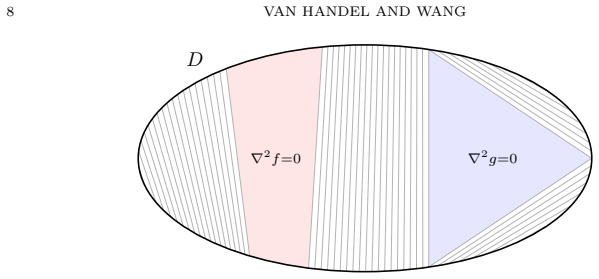
- If the mixed Hessian measure $H_{f,g}$ vanishes on an open connected domain, then outside planar regions the domain is foliated by affine lines on which both functions are affine, giving a mixed analogue of the classical flat-surface theorem.
- A projection-based induction that would prove the full conjecture in higher dimensions is blocked: the paper exhibits bodies in which a direction is extreme after projection but not extreme for the original body, so any higher-dimensional proof needs a new ingredient.
- The support result implies that, for the measures covered, every extreme direction is a limit of exposed directions, a fact previously known only in special cases.
Reading between the lines
- If the equality condition of the Alexandrov–Fenchel inequality is reproved in the full degenerate generality needed here, the measure-preserving modification construction would likely extend to arbitrary mixed area measures, upgrading the $\mathbb{R}^3$ result to all dimensions.
- The established equivalence between the convex-body and convex-function formulations suggests that the new support characterization should transfer to homogeneous mixed Monge–Ampère equations in all dimensions, not just the two-function case treated here.
- A concrete test: for smooth strictly convex bodies in $\mathbb{R}^4$, one could numerically approximate $S_{K,K,K,L}$ and compare its support with the closed set of extreme directions; a mismatch would disprove the full conjecture, and a match would support the remaining open direction.
- The projection obstruction indicates that non-projection methods, likely inspired by affine rigidity or by the line-foliation structure of the flat-surface theorem, are required for the full conjecture in higher dimensions.
Signed reviews
Editorial analysis
A structured set of objections, weighed in public.
Referee Report
Summary. The paper addresses Schneider's conjectural description of the support of mixed area measures, equivalently the equality cases in Minkowski's monotonicity problem for mixed volumes. The two central results are Theorem 1.8, which proves that the mixed area measure vanishes on the set of directions that are not (C_1,...,C_{n-1})-exposed, and Theorem 1.10, which gives the full characterization supp S_{K[n-2],L} = cl{u : u is (K[n-2],L)-extreme} for arbitrary convex bodies K,L in R^n, thereby resolving Schneider's conjecture in dimension three. The upper bound is proved by a Lipschitz cover of k-singular boundary points together with a tube-counting estimate. The lower bound is proved by induction on dimension, using a body modification lemma (Lemma 4.7) that leaves the mixed area measure unchanged and transfers extremality through a projection step; the cases of Theorem 1.21 needed for the induction are proved in Section 4 and Section 6. The paper also transcribes the results to mixed Hessian measures, derives a mixed Hartman--Nirenberg--Pogorelov theorem, and identifies a genuinely higher-dimensional obstruction to extending the induction.
Significance. If the arguments are correct, this is a major advance on a forty-year-old conjecture in convex geometry: it proves one direction of Schneider's conjecture in full generality and settles the full conjecture in the original three-dimensional setting of Minkowski. The proof strategy is coherent and, in the parts I checked, internally consistent. The paper is notably honest about its limitations: Theorem 1.21(b) and the discussion in Section 6.2 explicitly exhibit the obstruction that prevents the projection-induction method from working in dimension at least four. A particular strength is that the main proofs are written in full, including the delicate measure-theoretic upper bound and the explicit construction in Appendix A.
minor comments (5)
- [Section 1.2, Example 1.2] There is a typo: "Thoughout this paper" should be "Throughout this paper"; similarly, the caption of Figure 1.3 reads "Illustration of of Corollary 1.18" and should be corrected.
- [Section 4.2, Lemma 4.4] The display in the middle of the proof is compressed: the reader has to combine monotonicity with the Alexandrov--Fenchel inequality to see that V(K',K,C_1,...,C_{n-2})^2 equals the product V(K',K',C_1,...,C_{n-2})V(K,K,C_1,...,C_{n-2}). Adding one sentence making this equality explicit would improve readability.
- [Section 4.3, Lemma 4.7(a)] The convergence \hat K_t \to \hat K is asserted with a reference to [21, Lemma 7.5.2]; since \hat K_t is defined by intersecting a continuum of half-spaces, it would be helpful to note explicitly that h_{K_t} decreases to h_K as t\downarrow 0 and hence the compact convex sets \hat K_t form a nested family whose intersection is \hat K.
- [Section 6.1, Lemma 6.3] The statement that "any two touching cones of K are either equal or disjoint" is used without proof; it follows directly from Lemma 2.2 and could be stated there or in the proof of Lemma 6.3.
- [Section 6.3, Example 6.8] The convexity of the functions f and g is asserted but not verified; a parenthetical remark that h is positive semidefinite with vanishing x_1-derivative at x_1=0 would remove any doubt.
Circularity Check
No circularity: the main support theorems are proved from independent external inputs and do not reduce to Schneider's conjecture.
full rationale
The paper's central claims are Theorem 1.8 (upper bound for mixed area measure support) and Theorem 1.10 (lower bound for the two-body mixed area measure). Neither is assumed. Theorem 1.8 is proved in Section 3 from a Lipschitz cover of k-singular boundary points (Proposition 3.2, refining Anderson–Klee) and a tube-counting estimate; the definition of exposed directions is used to formulate the result, not to encode the support. Theorem 1.10 is proved by dimension induction in Section 4. The induction step constructs a modified body hat K (Lemma 4.7) that preserves S_{K,C} while forcing dim T(hat K,v)>1 on a cap; the extremality transfer uses Lemma 1.20, Lemma 2.8, and the dim T(K,u)=1 case of Theorem 1.21. Lemma 2.8 cites [23, Remark 8.6] by the same authors, but the cited identity is a projection formula for mixed area measures, not the conjectured support characterization; it is parameter-free and does not assume the target. Lemma 4.4 and Lemma 4.7 invoke the Alexandrov–Fenchel equality condition (Theorem 4.3) from Schneider's monograph; this is an external classical result, not an input equivalent to the conjecture. The equality condition is applied only when the relevant mixed volumes are positive, so the proportionality of mixed area measures is well defined. No parameter is fitted and no predicted formula is a renamed input. The self-citations [22] and [23] concern technical identities and methodology, not the support theorem, and they are not load-bearing in a circular sense. The one delicate point flagged by the reader—the equality condition in the possibly lower-dimensional setting—is a possible correctness risk about an external theorem, not a circularity.
Assumptions & free parameters
assumptions (6)
- standard math Alexandrov-Fenchel inequality with equality condition (Theorem 4.3, cited to Schneider [21, Theorems 7.3.1 and 7.4.2]).
- standard math Positive mixed volumes criterion for segments of independent directions (Fact 1.4, Schneider [21, Theorem 5.1.8]).
- standard math Anderson-Klee theorem on k-singular boundary points (Anderson and Klee [1]; Schneider [21, Theorem 2.2.5]).
- standard math Local approximability of a one-dimensional touching cone by a body that agrees outside a small cap (Lemma 4.2, using [21, Lemma 1.4.6]).
- standard math Projection formula for mixed volumes and continuity of mixed area measures under Hausdorff convergence (Schneider [21]).
- standard math Hug-Mussnig-Ulivelli correspondence between mixed area and mixed Hessian measures ([7, Corollary 4.9]).
Cite this review
Pith. "Pith review of On Minkowski's monotonicity problem." pith.science (2026). https://pith.science/paper/2XH6HFDZ
@misc{pith2026250720082,
  author       = {Pith},
  title        = {Pith review of: On Minkowski's monotonicity problem},
  year         = {2026},
  howpublished = {\url{https://pith.science/paper/2XH6HFDZ}},
  note         = {Machine review of arXiv:2507.20082}
}
abstract
We address an old open question in convex geometry that dates back to the work of Minkowski: what are the equality cases of the monotonicity of mixed volumes? The problem is equivalent to that of providing a geometric characterization of the support of mixed area measures. A conjectural characterization was put forward by Schneider (1985), but has been verified to date only for special classes of convex bodies. In this paper we resolve one direction of Schneider's conjecture for arbitrary convex bodies in $\mathbb{R}^n$, and resolve the full conjecture in $\mathbb{R}^3$. Among the implications of these results is a mixed counterpart of the classical fact, due to Monge, Hartman--Nirenberg, and Pogorelov, that a surface with vanishing Gaussian curvature is a ruled surface.
Figures


Figures from the paper (1 more)

Forward citations
Cited by 1 Pith paper
-
Godbersen's conjecture and the $L_p$-Rogers-Shephard inequality
Godbersen's 1938 conjecture is proved: V(K[k],−K[n−k]) ≤ C(n,k) vol(K) for all convex bodies, with equality characterizations, and it yields the sharp L_p Rogers–Shephard inequality.
Reference graph
Works this paper leans on
-
[1]
R. D. Anderson and V. L. Klee, Jr. Convex functions and upper semi-continuous collections. Duke Math. J., 19:349–357, 1952
work page 1952
-
[2]
T. Bonnesen and W. Fenchel.Theory of convex bodies. BCS Associates, Moscow, ID, 1987. 34 V AN HANDEL AND W ANG
work page 1987
-
[3]
A. Colesanti and D. Hug. Hessian measures of convex functions and applications to area measures. J. London Math. Soc. (2), 71(1):221–235, 2005
work page 2005
-
[4]
J. Favard. Sur les corps convexes.J. Math. Pures Appl. (9), 12:219–282, 1933
work page 1933
-
[5]
C.E.Gutiérrez. The Monge-Ampère equation, volume89of Progress in Nonlinear Differential Equations and their Applications. Birkhäuser/Springer, [Cham], second edition, 2016
work page 2016
-
[6]
P. Hartman and L. Nirenberg. On spherical image maps whose Jacobians do not change sign. Amer. J. Math., 81:901–920, 1959
work page 1959
-
[7]
D. Hug, F. Mussnig, and J. Ulivelli. Kubota-type formulas and supports of mixed measures,
- [8]
Show all 26 references
-
[9]
Kline.Mathematical thought from ancient to modern times
M. Kline.Mathematical thought from ancient to modern times. Vol. 2. The Clarendon Press, Oxford University Press, New York, second edition, 1990
1990
-
[10]
P. Mattila. Geometry of sets and measures in Euclidean spaces, volume 44 of Cambridge Studies in Advanced Mathematics. Cambridge University Press, Cambridge, 1995. Fractals and rectifiability
1995
-
[11]
Minkowski
H. Minkowski. Volumen und Oberfläche.Math. Ann., 57(4):447–495, 1903
1903
-
[12]
Minkowski
H. Minkowski. Theorie der konvexen Körper, insbesondere Begründung ihres Oberflächen- begriffs. In D. Hilbert, A. Speiser, and H. Weyl, editors,Gesammelte Abhandlungen von Hermann Minkowski. Zweiter Band, pages 131–229. B. G. Teubner, 1911
1911
-
[13]
B. S. Mityagin. The zero set of a real analytic function.Mat. Zametki, 107(3):473–475, 2020
2020
-
[14]
J. R. Munkres.Topology. Prentice Hall, Inc., Upper Saddle River, NJ, second edition, 2000
2000
-
[15]
A. A. Panov. Some properties of mixed discriminants.Mat. Sb. (N.S.), 128(170)(3):291–305, 446, 1985
1985
-
[16]
A. V. Pogorelov.Extrinsic geometry of convex surfaces, volume Vol. 35 ofTranslations of Mathematical Monographs.AmericanMathematicalSociety, Providence, RI,1973.Translated from the Russian by Israel Program for Scientific Translations
1973
-
[17]
R. T. Rockafellar.Convex analysis, volume No. 28 ofPrinceton Mathematical Series. Prince- ton University Press, Princeton, NJ, 1970
1970
-
[18]
Schneider
R. Schneider. Kinematische Berührmaße für konvexe Körper und Integralrelationen für Ober- flächenmaße. Math. Ann., 218(3):253–267, 1975
1975
-
[19]
Schneider
R. Schneider. On the Aleksandrov-Fenchel inequality. InDiscrete geometry and convexity, volume 440 ofAnn. New York Acad. Sci., pages 132–141. New York Acad. Sci., 1985
1985
-
[20]
Schneider
R. Schneider. On the Aleksandrov-Fenchel inequality involving zonoids.Geom. Dedicata, 27(1):113–126, 1988
1988
-
[21]
Schneider
R. Schneider. Convex bodies: the Brunn-Minkowski theory. Cambridge University Press, expanded edition, 2014
2014
-
[22]
Shenfeld and R
Y. Shenfeld and R. van Handel. Mixed volumes and the Bochner method.Proc. Amer. Math. Soc., 147(12):5385–5402, 2019
2019
-
[23]
Shenfeld and R
Y. Shenfeld and R. van Handel. The extremals of the Alexandrov-Fenchel inequality for convex polytopes.Acta Math., 231(1):89–204, 2023
2023
-
[24]
N. S. Trudinger and X.-J. Wang. Hessian measures. III.J. Funct. Anal., 193(1):1–23, 2002
2002
-
[25]
S. Weis. A note on touching cones and faces.J. Convex Anal., 19(2):323–353, 2012. Department of Mathematics, Princeton University, Princeton, NJ 08544, USA Email address: rvan@math.princeton.edu PACM, Princeton University, Princeton, NJ 08544, USA Email address: shoudawang@pri...
2012
-
[2024]
Preprint arxiv:2401.16371
Reviewed August 15, 2026 · model on record in the stance chip above.
Discussion (0). Continue with ORCID to comment.