REVIEW 4 major objections 6 minor 46 references
MLC-Agent: Cognitive Model based on Memory-Learning Collaboration in LLM Empowered Agent Simulation Environment
T0 review · 4 major / 6 minor · reviewed 2026-08-06 · deepseek-v4-flash
Pith's one-line read Agents built with a three-level memory system that collaborates with their learning mechanism achieve the highest average daily profit in an urban delivery simulation, compared with existing individual and collective memory models.
desk verdict A sensible memory-learning architecture with a promising delivery case study; the central value-proxy needs validation and the experiments need statistical rigor before the performance claim is solid. read the letter →
The pith
A machine-rendered reading of the paper's core claim, the machinery that carries it, and where it could break.
The reading
What carries the argument
The load-bearing object is the memory-learning collaborative decision model (MMDM), built on three structures: the individual memory set, the collective (group) memory set, and the memory buffer pool. It works through two mechanisms. The first is selective memory promotion and pruning: a buffer item enters collective memory when its value error $|\delta_t| > \theta_{value}$ or its rarity $R(m^i) > \theta_{rare}$, where $\delta_t = \gamma V(S_{t+1}) - V(S_t)$ and $R(m^i) = \min_{m^j \in M^{share}_t} \|m^i - m^j\|$; the memory set is then pruned to the top $k$ items by the score $|\delta_t| + S_{success} + \lambda^{t-t_0}$. The second is the credibility-weighted decision rule $a^i_t = a_{memory}$ if $C_{memory} > \theta_{memory}$, else $a_{learning}$, with $C_{memory} = \omega_1 S_{env} + \omega_2 S_{success} + \omega_3 \lambda^{t-t_0}$. The state value used inside $\delta_t$ is defined as $V = \frac{L_{best}}{L_{rest}+L_{past}}(status_t - status_{t-1}) + \frac{N_{orders}(scope)}{scope^2}$; this proxy is what makes memory selection possible in the first place.
What would settle it
Run the delivery simulation again with the value-error term in the memory selection replaced by draws of uniform random memories at the same retention rate; if random-memory agents match or beat MMDM on average daily profit, the claimed advantage of the value-error and rarity evaluation is not real. A simpler diagnostic is to compute, over the simulated steps, the correlation between the proxy $V$ and the profit actually earned by the agent on the following decision: a correlation near zero would show the proxy is not a meaningful state value.
Extended reading notes
Core claim
On its own terms, the paper's central claim is that memory and learning should be modeled as a single collaborative decision system rather than as separate add-ons. The proposed MMDM stores each experience as a memory item $m^i_t = \langle type, o^i_{t-1}, a^i_t, o^i_t \rangle$, keeps it in the individual set and the buffer pool, and then promotes it into collective memory when either its value error $|\delta_t| = |\gamma V(S_{t+1}) - V(S_t)|$ exceeds a threshold or its rarity $R(m^i) = \min_{m^j \in M^{share}_t} \|m^i - m^j\|$ is high; the collective set is kept under control by pruning to the top $k$ scored items. At decision time a credibility score $C_{memory} = \omega_1 S_{env} + \omega_2 S_{success} + \omega_3 \lambda^{t-t_0}$ compares the match between the current situation and stored experience, and the agent follows the memory-recommended action when the score exceeds a threshold, otherwise it falls back on its learned policy. When this machinery is attached to imitation learning, Q-learning, and LLM-based agents in the delivery simulation, the paper reports that it yields the highest average daily profit among the memory models tested, and interprets that as verification that memory-learning collaboration improves decision quality and adaptability.
Load-bearing premise
The load-bearing premise is that the hand-designed state-value proxy $V = \frac{L_{best}}{L_{rest}+L_{past}}(status_t - status_{t-1}) + \frac{N_{orders}(scope)}{scope^2}$ tracks how good the agent's situation really is, because the value-error term $\delta_t$ built from $V$ is what decides which memories get promoted and pruned.
Editorial extensions
If this is right
- If MMDM is right, adding a three-level memory with value-error and rarity filtering raises an agent's average daily profit over both individual episodic memory and collective experience replay baselines, across all three learning modes tested.
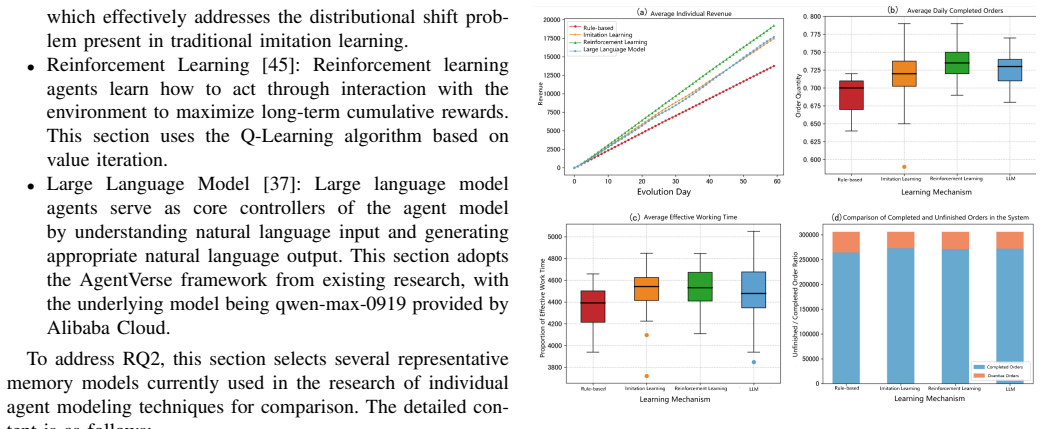
- Memory-assisted agents show less profit fluctuation over time; the plots show that no-memory imitation-learning agents suffer involution-like clustering, while MMDM agents avoid these swings, implying memory stabilizes behavior.
- Collective memory consistently outperforms individual-only memory, which supports the paper's premise that experience sharing across agents improves system-level adaptability.
- Memory gains are strongest for imitation learning and LLM agents - memory broadens the imitation data source and compensates for LLM short-context volatility - while Q-learning benefits from reduced invalid exploration and faster convergence.
- The same modular agent design is claimed to extend beyond delivery to other multi-agent scenarios such as autonomous driving, robot collaboration, and intelligent traffic scheduling.
Reading between the lines
- A direct test the authors did not run: ablating the value-error term by selecting memories at random while keeping the same retention rate would isolate whether $V$'s proxy actually drives the profit gain; this inference is mine, not the paper's.
- Because the credibility weights are task-adjustable, the framework suggests a measurable prediction: raising the recency weight $\omega_3$ should improve performance more in rapidly changing environments, while raising $S_{env}$ and $S_{success}$ weights should help in stable ones.
- The rarity term's min-distance to other memories is meant to keep strategy diversity; one could test whether removing it causes collapse of behavioral diversity in the collective memory pool.
- The buffer-to-collective promotion resembles a continual-learning mechanism, so the same architecture could be ported to LLM agents to mitigate catastrophic forgetting, though the paper only gestures at that direction.
Editorial analysis
A structured set of objections, weighed in public.
Referee Report
Summary. The paper proposes an individual-agent model for artificial societies in which memory is organized hierarchically into individual memory, a collective memory, and a memory buffer pool, and is coupled to learning through a memory–learning collaborative decision module. The memory evaluation selects and prunes items using a value error δ_t and a rarity metric, and decisions are made by comparing memory credibility C_memory with a threshold. The model is tested in an urban instant-delivery simulation with rule-based, imitation-learning, Q-learning, and LLM-based agents, comparing three memory baselines. The reported results show that the proposed MMDM yields the highest average daily profit in all learning settings, which is interpreted as evidence that memory–learning collaboration improves agent decision quality and adaptability.
Significance. If the mechanism were validated, the hierarchical memory–learning collaboration would be a useful contribution to individual-level agent-based modeling, providing a modular way to share experience across agents while retaining dynamic pruning. The paper has clear strengths: the full pipeline is specified with explicit equations, the experimental scenario is concrete, and the evaluation covers four learning mechanisms and three memory baselines. However, the current evidence does not yet establish that the specific memory evaluation mechanism, rather than the generic benefit of a shared replay pool, is responsible for the reported gains. The central mechanism rests on an unvalidated state-value proxy and the experiments lack statistical controls, so the contribution is plausible but not yet supported.
major comments (4)
- [III-B, Eq. (8), Table 6] The state value function V defined in Table 6 is an ad hoc proxy: V = (Lbest/(Lrest+Lpast))·(statust − statust−1) + Norders(scope)/scope^2. This function mixes a path-length ratio, a discrete status difference, and an order-density term, and no evidence is given that it correlates with future profit or decision quality. Because δt in Eq. (8) drives memory selection in Eq. (7) and pruning in Eq. (17), the claimed superiority of MMDM over a plain shared replay pool is not explained unless V is validated. Additionally, the scale of V relative to the thresholds θvalue = 0.9 and θrare = 0.6 is never analyzed. Please add a validation experiment for V (for example, correlation of V with observed returns) or replace V with a ground-truth return estimate to show that the evaluation mechanism behaves as intended.
- [IV-B, Figs. 7–9] The experimental results are based on what appears to be a single simulation run, with no seed variation, error bars, confidence intervals, or significance tests. The MMDM advantage over the next-best baseline in Figs. 7–9 could be within run-to-run noise, especially since the line plots show substantial fluctuations. To support the central claim, report multiple independent runs and provide standard errors or significance tests for the average daily profit comparisons.
- [IV-B, collective memory comparison] The comparison between MMDM and the Collective Experience Replay Pool Model does not isolate the contribution of the proposed evaluation mechanism. MMDM differs from the replay-pool baseline in several ways simultaneously: it uses a hierarchical memory structure, value-error-based selection, rarity-based selection, and pruning. An ablation that applies the same shared replay pool with and without the V-based selection/pruning is needed to attribute the profit gain to Eqs. (7) and (17). Without this ablation, the reported gains may simply reflect the general advantage of experience replay over no sharing.
- [Table 6 and Eq. (18)] Several hand-set parameters directly control the agent's behavior: θvalue = 0.9, θrare = 0.6, k = 4000, γ = 0.8, λ = 0.9, θmemory = 0.7, and the credibility weights 0.6, 0.2, 0.2 in Eq. (18). No sensitivity analysis is provided for any of these parameters, so it is unclear whether the reported MMDM advantage is robust to plausible variations or depends on a specific tuning. Please add a sensitivity study or a justification for these values.
minor comments (6)
- [Throughout] The acronym MMDM is used in figures and in the text but is never defined. Define the term at first use (presumably 'Memory–Learning Collaborative Decision Model' or similar) and use it consistently.
- [Section III-C and IV-B] The text in Section III-C describes imitation learning as Behavior Cloning, while Section IV-B says the imitation learning agent uses the DAgger algorithm. These are different algorithms; make the description consistent or clearly explain how they relate.
- [Section IV-B] The paper uses several names for the same memory baselines, including 'Individual Episodic Memory Model', 'scenario memory model', 'Collective Experience Replay Pool Model', and 'collective memory buffer pool model'. Standardize the terminology to avoid confusion.
- [Eq. (14)] Equation (14) is described as a 'fifth-order Gaussian function', but it is a mixture of five Gaussian components with different parameters. Consider calling it a five-component Gaussian mixture to avoid confusion with a polynomial of degree five.
- [Table 6] The status values in Table III are defined as 0, 1, and 2, so the term (statust − statust−1) in the definition of V takes values in a small discrete set. Clarify the units and scaling of V, since the thresholds θvalue and θrare are compared with δt, which depends directly on this difference.
- [Section IV-B] The reference for the Individual Episodic Memory Model is given as [34], which concerns knowledge graphs and large language models for emergency decision-making and does not appear to be the correct origin for the described memory model. Verify and correct this citation.
Circularity Check
No load-bearing circularity: the memory-selection heuristics use reward-derived signals by design, but the reported profit advantage is an empirical comparison, not an identity or fitted prediction.
full rationale
The paper's derivation chain consists of a descriptive model (Eqs 1-6), a memory filter (Eqs 7-9), pruning (10,17), and a memory/learning arbitration rule (11,12,18). The claimed conclusion is that MMDM achieves higher average daily profit than baselines (Figs 7-9). No equation has the profit metric as both input and output. Eq 8's δt uses a hand-defined V (Table 6) that encodes path length, status change, and order density; this is not the daily-profit objective, and selecting high |δt| memories is not equivalent to maximizing profit. Eq 17 and Eq 18 do include Ssuccess, the past positive-reward ratio, so the mechanism explicitly favors previously rewarding choices; that is a legitimate and testable mechanism rather than a tautology, since the experiment could have shown that such filtering hurts exploration or that the heuristic V is mis-scaled. The paper is vulnerable on empirical grounds (no seeds/error bars, no ablation isolating Eq 8, unvalidated V), and the conclusion itself admits the limitations. Self-citations to prior work by Yuwei Guo (refs 17,19,22) are background on computational experiments and social learning evolution; they are not used to justify the memory-learning collaboration or to preclude alternatives. Thus no circular step satisfying the evidentiary bar is present.
Assumptions & free parameters
free parameters (8)
- value_error_threshold θvalue =
0.9
- rarity_threshold θrare =
0.6
- memory_length_threshold k =
4000
- discount factor γ =
0.8
- memory decay coefficient λ =
0.9
- credibility weights ω1, ω2, ω3 =
0.6, 0.2, 0.2
- memory credibility threshold θmemory =
0.7
- order generation function parameters ai, bi, ci =
Table 1, 15 values
assumptions (5)
- ad hoc to paper V in Eq (8) is a valid state value proxy
- domain assumption Value error and rarity capture memory usefulness
- domain assumption Memory credibility gate improves decisions
- domain assumption Order generation from crawled review times represents real demand
- standard math Standard algorithms Q-learning and DAgger work as baselines
Cite this review
Pith. "Pith review of MLC-Agent: Cognitive Model based on Memory-Learning Collaboration in LLM Empowered Agent Simulation Environment." pith.science (2026). https://pith.science/paper/C67MZ3LP
@misc{pith2026250720215,
  author       = {Pith},
  title        = {Pith review of: MLC-Agent: Cognitive Model based on Memory-Learning Collaboration in LLM Empowered Agent Simulation Environment},
  year         = {2026},
  howpublished = {\url{https://pith.science/paper/C67MZ3LP}},
  note         = {Machine review of arXiv:2507.20215}
}
read the original abstract
Many real-world systems, such as transportation systems, ecological systems, and Internet systems, are complex systems. As an important tool for studying complex systems, computational experiments can map them into artificial society models that are computable and reproducible within computers, thereby providing digital and computational methods for quantitative analysis. In current research, the construction of individual agent models often ignores the long-term accumulative effect of memory mechanisms in the development process of agents, which to some extent causes the constructed models to deviate from the real characteristics of real-world systems. To address this challenge, this paper proposes an individual agent model based on a memory-learning collaboration mechanism, which implements hierarchical modeling of the memory mechanism and a multi-indicator evaluation mechanism. Through hierarchical modeling of the individual memory repository, the group memory repository, and the memory buffer pool, memory can be effectively managed, and knowledge sharing and dissemination between individuals and groups can be promoted. At the same time, the multi-indicator evaluation mechanism enables dynamic evaluation of memory information, allowing dynamic updates of information in the memory set and promoting collaborative decision-making between memory and learning. Experimental results show that, compared with existing memory modeling methods, the agents constructed by the proposed model demonstrate better decision-making quality and adaptability within the system. This verifies the effectiveness of the individual agent model based on the memory-learning collaboration mechanism proposed in this paper in improving the quality of individual-level modeling in artificial society modeling and achieving anthropomorphic characteristics.
Figures


Figures from the paper (7 more)




Reference graph
Works this paper leans on
-
[1]
Compu- tational social science: Obstacles and opportunities,
D. M. Lazer, A. Pentland, D. J. Watts, S. Aral, S. Athey, N. Contractor, D. Freelon, S. Gonzalez-Bailon, G. King, H. Margetts et al., “Compu- tational social science: Obstacles and opportunities,” Science, vol. 369, no. 6507, pp. 1060–1062, 2020
work page 2020
-
[2]
Research roadmap of service ecosystems: A crowd intelligence perspective,
X. Xue, G. Li, D. Zhou, Y . Zhang, L. Zhang, Y . Zhao, Z. Feng, L. Cui, Z. Zhou, X. Sun et al. , “Research roadmap of service ecosystems: A crowd intelligence perspective,” International Journal of Crowd Science, vol. 6, no. 4, pp. 195–222, 2022
2022
-
[3]
M. Jusup, P. Holme, K. Kanazawa, M. Takayasu, I. Romi ´c, Z. Wang, S. Ge ˇcek, T. Lipi ´c, B. Podobnik, L. Wang et al. , “Social physics,” Physics Reports, vol. 948, pp. 1–148, 2022
work page 2022
-
[4]
Saving human lives: What complexity science and information systems can contribute,
D. Helbing, D. Brockmann, T. Chadefaux, K. Donnay, U. Blanke, O. Woolley-Meza, M. Moussaid, A. Johansson, J. Krause, S. Schutte et al. , “Saving human lives: What complexity science and information systems can contribute,” Journal of statistical physics , vol. 158, no. 3, pp. 735–781, 2015
work page 2015
-
[5]
Computational Experiments: Past, Present and Future
X. Xue, X.-N. Yu, D.-Y . Zhou, X. Wang, Z.-B. Zhou, and F.-Y . Wang, “Computational experiments: Past, present and future,” arXiv preprint arXiv:2202.13690, 2022
work page Pith review arXiv 2022
-
[6]
Computational experiments: A new analysis method for cyber-physical- social systems,
X. Xue, Y . Shen, X. Yu, D.-Y . Zhou, X. Wang, G. Wang, and F.-Y . Wang, “Computational experiments: A new analysis method for cyber-physical- social systems,” IEEE Transactions on Systems, Man, and Cybernetics: Systems, vol. 54, no. 2, pp. 813–826, 2023
2023
-
[7]
J. Pearl and D. Mackenzie, The book of why: the new science of cause and effect. Basic books, 2018
work page 2018
-
[8]
Towards digital retina in smart cities: A model generation, utilization and communication paradigm,
Y . Lou, L.-Y . Duan, Y . Luo, Z. Chen, T. Liu, S. Wang, and W. Gao, “Towards digital retina in smart cities: A model generation, utilization and communication paradigm,” in 2019 IEEE International Conference on Multimedia and Expo (ICME) . IEEE, 2019, pp. 19–24
work page 2019
Show all 46 references
-
[9]
Parallel testing of vehicle intelligence via virtual-real interaction,
L. Li, X. Wang, K. Wang, Y . Lin, J. Xin, L. Chen, L. Xu, B. Tian, Y . Ai, J. Wang et al. , “Parallel testing of vehicle intelligence via virtual-real interaction,” Science robotics, vol. 4, no. 28, p. eaaw4106, 2019
2019
-
[10]
Intelligence testing for autonomous vehicles: A new approach,
L. Li, W.-L. Huang, Y . Liu, N.-N. Zheng, and F.-Y . Wang, “Intelligence testing for autonomous vehicles: A new approach,” IEEE Transactions on Intelligent Vehicles, vol. 1, no. 2, pp. 158–166, 2016
2016
-
[11]
Advancing military medical planning in large scale combat operations: insights from computer simulation and experi- mentation in nato’s vigorous warrior exercise 2024,
M. Benhassine, J. Quinn, D. Stewart, A. A. Arsov, D. Ianc, M. Ivan, and F. Van Utterbeeck, “Advancing military medical planning in large scale combat operations: insights from computer simulation and experi- mentation in nato’s vigorous warrior exercise 2024,” Military Medicin...
2024
-
[12]
Pathways for socio-economic system transitions expressed as a markov chain,
V . J. Schweizer, A. D. Jamieson-Lane, H. Cai, S. Lehner, and M. Smer- lak, “Pathways for socio-economic system transitions expressed as a markov chain,” PLoS One, vol. 18, no. 7, p. e0288928, 2023
2023
-
[13]
Investigating the impact of structural holes on the value creation in mobile application service ecosystems: Evidence from computational experiments,
L. Zhang, S. Chen, X. Xue, H. Wu, and Z. Feng, “Investigating the impact of structural holes on the value creation in mobile application service ecosystems: Evidence from computational experiments,” Journal of Software: Evolution and Process , vol. 36, no. 6, p. e2614, 2024
2024
-
[14]
A foundation model for generalizable cancer diagnosis and survival prediction from histopathological images,
Z. Yang, T. Wei, Y . Liang, X. Yuan, R. Gao, Y . Xia, J. Zhou, Y . Zhang, and Z. Yu, “A foundation model for generalizable cancer diagnosis and survival prediction from histopathological images,” Nature Communica- tions, vol. 16, no. 1, p. 2366, 2025
2025
-
[15]
A computational model to simulate spectral modulation and speech perception experiments of cochlear implant users,
F. Alvarez, D. Kipping, and W. Nogueira, “A computational model to simulate spectral modulation and speech perception experiments of cochlear implant users,” Frontiers in Neuroinformatics , vol. 17, p. 934472, 2023
2023
-
[16]
Computational social science, the evolution of policy design and rule making in smart societies,
N. Lettieri, “Computational social science, the evolution of policy design and rule making in smart societies,” Future internet, vol. 8, no. 2, p. 19, 2016
2016
-
[17]
Social learning evolution (sle): Computational experiment-based modeling framework of social manufacturing,
X. Xue, S. Wang, L. Zhang, Z. Feng, and Y . Guo, “Social learning evolution (sle): Computational experiment-based modeling framework of social manufacturing,” IEEE Transactions on Industrial Informatics , vol. 15, no. 6, pp. 3343–3355, 2018
2018
-
[18]
Sle2: The improved social learning evolution model of cloud manufacturing service ecosystem,
D. Zhou, X. Xue, and Z. Zhou, “Sle2: The improved social learning evolution model of cloud manufacturing service ecosystem,” IEEE Transactions on Industrial Informatics , vol. 18, no. 12, pp. 9017–9026, 2022
2022
-
[19]
A hierarchical model for complex adaptive system: From adaptive agent to ai society,
D. Zhou, X. Xue, X. Lu, Y . Guo, P. Ji, H. Lv, W. He, Y . Xu, Q. Li, and L. Cui, “A hierarchical model for complex adaptive system: From adaptive agent to ai society,” ACM Transactions on Autonomous and Adaptive Systems, 2024
2024
-
[20]
Computational experiments for complex social systems: Integrated design of experiment system,
X. Xue, X. Yu, D. Zhou, X. Wang, C. Bi, S. Wang, and F.-Y . Wang, “Computational experiments for complex social systems: Integrated design of experiment system,” IEEE/CAA Journal of Automatica Sinica , vol. 11, no. 5, pp. 1175–1189, 2024
2024
-
[21]
Computational experiments for complex social systems: Experiment design and generative explanation,
X. Xue, D. Zhou, X. Yu, G. Wang, J. Li, X. Xie, L. Cui, and F.-Y . Wang, “Computational experiments for complex social systems: Experiment design and generative explanation,” IEEE/CAA Journal of Automatica Sinica, vol. 11, no. 4, pp. 1022–1038, 2024
2024
-
[22]
Analysis and controlling of manufacturing service ecosystem: A research framework based on the parallel system theory,
X. Xue, Y . Guo, S. Chen, and S. Wang, “Analysis and controlling of manufacturing service ecosystem: A research framework based on the parallel system theory,” IEEE Transactions on Services Computing , vol. 14, no. 6, pp. 1598–1611, 2019
2019
-
[23]
Computational experiments for complex social systems—part ii: The evaluation of computational models,
M. Lu, S. Chen, X. Xue, X. Wang, Y . Zhang, Y . Zhang, and F.-Y . Wang, “Computational experiments for complex social systems—part ii: The evaluation of computational models,” IEEE Transactions on Computational Social Systems , vol. 9, no. 4, pp. 1224–1236, 2021
2021
-
[24]
A framework of multilayer social networks for communication behavior with agent- based modeling,
Y . Ge, L. Liu, X. Qiu, H. Song, Y . Wang, and K. Huang, “A framework of multilayer social networks for communication behavior with agent- based modeling,” Simulation, vol. 89, no. 7, pp. 810–828, 2013
2013
-
[25]
Swarm intelligence from natural to artificial systems: Ant colony optimization,
O. Deepa and A. Senthilkumar, “Swarm intelligence from natural to artificial systems: Ant colony optimization,” Networks (Graph-Hoc) , vol. 8, no. 1, pp. 9–17, 2016
2016
-
[26]
A general cognitive architecture for agent-based modeling in artificial societies,
P. Ye, S. Wang, and F.-Y . Wang, “A general cognitive architecture for agent-based modeling in artificial societies,” IEEE Transactions on Computational Social Systems , vol. 5, no. 1, pp. 176–185, 2017
2017
-
[27]
Agent-based modeling and simulation on planning analysis,
H. Wu and Z. H. Peng, “Agent-based modeling and simulation on planning analysis,” Applied Mechanics and Materials , vol. 631, pp. 1312–1319, 2014
2014
-
[28]
Intelligent agents: Theory and practice,
M. Wooldridge and N. R. Jennings, “Intelligent agents: Theory and practice,” The knowledge engineering review , vol. 10, no. 2, pp. 115– 152, 1995
1995
-
[29]
Bandura and R
A. Bandura and R. H. Walters, Social learning theory . Prentice hall Englewood Cliffs, NJ, 1977, vol. 1
1977
-
[30]
Generative adversarial imitation learning,
J. Ho and S. Ermon, “Generative adversarial imitation learning,” Ad- vances in neural information processing systems , vol. 29, 2016
2016
-
[31]
Markov games as a framework for multi-agent rein- forcement learning,
M. L. Littman, “Markov games as a framework for multi-agent rein- forcement learning,” in Machine learning proceedings 1994 . Elsevier, 1994, pp. 157–163
1994
-
[32]
Ghost in the minecraft: Generally capable agents for open-world environments via large language models with text-based knowledge and memory,
X. Zhu, Y . Chen, H. Tian, C. Tao, W. Su, C. Yang, G. Huang, B. Li, L. Lu, X. Wang et al., “Ghost in the minecraft: Generally capable agents for open-world environments via large language models with text-based knowledge and memory,” arXiv preprint arXiv:2305.17144 , 2023
2023 arXiv
-
[33]
Minding language models’(lack of) theory of mind: A plug-and-play multi-character belief tracker,
M. Sclar, S. Kumar, P. West, A. Suhr, Y . Choi, and Y . Tsvetkov, “Minding language models’(lack of) theory of mind: A plug-and-play multi-character belief tracker,” arXiv preprint arXiv:2306.00924 , 2023
2023 arXiv
-
[34]
Enhancing emergency decision-making with knowledge graphs and large language models,
M. Chen, Z. Tao, W. Tang, T. Qin, R. Yang, and C. Zhu, “Enhancing emergency decision-making with knowledge graphs and large language models,” International Journal of Disaster Risk Reduction , vol. 113, p. 104804, 2024
2024
-
[35]
Camel: Communicative agents for
G. Li, H. Hammoud, H. Itani, D. Khizbullin, and B. Ghanem, “Camel: Communicative agents for” mind” exploration of large language model society,” Advances in Neural Information Processing Systems , vol. 36, pp. 51 991–52 008, 2023
2023
-
[36]
Autogen: Enabling next-gen llm applications via multi-agent conversations,
Q. Wu, G. Bansal, J. Zhang, Y . Wu, B. Li, E. Zhu, L. Jiang, X. Zhang, S. Zhang, J. Liu et al., “Autogen: Enabling next-gen llm applications via multi-agent conversations,” in First Conference on Language Modeling , 2024
2024
-
[37]
Agentverse: Facilitating multi-agent col- laboration and exploring emergent behaviors in agents,
W. Chen, Y . Su, J. Zuo, C. Yang, C. Yuan, C. Qian, C.-M. Chan, Y . Qin, Y . Lu, R. Xie et al. , “Agentverse: Facilitating multi-agent col- laboration and exploring emergent behaviors in agents,” arXiv preprint arXiv:2308.10848, vol. 2, no. 4, p. 6, 2023
2023 arXiv
-
[38]
Generative agents: Interactive simulacra of human behavior,
J. S. Park, J. O’Brien, C. J. Cai, M. R. Morris, P. Liang, and M. S. Bernstein, “Generative agents: Interactive simulacra of human behavior,” in Proceedings of the 36th annual acm symposium on user interface software and technology , 2023, pp. 1–22
2023
-
[39]
Neural turing machines,
A. Graves, G. Wayne, and I. Danihelka, “Neural turing machines,” arXiv preprint arXiv:1410.5401, 2014
2014 arXiv
-
[40]
Agentsociety: Large-scale simulation of llm- driven generative agents advances understanding of human behaviors and society,
J. Piao, Y . Yan, J. Zhang, N. Li, J. Yan, X. Lan, Z. Lu, Z. Zheng, J. Y . Wang, D. Zhou et al. , “Agentsociety: Large-scale simulation of llm- driven generative agents advances understanding of human behaviors and society,” arXiv preprint arXiv:2502.08691 , 2025
2025 arXiv
-
[41]
Minedojo: Building open- ended embodied agents with internet-scale knowledge,
L. Fan, G. Wang, Y . Jiang, A. Mandlekar, Y . Yang, H. Zhu, A. Tang, D.-A. Huang, Y . Zhu, and A. Anandkumar, “Minedojo: Building open- ended embodied agents with internet-scale knowledge,” Advances in Neural Information Processing Systems , vol. 35, pp. 18 343–18 362, 2022
2022
-
[42]
A comprehensive survey of continual learning: Theory, method and application,
L. Wang, X. Zhang, H. Su, and J. Zhu, “A comprehensive survey of continual learning: Theory, method and application,” IEEE transactions on pattern analysis and machine intelligence , vol. 46, no. 8, pp. 5362– 5383, 2024
2024
-
[43]
Alvinn: An autonomous land vehicle in a neural network,
D. A. Pomerleau, “Alvinn: An autonomous land vehicle in a neural network,” Advances in neural information processing systems , vol. 1, 1988
1988
-
[44]
A reduction of imitation learning and structured prediction to no-regret online learning,
S. Ross, G. Gordon, and D. Bagnell, “A reduction of imitation learning and structured prediction to no-regret online learning,” in Proceedings of the fourteenth international conference on artificial intelligence and statistics. JMLR Workshop and Conference Proceedings, 2011, ...
2011
-
[45]
Learning from delayed rewards,
C. J. C. H. Watkins et al., “Learning from delayed rewards,” 1989
1989
-
[46]
Mac-po: Multi-agent experience replay via collective priority optimization,
Y . Mei, H. Zhou, T. Lan, G. Venkataramani, and P. Wei, “Mac-po: Multi-agent experience replay via collective priority optimization,”arXiv preprint arXiv:2302.10418, 2023
2023 arXiv
Reviewed August 6, 2026 · model on record in the stance chip above.
Discussion (0). Continue with ORCID to comment.