REVIEW 5 major objections 4 minor 52 references
Do Ultra-Diffuse Galaxies Follow the Globular Cluster-Halo Mass Relation?
T0 review · 5 major / 4 minor · reviewed 2026-08-06 · deepseek-v4-flash
Pith's one-line read Ultra-diffuse galaxies follow the globular cluster–halo mass relation, and the GC-rich among them are likely failed galaxies with massive halos and suppressed star formation.
desk verdict Five points with heterogeneous halo masses make a suggestive but not decisive case that UDGs follow the GC number–halo mass relation. read the letter →
The pith
A machine-rendered reading of the paper's core claim, the machinery that carries it, and where it could break.
The reading
What carries the argument
The load-bearing object is the Burkert & Forbes (2020) GC number–halo mass relation, a near-linear scaling of about $5\times10^9$ M$_\odot$ of halo mass per globular cluster that holds from dwarfs to galaxy clusters with roughly 0.3 dex scatter. The paper tests this relation against the stellar mass–halo mass relation using a sample of five galaxies (DF44, WLM, the Sgr dwarf, IC2574, and DDO52) whose halo masses come from independent kinematic tracers reaching large radii, rather than from radial extrapolations within one effective radius. The GC count is the quantity that predicts halo mass and hence the expected position on the stellar mass–halo mass relation; deviation from that relation is measured as a function of GC richness.
What would settle it
The claim would be undermined by a reanalysis of the Sgr dwarf's pre-infall orbit that places its halo mass outside the $1$–$6\times10^{10}$ M$_\odot$ range, moving Sgr off the GC number–halo mass relation; it would also be falsified if a larger sample of UDGs with halo masses from kinematics at large radii (e.g., beyond $3R_e$) showed a systematic offset from the Burkert & Forbes relation rather than scattering about it.
Extended reading notes
Core claim
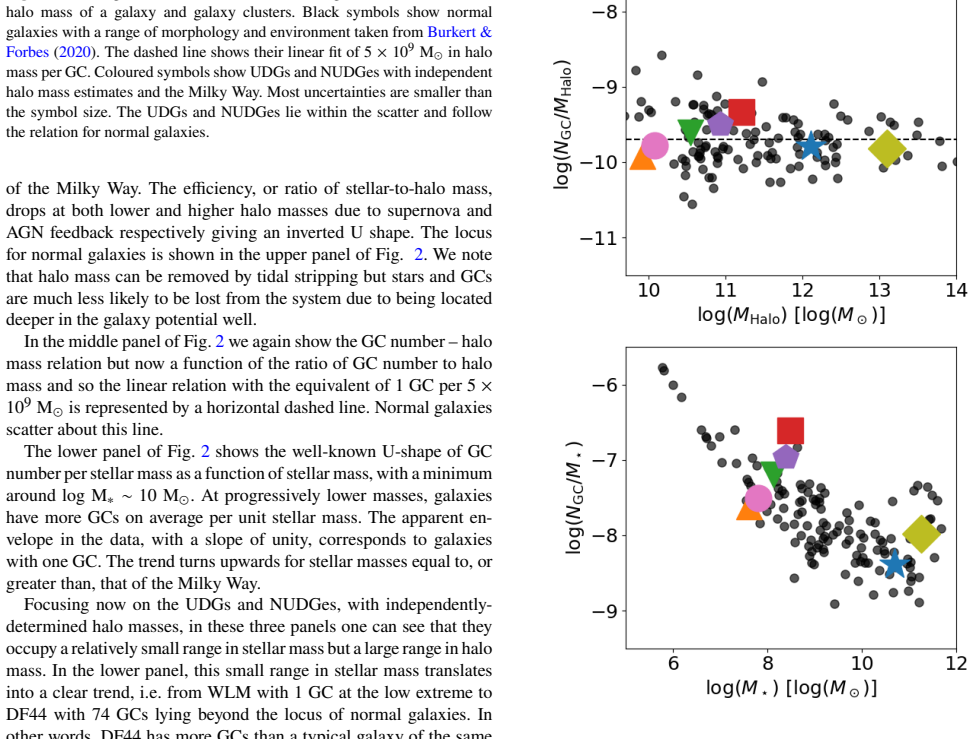
The central discovery is that UDGs and NUDGE galaxies with independent halo mass estimates lie within the scatter of the GC number–halo mass relation for normal galaxies, while their offset from the stellar mass–halo mass relation increases with GC count. DF44 (74 GCs) and IC2574 (27 GCs) deviate by roughly 1$\sigma$ and 2$\sigma$ from the stellar mass–halo mass relation, toward higher halo masses or equivalently lower stellar masses at a given halo mass. The paper argues that this supports the 'failed galaxy' scenario for GC-rich UDGs: they occupy massive dark matter halos that quenched star formation early, rather than being puffed-up classical dwarfs.
Load-bearing premise
The load-bearing premise is that the halo masses taken from the literature for the five galaxies are unbiased estimates of the same virial halo mass used in the Burkert & Forbes (2020) relation, even though the estimates come from different methods (stellar kinematics within 5.1 kpc, HI rotation, kinematic fitting, models, and a pre-infall N-body reconstruction) and the Sgr dwarf's pre-infall parameters are acknowledged as highly uncertain.
Editorial extensions
If this is right
- If UDGs follow the GC number–halo mass relation, then GC counts can be used to assign halo masses to UDGs that lack kinematic data, extending the relation to a regime where direct halo mass measurements are scarce.
- GC-rich UDGs (e.g., more than 20 GCs) are inferred to have massive halos and low stellar masses, implying that they are 'failed galaxies' whose star formation was quenched early, with later assembly times.
- The systematic offset of IC2574 and DF44 from the stellar mass–halo mass relation, at roughly 1$\sigma$ and 2$\sigma$, predicts that a larger sample of GC-rich UDGs will show a similar trend of increasing deviation with GC count.
- The Milky Way and Sombrero, which sit on the same relation with independent halo masses, show that the GC number–halo mass relation is not restricted to UDGs and that UDGs are not exceptional in their GC–halo scaling.
Reading between the lines
- The paper's reasoning implies that a UDG's GC count is a statistical proxy for its halo mass, so a wide-field survey of GC counts around UDGs could map the halo mass function of the UDG population without expensive spectroscopy.
- The failed-galaxy scenario predicts that GC-rich UDGs should have old stellar populations and little or no recent star formation; deep photometry or spectroscopy of DF44 and analogues could test this.
- Because the two NUDGE galaxies are expected to fade into the UDG regime within about 1 Gyr while keeping their GC counts, the paper implicitly predicts that some blue, star-forming dwarfs today will evolve into GC-rich UDGs, preserving the relation.
- If the offset from the stellar mass–halo mass relation grows with GC count, the most GC-rich UDGs (e.g., more than 50 GCs) should occupy halos of roughly $10^{11}$ M$_\odot$ or more, which is testable with future integral-field kinematic observations.
Editorial analysis
A structured set of objections, weighed in public.
Referee Report
Summary. The paper compiles a small sample of five low-mass galaxies (three ultra-diffuse galaxies, DF44, WLM, and the Sgr dwarf; and two 'NUDGE' galaxies, IC2574 and DDO52) that have both globular cluster (GC) counts and halo masses determined independently from GC counts. The authors place these objects on the GC number-halo mass relation of Burkert & Forbes (2020) and on the stellar mass-halo mass relation, reporting that all five fall within the scatter of the GC-halo relation (average scatter 0.19 dex) while deviating systematically from the stellar mass-halo mass relation in a GC-count-dependent way. They interpret the most GC-rich objects as 'failed galaxies' with massive halos and suppressed star formation.
Significance. The paper's principal strength is that it uses halo masses derived from kinematic tracers rather than from GC counts, thereby avoiding the circularity that has affected some earlier UDG halo-mass estimates. If correct, the result would provide empirical support for the failed-galaxy scenario and would extend the GC number-halo mass relation to the lowest-mass galaxies with independent mass determinations. The five-object sample is, however, too small and too heterogeneous to bear the weight of the headline claim as it stands, and the statistical treatment is insufficient to distinguish genuine agreement from systematic offsets of order 0.2-0.3 dex.
major comments (5)
- [Section 3 and Figure 1] The statement that 'All five lie well within the scatter of the relation for normal galaxies with an average scatter of 0.19 dex' is not a statistical significance test: the cited 0.19 dex is reported without definition, and with n=5 an average absolute residual of this size cannot distinguish consistency with the ~0.3 dex intrinsic scatter of the Burkert & Forbes (2020) relation from a systematic offset of similar magnitude. Please provide a quantitative assessment, such as residuals in units of the combined (intrinsic-plus-measurement) uncertainty, a chi-square statistic, or a bootstrap probability, and state the assumed intrinsic scatter separately.
- [Section 2, DF44] DF44's adopted total halo mass log M_Halo = 11.2 ± 0.6 is an extrapolation from kinematic data inside 5.1 kpc under a cored-halo assumption, rather than a virial mass measured in the same way as the masses used to calibrate the reference relation. Because the quoted uncertainty (0.6 dex) is twice the reference relation's ~0.3 dex scatter, DF44 alone cannot discriminate 'follows the relation' from 'does not follow the relation.' The authors should quantify how the conclusion changes when DF44 is excluded or when its mass is re-derived under alternative profile assumptions.
- [Section 2, Sgr dwarf] The Sgr dwarf is included using a pre-infall halo mass of 1-6 x 10^10 M_sun and a pre-infall GC count of 8-9, both of which refer to an earlier epoch than the present-day virial masses used for the other galaxies. Although the paper acknowledges these parameters are 'highly uncertain,' the central claim that all five points lie within the scatter depends critically on this pre-infall reconstruction. Please either exclude Sgr from the primary sample, demonstrate that the conclusion holds across the full allowed mass range, or justify explicitly why a pre-infall mass is the correct comparison quantity for a present-day scaling relation.
- [Section 2, NUDGE galaxies] The inclusion of IC2574 and DDO52 as 'reasonable proxies' for UDGs relies on the assumption that both will fade into the UDG regime within ~1 Gyr with no new star formation and no dramatic change in effective radius. This is a plausible but unverified assumption, and it means the sample is not a pure UDG sample. The authors should present these two objects as a separate class (as the 'NUDGE' label suggests) or explicitly discuss how a failure of the fading assumption would alter the conclusions.
- [Section 3, stellar mass-halo mass relation] The claim that DF44 and IC2574 'deviate by ~1 sigma and 2 sigma from the scatter of the normal galaxy relation' is not supportable without a defined measure of the intrinsic scatter of the comparison stellar mass-halo mass relation at these masses. Since this deviation is the basis for the failed-galaxy interpretation, the analysis should specify the adopted relation, its scatter, and how the sigma values are computed, so that the reader can reproduce the claim.
minor comments (4)
- [Throughout] The text contains numerous typographical errors and missing spaces, including 'Aremarkablenear-linear...' in the Introduction, 'IC 2574 ... has R_e = 2.7 kpc and central g band surface brightness of μ ∼ 23 mag/arcsec2. has R_e' (missing 'It') in Section 2, 'higher higher halo masses' in Section 3, and 'massses' in the Conclusions.
- [Figure 1] The caption states that 'Most uncertainties are smaller than the symbol size,' but DF44's 0.6 dex uncertainty is larger than a typical symbol size; error bars should be shown for all objects or the statement should be qualified to avoid misleading the reader.
- [References] Several citations refer to works listed as 'submitted' or 'in preparation' (e.g., Gannon et al. 2025, submitted; Gannon et al. 2025, in prep). These should be updated to published or accepted versions, or clearly identified as private communications, before final publication.
- [Section 2] The sentence beginning 'This fading on a relatively short timescale, and assuming no dramatic reduction in effective radius, suggests both galaxies are a reasonable proxy for a UDG' is grammatically awkward; consider rewriting to make the subject and verb clearer.
Circularity Check
No significant circularity: halo masses are kinematically independent of GC counts; minor self-citations are not load-bearing.
full rationale
The paper's central test is whether five galaxies with GC counts and literature halo masses fall on the Burkert & Forbes (2020) GC number-halo mass relation. The reference relation was calibrated using normal galaxies, not these UDGs, and the adopted halo masses come from kinematic tracers (stellar/GC kinematics for DF44, HI rotation for WLM, HI kinematics for IC2574/DDO52, N-body pre-infall reconstruction for Sgr) rather than from the GC-halo relation. No equation or fitting step in the paper converts GC counts into halo masses for the five targets; the 'average scatter of 0.19 dex' is a descriptive residual, not a fitted prediction. The main self-citations are the reference relation (Burkert & Forbes 2020, coauthored by Forbes) and two GC counts (DF44 from Forbes & Gannon 2024; Sgr from Forbes 2020). These are prior published estimates and are not used to derive the halo masses being tested, so they are not load-bearing circularity. The acknowledged uncertainty in Sgr's pre-infall halo mass is a robustness concern, not a circularity concern. Thus no circular step can be exhibited; score 2 reflects the minor self-citation only.
Assumptions & free parameters
free parameters (2)
- DF44 GC count =
74 ± 18
- Sgr dwarf pre-infall halo mass =
1-6 x 10^10 Msun
assumptions (4)
- domain assumption The globular cluster number-halo mass relation of Burkert and Forbes (2020) with about one GC per 5e9 Msun and 0.3 dex scatter describes normal galaxies at all masses.
- domain assumption The literature halo masses are unbiased estimates at the virial radius comparable to the benchmark relation.
- domain assumption IC2574 and DDO52 will fade by 1 and 0.5 mag in the g band on a Gyr timescale without changing GC count or halo mass, making them valid UDG proxies.
- domain assumption The stellar mass-halo mass relation locus and GC number-stellar mass locus for normal galaxies, as plotted from Burkert and Forbes (2020), are accurate references.
Cite this review
Pith. "Pith review of Do Ultra-Diffuse Galaxies Follow the Globular Cluster-Halo Mass Relation?." pith.science (2026). https://pith.science/paper/5TTY6UHH
@misc{pith2026250720687,
  author       = {Pith},
  title        = {Pith review of: Do Ultra-Diffuse Galaxies Follow the Globular Cluster-Halo Mass Relation?},
  year         = {2026},
  howpublished = {\url{https://pith.science/paper/5TTY6UHH}},
  note         = {Machine review of arXiv:2507.20687}
}
read the original abstract
The stellar mass-halo mass relation and the globular cluster (GC) number-halo mass relation are two scaling relations that relate fundamental properties of normal galaxies. Ultra-Diffuse Galaxies (UDGs), some of which, have rich GC systems and relatively low stellar masses can not follow the mean trend of both relations simultaneously; it is thus important to understand which relationship is followed by UDGs. Using independent halo masses determined from kinematic fitting to large radii, we identify three UDGs and two UDG-like galaxies from the literature and examine which scaling relation they follow. We find that the galaxies follow the GC number-halo mass relation but deviate in a systematic way from the stellar mass-halo mass relation, which depends on their GC count. This scatter off the relation is towards higher halo masses, or equivalently lower stellar masses. The galaxies exhibiting the largest offsets may represent `failed galaxies' that have experienced quenched star formation with later assembly.
Figures

Reference graph
Works this paper leans on
-
[1]
C., Monachesi A., Agnello A., White S
Amorisco N. C., Monachesi A., Agnello A., White S. D. M., 2018, @doi [ ] 10.1093/mnras/sty116 , https://ui.adsabs.harvard.edu/abs/2018MNRAS.475.4235A 475, 4235
-
[2]
Baumgardt H., Hilker M., 2018, @doi [ ] 10.1093/mnras/sty1057 , https://ui.adsabs.harvard.edu/abs/2018MNRAS.478.1520B 478, 1520
-
[3]
Bland-Hawthorn J., Gerhard O., 2016, @doi [ ] 10.1146/annurev-astro-081915-023441 , https://ui.adsabs.harvard.edu/abs/2016ARA&A..54..529B 54, 529
-
[4]
Bovy J., Rix H.-W., 2013, @doi [ ] 10.1088/0004-637X/779/2/115 , https://ui.adsabs.harvard.edu/abs/2013ApJ...779..115B 779, 115
-
[5]
Boylan-Kolchin M., 2017, @doi [ ] 10.1093/mnras/stx2164 , https://ui.adsabs.harvard.edu/abs/2017MNRAS.472.3120B 472, 3120
-
[6]
Burkert A., Forbes D. A., 2020, @doi [ ] 10.3847/1538-3881/ab5b0e , https://ui.adsabs.harvard.edu/abs/2020AJ....159...56B 159, 56
-
[7]
Carleton T., Errani R., Cooper M., Kaplinghat M., Pe \ n arrubia J., Guo Y., 2019, @doi [ ] 10.1093/mnras/stz383 , https://ui.adsabs.harvard.edu/abs/2019MNRAS.485..382C 485, 382
-
[8]
Carleton T., Guo Y., Munshi F., Tremmel M., Wright A., 2021, @doi [ ] 10.1093/mnras/stab031 , https://ui.adsabs.harvard.edu/abs/2021MNRAS.502..398C 502, 398
Show all 52 references
-
[9]
G., Greene J
Carlsten S. G., Greene J. E., Greco J. P., Beaton R. L., Kado-Fong E., 2021, @doi [ ] 10.3847/1538-4357/ac2581 , https://ui.adsabs.harvard.edu/abs/2021ApJ...922..267C 922, 267
2021 doi
-
[10]
S., 2025, @doi [ ] 10.1093/mnras/stae2680 , https://ui.adsabs.harvard.edu/abs/2025MNRAS.536.2072C 536, 2072
Crosby E., Mateo M., Escala I., Jerjen H., M \"u ller O., Pawlowski M. S., 2025, @doi [ ] 10.1093/mnras/stae2680 , https://ui.adsabs.harvard.edu/abs/2025MNRAS.536.2072C 536, 2072
2025 doi
-
[11]
Danieli S., et al., 2022, @doi [ ] 10.3847/2041-8213/ac590a , https://ui.adsabs.harvard.edu/abs/2022ApJ...927L..28D 927, L28
2022 doi
-
[12]
B., Dutton A
Di Cintio A., Brook C. B., Dutton A. A., Macci \`o A. V., Obreja A., Dekel A., 2017, @doi [ ] 10.1093/mnrasl/slw210 , https://ui.adsabs.harvard.edu/abs/2017MNRAS.466L...1D 466, L1
2017 doi
-
[13]
Dierickx M. I. P., Loeb A., 2017, @doi [ ] 10.3847/1538-4357/aa8767 , https://ui.adsabs.harvard.edu/abs/2017ApJ...847...42D 847, 42
2017 doi
-
[14]
E., Sales L
Doppel J. E., Sales L. V., Benavides J. A., Toloba E., Peng E. W., Nelson D., Navarro J. F., 2024, @doi [ ] 10.1093/mnras/stae647 , https://ui.adsabs.harvard.edu/abs/2024MNRAS.529.1827D 529, 1827
2024 doi
-
[15]
R., Choksi N., Boylan-Kolchin M., 2019, @doi [ ] 10.1093/mnras/sty3007 , https://ui.adsabs.harvard.edu/abs/2019MNRAS.482.4528E 482, 4528
El-Badry K., Quataert E., Weisz D. R., Choksi N., Boylan-Kolchin M., 2019, @doi [ ] 10.1093/mnras/sty3007 , https://ui.adsabs.harvard.edu/abs/2019MNRAS.482.4528E 482, 4528
2019 doi
-
[16]
A., 2020, @doi [ ] 10.1093/mnras/staa245 , https://ui.adsabs.harvard.edu/abs/2020MNRAS.493..847F 493, 847
Forbes D. A., 2020, @doi [ ] 10.1093/mnras/staa245 , https://ui.adsabs.harvard.edu/abs/2020MNRAS.493..847F 493, 847
2020 doi
-
[17]
A., Gannon J., 2024, @doi [ ] 10.1093/mnras/stad4004 , https://ui.adsabs.harvard.edu/abs/2024MNRAS.528..608F 528, 608
Forbes D. A., Gannon J., 2024, @doi [ ] 10.1093/mnras/stad4004 , https://ui.adsabs.harvard.edu/abs/2024MNRAS.528..608F 528, 608
2024 doi
-
[18]
A., Read J
Forbes D. A., Read J. I., Gieles M., Collins M. L. M., 2018, @doi [ ] 10.1093/mnras/sty2584 , https://ui.adsabs.harvard.edu/abs/2018MNRAS.481.5592F 481, 5592
2018 doi
-
[19]
A., Alabi A., Romanowsky A
Forbes D. A., Alabi A., Romanowsky A. J., Brodie J. P., Arimoto N., 2020, @doi [ ] 10.1093/mnras/staa180 , https://ui.adsabs.harvard.edu/abs/2020MNRAS.492.4874F 492, 4874
2020 doi
-
[20]
A., Buzzo M
Forbes D. A., Buzzo M. L., Ferre-Mateu A., Romanowsky A. J., Gannon J., Brodie J. P., Collins M. L. M., 2025, @doi [ ] 10.1093/mnras/stae2675 , https://ui.adsabs.harvard.edu/abs/2025MNRAS.536.1217F 536, 1217
2025 doi
-
[21]
S., Ferr \'e -Mateu A., Forbes D
Gannon J. S., Ferr \'e -Mateu A., Forbes D. A., Brodie J. P., Buzzo M. L., Romanowsky A. J., 2024, @doi [ ] 10.1093/mnras/stae1287 , https://ui.adsabs.harvard.edu/abs/2024MNRAS.531.1856G 531, 1856
2024 doi
-
[22]
R., Minniti D., Fern \'a ndez-Trincado J
Garro E. R., Minniti D., Fern \'a ndez-Trincado J. G., 2024, @doi [ ] 10.1051/0004-6361/202347389 , https://ui.adsabs.harvard.edu/abs/2024A&A...687A.214G 687, A214
2024 doi
-
[23]
Y., Puzia T
Georgiev I. Y., Puzia T. H., Goudfrooij P., Hilker M., 2010, @doi [ ] 10.1111/j.1365-2966.2010.16802.x , https://ui.adsabs.harvard.edu/abs/2010MNRAS.406.1967G 406, 1967
2010
-
[24]
Haacke L., et al., 2025, @doi [ ] 10.1093/mnras/staf559 , https://ui.adsabs.harvard.edu/abs/2025MNRAS.539..674H 539, 674
2025 doi
-
[25]
E., Harris G
Harris W. E., Harris G. L., Hudson M. J., 2015, @doi [ ] 10.1088/0004-637X/806/1/36 , https://ui.adsabs.harvard.edu/abs/2015ApJ...806...36H 806, 36
2015 doi
-
[26]
G., Bennet P., Mutlu-Pakdil B., Sand D
Jones M. G., Bennet P., Mutlu-Pakdil B., Sand D. J., Spekkens K., Crnojevi \'c D., Karunakaran A., Zaritsky D., 2021, @doi [ ] 10.3847/1538-4357/ac0975 , https://ui.adsabs.harvard.edu/abs/2021ApJ...919...72J 919, 72
2021 doi
-
[27]
Karim N., Collins M. L. M., Forbes D. A., Read J. I., 2024, @doi [ ] 10.1093/mnras/stae611 , https://ui.adsabs.harvard.edu/abs/2024MNRAS.530.4936K 530, 4936
2024 doi
-
[28]
N., Cooper A
Le M. N., Cooper A. P., 2025, @doi [ ] 10.3847/1538-4357/ad932d , https://ui.adsabs.harvard.edu/abs/2025ApJ...978...33L 978, 33
2025 doi
-
[29]
Y., 2014, @doi [ ] 10.1088/0004-637X/796/1/10 , https://ui.adsabs.harvard.edu/abs/2014ApJ...796...10L 796, 10
Li H., Gnedin O. Y., 2014, @doi [ ] 10.1088/0004-637X/796/1/10 , https://ui.adsabs.harvard.edu/abs/2014ApJ...796...10L 796, 10
2014 doi
-
[30]
W., C \^o t \'e P., Sales L
Lim S., Peng E. W., C \^o t \'e P., Sales L. V., den Brok M., Blakeslee J. P., Guhathakurta P., 2018, @doi [ ] 10.3847/1538-4357/aacb81 , https://ui.adsabs.harvard.edu/abs/2018ApJ...862...82L 862, 82
2018 doi
-
[31]
R., Skrutskie M
Majewski S. R., Skrutskie M. F., Weinberg M. D., Ostheimer J. C., 2003, @doi [ ] 10.1086/379504 , https://ui.adsabs.harvard.edu/abs/2003ApJ...599.1082M 599, 1082
2003 doi
- [32]
-
[33]
W., 2012, @doi [ ] 10.1088/0004-6256/144/1/4 , https://ui.adsabs.harvard.edu/abs/2012AJ....144....4M 144, 4
McConnachie A. W., 2012, @doi [ ] 10.1088/0004-6256/144/1/4 , https://ui.adsabs.harvard.edu/abs/2012AJ....144....4M 144, 4
2012 doi
-
[34]
I., Iorio G., Agertz O., Fraternali F., 2016, @doi [ ] 10.1093/mnras/stw1876 , https://ui.adsabs.harvard.edu/abs/2016MNRAS.462.3628R 462, 3628
Read J. I., Iorio G., Agertz O., Fraternali F., 2016, @doi [ ] 10.1093/mnras/stw1876 , https://ui.adsabs.harvard.edu/abs/2016MNRAS.462.3628R 462, 3628
2016 doi
-
[35]
I., Iorio G., Agertz O., Fraternali F., 2017, @doi [ ] 10.1093/mnras/stx147 , https://ui.adsabs.harvard.edu/abs/2017MNRAS.467.2019R 467, 2019
Read J. I., Iorio G., Agertz O., Fraternali F., 2017, @doi [ ] 10.1093/mnras/stx147 , https://ui.adsabs.harvard.edu/abs/2017MNRAS.467.2019R 467, 2019
2017 doi
-
[36]
P., Pontzen A., Agertz O., Orkney M
Rey M. P., Pontzen A., Agertz O., Orkney M. D. A., Read J. I., Saintonge A., Pedersen C., 2019, @doi [ ] 10.3847/2041-8213/ab53dd , https://ui.adsabs.harvard.edu/abs/2019ApJ...886L...3R 886, L3
2019 doi
-
[37]
L., Zepf S
Rhode K. L., Zepf S. E., 2004, @doi [ ] 10.1086/380616 , https://ui.adsabs.harvard.edu/abs/2004AJ....127..302R 127, 302
2004 doi
-
[38]
G., Montes M., Verdes-Montenegro L., Garrido J., S \'a nchez S., 2021, @doi [ ] 10.1051/0004-6361/202141001 , https://ui.adsabs.harvard.edu/abs/2021A&A...649L..14R 649, L14
Rom \'a n J., Jones M. G., Montes M., Verdes-Montenegro L., Garrido J., S \'a nchez S., 2021, @doi [ ] 10.1051/0004-6361/202141001 , https://ui.adsabs.harvard.edu/abs/2021A&A...649L..14R 649, L14
2021 doi
-
[39]
arXiv:2503.16367
Saifollahi T., et al., 2025, @doi [arXiv e-prints] 10.48550/arXiv.2503.16367 , https://ui.adsabs.harvard.edu/abs/2025arXiv250316367S p. arXiv:2503.16367
2025 doi
-
[40]
C., G \'o mez M., Alonso-Garc \' a J., 2024, @doi [ ] 10.1051/0004-6361/202450019 , https://ui.adsabs.harvard.edu/abs/2024A&A...689A.115S 689, A115
Saroon S., Dias B., Minniti D., Parisi M. C., G \'o mez M., Alonso-Garc \' a J., 2024, @doi [ ] 10.1051/0004-6361/202450019 , https://ui.adsabs.harvard.edu/abs/2024A&A...689A.115S 689, A115
2024 doi
-
[41]
Scholz-D \' az L., Mart \' n-Navarro I., Falc \'o n-Barroso J., Lyubenova M., van de Ven G., 2024, @doi [Nature Astronomy] 10.1038/s41550-024-02209-8 , https://ui.adsabs.harvard.edu/abs/2024NatAs...8..648S 8, 648
2024 doi
-
[42]
Sif \'o n C., van der Burg R. F. J., Hoekstra H., Muzzin A., Herbonnet R., 2018, @doi [ ] 10.1093/mnras/stx2648 , https://ui.adsabs.harvard.edu/abs/2018MNRAS.473.3747S 473, 3747
2018 doi
-
[43]
R., Forbes D
Spitler L. R., Forbes D. A., 2009, @doi [ ] 10.1111/j.1745-3933.2008.00567.x , https://ui.adsabs.harvard.edu/abs/2009MNRAS.392L...1S 392, L1
2009
-
[44]
Tollet E., et al., 2016, @doi [ ] 10.1093/mnras/stv2856 , https://ui.adsabs.harvard.edu/abs/2016MNRAS.456.3542T 456, 3542
2016 doi
-
[45]
M., Moster B
Valenzuela L. M., Moster B. P., Remus R.-S., O'Leary J. A., Burkert A., 2021, @doi [ ] 10.1093/mnras/stab1701 , https://ui.adsabs.harvard.edu/abs/2021MNRAS.505.5815V 505, 5815
2021 doi
-
[46]
Vasiliev E., Baumgardt H., 2021, @doi [ ] 10.1093/mnras/stab1475 , https://ui.adsabs.harvard.edu/abs/2021MNRAS.505.5978V 505, 5978
2021 doi
-
[47]
Wasserman A., et al., 2019, @doi [ ] 10.3847/1538-4357/ab3eb9 , https://ui.adsabs.harvard.edu/abs/2019ApJ...885..155W 885, 155
2019 doi
-
[48]
R., Skillman E
Weisz D. R., Skillman E. D., Cannon J. M., Dolphin A. E., Kennicutt Jr. R. C., Lee J., Walter F., 2008, @doi [ ] 10.1086/592323 , https://ui.adsabs.harvard.edu/abs/2008ApJ...689..160W 689, 160
2008 doi
-
[49]
J., Spekkens K., Zhang H., 2023, @doi [ ] 10.3847/1538-4365/acdd71 , https://ui.adsabs.harvard.edu/abs/2023ApJS..267...27Z 267, 27
Zaritsky D., Donnerstein R., Dey A., Karunakaran A., Kadowaki J., Khim D. J., Spekkens K., Zhang H., 2023, @doi [ ] 10.3847/1538-4365/acdd71 , https://ui.adsabs.harvard.edu/abs/2023ApJS..267...27Z 267, 27
2023 doi
-
[50]
G., Abraham R., Merritt A., Zhang J., Geha M., Conroy C., 2015, @doi [ ] 10.1088/2041-8205/798/2/L45 , https://ui.adsabs.harvard.edu/abs/2015ApJ...798L..45V 798, L45
van Dokkum P. G., Abraham R., Merritt A., Zhang J., Geha M., Conroy C., 2015, @doi [ ] 10.1088/2041-8205/798/2/L45 , https://ui.adsabs.harvard.edu/abs/2015ApJ...798L..45V 798, L45
2015 doi
-
[51]
van Dokkum P., et al., 2019, @doi [ ] 10.3847/1538-4357/ab2914 , https://ui.adsabs.harvard.edu/abs/2019ApJ...880...91V 880, 91
2019 doi
-
[52]
write newline
" write newline "" before.all 'output.state := FUNCTION fin.entry write newline FUNCTION new.block output.state before.all = 'skip after.block 'output.state := if FUNCTION new.sentence output.state after.block = 'skip output.state before.all = 'skip after.sentence 'output.stat...
Reviewed August 6, 2026 · model on record in the stance chip above.
Discussion (0). Sign in to comment.