REVIEW 4 major objections 4 minor 91 references
Simulating the Milky Way bar and bulge with an initially S\'{e}rsic disc
T0 review · 4 major / 4 minor · reviewed 2026-08-06 · deepseek-v4-flash
Pith's one-line read An initially bulgeless galaxy with a Sérsic stellar disc and 7% gas can grow a bar and box/peanut bulge matching the Milky Way's observed bulge+bar.
desk verdict A bulgeless Sérsic disc with 7% gas gives a plausible MW bar and BP bulge, but the match sits on a metastable state the paper itself expects perturbers to break. read the letter →
The pith
A machine-rendered reading of the paper's core claim, the machinery that carries it, and where it could break.
The reading
What carries the argument
The central object is the Sérsic stellar disc, with surface density $\Sigma(R) = \Sigma_0 e^{-(R/R_d)^{1/n}}$, which for $n > 1$ is denser in the centre than an exponential disc and thereby mimics the excess central light that other Milky Way models attribute to a classical bulge. The mechanism that carries the argument is gas-regulated metastability: the 7% gas disc is funnelled inward by the bar, briefly raising the pattern speed and trapping the bar in a metastable state (in the sense of Sellwood & Debattista 2006) in which the resonances face a rising phase-space density, suppressing angular-momentum loss to the halo. This keeps the bar short and fast for several gigayears, while gasless discs shed angular momentum steadily and grow bars of 8-10 kpc. The enabling tool is a modified GalactICS code that constructs equilibrium Sérsic discs with a double-exponential radial velocity dispersion, which is what allows the bulgeless initial conditions to exist at all.
What would settle it
Measure the Milky Way bar's corotation ratio and pattern-speed history with Gaia-era data: the TG07 scenario requires a fast bar ($R_{\rm CR}/R_{\rm bar} < 1.4$) whose speed is roughly flat over the last ~1 Gyr, so finding a slow bar or steady multi-gigayear deceleration rules the model out. The numerical complement is to rerun the TG07 initial conditions with a satellite or subhalo perturber, which the paper's Appendix C identifies as the likely route out of metastability; if the bar then resumes lengthening and spindown within a few gigayears, the isolated simulation overstates the durability of the matched state.
Extended reading notes
Core claim
The paper's central claim, stated in its conclusions, is that it is indeed possible to build a plausible Milky Way bar and box/peanut bulge from bulgeless initial conditions, provided a gas disc is present. The best-fit model, TG07, starts from a Sérsic stellar disc with index $n = 1.75$ and no classical bulge, a gas disc with 7% of the stellar mass, and a dark halo; at $t = 3$ Gyr it reproduces the Milky Way's bar length ($\sim 4.25$ kpc), pattern speed ($\sim 44$ km s$^{-1}$ kpc$^{-1}$), and the double-peaked line-of-sight number counts that trace the X-shaped BP bulge in the Gonzalez et al. (2015) data. The gas is the load-bearing ingredient: the gasless equivalents grow bars of 8-10 kpc with pattern speeds of roughly 20-35 km s$^{-1}$ kpc$^{-1}$, far outside the observed range, while three different 7%-gas realizations converge on the same steady configuration. The authors interpret this as a metastable state in which gas funneled to the centre briefly raises the pattern speed, trapping the bar against secular slowdown, and they emphasise that the match to the Milky Way lasts only about 1 Gyr before the model evolves away.
Load-bearing premise
The load-bearing premise is that the Milky Way's bar is right now sitting in the same short-lived metastable state that the simulated bar occupies at $t = 3$ Gyr, and that the real bar has not been perturbed out of that state; the paper's own runs show the state breaks down by 13 Gyr and that the model drifts from the observed rotation curve and surface density at late times, so if the real bar has been significantly disturbed, the resemblance is a snapshot coincidence rather than an explanation.
Editorial extensions
If this is right
- The Milky Way's bulge can be entirely secular: a classical bulge is not required to produce the observed box/peanut shape, so the Galaxy's central light excess may come from the disc itself.
- A gas disc of only a few percent of the stellar mass can hold a bar in a fast, metastable configuration for several gigayears, so reproducing the Milky Way's bar length and pattern speed does not require a specially tuned halo.
- Because a simulation can match the Milky Way's bar for only about 1 Gyr before evolving away, models should be compared through snapshot matching, and the time a model takes to reach an observed configuration could be used to date Galactic structures.
- The 7%-gas models host fast bars ($R_{\rm CR}/R_{\rm bar} < 1.4$) for nearly their entire evolution, implying that if this scenario describes the Galaxy, the Milky Way's bar should likewise be fast.
Reading between the lines
- An implication the paper leaves implicit is that real galaxies with satellite encounters would likely be knocked out of the metastable state, so for the Milky Way the match would need either recent re-entry into metastability or an additional stabilising agent; re-running these initial conditions with live substructure would settle this.
- The same construction predicts a population-level trend the paper does not state: gas-rich, bulgeless barred galaxies should preferentially host short, fast bars, which is testable with edge-on samples of barred galaxies.
- The paper's unconvolved line-of-sight distributions show a sharper double-peaked bulge signature than the magnitude-convolved data reveal, so surveys with individual stellar distances could recover that intrinsic bimodality and test the BP shape more strictly than the histograms used here.
Signed reviews
Editorial analysis
A structured set of objections, weighed in public.
Referee Report
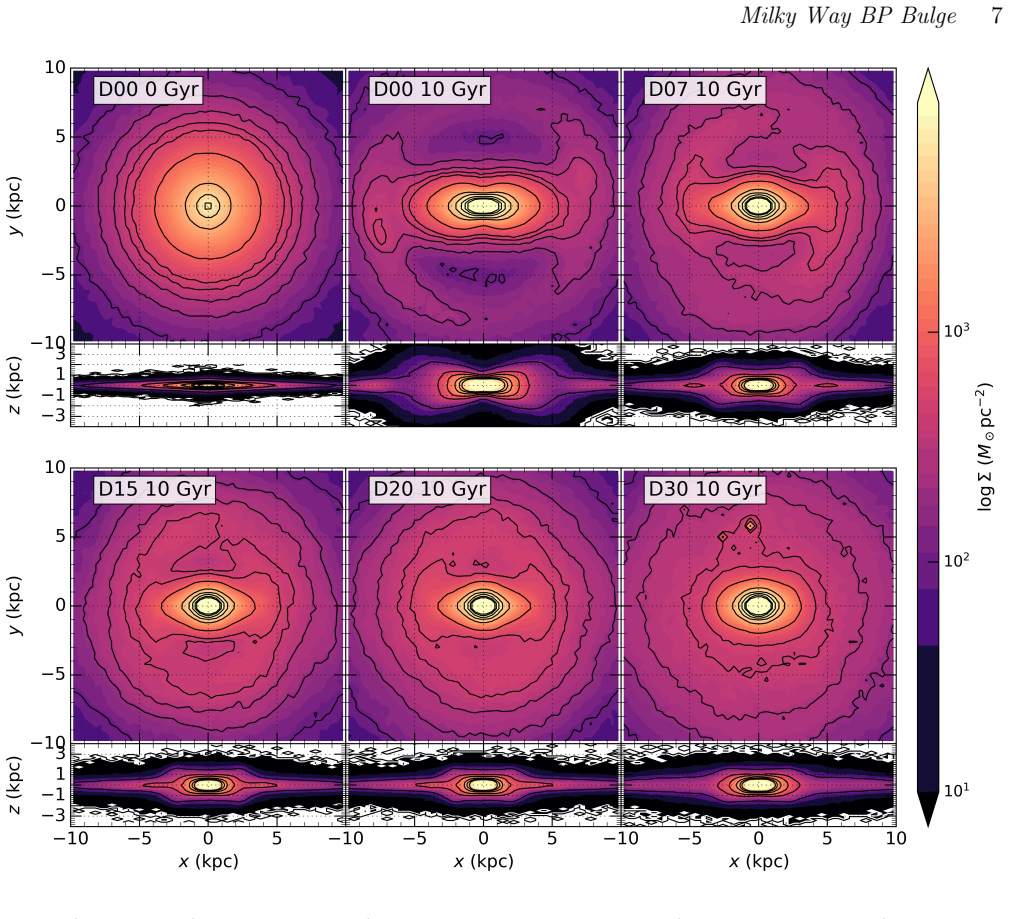
Summary. The paper presents isolated galaxy simulations built with a modified GalactICS that generates bulgeless initial conditions with Sérsic stellar discs and optional gas discs. A D-series varies gas fraction from 0% to 30% and a TG-series is based on the Tepper-Garcia et al. (2021) Milky Way model. The authors report that gas suppresses the secular growth of the bar and that their best model, TG07, at a selected t=3 Gyr snapshot roughly matches the Milky Way's bar length, pattern speed, and box/peanut bulge line-of-sight density distributions. The central claim in Section 5 is that it is possible to build a plausible Milky Way bar and BP bulge from bulgeless initial conditions provided a gas disc is present.
Significance. If the central claim holds, this is a useful proof-of-possibility result: it demonstrates that a classical bulge is not required to reproduce several Milky Way bar/bulge observables. The paper has clear strengths: the modified GalactICS code is publicly available, the three TG07 variants test robustness to random seeds and feedback implementation, and the mock red clump/RGBB comparisons against Gonzalez et al. (2015) are more independent than the bar-length and pattern-speed comparisons. The work also includes unusually explicit caveats about snapshot matching and metastability in Appendices B and C. The main value is as a proof-of-concept and as a tool release rather than as a unique or fully constrained model of the Milky Way.
major comments (4)
- [§4.2.2, Table 2, Appendix C, Figure C1] The stress-test concern about the metastable state lands. The TG07 match to the Milky Way is evaluated at t=3 Gyr, a snapshot selected because it best satisfies the three bar measurements in Table 2, and at that time the bar is in the metastable state discussed in Appendix C. Appendix C explicitly states that this state is 'quite fragile, and liable to be broken by external perturbations, such as would arise in a fully cosmological setting,' and Figure C1 shows that by 13 Gyr all three TG07 models leave the state, with TG07v2 and TG07v3 growing rapidly and TG07 becoming a slow rotator. Because the real Milky Way has experienced satellite impacts and ongoing gas inflow, the Section 5 claim requires either a direct perturbation test (for instance, a delayed satellite flyby or a subhalo encounter in the same numerical setup) or a clear scope restriction to isolated evolution. Without one of these, the conclusion is supported only by an unperturbed, selected snapshot.
- [Table 2, §4.2, §5] The treatment of the Chiba et al. (2021) slowdown constraint is not fully convincing. At the selected t=3 Gyr snapshot, Table 2 lists Omega_dot_p = -8 km/s/kpc/Gyr for TG07, which is about 2.5 sigma from the Milky Way value of -4.5 +/- 1.4. Section 5 dismisses this constraint because Chiba et al. assume a linear Omega_p(t), but the observable is a local deceleration estimate, and the paper does not demonstrate that the TG07 nonlinearity makes the comparison invalid. The authors should either apply the Chiba et al. measurement methodology to the simulation to compute what that method would infer from TG07, or explicitly list the slow-down rate as an unmatched property in Section 5.
- [Appendix B, Figure B1] The rotational-curve and surface-density comparisons are shown only at t=0 and t=10 Gyr, even though the Milky Way match is claimed at t=3 Gyr. At t=10 Gyr the TG07 rotation curve is 15-20 km/s lower than the Eilers et al. (2019) data between 5 and 10 kpc and is still rising where the observed curve falls, and the surface density profile in Figure B1 shows a double inflection not present in the Bovy & Rix (2013) data. Because the t=3 Gyr snapshot is the one claimed to represent the Milky Way, these diagnostics should be shown at t=3 Gyr as well; otherwise the 'plausible Milky Way' statement should be explicitly limited to the bar and BP-bulge observables.
- [§3.2, §4.1, Table 2] There is a degree of fit-driven agreement that should be quantified. The Sersic index n=1.75 and the 7% gas fraction were chosen after inspecting the D-series outcomes, and the snapshot in Table 2 is selected using the same bar measurements against which the model is judged. This is not fatal for a proof-of-possibility, but the paper should state how sensitive the match is to these choices, for example by indicating how far n and the gas fraction can be varied before the bar length or pattern speed leaves the observed ranges. The three TG07 variants establish robustness to seeds and feedback but not to the initial-condition parameters themselves.
minor comments (4)
- [Figure 8 caption] The caption says the TG sequence is shown 'at t = 10 Gyr,' but the figure and the associated text in Section 4.2.2 compare snapshots at t=3, 5, and 10 Gyr; the caption should be corrected.
- [§4.2.1] The text refers to 'model T00' where the context indicates model TG00; please correct the typo.
- [Table B1] The column header 'TG07 - 5 Gy' is truncated; it should read 'TG07 - 5 Gyr'.
- [Appendix D, Figure D4] The alternate normalization used in Figure D4 is important for interpreting the shapes of the line-of-sight distributions, but readers meet it only in an appendix; a brief explanation in Section 4.2.2 would make the main comparison easier to follow.
Circularity Check
The abstract's 'reproduces' is partly selection-driven: the 7% gas fraction and the t = 3 Gyr comparison snapshot are chosen using the same MW bar and BP measurements that are then presented as reproduced; the bar and BP are nonetheless emergent N-body products, so the bulgeless-IC claim keeps independent content (score 4).
-
fitted input called prediction
[Section 4.2 and Section 4.1.2 (model selection); abstract 'best-fit model']
"Based on the results of the D-sequence models, we only consider a gasless model, TG00, and three instances with a 7% gas disc, (TG07, TG07v2, and TG07v3). ... Ultimately, the D07 model has the most similar shape to the Gonzalez et al. (2015) data across all panels. ... Our best-fit model has an initial stellar disc with a Sérsic index of n = 1.75 and a gas disc with mass equal to 7% of the mass of the stellar disc. The model reproduces the bar size, pattern speed, and box/peanut shape of the Milky Way's bulge+bar."
The 7% gas fraction that defines the 'best-fit' TG07 model is not derived from first principles; it is the fraction carried over from D07, the grid model judged most similar to the MW in the Gonzalez et al. (2015) BP data, after the D-series had already been compared with the MW bar measurements. Presenting TG07 as reproducing the MW bar size, pattern speed, and BP shape therefore restates, in part, the comparison used to pick the gas fraction rather than an independent prediction of those quantities. This is partial: the bar and BP properties are emergent outputs of a full N-body/SPH evolution, not values inserted into an equation, and the paper explicitly aims for a 'plausible' rather than finely fitted model; the 2D line-of-sight BP distribution retains independent content.
-
fitted input called prediction
[Table 2 caption; Section 4.2.2]
"For the simulations, the specific snapshot is selected based on the quality of the combined comparison to the three MW measurements."
The evolution time is effectively a free parameter: the snapshot is chosen to maximise agreement with the very same three MW measurements (bar length, pattern speed, slowdown rate) that the abstract says the model 'reproduces'. The reported Rbar = 4.25 ± 0.5 kpc and Ωp = 44 km/s/kpc at t = 3 Gyr are therefore partly guaranteed by the selection rule rather than derived as unconstrained predictions. The circularity is incomplete: the TG07 bar is metastable, keeping Rbar and Ωp nearly constant from ~3.5 to ~10 Gyr, so the match is not confined to a single snapshot, and the slowdown rate still fails at the selected snapshot (-8 vs MW -4.5 ± 1.4 km/s/kpc/Gyr), so all three targets are not forced.
full rationale
The central claim — that a bulgeless Sérsic stellar disc plus a 7% gas disc can form a Milky Way-like bar and BP bulge — is established by direct N-body/SPH simulation: the ICs contain no classical bulge, and the bar and peanut structure grow self-consistently via the bar instability (Figs 2, 5–9), so no equation feeds the target bar size or BP shape into the ICs. The two flagged effects (gas-fraction grid selection and comparison-snapshot selection) mean part of the agreement with the three MW bar measurements is selection-driven; that is why the score is not lower. The BP-shape comparison against the Gonzalez et al. (2015) starcount data is the most independent evidence: it is a 2D line-of-sight distribution, was not a fitted input, and the paper documents the residual mismatch (missing central dips, weaker BP signature). The initial rotation-curve match is explicitly acknowledged to be inherited from the Tepper-Garcia et al. (2021) ICs by construction, and the evolved RC comparison is genuine (and partly fails). Self-citations do not create load-bearing circularity: the GalactICS code (Deg et al. 2019) is public; metastability (Sellwood & Debattista 2006) is an external mechanism whose presence is verified here by the nearly constant Rbar and Ωp over ~3.5–10 Gyr in Fig. 6; and Gonzalez et al. (2015) is observational. Appendix C's admission that the metastable state is 'quite fragile, and liable to be broken by external perturbations' and that 'confirmation needs further simulations with substructure taken into account' is an honest robustness limitation, not a circular step. Score 4: some self-citation and selection-driven agreement, but the central claim retains independent, emergent content.
Assumptions & free parameters
free parameters (6)
- Sérsic index n =
1.75 (TG series), 1.5 (D series)
- Gas disc mass fraction =
7% of the stellar disc mass
- Gas disc scale length Rg =
6.5 kpc
- Gas disc temperature =
10^4 K
- Star formation efficiency =
5% probability per dynamical time; SN feedback 0.8e51 erg (0.4e51 for D30)
- Disc velocity dispersion parameters =
sigma_r1=80 km/s, R_sigma1=2.5 kpc, sigma_r2=70 km/s, R_sigma2=1.8 kpc (TG series)
assumptions (4)
- domain assumption The Milky Way has no significant classical bulge; the central light excess is produced by the bar and box/peanut bulge.
- domain assumption Isolated galaxy evolution without cosmological accretion or substructure is adequate for the timescales studied.
- domain assumption The gas disc, star formation, and feedback prescriptions in ChaNGa reproduce the dynamical effect of gas on the bar.
- domain assumption The N-body and SPH codes with the adopted softening and time-stepping resolve the relevant bar-forming instabilities.
Cite this review
Pith. "Pith review of Simulating the Milky Way bar and bulge with an initially S\'{e}rsic disc." pith.science (2026). https://pith.science/paper/YZ6GYSCH
@misc{pith2026250720790,
  author       = {Pith},
  title        = {Pith review of: Simulating the Milky Way bar and bulge with an initially S\'ersic disc},
  year         = {2026},
  howpublished = {\url{https://pith.science/paper/YZ6GYSCH}},
  note         = {Machine review of arXiv:2507.20790}
}
abstract
We model the formation of a bar plus box/peanut bulge (BP bulge) component in a Milky Way-like disc galaxy using simulations of isolated multi-component systems that evolve from equilibrium initial conditions. The simulations are designed to test the hypothesis that the bar forms early on and thickens to create the bulge. To this end, our initial conditions include a stellar disc with a S\'{e}rsic surface density profile and do not include any classical bulge component. We also include a gas disc, which is important in regulating the growth of the bar. Our best-fit model has an initial stellar disc with a S\'{e}rsic index of $n = 1.75$ and a gas disc with mass equal to 7% of the mass of the stellar disc. The model reproduces the bar size, pattern speed, and box/peanut shape of the Milky Way's bulge+bar.
Figures


Figures from the paper (6 more)


Reference graph
Works this paper leans on
-
[1]
write newline
" write newline "" before.all 'output.state := FUNCTION fin.entry write newline FUNCTION new.block output.state before.all = 'skip after.block 'output.state := if FUNCTION new.sentence output.state after.block = 'skip output.state before.all = 'skip after.sentence 'output.state := if if FUNCTION not #0 #1 if FUNCTION and 'skip pop #0 if FUNCTION or pop #1...
-
[2]
Aguerri J. A. L., Mu \ n oz-Tu \ n \'o n C., Varela A. M., Prieto M., 2000, , https://ui.adsabs.harvard.edu/abs/2000A&A...361..841A 361, 841
2000
-
[3]
Anderson S. R., Debattista V. P., Erwin P., Liddicott D. J., Deg N., Beraldo e Silva L., 2022, @doi [ ] 10.1093/mnras/stac913 , https://ui.adsabs.harvard.edu/abs/2022MNRAS.513.1642A 513, 1642
-
[4]
Athanassoula E., 2003, @doi [ ] 10.1046/j.1365-8711.2003.06473.x , https://ui.adsabs.harvard.edu/abs/2003MNRAS.341.1179A 341, 1179
arXiv 2003
-
[5]
Athanassoula E., Misiriotis A., 2002, @doi [ ] 10.1046/j.1365-8711.2002.05028.x , https://ui.adsabs.harvard.edu/abs/2002MNRAS.330...35A 330, 35
arXiv 2002
-
[6]
Athanassoula E., Machado R. E. G., Rodionov S. A., 2013, @doi [ ] 10.1093/mnras/sts452 , https://ui.adsabs.harvard.edu/abs/2013MNRAS.429.1949A 429, 1949
-
[7]
Beane A., et al., 2023, @doi [ ] 10.3847/1538-4357/ace2b9 , https://ui.adsabs.harvard.edu/abs/2023ApJ...953..173B 953, 173
-
[8]
Beraldo e Silva L., Debattista V. P., Anderson S. R., Valluri M., Erwin P., Daniel K. J., Deg N., 2023, @doi [ ] 10.3847/1538-4357/ace976 , https://ui.adsabs.harvard.edu/abs/2023ApJ...955...38B 955, 38
Show all 91 references
-
[10]
Binney J., 2012, @doi [ ] 10.1111/j.1365-2966.2012.21692.x , https://ui.adsabs.harvard.edu/abs/2012MNRAS.426.1328B 426, 1328
2012
-
[11]
Binney J., Tremaine S., 2008, Galactic Dynamics: Second Edition
2008
-
[12]
Binney J., Vasiliev E., 2023, @doi [ ] 10.1093/mnras/stad094 , https://ui.adsabs.harvard.edu/abs/2023MNRAS.520.1832B 520, 1832
2023 doi
-
[13]
P., 2003, @doi [ ] 10.1086/367788 , https://ui.adsabs.harvard.edu/abs/2003AJ....125.1073B 125, 1073
B \"o ker T., Stanek R., van der Marel R. P., 2003, @doi [ ] 10.1086/367788 , https://ui.adsabs.harvard.edu/abs/2003AJ....125.1073B 125, 1073
2003 doi
-
[14]
A., et al., 2010, @doi [ ] 10.1088/0004-637X/716/1/1 , https://ui.adsabs.harvard.edu/abs/2010ApJ...716....1B 716, 1
Bond N. A., et al., 2010, @doi [ ] 10.1088/0004-637X/716/1/1 , https://ui.adsabs.harvard.edu/abs/2010ApJ...716....1B 716, 1
2010 doi
-
[15]
Bottema R., 1993, , https://ui.adsabs.harvard.edu/abs/1993A&A...275...16B 275, 16
1993
-
[16]
Bovy J., Rix H.-W., 2013, @doi [ ] 10.1088/0004-637X/779/2/115 , https://ui.adsabs.harvard.edu/abs/2013ApJ...779..115B 779, 115
2013 doi
-
[17]
Bovy J., et al., 2012, @doi [ ] 10.1088/0004-637X/759/2/131 , https://ui.adsabs.harvard.edu/abs/2012ApJ...759..131B 759, 131
2012 doi
-
[18]
K., 2024, @doi [ ] 10.1093/mnras/stae288 , https://ui.adsabs.harvard.edu/abs/2024MNRAS.528.4115C 528, 4115
Chiba R., Kataria S. K., 2024, @doi [ ] 10.1093/mnras/stae288 , https://ui.adsabs.harvard.edu/abs/2024MNRAS.528.4115C 528, 4115
2024 doi
-
[19]
Chiba R., Friske J. K. S., Sch \"o nrich R., 2021, @doi [ ] 10.1093/mnras/staa3585 , https://ui.adsabs.harvard.edu/abs/2021MNRAS.500.4710C 500, 4710
2021 doi
-
[20]
Collier A., Shlosman I., Heller C., 2019, @doi [ ] 10.1093/mnras/stz2327 , https://ui.adsabs.harvard.edu/abs/2019MNRAS.489.3102C 489, 3102
2019 doi
-
[21]
D'Onghia E., Aguerri J. A. L., 2020, @doi [ ] 10.3847/1538-4357/ab6bd6 , https://ui.adsabs.harvard.edu/abs/2020ApJ...890..117D 890, 117
2020 doi
-
[22]
P., Sellwood J
Debattista V. P., Sellwood J. A., 2000, @doi [ ] 10.1086/317148 , https://ui.adsabs.harvard.edu/abs/2000ApJ...543..704D 543, 704
2000 doi
-
[23]
P., Carollo C
Debattista V. P., Carollo C. M., Mayer L., Moore B., 2005, @doi [ ] 10.1086/431292 , https://ui.adsabs.harvard.edu/abs/2005ApJ...628..678D 628, 678
2005 doi
-
[24]
P., Mayer L., Carollo C
Debattista V. P., Mayer L., Carollo C. M., Moore B., Wadsley J., Quinn T., 2006, @doi [ ] 10.1086/504147 , https://ui.adsabs.harvard.edu/abs/2006ApJ...645..209D 645, 209
2006 doi
-
[25]
P., Ness M., Gonzalez O
Debattista V. P., Ness M., Gonzalez O. A., Freeman K., Zoccali M., Minniti D., 2017, @doi [ ] 10.1093/mnras/stx947 , https://ui.adsabs.harvard.edu/abs/2017MNRAS.469.1587D 469, 1587
2017 doi
-
[26]
M., Randriamampandry T., Carignan C., 2019, @doi [ ] 10.1093/mnras/stz1203 , https://ui.adsabs.harvard.edu/abs/2019MNRAS.486.5391D 486, 5391
Deg N., Widrow L. M., Randriamampandry T., Carignan C., 2019, @doi [ ] 10.1093/mnras/stz1203 , https://ui.adsabs.harvard.edu/abs/2019MNRAS.486.5391D 486, 5391
2019 doi
-
[27]
Dehnen W., Semczuk M., Sch \"o nrich R., 2023, @doi [ ] 10.1093/mnras/stac3184 , https://ui.adsabs.harvard.edu/abs/2023MNRAS.518.2712D 518, 2712
2023 doi
-
[28]
W., Rix H.-W., Ness M
Eilers A.-C., Hogg D. W., Rix H.-W., Ness M. K., 2019, @doi [ ] 10.3847/1538-4357/aaf648 , https://ui.adsabs.harvard.edu/abs/2019ApJ...871..120E 871, 120
2019 doi
-
[29]
Elia D., et al., 2022, @doi [ ] 10.3847/1538-4357/aca27d , https://ui.adsabs.harvard.edu/abs/2022ApJ...941..162E 941, 162
2022 doi
-
[31]
W., 1993, @doi [ ] 10.1093/mnras/260.1.191 , https://ui.adsabs.harvard.edu/abs/1993MNRAS.260..191E 260, 191
Evans N. W., 1993, @doi [ ] 10.1093/mnras/260.1.191 , https://ui.adsabs.harvard.edu/abs/1993MNRAS.260..191E 260, 191
1993 doi
-
[33]
M., Efstathiou G., 1980, @doi [ ] 10.1093/mnras/193.2.189 , https://ui.adsabs.harvard.edu/abs/1980MNRAS.193..189F 193, 189
Fall S. M., Efstathiou G., 1980, @doi [ ] 10.1093/mnras/193.2.189 , https://ui.adsabs.harvard.edu/abs/1980MNRAS.193..189F 193, 189
1980 doi
-
[34]
Feast M., Whitelock P., 1997, @doi [ ] 10.1093/mnras/291.4.683 , https://ui.adsabs.harvard.edu/abs/1997MNRAS.291..683F 291, 683
1997 doi
-
[35]
Flynn C., Fuchs B., 1994, @doi [ ] 10.1093/mnras/270.3.471 , https://ui.adsabs.harvard.edu/abs/1994MNRAS.270..471F 270, 471
1994 doi
-
[36]
C., 1970, @doi [ ] 10.1086/150474 , https://ui.adsabs.harvard.edu/abs/1970ApJ...160..811F 160, 811
Freeman K. C., 1970, @doi [ ] 10.1086/150474 , https://ui.adsabs.harvard.edu/abs/1970ApJ...160..811F 160, 811
1970 doi
-
[37]
S., B \'e dorf J., Baba J., Portegies Zwart S., 2019, @doi [ ] 10.1093/mnras/sty2747 , https://ui.adsabs.harvard.edu/abs/2019MNRAS.482.1983F 482, 1983
Fujii M. S., B \'e dorf J., Baba J., Portegies Zwart S., 2019, @doi [ ] 10.1093/mnras/sty2747 , https://ui.adsabs.harvard.edu/abs/2019MNRAS.482.1983F 482, 1983
2019 doi
-
[38]
A., Zoccali M., Debattista V
Gonzalez O. A., Zoccali M., Debattista V. P., Alonso-Garc \' a J., Valenti E., Minniti D., 2015, @doi [ ] 10.1051/0004-6361/201527434 , https://ui.adsabs.harvard.edu/abs/2015A&A...583L...5G 583, L5
2015 doi
-
[39]
A., et al., 2018, @doi [ ] 10.1093/mnrasl/sly171 , https://ui.adsabs.harvard.edu/abs/2018MNRAS.481L.130G 481, L130
Gonzalez O. A., et al., 2018, @doi [ ] 10.1093/mnrasl/sly171 , https://ui.adsabs.harvard.edu/abs/2018MNRAS.481L.130G 481, L130
2018 doi
-
[40]
Governato F., et al., 2010, @doi [ ] 10.1038/nature08640 , https://ui.adsabs.harvard.edu/abs/2010Natur.463..203G 463, 203
2010 doi
-
[41]
Hernquist L., 1990, @doi [ ] 10.1086/168845 , https://ui.adsabs.harvard.edu/abs/1990ApJ...356..359H 356, 359
1990 doi
-
[42]
Herpich J., Tremaine S., Rix H.-W., 2017, @doi [ ] 10.1093/mnras/stx352 , https://ui.adsabs.harvard.edu/abs/2017MNRAS.467.5022H 467, 5022
2017 doi
-
[43]
Holley-Bockelmann K., Weinberg M., Katz N., 2005, @doi [ ] 10.1111/j.1365-2966.2005.09501.x , https://ui.adsabs.harvard.edu/abs/2005MNRAS.363..991H 363, 991
2005
-
[44]
A., Hunter C., 2005, @doi [ ] 10.1086/432370 , https://ui.adsabs.harvard.edu/abs/2005ApJ...630..804J 630, 804
Jalali M. A., Hunter C., 2005, @doi [ ] 10.1086/432370 , https://ui.adsabs.harvard.edu/abs/2005ApJ...630..804J 630, 804
2005 doi
-
[45]
Jetley P., Gioachin F., Mendes C., Kalé L., Quinn T., 2008, Proceedings of IEEE International Parallel and Distributed Processing Symposium 2008
2008
-
[46]
V., Quinn T
Jetley P., Wesolowski L., Gioachin F., Kalé L. V., Quinn T. R., 2010, in SC '10: Proceedings of the 2010 ACM/IEEE International Conference for High Performance Computing, Networking, Storage and Analysis. pp 1--11, @doi 10.1109/SC.2010.49
2010 doi
-
[47]
M., 2024, @doi [ ] 10.1093/mnras/stad3666 , https://ui.adsabs.harvard.edu/abs/2024MNRAS.527.7781J 527, 7781
Joshi R., Widrow L. M., 2024, @doi [ ] 10.1093/mnras/stad3666 , https://ui.adsabs.harvard.edu/abs/2024MNRAS.527.7781J 527, 7781
2024 doi
-
[48]
Juri \'c M., et al., 2008, @doi [ ] 10.1086/523619 , https://ui.adsabs.harvard.edu/abs/2008ApJ...673..864J 673, 864
2008 doi
-
[49]
K., Shen J., 2022, The Astrophysical Journal, 940, 175
Kataria S. K., Shen J., 2022, The Astrophysical Journal, 940, 175
2022
-
[50]
W., Wadsley J., Benincasa S
Keller B. W., Wadsley J., Benincasa S. M., Couchman H. M. P., 2014, @doi [ ] 10.1093/mnras/stu1058 , https://ui.adsabs.harvard.edu/abs/2014MNRAS.442.3013K 442, 3013
2014 doi
-
[51]
R., 1966, @doi [ ] 10.1086/109857 , https://ui.adsabs.harvard.edu/abs/1966AJ.....71...64K 71, 64
King I. R., 1966, @doi [ ] 10.1086/109857 , https://ui.adsabs.harvard.edu/abs/1966AJ.....71...64K 71, 64
1966 doi
-
[52]
Kormendy J., Bender R., 2019, @doi [ ] 10.3847/1538-4357/aafdff , https://ui.adsabs.harvard.edu/abs/2019ApJ...872..106K 872, 106
2019 doi
-
[53]
J., 2004, @doi [ ] 10.1146/annurev.astro.42.053102.134024 , https://ui.adsabs.harvard.edu/abs/2004ARA&A..42..603K 42, 603
Kormendy J., Kennicutt Robert C. J., 2004, @doi [ ] 10.1146/annurev.astro.42.053102.134024 , https://ui.adsabs.harvard.edu/abs/2004ARA&A..42..603K 42, 603
2004
-
[54]
Kuijken K., Dubinski J., 1994, @doi [ ] 10.1093/mnras/269.1.13 , https://ui.adsabs.harvard.edu/abs/1994MNRAS.269...13K 269, 13
1994 doi
-
[55]
Kuijken K., Dubinski J., 1995, @doi [ ] 10.1093/mnras/277.4.1341 , https://ui.adsabs.harvard.edu/abs/1995MNRAS.277.1341K 277, 1341
1995 doi
-
[56]
L., 2020, @doi [ ] 10.1051/0004-6361/201937165 , https://ui.adsabs.harvard.edu/abs/2020A&A...634A.122L 634, A122
okas E. L., 2020, @doi [ ] 10.1051/0004-6361/201937165 , https://ui.adsabs.harvard.edu/abs/2020A&A...634A.122L 634, A122
2020 doi
-
[57]
Malhotra S., 1995, @doi [ ] 10.1086/175946 , https://ui.adsabs.harvard.edu/abs/1995ApJ...448..138M 448, 138
1995 doi
-
[58]
Martinez-Valpuesta I., Shlosman I., Heller C., 2006, @doi [ ] 10.1086/498338 , https://ui.adsabs.harvard.edu/abs/2006ApJ...637..214M 637, 214
2006 doi
-
[59]
L., Beane A., D'Onghia E., Filion C., Daniel K
McClure R. L., Beane A., D'Onghia E., Filion C., Daniel K. J., 2025, @doi [ ] 10.1093/mnras/staf107 , https://ui.adsabs.harvard.edu/abs/2025MNRAS.537.1475M 537, 1475
2025 doi
-
[60]
J., 2017, @doi [ ] 10.1093/mnras/stw2759 , https://ui.adsabs.harvard.edu/abs/2017MNRAS.465...76M 465, 76
McMillan P. J., 2017, @doi [ ] 10.1093/mnras/stw2759 , https://ui.adsabs.harvard.edu/abs/2017MNRAS.465...76M 465, 76
2017 doi
-
[61]
McWilliam A., Zoccali M., 2010, @doi [ ] 10.1088/0004-637X/724/2/1491 , https://ui.adsabs.harvard.edu/abs/2010ApJ...724.1491M 724, 1491
2010 doi
-
[62]
Menon H., Wesolowski L., Zheng G., Jetley P., Kale L., Quinn T., Governato F., 2015, @doi [Computational Astrophysics and Cosmology] 10.1186/s40668-015-0007-9 , https://ui.adsabs.harvard.edu/abs/2015ComAC...2....1M 2, 1
2015 doi
-
[63]
Michel-Dansac L., Wozniak H., 2006, @doi [ ] 10.1051/0004-6361:20041038 , https://ui.adsabs.harvard.edu/abs/2006A&A...452...97M 452, 97
2006 doi
-
[64]
H., Prendergast K
Miller R. H., Prendergast K. H., Quirk W. J., 1970, @doi [ ] 10.1086/150593 , https://ui.adsabs.harvard.edu/abs/1970ApJ...161..903M 161, 903
1970 doi
-
[65]
J., Mao S., White S
Mo H. J., Mao S., White S. D. M., 1998, @doi [ ] 10.1046/j.1365-8711.1998.01227.x , https://ui.adsabs.harvard.edu/abs/1998MNRAS.295..319M 295, 319
1998
-
[66]
M., Udalski A., Gould A., Fouqu \'e P., Stanek K
Nataf D. M., Udalski A., Gould A., Fouqu \'e P., Stanek K. Z., 2010, @doi [ ] 10.1088/2041-8205/721/1/L28 , https://ui.adsabs.harvard.edu/abs/2010ApJ...721L..28N 721, L28
2010 doi
-
[67]
M., Gould A
Nataf D. M., Gould A. P., Pinsonneault M. H., Udalski A., 2013, @doi [ ] 10.1088/0004-637X/766/2/77 , https://ui.adsabs.harvard.edu/abs/2013ApJ...766...77N 766, 77
2013 doi
-
[68]
F., Frenk C
Navarro J. F., Frenk C. S., White S. D. M., 1997, @doi [ ] 10.1086/304888 , https://ui.adsabs.harvard.edu/abs/1997ApJ...490..493N 490, 493
1997 doi
-
[69]
K., Dubinski J., 2003, @doi [ ] 10.1046/j.1365-2966.2003.07085.x , https://ui.adsabs.harvard.edu/abs/2003MNRAS.346..251O 346, 251
O'Neill J. K., Dubinski J., 2003, @doi [ ] 10.1046/j.1365-2966.2003.07085.x , https://ui.adsabs.harvard.edu/abs/2003MNRAS.346..251O 346, 251
2003
-
[70]
P., Peebles P
Ostriker J. P., Peebles P. J. E., 1973, @doi [ ] 10.1086/152513 , https://ui.adsabs.harvard.edu/abs/1973ApJ...186..467O 186, 467
1973 doi
-
[71]
V., Berczik P., Just A., 2016, @doi [ ] 10.1093/mnras/stw1907 , https://ui.adsabs.harvard.edu/abs/2016MNRAS.462.3727P 462, 3727
Polyachenko E. V., Berczik P., Just A., 2016, @doi [ ] 10.1093/mnras/stw1907 , https://ui.adsabs.harvard.edu/abs/2016MNRAS.462.3727P 462, 3727
2016 doi
-
[72]
Portail M., Gerhard O., Wegg C., Ness M., 2017, @doi [ ] 10.1093/mnras/stw2819 , https://ui.adsabs.harvard.edu/abs/2017MNRAS.465.1621P 465, 1621
2017 doi
-
[73]
C., Reyl \'e C., Derri \`e re S., Picaud S., 2003, @doi [ ] 10.1051/0004-6361:20031117 , https://ui.adsabs.harvard.edu/abs/2003A&A...409..523R 409, 523
Robin A. C., Reyl \'e C., Derri \`e re S., Picaud S., 2003, @doi [ ] 10.1051/0004-6361:20031117 , https://ui.adsabs.harvard.edu/abs/2003A&A...409..523R 409, 523
2003 doi
-
[74]
K., Zoccali M., McWilliam A., Minniti D., Gonzalez O
Saito R. K., Zoccali M., McWilliam A., Minniti D., Gonzalez O. A., Hill V., 2011, @doi [ ] 10.1088/0004-6256/142/3/76 , https://ui.adsabs.harvard.edu/abs/2011AJ....142...76S 142, 76
2011 doi
-
[75]
A., 1985, @doi [ ] 10.1093/mnras/217.1.127 , https://ui.adsabs.harvard.edu/abs/1985MNRAS.217..127S 217, 127
Sellwood J. A., 1985, @doi [ ] 10.1093/mnras/217.1.127 , https://ui.adsabs.harvard.edu/abs/1985MNRAS.217..127S 217, 127
1985 doi
-
[76]
Sellwood J., 2016, The Astrophysical Journal, 819, 92
2016
-
[77]
A., Debattista V
Sellwood J. A., Debattista V. P., 2006, @doi [ ] 10.1086/499482 , https://ui.adsabs.harvard.edu/abs/2006ApJ...639..868S 639, 868
2006 doi
-
[79]
A., Gerhard O., 2020, @doi [ ] 10.1093/mnras/staa1336 , https://ui.adsabs.harvard.edu/abs/2020MNRAS.495.3175S 495, 3175
Sellwood J. A., Gerhard O., 2020, @doi [ ] 10.1093/mnras/staa1336 , https://ui.adsabs.harvard.edu/abs/2020MNRAS.495.3175S 495, 3175
2020 doi
-
[80]
Shen S., Wadsley J., Stinson G., 2010a, @doi [ ] 10.1111/j.1365-2966.2010.17047.x , https://ui.adsabs.harvard.edu/abs/2010MNRAS.407.1581S 407, 1581
2010
-
[81]
M., Kormendy J., Howard C
Shen J., Rich R. M., Kormendy J., Howard C. D., De Propris R., Kunder A., 2010b, @doi [ ] 10.1088/2041-8205/720/1/L72 , https://ui.adsabs.harvard.edu/abs/2010ApJ...720L..72S 720, L72
-
[82]
G., 2001, PhD thesis, University of Washington, Seattle
Stadel J. G., 2001, PhD thesis, University of Washington, Seattle
2001
-
[83]
S., Dalcanton J
Stinson G. S., Dalcanton J. J., Quinn T., Gogarten S. M., Kaufmann T., Wadsley J., 2009, @doi [ ] 10.1111/j.1365-2966.2009.14555.x , https://ui.adsabs.harvard.edu/abs/2009MNRAS.395.1455S 395, 1455
2009
-
[84]
arXiv:2111.05466
Tepper-Garcia T., et al., 2021, arXiv e-prints, https://ui.adsabs.harvard.edu/abs/2021arXiv211105466T p. arXiv:2111.05466
2021 arXiv
-
[85]
Toomre A., Toomre J., 1972, @doi [ ] 10.1086/151823 , https://ui.adsabs.harvard.edu/abs/1972ApJ...178..623T 178, 623
1972 doi
-
[86]
Vasiliev E., 2019, @doi [ ] 10.1093/mnras/sty2672 , https://ui.adsabs.harvard.edu/abs/2019MNRAS.482.1525V 482, 1525
2019 doi
-
[87]
Virtanen P., et al., 2020, @doi [Nature Methods] 10.1038/s41592-019-0686-2 , https://rdcu.be/b08Wh 17, 261
2020 doi
-
[88]
W., Stadel J., Quinn T., 2004, @doi [ ] 10.1016/j.newast.2003.08.004 , https://ui.adsabs.harvard.edu/abs/2004NewA....9..137W 9, 137
Wadsley J. W., Stadel J., Quinn T., 2004, @doi [ ] 10.1016/j.newast.2003.08.004 , https://ui.adsabs.harvard.edu/abs/2004NewA....9..137W 9, 137
2004 doi
-
[89]
W., Keller B
Wadsley J. W., Keller B. W., Quinn T. R., 2017, @doi [ ] 10.1093/mnras/stx1643 , https://ui.adsabs.harvard.edu/abs/2017MNRAS.471.2357W 471, 2357
2017 doi
-
[90]
Wegg C., Gerhard O., 2013, @doi [ ] 10.1093/mnras/stt1376 , https://ui.adsabs.harvard.edu/abs/2013MNRAS.435.1874W 435, 1874
2013 doi
-
[91]
Wegg C., Gerhard O., Portail M., 2015, @doi [ ] 10.1093/mnras/stv745 , https://ui.adsabs.harvard.edu/abs/2015MNRAS.450.4050W 450, 4050
2015 doi
-
[92]
D., 1985, @doi [ ] 10.1093/mnras/213.3.451 , https://ui.adsabs.harvard.edu/abs/1985MNRAS.213..451W 213, 451
Weinberg M. D., 1985, @doi [ ] 10.1093/mnras/213.3.451 , https://ui.adsabs.harvard.edu/abs/1985MNRAS.213..451W 213, 451
1985 doi
-
[93]
D., Katz N., 2007, @doi [ ] 10.1111/j.1365-2966.2006.11306.x , https://ui.adsabs.harvard.edu/abs/2007MNRAS.375..425W 375, 425
Weinberg M. D., Katz N., 2007, @doi [ ] 10.1111/j.1365-2966.2006.11306.x , https://ui.adsabs.harvard.edu/abs/2007MNRAS.375..425W 375, 425
2007
-
[94]
M., Dubinski J., 2005, @doi [ ] 10.1086/432710 , https://ui.adsabs.harvard.edu/abs/2005ApJ...631..838W 631, 838
Widrow L. M., Dubinski J., 2005, @doi [ ] 10.1086/432710 , https://ui.adsabs.harvard.edu/abs/2005ApJ...631..838W 631, 838
2005 doi
-
[95]
M., Pym B., Dubinski J., 2008, @doi [ ] 10.1086/587636 , https://ui.adsabs.harvard.edu/abs/2008ApJ...679.1239W 679, 1239
Widrow L. M., Pym B., Dubinski J., 2008, @doi [ ] 10.1086/587636 , https://ui.adsabs.harvard.edu/abs/2008ApJ...679.1239W 679, 1239
2008 doi
Reviewed August 6, 2026 · model on record in the stance chip above.
Discussion (0). Continue with ORCID to comment.