REVIEW 4 major objections 4 minor 29 references
A $\sigma$-morphic convex protoset
T0 review · 4 major / 4 minor · reviewed 2026-08-06 · deepseek-v4-flash
Pith's one-line read A protoset of six convex polygons is constructed that tiles the plane in exactly countably many noncongruent ways.
desk verdict A promising construction of a convex sigma-morphic protoset, but the main theorem's proof leaves the crucial vertex-forcing argument deferred and the counting step unjustified, so the result is not established as written. read the letter →
The pith
A machine-rendered reading of the paper's core claim, the machinery that carries it, and where it could break.
The reading
What carries the argument
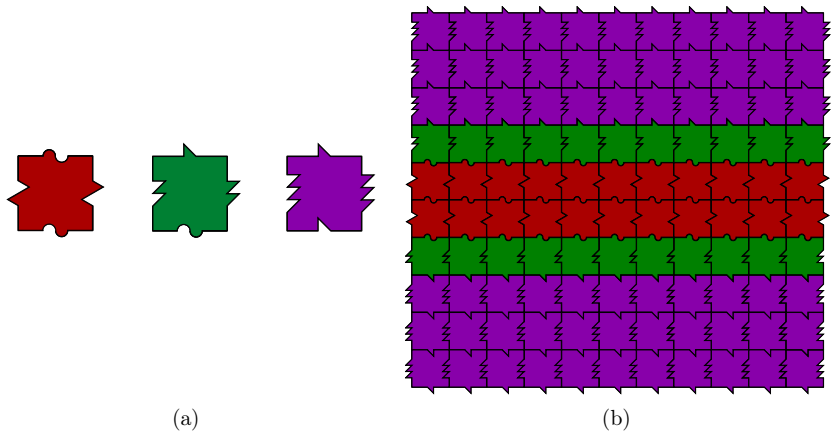
The load-bearing object is the angular replacement of a bump or nick. In the base protoset, matching is forced by a protrusion entering an indentation; here each such edge is replaced by two straight edges meeting at an angle $\alpha$, one pair protruding outward and one pair receding inward, so that only an $\alpha$-corner of the opposite sign can fit it. The paper adds two layers of control on the subdivided polygons: the angle sums available at any vertex are restricted (the only way to reach $360^\circ$ with $\alpha,\beta,\gamma$ is $\alpha+\beta+\gamma$, and no sum produces $\theta$ or $180^\circ-\theta$), and the lengths of consecutive inner edges are all distinct, so a 3-valent vertex can be surrounded in only one order and orientation. Recomposition — marking the new polygons so that the original tile edges reappear — transfers the forced tilings of the base protoset to the convex protoset $P$.
What would settle it
Take the six polygons with a proposed choice of $\alpha$, $Q$, $R$, and $Z$; compute all sums of tile angles that equal $360^\circ$ and all sums that equal $180^\circ-\theta$ for an inner angle $\theta$. If any unintended $360^\circ$ sum appears, or any two consecutive inner edges have equal length, the vertex surrounding is not unique and the protoset admits an extra local configuration, opening the way to uncountably many tilings.
Extended reading notes
Core claim
The paper's central claim is Theorem 3.2: there exists a protoset $P$ of convex prototiles that is $\sigma$-morphic. In the proof, a known two-tile non-convex $\sigma$-morphic protoset (the red outlines in Figure 7) is divided by inner segments into four convex hexagons and two convex pentagons. The subdivision is chosen so that (i) the angle $\alpha$ of each new angular bump or nick, together with the angles $\beta,\gamma$, gives the only triple of tile angles summing to $360^\circ$; (ii) no two consecutive inner edges of any tile have equal length; and (iii) no sum of tile angles equals $\theta$ or $180^\circ-\theta$ for any inner angle $\theta$. These conditions make each vertex of every tile admit exactly one possible cyclic arrangement of the tiles around it, and the edge-length inequalities force the order and orientation of the tiles. Consequently the tilings by $P$ are in bijective correspondence with the tilings by the base protoset, and since the latter has exactly $\aleph_0$ noncongruent tilings, so does $P$.
Load-bearing premise
The construction rests on the assumption that one can choose the angle $\alpha$ and the positions of the points $Q$, $R$, and $Z$ so that all required inequalities hold simultaneously — every vertex has a unique forced surrounding, no two consecutive inner edges are equal, no forbidden angle sum appears, and every polygon stays convex — with no explicit choice actually exhibited.
Editorial extensions
If this is right
- If the proof is correct, this is a $\sigma$-morphic protoset whose prototiles are all convex polygons, so countably-many-tiling behaviour is compatible with convexity at the level of protosets.
- The protoset $P$ inherits the tilings of the base protoset, including a periodic tiling; the paper recalls that any $\sigma$-morphic protoset must admit a periodic tiling.
- The new three-tile protoset of Theorem 3.1 gives a second mechanism for $\aleph_0$ tilings: a discrete parameter counts the finitely many red rows, with all but two tilings obtained this way.
- By the classification facts surveyed in the paper, no single convex tile can be $\sigma$-morphic: the possible convex monohedral tilers yield either finitely many or continuum many tilings.
Reading between the lines
- The proof's genericity step suggests a general recipe: any finite non-convex protoset whose forcing is purely local and vertex-based could be recomposed into convex polygons by replacing each bump or nick with an angular chain and choosing the chain angle outside the finitely many forbidden sums; testing this on other base constructions would show how far the method extends.
- The paper does not give explicit coordinates for $\alpha, Q, R, Z$; a concrete instantiation would let a computer check every vertex angle sum and edge-length inequality, turning the existence theorem into a verified explicit family of convex polygons.
- Because the construction uses six prototiles, a natural next test of the method is to search for a smaller convex protoset; the paper itself asks whether three or even two convex prototiles could suffice.
Editorial analysis
A structured set of objections, weighed in public.
Referee Report
Summary. The paper studies σ-morphic protosets (protosets that tile the plane in exactly countably many noncongruent ways). It surveys known constructions, presents a new non-convex σ-morphic protoset of three tiles (Theorem 3.1, Figure 6), and states the main result Theorem 3.2: a protoset P consisting of convex prototiles (shown in Figure 7) that is σ-morphic, obtained by recomposing Schmitt's σ-morphic protoset into convex polygons. The proof of Theorem 3.2 is a sketch: it proposes to choose angles and edge lengths generically so that every vertex of every tile is forced to be surrounded exactly as in Figure 7, then argues that the local forcing around vertices Q and R propagates to make P behave like Schmitt's protoset. A second convex protoset (Figure 8) is also announced with its proof omitted.
Significance. If the proof of Theorem 3.2 can be completed, the result would be the first example of a σ-morphic protoset consisting solely of convex prototiles, answering a natural variant of the open problem of Grünbaum and Shephard and showing that convexity is not an obstruction to countability of tiling classes. The new non-convex protoset of Theorem 3.1 and the geometric ideas for subdividing bump-and-nick tiles into convex pieces would also be of independent interest. The paper is clearly written and includes a useful survey; the constructions are explicitly tied to Schmitt's prior work, and the central claim does not depend on the conclusion it sets out to prove, so there is no circularity. However, as it stands the proof of the main theorem contains substantial gaps, as detailed below.
major comments (4)
- [§3.2, proof of Theorem 3.2] The proof explicitly defers the key vertex-forcing step: 'We first have to make sure that the correct tiles appear around the vertex... by a bit more complicated argument, but we'll leave that for later.' This step never appears. The subsequent order-forcing arguments for vertices Q and R assume that the correct set of tiles around each vertex has already been established. Since the theorem's conclusion requires that every vertex in every tiling by P have exactly the local configuration of Figure 7, the missing argument is load-bearing: without it, extra tilings, possibly continuum many, are not excluded.
- [§3.2, genericity of the parameters α and QR] The existence of a suitable angle α and of subdivision points Q, R, Z is justified by 'almost inevitable' genericity, stated as 'the set of forbidden angles is finite' and 'continuum many placements... taking one that will fulfill the requirements on the angles is then almost inevitable'. The forbidden conditions, however, include both angle equalities and edge-length equalities (for instance, distinctness of consecutive inner edges such as |QS| ≠ |QT|), which are algebraic equations and inequalities in the parameters (α and the position of QR). The bad parameter set is a finite union of proper real-algebraic subsets which is typically infinite, not a finite set. A rigorous existence proof (for example by a dimension/measure argument or an explicit construction) for a parameter choice satisfying all angle and length constraints simultaneously is needed.
- [§3.2, final paragraph] The conclusion 'As now the protoset P behaves in the same way that the pair of prototiles discovered by Schmitt... we have shown that P is indeed σ-morphic' does not follow from the recomposition definition used in the paper. The definition of recomposition only requires that the marks of any P-tiling form some Schmitt tiling; it does not state that the induced map from P-tilings to Schmitt tilings is countable-to-one, nor that every Schmitt tiling admits at least one P-tiling. Even if every P-tiling marks a Schmitt tiling, there could be continuum many P-tilings marking the same Schmitt tiling. The proof must show that the fibers of this map are countable (or alternatively count P-tilings directly).
- [§3.2, Figure 8] The second convex protoset shown in Figure 8 is announced with the proof omitted ('We will, however, omit the proof as it uses similar ideas as the previous one'). Since the section presents this as an additional result, the paper either needs to provide the proof or explicitly downgrade the statement to a conjecture. As written, the claim that the protoset is σ-morphic is unproved.
minor comments (4)
- [§3.1, Theorem 3.1] There is a typo in the theorem statement: 'The protest shown in Figure 6 (a) is σ-morphic' should read 'protoset'.
- [§3.2, recomposition definition] In the definition of recomposition, 'any tiling T1 admitted by T1' should read 'any tiling admitted by T1', and similarly for 'marks on the tiles are the vertices and edges of some tiling admitted by T2' the grammar needs fixing.
- [§3.2, paragraph after Theorem 3.2] The claim that 'each triangle is c-morphic while quadrangles can either be monomorphic or c-morphic' is stated without proof or reference; a citation or a brief justification would be helpful.
- [§3.2, proof of Theorem 3.2, tiles 7 and 8] The geometric argument concerning the edge ZW and the points Z′, Z′′, Z′′′, W′ relies on a configuration that is not fully described in the text; adding a sub-figure or a precise coordinate description would improve readability and verifiability.
Circularity Check
No significant circularity: Theorem 3.2 rests on external inputs (Schmitt's protoset, the recomposition definition, and convex-tiling classifications); the proof's self-asserted omissions and genericity leaps are correctness gaps, not circular reductions.
full rationale
The derivation chain for the central claim (Theorem 3.2) contains no step that reduces to its own input. The load-bearing premises are external: Schmitt's sigma-morphic protoset is cited from Schmitt's own work [24]; the recomposition notion is quoted from Grunbaum-Shephard [6]; and the convex-polygon tilability facts (pentagon classes, hexagon families, n >= 7 impossibility) come from standard sources [1, 6, 10, 13, 17, 18]. Nothing is fitted and then renamed a prediction, and no uniqueness theorem is imported from the author's own prior work. The only self-citations are to [2] (Basic-Dzuklevski-Slivkova) in Sections 2.1 and 4, used for context, and they are not load-bearing for Theorem 3.2. Under the reviewing rule, the manuscript's own assertions of missing support are flagged explicitly: Section 3.2 defers the key vertex-forcing argument ("We first have to make sure that the correct tiles appear around the vertex... but we'll leave that for later") and never returns to it; the closing inference ("As now the protoset P behaves in the same way that the pair of prototiles discovered by Schmitt from Figure 5 we have shown that P is indeed sigma-morphic") relies on that missing forcing claim, since recomposition alone only maps each P-tiling to some Schmitt tiling and does not by itself give countable fibers or surjectivity; the generic choice of alpha and of the segment QR is asserted ("almost inevitable since the set of forbidden angles is finite") without proof; and the Figure 8 claim is left with "We will, however, omit the proof". Each of these is a completeness or correctness risk, not a circularity: the paper nowhere defines P's sigma-morphicity in terms of, or fits parameters to, the very conclusion it draws.
Assumptions & free parameters
free parameters (2)
- Angle alpha of the convex bumps and nicks =
Not specified; chosen generically
- Positions of subdivision vertices Q, R, Z and resulting edge lengths =
Not specified; chosen in an open set
assumptions (3)
- domain assumption Schmitt's protoset from Figure 5 is sigma-morphic.
- domain assumption The classification of convex polygons that tile the plane is complete.
- ad hoc to paper A generic choice of subdivision parameters satisfies the angle-sum and edge-length constraints.
Cite this review
Pith. "Pith review of A $\sigma$-morphic convex protoset." pith.science (2026). https://pith.science/paper/TOKL73WV
@misc{pith2026250720867,
  author       = {Pith},
  title        = {Pith review of: A $\sigma$-morphic convex protoset},
  year         = {2026},
  howpublished = {\url{https://pith.science/paper/TOKL73WV}},
  note         = {Machine review of arXiv:2507.20867}
}
abstract
We say that a tile is $\sigma$-morphic if it tiles the plane in exactly $\aleph_0$ many noncongruent ways (up to an isometry). It is an unsolved problem of whether a $\sigma$-morphic tile exist in the plane. In this note we present a construction of a set of convex tiles that is $\sigma$-morphic. The result is interesting since all the constructions of $\sigma$-morphic sets of tiles that arise in the literature make use of bumps and nicks, which necessarily make the tiles non-convex. We construct our set by cleverly dividing the tiles of the set of tiles discovered by Schmitt into convex tiles so that they behave in the same manner.
Figures


Figures from the paper (6 more)




Reference graph
Works this paper leans on
-
[1]
C. Adams, The Tiling Book: An Introduction to the Mathematical Theory of Tilings, American Mathematical Society (2022)
work page 2022
- [2]
-
[3]
Dolbilin, The countability of a tiling family and the p eriodicity of a tiling
N. Dolbilin, The countability of a tiling family and the p eriodicity of a tiling. Discrete Comput Geom 13, 405–414 (1995)
work page 1995
-
[4]
L. Danzer, and N. Dolbilin, Delone Graphs; Some Species a nd Local Rules (1997)
work page 1997
-
[5]
B. Grünbaum and G. C. Shephard, Patch-determined tiling s, Math. Gaz. 61 (1977), 31–38
work page 1977
-
[6]
B. Grünbaum and G. C. Shephard, Tilings and Patterns , W. H. Freeeman and Company, New York (1987)
work page 1987
-
[7]
R. Jeandel, R. & M. Rao, An aperiodic set of 11 Wang tiles. A dvances in Combinatorics, #1/1–37 (2021)
work page 2021
-
[8]
Kari, A small aperiodic set of Wang tiles
J. Kari, A small aperiodic set of Wang tiles. Discret. Mat h., 160, 259-264 (1996)
work page 1996
Show all 29 references
-
[9]
C. Mann, Problems involving simple shapes and small prot osets, in: School and Workshop: Combinatorics on Words and Tilings, Centre de recherches mathématiques, Montréal, Canada, March 27 – April 7, 2017
2017
-
[10]
C. Mann, J. McLoud-Mann, and D. Von Derau, Convex pentag ons that admit i-block transitive tilings. Geom Dedicata 194, 141–167 (201 8)
-
[11]
Myers, Polyomino, polyhex and polyiamond tiling, https://www.polyomino.org.uk/mathematics/polyform-tiling/
J. Myers, Polyomino, polyhex and polyiamond tiling, https://www.polyomino.org.uk/mathematics/polyform-tiling/
-
[12]
Myers, Personal communication
J. Myers, Personal communication
-
[13]
Niven, Convex polygons which cannot tile the plane
I. Niven, Convex polygons which cannot tile the plane. A mer. Math. Monthly 85(1978), 785-792
1978
-
[14]
Payne, Unit Distance Graphs with Ambiguous Chroma tic Number
M.S. Payne, Unit Distance Graphs with Ambiguous Chroma tic Number. Elec- tron. J. Comb., 16. (2007) 13
2007
-
[15]
Penrose, Pentaplexity: A Class of Nonperiodic Thing s of the Plane, Eureka, 39, 1978, pp
R. Penrose, Pentaplexity: A Class of Nonperiodic Thing s of the Plane, Eureka, 39, 1978, pp. 16–22. Reprinted in The Mathematical Intellig encer, 2, 1979, pp. 32–37, and in Geometrical Combinatorics, F. C. Holroyd and R . J. Wilson, eds. Pitman, 1984
1978
-
[16]
Rao, Exhaustive search of convex pentagons which til e the plane, (2017)
M. Rao, Exhaustive search of convex pentagons which til e the plane, (2017). Arxiv: https://arxiv.org/abs/1708.00274
2017 arXiv
-
[17]
Reinhardt, Über die zerlegung der ebene in polygone
K. Reinhardt, Über die zerlegung der ebene in polygone. Dissertation der Natur- wiss. Fakultat, Universitat Frankfurt/ Main, Borna, (1918 )
1918
-
[18]
Reinhardt, Zwei Beweise für einen Satz über die Zerle gung der Ebene
K. Reinhardt, Zwei Beweise für einen Satz über die Zerle gung der Ebene. Tˆohoku Math. J. 28(1927), 221-225
1927
-
[19]
Reinhardt, Zur Zerlegung der euklidischen Räume in k ongruente Polytope, Sitzungsber
K. Reinhardt, Zur Zerlegung der euklidischen Räume in k ongruente Polytope, Sitzungsber. Preuss. Akad. Wiss. Berlin (1928), 150–155
1928
-
[20]
Schattschneider: Tiling the plane with congruent pe ntagons
D. Schattschneider: Tiling the plane with congruent pe ntagons. Math. Mag. 51(1), 29–44 (1978)
1978
-
[21]
Schmitt, Pairs of tiles which admit finitely or counta bly infinitely many tilings, Geom
P. Schmitt, Pairs of tiles which admit finitely or counta bly infinitely many tilings, Geom. Dedicata 20 (1986), 133–142
1986
-
[22]
Schmitt, Polymorphic pairs of prototiles, Österreich
P. Schmitt, Polymorphic pairs of prototiles, Österreich. Akad. Wiss. Math.- Natur. Kl. Sitzungsber. II 197 (1988), 305–313
1988
-
[23]
Schmitt, Sets of tiles with a prescribed number of til ings, Geom
P. Schmitt, Sets of tiles with a prescribed number of til ings, Geom. Dedicata 21 (1986), 123–144
1986
-
[24]
Schmitt, σ-morphic sets of prototiles, Discrete Comput
P. Schmitt, σ-morphic sets of prototiles, Discrete Comput. Geom. 2 (1987), 271–295
1987
-
[25]
Senechal, Quasicrystals and Geometry
M. Senechal, Quasicrystals and Geometry. Cambridge Un iversity Press (1995)
1995
-
[26]
Shelah and A
S. Shelah and A. Soifer, Axiom of choice and chromatic nu mber of the plane, J. Combin. Theory Ser. A, 103 (2003), pp. 387–391
2003
-
[27]
Smith, J
D. Smith, J. S. Myers, C. S. Kaplan, and C. Goodman-Strau ss, A chiral aperi- odic monotile, preprint (2023), https://arxiv.org/abs/2305.17743
2023 arXiv
-
[28]
Smith, J
D. Smith, J. S. Myers, C. S. Kaplan, and C. Goodman-Strau ss, An aperiodic monotile, preprint (2023), https://arxiv.org/abs/2303.10798
2023 arXiv
-
[29]
L. A. Székely, Measurable chromatic number of geometri c graphs and sets with- out some distances in Euclidean space, Combinatorica, 4 (19 84), pp. 213–218. 14
Reviewed August 6, 2026 · model on record in the stance chip above.
Discussion (0). Continue with ORCID to comment.