REVIEW 2 major objections 6 minor 2 cited by
Color and Transparency from Quantum Geometry
T0 review · 2 major / 6 minor · reviewed 2026-08-06 · deepseek-v4-flash
Pith's one-line read This paper argues that the quantum geometry of Bloch wavefunctions, independent of band dispersion, can determine a material's perceived color and transparency, demonstrated in tunable quadratic band-touching models.
desk verdict A clean conceptual illustration that quantum geometry can change perceived color at fixed dispersion, but an internal Drude-weight error in the printed formulas undermines the central figures until fixed. read the letter →
The pith
A machine-rendered reading of the paper's core claim, the machinery that carries it, and where it could break.
The reading
What carries the argument
The load-bearing object is the momentum-space quantum geometry encoded in the Berry connection $A^j_{nm}(\mathbf{k})$ inside the Kubo formula for optical conductivity. Its geometric content is distilled into the factor $\mathcal{J}^j_{J_\theta,J_\phi} = \tfrac12\left(J_\theta^2 C_\theta^j + J_\phi^2 C_\phi^j\right)$, with $C_\theta^j = \pi(2+6\delta_{jz})/3$ and $C_\phi^j(J_\theta) = (1-\delta_{jz})\pi\int_0^\pi d\theta\, \sin^2(J_\theta\theta)/\sin\theta$. This factor controls the strength of interband absorption in 3D, and the analogous $d^2$ factor in 2D, while the absorption threshold is set by $2\mu$. The Kubo formula plus these geometric coefficients is what converts a change in wavefunction texture into a quantitative change in reflectance and transmittance.
What would settle it
Measure the normal-incidence reflectance of two real crystals that share the same quadratic band dispersion but realize different pseudospin textures (e.g., different orbital parentage), and check whether the interband peak height above $\hbar\omega = 2\mu$ tracks $J_\theta^2 C_\theta + J_\phi^2 C_\phi$; or, in a 2D material, tune $d$ and verify that the transmittance plateau above $2\mu$ scales as $d^2$. A deviation in the scaling would invalidate the claim.
Extended reading notes
Core claim
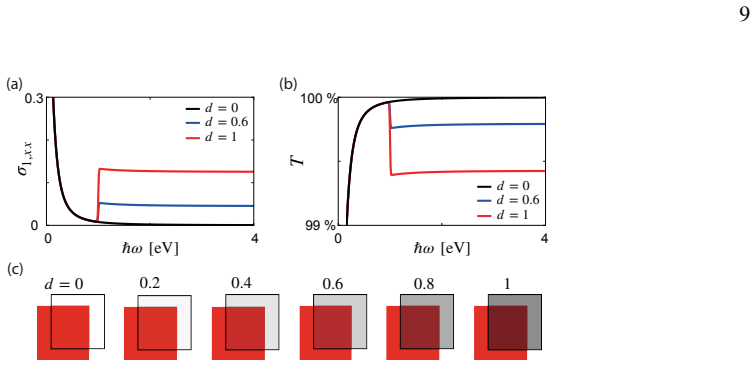
The central claim is that quantum geometry alone can dictate color and transparency. In the 3D quadratic band-touching model $H(k) = (\hbar k)^2/(2m)\, \mathbf{d}(\theta,\phi)\cdot\boldsymbol{\sigma}$ with $\mathbf{d}(\theta,\phi) = (\sin(J_\theta\theta)\cos(J_\phi\phi), \sin(J_\theta\theta)\sin(J_\phi\phi), \cos(J_\theta\theta))$, the energy eigenvalues remain $\pm(\hbar k)^2/(2m)$ for every integer pair $(J_\theta, J_\phi)$, yet the diagonal interband optical conductivity is proportional to $J_\theta^2 C_\theta^j + J_\phi^2 C_\phi^j$. Changing the winding integers therefore changes the reflectance spectrum $R(\omega)$ and, as rendered in the paper, the perceived color, with no change in the band dispersion. In the 2D isotropic quadratic band-touching model with parameter $d$, the interband conductivity is $(e^2/8\hbar)\, d^2\, \Theta(\hbar\omega-2\mu)$, a mass-invariant term that sets the absorbance and hence the transmittance of a stack of sheets. The paper takes this decoupling of wavefunction texture from energy dispersion as the mechanism for a new 'quantum geometry engineering' approach to optical materials.
Load-bearing premise
The argument assumes the clean single-particle Kubo formula with a small broadening $\eta$ fully determines the optical response, so vertex corrections, excitonic effects, phonon coupling, and many-body renormalization are not part of the story.
Editorial extensions
If this is right
- Color can be engineered without shifting or opening band gaps: materials with identical dispersion but different orbital character will display different reflectance spectra.
- The absorption edge stays at $\hbar\omega = 2\mu$, so geometry controls the height of interband absorption while doping controls its threshold; the two knobs are complementary.
- In 2D, transparency becomes a geometric property: stacking non-interacting sheets with larger $d$ dims transmitted light without changing the band dispersion.
- Quantum geometric engineering becomes a design rule for metamaterials: target a reflectance or transmittance profile by choosing a wavefunction texture, then check stability.
Reading between the lines
- The same mechanism could be probed in real materials by finding two compounds or a single material under strain that preserves the quadratic band dispersion but changes the orbital composition of Bloch states; a color change would confirm the effect.
- Because the geometric factor enters only the strength, not the shape, of the interband step, the framework suggests a sum rule: integrated interband weight tracks $J_\theta^2 C_\theta + J_\phi^2 C_\phi$ in any model with the same dispersion.
- Dynamic control of color may be possible if the texture integers $(J_\theta,J_\phi)$ can be switched by an external field, since the dispersion need not change.
- The mass-invariance in 2D raises a sharper test: the 2D interband conductivity should be the same for any material with the same $d$ and Fermi level, regardless of effective mass.
Editorial analysis
A structured set of objections, weighed in public.
Referee Report
Summary. The paper argues that the perceived color and transparency of a material can be controlled by the quantum geometry of its Bloch wavefunctions while keeping the energy dispersion fixed. The authors introduce two toy models: a 3D quadratic band-touching Hamiltonian whose pseudospin texture is parameterized by winding numbers (J_theta, J_phi), and a 2D quadratic band-touching model with a geometric parameter d. Using the Kubo formula, they derive optical conductivity formulas, compute reflectance and transmittance, and render photorealistic images showing color changes with (J_theta, J_phi) and transparency changes with d. The central claim is that the interband conductivity is proportional to geometric factors, so geometry alone can alter visual appearance.
Significance. If the results are correct, the paper provides a clean conceptual demonstration that wavefunction geometry, independent of band dispersion, can determine macroscopic optical appearance. The explicit separation of geometry from dispersion in the toy models is a useful pedagogical and conceptual step, and the 2D mass-invariant interband conductivity connects to a growing literature on quantum geometry. However, the work is limited to idealized toy models with no proposed material realization, and the quantitative color and transparency predictions are affected by a clear inconsistency in the printed Drude formula. The paper does not provide code or data, so the figures cannot be independently reproduced. Overall, the idea is fresh and worth considering, but the central quantitative demonstration needs correction.
major comments (2)
- [Eq. (16)-(17) and Appendix Eq. (26)] The intraband Drude term in Eq. (16) is written as (e^2/hbar)(k_F^3/6pi^2) eta/((hbar omega)^2+eta^2), while the Appendix's Eq. (26) gives (e^2/hbar)(n/m) i/(hbar omega+i eta) with n=k_F^3/6pi^2 in 3D, i.e., a prefactor (e^2/hbar)(k_F^3/6pi^2 m). The printed Eq. (16) is therefore missing the factor 1/m. With the stated m=0.1 m_e, this changes the Drude weight by an order of magnitude, and because the perceived color in Figs. 1-2 is set by the relative strength of the Drude and interband terms, the printed formula cannot be the one used to generate the rendered spectra. The authors must correct this prefactor, check the overall dimensional consistency of the Drude expression against the Kubo formula, and recompute or confirm the figures.
- [Appendix, Eqs. (36)-(38)] The principal-value integral on the right-hand side of Eq. (36) is linearly divergent in the upper limit because the integrand tends to -1 for large k, so Eq. (38) is not its direct evaluation. The text says 'we drop the omega-independent background constant,' but the dropped term is a cutoff-dependent linear divergence, and this subtraction must be specified before the Kramers-Kronig consistency claimed after Eq. (39) can be verified. Since sigma_2 enters the reflectance through Eqs. (10)-(12), the derivation of Eq. (17) needs to be made explicit.
minor comments (6)
- [Abstract and Conclusion] The abstract and conclusion refer to 'materials' generally, but the calculations are for toy models with no material realization; please qualify the claims as proof-of-principle demonstrations.
- [Eq. (16)] The symbol J^j_{J_theta,J_phi} is used before its definition in Eq. (18); define it at first use.
- [Fig. 1 caption] In the figure caption, 'm_e = 0.511 MeV' should read 'm_e c^2 = 0.511 MeV' (or state the mass in atomic units).
- [Appendix] The main text states that Eq. (17) is obtained via the Kramers-Kronig relation, but the Appendix derives Im sigma directly; please clarify which route is intended and show the Kramers-Kronig check explicitly.
- [Transparency results, Fig. 3] The transparency demonstration uses a stack of 50 non-interacting sheets, which is an artificial construct that amplifies the small single-sheet effect; the text should state this limitation more prominently.
- [References] Reference [29] is an arXiv preprint; if it has been published, please update the citation.
Circularity Check
No significant circularity: the 3D color claim is fully derived from the Kubo formula with no fitted inputs; the only flagged item is the 2D transparency formula whose derivation is deferred to the same authors' Ref. [29].
-
self citation load bearing
[Sec. 'Transparency modulated by quantum geometry', Eq. (23); Appendix heading 'Interband contribution of the 3D model' (p. 14)]
"The real part of the diagonal optical conductivity for this model is given by (See Appendix and Ref. [29] for derivation): sigma1,jj(omega) = (e2/hbar)(mu/2pi) eta/((hbar omega)^2+eta^2) + (e2/8hbar) d^2 Theta(hbar omega - 2mu)."
The transparency demonstration (Fig. 3) rests entirely on the interband formula sigma1 = e^2/(8hbar) d^2, and the paper defers its derivation to Ref. [29], whose first two authors (C.-g. Oh, S.-W. Kim) are the present authors. The Appendix of this paper, headed 'Interband contribution of the 3D model,' derives only the Drude term (Eq. 26) and the 3D interband term (Eqs. 34-39), not this 2D result. Thus the central 2D premise — 'the transmittance—and thus the perceived transparency—of a material can be engineered via its quantum geometry' — is justified by a same-author citation rather than by an in-paper derivation.
full rationale
Verdict: no significant circularity (score 2). The central 3D color claim is a genuine model calculation: the Hamiltonian Eq. (13)-(14) fixes the dispersion epsilon_+- = ±(hbar k)^2/(2m) (Eq. 15) while (J_theta, J_phi) alter only the pseudospin texture; the interband conductivity is derived in the Appendix from the Kubo formula (Eqs. 1/24), giving sigma proportional to J_theta^2 C_theta + J_phi^2 C_phi (Eqs. 16-19, 34-39); reflectance R(omega) follows from the standard Maxwell/dielectric relations (Eqs. 3-12) with no further assumptions, and the color renderings are outputs, never inputs. No parameter is fitted to a predicted quantity; the free parameters (m, mu, eta) are stated model and broadening choices. The single flagged step is the 2D transparency section: Eq. (23) defers its interband formula to Ref. [29] (overlapping authors), and this paper's Appendix derives only the Drude and 3D interband contributions. This is a same-author citation dependency on a routine Kubo derivation — not a definitional circle — so it raises the score only to 2. The reviewer-flagged discrepancy between Eq. (16) and the Appendix Drude result Eq. (26) (the missing 1/m factor) is an internal-consistency/correctness risk, not a circularity: it does not equate any output with any input. Likewise, the clean-limit Kubo assumptions affect validity, not circularity.
Assumptions & free parameters
free parameters (6)
- Effective mass m =
0.1 m_e
- Chemical potential mu =
1.0, 1.2, 1.4 eV
- Broadening eta =
0.1 eV
- Cutoff momentum k_c =
not specified
- Winding numbers (J_theta, J_phi) =
(0,0), (1,1), (2,2), (3,3)
- Geometric parameter d =
0, 0.2, 0.4, 0.6, 0.8, 1.0
assumptions (5)
- domain assumption The Kubo formula for the optical conductivity in the single-particle approximation
- domain assumption The non-magnetic, homogeneous medium with an Ohmic response J = sigma(omega) E
- domain assumption The low-absorbance approximation for 2D materials in Eq. (20)
- standard math The step-function form of the Fermi occupation at zero temperature
- standard math Kramers-Kronig relation between sigma_1 and sigma_2
invented entities (2)
-
3D quadratic band-touching model with winding numbers (J_theta, J_phi)
-
2D quadratic band-touching model with parameter d
independent evidence
Cite this review
Pith. "Pith review of Color and Transparency from Quantum Geometry." pith.science (2026). https://pith.science/paper/IDYZQV5W
@misc{pith2026250720904,
  author       = {Pith},
  title        = {Pith review of: Color and Transparency from Quantum Geometry},
  year         = {2026},
  howpublished = {\url{https://pith.science/paper/IDYZQV5W}},
  note         = {Machine review of arXiv:2507.20904}
}
read the original abstract
The optical properties of solids are governed not only by their energy band dispersions but also by the quantum geometry of Bloch states. While the role of energy bands in determining the perceived optical appearance of materials, such as color and transparency, is well established, the influence of quantum geometry remains elusive. Here, we demonstrate that the color and transparency of materials can be direct manifestations of their underlying quantum geometry. To illustrate this principle, we employ quadratic band-touching models that allow us to tune only the geometric properties of Bloch states, while keeping the energy dispersion fixed. This decoupling reveals that modifying the wavefunction texture alone can lead to dramatic changes in the optical conductivity and, consequently, in the reflectance spectrum of the material. This results in distinct and controllable changes in perceived color. Similarly, we show that quantum geometry can govern the transparency of two-dimensional materials. Our findings demonstrate how quantum geometry shapes the visual appearance of materials, opening new avenues for tailoring color and transparency beyond traditional band structure design. This establishes quantum geometric engineering as a novel approach for manipulating materials with customized optical functionalities.
Figures


Forward citations
Cited by 2 Pith papers
-
Orbital Embedding and the Physical Definition of Quantum Geometry
The quantum geometric tensor is only physical when computed with the full position operator, which is equivalent to embedding orbital positions in the Bloch phase; standard k·p models miss this for bond-ordered gaps.
-
Quantum geometry and RKKY in flat bands
In flat bands, the RKKY magnetic interaction is mediated by the quantum metric of Bloch wavefunctions, which controls spin stiffness and finite-size ordering temperature.
Reference graph
Works this paper leans on
-
[29]
M. Ezawa, Quantum geometry and elliptic optical dichroism in p-wave magnets, Physical Review B112, 045302 (2025)
work page 2025
-
[1]
(b) Transmittance T (ℏω) of a single 2D sheet for the same values of d shown in (a). (c) Visualization of the engineered transparency. This panel simulates the appearance of a stack of 50 non-interacting sheets placed over a red background for d = 0, 0.2, 0.4, 0.6, 0.8, and 1. In the calculations, we set µ = 0.5 eV and η = 0.1 eV. to Joule heating. The po...
-
[2]
S. Peotta and P. T ¨orm¨a, Superfluidity in topologically nontrivial flat bands, Nat. Commun. 6, 8944 (2015)
work page 2015
-
[3]
P. T ¨orm¨a, S. Peotta, and B. A. Bernevig, Superconductivity, superfluidity and quantum geometry in twisted multilayer systems, Nat. Rev. Phys. 4, 528 (2022)
work page 2022
-
[4]
T. Ozawa and B. Mera, Relations between topology and the quantum metric for Chern insulators, Phys. Rev. B 104, 045103 (2021). 12
work page 2021
-
[5]
J. Yu, B. A. Bernevig, R. Queiroz, E. Rossi, P. T¨orm¨a, and B.-J. Yang, Quantum geometry in quantum materials, arXiv preprint arXiv:2501.00098 (2024)
arXiv 2024
-
[6]
T ¨orm¨a, Essay: Where can quantum geometry lead us?, Phys
P. T ¨orm¨a, Essay: Where can quantum geometry lead us?, Phys. Rev. Lett. 131, 240001 (2023)
work page 2023
-
[7]
J. Provost and G. Vallee, Riemannian structure on manifolds of quantum states, Commun. Math. Phys. 76, 289 (1980)
work page 1980
Show all 35 references
-
[8]
Y .-Q. Ma, S. Chen, H. Fan, and W.-M. Liu, Abelian and non-Abelian quantum geometric tensor, Phys. Rev. B 81, 245129 (2010)
2010
-
[9]
M. V . Berry, The quantum phase, five years after, in Geometric Phases in Physics , edited by F. Wilczek and E. Shapere (1989) pp. 3–28
1989
-
[10]
Nagaosa, J
N. Nagaosa, J. Sinova, S. Onoda, A. H. MacDonald, and N. P. Ong, Anomalous Hall effect, Rev. Mod. Phys.82, 1539 (2010)
2010
-
[11]
Xiao, M.-C
D. Xiao, M.-C. Chang, and Q. Niu, Berry phase effects on electronic properties, Rev. Mod. Phys. 82, 1959 (2010)
2010
-
[12]
C.-g. Oh, K. W. Kim, and J.-W. Rhim, Thermoelectric transport driven by the Hilbert–Schmidt distance, Adv. Sci. 11, 2411313 (2024)
2024
-
[13]
Liang, T
L. Liang, T. I. Vanhala, S. Peotta, T. Siro, A. Harju, and P. T ¨orm¨a, Band geometry, Berry curvature, and super- fluid weight, Phys. Rev. B 95, 024515 (2017)
2017
-
[14]
J.-W. Rhim, K. Kim, and B.-J. Yang, Quantum distance and anomalous Landau levels of flat bands, Nature 584, 59 (2020)
2020
-
[15]
Hwang, J.-W
Y . Hwang, J.-W. Rhim, and B.-J. Yang, Geometric characterization of anomalous Landau levels of isolated flat bands, Nat. Commun. 12, 6433 (2021)
2021
-
[16]
Verma, D
N. Verma, D. Guerci, and R. Queiroz, Geometric stiffness in interlayer exciton condensates, Phys. Rev. Lett. 132, 236001 (2024)
2024
-
[17]
X. Hu, T. Hyart, D. I. Pikulin, and E. Rossi, Quantum-metric-enabled exciton condensate in double twisted bilayer graphene, Phys. Rev. B 105, L140506 (2022)
2022
-
[18]
Oh, J.-W
C.-g. Oh, J.-W. Rhim, and B.-J. Yang, Revisiting the magnetic responses of bilayer graphene from the perspec- tive of quantum distance, Phys. Rev. B 110, 155412 (2024)
2024
-
[19]
Panahiyan, W
S. Panahiyan, W. Chen, and S. Fritzsche, Fidelity susceptibility near topological phase transitions in quantum walks, Physical Review B 102, 134111 (2020)
2020
-
[20]
C.-g. Oh, D. Cho, S. Y . Park, and J.-W. Rhim, Bulk-interface correspondence from quantum distance in flat band systems, Commun. Phys. 5, 320 (2022)
2022
-
[21]
Kim, C.-g
H. Kim, C.-g. Oh, and J.-W. Rhim, General construction scheme for geometrically nontrivial flat band models, Commun. Phys. 6, 305 (2023)
2023
-
[22]
A. M. Cook, B. M. Fregoso, F. De Juan, S. Coh, and J. E. Moore, Design principles for shift current photo- voltaics, Nat. Commun. 8, 14176 (2017)
2017
-
[23]
De Juan, A
F. De Juan, A. G. Grushin, T. Morimoto, and J. E. Moore, Quantized circular photogalvanic effect in Weyl semimetals, Nat. Commun. 8, 15995 (2017). 13
2017
-
[24]
Bhalla, K
P. Bhalla, K. Das, D. Culcer, and A. Agarwal, Resonant second-harmonic generation as a probe of quantum geometry, Phys. Rev. Lett.129, 227401 (2022)
2022
-
[25]
Ghosh, Y
B. Ghosh, Y . Onishi, S.-Y . Xu, H. Lin, L. Fu, and A. Bansil, Probing quantum geometry through optical con- ductivity and magnetic circular dichroism, Sci. Adv. 10, eado1761 (2024)
2024
-
[26]
Ezawa, Analytic approach to quantum metric and optical conductivity in Dirac models with parabolic mass in arbitrary dimensions, Phys
M. Ezawa, Analytic approach to quantum metric and optical conductivity in Dirac models with parabolic mass in arbitrary dimensions, Phys. Rev. B 110, 195437 (2024)
2024
-
[27]
Ahn, G.-Y
J. Ahn, G.-Y . Guo, N. Nagaosa, and A. Vishwanath, Riemannian geometry of resonant optical responses, Nat. Phys. 18, 290 (2022)
2022
-
[28]
Chen, Dielectric and optical markers originating from quantum geometry, Physical Review B 111, 085202 (2025)
W. Chen, Dielectric and optical markers originating from quantum geometry, Physical Review B 111, 085202 (2025)
2025
-
[30]
Oh, S.-W
C.-g. Oh, S.-W. Kim, K. W. Kim, B. Monserrat, and J.-W. Rhim, Universal optical conductivity from quantum geometry in quadratic band-touching semimetals, arXiv preprint arXiv:2503.18372 (2025)
2025 arXiv
-
[31]
Nassau, The physics and chemistry of color: the fifteen causes of color (John Wiley and Sons, 2001)
K. Nassau, The physics and chemistry of color: the fifteen causes of color (John Wiley and Sons, 2001)
2001
-
[32]
Fox, Optical properties of solids (Oxford university press, 2010)
M. Fox, Optical properties of solids (Oxford university press, 2010)
2010
-
[33]
S.-W. Kim, L. J. Conway, C. J. Pickard, G. L. Pascut, and B. Monserrat, Microscopic theory of colour in lutetium hydride, Nature Communications 14, 7360 (2023)
2023
-
[34]
Jakob, S
W. Jakob, S. Speierer, N. Roussel, M. Nimier-David, D. Vicini, T. Zeltner, B. Nicolet, M. Crespo, V . Leroy, and Z. Zhang, Mitsuba 3 renderer (2022), https://mitsuba-renderer.org
2022
-
[35]
R. R. Nair, P. Blake, A. N. Grigorenko, K. S. Novoselov, T. J. Booth, T. Stauber, N. M. Peres, and A. K. Geim, Fine structure constant defines visual transparency of graphene, science 320, 1308 (2008). ACKNOWLEDGMENTS The authors thank B. Monserrat for useful discussions. C.O....
2008
Reviewed August 6, 2026 · model on record in the stance chip above.
Discussion (0). Continue with ORCID to comment.