REVIEW 4 major objections 6 minor 1 cited by
Improving SpGEMM Performance Through Matrix Reordering and Cluster-wise Computation
T0 review · 4 major / 6 minor · reviewed 2026-08-06 · deepseek-v4-flash
Pith's one-line read Grouping similar rows, found cheaply via one sparse matrix-times-transpose product, and computing cluster-wise speeds up SpGEMM by 1.39x on average with amortizable preprocessing.
desk verdict Practical and reproducible SpGEMM reordering study; the core speedup is real, but the hand-set hyperparameters need a sensitivity check to be fully convincing. read the letter →
The pith
A machine-rendered reading of the paper's core claim, the machinery that carries it, and where it could break.
The reading
What carries the argument
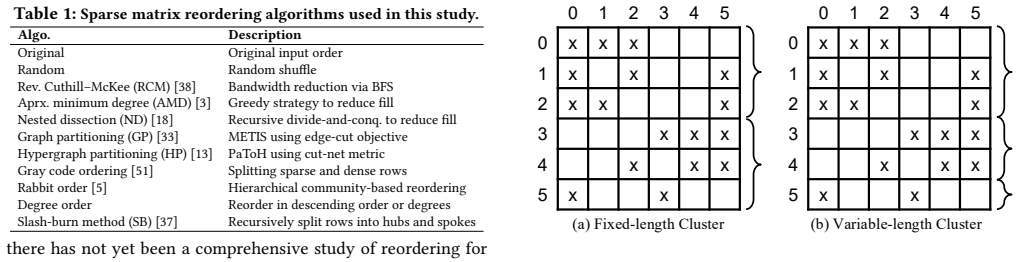
Three pieces carry the argument. The first is candidate generation: A is copied with all values set to 1, the product A times A-transpose is computed, and only the top K entries by set-overlap similarity are retained, converting expensive hashing-based row similarity into one SpGEMM. The second is an agglomerative clustering step that greedily unions those candidate pairs under a similarity threshold (jacc_th = 0.3) and a maximum cluster size (max_cluster_th = 8), producing variable-length groups of similar rows. The third is the CSR_Cluster sparse format, which stores each cluster's nonzeros grouped by column with cluster pointer and cluster-size arrays, together with a cluster-wise SpGEMM dataflow that keeps the accessed rows of B resident in cache while all rows of a cluster are processed. The hand-set similarity threshold and cluster-size cap are what convert structural overlap into usable clusters, and the format is what converts clusters into a memory-access pattern.
What would settle it
On the same set of 110 matrices, sweep the similarity threshold between 0.1 and 0.6 and the maximum cluster size between 4 and 32 and measure the geometric-mean speedup and preprocessing fraction. If no setting reproduces the reported 1.39x average with preprocessing under 20x a single SpGEMM, or if replacing the top-K candidates with randomly chosen row pairs yields the same speedups, then similarity-driven clustering is not the cause of the improvement.
Extended reading notes
Core claim
The central claim, stated as the authors would state it, is that the expensive locality-sensitive hashing used in earlier hierarchical clustering can be replaced by a single sparse multiplication A times A-transpose whose nonzeros count row-pair overlaps, and that these overlaps are enough to form clusters whose joint processing improves reuse of B rows. In this scheme the matrix A's values are reset to 1, the top-K row pairs by a set-overlap similarity are fed to a greedy union step, and the resulting clusters are stored in a CSR_Cluster format that groups nonzeros by column within each cluster. Cluster-wise computation then iterates over clusters of A instead of single rows, so each B row that is pulled into cache serves every row in the cluster simultaneously. The paper reports that this hierarchical clustering speeds up SpGEMM by 1.39x in geometric mean across 110 matrices from a standard sparse-matrix collection, with a best case of 4.68x, and that the same mechanisms transfer to square-times-tall-skinny multiplication where the reordered A is reused across many B matrices.
Load-bearing premise
The method assumes the top-K row pairs found by one sparse A times A-transpose product really identify rows whose joint processing improves cache reuse, and that the fixed similarity threshold of 0.3 and maximum cluster size of 8 work across most matrices; neither assumption is ablated in the paper.
Editorial extensions
If this is right
- Applications that run many SpGEMMs on the same matrix, such as iterative graph algorithms, can amortize the preprocessing: on about 90% of inputs the clustering cost is repaid within 20 SpGEMM invocations.
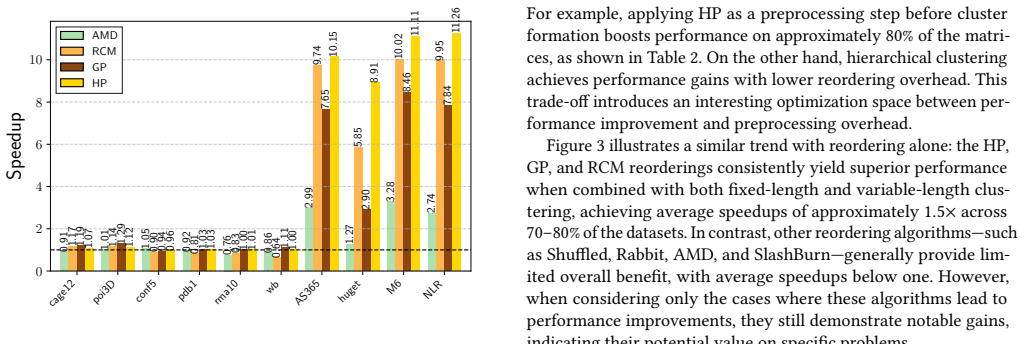
- Graph and hypergraph partitioning reorderings deliver the largest speedups (geomean 1.77x for hypergraph partitioning) but cost far more preprocessing, so hierarchical clustering sits at a different point on the cost-performance curve.
- Because the clustered format is decoupled from reordering, users can apply a strong reordering first and then cluster; this combination improves performance on roughly 80% of the test matrices in the study.
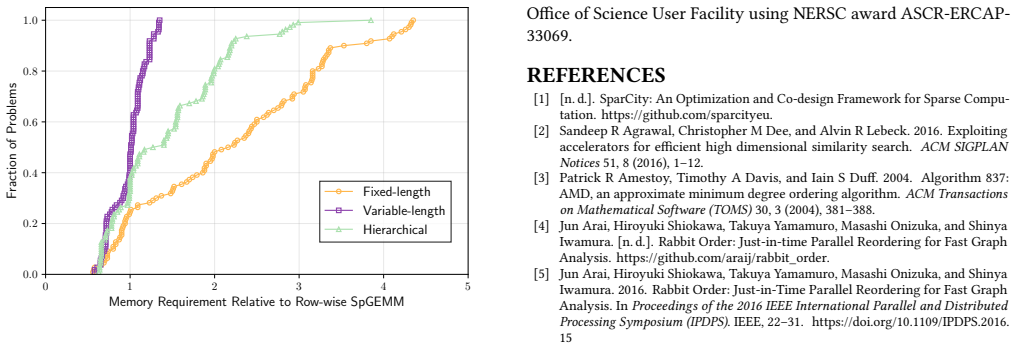
- CSR_Cluster frequently stores fewer column indices than plain CSR, so cluster-wise computation can use less memory than the baseline while also running faster; its memory overhead stays below 2x in over 80% of cases.
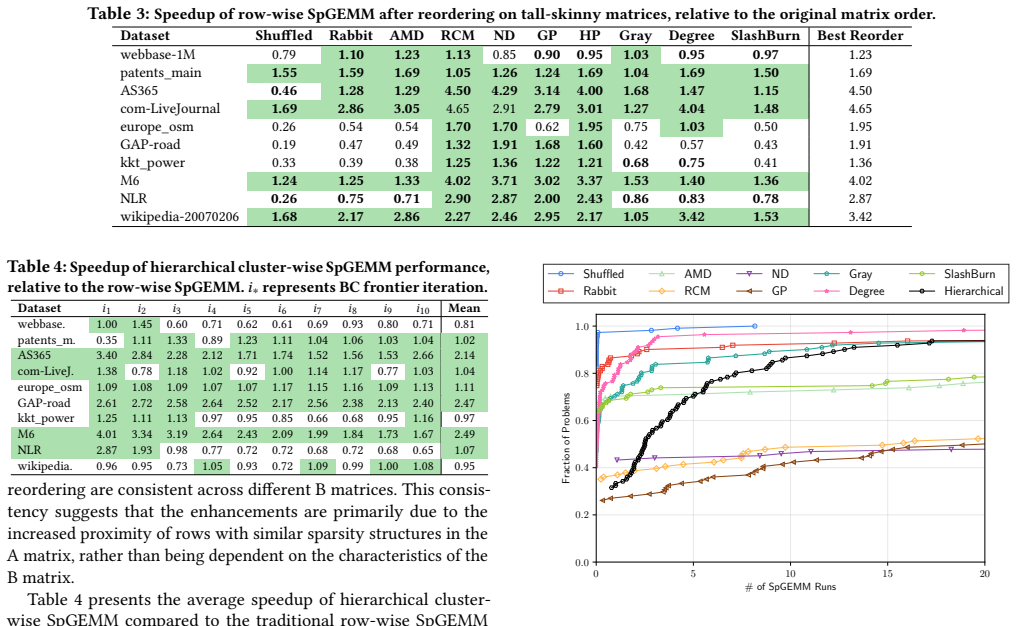
- Reordering benefits transfer across different second matrices: the same reordered A speeds up square-times-tall-skinny SpGEMM, indicating the gain comes from row similarity in A rather than from B's shape.
Reading between the lines
- The similarity threshold of 0.3 and cluster-size cap of 8 are not swept in the paper, so a natural extension is to test whether tuning them per matrix family pushes the 70% improvement rate higher or whether the method is insensitive to them.
- Because the candidate-generation step is itself a SpGEMM on structural data, the same A times A-transpose product could be reused by other kernels that share the same matrix, such as sparse-matrix times dense-matrix or sampling kernels, making the preprocessing cheaper when several kernels run together.
- The study covers row-wise SpGEMM on multicore CPUs; testing the same cluster-wise dataflow on GPU tiled variants or distributed-memory SpGEMM would show whether the cache-reuse argument survives different memory hierarchies.
- The measured tradeoff curves could feed a learned per-input selector, which the paper itself flags as future work, choosing among reordering, clustering, and their combination automatically.
Editorial analysis
A structured set of objections, weighed in public.
Referee Report
Summary. The paper proposes hierarchical clustering for SpGEMM, combining a new row reordering scheme (based on candidate row pairs from SpGEMM(A,A^T)) with a new sparse storage format (CSR_Cluster) and a cluster-wise computation pattern that improves reuse of rows of the second input matrix B. It also decouples reordering from clustering, enabling either optimization to be applied independently. The empirical evaluation covers 110 SuiteSparse matrices, 10 reordering algorithms, and 3 clustering schemes on two workloads: squaring a sparse matrix and multiplying a square sparse matrix by tall-skinny BFS frontier matrices. The central claim is a 1.39x geometric mean speedup for hierarchical clustering over a row-wise SpGEMM baseline, with speedups up to 4.68x, improvements on about 70% of inputs, and preprocessing cost below 20x a single SpGEMM on about 90% of inputs.
Significance. If the empirical claims hold, the paper makes a useful contribution to shared-memory SpGEMM optimization, particularly for workloads where the same matrix A is multiplied many times (e.g., betweenness centrality and Markov clustering). The strengths of the paper are its unusually broad benchmark suite, the decoupling of reordering and clustering into independent optimizations, the public code release, and the explicit analysis of preprocessing amortization and memory overhead. The comparison of 10 reordering algorithms in the SpGEMM context is a worthwhile addition to the literature, which has mostly focused on SpMV. However, the central speedup and overhead claims are conditional on several hand-set parameters and on the authors' own baseline implementation, so the significance is real but not yet fully established.
major comments (4)
- [Section 3.2, Section 3.3, Algorithm 3] The method depends on several unablated hand-set parameters: the Jaccard threshold jacc_th=0.3, the maximum cluster size max_cluster_th=8, and the derived candidate count topk = max_cluster_th - 1 used in SpGEMM_TopK. These parameters directly determine which row pairs are considered similar and how large clusters can grow, and therefore directly shape the reported 1.39x geomean speedup and the overhead claim in Section 4.5. The paper provides no parameter sweep, no robustness analysis, and no sensitivity discussion. The authors should at least report performance for a range of jacc_th and max_cluster_th values on a representative subset of matrices, or provide evidence that the results are stable across reasonable parameter choices.
- [Section 4.1, Section 4.2] The baseline is the authors' own row-wise SpGEMM implementation using a hash-table accumulator, and no comparison is made against a production or highly optimized SpGEMM library such as Intel MKL, Kokkos, CombBLAS, or the implementation of Nagasaka et al. [40]. Since the paper claims to 'speed up SpGEMM,' the practical significance of the speedup depends on how competitive the baseline is. The authors should validate their row-wise baseline against a state-of-the-art implementation on at least a representative subset of the 110 matrices, or clearly scope the claim as being relative to their own row-wise kernel.
- [Section 4.2, Table 2, Figure 8] All performance numbers are reported as the mean of 10 runs, but no variance, confidence intervals, or statistical tests are provided. This is important because the claim that hierarchical clustering 'improves performance on 70% of inputs' is a per-matrix binary outcome, and benchmark noise near the 1.0 speedup threshold could materially change that fraction. The authors should report standard deviations or min/max values, and ideally provide a per-matrix speedup distribution or a statistical comparison between methods.
- [Section 3.1, Section 4.5] The CSR_Cluster format introduces placeholder entries when rows in a cluster do not share a column, and Algorithm 1 iterates over these placeholders. Section 4.5 quantifies the memory overhead of this padding, but not its computational cost. The slowdowns observed for some matrices (e.g., Figure 8) may be partly explained by placeholder iteration overhead, and the paper claims cluster-wise computation is beneficial overall without characterizing this cost. The authors should report the fraction of placeholder entries and its correlation with observed speedups or slowdowns.
minor comments (6)
- [Abstract] The abstract contains a typo: 'withhierarchical' should be 'with hierarchical'.
- [Algorithm 1] The indexing in lines 5-6 is confusing: the variable 'l' appears in 'a_ikl' and 'c_ijl' without being defined in the loop structure, and the update looks like it should be a sparse accumulator update rather than an element-wise indexed assignment. Please clarify the notation.
- [Algorithm 2] In line 6, the equality check uses a single equals sign. Since this is pseudocode it is understandable, but using '==' or making the condition explicit would avoid confusion with assignment.
- [Table 2] The 'Best Reord.' row appears to be an oracle result (the best reordering per matrix). This should be stated explicitly in the caption or text so that readers do not interpret it as a single algorithm's performance.
- [Section 4.5, Figure 10] The sentence 'about 50% of cases requiring at least 20 SpGEMM iterations to amortize the overhead' is ambiguous about the denominator. Please clarify whether 'cases' means all matrices, only matrices where reordering improves performance, or only matrices where reordering is applied.
- [Section 4.4, Table 3] The tall-skinny evaluation is limited to 10 hand-picked datasets that were selected based on their A^2 performance. This selection bias should be acknowledged in the main text, and ideally the authors should add a short discussion of how the results might generalize.
Circularity Check
No significant circularity: speedup claims are measured against an independent row-wise baseline; the only self-referential element is using SpGEMM(A,A^T) in preprocessing, which is a cost-accounting concern, not a derivation collapse.
full rationale
This is an empirical systems paper rather than a formal derivation. The central claim of 1.39x average speedup for hierarchical cluster-wise SpGEMM is a measured ratio between the proposed CSR_Cluster kernel and a row-wise Gustavson baseline in original matrix order, using an independently published hashtable accumulator [40]. The clustering and reordering algorithms are heuristics with fixed hand-set thresholds (jacc_th=0.3, max_cluster_th=8); no parameter is fitted to the benchmark set, and the reported speedups are not predictions generated from a model that bakes in the answer. The clustering preprocessing does invoke an SpGEMM (A times A^T) to discover similar rows; for the A^2 workload on symmetric matrices this can compute the same product as the target, and that cost is included in the 'low preprocessing cost' figure, but this affects cost accounting rather than making the measured kernel speedup equivalent to the input by construction. Comparisons against HP, GP, RCM, and other reorderers are external benchmarks. No load-bearing self-citation chain or uniqueness theorem is used; prior work [32] is cited for background and is explicitly modified. The unablated thresholds are an external-validity risk, not circularity.
Assumptions & free parameters
free parameters (5)
- jacc_th (Jaccard similarity threshold) =
0.3
- max_cluster_th (maximum cluster size) =
8
- topK (number of candidate row pairs) =
7
- fixed-length cluster size =
Not reported, varies per matrix
- Dataset inclusion thresholds =
8 million to 10 billion nonzeros
assumptions (4)
- domain assumption Reset values of A to 1 so SpGEMM(A, A^T) output counts overlapping nonzeros between rows.
- ad hoc to paper The top-K candidate pairs and representative-row Jaccard comparisons produce clusters that improve B-row reuse.
- domain assumption Row-wise SpGEMM with hashtable sparse accumulator in original order is a fair baseline for practical speedup.
- domain assumption The SuiteSparse selection criteria yield a representative sample of SpGEMM workloads.
Cite this review
Pith. "Pith review of Improving SpGEMM Performance Through Matrix Reordering and Cluster-wise Computation." pith.science (2026). https://pith.science/paper/MFXO2FDY
@misc{pith2026250721253,
  author       = {Pith},
  title        = {Pith review of: Improving SpGEMM Performance Through Matrix Reordering and Cluster-wise Computation},
  year         = {2026},
  howpublished = {\url{https://pith.science/paper/MFXO2FDY}},
  note         = {Machine review of arXiv:2507.21253}
}
read the original abstract
Sparse matrix-sparse matrix multiplication (SpGEMM) is a key kernel in many scientific applications and graph workloads. Unfortunately, SpGEMM is bottlenecked by data movement due to its irregular memory access patterns. Significant work has been devoted to developing row reordering schemes towards improving locality in sparse operations, but prior studies mostly focus on the case of sparse-matrix vector multiplication (SpMV). In this paper, we address these issues with hierarchical clustering for SpGEMM that leverages both row reordering and cluster-wise computation to improve reuse in the second input (B) matrix with a novel row-clustered matrix format and access pattern in the first input (A) matrix. We find that hierarchical clustering can speed up SpGEMM by 1.39x on average with low preprocessing cost (less than 20x the cost of a single SpGEMM on about 90% of inputs). Furthermore, we decouple the reordering algorithm from the clustered matrix format so they can be applied as independent optimizations. Additionally, this paper sheds light on the role of both row reordering and clustering independently and together for SpGEMM with a comprehensive empirical study of the effect of 10 different reordering algorithms and 3 clustering schemes on SpGEMM performance on a suite of 110 matrices. We find that reordering based on graph partitioning provides better SpGEMM performance than existing alternatives at the cost of high preprocessing time. The evaluation demonstrates that the proposed hierarchical clustering method achieves greater average speedup compared to other reordering schemes with similar preprocessing times.
Figures


Figures from the paper (8 more)



Forward citations
Cited by 1 Pith paper
-
SparseDitto: Customizing GPU Kernels for Different Sparsity Patterns with LLM-Based Agentic System
SparseDitto uses LLM agents guided by structural matrix features and target-GPU measurements to generate custom CUDA kernels for SpMV, SpMM, and SpGEMM, beating cuSPARSE by 2.68x to 2.79x on average.
Reference graph
Works this paper leans on
-
[32]
Peng Jiang, Changwan Hong, and Gagan Agrawal. 2020. A novel data trans- formation and execution strategy for accelerating sparse matrix multiplica- tion on GPUs. In Proceedings of the 25th ACM SIGPLAN Symposium on Prin- ciples and Practice of Parallel Programming (San Diego, California) (PPoPP ’20). Association for Computing Machinery, New York, NY, USA, ...
arXiv 2020
-
[40]
Yusuke Nagasaka, Satoshi Matsuoka, Ariful Azad, and Aydın Buluç. 2018. High- Performance Sparse Matrix-Matrix Products on Intel KNL and Multicore Archi- tectures. In Proceedings of the 47th International Conference on Parallel Process- ing Companion. ACM, Eugene OR USA, 1–10. https://doi.org/10.1145/3229710. 3229720
-
[1]
[n. d.]. SparCity: An Optimization and Co-design Framework for Sparse Compu- tation. https://github.com/sparcityeu
-
[2]
Sandeep R Agrawal, Christopher M Dee, and Alvin R Lebeck. 2016. Exploiting accelerators for efficient high dimensional similarity search. ACM SIGPLAN Notices 51, 8 (2016), 1–12
work page 2016
-
[3]
Patrick R Amestoy, Timothy A Davis, and Iain S Duff. 2004. Algorithm 837: AMD, an approximate minimum degree ordering algorithm. ACM Transactions on Mathematical Software (TOMS) 30, 3 (2004), 381–388
work page 2004
-
[4]
Jun Arai, Hiroyuki Shiokawa, Takuya Yamamuro, Masashi Onizuka, and Shinya Iwamura. [n. d.]. Rabbit Order: Just-in-time Parallel Reordering for Fast Graph Analysis. https://github.com/araij/rabbit_order
-
[5]
Jun Arai, Hiroyuki Shiokawa, Takuya Yamamuro, Masashi Onizuka, and Shinya Iwamura. 2016. Rabbit Order: Just-in-Time Parallel Reordering for Fast Graph Analysis. In Proceedings of the 2016 IEEE International Parallel and Distributed Processing Symposium (IPDPS). IEEE, 22–31. https://doi.org/10.1109/IPDPS.2016. 15
-
[6]
Ariful Azad, Aydin Buluç, and John Gilbert. 2015. Parallel triangle counting and enumeration using matrix algebra. In 2015 IEEE International Parallel and Distributed Processing Symposium Workshop. IEEE, 804–811
work page 2015
Show all 54 references
-
[7]
Ariful Azad, Georgios A Pavlopoulos, Christos A Ouzounis, Nikos C Kyrpides, and Aydin Buluç. 2018. HipMCL: a high-performance parallel implementation of the Markov clustering algorithm for large-scale networks. Nucleic acids research 46, 6 (2018), e33–e33
2018
-
[8]
Vignesh Balaji, Neal C Crago, Aamer Jaleel, and Stephen W Keckler. 2023. Community-based matrix reordering for sparse linear algebra optimization. In 2023 IEEE International Symposium on Performance Analysis of Systems and Software (ISPASS). IEEE, 214–223
2023
-
[9]
Grey Ballard, Christopher Siefert, and Jonathan Hu. 2016. Reducing communi- cation costs for sparse matrix multiplication within algebraic multigrid. SIAM Journal on Scientific Computing 38, 3 (2016), C203–C231
2016
-
[10]
D. Bates. 2006. https://sparse.tamu.edu/Bates
2006
-
[11]
Aydın Buluç and John R Gilbert. 2011. The Combinatorial BLAS: Design, im- plementation, and applications. The International Journal of High Performance Computing Applications 25, 4 (2011), 496–509
2011
-
[12]
Andrew Canning, Giulia Galli, Francesco Mauri, Alessandro De Vita, and Roberto Car. 1996. O(N) tight-binding molecular dynamics on massively parallel comput- ers: an orbital decomposition approach. Computer Physics Communications 94, 2-3 (1996), 89–102
1996
-
[13]
Catalyurek and Cevdet Aykanat
Umit V. Catalyurek and Cevdet Aykanat. 1999. Hypergraph-Partitioning- Based Decomposition for Parallel Sparse-Matrix Vector Multiplication. IEEE Transactions on Parallel and Distributed Systems 10, 7 (1999), 673–693. https: //doi.org/10.1109/71.780863
1999 doi
-
[14]
Jou-An Chen, Hsin-Hsuan Sung, Ruifeng Zhang, Ang Li, and Xipeng Shen
-
[15]
Elizabeth Cuthill and James McKee. 1969. Reducing the bandwidth of sparse symmetric matrices. In Proceedings of the 1969 24th national conference . 157–172
1969
-
[16]
Davis and Yifan Hu
Timothy A. Davis and Yifan Hu. 2011. The university of Florida sparse matrix collection. ACM Trans. Math. Softw. 38, 1, Article 1 (Dec. 2011), 25 pages. https: //doi.org/10.1145/2049662.2049663
2011
-
[17]
Feldmann, R
P. Feldmann, R. Melville, and D. Long. 1996. https://sparse.tamu.edu/ATandT
1996
-
[18]
Alan George. 1973. Nested dissection of a regular finite element mesh. SIAM journal on numerical analysis 10, 2 (1973), 345–363
1973
-
[19]
Alan George and Joseph WH Liu. 1989. The evolution of the minimum degree ordering algorithm. Siam review 31, 1 (1989), 1–19
1989
-
[20]
Alan George and Joseph W. H. Liu. 1979. An Implementation of a Pseudope- ripheral Node Finder. ACM Trans. Math. Softw. 5, 3 (Sept. 1979), 284–295. https://doi.org/10.1145/355841.355845
1979
-
[21]
Gibbs, William G
Norman E. Gibbs, William G. Poole, Jr., and Paul K. Stockmeyer. 1976. An Algorithm for Reducing the Bandwidth and Profile of a Sparse Matrix. SIAM J. Numer. Anal. 13, 2 (April 1976), 236–250. https://doi.org/10.1137/0713023
1976 doi
-
[22]
John R Gilbert, Cleve Moler, and Robert Schreiber. 1992. Sparse matrices in MATLAB: Design and implementation. SIAM journal on matrix analysis and applications 13, 1 (1992), 333–356
1992
-
[23]
John R Gilbert, Steve Reinhardt, and Viral B Shah. 2006. High-performance graph algorithms from parallel sparse matrices. In International Workshop on Applied Parallel Computing. Springer, 260–269
2006
-
[24]
John R Gilbert and Robert Endre Tarjan. 1986. The analysis of a nested dissection algorithm. Numerische mathematik 50, 4 (1986), 377–404. 11
1986
-
[25]
Theodoros Gkountouvas, Vasileios Karakasis, Kornilios Kourtis, Georgios Goumas, and Nectarios Koziris. 2013. Improving the performance of the sym- metric sparse matrix-vector multiplication in multicore. In 2013 IEEE 27th Inter- national Symposium on Parallel and Distributed P...
2013
-
[26]
Anshul Gupta. 1996. https://sparse.tamu.edu/Gupta
1996
-
[27]
Fred G Gustavson. 1978. Two fast algorithms for sparse matrices: Multiplication and permuted transposition. ACM Transactions on Mathematical Software (TOMS) 4, 3 (1978), 250–269
1978
-
[28]
Song Han, Huizi Mao, and William J Dally. 2016. Deep compression: Compressing deep neural networks with pruning, trained quantization and huffman coding. In Proceedings of the 4th International Conference on Learning Representations (ICLR)
2016
-
[29]
Guoming He, Haijun Feng, Cuiping Li, and Hong Chen. 2010. Parallel SimRank computation on large graphs with iterative aggregation. In Proceedings of the 16th ACM SIGKDD international conference on Knowledge discovery and data mining. 543–552
2010
-
[30]
Yuxi Hong and Aydin Buluç. 2024. A Sparsity-Aware Distributed-Memory Algorithm for Sparse-Sparse Matrix Multiplication. In Proceedings of the In- ternational Conference for High Performance Computing, Networking, Storage, and Analysis (Atlanta, GA, USA) (SC ’24) . IEEE Press, ...
2024 arXiv
-
[31]
Paul Jaccard. 1901. Étude comparative de la distribution florale dans une portion des Alpes et des Jura. Bull Soc Vaudoise Sci Nat 37 (1901), 547–579
1901
-
[33]
George Karypis and Vipin Kumar. 1998. A Fast and High Quality Multilevel Scheme for Partitioning Irregular Graphs. SIAM Journal on Scientific Computing 20, 1 (1998), 359–392. https://doi.org/10.1137/S1064827595287997
1998 doi
-
[34]
Jeremy Kepner, David Bader, Aydın Buluç, John Gilbert, Timothy Mattson, and Henning Meyerhenke. 2015. Graphs, matrices, and the GraphBLAS: Seven good reasons. Procedia Computer Science 51 (2015), 2453–2462
2015
-
[35]
Mohsen Koohi Esfahani, Peter Kilpatrick, and Hans Vandierendonck. 2021. Ex- ploiting in-Hub Temporal Locality in SpMV-based Graph Processing. In Proceed- ings of the 50th International Conference on Parallel Processing (Lemont, IL, USA) (ICPP ’21). Association for Computing Ma...
2021
-
[36]
Jure Leskovec, Anand Rajaraman, and Jeffrey David Ullman. 2020. Mining of massive data sets. Cambridge university press
2020
-
[37]
Yongsub Lim, U Kang, and Christos Faloutsos. 2014. SlashBurn: Graph Compres- sion and Mining beyond Caveman Communities.IEEE Transactions on Knowledge and Data Engineering 26, 12 (2014), 3077–3089. https://doi.org/10.1109/TKDE. 2014.2320716
2014
-
[38]
Wai-Hung Liu and Andrew H Sherman. 1976. Comparative analysis of the Cuthill–McKee and the reverse Cuthill–McKee ordering algorithms for sparse matrices. SIAM J. Numer. Anal. 13, 2 (1976), 198–213
1976
-
[39]
Johannes Sebastian Mueller-Roemer, Christian Altenhofen, and André Stork
-
[41]
Angshuman Parashar, Minsoo Rhu, Anurag Mukkara, Antonio Puglielli, Rang- harajan Venkatesan, Brucek Khailany, Joel Emer, Stephen W Keckler, and William J Dally. 2017. SCNN: An accelerator for compressed-sparse convo- lutional neural networks. ACM SIGARCH computer architecture ...
2017
-
[42]
Juan C Pichel, David E Singh, and Jesús Carretero. 2008. Reordering algorithms for increasing locality on multicore processors. In 2008 10th IEEE International Conference on High Performance Computing and Communications. IEEE, 123–130
2008
-
[43]
Ali Pinar and Michael T Heath. 1999. Improving performance of sparse matrix- vector multiplication. In Proceedings of the 1999 ACM/IEEE conference on Super- computing. 30–es
1999
-
[44]
Usha Nandini Raghavan, Réka Albert, and Soundar Kumara. 2007. Near linear time algorithm to detect community structures in large-scale networks. Physical Review E—Statistical, Nonlinear, and Soft Matter Physics 76, 3 (2007), 036106
2007
-
[45]
Viral B Shah. 2007. An interactive system for combinatorial scientific computing with an emphasis on programmer productivity . University of California, Santa Barbara
2007
-
[46]
Tinney and John W
William F. Tinney and John W. Walker. 1967. Direct solutions of sparse network equations by optimally ordered triangular factorization. Proc. IEEE 55, 11 (1967), 1801–1809
1967
-
[47]
Nick Trefethen. 2008. https://sparse.tamu.edu/JGD_Trefethen
2008
-
[48]
James D. Trotter. [n. d.]. Libmtx, High Performance Computing at Simula Re- search Laboratory. https://github.com/simulahpc/libmtx
-
[49]
James D Trotter, Sinan Ekmekçibaşı, Johannes Langguth, Tugba Torun, Emre Düzakın, Aleksandar Ilic, and Didem Unat. 2023. Bringing order to sparsity: A sparse matrix reordering study on multicore cpus. In Proceedings of the Inter- national Conference for High Performance Comput...
2023
-
[50]
Emer, and Daniel Sanchez
Guowei Zhang, Nithya Attaluri, Joel S. Emer, and Daniel Sanchez. 2021. Gamma: leveraging Gustavson’s algorithm to accelerate sparse matrix multiplication. In Proceedings of the 26th ACM International Conference on Architectural Support for Programming Languages and Operating S...
2021
-
[51]
Haoran Zhao, Tian Xia, Chenyang Li, Wenzhe Zhao, Nanning Zheng, and Pengju Ren. 2020. Exploring better speculation and data locality in sparse matrix- vector multiplication on intel xeon. In 2020 IEEE 38th International Conference on Computer Design (ICCD). IEEE, 601–609
2020
-
[52]
Haoran Zhao, Tian Xia, Chenyang Li, Wenzhe Zhao, Nanning Zheng, and Pengju Ren. 2020. Exploring Better Speculation and Data Locality in Sparse Matrix- Vector Multiplication on Intel Xeon. In 2020 IEEE 38th International Conference on Computer Design (ICCD) . IEEE, Hartford, CT...
2020
-
[2017]
In Computer Graphics Forum, Vol
Ternary sparse matrix representation for volumetric mesh subdivision and processing on GPUs. In Computer Graphics Forum, Vol. 36. Wiley Online Library, 59–69
-
[2025]
In Proceedings of the 30th ACM SIGPLAN Annual Symposium on Principles and Practice of Parallel Programming (Las Vegas, NV, USA) (PPoPP ’25)
Accelerating GNNs on GPU Sparse Tensor Cores through N:M Sparsity- Oriented Graph Reordering. In Proceedings of the 30th ACM SIGPLAN Annual Symposium on Principles and Practice of Parallel Programming (Las Vegas, NV, USA) (PPoPP ’25). Association for Computing Machinery, New Y...
Reviewed August 6, 2026 · model on record in the stance chip above.
Discussion (0). Sign in to comment.