REVIEW 3 major objections 4 minor 16 references
Sweeping $x$-monotone pseudolines
T0 review · 3 major / 4 minor · reviewed 2026-08-06 · deepseek-v4-flash
Pith's one-line read Every arrangement of n x-monotone pseudolines can be swept with rope-length at most 2n−2, and some arrangements need at least 7n/4 − 5/4.
desk verdict A solid, inventive paper that introduces a new sweep problem with clean bounds; the lower-bound construction and its analysis need formalization, but the core contributions are believable and worth refereeing. read the letter →
The pith
A machine-rendered reading of the paper's core claim, the machinery that carries it, and where it could break.
The reading
What carries the argument
The central object is the hugging rope pair: a rope π in the arrangement graph G_A and a dual rope π* in the dual bipolar orientation G*_A that cross exactly once at the active edge, with four symmetry conditions specifying which faces and vertices lie on which side. The update rule flips π across the face immediately to the left of the active edge when that edge is not top-incoming, and otherwise flips π* across the vertex to its right, preserving the hugging condition at every step. The length analysis rests on the ordering of pseudolines by their top-to-bottom incidence with s: along the rope, pseudoline indices never decrease, and each pseudoline is encountered at most once on the s-side and at most once on the t-side of the active edge, giving at most n vertices on each side and hence at most 2n−2 edges total.
What would settle it
Try to realize the lower-bound construction for n = 19 (K = 4) with explicit x-monotone curves, verifying that the half-grids and the three faces F_L, F_C, F_R have exactly the incidences claimed; if two pseudolines are forced to cross twice or a face chain gains or loses edges, the proof of Theorem 1 collapses. As a second check, compute the exact minimum rope-length for all pseudoline arrangements on n = 11 pseudolines: the theorem predicts at least one arrangement with rope-length 18, so finding none would refute the bound.
Extended reading notes
Core claim
On its own terms, the paper establishes that the rope-length of a sweep of an x-monotone pseudoline arrangement lies between 7n/4 − 5/4 and 2n−2: Theorem 2 gives the universal upper bound, and Theorem 1 gives the lower bound for n ≡ 3 (mod 4). The upper bound is achieved by a greedy left-first sweep that simultaneously sweeps the arrangement and its dual; the two ropes always cross once at an active edge and 'hug' in a precise sense, and the length analysis shows each half of the rope meets every pseudoline at most once. The lower-bound family is built from five sections of half-grids and three distinguished faces F_L, F_C, F_R, whose sweep order forces any rope to contain long subpaths at the moment after flipping F_L and F_R but before F_C. The paper also proves that Directed Cutwidth is NP-hard on planar maximum-degree-6 graphs, and via Lemma 1 relates the sweep problem to directed cutwidth on dual graphs.
Load-bearing premise
The lower-bound construction is described from figures and a straight-line drawing for n=15, but the paper gives no coordinate-level or inductive proof that the claimed five-section arrangement with its half-grids and faces F_L, F_C, F_R exists for every n = 4K+3; if some K forces an unintended crossing or changes the face incidences, the 7n/4 − 5/4 lower bound would not follow.
Editorial extensions
If this is right
- Worst-case rope-length for sweeping n x-monotone pseudolines is Θ(n), settling the asymptotic order of the problem.
- The coordinated primal-dual sweep simultaneously sweeps the dual graph with a dual rope that also has length at most 2n−2, and it provides a left-first greedy interpretation.
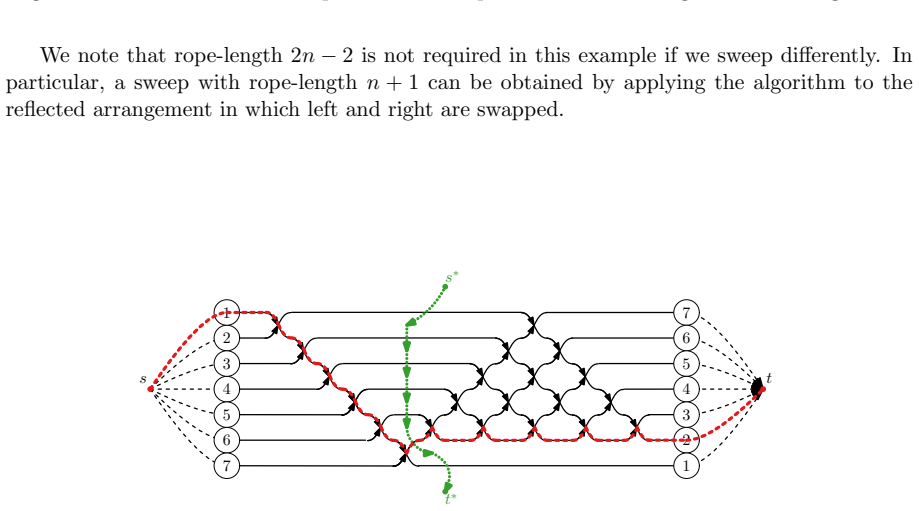
- The lower-bound example is tight for the primal-dual sweep (rope-length exactly 7n/4 − 5/4), but the 2n−2 upper bound is not tight: the appendix constructs an arrangement where this sweep uses 2n−2 yet another sweep uses only n+1.
- Directed Cutwidth is NP-hard even for planar graphs with maximum degree 6, extending the known hardness landscape of this layout parameter.
- Computer experiments through n=9 match the lower bound at n=3,7 and suggest the true worst case may be lower than 2n−2 for many n.
Reading between the lines
- If an explicit realization of the lower-bound family for every K is supplied, the true worst case might be pinned between 7n/4 and some value below 2n−2; the experimental trend hints at roughly n+1 for many n, but that is not a theorem.
- Because the general planar Directed Cutwidth problem is NP-hard while the pseudoline-dual case is open, any polynomial algorithm for the sweep problem would have to exploit the special structure of duals of pseudoline arrangements rather than generic planarity.
- The hugging technique is not obviously limited to pseudoline arrangements; it may give rope-length bounds for arbitrary bipolar orientations in terms of parameters such as the number of source and sink vertices.
- The open monotonicity question (whether allowing a face to be flipped more than once could shorten a sweep) could be tested experimentally on the enumerated arrangements for n=9 and n=10 before any theoretical resolution.
Editorial analysis
A structured set of objections, weighed in public.
Referee Report
Summary. The paper studies the rope-sweeping problem for arrangements of n x-monotone pseudolines. A rope is an st-path in the directed arrangement graph GA, and a sweep flips the rope across faces until it becomes the upper hull; the rope-length is the maximum number of edges on the rope. The main results are: (Theorem 2) every arrangement admits a sweep of rope-length at most 2n-2, proved via a coordinated primal-dual sweep whose primal and dual ropes 'hug' each other; (Theorem 1) for n = 3 mod 4 there exist arrangements for which every sweep needs rope-length at least 7n/4 - 5/4, using a five-section construction with half-grids; and (Theorem 3) Directed Cutwidth is NP-hard for planar graphs of maximum degree 6, via a reduction from Cutwidth. The paper also reports exhaustive experiments for n <= 9 and discusses open problems.
Significance. The upper bound is the strongest and most elegant contribution: the hugging invariant is a parameter-free construction, and the index/counting argument in Section 4 (Observation 1 and Claims 1-4) is convincing. The NP-hardness reduction in Section 6 fills a genuine gap in the literature and appears technically sound. The lower-bound construction is plausible and is corroborated by the exhaustive experiments up to n = 9, but the proof currently lacks a formal existence argument for all K. If that gap is closed, the results establish that the worst-case rope-length is linear and pin it down within a constant factor between 7/4 and 2. The results are derived from definitions rather than fitted to data, and the experimental table is appropriate corroboration.
major comments (3)
- [Section 3, Theorem 1] The lower-bound family is not proven to exist for all K. The proof describes five sections and half-grids verbally and illustrates K=1 and K=3, but it never specifies, for general K, the order of crossings along each pseudoline (or an equivalent coordinate/inductive construction), nor does it prove that the described pattern is realizable as an arrangement of n x-monotone curves in which every pair crosses exactly once and no unintended crossings occur. The three bullet-point path-length estimates and the subsequent sweep argument rely on the exact geometry of the half-grids and the faces F_l, F_c, F_r. Please provide an explicit construction for all n = 4K+3 and prove the three path-length properties for that construction.
- [Section 5, Proposition 1] The proof of Proposition 1 is a high-level phase description rather than a proof. It asserts that the rope 'skips' certain numbers of layers and that at a particular moment 'this is where the maximum ropelength so far was achieved,' but it does not define the layers precisely, does not state an invariant for the primal-dual sweep on the K-family, and does not compute the rope length at every step. As it stands, the tightness claim for the Section 3 examples is unverified. Please replace this with a formal invariant-based analysis for all K, or explicitly mark Proposition 1 as an observation for the depicted instances.
- [Section 3, sweep argument] In the equation for |π|, the '+1' term assumes that, at the moment considered, the rope contains exactly one edge from s(F_r) to t(F_c). This structural fact is not stated or justified; the preceding bullets only bound |π(s, s(F_l))|, |π(t(F_l), s(F_r))|, and |π(t(F_c), t)|, but not the connection between s(F_r) and t(F_c). The decomposition of the rope into these four parts should be proven from the flip sequence and the construction.
minor comments (4)
- [Abstract and Theorem 1] The abstract states the lower bound as 7(n-2)/4 + 1, which is inconsistent with the bound 7n/4 - 5/4 = 7K + 4 proven in Theorem 1; for n = 7 it evaluates to 9.75 instead of 11. The abstract should be corrected, for example to 7(n-3)/4 + 4.
- [Section 2, Definition 1] In condition (4), the expression π∗(x, s∗) appears where the second part of the dual rope should be π∗(x, t∗), matching the split at the crossing point x.
- [Sections 6 and 8] There are minor typographical errors: 'problemDirected Cutwidth' (missing space) and 'ihas' (should be 'has'); the phrase 'reduce our sweep-problem to solving Directed Cutwidth' in Section 6 should clarify the intended direction, since Lemma 1 proves an equivalence.
- [Figures 3 and 4] The figures are dense and some labels (e.g., t_2, b_2) are difficult to read; a larger rendering or a zoomed detail would help the reader verify the construction and the path-length claims.
Circularity Check
No significant circularity: both main bounds are proven from the definitions; self-citations are contextual only.
full rationale
The paper's central claims are derived self-containedly. Theorem 2 (upper bound 2n-2) follows from Claims 1-4, which count rope encounters with pseudolines using only the definition of an x-monotone pseudoline arrangement; no fitted parameter or external result is used. Theorem 1 (lower bound 7(n-2)/4+1) is a direct construction whose path-length lower bounds are argued from the half-grid structure; the experimental table in Section 7 merely corroborates this bound and is not part of the proof. The equivalence in Lemma 1 between a sweep and directed cutwidth in the dual is a proved bijection, not a definitional collapse, and it is used only for the complexity discussion. Self-citations ([3], [7], [15]) supply background on homotopy height, monotone sweepouts, and the enumeration tool used in experiments, but none is load-bearing: the main theorems do not call on these papers. The only notable weakness is that the lower-bound arrangement of Section 3 is specified through Figures 3-5 and a verbal description rather than a fully formal inductive or coordinate construction for all K; if that family were not realizable, the lower bound would fail. This is a correctness/completeness concern, not circularity, since the argument does not presuppose the result it proves. Score 1 reflects only the presence of contextual self-citations.
Assumptions & free parameters
assumptions (4)
- domain assumption A is a set of n x-monotone infinite curves, each pair crossing exactly once, yielding a bipolar orientation G_A (Section 2).
- standard math The dual graph G*_A of a bipolar orientation is a bipolar orientation with directed edges F_L -> F_R (Section 2).
- ad hoc to paper The lower-bound example with five sections and half-grids exists for every n = 4K+3 (Section 3).
- standard math Cutwidth is NP-hard for planar graphs of maximum degree 3, as cited from Monien and Sudborough [13].
Cite this review
Pith. "Pith review of Sweeping $x$-monotone pseudolines." pith.science (2026). https://pith.science/paper/Z6GGFUTQ
@misc{pith2026250721322,
  author       = {Pith},
  title        = {Pith review of: Sweeping $x$-monotone pseudolines},
  year         = {2026},
  howpublished = {\url{https://pith.science/paper/Z6GGFUTQ}},
  note         = {Machine review of arXiv:2507.21322}
}
abstract
We study the problem of sweeping a pseudoline arrangement with $n$ $x$-monotone curves with a rope (an $x$-monotone curve that connects the points at infinity). The rope can move by flipping over a face of the arrangement, replacing parts of it from the lower to the upper chain of the face. Counting as length of the rope the number of edges, what rope-length can be needed in such a sweep? We show that all such arrangements can be swept with rope-length at most $2n-2$, and for some arrangements rope-length at least $7(n-2)/4+1$ is required. We also discuss some complexity issues around the problem of computing a sweep with the shortest rope-length.
Figures


Figures from the paper (11 more)



Reference graph
Works this paper leans on
-
[1]
Victor Alvarez and Raimund Seidel. A simple aggregative algorithm for counting triangu- lations of planar point sets and related problems. In Guilherme Dias da Fonseca, Thomas Lewiner, Luis Mariano Pe˜ naranda, Timothy M. Chan, and Rolf Klein, editors,Symposium on Computational Geometry 2013, SoCG ’13, Rio de Janeiro, Brazil, June 17–20, 2013 , pages 1–8....
-
[2]
J´ ozsef Balogh, Oded Regev, Clifford D. Smyth, William L. Steiger, and Mario Szegedy. Long monotone paths in line arrangements. Discret. Comput. Geom., 32(2):167–176, 2004. doi:10.1007/S00454-004-1119-1
-
[3]
T. Biedl, E. Chambers, D. Eppstein, A. de Mesmay, and T. Ophelders. Homotopy height, grid-major height and graph-drawing height. In Daniel Archambault and Csaba D. T´ oth, ed- itors, Graph Drawing and Network Visualization (GD 2019) , volume 11904 of Lecture Notes in Computer Science , pages 468–481. Springer, 2019. doi:10.1007/978-3-030-35802-0\ _36. Th....
-
[4]
Hans L. Bodlaender, Michael R. Fellows, and Dimitrios M. Thilikos. Derivation of algo- rithms for cutwidth and related graph layout parameters. J. Comput. Syst. Sci. , 75(4):231– 244, 2009. doi:10.1016/J.JCSS.2008.10.003
-
[5]
Bodlaender, Lars Jaffke, and Jan Arne Telle
Hans L. Bodlaender, Lars Jaffke, and Jan Arne Telle. Typical sequences revisited - com- puting width parameters of graphs. Theory Comput. Syst. , 67(1):52–88, 2023. doi: 10.1007/S00224-021-10030-3
-
[6]
Graham R. Brightwell and Peter Winkler. Submodular percolation. SIAM Journal on Discrete Mathematics, 23(3):1149–1178, January 2009. doi:10.1137/07069078x
-
[7]
Chambers, Arnaud de Mesmay, Tim Ophelders, and Regina Rotman
Erin Wolf Chambers, Gregory R. Chambers, Arnaud de Mesmay, Tim Ophelders, and Regina Rotman. Constructing monotone homotopies and sweepouts. Journal of Differential Geometry, 119(3):383–401, 2021. doi:10.4310/jdg/1635368350
arXiv 2021
-
[8]
On the complexity of optimal homotopies
Erin Wolf Chambers, Arnaud de Mesmay, and Tim Ophelders. On the complexity of optimal homotopies. In Artur Czumaj, editor, Proceedings of the Twenty-Ninth Annual ACM-SIAM Symposium on Discrete Algorithms, SODA 2018, New Orleans, LA, USA, January 7-10, 2018, pages 1121–1134. SIAM, 2018. doi:10.1137/1.9781611975031.73
Show all 16 references
-
[9]
Chrobak and S
M. Chrobak and S. Nakano. Minimum-width grid drawings of plane graphs. Comput. Geom., 11(1):29–54, 1998. doi:10.1016/S0925-7721(98)00016-9
1998 doi
-
[10]
Bipolar orienta- tions revisited
Hubert de Fraysseix, Patrice Ossona de Mendez, and Pierre Rosenstiehl. Bipolar orienta- tions revisited. Discret. Appl. Math., 56(2-3):157–179, 1995. doi:10.1016/0166-218X(94) 00085-R
1995 doi
-
[11]
On some monotone path problems in line arrangements
Adrian Dumitrescu. On some monotone path problems in line arrangements. Comput. Geom., 32(1):13–25, 2005. doi:10.1016/J.COMGEO.2005.01.001
2005 doi
-
[12]
Lower bounds on the length of monotone paths in arrangement
Jir ´ ı Matousek. Lower bounds on the length of monotone paths in arrangement. Discret. Comput. Geom., 6:129–134, 1991. doi:10.1007/BF02574679
1991 doi
-
[13]
Monien and I.H
B. Monien and I.H. Sudborough. Min cut is NP-complete for edge weighted trees. The- oretical Computer Science , 58(1–3):209–229, 1988. doi:http://dx.doi.org/10.1016/ 0304-3975(88)90028-X
1988
-
[14]
Minimum height drawings of ordered trees in polyno- mial time: Homotopy height of tree duals
Tim Ophelders and Salman Parsa. Minimum height drawings of ordered trees in polyno- mial time: Homotopy height of tree duals. In Xavier Goaoc and Michael Kerber, editors, 38th International Symposium on Computational Geometry (SoCG 2022), pages 55:1–55:16. Schloss Dagstuhl – L...
2022 doi
-
[15]
NumPSLA – an experimental research tool for pseudoline arrangements and order types
G¨ unter Rote. NumPSLA – an experimental research tool for pseudoline arrangements and order types. In Jan Kratochv ´ ıl and Giuseppe Liotta, editors, 41st European Workshop on Computational Geometry (EuroCG 2025), pages 18:1–18:8, April 2025. URL:http://page. mi.fu-berlin.de/...
2025 arXiv
-
[16]
Inapproximability of treewidth and related problems
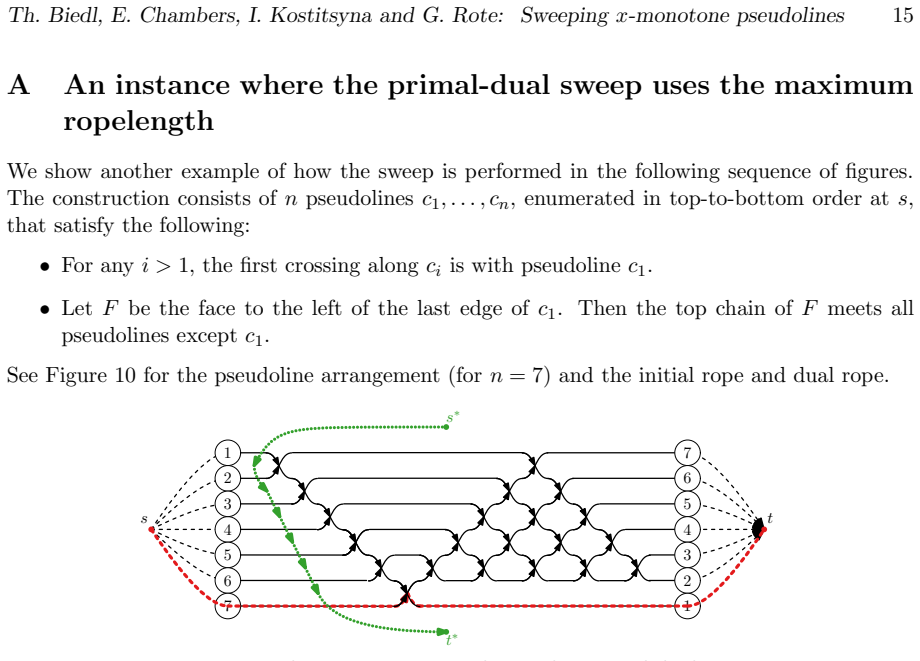
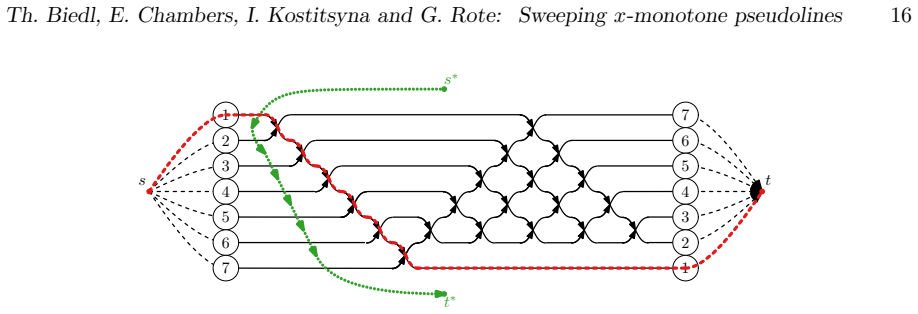
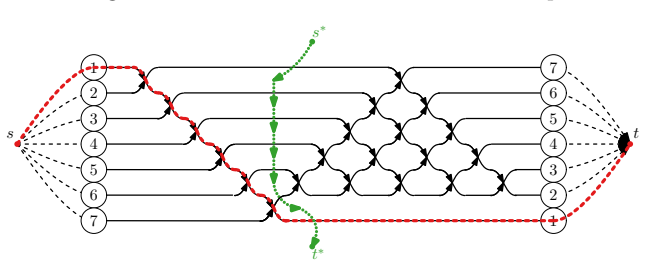
Yu Wu, Per Austrin, Toniann Pitassi, and David Liu. Inapproximability of treewidth and related problems. J. Artif. Intell. Res. , 49:569–600, 2014. doi:10.1613/jair.4030. Th. Biedl, E. Chambers, I. Kostitsyna and G. Rote: Sweepingx-monotone pseudolines 15 A An instance where t...
2014 doi
Reviewed August 6, 2026 · model on record in the stance chip above.
Discussion (0). Continue with ORCID to comment.