REVIEW 4 major objections 5 minor 73 references
InSituTale: Enhancing Augmented Data Storytelling with Physical Objects
T0 review · 4 major / 5 minor · reviewed 2026-08-06 · deepseek-v4-flash
Pith's one-line read Physical objects can be turned into live controls for data visualizations, and InSituTale shows how a depth camera and a vision-language model let presenters drive charts by lifting, pointing at, arranging, and even peeling props.
desk verdict A solid, honestly-scoped HCI systems paper; the intuitiveness evidence is weaker than the abstract implies, but the prototype and design process deserve engagement. read the letter →
The pith
A machine-rendered reading of the paper's core claim, the machinery that carries it, and where it could break.
The reading
What carries the argument
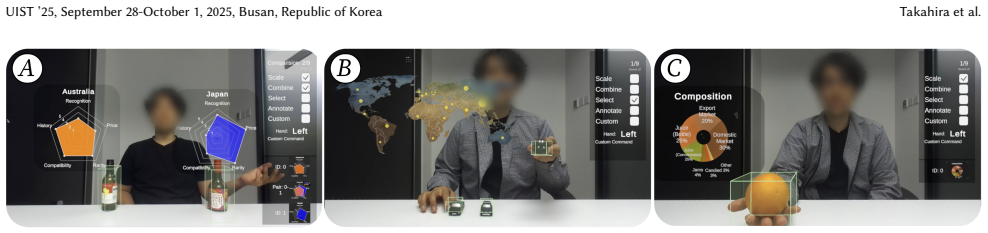
The load-bearing mechanism is the mapping between physical manipulations and visualization commands, carried by two sensing channels and a layout algorithm. A depth camera with YOLOv4, a standard object-detection model, tracks objects in 3D space, recognizing placement, lifting through vertical displacement from a detected table plane, changes in distance from the camera, and inter-object distances, while hand and finger tracking supports pointing gestures. A vision-language model, Qwen-VL-Chat, examines one compressed frame per second against authored text prompts to detect custom real-world events such as a glass being filled or a banana being peeled. The resulting detections are translated into visualization updates, including show/hide, scale, compose/decompose, data selection, chart-type change, and overview-to-detail navigation, and a greedy layout algorithm places each chart near its associated object while avoiding the presenter's face and other visual elements.
What would settle it
Conduct a between-subjects study in which naive presenters deliver the same two stories with InSituTale and with a conventional slide deck, using everyday objects outside the original six, for example a heavy mug, a fabric glove, and a large book, and count unintended triggers and failed commands. If presenters do not spontaneously perform the workshop mappings, lifting to select, moving nearer to scale, and bringing objects together to compose, or if error rates are comparable to or worse than the gesture systems the paper contrasts with, the general claim of intuitive and robust physical-object control would be refuted.
Extended reading notes
Core claim
The central discovery is that physical object manipulation can serve as an intuitive, real-time control channel for data storytelling once reliable 3D sensing is combined with user-defined event detection. The paper proposes augmented physical data storytelling as a concept, derives eight visualization commands from a survey of 31 data-driven presentation videos, and collects a taxonomy of manipulation-to-command mappings from nine HCI/VIS researchers, organized into appearance-, movement-, arrangement-, gesture-, affordance-, and visualization-based interactions. InSituTale instantiates these mappings: placing an object reveals its chart, moving it toward the camera scales the chart and can trigger a detail view, lifting an object highlights its data series, pointing selects a data point or shows an annotation, and bringing two objects together composes or decomposes charts; an authoring mode lets presenters assign visualizations to objects, arrange scenes, and write text prompts such as "Is the banana peeled?" that trigger state-based visualization changes. The 12-participant user study is offered as evidence that these interactions are intuitive, useful, and engaging in live presentations, with several presenters improvising content they had not planned during the session.
Load-bearing premise
The load-bearing premise is that the manipulation-to-command mappings elicited from nine human-computer interaction and visualization researchers around six props (cup, bottle, banana, toy car, backpack, laptop) generalize to the wider population of presenters and to other objects; the paper itself flags in Section 9.2 that interactions may not transfer to objects with different forms or materials, so if that premise fails, the claim that physical manipulation is an intuitive control method loses its experimental grounding.
Editorial extensions
If this is right
- Presenters could improvise with data during a talk, highlighting series, composing charts on the fly, and switching chart types, because the mapping from physical manipulation to visualization is computed live rather than pre-edited.
- Any observable physical state change can become a visualization trigger by writing a text prompt, so the interaction design extends beyond predefined gestures to context-specific events such as peeling a banana or filling a glass.
- Tangible object manipulation can reduce physical fatigue relative to gesture-only control, since presenters perform natural actions they would already perform while explaining.
- Scene-based authoring, where each scene pairs objects with visualizations and only a small set of active commands, keeps the interaction space simple enough to prevent unintended triggers while preserving forward and backward improvisation.
- If the interaction mappings transfer, the same framework can support product promotion, education, and consumer-behavior talks in which physical props are the narrative referents.
Reading between the lines
- The paper's evaluation measures presenter experience, not audience outcomes; a decisive extension would compare audience comprehension and attention against a conventional slide deck.
- The vision-language trigger channel is more general than the six props suggest: any queryable visual state, such as an audience member raising a hand or a prop changing color, could serve as a custom command, though the manipulation-to-command mappings themselves may need re-elicitation for unfamiliar objects.
- The paper discusses but does not implement bidirectional coupling; a natural next step is having visualization state drive physical actuators so objects move in sync with charts, closing the loop between digital and physical.
Editorial analysis
A structured set of objections, weighed in public.
Referee Report
Summary. The paper introduces 'augmented physical data storytelling,' an approach in which presenters control visualizations in real time by manipulating physical objects that are captured by a depth camera and interpreted by a vision-language model. The design is grounded in a survey of 31 presentation videos, elicitation workshops with nine HCI/VIS researchers, and an iterative prototype called InSituTale. The authors report a user study with 12 participants who authored and delivered short data stories using the system, and they interpret Likert-scale ratings plus semi-structured interviews as evidence that the interactions are intuitive, useful, and engaging. The paper also reports system latency (0.1 s for tracking, 1.08 s for the vision-language query) and discusses design implications and limitations.
Significance. If the central claim is accepted, the paper makes a useful contribution to augmented presentation and tangible interaction research: it extends prior gesture- and speech-driven systems toward physical-object-mediated control of visualizations, and it documents a workshop-based mapping methodology that other systems could adopt. The engineering is substantive, including markerless depth tracking, a custom query mechanism via Qwen-VL-Chat, dynamic layout, and authoring/presentation modes. The reported latency figures are helpful for feasibility. However, the evidence for the intuitive-effectiveness claim is currently conditional: the mappings come from primed elicitation, and the user study uses only subjective post-training ratings without a baseline or objective performance measures. The object coverage in the evaluation is also narrower than the six-object design space. These issues are partly acknowledged in the paper's own limitation section, which strengthens the authors' transparency but does not remove the overreach in the abstract's claim of demonstration.
major comments (4)
- [Section 4.3.2 and Section 8] The claim that InSituTale enables 'intuitive interactions' is not fully supported by the evidence, because the interaction mappings were elicited with the help of example mappings used as priming (Section 4.3.2, citing [39] on legacy bias), and the user study then gave participants a guided demonstration of those same mappings before collecting Likert ratings and qualitative testimony (Section 8.3). The dominant mappings, such as the 89% agreement for compose/decompose in Section 4.4.2, may therefore partly reflect the experimenters' suggestions rather than spontaneous user intuition. To keep the 'intuitive' claim, the authors should add an unprimed elicitation or an independent preference/comparison test of alternative mappings, or they should explicitly soften the claim to 'learnable after demonstration' and adjust the abstract and Section 8.4 accordingly.
- [Section 8 (Evaluation)] The evaluation provides no comparison baseline and no objective task-performance metrics; the abstract's wording that the user study 'demonstrated' high utility is stronger than the data support. All utility and engagement conclusions rest on 12 participants' self-reports, and the paper does not report the actual Likert distributions or per-item medians underlying Figure 8. Without a slideshow or gesture-based control condition, the claim that physical-object manipulation improves the storytelling experience is not established beyond perceived preference after a tutorial. The authors should either report the full rating data and frame the results as perceived usability, or add a baseline comparison if they wish to retain the effectiveness claim.
- [Section 8.3 and Table 1] The user study tested only two of the six workshop-selected objects (wine bottle and banana), and it added objects that were not in the workshop set (wine glass and orange). The cup, toy car, backpack, and laptop from Table 1 never appear in the evaluation. The paper's own Section 9.2 acknowledges limited object diversity, but the actual gap is larger than the text suggests: the interaction mapping was grounded in six objects, yet the evaluation exercises only a small subset, so the generalization claim for the interaction design is even weaker than stated. I recommend either expanding the evaluated object set or explicitly scoping the contribution to the evaluated object types.
- [Section 6.3.1 and Section 8.4] The system's per-frame object detection assigns temporary identities by detection order, and the study scenarios require multiple objects of the same class (two wine bottles; two bananas; two oranges). Participants P4–P6 reported that tracking failures led to visualization mismatches and that they had to remove and re-introduce objects to fix assignments. This directly affects the central 'real-time storytelling' claim in the two main use cases, and it suggests that the reported qualitative successes may not reflect the system's reliability in the exact scenarios it targets. The paper should report how often tracking failures occurred, add a more robust identity-tracking method, or substantially qualify the reliability claim.
minor comments (5)
- [Section 4.4.2] The heading 'Composose/Decompose' contains a typo; it should read 'Compose/Decompose.'
- [Figure 8] The paper cites Figure 8 as a summary of usability ratings but does not report the underlying Likert values or distributions in the text; adding medians and ranges would make the results interpretable.
- [Section 3.1] 'An approach' is capitalized mid-sentence in the first paragraph; the capitalization should be made consistent with the rest of the text.
- [Section 5] The sentence 'drawing our workshop's results on the natural mappings between physical manipulations and visualization commands from our workshop' is redundant and should be rephrased.
- [Section 8.4] Quotes such as P8's 'I could remember the mappings easily because they made sense' are presented as evidence of intuitiveness, but the participants had just received a demonstration of the mappings; the authors should acknowledge this priming in the interpretation.
Circularity Check
No significant circularity: the system is an empirical design-and-evaluation loop, not a derivation that reduces to its own inputs.
full rationale
The paper's claimed contribution is an interaction design and prototype, not a quantitative prediction derived from a fitted equation. The derivation chain is: (1) a survey of 31 videos identifies visualization commands; (2) workshops with nine HCI/VIS researchers elicit candidate physical-manipulation-to-command mappings; (3) the authors implement the dominant mappings in InSituTale; (4) a 12-participant study collects Likert ratings and interview feedback on usability and engagement. None of these steps reduces to its own input by construction: the user study does not fit a parameter and then report that parameter as a prediction; the workshop mappings are not derived from the user study data; and the system is not validated by comparing InSituTale to itself. The only self-citation identified ([60], cited for the expectation that tangible interactions reduce cognitive load) is motivational background and is not load-bearing for the central claim. The admitted priming of example mappings in the elicitation workshop (Section 4.3.2) is a recognized methodological limitation that could inflate agreement rates, and the paper itself acknowledges generalization limits in Section 9.2, but this is an external-validity concern rather than a self-referential logical circularity. The evaluation uses subjective ratings after demonstrating the system, which is a standard HCI design-evaluation loop, not an equation-level equivalence. Therefore no circular step can be quoted.
Assumptions & free parameters
assumptions (3)
- domain assumption The six selected physical objects (cup, bottle, banana, toy car, backpack, laptop) represent a sufficient range of affordances for generalizable interaction design.
- domain assumption The nine HCI/VIS workshop participants' proposed mappings reflect intuitive mappings for the general presenter population.
- domain assumption Vision-language model responses (Qwen-VL-Chat) are sufficiently reliable for detecting user-defined real-world events in real time.
Cite this review
Pith. "Pith review of InSituTale: Enhancing Augmented Data Storytelling with Physical Objects." pith.science (2026). https://pith.science/paper/TO2JDTWZ
@misc{pith2026250721411,
  author       = {Pith},
  title        = {Pith review of: InSituTale: Enhancing Augmented Data Storytelling with Physical Objects},
  year         = {2026},
  howpublished = {\url{https://pith.science/paper/TO2JDTWZ}},
  note         = {Machine review of arXiv:2507.21411}
}
read the original abstract
Augmented data storytelling enhances narrative delivery by integrating visualizations with physical environments and presenter actions. Existing systems predominantly rely on body gestures or speech to control visualizations, leaving interactions with physical objects largely underexplored. We introduce augmented physical data storytelling, an approach enabling presenters to manipulate visualizations through physical object interactions. To inform this approach, we first conducted a survey of data-driven presentations to identify common visualization commands. We then conducted workshops with nine HCI/VIS researchers to collect mappings between physical manipulations and these commands. Guided by these insights, we developed InSituTale, a prototype that combines object tracking via a depth camera with Vision-LLM for detecting real-world events. Through physical manipulations, presenters can dynamically execute various visualization commands, delivering cohesive data storytelling experiences that blend physical and digital elements. A user study with 12 participants demonstrated that InSituTale enables intuitive interactions, offers high utility, and facilitates an engaging presentation experience.
Figures


Figures from the paper (5 more)



Reference graph
Works this paper leans on
-
[39]
Meredith Ringel Morris, Andreea Danielescu, Steven Drucker, Danyel Fisher, Bongshin Lee, m. c. schraefel, and Jacob O. Wobbrock. 2014. Reducing legacy bias in gesture elicitation studies.Interactions21, 3 (may 2014), 40–45. doi:10. 1145/2591689
work page 2014
- [1]
-
[2]
Learning Implicit Surface Light Fields
R. Azuma and C. Furmanski. 2003. Evaluating label placement for augmented reality view management. InThe Second IEEE and ACM International Sym- posium on Mixed and Augmented Reality, 2003. Proceedings.IEEE Computer Society, Los Alamitos, CA, USA, 66–75. doi:10.1109/ISMAR.2003.1240689
work page Pith review arXiv 2003
-
[3]
Sandra Bae, Takanori Fujiwara, Anders Ynnerman, Ellen Yi-Luen Do, Michael L
S. Sandra Bae, Takanori Fujiwara, Anders Ynnerman, Ellen Yi-Luen Do, Michael L. Rivera, and Danielle Albers Szafir. 2024. A Computational Design Pipeline to Fabricate Sensing Network Physicalizations.IEEE Transactions on Visualization and Computer Graphics30, 1 (2024), 913–923. doi:10.1109/TVCG. 2023.3327198 UIST ’25, September 28-October 1, 2025, Busan, ...
arXiv 2024
-
[4]
Jinze Bai, Shuai Bai, Shusheng Yang, Shijie Wang, Sinan Tan, Peng Wang, Junyang Lin, Chang Zhou, and Jingren Zhou. 2023. Qwen-VL: A Versatile Vision-Language Model for Understanding, Localization, Text Reading, and Beyond. arXiv:2308.12966 [cs.CV] https://arxiv.org/abs/2308.12966
arXiv 2023
-
[5]
Matthew Brehmer and Robert Kosara. 2022. From Jam Session to Recital: Synchronous Communication and Collaboration Around Data in Organiza- tions.IEEE Transactions on Visualization and Computer Graphics28, 1 (2022), 1139–1149. doi:10.1109/TVCG.2021.3114760
arXiv 2022
-
[6]
Yining Cao, Rubaiat Habib Kazi, Li-Yi Wei, Deepali Aneja, and Haijun Xia
-
[8]
Paul Crowther. 2019.Theory of the Art Object. Routledge, New York
work page 2019
Show all 73 references
-
[9]
Peter Dalsgaard and Kim Halskov. 2012. Tangible 3D tabletops: combining tangible tabletop interaction and 3D projection. InProceedings of the 7th Nordic Conference on Human-Computer Interaction: Making Sense Through Design(Copenhagen, Denmark)(NordiCHI ’12). Association for Co...
2012
-
[10]
Josh Urban Davis, Paul Asente, and Xing-Dong Yang. 2023. Multimodal Direct Manipulation in Video Conferencing: Challenges and Opportunities. InPro- ceedings of the 2023 ACM Designing Interactive Systems Conference(Pittsburgh, PA, USA)(DIS ’23). Association for Computing Machin...
2023
-
[12]
Neven ElSayed, Bruce Thomas, Kim Marriott, Julia Piantadosi, and Ross Smith
-
[13]
ElSayed, Bruce H
Neven A.M. ElSayed, Bruce H. Thomas, Kim Marriott, Julia Piantadosi, and Ross T. Smith. 2016. Situated Analytics: Demonstrating immersive analytical tools with Augmented Reality.Journal of Visual Languages & Computing36 (2016), 13–23. doi:10.1016/j.jvlc.2016.07.006
2016 doi
-
[14]
Wang, Samuel Gratzl, Zac Lucarelli, Brendan Moyle, Jim Smiley, and Tim Dwyer
Barrett Ens, Sarah Goodwin, Arnaud Prouzeau, Fraser Anderson, Florence Y. Wang, Samuel Gratzl, Zac Lucarelli, Brendan Moyle, Jim Smiley, and Tim Dwyer. 2021. Uplift: A Tangible and Immersive Tabletop System for Ca- sual Collaborative Visual Analytics.IEEE Transactions on Visua...
2021
-
[15]
Temiloluwa Paul Femi-Gege, Matthew Brehmer, and Jian Zhao. 2024. VisCon- ductor: Affect-Varying Widgets for Animated Data Storytelling in Gesture- Aware Augmented Video Presentation.Proc. ACM Hum.-Comput. Interact.8, ISS, Article 531 (Oct. 2024), 22 pages. doi:10.1145/3698131
2024 doi
-
[16]
Alba Fombaro, Guillermo Fombaro, and Octavio Fombaro. 2022. Augmented Reality, a Review of a Way to Represent and Manipulate 3D Chemical Struc- tures.Journal of Chemical Information and Modeling62, 8 (2022), 2012–2028. doi:10.1021/acs.jcim.1c01255
2022 doi
-
[17]
Gapminder Foundation. 2014. The Future of Ebola if Not Stopped Now - Rosling’s Factpod #8. https://www.youtube.com/watch?v=sYVUs2_F5Kg
2014
-
[18]
Mikhaila Friske, Jordan Wirfs-Brock, and Laura Devendorf. 2020. Entangling the Roles of Maker and Interpreter in Interpersonal Data Narratives: Explo- rations in Yarn and Sound. InProceedings of the 2020 ACM Designing Interactive Systems Conference(Eindhoven, Netherlands)(DIS ...
2020
-
[19]
Zeinab Ghaemi, Kadek Ananta Satriadi, Ulrich Engelke, Barrett Ens, and Bernhard Jenny. 2023. Visualization Placement for Outdoor Augmented Data Tours. InProceedings of the 2023 ACM Symposium on Spatial User Interaction (Sydney, NSW, Australia)(SUI ’23). Association for Computi...
2023
-
[20]
Weilun Gong, Stephanie Santosa, Tovi Grossman, Michael Glueck, Daniel Clarke, and Frances Lai. 2023. Affordance-Based and User-Defined Gestures for Spatial Tangible Interaction. InProceedings of the 2023 ACM Designing Interactive Systems Conference(Pittsburgh, PA, USA)(DIS ’23...
2023 doi
-
[21]
Raphaël Grasset, Tobias Langlotz, Denis Kalkofen, Markus Tatzgern, and Di- eter Schmalstieg. 2012. Image-driven view management for augmented reality browsers. In2012 IEEE International Symposium on Mixed and Augmented Reality (ISMAR). IEEE Computer Society, Los Alamitos, CA, ...
2012
-
[22]
Hall, Lyn Bartram, and Matthew Brehmer
Brian D. Hall, Lyn Bartram, and Matthew Brehmer. 2022. Augmented Chi- ronomia for Presenting Data to Remote Audiences. InProceedings of the 35th Annual ACM Symposium on User Interface Software and Technology(Bend, OR, USA)(UIST ’22). Association for Computing Machinery, New Yo...
2022
-
[23]
Shuqi He, Haonan Yao, Luyan Jiang, Kaiwen Li, Nan Xiang, Yue Li, Hai- Ning Liang, and Lingyun Yu. 2024. Data Cubes in Hand: A Design Space of Tangible Cubes for Visualizing 3D Spatio-Temporal Data in Mixed Reality. In Proceedings of the CHI Conference on Human Factors in Compu...
2024
-
[24]
Richter, Francesca Samsel, Greg Abram, and Daniel F
Bridger Herman, Maxwell Omdal, Stephanie Zeller, Clara A. Richter, Francesca Samsel, Greg Abram, and Daniel F. Keefe. 2021. Multi-Touch Querying on Data Physicalizations in Immersive AR.Proc. ACM Hum.-Comput. Interact.5, ISS, Article 497 (Nov. 2021), 20 pages. doi:10.1145/3488542
2021 doi
-
[25]
Mark Hough. 2017. Adidas - Low Waste Brand Film. https://vimeo.com/ 199539760
2017
-
[26]
Flow Immersive. 2024. Life Expectancy Avatar Story. https://www.youtube. com/watch?v=MMB3rHeZdcE
2024
-
[27]
Hiroshi Ishii and Brygg Ullmer. 1997. Tangible bits: towards seamless inter- faces between people, bits and atoms. InProceedings of the ACM SIGCHI Con- ference on Human Factors in Computing Systems (CHI ’97). Association for Com- puting Machinery, New York, NY, USA, 234–241. d...
1997
-
[28]
Terry Haekyung Kim and Ho Jung Choo. 2021. Augmented reality as a product presentation tool: focusing on the role of product information and presence in AR.Fashion and Textiles8, 1 (2021), 1–21. doi:10.1186/s40691-021-00261-w
2021 doi
-
[29]
Adrian Kristanto, Maxime Cordeil, Benjamin Tag, Nathalie Henry Riche, and Tim Dwyer. 2023. Hanstreamer: an Open-source Webcam-based Live Data Presentation System. arXiv:2309.12538 [cs.HC] https://arxiv.org/abs/2309. 12538
2023 arXiv
-
[30]
Bongshin Lee, Rubaiat Habib Kazi, and Greg Smith. 2013. SketchStory: Telling More Engaging Stories with Data through Freeform Sketching.IEEE Trans- actions on Visualization and Computer Graphics19, 12 (2013), 2416–2425. doi:10.1109/TVCG.2013.191
2013 doi
-
[31]
Boyu Li, Linping Yuan, Zhe Yan, Qianxi Liu, Yulin Shen, and Zeyu Wang. 2024. AniCraft: Crafting Everyday Objects as Physical Proxies for Prototyping 3D Character Animation in Mixed Reality. InProceedings of the 37th Annual ACM Symposium on User Interface Software and Technolog...
2024
-
[32]
Jian Liao, Adnan Karim, Shivesh Singh Jadon, Rubaiat Habib Kazi, and Ryo Suzuki. 2022. RealityTalk: Real-Time Speech-Driven Augmented Presentation for AR Live Storytelling. InProceedings of the 35th Annual ACM Symposium on User Interface Software and Technology(Bend, OR, USA)(...
2022
-
[33]
Jian Liao, Kevin Van, Zhijie Xia, and Ryo Suzuki. 2024. RealityEffects: Aug- menting 3D Volumetric Videos with Object-Centric Annotation and Dynamic Visual Effects. InProceedings of the 2024 ACM Designing Interactive Systems Conference(Copenhagen, Denmark)(DIS ’24). Associatio...
2024
-
[34]
Tica Lin, Yalong Yang, Johanna Beyer, and Hanspeter Pfister. 2023. Label- ing Out-of-View Objects in Immersive Analytics to Support Situated Visual Searching.IEEE Transactions on Visualization and Computer Graphics29, 3 (2023), 1831–1844. doi:10.1109/TVCG.2021.3133511
2023
-
[35]
Lawrence Zitnick
Tsung-Yi Lin, Michael Maire, Serge Belongie, James Hays, Pietro Perona, Deva Ramanan, Piotr Dollár, and C. Lawrence Zitnick. 2014. Microsoft COCO: Com- mon Objects in Context. InComputer Vision – ECCV 2014, David Fleet, Tomas Pajdla, Bernt Schiele, and Tinne Tuytelaars (Eds.)....
2014 doi
-
[36]
Jingyuan Liu, Hongbo Fu, and Chiew-Lan Tai. 2020. PoseTween: Pose-driven Tween Animation. InProceedings of the 33rd Annual ACM Symposium on User Interface Software and Technology(Virtual Event, USA)(UIST ’20). Association for Computing Machinery, New York, NY, USA, 791–804. do...
2020 doi
-
[37]
Weizhou Luo, Zhongyuan Yu, Rufat Rzayev, Marc Satkowski, Stefan Gumhold, Matthew McGinity, and Raimund Dachselt. 2023. Pearl: Physical Environment based Augmented Reality Lenses for In-Situ Human Movement Analysis. In Proceedings of the 2023 CHI Conference on Human Factors in ...
2023
-
[38]
Kyzyl Monteiro, Ritik Vatsal, Neil Chulpongsatorn, Aman Parnami, and Ryo Suzuki. 2023. Teachable Reality: Prototyping Tangible Augmented Reality with Everyday Objects by Leveraging Interactive Machine Teaching. InProceedings of the 2023 CHI Conference on Human Factors in Compu...
2023
-
[40]
Prasanth Murali, Javier Hernandez, Daniel McDuff, Kael Rowan, Jina Suh, and Mary Czerwinski. 2021. AffectiveSpotlight: Facilitating the Communication of Affective Responses from Audience Members during Online Presentations. InProceedings of the 2021 CHI Conference on Human Fac...
2021
-
[41]
Biswaksen Patnaik, Huaishu Peng, and Niklas Elmqvist. 2024. VisTorch: Inter- acting with Situated Visualizations using Handheld Projectors. InProceedings of the 2024 CHI Conference on Human Factors in Computing Systems(Honolulu, HI, USA)(CHI ’24). Association for Computing Mac...
2024
-
[42]
Ken Perlin, Zhenyi He, and Karl Rosenberg. 2018. Chalktalk : A Visualization and Communication Language – As a Tool in the Domain of Computer Science Education. arXiv:1809.07166 [cs.HC] https://arxiv.org/abs/1809.07166
2018 arXiv
-
[43]
Dominic Potts, Martynas Dabravalskis, and Steven Houben. 2022. Tangible- Touch: A Toolkit for Designing Surface-based Gestures for Tangible Interfaces. InProceedings of the Sixteenth International Conference on Tangible, Embedded, and Embodied Interaction (TEI ’22). Associatio...
2022
-
[44]
2018.Data-Driven Storytelling
Nathalie Henry Riche, Christophe Hurter, Nicholas Diakopoulos, and Sheelagh Carpendale. 2018.Data-Driven Storytelling. CRC Press, Boca Raton, FL. doi:10.1201/9781315281575
2018 doi
-
[45]
Dario Rodighiero, Lins Derry, Douglas Duhaime, Jordan Kruguer, Maxim- ilian C Mueller, Christopher Pietsch, Jeffrey T Schnapp, and Jeff Steward
-
[46]
Hans Rosling. 2007. The best stats you’ve ever seen. https://www.youtube. com/watch?v=hVimVzgtD6w
2007
-
[47]
Hans Rosling. 2013. DON’T PANIC — Hans Rosling showing the facts about population. https://vimeo.com/79878808
2013
-
[48]
Hans Rosling. 2013. The River of Myths. https://www.youtube.com/watch? v=lYpX4l2UeZg
2013
-
[49]
Hans Rosling. 2014. Global population growth, box by box. https://www.ted. com/talks/hans_rosling_global_population_growth_box_by_box
2014
-
[50]
Hans Rosling. 2016. Hans Rosling: What if every squash had a washing machine? https://www.youtube.com/watch?v=rMPCQ0XI25c&ab_channel= BillGates
2016
-
[51]
Hans Rosling. 2016. Numbers are boring, people are interesting. https://www. youtube.com/watch?v=nh94kK05l-M&ab_channel=TEDxTalks
2016
-
[52]
Hans Rosling. 2016. Why the world population won’t exceed 11 billion. https://www.youtube.com/watch?v=2LyzBoHo5EI
2016
-
[53]
Nazmus Saquib, Rubaiat Habib Kazi, Li-Yi Wei, and Wilmot Li. 2019. Interactive Body-Driven Graphics for Augmented Video Performance. InProceedings of the 2019 CHI Conference on Human Factors in Computing Systems(Glasgow, Scotland Uk)(CHI ’19). Association for Computing Machine...
2019
-
[54]
Kadek Ananta Satriadi, Barrett Ens, Sarah Goodwin, and Tim Dwyer. 2023. Active Proxy Dashboard: Binding Physical Referents and Abstract Data Repre- sentations in Situated Visualization through Tangible Interaction. InExtended Abstracts of the 2023 CHI Conference on Human Facto...
2023
-
[55]
Kadek Ananta Satriadi, Jim Smiley, Barrett Ens, Maxime Cordeil, Tobias Cza- uderna, Benjamin Lee, Ying Yang, Tim Dwyer, and Bernhard Jenny. 2022. Tangible Globes for Data Visualisation in Augmented Reality. InProceedings of the 2022 CHI Conference on Human Factors in Computing...
2022
-
[56]
Orit Shaer and Eva Hornecker. 2010. Tangible User Interfaces: Past, Present, and Future Directions.Found. Trends Hum.-Comput. Interact.3, 1–2 (jan 2010), 1–137. doi:10.1561/1100000026
2010 doi
-
[57]
Arjun Srinivasan and Matthew Brehmer. 2023. Combining Voice and Ges- ture for Presenting Data to Remote Audiences. InIEEE VIS 2023 Workshop on Multimodal Experiences for Remote Communication Around Data Online, MERCADO’23. IEEE Computer Society, Los Alamitos, CA, USA
2023
-
[58]
Critical Statistics. 2019. Better and better? A comment on Hans Rosling. https: //www.youtube.com/watch?v=OoIcsj9ysvs&ab_channel=CriticalStatistics
2019
-
[59]
Adam Strantz. 2023. Print-and-play: Data Physicalization Methods for Re- search Analysis in Technical Communication. InProceedings of the 41st ACM International Conference on Design of Communication(Orlando, FL, USA)(SIG- DOC ’23). Association for Computing Machinery, New York...
2023
-
[60]
Kentaro Takahira, Wong Kam-Kwai, Leni Yang, Xian Xu, Takanori Fujiwara, and Huamin Qu. 2025. TangibleNet: Synchronous Network Data Storytelling through Tangible Interactions in Augmented Reality. InProceedings of the 2025 CHI Conference on Human Factors in Computing Systems (C...
2025
-
[61]
Pratik Tarafdar, Alvin Chung Man Leung, Wei Thoo Yue, and Indranil Bose
-
[62]
Wai Tong, Chen Zhu-Tian, Meng Xia, Leo Yu-Ho Lo, Linping Yuan, Benjamin Bach, and Huamin Qu. 2023. Exploring Interactions with Printed Data Vi- sualizations in Augmented Reality.IEEE Transactions on Visualization and Computer Graphics29, 1 (2023), 418–428. doi:10.1109/TVCG.202...
2023
-
[63]
Ullmer and H
B. Ullmer and H. Ishii. 2000. Emerging frameworks for tangible user interfaces. IBM Systems Journal39, 3.4 (2000), 915–931. doi:10.1147/sj.393.0915
2000 doi
-
[64]
John Underkoffler and Hiroshi Ishii. 1999. Urp: a luminous-tangible workbench for urban planning and design. InProceedings of the SIGCHI Conference on Human Factors in Computing Systems(Pittsburgh, Pennsylvania, USA)(CHI ’99). Association for Computing Machinery, New York, NY,...
1999
-
[65]
doi:10.1016/j.ijinfomgt.2023
Understanding the impact of augmented reality product presentation on diagnosticity, cognitive load, and product sales.International Journal of Information Management75 (2024), 102744. doi:10.1016/j.ijinfomgt.2023. 102744
2024 doi
-
[66]
Vox. 2015. Obama on what most Americans get wrong about foreign aid. https://www.youtube.com/watch?v=nzL_avUIlEE
2015
-
[67]
Zhen Wen, Wei Zeng, Luoxuan Weng, Yihan Liu, Mingliang Xu, and Wei Chen. 2023. Effects of View Layout on Situated Analytics for Multiple-View Representations in Immersive Visualization.IEEE Transactions on Visualization and Computer Graphics29, 1 (2023), 440–450. doi:10.1109/T...
2023
-
[68]
Wesley Willett, Yvonne Jansen, and Pierre Dragicevic. 2017. Embedded Data Representations.IEEE Transactions on Visualization and Computer Graphics 23, 1 (2017), 461–470. doi:10.1109/TVCG.2016.2598608
2017
-
[69]
Paul Viola and Michael J Jones. 2004. Robust real-time face detection.In- ternational journal of computer vision57 (2004), 137–154. doi:10.1023/B: VISI.0000013087.49260.fb
2004
-
[70]
Xiaoyan Zhou, Yalong Yang, Francisco Ortega, Anil Ufuk Batmaz, and Ben- jamin Lee. 2023. Data-driven Storytelling in Hybrid Immersive Display En- vironments. In2023 IEEE International Symposium on Mixed and Augmented Reality Adjunct (ISMAR-Adjunct). IEEE Computer Society, Los ...
2023
-
[71]
Chen Zhu-Tian, Daniele Chiappalupi, Tica Lin, Yalong Yang, Johanna Beyer, and Hanspeter Pfister. 2024. RL-L: A Deep Reinforcement Learning Approach Intended for AR Label Placement in Dynamic Scenarios.IEEE Transactions on Visualization and Computer Graphics30, 1 (Jan. 2024), 1...
2024
-
[73]
Lijie Yao, Federica Bucchieri, Victoria McArthur, Anastasia Bezerianos, and Petra Isenberg. 2025. User Experience of Visualizations in Motion: A Case Study and Design Considerations.IEEE Transactions on Visualization and Computer Graphics31, 1 (2025), 174–184. doi:10.1109/TVCG...
2025
-
[2015]
In2015 Big Data Visual Analytics (BDV A)
Situated Analytics. In2015 Big Data Visual Analytics (BDV A). IEEE Computer Society, Los Alamitos, CA, USA, 1–8. doi:10.1109/BDVA.2015. 7314278
2015 doi
-
[2022]
Information Design Journal27, 1 (2022), 21–34
Surprise machines: Revealing harvard art museums’ image collection. Information Design Journal27, 1 (2022), 21–34
2022
-
[2024]
InProceedings of the CHI Conference on Human Factors in Computing Systems(Honolulu, HI, USA)(CHI ’24)
Elastica: Adaptive Live Augmented Presentations with Elastic Mappings Across Modalities. InProceedings of the CHI Conference on Human Factors in Computing Systems(Honolulu, HI, USA)(CHI ’24). Association for Computing Machinery, New York, NY, USA, Article 599, 19 pages. doi:10...
Reviewed August 6, 2026 · model on record in the stance chip above.
Discussion (0). Sign in to comment.