REVIEW 4 major objections 5 minor 14 references
BANG: Dividing 3D Assets via Generative Exploded Dynamics
T0 review · 4 major / 5 minor · reviewed 2026-08-06 · deepseek-v4-flash
Pith's one-line read BANG generates a watertight exploded mesh sequence that carries any input 3D asset from fully assembled to fully divided, preserving part coherence.
desk verdict A genuinely new task and a sensible architecture, but the evaluation never tests the core claim that the model finds meaningful parts. read the letter →
The pith
A machine-rendered reading of the paper's core claim, the machinery that carries it, and where it could break.
The reading
What carries the argument
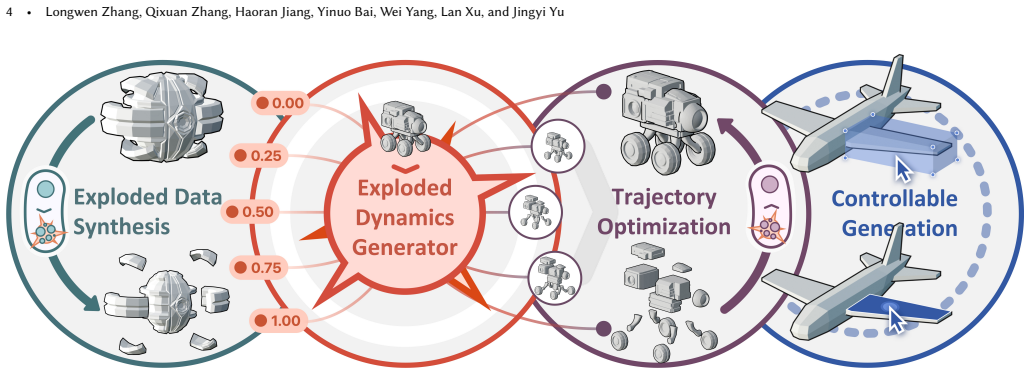
The load-bearing object is the Exploded View Adapter: a lightweight transformer that encodes the input geometry (a 20,480-point surface sample) and the explosion timestamp into a conditioning feature, fed via parallel cross-attention into every layer of the frozen diffusion transformer backbone. The temporal attention module, using frame-wise rotary time embeddings in self-attention over $T \times L$ tokens, makes the sequence temporally coherent. After generation, SDF-based trajectory optimization with masked-overlap gradients recovers per-part translation vectors, reassembling parts using the same signed-distance field used for synthesis. These pieces let a model trained mainly on static shapes inherit a strong geometry prior while learning exploded dynamics from a curated 20k-asset dataset.
What would settle it
Take a watertight single-piece mesh with no internal component boundaries and run BANG on it. If the fully divided state does not consist of perceptually coherent parts, or if the reassembled parts do not align with the original surface within the tolerance of the paper's SDF objective, then the claim that BANG decomposes arbitrary 3D assets into meaningful watertight parts is falsified.
Extended reading notes
Core claim
The central claim is that a frozen, large-scale pretrained latent diffusion model can be adapted with a lightweight exploded-view adapter to generate a complete exploded-dynamics sequence from a single input geometry. The adapter encodes the input mesh and the target explosion time into conditioning features injected through parallel cross-attention; a temporal attention module then generates all frames in one pass so parts move consistently. The paper argues the resulting sequences preserve part-level geometric and semantic coherence, and that trajectory optimization on signed distance fields recovers the per-part translations needed to reassemble the object exactly. This turns the exploded view from a hand-built visualization into a generative, controllable, part-aware representation of 3D structure.
Load-bearing premise
The pipeline depends on the synthetic training explosions being a faithful teacher: connected components in the asset repository, pushed radially outward until bounding-box overlap falls below a threshold, must correspond to parts that a human would regard as meaningful.
Editorial extensions
If this is right
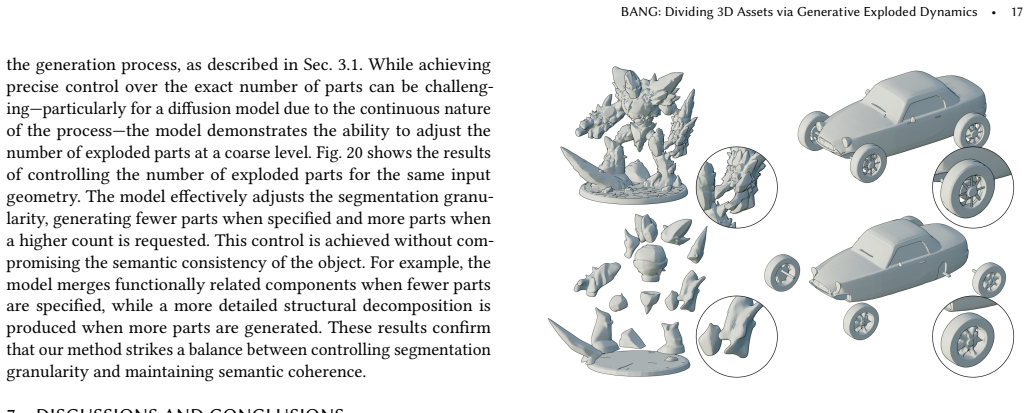
- Users can turn any input mesh into an exploded sequence with watertight, per-part geometry at the fully divided state, so part-level editing, animation, and reassembly need no manual segmentation.
- Spatial prompts such as bounding boxes and surface regions, as well as selections made on 2D rendered views, control which parts separate and how, enabling workflows such as 'explode only this region'.
- Per-part regeneration and reassembly improves surface detail beyond what single-mesh generation achieves in the same latent space.
- Exploded parts can be 3D printed individually and reassembled, with programmatically generated interlocking structures for physical assembly.
- Integration with a multimodal chatbot supports both 'explode then describe' and 'describe then explode' interactions for part-level understanding.
Reading between the lines
- If the synthetic explosions encode meaningful parts, the fully divided states could serve as a pseudo-label generator for volumetric part segmentation, producing part labels at lower annotation cost than manual labeling.
- The temporal sequence itself is a form of structural supervision: forcing the model to predict intermediate meshes commits it to deciding where one part ends and another begins, suggesting the approach could be extended to unsupervised part discovery on unlabeled single-piece meshes.
- A directly testable extension is to evaluate the adapter on real mechanical assemblies with known part hierarchies and physical constraints, such as axis-aligned motion or contact surfaces; this would reveal whether the radial-explosion prior generalizes beyond artistic assets.
- The 2D-to-3D region selection used for control could be pushed further so that a user's sketch of an intended separation line maps directly to a surface-region prompt, enabling stroke-controlled explosion.
Editorial analysis
A structured set of objections, weighed in public.
Referee Report
Summary. The paper introduces BANG, a generative framework for part-level decomposition of 3D assets through "generative exploded dynamics." It builds on a pretrained 3D latent diffusion model, keeps the base model frozen, and trains a lightweight exploded-view adapter conditioned on input geometry, time, and expected part count, together with a temporal attention module for smooth multi-frame transitions. Training data are synthetic explosions created from Objaverse meshes by treating connected components as parts and optimizing radial translation vectors so that component bounding boxes stop overlapping. The paper also presents spatial control via bounding boxes and surface regions, 2D-3D feature alignment with DINOv2 and GPT-4 integration, per-part detail enhancement, SDF-based trajectory tracking, and applications to 3D printing. Quantitative evaluation is performed on 50 PartObjaverse-Tiny objects using ground-truth bounding boxes; the main results are an ablation of temporal attention and gradient masking, a frame-count analysis, and a user study against SAMesh and SAMPart3D.
Significance. If the central claim holds, BANG would be a notable contribution bridging 3D generation and part-level understanding. The pretrain-then-adapt design is practical and economical: it preserves strong geometry priors while limiting trainable parameters, and the temporal attention module is a sensible mechanism for sequence consistency. The accompanying trajectory tracking, spatial controllability, and cross-modal integration make the framework broadly applicable. The authors also give an honest limitations section, including detail drift and lack of physical realism. However, the load-bearing claim of semantic and geometric coherence rests on synthetic supervision whose validity is not checked, and the main quantitative evaluation conditions on ground-truth bounding boxes before measuring IoU against those same boxes. The manuscript therefore does not yet establish the semantic decomposition quality that motivates the method.
major comments (4)
- [Sec. 6.4, Eq. (9)] The main quantitative evaluation is partially circular: exploded sequences are generated conditioned on ground-truth bounding boxes, and the weighted IoU in Eq. (9) is then measured against those same boxes. This validates trajectory tracking under an oracle decomposition, not whether BANG infers meaningful part structure from an input geometry alone. Please add an evaluation without spatial prompts, scored against human-annotated part boxes or segmentations, or at minimum report the prompted evaluation as an explicit oracle upper bound separate from an unprompted evaluation.
- [Sec. 3.2] The training signal for "parts" is entirely synthetic: connected components of Objaverse meshes are treated as semantic parts, and explosion vectors are optimized so that component bounding boxes stop overlapping. The manuscript does not validate that connected components correspond to functional parts or that radial AABB separation matches natural disassembly. Since the adapter is trained to reproduce these synthetic sequences, the model's part semantics can only be as meaningful as this heuristic. A concrete test would be to measure agreement with human-annotated parts on PartObjaverse-Tiny or PartNet without supplying ground-truth boxes; the current user study (Sec. 6.3) compares only against surface-segmentation baselines and does not provide such ground truth.
- [Table 1, Sec. 6.4] The ablation table reports point estimates for three variants on 50 objects, with no error bars, statistical significance, or non-ablation baseline. The metrics are also computed after the SDF trajectory-optimization post-process, so they conflate generation quality with tracking optimization. Please report variance over objects or seeds, and include an evaluation of the raw generated meshes before trajectory optimization, so that the contribution of the generator itself can be isolated.
- [Sec. 7 and Fig. 21] The limitations section concedes that generated exploded views "exhibit noticeable deviation from the original geometry" and that "some local details are lost," which directly qualifies the geometric-coherence half of the central claim in Sec. 3.1. This is an honest limitation, but the paper should state more precisely which regimes are affected, for example by reporting the quantitative metrics on the failure subset, and clarify whether "geometric coherence" means global part layout rather than faithful surface detail.
minor comments (5)
- [Sec. 3.1] "Radically exploding" should be "radially exploding," and the phrase "explosive linearity" in the discussion of Table 1 is unclear.
- [Eq. (5)] The ⊕ operator used to add TimeEmb(t) to queries and keys is not defined; please state whether it denotes concatenation or addition.
- [Sec. 6.3] The user study reports preference percentages but no details on blinding, presentation order, or statistical testing; a short protocol description would improve confidence in the result.
- [Fig. 19 and surrounding text] The text says performance "naturally starts to drop" beyond 5 frames and then states that results "still show some generalizability"; please reconcile this wording with the plotted trends.
- [Sec. 6.4] "Generation time cost" is listed as an evaluation metric but does not appear in Table 1 or in the surrounding quantitative discussion; please either report it or remove it from the metric list.
Circularity Check
Evaluation is conditioned on ground-truth bounding boxes and then scored by weighted IoU against those same boxes, making the wIoU metric a self-consistency check of prompt following rather than an independent test of semantic part decomposition.
-
fitted input called prediction
[Sec. 6.4, Eq. (9), 'Evaluations']
"For each object, we generate exploded view sequences conditioned on ground truth bounding boxes and evaluate the performance using part trajectory tracking. ... wIoU = Σ𝑖 𝑉𝑖· IoU(𝑩𝑖, 𝑩gt𝑖) / Σ𝑗𝑉𝑗 (9) where 𝑉𝑖 represents the convex hull volume of the 𝑖-th part, 𝑩𝑖 and 𝑩gt𝑖 are the predicted and ground truth bounding boxes, respectively. This metric quantifies the accuracy of part localization after explosion."
The ground-truth bounding boxes are used both as the conditioning input to the generator and as the reference target in Eq. (9). A high wIoU therefore only measures whether the generated explosion reproduces the boxes that were already provided; it cannot measure whether the model inferred meaningful part structure or discovered parts without an oracle. The 'predicted' boxes are statistically anchored to the input condition by the experimental design, so the headline quantitative claim of 'part localization after explosion' is a prompt-adherence check rather than an independent evaluation of decomposition quality.
full rationale
The core method is not derivationally circular: the exploded-view adapter is a learned conditional diffusion module trained on synthetic exploded sequences, and the temporal-attention module is a sequence-consistency mechanism, neither of which reduces to the target claim by construction. The base model is pretrained on Objaverse following the authors' own 3DShape2VecSet/CLAY scheme, but the citation is architectural and the model is retrained, so it is not load-bearing self-citation. The main circularity is in the quantitative evaluation (Sec. 6.4): sequences are generated conditioned on ground-truth bounding boxes, then scored by weighted IoU against those same boxes (Eq. 9). This wIoU is a self-consistency check of prompt following, not evidence that the model discovers meaningful part structure. The Sec. 3.2 data pipeline, which treats connected components as semantic parts and pushes their axis-aligned bounding boxes apart, is an unverified construct-validity assumption rather than a circular step; supporting the 'meaningful parts' claim would require independent human-part benchmarks, and the paper's limitations section does not concede this gap. The user study and qualitative comparisons to SAMesh and SAMPart3D provide some independent support, but the only quantitative part-localization metric is the self-referential one. Overall, the method has independent technical content, but the quantitative validation loop is partially circular, giving a score of 6.
Assumptions & free parameters
free parameters (6)
- Data component-count filter =
2-30 components
- Vertex count thresholds =
1e3 to 1e6
- Explosion overlap threshold =
predefined small threshold
- Classifier-free guidance scale =
7
- Sequence length =
5 frames
- Expected parts count embedding =
user-specified integer
assumptions (5)
- domain assumption Objaverse connected components are meaningful semantic parts
- domain assumption Radial explosion with linear translations is the right supervision
- domain assumption Pretrained latent can encode part-level detail
- domain assumption DINOv2 L2 alignment transfers 2D ROIs to 3D surface points
- domain assumption SDF-based trajectory recovery is accurate
Cite this review
Pith. "Pith review of BANG: Dividing 3D Assets via Generative Exploded Dynamics." pith.science (2026). https://pith.science/paper/YGTX76FB
@misc{pith2026250721493,
  author       = {Pith},
  title        = {Pith review of: BANG: Dividing 3D Assets via Generative Exploded Dynamics},
  year         = {2026},
  howpublished = {\url{https://pith.science/paper/YGTX76FB}},
  note         = {Machine review of arXiv:2507.21493}
}
read the original abstract
3D creation has always been a unique human strength, driven by our ability to deconstruct and reassemble objects using our eyes, mind and hand. However, current 3D design tools struggle to replicate this natural process, requiring considerable artistic expertise and manual labor. This paper introduces BANG, a novel generative approach that bridges 3D generation and reasoning, allowing for intuitive and flexible part-level decomposition of 3D objects. At the heart of BANG is "Generative Exploded Dynamics", which creates a smooth sequence of exploded states for an input geometry, progressively separating parts while preserving their geometric and semantic coherence. BANG utilizes a pre-trained large-scale latent diffusion model, fine-tuned for exploded dynamics with a lightweight exploded view adapter, allowing precise control over the decomposition process. It also incorporates a temporal attention module to ensure smooth transitions and consistency across time. BANG enhances control with spatial prompts, such as bounding boxes and surface regions, enabling users to specify which parts to decompose and how. This interaction can be extended with multimodal models like GPT-4, enabling 2D-to-3D manipulations for more intuitive and creative workflows. The capabilities of BANG extend to generating detailed part-level geometry, associating parts with functional descriptions, and facilitating component-aware 3D creation and manufacturing workflows. Additionally, BANG offers applications in 3D printing, where separable parts are generated for easy printing and reassembly. In essence, BANG enables seamless transformation from imaginative concepts to detailed 3D assets, offering a new perspective on creation that resonates with human intuition.
Figures


Figures from the paper (14 more)


Reference graph
Works this paper leans on
-
[3]
arXiv preprint arXiv:2405.18937 (2024)
Kestrel: Point Grounding Multimodal LLM for Part-Aware 3D Vision-Language Understanding. arXiv preprint arXiv:2405.18937 (2024). Lin Gao, Jie Yang, Tong Wu, Yu-Jie Yuan, Hongbo Fu, Yu-Kun Lai, and Hao Zhang
arXiv 2024
-
[5]
In Proceedings of the IEEE/CVF International Conference on Computer Vision
Segment anything. In Proceedings of the IEEE/CVF International Conference on Computer Vision. 4015–4026. Juil Koo, Seungwoo Yoo, Minh Hieu Nguyen, and Minhyuk Sung. 2023. Salad: Part-level latent diffusion for 3d shape generation and manipulation. In Proceedings of the IEEE/CVF International Conference on Computer Vision. 14441–14451. Changjian Li, Hao Pa...
arXiv 2022
-
[7]
DreamGaussian4D: Generative 4D Gaussian Splatting. CoRR abs/2312.17142 (2023). https://doi.org/10.48550/arXiv.2312.17142 Xuanchi Ren, Jiahui Huang, Xiaohui Zeng, Ken Museth, Sanja Fidler, and Francis Williams. 2024. Xcube: Large-scale 3d generative modeling using sparse voxel hierarchies. In Proceedings of the IEEE/CVF Conference on Computer Vision and Pa...
-
[8]
Text-to-4D dynamic scene generation. InProceedings of the 40th International Conference on Machine Learning (Honolulu, Hawaii, USA) (ICML’23). JMLR.org, Article 1323, 15 pages. Ayça Takmaz, Elisabetta Fedele, Robert W. Sumner, Marc Pollefeys, Federico Tombari, and Francis Engelmann. 2023. OpenMask3D: Open-Vocabulary 3D Instance Seg- mentation. In Advances...
arXiv 2024
-
[10]
In Proceedings of the IEEE/CVF Conference on Computer Vision and Pattern Recognition
PartDistill: 3D Shape Part Segmentation by Vision-Language Model Distilla- tion. In Proceedings of the IEEE/CVF Conference on Computer Vision and Pattern Recognition. 3470–3479. Mikaela Angelina Uy, Yen-Yu Chang, Minhyuk Sung, Purvi Goel, Joseph G Lambourne, Tolga Birdal, and Leonidas J Guibas. 2022. Point2cyl: Reverse engineering 3d ob- jects from point ...
arXiv 2023
-
[11]
ACM Transactions on Graphics (TOG) 38, 4 (2019), 1–14
Sagnet: Structure-aware generative network for 3d-shape modeling. ACM Transactions on Graphics (TOG) 38, 4 (2019), 1–14. Jianfeng Xiang, Zelong Lv, Sicheng Xu, Yu Deng, Ruicheng Wang, Bowen Zhang, Dong Chen, Xin Tong, and Jiaolong Yang. 2024. Structured 3D Latents for Scalable and Versatile 3D Generation. arXiv preprint arXiv:2412.01506 (2024). Jianfeng X...
arXiv 2019
-
[12]
InProceedings of the IEEE/CVF Conference on Computer Vision and Pattern Recognition
Neurallift-360: Lifting an in-the-wild 2d photo to a 3d object with 360deg views. InProceedings of the IEEE/CVF Conference on Computer Vision and Pattern Recognition. 4479–4489. Haotian Xu, Ming Dong, and Zichun Zhong. 2017. Directionally convolutional networks for 3D shape segmentation. In Proceedings of the IEEE International Conference on Computer Visi...
arXiv 2024
-
[13]
In European Conference on Computer Vision
Pointllm: Empowering large language models to understand point clouds. In European Conference on Computer Vision. Springer, 131–147. Le Xue, Mingfei Gao, Chen Xing, Roberto Martín-Martín, Jiajun Wu, Caiming Xiong, Ran Xu, Juan Carlos Niebles, and Silvio Savarese. 2023. Ulip: Learning a unified repre- sentation of language, images, and point clouds for 3d ...
arXiv 2024
Show all 14 references
-
[14]
arXiv preprint arXiv:2311.14603 (2023)
Animate124: Animating one image to 4d dynamic scene. arXiv preprint arXiv:2311.14603 (2023). Xin-Yang Zheng, Hao Pan, Peng-Shuai Wang, Xin Tong, Yang Liu, and Heung-Yeung Shum. 2023. Locally Attentional SDF Diffusion for Controllable 3D Shape Generation. ACM Trans. Graph. 42, ...
2023 arXiv
-
[2019]
ACM Transactions on Graphics (TOG) 38, 6 (2019), 1–15
SDM-NET: Deep generative network for structured deformable mesh. ACM Transactions on Graphics (TOG) 38, 6 (2019), 1–15. Ruiqi Gao, Aleksander Holynski, Philipp Henzler, Arthur Brussee, Ricardo Martin Brualla, Pratul P. Srinivasan, Jonathan T. Barron, and Ben Poole. 2024. CAT3D...
2019 arXiv
-
[2021]
In International conference on machine learning
Learning transferable visual models from natural language supervision. In International conference on machine learning. PMLR, 8748–8763. Ohad Rahamim, Ori Malca, Dvir Samuel, and Gal Chechik. 2024. Bringing Objects to Life: 4D generation from 3D objects. arXiv preprint arXiv:2...
2024 arXiv
-
[2023]
In Proceedings of the IEEE/CVF International Conference on Computer Vision
Set-the-scene: Global-local training for generating controllable nerf scenes. In Proceedings of the IEEE/CVF International Conference on Computer Vision. 2920– 2929. Matt Deitke, Dustin Schwenk, Jordi Salvador, Luca Weihs, Oscar Michel, Eli Vander- Bilt, Ludwig Schmidt, Kiana ...
2024 arXiv
-
[2024]
In Proceedings of the 41st International Conference on Machine Learning (Vienna, Austria) (ICML’24)
Disentangled 3D scene generation with layout learning. In Proceedings of the 41st International Conference on Machine Learning (Vienna, Austria) (ICML’24). JMLR.org, Article 500, 13 pages. Ziya Erkoç, Fangchang Ma, Qi Shan, Matthias Nießner, and Angela Dai. 2023. Hyperdif- fus...
2023
-
[2025]
In European Conference on Computer Vision
3x2: 3D Object Part Segmentation by 2D Semantic Correspondences. In European Conference on Computer Vision. Springer, 149–166. Ardian Umam, Cheng-Kun Yang, Min-Hung Chen, Jen-Hui Chuang, and Yen-Yu Lin
Reviewed August 6, 2026 · model on record in the stance chip above.
Discussion (0). Sign in to comment.