REVIEW 3 major objections 5 minor 15 references
Solution for Meta KDD Cup'25: A Comprehensive Three-Step Framework for Vision Question Answering
T0 review · 3 major / 5 minor · reviewed 2026-08-06 · deepseek-v4-flash
Pith's one-line read A three-step RAG framework with reranking ranks first on CRAG-MM Task3.
desk verdict Credible competition results with real leaderboard evidence, but the ablation claims are single-shot and the GPT-4o oracle is the main reliability question. read the letter →
The pith
A machine-rendered reading of the paper's core claim, the machinery that carries it, and where it could break.
The reading
What carries the argument
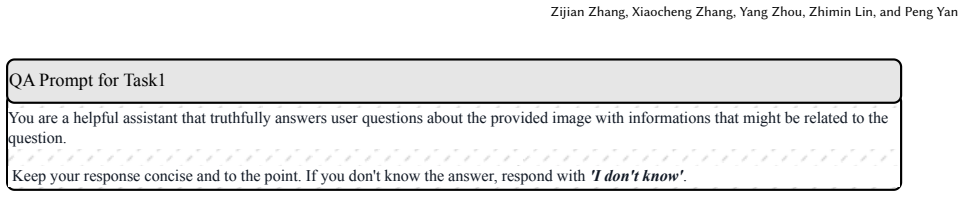
The central object is a single Llama-3.2-11B-Vision-Instruct model adapted with LoRA (low-rank adaptation) to perform three sub-tasks in one pass: generating diverse retrieval queries, reranking retrieval results listwise into an ordered list of relevant identifiers, and producing the final answer. Around this model, the pipeline builds a retrieval step that keeps the result group with the most hits from several sampled queries, a reranking prompt that asks for "[x, xx, xxx, ...]" or "[]", and a multi-task fine-tuning set where the QA label is replaced by the model's own answer when GPT-4o mini confirms consistency with the ground truth, or by "I don't know" when it does not. For Task1, image retrieval is converted to extracted text context, and data augmentation generates 20 paraphrased labels per sample after hallucination filtering.
What would settle it
Take a random sample of the marked samples from the paper's augmentation loop and have two human annotators re-label them as hallucinated or consistent; if agreement with GPT-4o mini is low, the "I don't know" conversions are not as clean as the ablation implies. A cheaper check is to rerun the pipeline with a different judge model (or no judge) and see whether the Task3 gap from 0.0700 to 0.1755 reproduces.
Extended reading notes
Core claim
The paper's central claim is that its three-step framework—query generation, retrieval-result reranking, and answer generation carried out by one multi-task fine-tuned model—is a competitive recipe for multimodal RAG QA under the CRAG-MM evaluation rules. On the task with multi-turn conversations, the paper reports that fine-tuning on the plain RAG data yields 0.0700, adding refusal-data construction raises it to 0.1322, multi-query retrieval to 0.1471, reranking to 0.1505, and reducing the refusal-data proportion to 0.1755, enough to rank first in automatic evaluation. It also claims automatic third place on the single-source and multi-source tasks and second place in Task3 after human correction of automatic scores.
Load-bearing premise
Everything rests on GPT-4o mini correctly deciding which model answers are hallucinations and which generated labels agree with the ground truth; if that oracle is unreliable, the training labels become noisy and the reported leaderboard gains may not transfer.
Editorial extensions
If this is right
- Refusal-data construction is worth a 0.0622-point jump on Task3, from 0.0700 to 0.1322, making abstention a trainable behavior under the CRAG scoring rubric.
- One 11B model can serve query generation, reranking, and answering, so the whole recipe needs a single deployment within the 30-second limit.
- Keeping the retrieval-result group with the most hits and reranking to the top 10 fits the 8192-token input cap while preserving recall.
- Multi-turn Task3 re-enters the retrieval step with history, so the framework extends directly to conversational QA.
Reading between the lines
- A testable extension is to swap the GPT-4o mini oracle for a deterministic or self-consistency check, which would show whether the refusals can be produced without a proprietary judge.
- If abstention generalizes, there is an optimal abstention rate: converting a hallucination from -1 to 0 helps, but giving up too many answers sacrifices valid correct answers, which may explain the final reduction in refusal-data proportion.
- The listwise reranking module is a transferable piece, since any retrieval-augmented system with more passages than fit in the context window needs a selection mechanism.
Editorial analysis
A structured set of objections, weighed in public.
Referee Report
Summary. The paper describes the BlackPearl team's solution for the three tasks of the CRAG-MM challenge at KDD Cup 2025. For Task 1, the solution combines official image retrieval with extraction of associated textual information, data augmentation guided by a GPT-4o mini judge, and LoRA fine-tuning of Llama-3.2-11B-Vision-Instruct. For Tasks 2 and 3, the pipeline generates multiple retrieval queries from the Llama model, performs web retrieval, applies a listwise reranking module, and uses multi-task fine-tuning on query-generation, reranking, and QA data, with GPT-4o mini also used to decide whether model-generated answers can replace ground-truth labels. The authors report automatic evaluation rankings of 3rd, 3rd, and 1st on the three tasks, and 2nd in Task 3 after human evaluation. Ablation results in Tables 5 and 6 attribute score improvements to data augmentation, refusal-data construction, multi-query retrieval, and reranking, with the Task 3 score rising from 0.0700 to 0.1755.
Significance. If the reported rankings and ablations hold, this is a competitive and reproducible pipeline for multimodal retrieval-augmented question answering, with practical insights into refusal-data construction, multi-query retrieval, and reranking. The paper's main strengths are its use of externally measured leaderboard evaluations, clear descriptions of the engineering components, and publicly available code. The main limitation is that the central internal claims about component effectiveness rest on unvalidated GPT-4o mini oracle decisions and on single-score ablations without uncertainty quantification. The work is therefore more a well-documented competition solution than a fully supported research contribution, but the externally measured results give it value.
major comments (3)
- [Sections 2.2 and 3.3; Tables 5 and 6] The paper reports no agreement analysis between GPT-4o mini and the official evaluator, and no sensitivity analysis with respect to the oracle's leniency. Because the ablation gains in Table 5 (0.01 to 0.043) and Table 6 (0.0700 to 0.1755) depend directly on labels produced or accepted by this oracle, the reported improvements may reflect the oracle's biases rather than a generalizable method.
- [Section 4.3; Tables 5 and 6] The authors should report multiple runs, cross-validation, or at least a variance estimate over the validation split before claiming that each component 'significantly improved the scores.'
- [Section 3.3] The paper should report a retrieval-success rate (for example, the fraction of generated queries that return nonempty or relevant results) and, ideally, compare against a baseline of fixed or human-written queries.
minor comments (5)
- [Abstract and Section 1] Grammar issues such as 'Our solution achieve' and 'win second place' should be corrected to 'achieves' and 'won second place.'
- [Table 4] The scores in Table 4 (e.g., 30.9 for BlackPearl in Task 3) are not explained relative to the 0-1 scores in Tables 1-3; if they are percentages, the relationship should be stated explicitly.
- [Section 2.2 and Appendix A.2] Section 2.2 states that GPT-4o mini generates 10 similar labels (n=10), but the prompt in Figure 5 says '20 similar standard answers'; the number should be made consistent.
- [Section 3.3] The phrase 'mLLama's LoRA weights' is unclear; the base model is referred to elsewhere as Llama-3.2-11B-Vision-Instruct, and the terminology should be unified.
- [Appendix A.6] The sentence 'And the correct answer is satisfied following rules' in the VQA prompt is ungrammatical and should read 'the correct answer should satisfy the following rules.'
Circularity Check
No significant circularity: the reported rankings and ablation improvements are grounded in external official evaluation, not in fitted or self-referential quantities.
full rationale
The paper contains no mathematical derivation or first-principles claim whose output is equivalent to its input. The central claims are the automatic-evaluation rankings (3rd, 3rd, 1st) and the post-human-evaluation second place in Task3, plus the ablation progression in Table 6 (0.0700 to 0.1755). These are measured by the competition's official rubric described in Section 4.1 (Perfect/Acceptable/Missing/Incorrect scoring) and by the organizers' human evaluation, so they are not defined in terms of the model's own outputs or GPT-4o mini judgments. The closest candidate for circularity is the self-labeling pipeline in Sections 2.2 and 3.3: Llama proposes answers, GPT-4o mini judges hallucination/consistency, and consistent model-generated answers replace ground-truth labels in training data. That is self-training, but it does not make the evaluation scores equivalent to the oracle by construction; the oracle is not used to score the test set, and the paper's claims do not reduce to a fitted parameter. There is no load-bearing self-citation chain: the cited related work ([8], [9], etc.) is external, and no uniqueness theorem is imported from the authors. The unvalidated GPT-4o mini oracle is a legitimate correctness/robustness concern, not a circularity, and should be weighed in a correctness review rather than raising the circularity score. Accordingly, the appropriate finding is no significant circularity.
Assumptions & free parameters
free parameters (10)
- learning_rate_task1 =
5e-5
- learning_rate_task2_3 =
5e-6
- training_epochs_task1 =
2
- training_epochs_task2_3 =
10
- LoRA_rank =
64
- LoRA_alpha =
128
- LoRA_dropout =
0.05
- max_retrieval_results =
30
- query_sampling_temperature =
0.8
- refusal_data_proportion =
reduced
assumptions (4)
- domain assumption The CRAG-MM benchmark and its official retrieval tools provide reliable ground-truth answers and useful retrieved content.
- domain assumption An 8:2 image-based split of the provided training data is representative of the official evaluation set.
- domain assumption GPT-4o mini's judgments about hallucinations and label consistency match the competition scoring rubric.
- domain assumption Self-generated labels for retrieval-query generation and reranking are of sufficient quality for multi-task fine-tuning.
Cite this review
Pith. "Pith review of Solution for Meta KDD Cup'25: A Comprehensive Three-Step Framework for Vision Question Answering." pith.science (2026). https://pith.science/paper/AWHMKWFP
@misc{pith2026250721520,
  author       = {Pith},
  title        = {Pith review of: Solution for Meta KDD Cup'25: A Comprehensive Three-Step Framework for Vision Question Answering},
  year         = {2026},
  howpublished = {\url{https://pith.science/paper/AWHMKWFP}},
  note         = {Machine review of arXiv:2507.21520}
}
read the original abstract
Vision Large Language Models (VLLMs) have improved multi-modal understanding and visual question answering (VQA), but still suffer from hallucinated answers. Multi-modal Retrieval-Augmented Generation (RAG) helps address these issues by incorporating external information, yet challenges remain in visual context comprehension, multi-source retrieval, and multi-turn interactions. To address these challenges, Meta constructed the CRAG-MM benchmark and launched the CRAG-MM Challenge at KDD Cup 2025, which consists of three tasks. This paper describes the solutions of all tasks in Meta KDD Cup'25 from BlackPearl team. We use a single model for each task, with key methods including data augmentation, RAG, reranking, and multi-task fine-tuning. Our solution achieve automatic evaluation rankings of 3rd, 3rd, and 1st on the three tasks, and win second place in Task3 after human evaluation.
Figures


Figures from the paper (5 more)


Reference graph
Works this paper leans on
-
[1]
Ge Bai, Jie Liu, Xingyuan Bu, Yancheng He, Jiaheng Liu, Zhanhui Zhou, Zhuoran Lin, Wenbo Su, Tiezheng Ge, Bo Zheng, et al. 2024. Mt-bench-101: A fine-grained benchmark for evaluating large language models in multi-turn dialogues. arXiv preprint arXiv:2402.14762 (2024)
arXiv 2024
-
[2]
Yunfan Gao, Yun Xiong, Xinyu Gao, Kangxiang Jia, Jinliu Pan, Yuxi Bi, Yixin Dai, Jiawei Sun, Haofen Wang, and Haofen Wang. 2023. Retrieval-augmented generation for large language models: A survey. arXiv preprint arXiv:2312.10997 2, 1 (2023)
arXiv 2023
-
[3]
Edward J Hu, Yelong Shen, Phillip Wallis, Zeyuan Allen-Zhu, Yuanzhi Li, Shean Wang, Lu Wang, Weizhu Chen, et al. 2022. Lora: Low-rank adaptation of large language models. ICLR 1, 2 (2022), 3
2022
-
[4]
Jules King, L Burleigh, Simon Woodhead, Panagiota Kon, Perpetual Baffour, Scott Crossley, Walter Reade, and Maggie Demkin. 2024. Eedi - Mining Misconceptions in Mathematics. https://kaggle.com/competitions/eedi-mining-misconceptions- in-mathematics. Kaggle
work page 2024
-
[5]
Gonzalez, Hao Zhang, and Ion Stoica
Woosuk Kwon, Zhuohan Li, Siyuan Zhuang, Ying Sheng, Lianmin Zheng, Cody Hao Yu, Joseph E. Gonzalez, Hao Zhang, and Ion Stoica. 2023. Efficient Memory Management for Large Language Model Serving with PagedAtten- tion. In Proceedings of the ACM SIGOPS 29th Symposium on Operating Systems Principles
work page 2023
-
[6]
Gonzalez, Ion Stoica, Sohier Dane, Maggie Demkin, and Nate Keating
Wei lin Chiang, Evan Frick, Lisa Dunlap, Anastasios Angelopoulos, Joseph E. Gonzalez, Ion Stoica, Sohier Dane, Maggie Demkin, and Nate Keating. 2024. WSDM Cup - Multilingual Chatbot Arena. https://kaggle.com/competitions/ wsdm-cup-multilingual-chatbot-arena. Kaggle
work page 2024
-
[7]
Jielin Qiu, Andrea Madotto, Zhaojiang Lin, Paul A Crook, Yifan Ethan Xu, Xin Luna Dong, Christos Faloutsos, Lei Li, Babak Damavandi, and Seungwhan Moon. 2024. Snapntell: Enhancing entity-centric visual question answering with retrieval augmented multimodal llm. arXiv preprint arXiv:2403.04735 (2024)
arXiv 2024
-
[8]
Yikuan Xia, Jiazun Chen, and Jun Gao. 2024. Winning Solution For Meta KDD Cup’24. arXiv preprint arXiv:2410.00005 (2024)
arXiv 2024
Show all 15 references
-
[9]
Xiao Yang, Kai Sun, Hao Xin, Yushi Sun, Nikita Bhalla, Xiangsen Chen, Sajal Choudhary, Rongze Gui, Ziran Jiang, Ziyu Jiang, et al. 2024. Crag-comprehensive rag benchmark. Advances in Neural Information Processing Systems 37 (2024), 10470–10490
2024
-
[10]
Weihao Yu, Zhengyuan Yang, Linjie Li, Jianfeng Wang, Kevin Lin, Zicheng Liu, Xinchao Wang, and Lijuan Wang. 2023. Mm-vet: Evaluating large multimodal models for integrated capabilities. arXiv preprint arXiv:2308.02490 (2023). A Prompts Used in the Competition A.1 VQA Prompt fo...
2023 arXiv
-
[12]
xx (Rule: Simplified|Complexified)
-
[13]
Question: {query} Standard answer: {ans_full} Data Augmentation Prompt for Task1 Figure 5: Data augmentation prompt for Task1
xx ... Question: {query} Standard answer: {ans_full} Data Augmentation Prompt for Task1 Figure 5: Data augmentation prompt for Task1. You are a web retrieval and query reformulation agent. Based on the history dialog, the current original question, and the provided image, plea...
-
[14]
The answer is correct if it captures all the key information
-
[15]
The answer is correct even if phrased differently as long as the meaning is the same
-
[16]
For example, when answer a question about time, it's better to answer with day, month and year
The answer is incorrect if it contains incorrect information or is missing essential details. For example, when answer a question about time, it's better to answer with day, month and year. Remeber the above rules and keep your response concise and to the point. Note that the ...
Reviewed August 6, 2026 · model on record in the stance chip above.
Discussion (0). Sign in to comment.